Implications
Genetic selection can improve the rates of growth and muscle development in sheep, and should also permit reproduction at a younger age because the onset of puberty depends on attainment of sufficient body mass. Our data support this hypothesis, suggesting that phenotypic and genetic selection for growth or muscling will improve the reproductive performance of Merino ewes mated to lamb at 1 year of age. These findings will inform bio-economic models and promote genetic selection strategies with a view to improving profitability of sheep production systems by achieving improvements in reproductive efficiency. The data also suggest a physiological link between muscle and the reproductive system of female sheep, a possible new direction in reproductive biology that needs further exploration.
Introduction
International demand for lamb and the need to reduce emission intensity are increasing the emphasis on the reproductive efficiency of sheep flocks and renewing attention on the breeding of young ewes in their 1st year of life (Martin et al., Reference Martin, Durmic, Kenyon and Vercoe2009; Ferguson et al., Reference Ferguson, Kennedy, Young and Thompson2011). Puberty, defined as the first spontaneous ovulation (reviewed by Foster et al., Reference Foster, Yellon and Olster1985), is the result of dynamic interactions among several genetic and environmental factors (reviewed by Dýrmundsson, Reference Dýrmundsson1981) and is generally reached in ewe lambs when they attain 50% to 70% of their expected mature body mass (Hafez, 1952; Dýrmundsson, 1973). If growth during early life is restricted, young ewes will remain pre-pubertal until the required proportion of mature body mass is reached (Foster et al., Reference Foster, Yellon and Olster1985); hence, rapidly growing lambs achieve puberty earlier than slower growing lambs (Boulanouar et al., Reference Boulanouar, Ahmed, Klopfenstein, Brink and Kinder1995). This relationship between growth rate and puberty explains the earlier puberty in ewes raised as singles compared with those raised as twins across a range of breeds (Southam et al., Reference Southam, Hulet and Botkin1971). We would thus expect puberty to be advanced by phenotypic and genetic selection for enhanced growth rate. This could be achieved through selection of ewes with high Australian Sheep Breeding Values (ASBVs) for post-weaning weight (PWT). As live weight (LW) at mating is related to fertility and reproductive rate in young ewes (McGuirk et al., Reference McGuirk, Bell and Smith1968), we would also expect that, at first mating, ewes with higher growth rates would be more fertile and have higher reproductive rates than ewes with lower growth.
In addition to the relationships between growth rate and early fertility, selection strategies that alter the body composition of sheep might also be related to the timing of first oestrus, fertility and reproductive rate. In Merino sheep, there are positive genetic correlations between reproduction and growth, and between reproduction and body content of muscle and fat (Huisman and Brown, Reference Huisman and Brown2009). The fertility and reproductive rate of adult Merino ewes is also known to be greater for genotypes with higher body content of muscle and fat (Ferguson et al., Reference Ferguson, Adams and Robertson2007 and Reference Ferguson, Young, Kearney, Gardner, Robertson and Thompson2010). Furthermore, phenotypic enhancement in muscle mass and fatness, as assessed through condition score, are known to increase fertility and reproductive rate in ewes mated to lamb at 1 or 2 years of age (Malau-Aduli et al., Reference Malau-Aduli, Bond and Dunbabin2007). Overall, it appears that ewe lambs that accumulate fat and muscle rapidly will achieve puberty earlier, be more fertile and have a higher reproductive rate when mated at 8 or 9 months, than their counterparts with lower rates of fat and muscle accumulation. Moreover, growth, fatness and the onset of puberty are all associated with circulating concentrations of IGF-I and leptin (Roberts et al., Reference Roberts, McCutcheon, Blair, Gluckman and Breier1990; Chilliard et al., Reference Chilliard, Delavaud and Bonnet2005); thus, we would expect reproductive development to be explained by the secretory patterns of these two metabolic hormones.
We tested these hypotheses by studying the relationships among phenotypic values and ASBVs for rates of growth and accumulation of fat and muscle, plasma concentrations of IGF-I and leptin, the timing of puberty and outcomes for fertility and reproductive rate in Merino ewe lambs.
Material and methods
This work was conducted in accordance with the Australian Code of Practice for the Care and Use of Animals for Scientific Purposes (7th Edition, 2004) and was approved by the Animal Ethics Committee of the Department of Agriculture and Food, Western Australia.
Experimental location and animals
The Merino ewe lambs (n = 136) used in this study were born on a commercial farm (‘Moojepin’) from August to September 2009 to dams that had been sourced from two Western Australian ram breeding flocks (‘Merinotech WA’ and ‘Moojepin’) and mated to sires with a wide range in ASBVs for growth, muscle and fat. The ewe lambs were transported to Medina Research Station (32.2°S, 115.8°E) where the experiment was conducted from February to June 2010. Live weight (LW) was recorded weekly and the data were used to generate the average daily gain (ADG). The depths of the longissimus dorsi muscle and subcutaneous fat at a point 45 mm from the midline over the 12th rib were measured using ultrasound when the ewe lambs were aged 164 (range 134 to 176) and 251 (range 221 to 263) days. The ultrasound data were used to generate phenotypic values for eye muscle depth (EMD; range 20 to 33 mm) and C-site fat depth (FAT; range 2 to 8 mm). The data were also used to generate ASBVs at post-weaning age for weight (PWT; range 0 to 9 kg), depth of eye muscle (PEMD; range 0 to 2.6 mm) and fat (PFAT; range 0 to 1.2 mm) by MERINOSELECT (Brown et al., Reference Brown, Huisman, Swan, Graser, Woolaston, Ball, Atkins and Banks2007). The ewe lambs were shorn when they were on average 236 days old.
Animal management and feeding
The ewe lambs were initially run in two management groups in two 20 × 60 m pens, with ad libitum access to clean water and sheep pellets that were introduced over a 7-day period. The pellets based on barley, wheat and lupin grains, cereal straw and hay, canola meal, minerals and vitamins were formulated to provide 11.5 MJ of metabolisable energy per kg dry matter, 15% protein and minerals to meet their daily requirements for maximum growth (Macco Feeds Australia). On February 24 (day 69), when the ewe lambs were 179 days old (range 149 to 191) and weighed 37 ± 0.4 kg, four Merino wethers (rams castrated before puberty) with harnesses (MatingMark®; Hamilton, New Zealand) were introduced to detect the onset of oestrus. The wethers had received a 2 ml subcutaneous injection of testosterone enanthate (75 mg/ml; Ropel®, Jurox, NSW, Australia) 1 week before they were placed with the ewe lambs. Every 2 weeks, the injections were repeated and the crayons on the harnesses were changed. Crayon marks on the rumps of ewe lambs were recorded three times per week to estimate the date of standing oestrus. Date of oestrus was deemed as the date the first crayon mark was recorded, and age at this point was deemed to be the age at puberty. The closest LW recorded to the first crayon mark was deemed to be LW at puberty.
The wethers were removed at the end of this ‘teasing period’, on 4 May (day 0), when the ewe lambs were 249 (range 219 to 261) days old and weighed 41 ± 0.5 kg. For the ‘mating period’, the ewe lambs had received a 1 ml intramuscular injection of supplement of vitamins (vit A 500 000 IU; vit D3 75 000 IU, vit E 50 IU/ml; Vet ADE®, Auckland, New Zealand) and were allocated, on the basis of LW and sire, into eight management groups of 15 and moved into 3 × 7 m pens where they had ad libitum access to clean water and the sheep pellets. An experienced single Merino ram was introduced into each group of ewe lambs. The rams were removed on day 47 and the ewes remained indoors. Pregnancy and number of foetus were confirmed by ultrasound scanning 60 days after the rams were removed, and the data were used to generate the fertility and reproductive rate.
Blood sampling and immunoassay
Ewe lambs were not fasted and blood was sampled by jugular venipuncture on five occasions, when the ewe lambs were on average 199, 227, 248, 269 and 285 days old. Blood was collected into heparinised tubes, placed immediately on ice and later centrifuged at 2000 × g for 20 min so that plasma could be harvested and stored at −20°C until hormone analysis.
Plasma leptin concentrations were determined by radioimmunoassay (RIA) in duplicate 100 μl aliquots as described by Blache et al. (Reference Blache, Tellam, Chagas, Blackberry, Vercoe and Martin2000). The limit of detection was 0.06 ng/ml and the intra-assay coefficient of variation was 7.3% at 0.73 ng/ml, 4.4% at 0.84 ng/ml and 2.4% at 1.61 ng/ml. Plasma concentrations of IGF-I were measured in duplicate samples using the RIA described by Gluckman et al. (Reference Gluckman, Johnson–Barrett, Butler, Edgar and Gunn1983). Interference by binding proteins was minimised by acid–ethanol cryoprecipitation, as validated for ruminants by Breier et al. (Reference Breier, Gallaher and Gluckman1991). The limit of detection for the assay was 0.05 ng/ml and the intra-assay coefficient of variation was 7% at 0.29 ng/ml and 5.1% at 2.9 ng/ml.
Statistical analysis
Live weight and age at first oestrus were analysed using the linear mixed model procedures (PROC MIXED; SAS/STAT software, 2010). Fixed effects in the model were dam source, birth type, management group, age and LW at the start of teasing. In addition, covariants for ADG (‘teasing’ period) or phenotypic value (FAT or EMD) or ASBV (PWT or PEMD or PFAT) or hormone concentrations (leptin or IGF-I) were included. Dam age was used as random effect.
Puberty (marked or not) was analysed using the generalised linear mixed model procedures with a binomial distribution and logit link function (PROC GLIMMIX; SAS/STAT software, 2010). Fixed effects in the model were dam source, birth type, management group, age and LW at the start of teasing. In addition, covariants for ADG (‘teasing’ period) or phenotypic value (FAT or EMD) or ASBV (PWT or PEMD or PFAT) or hormone concentrations (leptin or IGF-I) were included. Dam age was used as random effect.
Fertility (pregnant or not) was analysed using the generalised linear mixed model procedures with a binomial distribution and logit link function (PROC GLIMMIX; SAS/STAT software, 2010). Fixed effects in the model were dam source, birth type, management group, age and LW at the start of mating. In addition, covariants for ADG (‘mating’ period) or phenotypic value (FAT or EMD) or ASBV (PWT or PEMD or PFAT) or hormone concentrations (leptin or IGF-I) were included. Dam age was used as random effect.
Reproductive rate (dry or pregnant with single or twins) was analysed using the generalised linear mixed model procedures with a multinomial distribution and logit link function (PROC GLIMMIX; SAS/STAT software, 2010). Fixed effects in the model were dam source, birth type, management group, age and LW at the start of mating. In addition, covariants for ADG (‘mating’ period) or phenotypic value (FAT or EMD) or ASBV (PWT or PEMD or PFAT) or hormone concentrations (leptin or IGF-I) were included. Dam age was used as random effect.
Hormone concentration (leptin and IGF-I) was analysed using the linear mixed model procedures with repetitive measure (PROC MIXED; SAS/STAT software, 2010). Fixed effects in the model were dam source, birth type, management group, age and LW at the start of mating. In addition, covariants for phenotypic value (FAT or EMD) or ASBV (PWT or PEMD or PFAT) were included. Identification number of the ewe within management group was used as random effect. Identification number of the ewe within management group and date of sampling were used as repeated measures. Mean hormone concentration was analysed using ANOVA model procedures, where Factor A was hormone concentration and Factor B was date at sampling (PROC ANOVA; SAS/STAT software, 2010).
Live weight (LW) during the experiment was analysed using the linear mixed model procedures with repetitive measure (PROC MIXED; SAS/STAT software, 2010). Fixed effects in the model were dam source, birth type, management group and age at the start of mating. In addition, covariants for ADG (split into the ‘teasing’ and ‘mating’ periods) or phenotypic value (FAT or EMD) or ASBV (PWT or PEMD or PFAT) were included. Identification number of the ewe within management group was used as random effect. Identification number of the ewe within management group and date of sampling were used as repeated measures.
Average daily gain (ADG) during the ‘teasing’ and ‘mating’ periods were determined over time for each lamb using a cubic smoothing spline approach with the transformation regression model procedures, which is appropriate when the response is non-linear (TRANSREG; SAS/STAT software, 2010). ADG was analysed using the linear mixed model procedures (PROC MIXED; SAS/STAT software, 2010). Fixed effects in the model were dam source, birth type and age at the start of the period (split into the ‘teasing’ and ‘mating’ periods). In addition, covariants for phenotypic value (FAT or EMD) or ASBV (PWT or PEMD or PFAT) were included. Management group was used as random effect.
All two-way interactions among the fixed effects were included in each model and non-significant (P > 0.05) interactions were removed from the final model. The data for puberty, fertility and reproductive rate are presented as logit values and back-transformed percentages.
Mature LW was considered reached when ewes were more than 2 years. Therefore, to estimate it, individual records from LW and body condition score (BCS) from the ewe lambs from birth to up to 2 years of age were used. Mature LW was predicted at BCS 3 based on these records using linear regression of weight and BCS.
Results
Ewe live weight
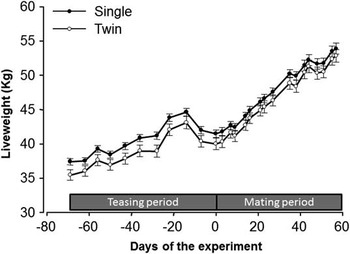
From day 138 to day 55, mean (±s.e.m.) LW increased from 24.2 ± 0.3 to 52.6 ± 0.5 kg (Figure 1). The ADG of the ewe lambs was 90 ± 2.5 g/day during the ‘teasing’ period and 214 ± 5.3 g/day during the ‘mating’ period. LW during the experiment (both periods) was positively related with increases in values for phenotypic traits (EMD or FAT; P < 0.001) and ASBVs (PEMD or PFAT; P < 0.001). In general, LW increased by 1.4 kg as EMD increased 1 mm, by 3 kg as FAT increased by 1 mm, by 2.2 kg as PEMD increased 1 mm or by 4.4 kg as PFAT increased 1 mm. The ADG during the ‘teasing’ period was positively correlated with increases in values for EMD (P < 0.001) and FAT (P < 0.001). The ADG increased 4 g/day as EMD increased 1 mm or by 13 g/day as FAT increased by 1 mm. PEMD or PFAT had no effect (P > 0.05) on the ADG during the ‘teasing’ period. None of the variables had an effect on the ADG during the ‘mating’ period.
Average live weight (±s.e.m.) of single-born (●) or twin-born (○) Merino ewe lambs fed ad libitum high-quality pellet (11.5 MJ metabolisable energy per kg dry matter and 15% protein) during the experiment. Day 0 is the day when Merino entire rams were introduced.

Live weight and age at puberty
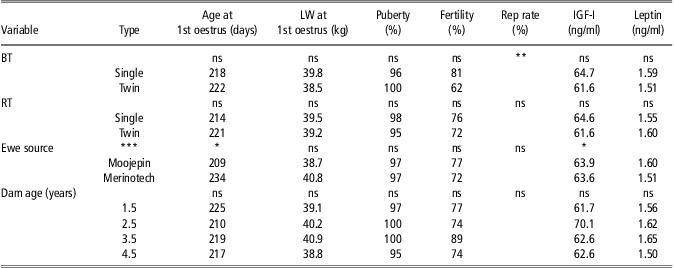
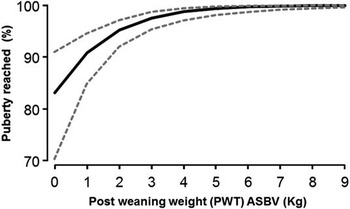
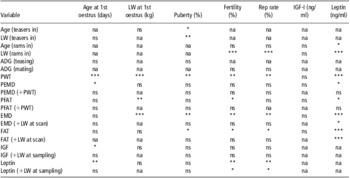
Of the 136 lambs in the flock, 132 (97%) displayed oestrus during the ‘teasing’ or ‘mating’ periods. The average weight at first oestrus was 39.4 ± 0.5 kg (range 26.9 to 55.1 kg) and the average age at first oestrus was 219 ± 3 days (range 163 to 301 days). The proportion of ewe lambs that attained puberty was influenced by both their age (P < 0.05) and their LW (P < 0.01) at the beginning of the ‘teasing’ period. Ewe source, dam age, birth type or teasing group did not affect the proportion of ewe lambs that attained puberty (P > 0.05) (Table 1). The ADG during the ‘teasing’ period had no effect on the proportion of ewes that reached puberty. The proportion of ewe lambs that attained puberty was positively related with increases in values for PWT (P < 0.01; Figure 2), EMD (P < 0.01) and FAT (P < 0.05). The ASBVs for PEMD or PFAT had no effect on the likelihood of an ewe reaching puberty (P > 0.05) (Table 2).
Effect of classification variables (BT, RT, ewe source and dam age) on reproductive performance (age or LW at first oestrus, puberty, fertility and reproductive rate) and on metabolic hormone concentration (IGF-I or leptin) in Merino ewe lambs
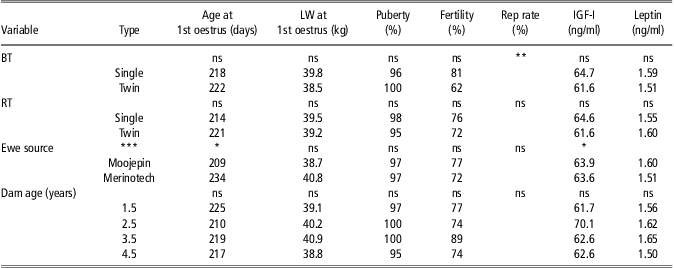
BT = birth type; RT = rear type; LW = live weight.
P-values: *P ⩽ 0.05; **P ⩽ 0.01; ***P ⩽ 0.001; ns P > 0.05.
Relationships between Australian Sheep Breeding Value (ASBV) for post–weaning weight (PWT) and the proportion of Merino ewe lambs that achieved puberty by the end of mating when their average age was 296 days. The dashed lines represent upper and lower 95% confidence limits.

Effect of phenotype (EMD and FAT), ASBV for PWT,PEMD, or PFAT, or metabolic hormone concentration (IGF-I or leptin) on reproductive performance (age or LW at first oestrus, puberty, fertility and reproductive rate) or metabolic hormone concentration (IGF-I or leptin) in Merino ewe lambs

EMD = eye muscle depth; FAT = fatness; ASBV = Australian Sheep Breeding Value; PWT = post-weaning weight; PEMD = post-weaning eye muscle depth; PFAT = post-weaning fatness; LW = live weight; ADG = average daily gain.
P-values: *P ⩽ 0.05; **P ⩽ 0.01; ***P ⩽ 0.001; NS P > 0.05; na, not applicable.
The average LW and age at the beginning of the ‘teasing’ period was 36.8 ± 0.4 kg and 179 ± 1 days (range 149 to 191 days). LW and age at first oestrus differed with ewe source (P < 0.05; P < 0.001), but the other variables tested had no effect on either LW or age at first oestrus (P > 0.05). There was no relationship between the ADG and age at first oestrus (P > 0.05; Table 2). On average, of the lambs that achieved puberty, twin-born lambs were 1.3 kg lighter and 4 days older than single lambs at their first oestrus (38.5 v. 39.8 kg and 222 v. 218 days).
Live weight at first oestrus was estimated to be 62% of mature BW. The average mature body LW was 63.7 ± 0.7 kg (range 49 to 86). LW at first oestrus was positively correlated with increases in values for PFAT (P < 0.01), PWT (P < 0.001) or EMD (P < 0.001), and it increased by 0.3 kg for each 1 mm of PFAT, by 2.3 kg for each 1 kg increase in PWT and by 1.2 kg for each 1 mm of EMD. Neither PEMD nor FAT had effect on LW at first oestrus (P > 0.05) (Table 2).
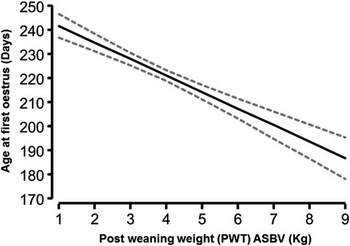
Ewe lambs with higher values for PEMD (P < 0.05) or PWT (P < 0.001; Figure 3) were younger at first oestrus than ewe lambs with lower values for those traits. Age at first oestrus decreased by 1 day as PEMD increased 1 mm or by 7 days as PWT increased 1 kg. PFAT, EMD and FAT had no effect on age at first oestrus (P > 0.05) (Table 2).
Relationships between Australian Sheep Breeding Value (ASBV) for post-weaning weight (PWT) and age at first oestrus in Merino ewe lambs. Data from single and twin birth type are combined. All lambs were fed ad libitum with high-quality pellets from 6 to 10 months of age. The dashed lines represent upper and lower 95% confidence limits.

When LW at scanning for EMD or FAT or PWT for PEMD was included in the statistical model, the effect of EMD and FAT on puberty and PEMD on age at first oestrus was no longer evident.
Fertility and reproductive rate
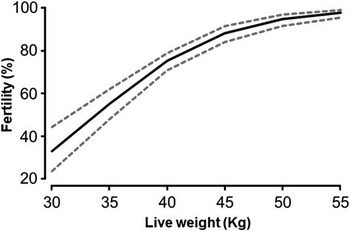
A total of 102 out of 136 (75%) ewe lambs were pregnant. Fertility was positively related to LW at the start of mating. Ewe lambs that were heavier at the start of mating were pregnant (P < 0.001; Figure 4). Of those that conceived, the average weight and age at pregnancy was 44.7 ± 0.5 kg (range 35.3 to 59.2 kg) and 263 ± 2 days (range 219 to 307 days). The ADG during the ‘mating’ period had no effect on fertility. Fertility differed with birth type (P < 0.05) and mating sire (P < 0.05), but the rest of the variables had no effect (P > 0.05) (Table 1). On average, twin-born lambs were 0.6 kg lighter and 7 days older than single lambs at pregnancy (44.3 v. 44.9 kg and 268 v. 261 days).
Relationships between live weight at the start of mating and fertility of Merino ewe lambs between 6 and 10 months of age. Singles and twins combined. All lambs were fed ad libitum with high-quality pellets. The dashed lines represent upper and lower 95% confidence limits.

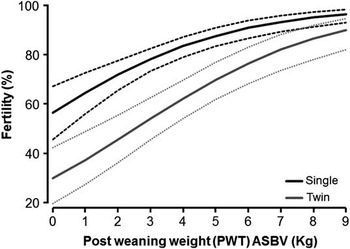
The pregnancy rate was positively related with increases in values for PWT (P < 0.01; Figure 5), PFAT (P < 0.05), EMD (P < 0.01) and FAT (P < 0.05); however, these relationships, except PWT, were explained by correlated changes in LW and disappeared when LW or PWT was added to the model. The ASBV for PEMD had no effect on fertility (P > 0.05) (Table 2).
Relationships between Australian Sheep Breeding Value (ASBV) for post-weaning weight (PWT) and the proportion of single- and twin-born Merino ewe lambs that conceived between 7 and 10 months of age. All lambs were fed at libitum with high-quality pellets. The dashed lines represent upper and lower 95% confidence limits.

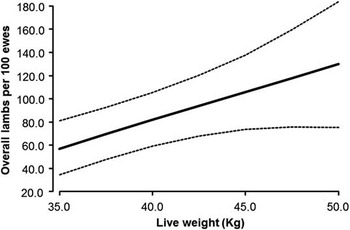
Of the ewe lambs that were pregnant, 84% were carrying a single lamb and 16% were carrying twins. Reproductive rate differed with birth type (P < 0.01). Reproductive rate was positively related to LW at the start of the mating period (P < 0.001). On average, each extra kg at the start of mating was associated with extra 4.8 foetuses per 100 ewes (P < 0.001; Figure 6). Reproductive rate was positively correlated with increases in values for PWT (P < 0.01), EMD (P < 0.01) and FAT (P < 0.05). However, the effect of EMD or FAT on reproductive rate was no longer evident once LW was added in the statistical analyses.
Relationships between live weight at the start of mating and proportion of overall lambs of Merino ewe lambs fed ad libitum high-quality pellets (15% protein) between 6 and 10 months of age. The dashed lines represent upper and lower 95% confidence limits

Hormone profiles
As the experiment progressed, circulating concentrations of leptin increased from 1.31 ± 0.02 to 1.78 ± 0.01 ng/ml (P < 0.001) and concentrations of IGF-I increased from 39.2 ± 1.3 to 85 ± 2.2 ng/ml (P < 0.001). Leptin concentrations differed with ewe source (P < 0.05), birth type (P < 0.05) and date of sampling (P < 0.001). Concentrations of IGF-I differed with date of sampling (P < 0.001), but the other variables were not related to IGF-I values (P > 0.05) (Table 1).
The concentration of IGF-I or leptin was positively associated with the age at first oestrus. First oestrus was advanced with increases in the concentrations of both leptin (P < 0.01) and IGF-I (P < 0.05). Ewe lambs were younger at first oestrus by 0.2 days as IGF-I concentration increased 1 ng/ml or by 28 days as leptin increased 1 ng/ml. Concentrations of IGF-I and leptin were not related to LW at first oestrus or puberty (P > 0.05) (Table 2). The concentration of leptin, but not IGF-I, was positively related to fertility and to reproductive rate (P < 0.01; Table 2).
Ewe lambs with higher values for PWT (P < 0.001), PEMD (P < 0.05), PFAT (P < 0.05), EMD (P < 0.001) and FAT (P < 0.001) had a greater leptin concentration than ewe lambs with lower values. Leptin concentration increased by 0.05 ng/ml as PWT increased 1 kg, by 0.05 ng/ml as PEMD increased 1mm by 0.01 ng/ml as PFAT increased 1 mm, by 0.03 ng/ml as EMD increased 1 mm or by 0.09 ng/ml as FAT increased 1 mm. Neither ASBV nor phenotypic values had an effect on IGF-I concentrations (P > 0.05) (Table 2). The effect of leptin on age at first oestrus and ASBV was no longer evident once LW was added in the statistical analysis. However, the effect of leptin on fertility, reproductive rate, EMD or FAT remained evident after LW was added in the statistical analysis.
Discussion
The data support the hypothesis that age and LW at first oestrus, puberty onset, fertility and reproductive rate are all influenced by genetic potential for post-weaning growth. These observations extend those of Hawker and Kennedy (Reference Hawker and Kennedy1978) and Alkass et al. (Reference Alkass, Aziz and Al-Nidawi1994) who showed that ewes that grew faster reached puberty at a younger age. In addition, our observations agree with those by Kenyon et al. (Reference Kenyon, Morris and West2010) who observed that ewe lambs that attained heavier LW and higher condition score at mating were more likely to get pregnant and improve the fecundity rate. Decades of research has shown that we need to provide high-quality nutrition to young ewes so that they can reach puberty in a timely manner (Cave et al., Reference Cave, Kenyon and Morris2012); however, the present study has also shown that we can also achieve that aim while developing lean carcasses through genetic selection.
The fundamental relationship between body mass and the onset of puberty was not challenged, because the average LW of the lambs that reached puberty was about 62% of their mature weight and thus within the critical 50% to 70% range (Hafez, 1952; Dýrmundsson, 1973). On the other hand, there seems to be a critical LW around 45 kg at the start of mating, reached earlier in faster growing ewe lambs, where fertility improves. We observed a linear response between pregnancy rate and LW at the start of mating, over the range 30 to 45 kg, expanding upon previous observations in 18-month-old maiden ewes by Kleemann and Walker (Reference Kleemann and Walker2005). However, once the 45 kg point had been exceeded, the response became curvilinear. There was also positive linear effect of LW at the start of mating on reproductive rate, consistent with our observations on mature ewes (Ferguson et al., Reference Ferguson, Kennedy, Young and Thompson2011), with perhaps greater benefit of additional weight for ewe lambs than for mature ewes. For ewe lambs, each extra kg was associated with 4.8 extra foetuses per 100 ewes in contrast with 1.7 to 2.4 extra foetuses for mature ewes (Ferguson et al., Reference Ferguson, Kennedy, Young and Thompson2011). This increases the value of reaching the critical LW at the start of mating for ewe lambs.
High ASBV values for growth can also improve fertility and reproductive rate because ewe lambs with higher values for PWT achieve the critical percentage of mature LW earlier and are more suitable for mating at younger ages, as reported previously (McGuirk et al., Reference McGuirk, Bell and Smith1968). This reflects the positive genetic correlation between weaning weight and fertility (Barlow and Hodges, Reference Barlow and Hodges1976). On the other hand, in the present study, ADG during the ‘mating’ period had no effect on fertility or reproductive rate, perhaps because the pregnancy rates were already maximal with ADG at high values (more than 200 g per day). In addition, the ewes that conceived presumably did so during the second or third cycle after their first oestrus, as observed by Hare and Bryant (Reference Hare and Bryant1985). The remainder of the ewes were detected in oestrus by either teasers or rams but failed to conceive, perhaps reflecting low quality of ovum or a high incidence of pre-natal mortality (Quirke, Reference Quirke1981; McMillan and McDonald, Reference McMillan and McDonald1985). Despite this problem, it is clear that genetic strategies that increase growth rate will not only advance puberty but also result in greater fertility and reproductive rate in Merino ewe lams.
The data support the hypotheses that age and LW at first oestrus, puberty, fertility and reproductive rate are all influenced by the rate of accumulation of muscle or fat. An important aspect of the present study is the dissection of effects based on LW, a passive endpoint, into effects that can be specifically attributed to major, physiologically active body tissues. Thus, the relationship between onset of puberty and the rate of accumulation of muscle and fat is supported by the existence of endocrine factors from both tissues that are thought to directly affect the brain processes that control the initiation of puberty. We found that circulating concentrations of leptin and IGF-I increased progressively as the experiment progressed and puberty approached, consistent with previous reports (Roberts et al., Reference Roberts, McCutcheon, Blair, Gluckman and Breier1990; Foster and Nagatani, Reference Foster and Nagatani1999), suggesting that the two metabolic hormones inform the central nervous system of the metabolic status of the body, perhaps specifically the accumulation of fat (leptin) and muscle (IGF-I), and thus permit the triggering of puberty. This role for leptin has been largely confirmed in ewe lambs, but the question still remains open for IGF-I or any other endocrine factor associated with muscle.
After puberty, leptin (but not IGF-I) might also explain the relationships between fertility and reproductive rate, and the accumulation of muscle and fat in both young ewes (present study) and mature Merino ewes (Ferguson et al., Reference Ferguson, Adams and Robertson2007 and Reference Ferguson, Young, Kearney, Gardner, Robertson and Thompson2010). We found that the concentration of leptin was associated with fertility and reproductive rate, consistent with earlier evidence linking leptin to the regulation of fertility (reviewed by Smith et al., Reference Smith, Jackson and Foster2002). Furthermore, ewe lambs with higher phenotypic values for EMD or FAT or ASBVs for PWT, PEMD or PFAT had greater leptin concentrations than ewe lambs with lower values for those traits. Interestingly, when LW was added in the statistical model for EMD and FAT, the effect of these traits on leptin concentration remained. This might be expected, as animals selected for muscling tend to have bigger muscles and be bigger and heavier and, as leptin is produced by adipose tissue, changes in leptin concentration are driven by changes in LW (Blache et al., Reference Blache, Tellam, Chagas, Blackberry, Vercoe and Martin2000). It seems that muscle and fat accumulation modifies circulating leptin, exerting a positive influence on the reproductive performance of Merino ewe lambs.
Conclusion
Live weight at the start of mating is an important determinant of the reproductive performance of ewe lambs, and the present study shows that we can address this limitation in Merino sheep by using genetic strategies for increasing the rates of muscle and fat accumulation and thus advancing puberty and increasing fertility and reproductive rate. Our data also suggest that there is a physiological link between muscle and the reproductive system of female sheep, a novel hypothesis that needs further investigation. For the sheep industry, these findings should promote genetic selection strategies that improve profitability by improving reproductive efficiency, and also help establish modern systems of animal management that will reduce emissions intensity (Martin et al., Reference Martin, Durmic, Kenyon and Vercoe2009).
Acknowledgements
The authors wish to thank Andrew Kennedy and David and Hamish Thompson for their assistance with collection of pedigree data, and Margaret Blackberry for her help with hormone analyses. Cesar Rosales Nieto was supported by CONACyT (the Mexican National Council for Science and Technology), the Department of Agriculture and Food of Western Australia, the Cooperative Research Centre for Sheep Industry Innovation and the UWA School of Animal Biology, during his doctoral studies.