Introduction
Between the First and Second World Wars the countryside held particular significance for English people,Footnote 1 partly because it was now more accessible by motor transport.Footnote 2 This permitted previously avant-garde forms of rural leisure, such as hiking, to become part of mass culture.Footnote 3
Concurrently, the place of the countryside within the English national myth was growing.Footnote 4 An idealised southern rural landscape was considered the authentic England in which national moral values resided.Footnote 5 Many feared that this countryside was threatened by urban tourists, suburban sprawl, and industrial, modern or capitalist society.Footnote 6 This led to a number of varied responses. Matless has examined some of the most important and contrasted ‘planner-preservationist’ perspectives in which government planning was considered the best means to reconcile the needs of town and countryside, and ‘organicist’ views that romanticised the rural community and its close relationship with the soil.Footnote 7 Such perspectives represent the extremes of a continuum of thinking on the English countryside and, as will be shown below, elements from each could be adopted by any particular person. Additionally, certain figures, such as Patrick Geddes, influenced both schools alike.Footnote 8 For many, concern for the countryside was linked with a ‘gut-feeling’ that the status quo had failed.Footnote 9 This led to calls for land settlement schemes from some sections of society.
Consequently, it is unsurprising that schemes that sought to ease long-term unemployment in the wake of the Great Depression often included a rural element. As well as being a result of contemporary concerns, the connection between the countryside and unemployment relief also developed out of a long history of land reform movements such as the 1840s Chartist Land Company, and the wide range of schemes that developed in the wake of growing long-term unemployment from the 1880s, under the inspiration of figures such as William Morris, Henry George and Tolstoy.Footnote 10
It is interesting, however, that there is no single way in which the countryside was invoked by people organising 1930s unemployment relief. We will argue that instead of utilising a single coherent model of an ideal rural society, such as the ‘planner-preservationist’ or Organic Movements, the promoters of each scheme drew on a more general sense of the virtue of the countryside for the symbolism and form of their schemes. In order to explore the ways in which unemployment relief schemes used the countryside, we will examine four case studies in North East England.
The case studies
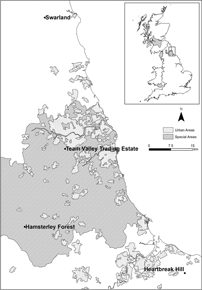
North East England has been chosen because it was especially badly affected by the Great Depression (Figure 1). In the UK the Depression had a particularly regional influence; being felt most in areas dependent on heavy, particularly extractive, industry, namely North East England, North West England, Central Scotland and South Wales. Not only were these areas worst affected, they failed to recover after 1933 because the sectors on which they relied, such as coal mining and ship building, remained depressed longer than other sectors.Footnote 11 The government declared part of the North East a ‘Special Area’ in the Special Areas Act 1934 (amended 1937).Footnote 12 All of our case studies, apart from Heartbreak Hill, are within the Special Area or assisted people from it. Heartbreak Hill is in East Cleveland, which although not in the Special Area was probably as depressed as the Special Areas.Footnote 13
A map showing the locations of the four case studies and the Special Areas designated by the 1934 Act.

Heartbreak Hill
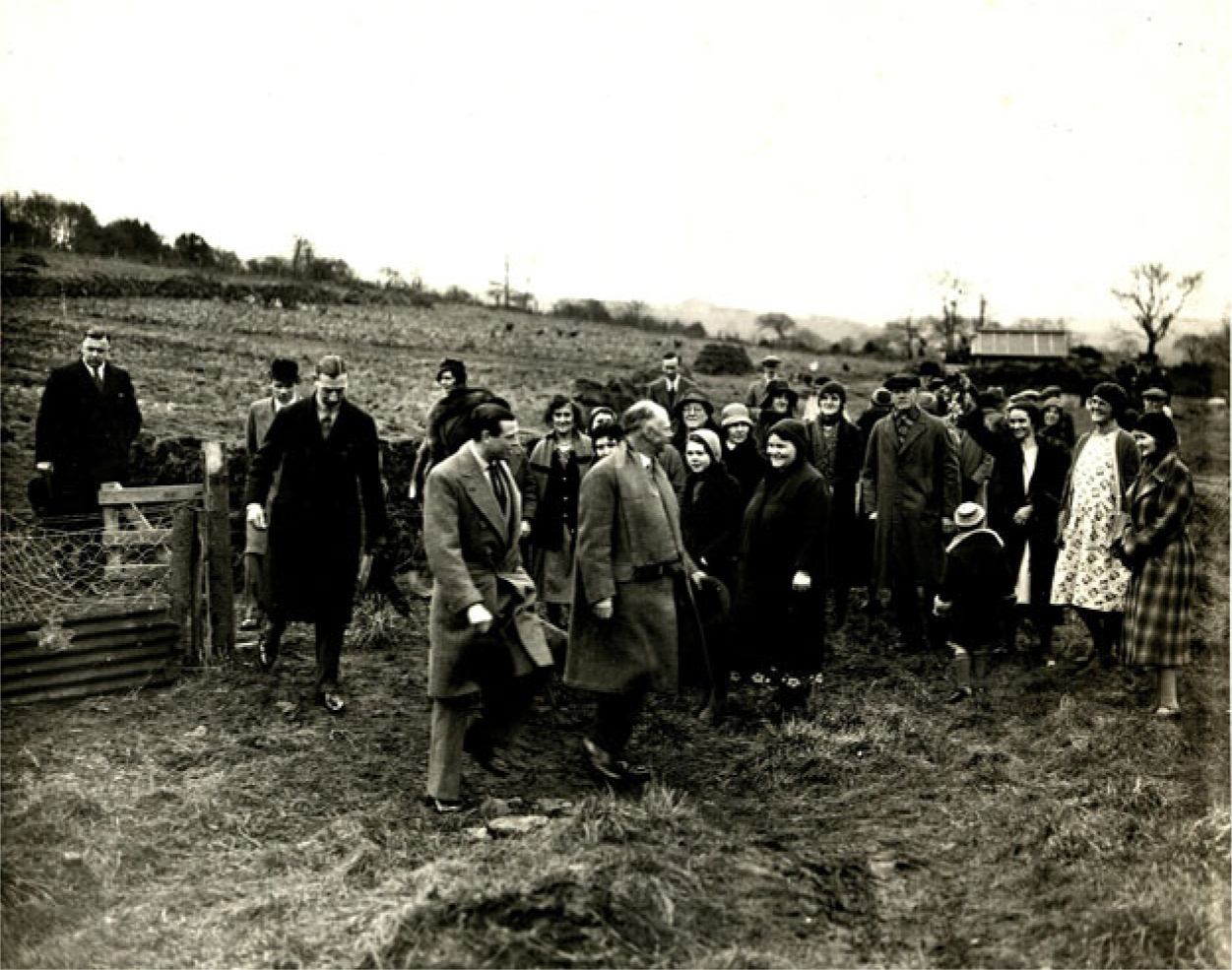
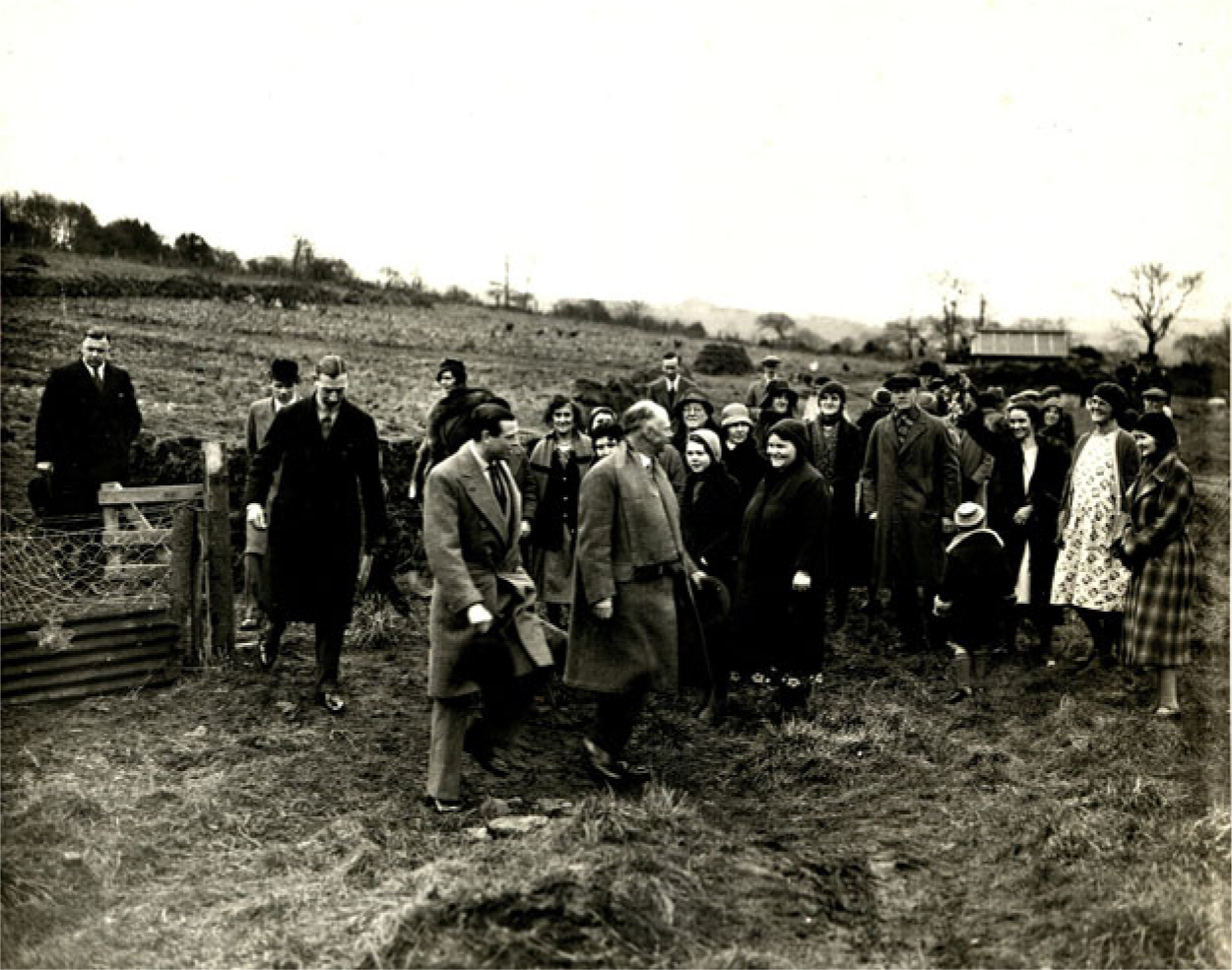
This scheme was created by local aristocrats Ruth and James Pennyman of Ormesby Hall, near Middlesbrough. The East Cleveland ironstone mining villages had been in decline for some years prior to the Depression. In 1932 the Pennymans, with the assistance of some of their friends, decided to help the unemployed miners of Boosbeck, Margrove Park, Lingdale and Charltons villages. The scheme comprised several different elements, including cooperative horticulture. Three branches were formed – one each at Charltons, Margrove Park and Lingdale – and a piece of land rented for each (Figure 2).Footnote 14 ‘Heartbreak Hill’, which we will use to refer to the whole scheme, was the name informally given by the unemployed miners to one of these pieces of land. Vegetables were grown and animals kept. Some produce was sold to cover costs and the rest divided between the members for their own consumption. The allotments were run by the unemployed miners themselves, but at summer and Easter, groups of English and German students camped in the area to help with the more physically demanding work.Footnote 15 These work camps were run by Rolf Gardiner, a friend of the Pennymans, who was a Nazi fellow traveller and later became significant in the Organic Movement.Footnote 16 In addition to this, Ruth Pennyman ran a cooperative sewing group for local women, allowing them to purchase materials cooperatively, and a workshop was established in order to allow the men to mend furniture and shoes, and to build cold frames, hen houses, etc. for the allotments. In 1933 this developed into a commercial furniture-making business.Footnote 17 They also produced dramatic and musical performances. We will primarily utilise records within the Ormesby Hall Manuscripts, which comprise publicity material, photographs and newspaper clippings, and some correspondence.Footnote 18
One of the Cleveland Unemployed Miners’ Association’s allotment sites on the occasion of a visit of the Duke of Kent. Note the huts and hen houses in the background. By courtesy of Teesside County Record Office, U/PEN 11/2.
Swarland and the Fountains Abbey Settlers’ Society
Like Heartbreak Hill, the Fountains Abbey Settlers’ Society (FASS) was an act of private philanthropy. Mr Clare Vyner, the owner of Studley Royal and Fountains Abbey (North Yorkshire) became aware of the conditions for working class people on Tyneside and decided to help.Footnote 19 The FASS had two aims: to train young single men for farming work or domestic service at a camp in the grounds of Fountains Abbey, and to establish a model village for unemployed workers from Tyneside and their families.Footnote 20 We are concerned with the latter. In 1934, Swarland Hall and its grounds were purchased to build the village.Footnote 21 Unemployed men were found through the Gateshead and Jarrow employment exchanges, were interviewed and then taken to visit the site. If they liked it, they and their families were moved into temporary houses while the men were put to work building the permanent village.Footnote 22 Each was guaranteed thirty days of paid work initially at building but later in industries developed for this purpose. The industries included a brickworks, a tweed mill, and a joinery. Construction continued through the 1930s and the village itself survives today, albeit with significant recent development. Swarland is mainly chronicled in the Studley Royal manuscripts, which contain the FASS correspondence, publicity materials, accounts and invoices for building work.Footnote 23
Hamsterley Instructional Centre
Hamsterley Forest (Durham) contained a Ministry of Labour Instructional Centre. The Centres were a national programme, which by the 1930s had evolved into a scheme to keep unemployed men in good physical condition by providing them with unpaid work.Footnote 24 The Instructional Centres Scheme had developed out of the Transfer Instructional Centres that the Ministry of Labour had established in the wake of the General Strike to train settlers for emigration to the colonies.Footnote 25 These, in turn, were inspired by a long history of rural work camps stretching back to the private and religious ventures of the 1880s. The history of these camps and their relationship with state unemployment relief measures has been elucidated by Field in his Working Men’s Bodies.Footnote 26
The Hamsterley Forest Centre opened in 1934 and continued to operate until the start of the Second World War.Footnote 27 The camp itself was run by the Ministry of Labour, but the work was provided by the Forestry Commission. Consequently, Instructional Centres, including Hamsterley, were placed on or near to Forestry Commission properties. The work consisted of road building and tree planting. The men were housed in prefabricated huts. In addition to accommodation, there were huts for the canteen, recreation, administration and a sick bay. Football fields and a swimming pool were provided to keep the men occupied in the evenings. The principal sources used to investigate this site are within the papers of the Ministry of Labour in the National Archives and consist of correspondence and minutes.Footnote 28
Team Valley Trading Estate
The Team Valley Trading Estate was also a government initiative, but was more ambitious and original than Hamsterley. The idea was to counter the perceived drift of light industry to the south of England by providing factories for rent, and thus saving the capital cost of factory construction, for businesses establishing in the North East. It was inspired by the success of private trading estates, particularly at Slough. The project was carried out under the Special Areas Act by the Commissioner for Special Areas of England and Wales (CSAEW). As the Commissioner could not directly subsidise private industry, an independent, non-profit-making company was established, called North Eastern Trading Estates (NETE). The Commissioner loaned public money to NETE to develop the Estate. A site was selected near Gateshead in 1936 and factories began to open in 1937.Footnote 29 By the end of 1939, around 100 factories had been built. A wide range of light industries established themselves on the Estate, including food, clothing and light engineering, as well as branches of large firms such as ICI and Cadburys. Great attention was paid to planning the layout of the Estate, under the guidance of William Holford; the consulting architect.Footnote 30
Each of these schemes either sought to create a rural environment or was placed in the countryside. Taken together, the case studies illustrate a range of ways in which the countryside formed part of unemployment relief schemes. In some cases, the value of the rural within the scheme was almost entirely aesthetic or rhetorical, while in others a rural economy and community was seen as a solution to contemporary social problems.
Recreating a rural society or economy
A number of unemployment schemes acted on a belief that to solve the problems of industrial capitalism it was necessary for at least part of the urban population to become smallholders. To their advocates, such schemes provided not only a solution to unemployment but also to the neglect that some agricultural land was suffering due to prolonged agricultural depression. The land settlement movement was already well established by the 1930s, having begun during the nineteenth century.Footnote 31 One of the best-known interwar schemes of this type was the Land Settlement Association (LSA). Percy Malcolm Stewart founded the LSA in 1934 with some government match-funding, shortly before he was appointed CSAEW. The LSA placed people from the Special Areas on smallholdings where they purchased and marketed cooperatively, and provided loans and training. The LSA did not believe that the entire urban population should become small farmers, but that horticulture could absorb a proportion of the unemployed.Footnote 32 The Forestry Commission also created smallholdings to absorb unemployment. It had provided smallholdings for its workers since its foundation in 1919. In the wake of the Depression it was given additional funding in order to make 3,000 smallholdings and to plant 353,000 acres.Footnote 33 Again, this was seen as a source of employment for some members of the working class, alongside industrial employments for the majority.
Both Heartbreak Hill and Swarland attempted to alleviate unemployment via a return to the countryside. Both relied on horticulture and small-scale livestock farming. At Heartbreak Hill we have frustratingly little evidence for the Pennymans’ motivations. The best evidence that survives is a leaflet describing the scheme at the end of its first year.Footnote 34 It does not explicitly refer to the scheme as a land settlement, but does note that: ‘[i]n any case there will soon be 15 acres of additional food and stock-producing land, which will belong to those who need it most’, which implies some pride in extending agriculture as well as assisting unemployed miners. This leaflet also said that ‘[w]e hope that some more comprehensive land development schemes may grow out of this very small beginning’, which suggests that the Pennymans did subscribe to the idea of land settlement.
James Pennyman was interested in agriculture for its own sake. He corresponded with agricultural writers, including Christopher Hatton Turnor, J. W. Scott and Arthur Howard.Footnote 35 His correspondence with Turnor, during August 1938, concerned Turnor’s study of reclamation. Only Turnor’s reply survives but it shows that Pennyman had mentioned Heartbreak Hill as an example of reclamation, as Turnor replied, ‘You had I think an exceptional lot of men doing that excellent scheme of moorland reclamation – and they were working near their homes.’ He went on to say that the LSA had experienced problems because it moved people to unfamiliar areas.Footnote 36 This suggests that Pennyman saw Heartbreak Hill as part of the land settlement movement and that others agreed. Pennyman’s correspondence with Scott also concerned land settlement. Scott had written a book called Unemployment: A Suggested Policy in 1924, of which Pennyman owned a copy.Footnote 37 This book outlined a system called ‘homecrofting’, based on the ideas of Kropotkin, in which unemployed people could become small farmers. Again we only have Scott’s reply, but it is clear that Pennyman had mentioned Heartbreak Hill, because Scott said: ‘Your hint, to appeal to the Public Assistance Committee to permit distribution of half the crop amongst the men, is most useful.’Footnote 38 This was something upon which Heartbreak Hill had depended because there was some fear that it could result in loss of benefits due to strict application of the means test.Footnote 39 Scott also said: ‘Our two efforts do seem to approximate’, so again Scott clearly accepted Heartbreak Hill as a land settlement. Chase and Whyman have suggested that James Pennyman wanted the scheme to redefine the role of the aristocracy.Footnote 40 Since some elements of the British aristocracy have traditionally seen themselves as a force for promoting good or efficient agriculture this tallies with the agricultural concerns of the scheme.
The organisers of the Heartbreak Hill work camps also believed that they were practising land settlement, and took the ideas somewhat further than James Pennyman himself. The leaflets advertising the work camps often speak of agriculture as the future for Cleveland; for instance, the leaflet for the fifth camp said that:
Discussions [at previous camps] centred largely on agriculture, which members of the scheme regard as the greatest hope for Cleveland.Footnote 41
Similarly, a report suggested that:
[s]ubsistence farming seems to be the best alternative to the decaying mining industry, and we concentrated on this subject, bringing in experts from Leeds and elsewhere to lecture … Many miners were keen to attempt subsistence farming … if possible a group of the men will be installed on a farm.
The report went on to say that:
It became more and more apparent during the fourth camp that land settlement is the ultimate solution of the economic problem in Cleveland, and it is fortunate that many of the unemployed are of good agricultural stock and have not been separated from the soil for more than a generation. The purpose of the scheme was, and still is, ameliatory, but there is no reason why it should not develop into a training centre for those who would become farmers.Footnote 42
This was partly inspired by history, as in discussions held after a visit to Guisborough Priory by one of the work camps it is reported that someone said that they ‘must become the modern monks!’ – probably in reference to medieval monastic land reclamation.Footnote 43
The work camps were run by Arthur Cobb and Rolf Gardiner, who probably prepared these texts and certainly participated in the discussions. Gardiner believed that the key to civilisation was a mystical, organic relationship between people and nature.Footnote 44 He considered civilisation threatened by urbanism and industrialism, which resulted from a loss of religious values, and wished to recreate an organic society to counter this.Footnote 45 The comment about becoming ‘modern monks’ may reflect this concern and is reminiscent of Gardiner’s later comparison of his ‘rural university’ with Dark Age monasteries.Footnote 46 He believed that traditional music and dance would develop the psychic bonds of an organic community and provide links with earlier rural traditions.Footnote 47 Local aristocratic leadership, which could subordinate the parts of a local community to an organic ‘whole’, was a further element of Gardiner’s ideology.Footnote 48 However, he considered most of the British aristocracy a spent force and hoped that a new leadership would emerge from his numerous efforts, including Heartbreak Hill.Footnote 49 The aristocratic origin of the Heartbreak Hill scheme, the importance of music and James Pennyman’s concern for the aristocracy all find parallels in Gardiner’s thinking.
Indeed, there is a letter from Gardiner to the Pennymans persuading them to take action in East Cleveland, though it was written in 1929, several years before Heartbreak Hill began.Footnote 50 Gardiner stated that he did not believe that there would be a revival of trade and that economic activity will ‘only justify itself if it is directed by non-economic, i.e. religious impulses. We must concern ourselves with food, warmth and shelter, but not as an end in itself, but in order to attain a maximum realization of life.’Footnote 51 It is possible that ‘food, warmth and shelter’ is a reference, conscious or otherwise, to Tolstoy’s basic duties: ‘food, shelter and clothing’,Footnote 52 but adapted to Gardiner’s philosophy, and thus highlighting the conceptual links between the 1930s and earlier rural schemes. He went on to say that they should create something new that would counter the feeling of futility, which he considered worse than economic insecurity. He called on the Pennymans to do this in Cleveland: ‘Cleveland and the North Riding: there’s your job! To initiate something new, and to kindle the life-quality where it has been quenched.’ This could very well be part of the impetus behind Heartbreak Hill, but Gardiner did not, in this letter, outline any of the specific features of Heartbreak Hill, only that ‘some form of rural activity’ should be used to ‘train the surplus young men’. Thus, while Gardiner appears to have had some influence on the scheme we should be wary of reading his philosophy into all its aspects. Everything that occurred at Heartbreak Hill is paralleled in mainstream unemployment schemes, and the pamphlets filed among the Heartbreak Hill papers encompass the full range of political positions taken by unemployment relief schemes.Footnote 53 It is also likely that Pennyman built on the already well-established tradition of allotment gardening in the area. The Ordnance Survey depicts many allotment gardens around Lingdale and Boosbeck at least as early as 1894, and the importance of these to local families had been noted by David Ayerst in an 1934 piece for the Manchester Guardian.Footnote 54
Consequently, Heartbreak Hill was clearly intended as land settlement, albeit without physical relocation of people. It incorporates parts of Rolf Gardiner’s conception of an organic society, though it did not adhere slavishly to his philosophies. On balance, it is more compelling to see it as an attempt to revive the relevance of the aristocracy in a particular region of the English countryside via their supposedly traditional agricultural role. It is frustrating that the only evidence that survives pertains to the views of the aristocratic and middle-class organisers of the scheme, while the views of the unemployed people who worked on it and had a significant role in day-to-day decision-making are not recorded. It is possible that details, such the type of crops grown, may originate from them rather than the Pennymans and their associates, especially as many would have had experience of allotment gardening.
Swarland is similar to Heartbreak Hill, in that it involved an aristocratic leader and horticulture. However, there seems to have been even less theoretical basis behind Swarland than Heartbreak Hill. Each cottage had 1.5 acres of land for growing fruit and vegetables and keeping pigs, hens, goats or rabbits. There is some confusion over whether Swarland was considered a land settlement scheme in the strict sense, that is, that unemployed people would be sent into the countryside and become almost entirely dependent on their own food production. Land settlement is given as an objective in the FASS articles of association and Mr Nott, the FASS’s secretary, consistently referred to Swarland as a land settlement in Society correspondence.Footnote 55 However, in interviews made some decades later, Vyner emphasised that it was not a land settlement because the settlers were not practising subsistence agriculture. However, in this same interview he also said that the intention was to move the unemployed into ‘less populated districts’ of England, which is closely aligned with some notions of land settlement.Footnote 56 In December 1936 the Leeds Mercury reported that the intention was that 80 per cent of the settlers would be employed in industries.Footnote 57 These people would sublet most of their land to other settlers who had proven adept at horticulture and wanted to pursue it full-time. As this did not actually happen, and as there is no mention of this in the Society manuscripts, it may have been little more than a vague idea. It may also have been an attempt to counter the criticism that 1.5 acres was insufficient for any serious agriculture. If this had been carried out, Swarland would be more similar to land settlement schemes. In the event, Swarland, while incorporating much land settlement rhetoric, never fully embraced the economic model of back-to-the-land movements. It is possible that some of the inspiration for land reclamation in the Swarland scheme came from the activities of the monks of Fountains in the Middle Ages. In an advertisement, the work of the FASS was compared with the social work of the abbey, though land reclamation was not specifically mentioned.Footnote 58
Both Swarland and Heartbreak Hill relied on the notion that reclaiming agricultural land for unemployed people was a partial solution to unemployment. At Heartbreak Hill there may have been little realistic prospect of success in reclaiming its especially poor land, but the scheme was seen at least as a model for efforts elsewhere. In both cases there is some evidence that the organisers of the schemes were inspired by medieval society, in which a larger proportion of the population worked on the land.
However, neither Heartbreak Hill nor Swarland were attempts to ‘turn back the clock’ to an imagined past. This is best demonstrated by the agricultural methods employed. In neither case are the methods or products traditional in England. At Swarland goats were kept and a modern approach was taken to raising poultry by seeking advice from the Ministry of Agriculture and Fisheries on egg marketing.Footnote 59 Similarly, the rabbits seem to have been modern breeds – Chinchilla and Beveren – and were raised in hutches, not warrens.Footnote 60 The tweed mill was also based on modern electric power looms not traditional craft production.Footnote 61 Of course, tweed is traditionally Scottish and so would be out of place in any attempt to recreate the ‘English’ village. It is possible that Vyner drew on his connections with Scotland, where he owned land, in developing this idea. Alternatively, the inspiration could have been John Ruskin’s St George’s Mill, which had attempted to revive the Manx woollen industry at the end of the nineteenth century.Footnote 62
Heartbreak Hill also used dairy goats, while the cold frames and beehives shown in photographs of the site are also of modern types.Footnote 63 Advertisements described Boosbeck Industries’ furniture as modern and it is certainly modern in style.Footnote 64 It was produced on a production line and not by individual craftsmen.Footnote 65 A nod was made to tradition by naming the furniture lines after local places and by describing them as ‘on modern lines, but old-fashioned principles’ in some advertising.Footnote 66 Although Rolf Gardiner was opposed to ‘modernism’, and drew on history he was able to accept particular modern developments if they complemented his worldview.Footnote 67 There is, thus, a tension between desires for the project to recover vaguely defined, though probably religious, lost virtues while also creating a modern society.
Neither Hamsterley nor the Team Valley Trading Estate recreated a rural society or economy as a solution to unemployment. The Team Valley Trading Estate was intended to create jobs in light industry, which would employ people living in nearby urban areas. In fact, the Estate had to remove a number of allotments on its site before building began.Footnote 68 When the Mayor of Gateshead suggested that allotments might be included in the Estate’s Physical Training and Recreation Centre one of the Estate staff commented: ‘Allotments, however beautiful, would not fit in with our development, in my opinion.’Footnote 69 At Hamsterley, although the work carried out was forestry, the trainees were being kept fit for normal employment in industry, and were only sent to Hamsterley on a temporary basis.
Thus, although some schemes were based on a notion that a restoration of rural society and economy was a valid approach to unemployment, this was rarely seen as an uncomplicated return to the past or as any more than a partial solution. At the same time other schemes, which did not subscribe to this notion, drew on the positive image of the countryside in other ways.
Health, aesthetics and anti-urbanism
Most of the sites exhibit a concern for aesthetics and the health of the unemployed. This usually stemmed from a reaction against slum housing and as such was anti-urban. This, of course, ignored the poor quality of much rural housing, indeed while the Swarland settlement was being constructed the Alnwick Rural District Council was busy condemning cottages in Old Swarland not one mile away.Footnote 70 Nonetheless, concerns were bound up with, and in part responsible for, the rural aspects of these schemes.
Rural rhetoric was a key part of Team Valley Trading Estate’s marketing. For example, advertisements displayed at a trade fair said that ‘Team Valley is in unspoiled country, not far from Gateshead.’Footnote 71 Similarly, the announcement of the selection of the site said ‘It is most admirably situated in beautiful surroundings of a rural nature.’Footnote 72 Estate officials often contrasted their plan for the Estate with the existing industrial districts of English towns. For instance, Mr Appleyard, the chair of NETE’s board of directors, said, ‘it is pleasant … to compare the airy, well lighted factories surrounded with roads and backing on to the open spaces with a factory situated in the heart of a residential area with no space, little light and congested conditions for its workers and its traffic’,Footnote 73 and that the Estate ‘will give people the feeling that they are going into a Rural atmosphere rather than into the depressing atmosphere always associated with Iron & Steel and Heavy Engineering Industries’.Footnote 74 Others accepted this view of the Estate. For example, at the British Architects’ Conference, a Mr Percy Thomas, although not personally associated with the scheme, cited the Team Valley as an exemplar: ‘anxious to play its part in creating those better, healthier and more beautiful conditions which they hoped would be the mark of the twentieth century as compared with the disorder and ugliness that were the mark of the nineteenth’. It appears that Mr Thomas accepted the success of the Estate in creating an alternative to slums.Footnote 75
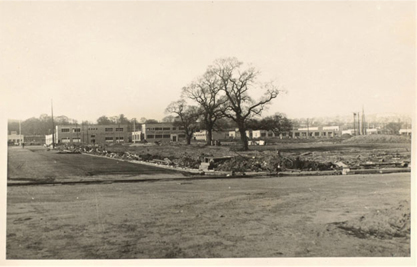
The designers of the Estate took pains to create a rural atmosphere in several ways. They prevented the margins of the Estate from being built on by purchasing land around it.Footnote 76 They also established a nursery to facilitate maintenance of flowerbeds around the Estate. Although the Team River was culverted, and thus an unruly natural phenomenon was constrained, the culvert was covered with wire mesh and planted with creepers so that it could blend in with the Estate’s planting schemes.Footnote 77 Tree preservation was given particular attention, almost to the point at which contractors had to ask permission to cut down each tree (Figure 3).Footnote 78 The Estate was prepared to go to extra expense to preserve trees in some cases. For example, it had Alexander Gibb and Partners carry out a survey of all the trees on the Estate so that they could be considered when siting buildings, and extra drainage was included in the main roads contract to avoid felling trees.Footnote 79 The Estate was proud of these efforts and reported to the CSAEW that ‘[g]reat care has been taken to preserve the many beautiful trees which are situated on the Estate.’Footnote 80 Such concern was probably not unique to the Team Valley Estate. The similar Trading Estates established by the CSAEW and the Commissioner for Special Areas Scotland, appear similar in plan to the Team Valley though on a much smaller scale. Both have wide roads with substantial central reservations. The Treforest Estate (Rhondda) contained many trees, while that at Hillingdon (Glasgow) had a small park with a monument in front of its canteen.Footnote 81
A photograph (c. 1937) of building work at the Team Valley continuing between preserved trees. By courtesy of the University of Liverpool Library, D147/C64.

Another aspect of preserving the rural environment was the elimination of smoke and unpleasant smells. The factory heating systems, designed by the Buell company, burnt pulverised coal, and were theoretically smokeless. In 1936, before the Buell plant had been decided upon, the heating contractor suggested that if coke had to be used the chimneys could be hidden behind the factories, but that they were also investigating the use of gas.Footnote 82 As well as fitting smokeless heating systems, the Estate refused leases to tenants who were likely to render the estate obnoxious or unsuitable, mainly through pollution, for other tenants.Footnote 83 They also used leases to insist on smoke-preventing plants. A 1937 report to the Commissioner mentioned that the tenants were particularly grateful for freedom from smoke, and in a radio programme about the Estate the presenter made a point of saying that the factories were running on electricity or smokeless fuels.Footnote 84
The benefits of the Team Valley’s rural environment were not purely aesthetic but were intended to be healthy. This was part of a general concern with health and fitness during the interwar period, most famously embodied in the person of Prunella Stack and her Women’s League for Health and Beauty.Footnote 85 Clean air was used in promotional material as an indication that the Team Valley was healthier than traditional factories. For instance, in one speech, Appleyard said: ‘Freedom from smoke, dirt and squalor was an essential to industry which, not only cared for its employees, but whose point of advertisement was that its goods were produced under cleanly conditions.’Footnote 86
Similar appreciation of the aesthetic and health benefits of the countryside is evident at Hamsterley. Mr Green, the local Ministry of Labour official who built the camp, reported that it was set in pleasing and picturesque surroundings.Footnote 87 The press often remarked on the situation of the camp. The Sunderland Daily Echo said: ‘[t]he camp is a picturesque colony of green hutments situated in the richly wooded Wear Valley’,Footnote 88 and that it was ‘in the most healthy of surroundings’.Footnote 89 The small scale of the project and lack of promotion compared with Team Valley mean that there is less evidence available. However, it is clear that, in a very similar way, aesthetics and health were considered benefits of the camp’s rural setting. Field has argued that the rural location of Instructional Centres was primarily pragmatic, as work was available on Forestry Commission land, so they were not intended to instil anti-urban values.Footnote 90 We do not dispute this; there is indeed no evidence that the location of Hamsterley was anything more than pragmatic. However, it is clear that a rural location was considered an extra advantage for health and aesthetic reasons.Footnote 91 Such ideas were probably held to some extent by the leaders of all Instructional Centres,Footnote 92 but may have been especially so at Hamsterley as its fountain and small garden suggest an attention to aesthetics not present at other sites.
The aesthetics of Swarland were also considered, but no evidence for a belief in the direct health benefits of a rural environment has been found. In an interview, Vyner explained how his initial aesthetic impression of the site influenced his choice to build there:
[the] sun was shining, and it was a very very beautiful spot and I said well I could live here very happily I’m sure, and I’m sure all of you could. To the imaginary people who were going to come. They would enjoy the sound of the birds in the spring and the whole thing was clean, tidy and everything was new, the houses were going to be new. I couldn’t imagine there was anything you could complain about. And I said if they didn’t like it they hadn’t far to go back into Tyneside.Footnote 93
Only at Heartbreak Hill is there no evidence for the aesthetics of the site being valued or maintained. Surviving publicity material focuses on the benefits of providing good food and activities to fill spare time.Footnote 94 It is possible that this is a result of Organic Movement’s primary focus upon the soil and agricultural production rather than any other rural concerns.Footnote 95
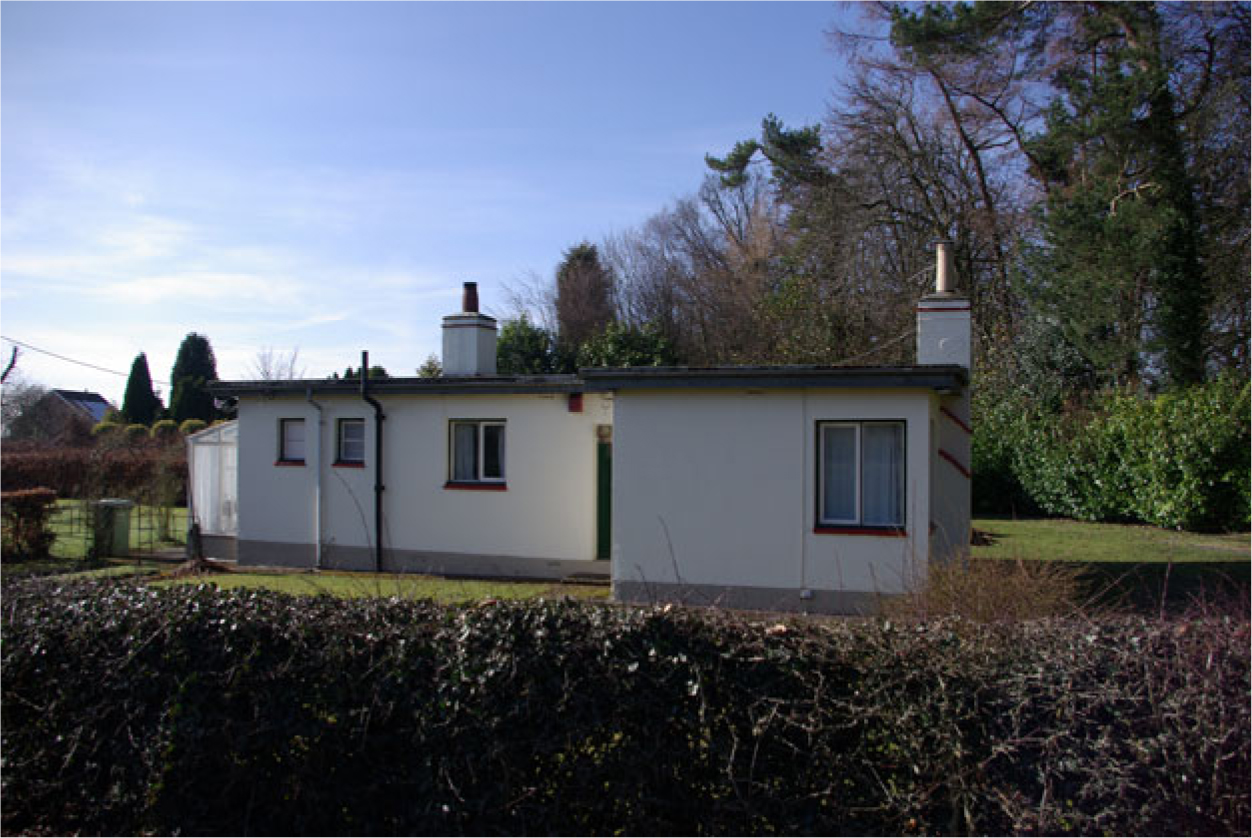
In some cases these concerns may come from the planner-preservationist viewpoint. This movement was a particular reaction to the perception that the countryside, and thus English identity, was threatened.Footnote 96 The movement favoured large-scale, government-led, planning in both town and country. Such planning would be carried out by architects. Planning would remove untidiness and create spaces that were clearly either urban or rural.Footnote 97 It also valued functional and unembellished architecture over heavily decorated Victorian buildings. This may explain the choice of particularly modernist architecture for the earliest Swarland cottages, including flat roofs and whitewashed render (Figure 4).Footnote 98 This is in contrast to the sham old-world buildings that often comprised suburban developments and which the planner-preservationists despised.Footnote 99 However, later Swarland cottages introduced pitched roofs, and weatherboarding was used for the village hall, so the style appears to have become more conservative over time.Footnote 100 ‘Planner-preservationism’ is clearest, however, at the Team Valley. This was planned on a large scale by William Holford, who went on to become a leading figure in the postwar town planning movement.Footnote 101 It is important to note, however, that Holford was strongly influenced by the work of Patrick Geddes, who was also influential to the Organicist Movement, and even contributed an introduction to a biography of Geddes by the leading organisict Philip Mairet.Footnote 102 Consequently, we must be careful of drawing the line between planner and organicist too rigidly. Holford designed the layout, major buildings like the Central Administrative Building, details such as lampposts and brick colours, and the outline of the standard factories that were built by local architects. This meant that the Estate conformed to an overall plan. The plan addressed a number of particular concerns of the planner-preservationist movement. The Estate insisted that the Electricity and phone lines be put entirely underground so there would be no poles whatsoever carrying telephone wires on the Estate.Footnote 103 Unregulated telephone and electricity wires were a particular bugbear of the planner-preservationist movement because they appear untidy.Footnote 104 NETE also sought the advice of the ‘Roads Beautifying Association’ for the development of the Estate roads.Footnote 105 This was part of the Ministry of Transport that was established in response to pressure from preservationists, but which was treated with suspicion from some quarters of the movement.Footnote 106 The Estate was also proud of the fact that it had removed nine pit heaps from the landscape. Appleyard told the BBC that ‘we have improved the scenery; we’ve shifted no less than nine pit-heaps’.Footnote 107 Pit heaps were particularly unpopular and feature strongly in J. B. Priestley’s description of the North East.Footnote 108 Consequently, the NETE’s ethos drew strongly on the planner-preservationist movement. However, it did differ from the movement by being unable to clearly define itself as either rural or urban; using both ‘rural’ and ‘city’ to describe the Estate.Footnote 109
One of the cottages built by the Fountains Abbey Settlers’ Society in an unexpectedly modern style.

Thus, our case studies show that the aesthetics or health benefits of the countryside were valued by unemployment schemes. Nonetheless, Heartbreak Hill demonstrates that an explicitly rural scheme could ignore these advantages. In some cases, we can identify the influence of a ‘planner-preservationist’ movement though at no site could it be said to be either completely pure or coherent, and is perhaps better seen as a loose collection of ideas current at the time upon which some drew more than others.
Benefits of a rural community
The final way in which unemployment schemes invoked positive notions of the countryside was through the creation of rural communities. Like the countryside, the village community was considered threatened, and some viewed this as worse than the decay of agriculture.Footnote 110 Evidence for attempts to create village communities is absent from both Heartbreak Hill and Team Valley. In the former, unemployed miners were already living in villages, while the latter was non-residential. There is some suggestion that this may have been in the minds of the individuals behind Hamsterley as Mr Workman, the camp manager, told the press that they were a ‘self-contained little community’.Footnote 111 The organisation of sports matches between teams representing each dormitory hut may also have been an attempt to encourage community.Footnote 112 However, any community that developed was limited by the fact that the men only stayed eight weeks at a time. Consequently, it could never have become a village community, but any community spirit that did develop as a result of being in a small group and isolated from the urban world was probably appreciated. The camp also failed to become part of the existing community, and relations were sometimes tense. The owner of Bedburn Hall and the Forestry Commission’s shooting tenant both complained about proposals to establish the camp, and one man who had been at the camp and was interviewed in the 1990s said that the locals ‘didn’t want to know you’.Footnote 113
Swarland is a clearer attempt to develop a village community for its own sake. A village hall, used for a range of social functions, was one of the earliest buildings constructed. Work on a temporary hall began in November 1935, immediately after the first block of houses was built.Footnote 114 In 1938 it was replaced with a larger hall incorporating many features. The main hall had a stage, a cinema projection room, cloakrooms, showers and a gym store. Adjoining the hall was a building containing a committee room, kitchen, games room and billiard room.Footnote 115 The village hall was constructed with a National Council for Social Service (NCSS) grant. The NCSS supported village hall building nationally because they considered them the best place for community to be realised, and that community was necessary for developing sense of citizenship.Footnote 116 Halls were particularly favoured by the professional middle class who desired a meritocratic society rather than a squirarchy, because halls could be seen as a replacement for the declining squire and church as the centre for village life.Footnote 117 In this respect it is interesting that Vyner said he specifically avoided making the Settlement too personal to him,Footnote 118 implying that he was wary of recreating the more negative aspects the imagined English village.
The hall was used for community events, which the FASS encouraged. One of the earliest was the 1935 Christmas party. This was organised by Mr and Mrs Vyner who provided toys for the children and donations were taken from locals towards tea.Footnote 119 More formal efforts to organise community events began in late 1936. A Welfare Committee including both settlers and society staff was formed and given responsibility for a number of things, including future Christmas parties.Footnote 120 The party for George VI’s coronation was a major social event. The first evidence for the planning of this dates to February 1937.Footnote 121 Such advanced preparation – the Coronation was not until 12th May – suggests that a major event was intended. The secretary of FASS, Mr Nott, contacted the local Catholic priest, Fr O’Connor, Canon Moran of the Church of England and a Presbyterian minister in the hope that a joint Coronation service in which the entire village could take part would be arranged. In the event, however, this was not possible.Footnote 122
A horticultural show was held annually and also supported by the Society. This was first considered in May 1937. Mr Nott initiated the idea by writing to a local seed merchant, for advice on running a show.Footnote 123 Nott passed the reply on to Mr Naylor, a settler and the secretary of the Swarland Allotments Association, which was to organise the show. Again, although the initiative came from the FASS, settlers were expected to take some responsibility. On the 23rd July 1937 Naylor wrote to Nott to say that they had fixed a date for the show.Footnote 124 The Allotments Committee must have taken over running the show from this point as no more is heard of it. The show continued through the 1930s.Footnote 125 This fitted in well with the horticultural aspect of the settlement, and was a specifically rural form of social activity. In fact, similar shows were held at many of the surrounding villages.
There were also clubs for both boys and girls. Mrs Chasemore, the wife of the tweed mill manager, ran a Girls’ Club.Footnote 126 The Club seems to have been encouraged by Mr Vyner who in 1935 sought the advice of the Council for Social Services on finding someone to run it.Footnote 127 Unfortunately there is little information about what the club did. The Boys’ Club was a more substantial operation, or at least required more effort on the part of the FASS. It began in May 1937,Footnote 128 and was run by Mr Swayne, who was a settler. It had sessions from 6:30 pm to 8 pm and from 8 pm to 10 pm on Mondays and had forty boys on average. Several other settlers assisted with the Boys’ Club party in January 1939.Footnote 129
There was also a Women’s Institute. This was encouraged by Mrs Vyner, who was president and was enthusiastically supported by Nurse Collins, who was employed by the FASS.Footnote 130 It operated from at least 1936 and was active up to 1938.Footnote 131 The Women’s Institute was a specifically rural form of social activity, having begun under the Agricultural Organisation Society in 1915 as a means to improve the material conditions of rural women by enhancing skills.Footnote 132
The Society also encouraged Anglican worship, using the village hall. This would have provided a further forum for community activity, and seems to have been popular enough to attract reasonable turnouts to two services every Sunday.Footnote 133 Mr Nott asked Canon Moran of Felton whether he would be able to hold regular services, until a church was built and put on a regular footing by the bishop. Moran agreed to do so and also spoke with the bishop. In interviews recorded in the 1990s, Vyner said that they had always intended to build a church but their plans were interrupted by the Second World War.Footnote 134
Vyner said that he considered the school, built by the council in 1937, to have had ‘an enormous effect’ because without it the children would have had to go to different schools.Footnote 135 The importance of educating children from villages together in the countryside was recognised at the time, particularly in the work of Henry Morris in Cambridgeshire.Footnote 136 The FASS assisted with building the school by designing the water supply and drainage.Footnote 137 The school opened on Monday 29th November 1937. Its managers included Muriel Winifred Chasemore and Charles Mellor, who were both society staff but no settlers appear to have participated.Footnote 138
In all the cases listed above the Society was strongly involved in the initiation of social institutions and activities, but included settlers in their planning and organisation. It is likely that the Society did so because it considered it important that Swarland became a self-supporting community.
Conclusions
Our four case studies illustrate a range of different attitudes to the English countryside of the interwar period. The only clear link between them is that they all viewed the countryside positively and believed it had a role to play in unemployment relief. For some, such as Hamsterley, this was little more than recognition of a healthy and attractive environment and an opportunity to build a temporary sense of community. These were unintended bi-products of the convenience of Forestry Commission land, and may have been even less appreciated in other Instructional Centres. At Team Valley health and aesthetics were also the major benefits of the NETE’s notion of a rural environment. However, this was a result of the Estate’s planners drawing extensively, though not exclusively, on the planner-preservationist movement. Their vision of a rural environment was part of a larger model of a planned economy. Only at Heartbreak Hill and Swarland was a specifically rural economy considered part of the solution to unemployment. At both, a rural setting was used to grow food, primarily for home consumption. At Heartbreak Hill some of the scheme’s organisers, notably Rolf Gardiner and perhaps James Pennyman, may have envisioned a utopian future in which most people were small-farmers and saw Heartbreak Hill as either a step towards, or a model for, this. However, in practice the scheme confined itself to the more modest goal of improving diet, which was of course a major concern of the Organic Movement in its own right.Footnote 139 At Swarland, market gardening was only intended as a supplement to employment. Vyner’s insistence that it was not a land settlement emphasises this. However, in both cases the schemes adapted elements of the formal land settlement movement and deployed some of its rhetoric. The FASS also seems to have bought into the notion of an idyllic rural community and sought to create one.
None of these schemes were attempts to realise a fully coherent model of a rural civilisation that would replace contemporary society entirely. While some of the people involved considered this desirable the schemes themselves were not taken so far. In each case the schemes picked up on contemporary notions of the countryside and deployed them either rhetorically or practically. This acceptance of a general belief in the virtue of the countryside may have been almost subconscious for the people involved, and in most cases while they accepted elements of a range of schools of thought on the countryside no scheme adopted one model in its entirety.
Acknowledgements
The authors are grateful to the Leverhulme Trust for funding the ‘Landscapes of the Great Depression in the North East’ project from which this article is derived. We would also like to thank the staff of the various archives whose material is cited for their assistance. Finally, we would like to thank the anonymous reviewers for their helpful comments.