Introduction
Invasive forest pests can alter the structure, composition, and function of forest ecosystems. The severity of these impacts varies among pests and forest types. For example, the hemlock woolly adelgid, Adelges tsugae (Annand) (Hemiptera: Adelgidae), has changed the structure and function of eastern hemlock (Tsuga canadensis (Linnaeus) Carrière and T. caroliniana Engelmann; Pinaceae) forests in eastern North America (Orwig and Foster Reference Orwig and Foster1998; Orwig et al. Reference Orwig, Cobb, D’Amato, Kizlinski and Foster2008). This has had cascading effects on hydrology, nutrient cycling, and biodiversity because hemlock is a foundation species that functionally supports many other species in these forests (Ellison et al. Reference Ellison, Bank, Clinton, Colburn, Elliot and Ford2005). Emerald ash borer, Agrilus planipennis Fairmaire (Coleoptera: Buprestidae), has already killed nearly all ash (Fraxinus Linnaeus; Oleaceae) it has encountered in areas it has invaded in North America (Knight et al. Reference Knight, Brown and Long2013; Klooster et al. Reference Klooster, Herms, Knight, Herms, McCullough and Smith2014). This invasion has changed forest composition, and threatens the community of specialists that inhabit and/or feed upon ash (Wagner and Todd Reference Wagner and Todd2015). In contrast, some exotic insects never reach a threshold where economic or ecological damage is widespread or intense. For example, the pine shoot beetle, Tomicus piniperda (Linnaeus) (Coleoptera: Curculionidae: Scolytinae), predicted to be a high-risk pest, has become only a minor pest of pine (Pinus Linnaeus; Pinaceae) in North America, partly because it is not a very aggressive tree killer (Morgan et al. Reference Morgan, de Groot and Smith2004). The pine shoot beetle, essentially a naturalised resident, is now part of a species-rich community of insects that feed on pines in the Great Lakes Region. Several species of exotic ambrosia beetles are also established in North America where they cause damage in nursery settings (Ranger et al. Reference Ranger, Reding, Schultz, Oliver, Frank and Addesso2016), but no noticeable impacts in natural forests have been recorded. Some of these species have become so common that they now are dominant Scolytinae captured in bark beetle surveys in some environments (Coyle et al. Reference Coyle, Booth and Wallace2005; Reed and Muzika Reference Reed and Muzika2010).
Predicting the impact of a new invasive pest can be difficult. An invading insect faces many challenges, including interactions with host trees, other invertebrates and microorganisms, and abiotic factors such as climate. For these reasons, the impact of a pest can vary in different places. This has been the case with the European woodwasp, Sirex noctilio Fabricius (Hymenoptera: Siricidae), which is native to Europe and Asia, and introduced in North America and many countries throughout the Southern Hemisphere (Hurley et al. Reference Hurley, Slippers and Wingfield2007; Slippers et al. Reference Slippers, Hurley and Wingfield2015). In some areas, S. noctilio is a major pest of pine, especially in exotic pine monocultures with limited herbivore (and associated natural enemy) communities found throughout the Southern Hemisphere (Madden Reference Madden1988; Haugen Reference Haugen1990; Hurley et al. Reference Hurley, Slippers and Wingfield2007). Poor management practices and drought have also exacerbated the impact of S. noctilio in the Southern Hemisphere (Madden Reference Madden1988; Haugen Reference Haugen1990; Hurley et al. Reference Hurley, Slippers and Wingfield2007). Since it was detected in 2004 (Hoebeke et al. Reference Hoebeke, Haugen and Haack2005; de Groot et al. Reference de Groot, Nystrom and Scarr2006), S. noctilio has not been a major pest in North America. This is probably because forests in North America are similar to those in the native range of the pest; they are more heterogeneous and patchy on the landscape, and support a rich community of natural enemies and potential competitors of S. noctilio (Dodds and de Groot Reference Dodds and de Groot2012).
Though established and likely spreading in North America, S. noctilio has primarily been found in unmanaged stands, particularly in scots pine, P. sylvestris Linnaeus, and red pine, P. resinosa Torrey (Dodds et al. Reference Dodds, de Groot and Orwig2010; Ayres et al. Reference Ayres, Pena, Lombardo and Lombardero2014), less often in jack pine, P. banksiana Lambert (Ryan et al. Reference Ryan, de Groot and Smith2012b), and rarely in white pine, P. strobus (Zylstra and Mastro Reference Zylstra and Mastro2012). Natural enemies and competitors may play a role in limiting S. noctilio in North America, but pine resistance appears to be the most important limiting factor (Haavik et al. Reference Haavik, Dodds and Allison2015). The most suitable hosts for S. noctilio are intermediate and suppressed pines (Ayres et al. Reference Ayres, Pena, Lombardo and Lombardero2014; Dodds et al. Reference Dodds, de Groot and Orwig2010, Reference Dodds, Cooke and Hanavan2014; Haavik et al. Reference Haavik, Dodds, Ryan and Allison2016) that are likely stressed and not well defended against herbivores. There is some evidence that availability of pine, especially suppressed pine, has limited S. noctilio in Ontario, Canada (Haavik et al. Reference Haavik, Dodds, Ryan and Allison2016). In areas with more suppressed trees, more co-dominant trees were attacked, but not killed by S. noctilio, which suggests it has potential to become a pest (Haavik et al. Reference Haavik, Dodds, Ryan and Allison2016), perhaps under stressful environmental conditions. To date, there has been no effort to quantify the short-term impact of S. noctilio over time in North American pine forests.
Periodic reporting and analysis (i.e., short-term impact) of S. noctilio activity from a long-term study will help to identify variables that drive temporal changes in S. noctilio population dynamics in North America that may be missed with longer sampling intervals. We sought to better understand and describe S. noctilio impact on forests and attack behaviour in Ontario over a five-year period. Using eight pine stands, our specific objectives were to examine general patterns in S. noctilio activity annually between 2012 and 2016, and ascertain the fate of trees attacked by S. noctilio over time.
Materials and methods
Site selection
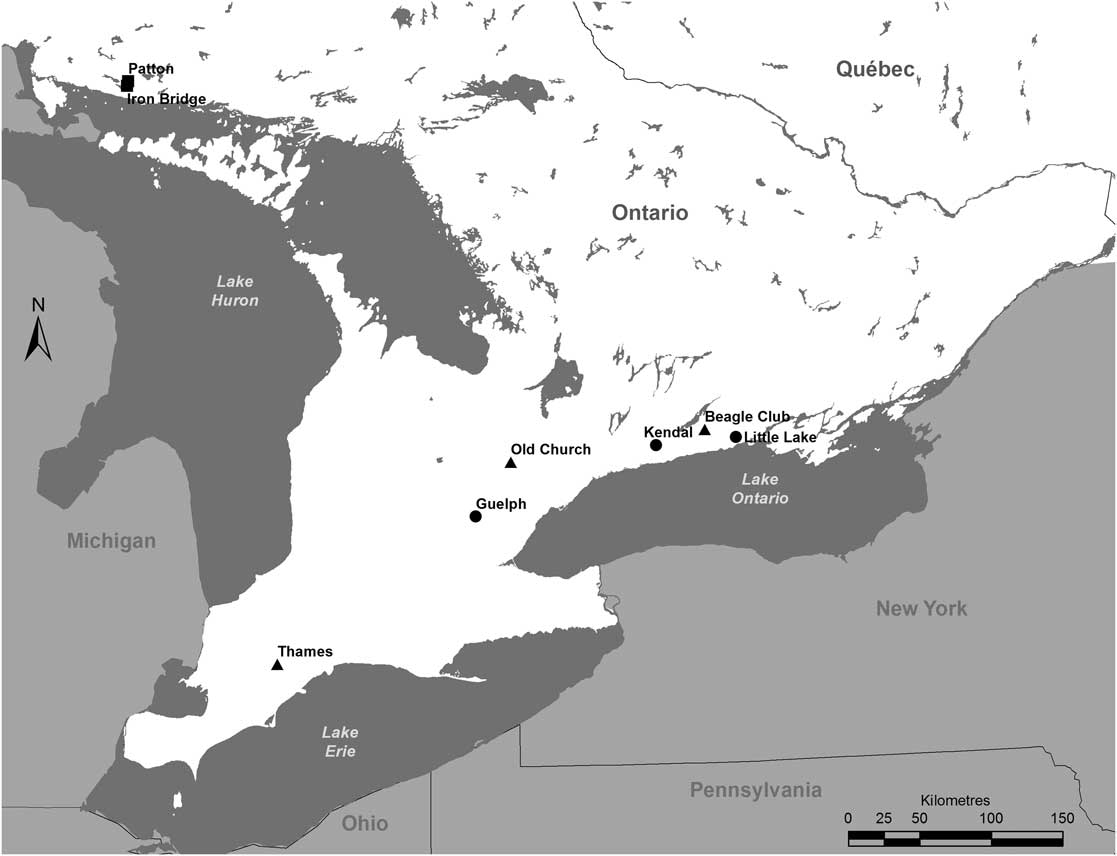
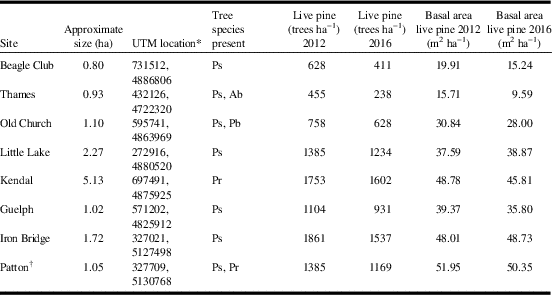
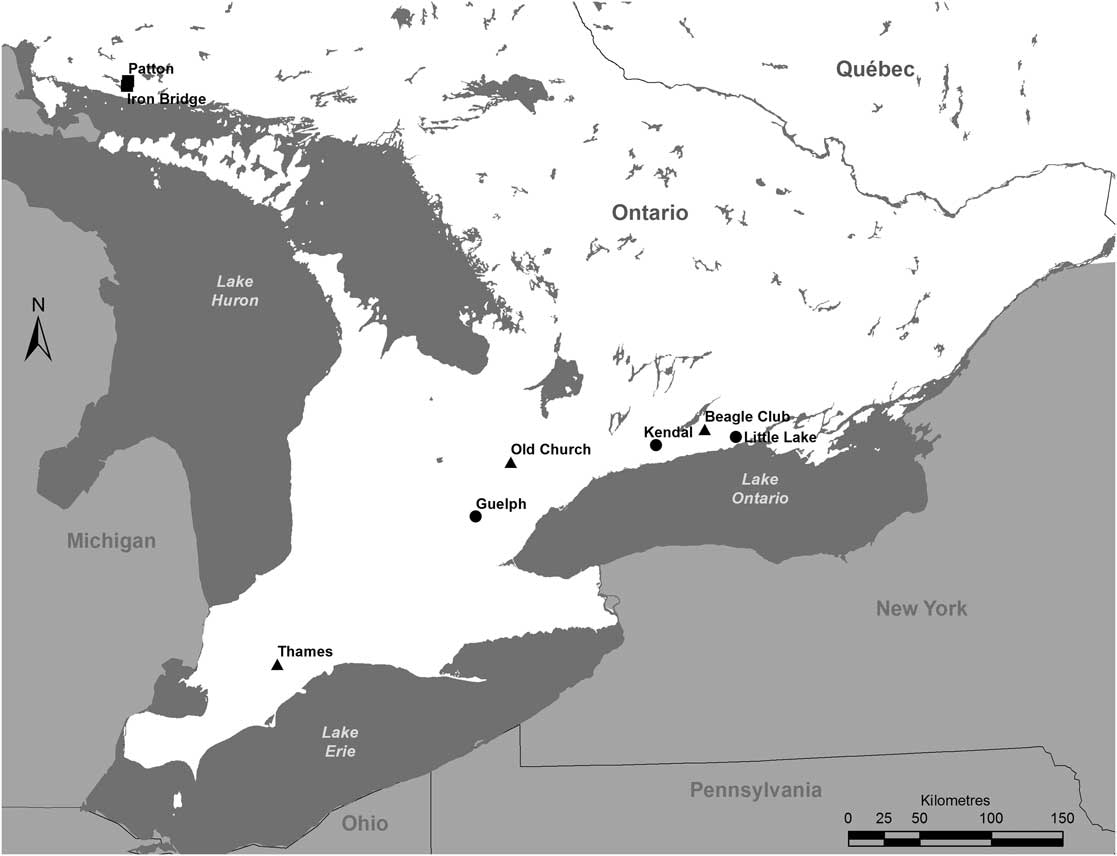
We used locations with positive trap captures from the 2006 and 2007 Ontario Ministry of Natural Resources delimitation surveys for S. noctilio in southern Ontario as a guide to select study sites. We also selected sites in northern Ontario where S. noctilio was likely to have established (P. sylvestris, P. resinosa, or P. banksiana stands with little or no indication of recent forest management). We examined 50 potential sites, and chose eight for this study (Fig. 1). We selected sites with differing levels of S. noctilio activity to represent forests that varied in apparent favourability for and/or success of S. noctilio. Stand sizes, along with pine density and basal area (in 2012 and 2016) are listed in Table 1.
Map showing names, locations, and level of Sirex impact in eight pine stands in Ontario. Low impact stands are represented by circles; high impact stands by triangles, and stands in northern Ontario by squares.
Summary of size, location, and composition of stands surveyed for Sirex noctilio activity in Ontario.

* All sites located in Zone 17 T, except Little Lake (Zone 18 T).
† Stand not measured in 2012 (2013 density reported).
Ab, Abies balsamea; Pb, Pinus banksiana; Ps, P. sylvestris; Pr, P. resinosa; UTM, Universal Transverse Mercator.
Stands located in southern Ontario included Beagle Club, Thames, Old Church, Little Lake, Kendal, and Guelph. Beagle Club was a topographically flat, unmanaged P. sylvestris plantation. Thames was a topographically flat, unmanaged mixed P. sylvestris, Abies balsamea (Linnaeus) Miller (Pinaceae), and hardwood forest. Old Church was a small, unmanaged forest patch located on the ridge-top of a slope, populated by P. sylvestris and P. banksiana. Little Lake was a topographically flat, unmanaged P. sylvestris plantation. Kendal was a topographically flat P. resinosa plantation that had not yet been thinned. Guelph was a P. sylvestris forest on slightly hilly terrain that had not been managed.
Two stands, Iron Bridge and Patton, were located in northern Ontario. We assumed S. noctilio spread to northern Ontario after its introduction to southern Ontario, probably arriving years later. Iron Bridge was a topographically flat, unmanaged P. sylvestris plantation. Patton was a topographically flat, mixed P. resinosa, P. sylvestris, and hardwood forest; it may have been thinned, but not recently.
Pine surveys
We obtained forest measurements and quantified Sirex activity in three, circular fixed-radius (7 m) plots at each site, spaced at least 25 m apart and 15 m from the forest edge. Sites ranged in size from 0.80 to 2.27 ha (Table 1). Kendal (low activity, southern Ontario) was larger (5.13 ha) than the others, but was homogeneous in pine density and Sirex activity throughout.
To establish permanent plots, in the winter of 2012 we affixed unique metal identification tags to each standing pine that was within a plot. We surveyed these trees through visual assessment and assigned possible mortality factors (dead or alive; attacked or colonised by Sirex, bark beetles, and/or wood borers); assigned crown class (suppressed, intermediate, or co-dominant); and collected stand-level forest measurements. To assess pine health, we visually surveyed each tree with binoculars from the base of the bole to the top of the crown for fresh resin beading, i.e., resinosis, indicative of Sirex attack (Ryan et al. Reference Ryan, de Groot, Smith and Turgeon2013), and adult emergence holes from Sirex, bark beetles, or other wood borers (Monochamus Dejean; Coleoptera: Cerambycidae) to confirm successful colonisation (Ayres et al. Reference Ayres, Sullivan, Harrison and Lombardero2009). Although it was not possible to distinguish between evidence of S. noctilio and the native pine woodwasp, S. nigricornis Fabricius, in most cases evidence was probably attributable to S. noctilio, because many more S. noctilio than S. nigricornis adults emerged from trees identified as attacked by Sirex in these stands (Haavik et al. Reference Haavik, Dodds, Ryan and Allison2016). We defined Sirex activity as the collective amount of pine attacked or killed by either S. noctilio or S. nigricornis.
For the entire study, a total of 493 pines were surveyed annually over a five-year period from 2012 to 2016. We surveyed pine health at all sites after the adult flight periods of S. noctilio and S. nigricornis had ceased (Ryan et al. Reference Ryan, de Groot, Nott, Drabble, Ochoa and Davis2012a), in the winter of 2012, and late fall of 2013–2016. In 2012 and again in 2016, we measured diameter at breast height (1.4 m from the ground) for all pines ⩾5 cm diameter at breast height in order to estimate pine basal area (in m2 ha−1). Forest measurements (stem density and basal area) from the three plots at each site were summed, converted to a per ha basis, and used as an estimate for each site. For each pine that was standing and dead in 2012, we included it in the survey only if it had died recently (1–3 years ago: branch structure and bark intact, no decay fungus visible). In 2013 and 2014, between one and five Sirex-infested trees were removed from each site, though well outside of survey plots used for this study. A few Sirex emerged from the removed trees (mean=8±2 (standard error), range=0–28 females per tree), except one tree from Thames that produced 150 females. It is possible that these tree removals had some influence in mitigating the impact of S. noctilio at the survey sites, especially at Thames, although we expect that this influence is minimal over time.
Results and discussion
Forest impact
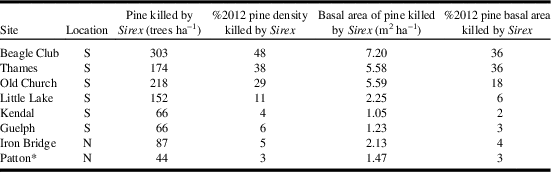
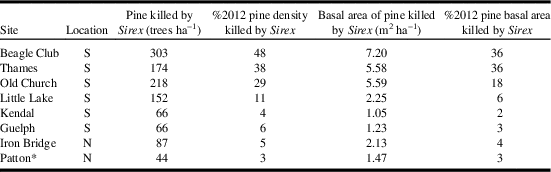
Among the eight sites surveyed in 2012, density of live pine susceptible to Sirex (P. resinosa, P. sylvestris, P. banksiana) varied from 455 to 1861 stems per ha, and declined by 130 to 324 stems per ha to between 411 and 1602 stems per ha in 2016 (Table 1). The average decline in pine density between 2012 and 2016 was 197±58 (standard error) stems per ha. Sirex killed between 44 and 303 stems per ha (29–48%, 4–11%, and 3–5% of stem density at high activity, low activity, and northern Ontario sites, respectively) between 2012 and 2016 (Table 2), an average of 139±84 stems per ha.
Stem density and basal area of pine killed by Sirex at sites in Ontario between 2012 and 2016.
* Stand not measured in 2012 (change from 2013 to 2016 reported).
S, southern Ontario; N, northern Ontario.
In 2012, the basal area of live pine susceptible to Sirex varied from 15.71 to 51.95 m2/ha, and in 2016, it varied from 9.59 to 50.35 m2/ha (Table 1). Six sites experienced a decrease, and two sites experienced an increase in live pine basal area between 2012 and 2016. The change in basal area among all sites ranged from a 1.28 m2/ha increase to a 6.12 m2/ha decrease; average change in basal area was a decrease of 2.47±2.36 m2/ha. Basal area of pine killed by Sirex between 2012 and 2016 varied from 1.05 to 7.20 m2/ha (18–36%, 2–6%, and 3–4% of basal area at high activity, low activity, and northern Ontario sites, respectively, Table 2), an average of 3.31±2.26 m2/ha.
In 2008, S. noctilio had already killed 3–18% of trees in several P. resinosa and P. sylvestris stands in New York (United States of America) and Ontario (Dodds et al. Reference Dodds, de Groot and Orwig2010). Another study in New York reported that between 5% and 17% of pines were recently dead or dying in 2009, about half of which were affected (attacked and/or killed) by S. noctilio (Ayres et al. Reference Ayres, Pena, Lombardo and Lombardero2014). It appears that since 2009, in areas where S. noctilio is present (i.e., unmanaged pine forests), it has acted somewhere between a primary and secondary pest. It is unclear whether this difference is due to time since invasion, since it was first detected at most of these sites in 2006 or 2007 (2014 by us in the northern Ontario sites, although delimitation efforts in Ontario had ceased after 2009). Continued monitoring of S. noctilio activity at our study sites will likely reveal sources of variability in the aggressiveness of the woodwasp.
Comparatively, during outbreaks in Australia and New Zealand, where it behaves as a primary pest, S. noctilio has killed 35–90% and 5–30% of pine in high and low impact areas, respectively (Rawlings Reference Rawlings1948; Madden Reference Madden1975; Neumann et al. Reference Neumann, Morey and McKimm1987; Morgan Reference Morgan1989; Haugen Reference Haugen1990). In its native range, S. noctilio is present in dying pine, but is not considered an aggressive, primary tree killer. For example, in Galica, Spain, 3–71% of dying pines at affected sites were attacked and/or killed by S. noctilio (Ayres et al. Reference Ayres, Pena, Lombardo and Lombardero2014). In the Rhone Valley, Switzerland, S. noctilio was found in roughly 8% of P. sylvestris suffering from decline (Wermelinger et al. Reference Wermelinger, Rigling, Schneider and Dobbertin2008). Clearly, S. noctilio has not yet had the impact in North America that it has in other invaded areas in the Southern Hemisphere, and its impact is more similar to that within its native range.
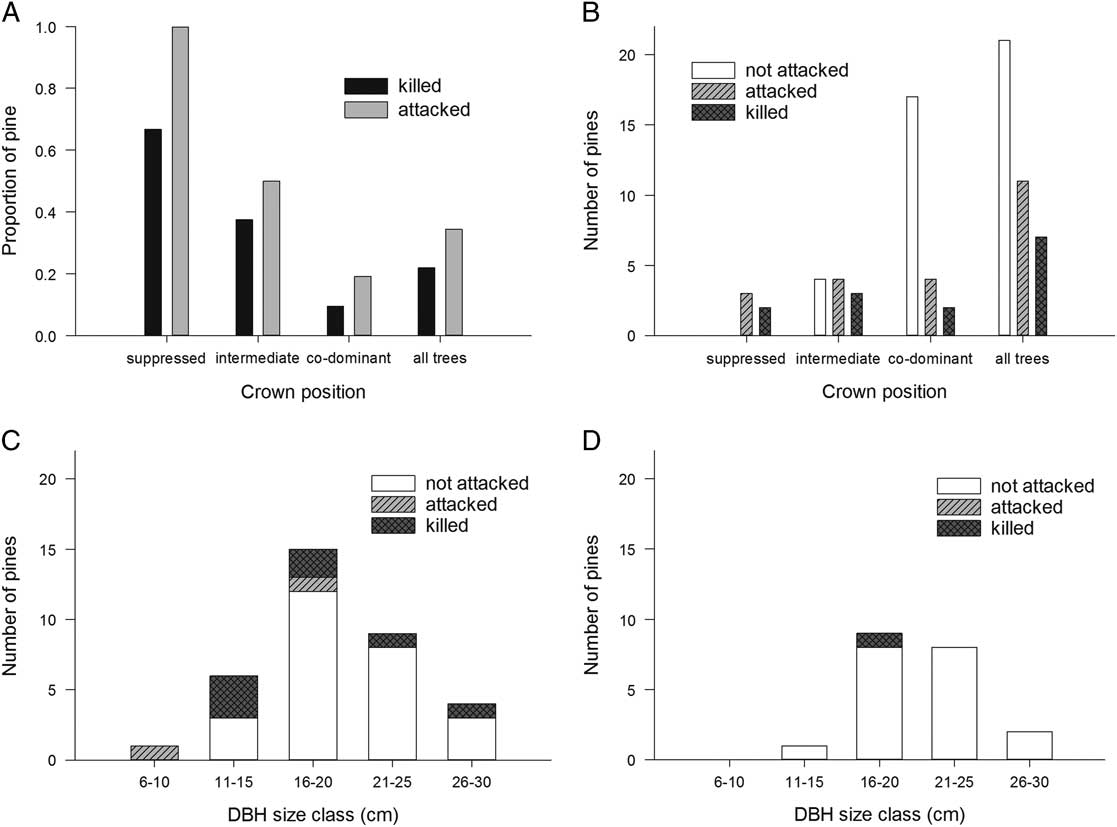
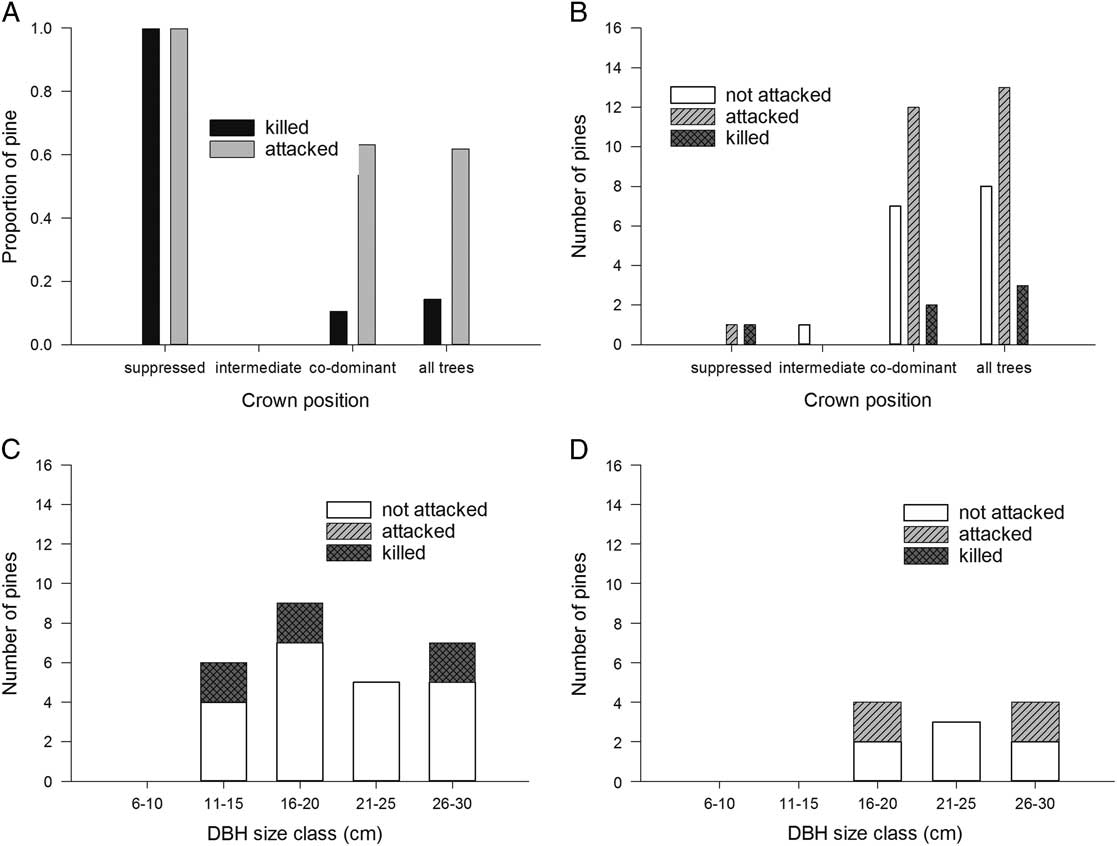
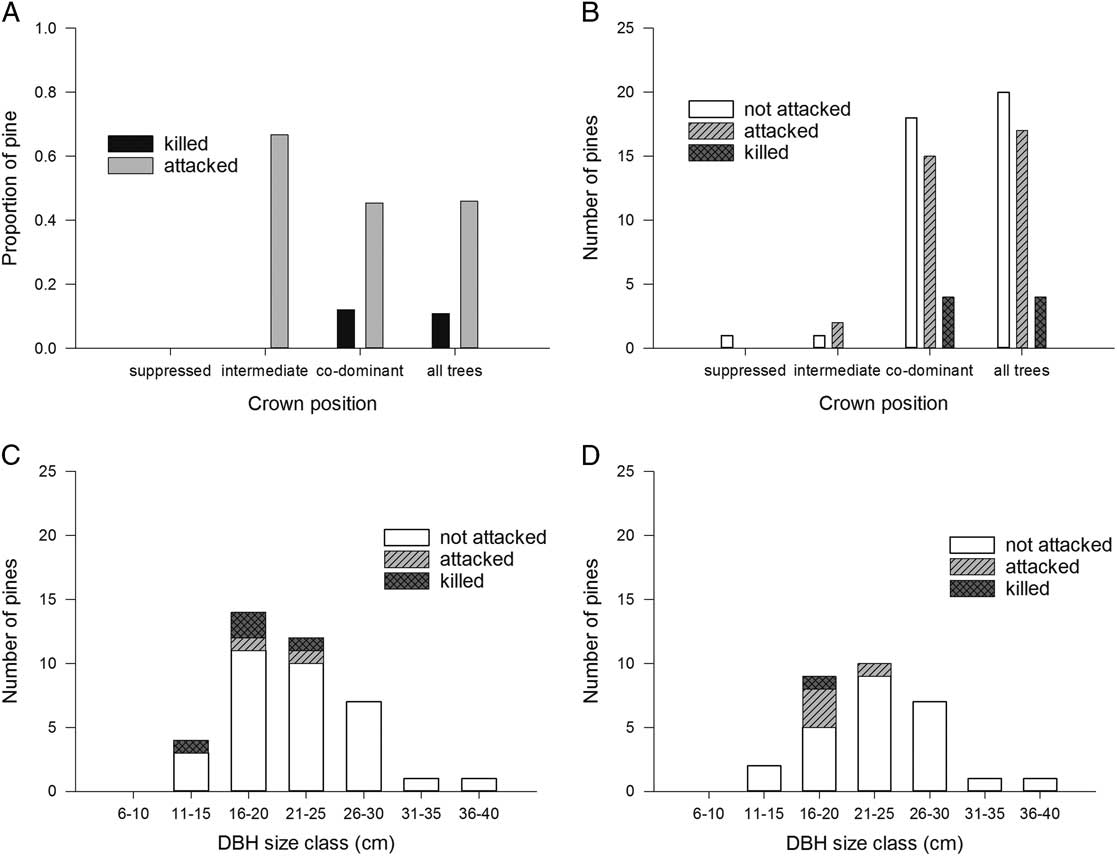
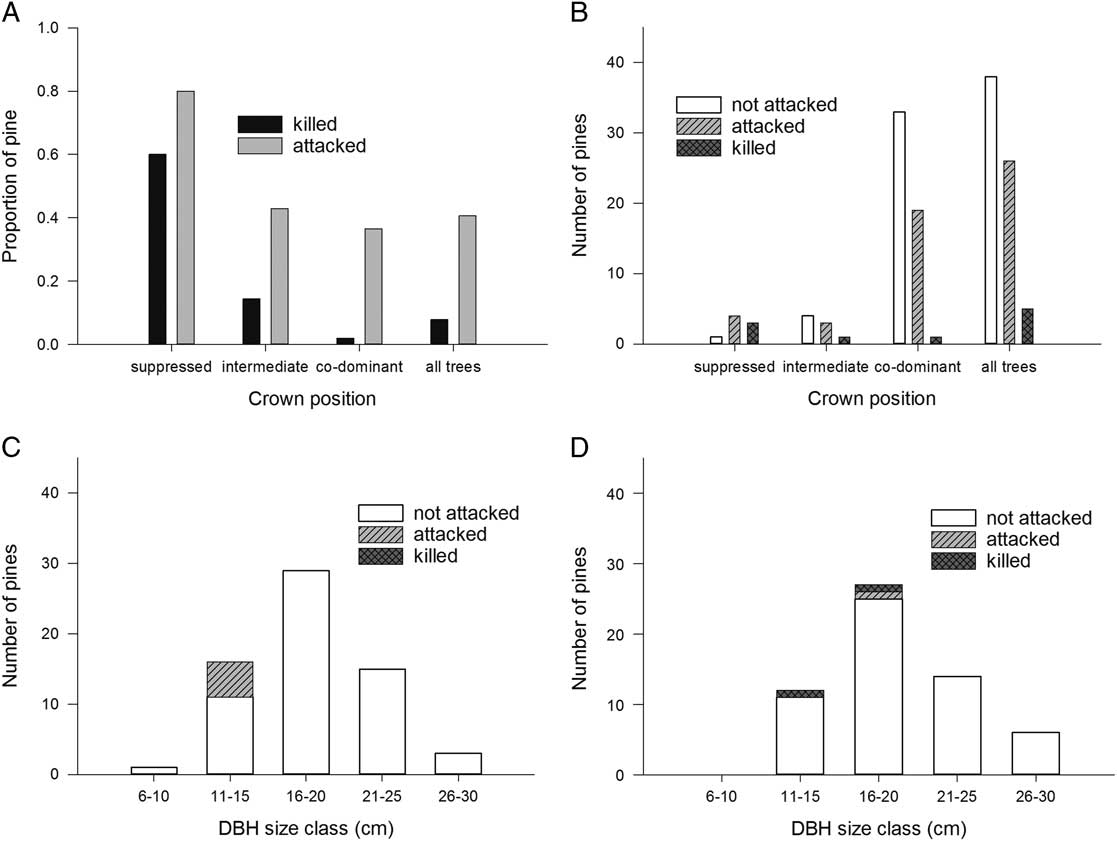
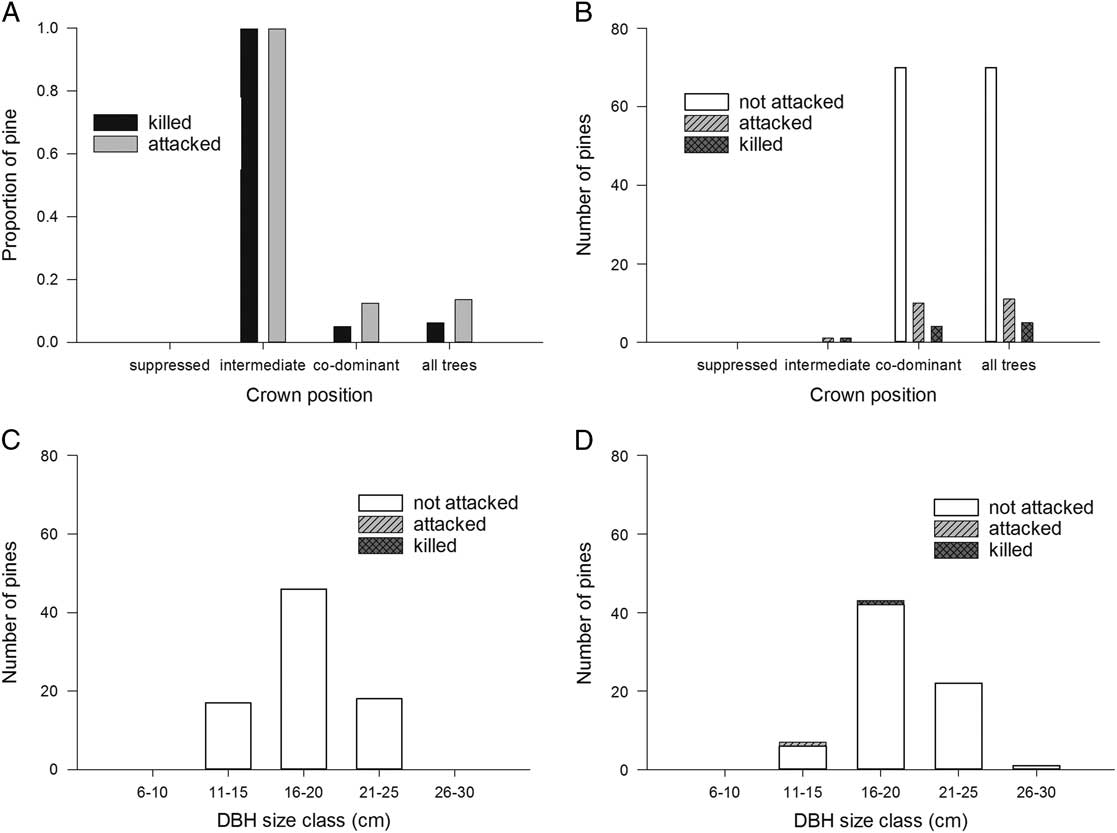
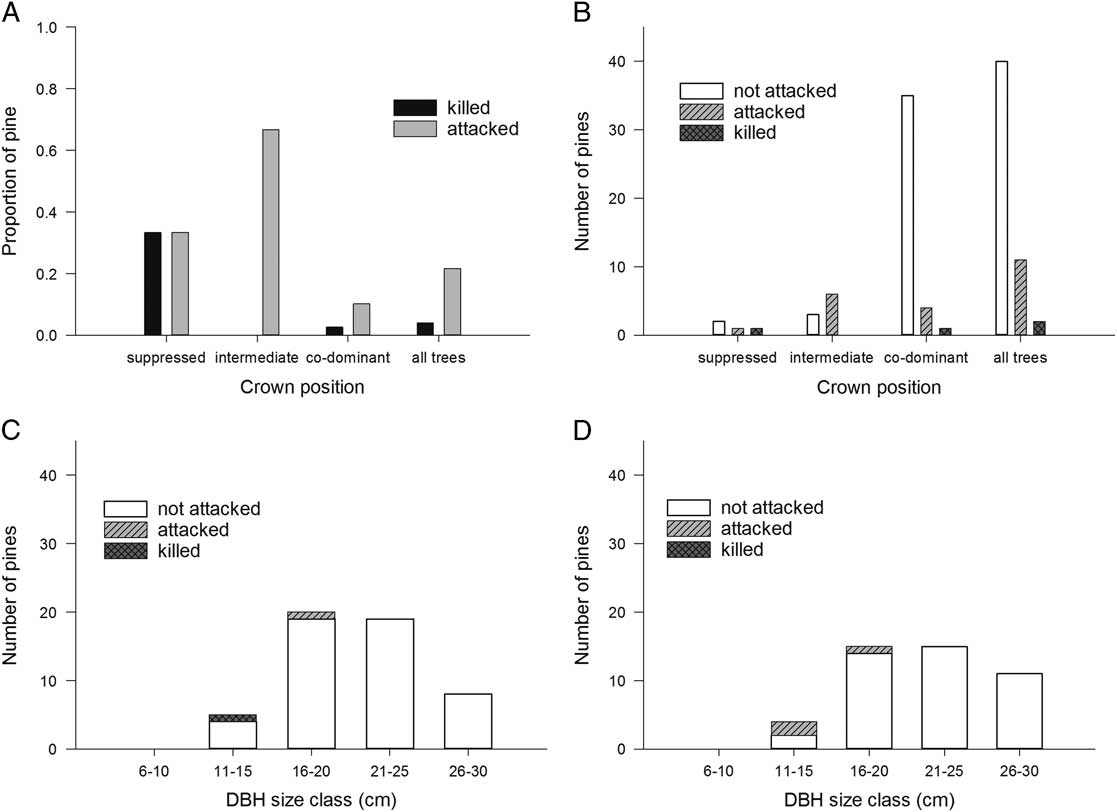
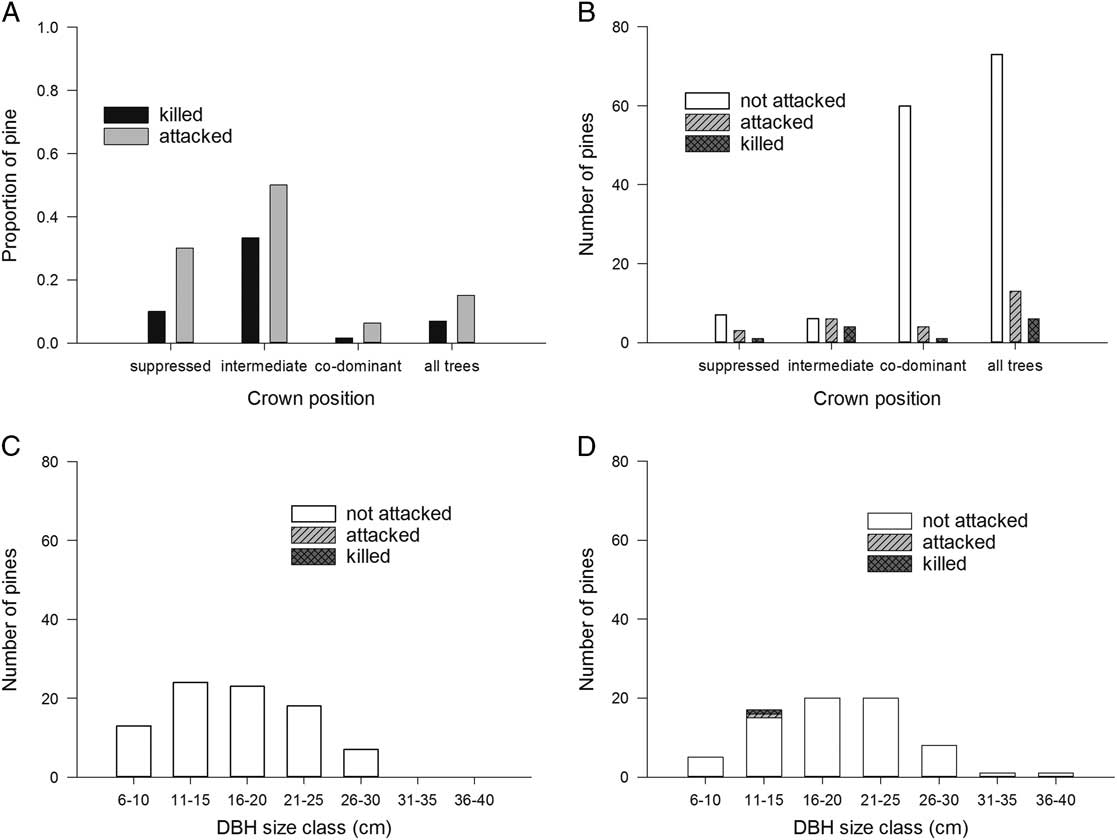
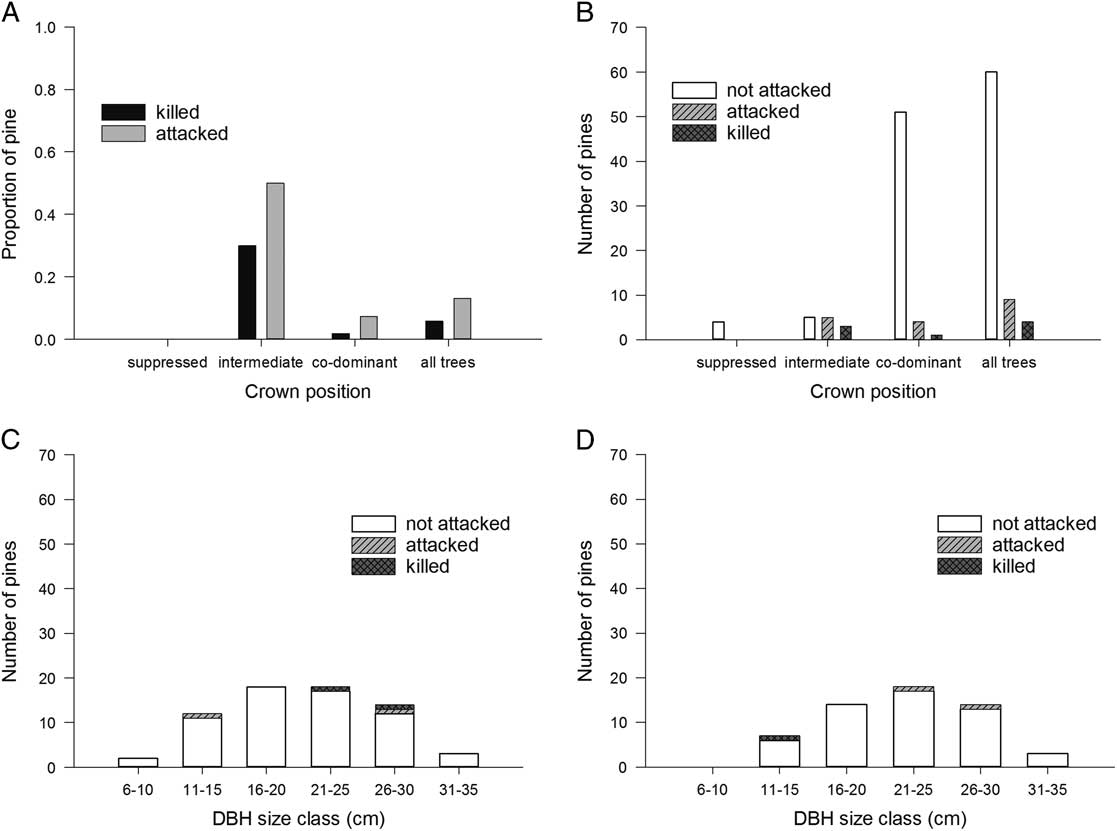
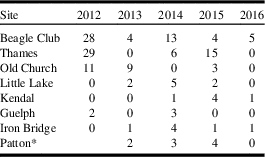
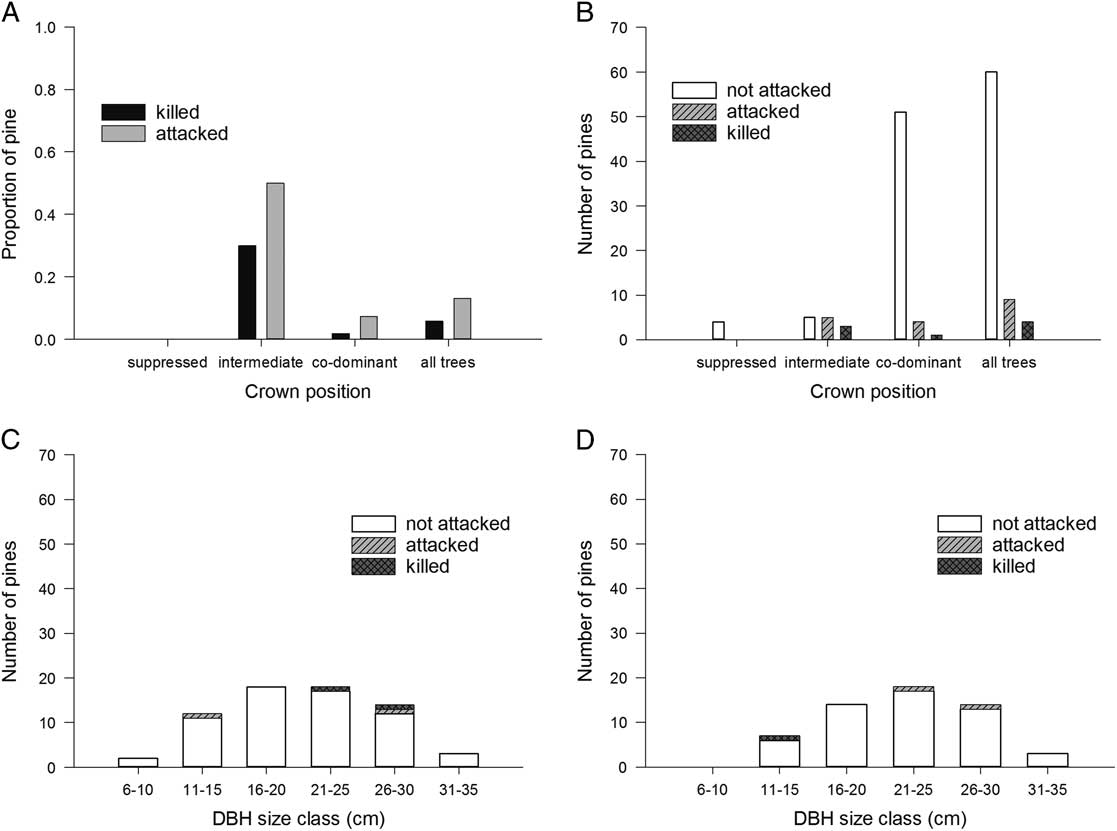
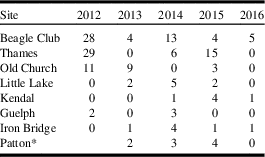
In our study, there were minor fluctuations from year to year in the percentage of pines killed by Sirex, with an overall mean among sites and years of 4±6% (Table 3). No year stood out among all sites as experiencing more Sirex-caused tree mortality than other years. At all sites, relatively more intermediate and suppressed than co-dominant pines were attacked and/or killed by Sirex (Figs. 2–9A, 9B), a continuation of the pattern observed previously (Dodds et al. Reference Dodds, de Groot and Orwig2010; Ayres et al. Reference Ayres, Pena, Lombardo and Lombardero2014). Also, a greater proportion of pine was attacked than actually killed by Sirex, a pattern that was particularly strong among co-dominant relative to intermediate and suppressed pine (Figs. 2A–9A). Although co-dominant pines represent the majority of trees at all sites, trees in intermediate and/or suppressed canopy positions remain at most sites; this indicates that at least some host material that is presumably suitable for Sirex is still available at these sites. With respect to site, size classes affected by Sirex in 2012 were the same size classes affected in 2016 (Figs. 2–9C–D). Collectively, these observations suggest that S. noctilio populations remained stable at these sites between 2012 and 2016, and have not progressed to killing trees in the main canopy.
Sirex activity at Beagle Club. Proportion of pine alive in 2012 that was (A; all years) attacked (grey) and killed (black) by crown position; number of pines that were not attacked, attacked, and also killed by (B; all years) crown position; and size class in (C) 2012 and (D) 2016. The killed portion of bars in (C) and (D) represents trees that were both attacked and killed that year, and the attacked portion represents trees that were attacked but did not die that year, whereas in (A) and (B) trees that were attacked and killed are represented in both the attacked bar and the killed bar. DBH, diameter at breast height.
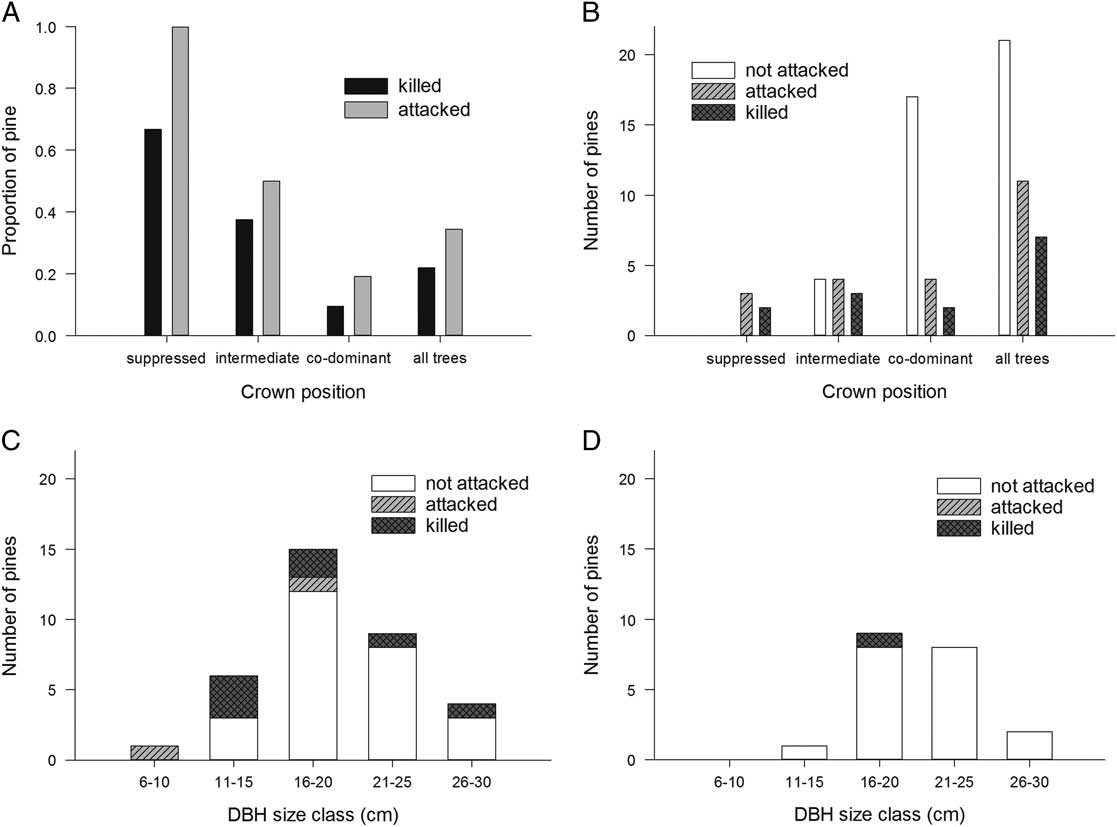
Sirex activity at Thames. Proportion of pine alive in 2012 that was (A; all years) attacked (grey) and killed (black) by crown position; number of pines that were not attacked, attacked, and also killed by (B; all years) crown position; and size class in (C) 2012 and (D) 2016. The killed portion of bars in (C) and (D) represents trees that were both attacked and killed that year, and the attacked portion represents trees that were attacked but did not die that year, whereas in (A) and (B) trees that were attacked and killed are represented in both the attacked bar and the killed bar. DBH, diameter at breast height.
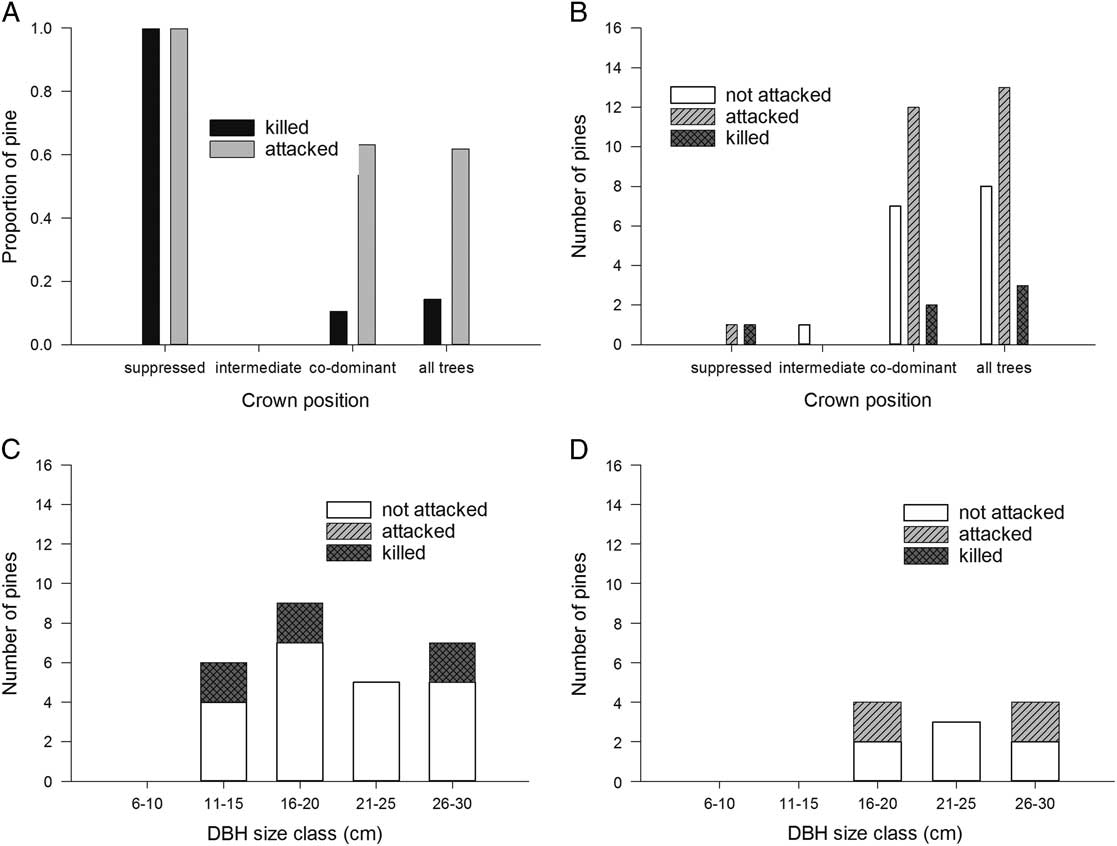
Sirex activity at Old Church. Proportion of pine alive in 2012 that was (A; all years) attacked (grey) and killed (black) by crown position; number of pines that were not attacked, attacked, and also killed by (B; all years) crown position; and size class in (C) 2012 and (D) 2016. The killed portion of bars in (C) and (D) represents trees that were both attacked and killed that year, and the attacked portion represents trees that were attacked but did not die that year, whereas in (A) and (B) trees that were attacked and killed are represented in both the attacked bar and the killed bar. DBH, diameter at breast height.
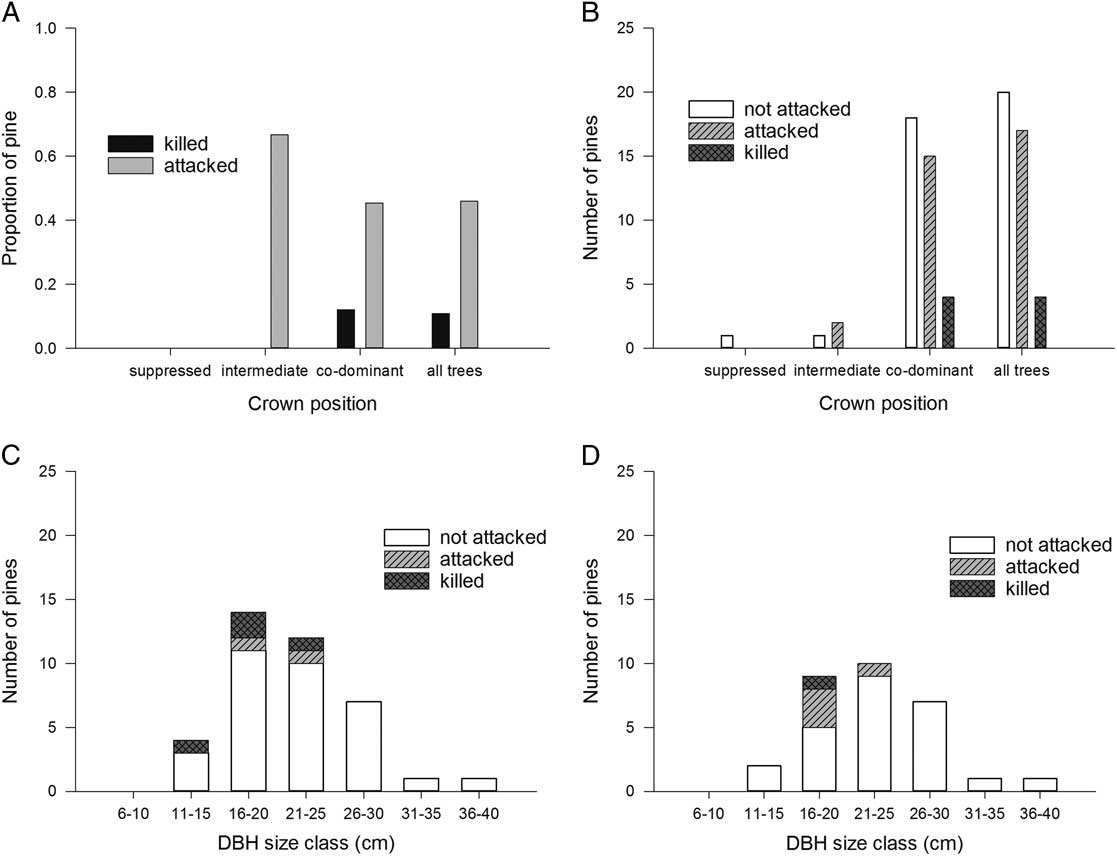
Sirex activity at Little Lake. Proportion of pine alive in 2012 that was (A; all years) attacked (grey) and killed (black) by crown position; number of pines that were not attacked, attacked, and also killed by (B; all years) crown position; and size class in (C) 2012 and (D) 2016. The killed portion of bars in (C) and (D) represents trees that were both attacked and killed that year, and the attacked portion represents trees that were attacked but did not die that year, whereas in (A) and (B) trees that were attacked and killed are represented in both the attacked bar and the killed bar. DBH, diameter at breast height.
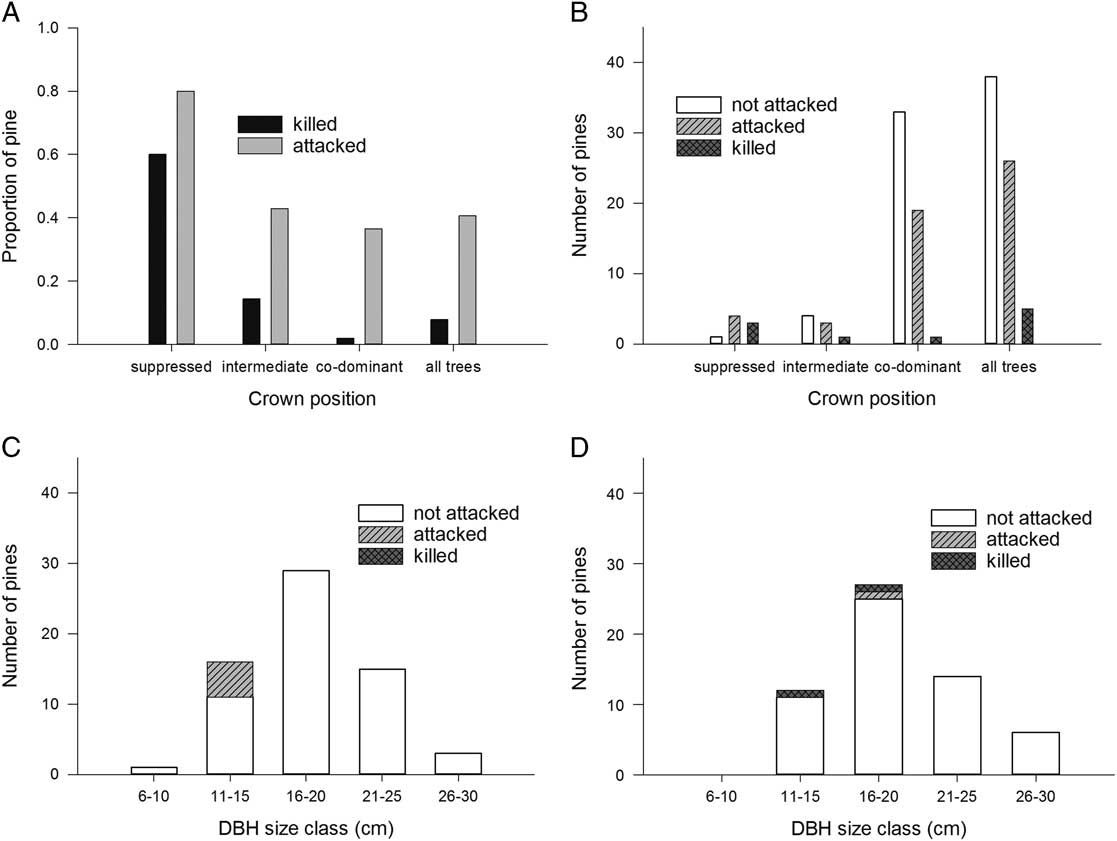
Sirex activity at Kendal. Proportion of pine alive in 2012 that was (A; all years) attacked (grey) and killed (black) by crown position; number of pines that were not attacked, attacked, and also killed by (B; all years) crown position; and size class in (C) 2012 and (D) 2016. The killed portion of bars in (C) and (D) represents trees that were both attacked and killed that year, and the attacked portion represents trees that were attacked but did not die that year, whereas in (A) and (B) trees that were attacked and killed are represented in both the attacked bar and the killed bar. DBH, diameter at breast height.
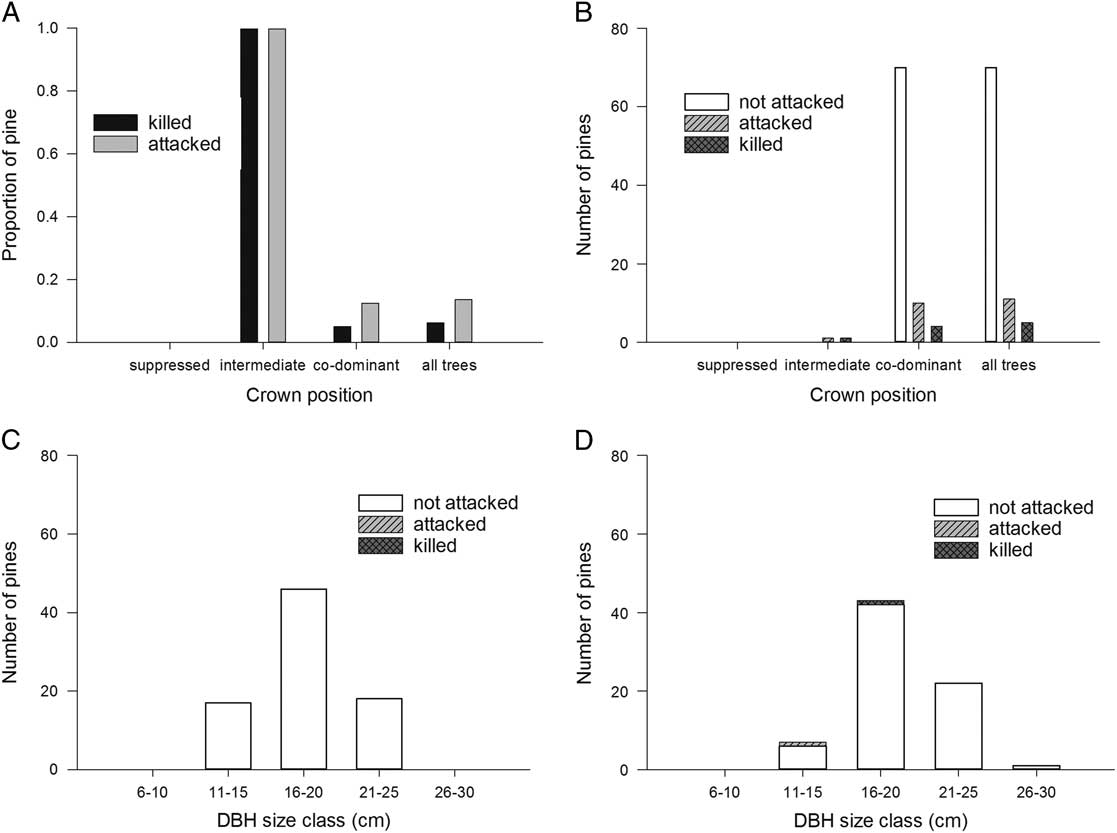
Sirex activity at Guelph. Proportion of pine alive in 2012 that was (A; all years) attacked (grey) and killed (black) by crown position; number of pines that were not attacked, attacked, and also killed by (B; all years) crown position; and size class in (C) 2012 and (D) 2016. The killed portion of bars in (C) and (D) represents trees that were both attacked and killed that year, and the attacked portion represents trees that were attacked but did not die that year, whereas in (A) and (B) trees that were attacked and killed are represented in both the attacked bar and the killed bar. DBH, diameter at breast height.
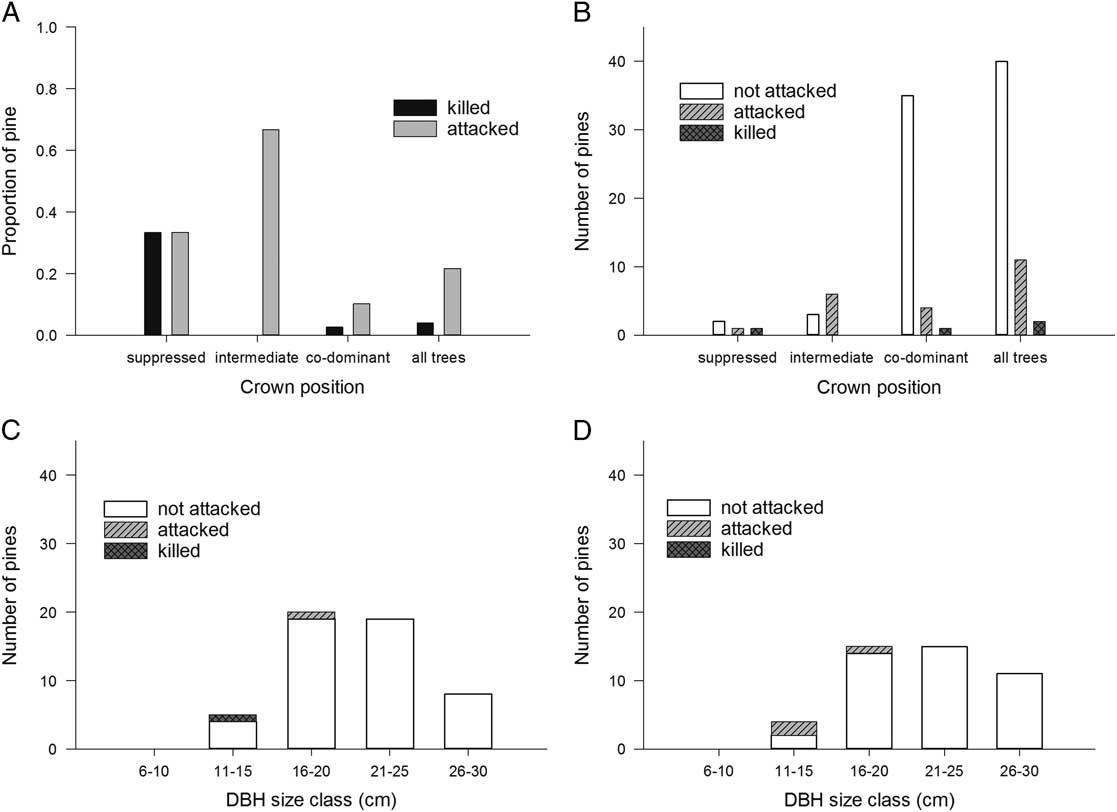
Sirex activity at Iron Bridge. Proportion of pine alive in 2012 that was (A; all years) attacked (grey) and killed (black) by crown position; number of pines that were not attacked, attacked, and also killed by (B; all years) crown position; and size class in (C) 2012 and (D) 2016. The killed portion of bars in (C) and (D) represents trees that were both attacked and killed that year, and the attacked portion represents trees that were attacked but did not die that year, whereas in (A) and (B) trees that were attacked and killed are represented in both the attacked bar and the killed bar. DBH, diameter at breast height.
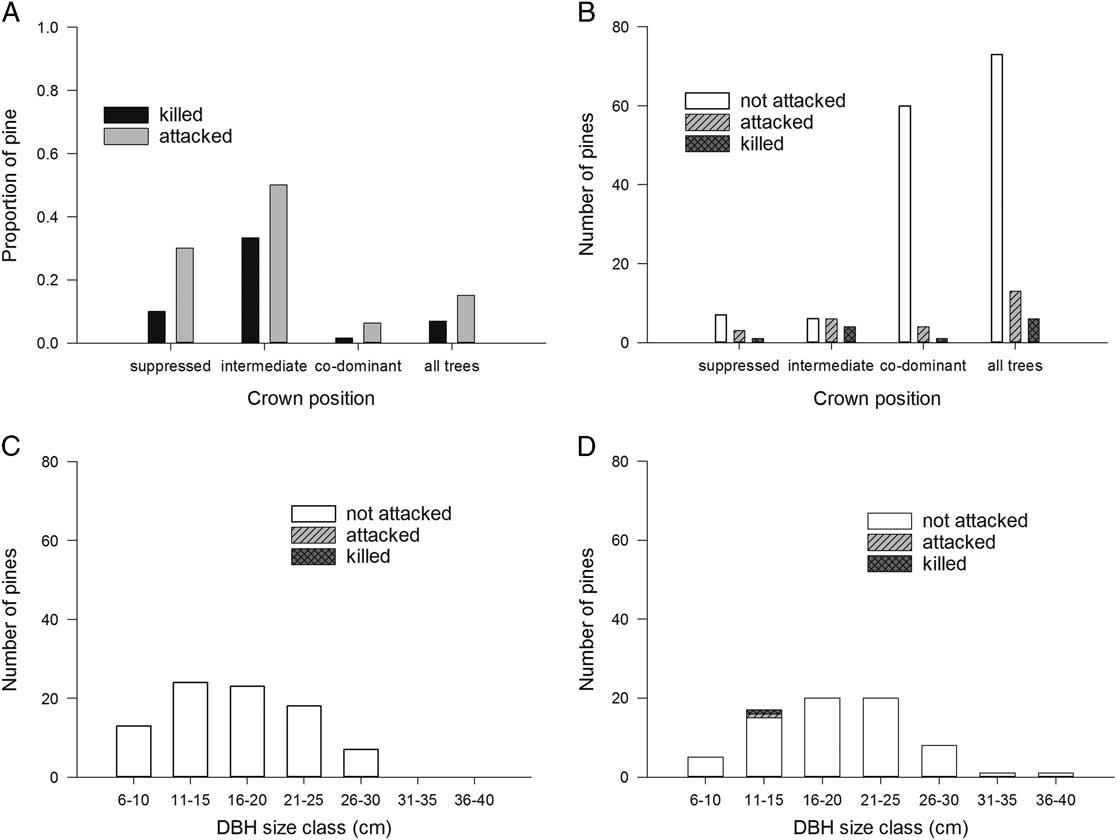
Sirex activity at Patton. Proportion of pine alive in 2012 that was (A; all years) attacked (grey) and killed (black) by crown position; number of pines that were not attacked, attacked, and also killed by (B; all years) crown position; and size class in (C) 2012 and (D) 2016. The killed portion of bars in (C) and (D) represents trees that were both attacked and killed that year, and the attacked portion represents trees that were attacked but did not die that year, whereas in (A) and (B) trees that were attacked and killed are represented in both the attacked bar and the killed bar. DBH, diameter at breast height.
Percentage of pine killed by Sirex in Ontario by site and year.
* Stand not surveyed in 2012.
Fate of attacked trees
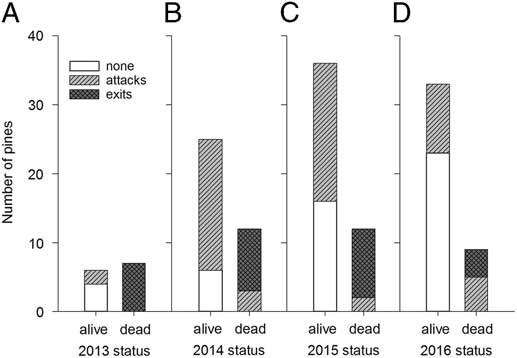
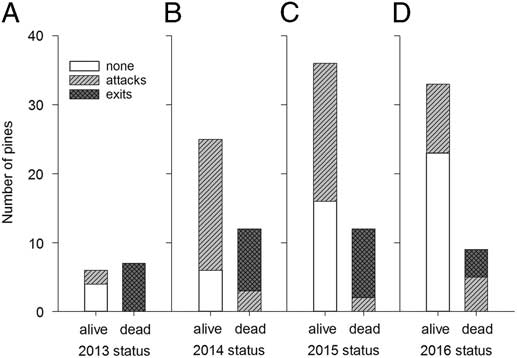
Only 17% (86) of trees surveyed during the five years of the study were affected by Sirex (attacked or attacked and killed). One-third (29) of trees attacked by Sirex died within the year following attack, which was synonymous with successful colonisation, i.e., brood (F1 generation) production as evidenced by exit holes (Table 4). Of trees that died within the year following attack, some did not produce Sirex brood and were re-attacked in the same year that they died (Fig. 10). These trees may have lived long enough after re-attack by Sirex to be colonised and killed by bark beetles (which either out-competed or co-existed with a two-year Sirex brood), or the initial Sirex brood did not survive and trees were successfully killed very quickly after re-attack (between cessation of adult flight in summer and our tree survey in fall). More trees (nine of 11) exhibited evidence of bark beetle attacks than of Sirex brood failure and rapid mortality after re-attack. In Ontario, Ips grandicollis (Eichhoff) typically attacks trees later in the season than S. noctilio (Ryan et al. Reference Ryan, de Groot and Smith2012b), and may be multivoltine. In addition, bark beetles are likely more aggressive colonisers of weakened pines than S. noctilio, given their ability to concentrate attacks through aggregation pheromones, and their fungal associates are known to out-compete Sirex fungal associates (Ryan et al. Reference Ryan, Moncalvo, de Groot and Smith2011; Yousuf et al. Reference Yousuf, Carnegie, Bashford, Bedding, Nicol and Gurr2014). Sirex noctilio can have a two-year and even three-year generation time (Morgan and Stewart Reference Morgan and Stewart1966), which can have major consequences for population growth if a large enough portion (25%) of the population has an extended generation time (Corley and Villacide Reference Corley and Villacide2012); however, it has been estimated that <5% of the S. noctilio population in Ontario requires two or more years to complete development (Ryan et al. Reference Ryan, de Groot, Nott, Drabble, Ochoa and Davis2012a).
Fate and infestation status of pines attacked by Sirex (A–D: 2012–2015) in the year following attack (2013 status–2016 status). Pines were either re-attacked (attacks), successful as hosts for the F1 generation (exits), or showed no further signs of Sirex infestation (none).
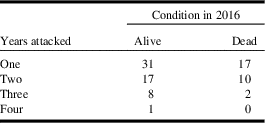
Among trees attacked by Sirex (all sites combined), number of years in which trees were attacked or re-attacked by Sirex.
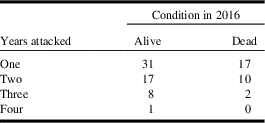
Depending on the year, between 46% and 79% of trees remained alive in the year immediately after Sirex attack (Fig. 10). No trees that remained alive in the year following Sirex attack successfully produced brood (i.e., an absence of exit holes), which provides evidence that pines in Ontario die before S. noctilio completes development. Others have reported that trees may remain alive, or only portions of the tree die, after successful S. noctilio colonisation (Morgan and Stewart Reference Morgan and Stewart1966), but this has rarely been observed in North America. Among trees that survived one year of Sirex attack, between 15% and 51% were re-attacked by Sirex the following year; the remaining survivors were not revisited by Sirex in the following year (Fig. 10). Of the trees attacked by Sirex that remained alive in 2016 (57), 46% of them had been attacked in multiple years (not necessarily in sequential years, though) (Table 4); 41% (12) of trees that died from Sirex infestation survived multiple years of attack before mortality (Table 4). In trees that were attacked multiple times, Sirex likely injected a toxic venom and its fungal partner, Amylostereum Boidin (Amylostereaceae) (A. areolatum (Chaillet ex Fries) Boidin or A. chialletii (Persoon) Boidin) (Gaut Reference Gaut1969; Wooding et al. Reference Wooding, Wingfield, Hurley, Garnas, de Groot and Slippers2013), which would weaken trees over time. This provides further evidence that many pines in North American forests are resistant to S. noctilio, at least when initially attacked, and especially if S. noctilio population levels remain low.
Conclusions
Several studies have investigated the effects of S. noctilio in pine stands in North America (Dodds et al. Reference Dodds, de Groot and Orwig2010; Ayres et al. Reference Ayres, Pena, Lombardo and Lombardero2014; Haavik et al. Reference Haavik, Dodds, Ryan and Allison2016). Those studies generally relied on one year of forest health survey information and the ability to track S. noctilio effects in stands for one or two years previous to sampling through tree damage. Our study is the first in North America that revisited susceptible and Sirex-infested stands for multiple years and tracked the survival of individual trees. Like other studies, our data suggest that in Ontario, S. noctilio has thus far largely been limited to suppressed or otherwise stressed pines; and in most areas, has not caused appreciable reductions in pine basal area. We found no evidence that S. noctilio has had a significant impact on general pine forest health after being present in Ontario forests for a decade or more.
As S. noctilio has demonstrated the capacity to outbreak and cause extensive economic damage on other continents, and it behaved more like a primary pest in some unmanaged pine forests in this study, temporal observations of its activity are important for describing its long-term threat to North American pine forests. Revisiting plots in these eight stands and following the fate of individual pines in future years will allow us to generate a dataset to evaluate whether or not S. noctilio will become a major pest in North America. We will be able to determine if S. noctilio populations can escape low, non-harmful levels on their own by building slowly over time, or if changing environmental conditions (increased frequency and intensity of droughts, increasing temperatures, longer growing seasons), or forest management strategies (thinning versus do nothing) will allow S. noctilio populations to reach damaging levels.
Acknowledgements
The authors thank Ronald Fournier for creation of Figure 1; Sarah Drabble, Reg Nott, and Nick Boyonoski for field and laboratory assistance; Al Foley for access to the Ontario Tree Seed Facility; and two anonymous reviewers for helpful comments on an earlier version of the manuscript. This work was funded in part by Natural Resources Canada, The Ontario Ministry of Natural Resources, and the United States Department of Agriculture Forest Service-Forest Health Protection.