I. INTRODUCTION
Gallium oxide (Ga2O3) is a wide band-gap (4.8 eV) n-type semiconductorReference Tippins1 and has a wide range of applications, such as transparent conducting electrodes,Reference Ohta, Nomura, Hiramatsu, Ueda, Kamiya, Hirano and Hosono2 phosphors,Reference Xie, Chen, Liu and Huang3 catalysts,Reference Nakagawa, Kajita, Ide, Okamura, Kato, Kasuya, Ikenaga, Kobayashi and Suzuki4 and gas sensors.Reference Schwebel, Fleischer and Meixner5–Reference Schwebel, Fleischer, Meixner and Kohl9 High chemical and thermal stability of Ga2O3 makes it suitable for a high-temperature gas sensor application.Reference Fleischer and Meixner7 At high temperatures (700–1000 °C), Ga2O3 was used to make oxygen sensors.Reference Schwebel, Fleischer and Meixner5, Reference Ogita, Hiro, Nakanishi and Hatanaka6 Ga2O3-based sensors have been used to detect the reducing gases such as H2 and CO in the intermediate temperatures (400–650 °C),Reference Fleischer and Meixner7–Reference Schwebel, Fleischer, Meixner and Kohl9 but the high working temperature still limits the widespread use of Ga2O3-based gas sensors.
One-dimensional (1D) nanostructures have been widely used for chemical gas sensors due to their large surface-area-to-volume ratio and size effects.Reference Kolmakov and Moskovits10, Reference Shen, Chen, Ryu and Zhou11 The nanostructured gas sensors showed the higher sensitivity and selectivity, faster response, and lower operating temperature.Reference Huang and Choi12, Reference Wang, Zhu, Yang, Xu and Yang13 This nanostructure approach has been applied to Ga2O3, and the low temperature gas sensing was successfully accomplished by fabricating the Ga2O3 nanowire sensors.Reference Feng, Xue, Liu, Wan and Wang14–Reference Arnold, Prokes, Perkins and Zaghloul16
Only a few studies have been reported for the conductivity control of Ga2O3 by doping.Reference Ueda, Hosono, Waseda and Kawazoe17, Reference Zhang, Xia, Deng, Xu, Shi, Wu and Xu18 SnO2 is an excellent candidate for doping material in terms of same n-type conductivity and similar ionic radius. A small amount of SnO2 incorporation into Ga2O3 is known to increase the electrical conductivity and improve the CO and CH4 gas sensitivity.Reference Suzuki, Ohira, Tanaka, Sugawara, Nakajima and Shishido19, Reference Frank, Fleischer, Meixner and Feltz20 Alternatively, Ga2O3–SnO2 heterostructure and Ga2O3-core/SnO2-shell coaxial 1D nanostructures were fabricated, and their optical properties were investigated.Reference Mazeina, Picard, Maximenko, Perkins, Glaser, Twigg, Freitas and Prokes21, Reference Jin, Kim, Baek, Kim and Lee22 The Ga2O3/SnO2 core–shell nanostructure is expected to improve the gas sensing performance similar to the previously reported other heterostructures,Reference Kim, Cho, Kim, Lee, Kang, Kim and Yoon23–Reference Hwang, Kim, Choi, Choi, Ji, Kim, Cao and Lee25 but the gas sensing properties of Ga2O3/SnO2 core–shell have not been reported yet.
In this study, Ga2O3/SnO2 core–shell nanowires were synthesized by combining the thermal evaporation and plasma-enhanced atomic layer deposition (PEALD). The nanowire network sensors were fabricated by directly depositing the nanowires on Pt electrode patterned SiO2/Si substrate. The thickness of SnO2 shell was controlled by the number of atomic layer deposition (ALD) cycles, and the gas sensing characteristics of network sensors with the shell thickness were investigated, particularly focusing on the ethanol detection.
II. EXPERIMENTAL PROCEDURES
A. Synthesis of Ga2O3 nanowires
β-Ga2O3 nanowires were synthesized by thermal evaporation via Au-catalyzed vapor–liquid–solid (VLS) growth. For this, 0.5 g gallium metal (99.99% metal basis, Aldrich, Milwaukee, WI) was put on an alumina boat, which was placed 5 cm upstream from the substrate in a quartz tube. The substrate was Au-coated SiO2/Si with interdigitated Pt electrodes. The quartz tube was inserted into a horizontal tube furnace and evacuated by a rotary pump to a pressure of 50 mTorr. The furnace was heated to 800 °C at a heating rate of 10 °C/min and maintained at that temperature for 2 h under a constant Ar gas flow of 300 sccm at a total pressure of 10 Torr. After deposition, the furnace was cooled to room temperature, and Ga2O3 nanowire-deposited substrate was removed from the tube furnace.
B. Synthesis of Ga2O3/SnO2 core–shell nanowires
SnO2 shell layer was deposited on as-synthesized Ga2O3 nanowires by PEALD (capacitively coupled plasma type). Dibutyltindiacetate (DBTDA) [(CH3CO2)2Sn [(CH2)3–CH3]2] was used as the Sn precursor instead of halide precursors such as SnCl4 and SnI4 to reduce the growth temperature and overcome the halide contamination.Reference Choi, Satyanarayana and Park26–Reference Park, Lee, Lee, Kim, Shin and Yoon28 DBTDA was evaporated at 40 °C and transported to the deposition chamber by Ar (99.99%) gas of 50 sccm. The O2 (99.99%) and Ar (99.99%) gases of 50 sccm were used as the plasma and purge gases, respectively. The time sequence for source pulse, first purge, plasma pulse, and second purge was 3, 12, 12, and 12 s, respectively. The deposition was conducted with a radio-frequency (rf) power of 100 W at 240 mTorr, and the substrate temperature during deposition was maintained at 100 °C. The thickness of SnO2 shell layer was controlled by the number of ALD cycles, e.g., 50, 100, and 300 cycles. The Ga2O3/SnO2 core–shell nanowires were annealed at 700 °C for 1 h to crystallize the SnO2.
C. Characterization
The phases of as-prepared Ga2O3 and Ga2O3/SnO2 nanowires were examined by x-ray diffraction (XRD, M18XHF-SRA, MAC Science Co., Yokohama, Japan). The morphology of nanowires was observed by field-emission scanning electron microscopy (FESEM, JSM-6330F, JEOL, Tokyo, Japan) and high-resolution transmission electron microscopy (HRTEM, JEM-3000F, JEOL, Tokyo, Japan).
For the gas sensing measurements, Au wires were attached to Pt electrodes using silver (Ag) paste. The sensor devices were placed in a quartz tube located inside an electrical tube furnace with a gas inlet and outlet. A continuous flow-through measurement system was used, and the sample gases used were ethanol (100–1000 ppm), H2 (1000 ppm), CO (1000 ppm), and NH3 (1000 ppm) balanced with air. The gas sensing properties were determined by measuring the changes in the electric resistance of nanowire network sensor between the sample gases and the reference gas at various operating temperatures ranging from 200 to 700 °C. The reference gas was pure dry air without humidity control. The magnitude of the gas response (S, sensitivity) was defined as a ratio of R air/R gas, i.e., the ratio of the electrical resistance in air (R air) to that in the sample gas (R gas).
III. RESULTS AND DISCUSSION
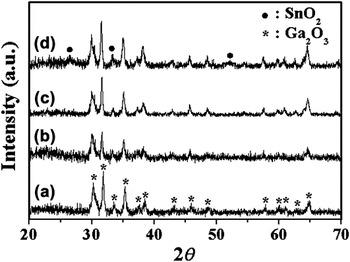
The XRD patterns of as-prepared nanowires are shown in Fig. 1. The pattern for the nanowires synthesized by thermal evaporation matches well with the standard pattern of β-Ga2O3 (JCPDS Card No. 41-1103) [Fig. 1(a)]. Thus, the crystalline Ga2O3 nanowires were successfully obtained on an Au-coated SiO2/Si substrate by thermal evaporation at 800 °C. As-coated Ga2O3 nanowires by PEALD did not show any diffraction peak of SnO2 except Ga2O3 peaks (not shown here) due to a noncrystalline nature of oxide coating resulting from the low substrate temperature of 100 °C. It was reported that the crystalline SnO2 could be realized at the substrate temperature of 200 °C by PEALD using DBTDA.Reference Choi, Satyanarayana and Park26 Thus, the Ga2O3/SnO2 core–shell nanowires were annealed at 700 °C to crystallize the SnO2. However, no distinctive diffraction peaks of SnO2 were observed in the patterns of 50- and 100-cycle-coated nanowires [Figs. 1(b) and 1(c)], possibly because SnO2 shell layers were too thin to be detected by XRD. When the ALD cycle increased to 300 cycles, the weak and broad diffraction peaks of SnO2 appeared along with those of Ga2O3 [Fig. 1(d)] confirming the presence of crystalline SnO2 in the SnO2-coated nanowires.
X-ray diffraction patterns of (a) as-synthesized Ga2O3 nanowire and annealed Ga2O3/SnO2 core–shell nanowires prepared with different ALD cycles: (b) 50, (c) 100, and (d) 300 cycles.

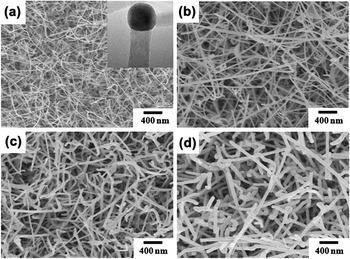
Figure 2(a) shows a typical FESEM image of Ga2O3 nanowires synthesized by thermal evaporation. The nanowires had a relatively uniform diameter of ∼20 nm, and the length was several micrometers long. The individual nanowires were randomly distributed and connected to form a self-supporting network. The presence of Au at the tip of nanowires indicated that Ga2O3 nanowires were grown by VLS mechanism [inset of Fig. 2(a)].Reference Wagner and Ellis29 The ALD process yielded the uniform and conformal SnO2 coating on the Ga2O3 nanowires, and the Ga2O3/SnO2 core–shell nanowires exhibited a uniform diameter with smooth surface. The diameter of the annealed Ga2O3/SnO2 nanowires increased with the number of ALD cycles [Figs. 2(b)–2(d)].
Field-emission scanning electron microscopy images of (a) as-synthesized Ga2O3 nanowire and annealed Ga2O3/SnO2 core–shell nanowires prepared with different ALD cycles: (b) 50, (c) 100, and (d) 300 cycles.

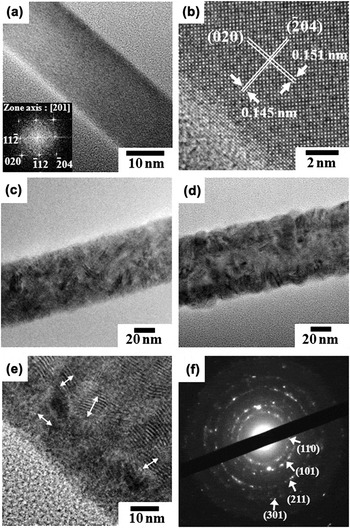
The nanowires were further investigated by transmission electron microscopy (TEM). Figure 3(a) shows a medium-magnification image of an individual Ga2O3 nanowire. It reveals a constant diameter and a straight, smooth surface. The fast-Fourier transformation (FFT) pattern of nanowire [inset of Fig. 3(a)] was completely indexed to β-Ga2O3, which was viewed along the [201] zone axis. High-resolution TEM images of Ga2O3 nanowires exhibited the clear lattice fringes without obvious defects [Fig. 3(b)]. The interplanar spacings were determined to be 0.151 and 0.145 nm, which correspond to the (020) and  planes of β-Ga2O3, respectively. Thus, the sidewall of nanowire was parallel to the (010) plane of Ga2O3. Similar structural characteristics have been reported in Ga2O3 nanoribbons grown by chemical vapor deposition.Reference Auer, Lugstein, Löffler, Hyun, Brezna, Bertagnolli and Pongratz30 Low-magnification TEM images of annealed Ga2O3/SnO2 core–shell nanowires are shown in Figs. 3(c) and 3(d). The Ga2O3 core and SnO2 shell were not well distinguished in 100-cycle-coated nanowires [Fig. 3(c)], but ∼15 nm thick shell layer was discernable in 300-cycle-coated nanowires [Fig. 3(d)]. The average growth rate of SnO2 shell was estimated to be ∼0.05 nm/cycle, and the shell thickness of 100-cycle-coated nanowires was expected to be ∼5 nm. High-resolution TEM image indicated that the SnO2 shell layer of 300-cycle-coated nanowire was indeed composed of interconnected nanoparticles of ∼5 nm [Fig. 3(e)]. The spots and rings in selected-area electron diffraction (SAED) pattern revealed the randomly oriented polycrystalline SnO2, and the patterns were completely indexed to the rutile SnO2 (JCPDS No. 41-1445) [Fig. 3(f)].
(a) Medium-magnification and (b) high-resolution transmission electron microscopy (TEM) images of as-synthesized Ga2O3 nanowires (inset in (a) is fast-Fourier transformation pattern of nanowire), (c) and (d) low-magnification TEM images of annealed 100- and 300-cycle-coated Ga2O3/SnO2 core–shell nanowires, respectively, (e) high-resolution TEM image, and (f) selected-area electron diffraction pattern of 300-cycle-coated core–shell nanowires.

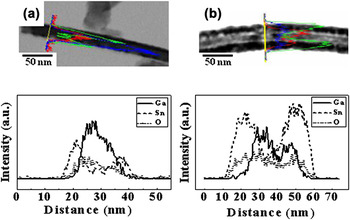
The distribution of elements in the annealed Ga2O3/SnO2 core–shell nanowires was assessed by the Energy dispersive x-ray spectroscopy (EDS) composition profile cross the nanowire (Fig. 4). The Ga-rich core and Sn-rich shell were obviously seen from the profile, but the boundary was not clearly distinguished probably due to the coaxial nanostructure. Sn has a low solubility in β-Ga2O3, and the solubility of Ga in SnO2 is also low.Reference Edwards and Mason31 Thus, there is little possibility to form an intermediate layer. The estimated SnO2 shell thickness was 4–5 and 12–15 nm for 100- and 300-cycle-coated nanowires, respectively.
EDS composition profiles cross the annealed Ga2O3/SnO2 core–shell nanowires with different ALD cycles: (a) 100 and (b) 300 cycles.

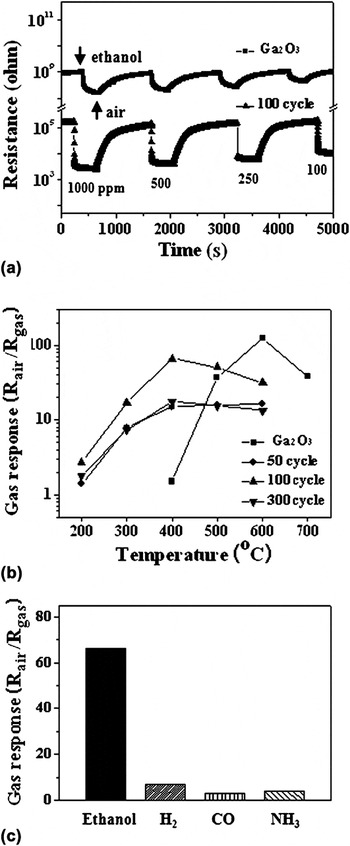
The typical response transients of Ga2O3 and Ga2O3/SnO2 nanowire network sensors toward ethanol balanced with air measured at 400 °C are shown in Fig. 5(a). Upon injecting a target gas, the resistance rapidly decreased by an order of magnitude. The recovery was slightly slow, but the sensing signal was quite stable, and the magnitude of the gas response (S) decreased almost linearly with decreasing ethanol concentration. The response transients showed that the resistance of Ga2O3/SnO2 core–shell nanowire sensors in air was ∼105 whereas the resistance of Ga2O3 nanowire sensor was ∼109. Thus, the resistance of Ga2O3/SnO2 nanowire sensor was orders of magnitude lower than that of Ga2O3 nanowire sensor, which can be attributed to the low resistance of SnO2 shell. The determined magnitude of gas response (S) toward 1000 ppm ethanol as a function of the sensing temperature is shown in Fig. 5(b). The Ga2O3 nanowire sensor exhibited the maximum gas response at 600 °C, but all the core–shell nanowire sensors showed the highest ethanol response at 400 °C. Thus, the optimum sensing temperature was reduced by ∼200 °C for the core–shell sensors.
(a) Response transients of Ga2O3 and 100-cycle-coated Ga2O3/SnO2 core–shell nanowire sensors toward ethanol at 400 °C, (b) temperature dependence of gas response toward 1000 ppm ethanol with different ALD cycles, and (c) gas responses toward ethanol, H2, CO, and NH3 in the 100-cycle-coated Ga2O3/SnO2 core–shell nanowires at 400 °C.

The maximum gas response toward ethanol in SnO2-based nanostructured gas sensors was commonly observed between 220 and 330 °C.Reference Maekawa, Tamaki, Miura and Yamazoe32–Reference Qi, Zhang, Liu, Zheng and Lu35 It indicated that the Ga2O3/SnO2 nanowire sensor exhibited the highest gas response in the intermediate working temperature (400 °C) between Ga2O3 and SnO2 single sensors. In addition, Ga2O3/SnO2 nanowire gas sensor showed the relatively constant gas response in the range of 400–600 °C. This wide range of working temperature is believed to be beneficial for the stable ethanol gas sensing. Among the core–shell nanowire sensors, 100-cycle-coated sensor had higher ethanol gas response in all the temperatures investigated. The observed gas response was comparable to that of the reported SnO2-based nanostructured gas sensors.Reference Maekawa, Tamaki, Miura and Yamazoe32–Reference Qi, Zhang, Liu, Zheng and Lu35 The SnO2 shell thickness of 100-cycle-coated nanowires was 4–5 nm, which was close to the Debye length of SnO2 (∼3 nm).Reference Ogawa, Nishikawa and Abe36 The higher gas response in the sensor of 100 ALD cycles is due to the complete electron depletion and fast effective gas diffusion through the shell.Reference Kim, Lee, Kim, Kim, Yu and Hong37
The Ga2O3/SnO2 core–shell nanowire sensors also responded toward H2, CO, and NH3 gases, and the magnitude of gas response toward 1000 ppm gases at 400 °C is shown in Fig. 5(c). The core–shell nanowire sensor showed a significantly higher gas response toward ethanol (S = 66) compared with the other gases (S =3–7). Thus, the Ga2O3/SnO2 core–shell nanowire sensors exhibited the higher gas response to ethanol against H2, CO, and NH3 gases. The observed gas response ratio (selectivity) was similar or higher than the reported values of SnO2-based nanostructured sensors.Reference Kim, Cho, Kim, Lee, Kang, Kim and Yoon23–Reference Hwang, Kim, Choi, Choi, Ji, Kim, Cao and Lee25, Reference Qi, Zhang, Liu, Zheng and Lu35, Reference Lee, Huang, Tan and Tse38–Reference Yu, Fan, Qi, Ma and Yan40 Currently, the higher gas response toward ethanol in SnO2-based sensors compared with other reducing gases is not well understood, but it has been attributed to the higher reactivity of ethanol in this temperature range and more electron generation when the same number of gas molecules react with the surface-adsorbed oxygen species.Reference Hieua, Kim, Ju and Lee41–Reference Ansari, Boroojerdian, Sainkar, Karekar, Aiyer and Kulkarni44
IV. CONCLUSION
Single-crystal Ga2O3 nanowires of ∼20 nm diameter were prepared by thermal evaporation via Au-catalyzed VLS growth. The polycrystalline SnO2 shell was uniformly coated on the Ga2O3 nanowires by PEALD, and the shell thickness was adjusted by the number of ALD cycles. The Ga2O3/SnO2 core–shell nanowire network sensors responded toward ethanol gas and reduced the optimum operating temperature by ∼200 °C. The thickness of SnO2 shell strongly affected the gas response, and the highest magnitude of gas response was observed in the 100-cycle-coated nanowire sensor whose shell thickness was close to the Debye length. In addition, the Ga2O3/SnO2 nanowire sensors showed a stable gas sensing in a wide range of working temperature.
ACKNOWLEDGMENT
This work was supported by the National Research Foundation of Korea (NRF) grant funded by the Korean government (MEST) (No. 2011-0000147).