1. Introduction
In the second half of the 18th century, an irreversible change in society, a verifiable economic and social shock, took place, particularly in certain parts of Europe. Age-old trends in the key economic variables (output, population, and GDP per capita) took a definitive turn and became the initial process of precursory modern economic growth (Kuznets, Reference Kuznets1973).
One of the challenges that persist in both history and economic theory is to better understand why modern economic growth started. Among historians, the main factors proposed have been technology and innovation (Mokyr, Reference Mokyr1990, 2002; Rosenberg and Birdzell, Reference Rosenberg and Birdzell1986), the importance of bourgeois culture (McCloskey, Reference McCloskey2006, 2010), the process of industrialization in the pioneering countries (Landes, Reference Landes1969, 1990), the allocation of appropriate resources to start systematic growth (Pomeranz, Reference Pomeranz2000), or the process of regression to the mean of the ruling class with clear genetic connotations (Clark, Reference Clark2007). Among growth theory, the main contributions to explain the start of modern economic growth have been the accumulation of capital (Domar, Reference Domar1948; Harrod, Reference Harrod1939), the contribution of human capital (Lucas, Reference Lucas2004), technological change and innovation, whether external (Solow, Reference Solow1956; Swan, Reference Swan1956) or internal (Romer, Reference Romer1990), geographic and climatic factors (Engerman and Sokolof, Reference Engerman, Sokolof and Haber1997), openness (Sachs and Warner, Reference Sachs and Warner1995), changes in fertility decisions (Galor and Moav, Reference Galor and Moav2001; Galor and Weil, Reference Galor and Weil2000), and institutional factors (Acemoglu and Johnson, Reference Acemoglu and Johnson2005; Acemoglu et al., Reference Acemoglu, Johnson and Robinson2002; De Haan, Reference De Haan2007; Greif, Reference Greif2004; North, Reference North1990; Rodrik et al., Reference Rodrik, Subramanian and Trebbi2002).Footnote 1
Focusing on institutional factors, there is much literature on the relationship between economic freedom and growth (Cole, Reference Cole2003; Compton et al., Reference Compton, Giedeman and Hoover2011; De Haan and Sturm, Reference De Haan and Sturm2000; Faria and Montesinos, Reference Faria and Montesinos2009; Justesen, Reference Justesen2008, among others). There are also numerous contributions to the study of the association between democracy, or the lack thereof, and economic growth (Acemoglu et al., Reference Acemoglu, Johnson, Robinson and Yared2008, 2009; Aghion et al., Reference Aghion, Alesina and Trebbi2007; Barro, Reference Barro1996; Gundlach and Paldam, Reference Gundlach and Paldam2009; Heid et al., Reference Heid, Langer and Larch2012; Persson and Tabellini, Reference Persson and Tabellini2006; Przeworski and Limongi, Reference Przeworski and Limongi1993; Rodrik and Wacziarg, Reference Rodrik and Wacziarg2005; Xu and Li, Reference Xu and Li2008). In this last relation, the key point of the actual academic debate is the direction of causality. Gundlach and Paldam (Reference Gundlach and Paldam2009), among others, find support for the Democratic Transition hypothesis, i.e., more income is a contributing factor that leads to democracy. This view is in contrast with Acemoglu et al. (Reference Acemoglu, Johnson, Robinson and Yared2008), who support the Critical Junctures hypothesis, i.e., democracy causes economic growth.
This paper focuses neither on the causality between economic freedom and growth nor in the relationship between democracy and growth, as the mentioned authors do. We differ from that literature by focusing on the long-run association between civil liberty and growth. Since very little work has appeared on this last relation (Aixalá and Fabro, Reference Aixalá and Fabro2009; Benyishay and Betancourt, Reference Benyishay and Betancourt2010; Kormendi and Meguire, Reference Kormendi and Meguire1985) and even less in the long run, this paper contributes to the literature on the association between institutional factors and growth by focusing on the long-run association, from 1850 to 2010, between civil liberty and economic growth.Footnote 2 For this purpose, we use data on civil liberty from Polity IV (2012) and data on GDP per capita from the Maddison Project (Bolt and van Zanden, Reference Bolt and van Zanden2013; Maddison, Reference Maddison2010). We merge both databases and obtain an unbalanced panel of 149 countries for the period 1850 to 2010.Footnote 3
The hypothesis we investigate in this paper is that higher levels of civil liberties are associated with higher economic growth rates and the loss of civil liberties discourages economic growth. According to the findings of this paper, the emergence and consolidation of individual and collective civil liberties, in the form of a public good, generated the basic institutions of the capitalist system and were an important factor for change in economic growth rates.
The rest of the paper is organized as follows. Section 2 illustrates the evolution of the economic and civil liberty variables up to and after the 18th century and justifies the indicator we use to measure civil liberties. In Section 3, the events that may have triggered historical change are suggested and a proposal is put forth as to how civil liberty may be a potential determining factor in economic growth. In Section 4, we use a panel data model to explore the dynamics of civil liberty and economic growth and the relationship between them. A positive and statistically significant association between these two variables is found. We also offer a battery of sensitivity checks that confirm the robustness of our results to different specifications and estimation strategies. Section 5 offers several conclusions.
2. The facts and the definition of civil liberty
Before the 18th century, the world lived in Malthusian equilibrium (Ashraf and Galor, Reference Ashraf and Galor2011). Any output growth led to a corresponding population increase that stifled any positive result in the GDP per capita, thus maintaining well-being at a subsistence level (Galor and Moav, Reference Galor and Moav2001). The 18th century is the beginning of what the literature refers to as ‘modern economic growth’, during which the Malthusian trap began its decline, and in some areas broke down altogether (Kuznets, Reference Kuznets1973).
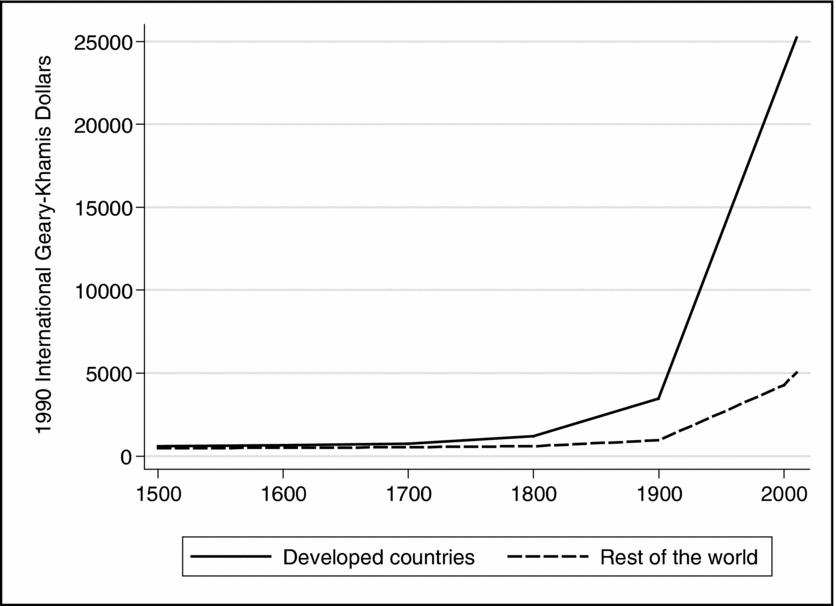
From then on, in some countries of the world, output grew more than the population, thus increasing the output per person, i.e., the well-being of the population. The beginning of economic growth radically broke with the past due to the potential implication of the entire population in those countries, not just a small part of it. From the 18th century on, increases in output were not only greater, but the appropriation of the surplus began to be shared by a larger proportion of the population, breaking with the inertia of the past (Allen, Reference Allen2009; Crafts, Reference Crafts1985). There is academic consensus on the rupture of the Malthusian trap at this time, as well as on the appearance of the divergence in GDP per capita across certain areas of the world (Pritchett, Reference Pritchett1997). Moreover, the Malthusian rupture took place only in specific locations, and in many countries, signs of rupture did not appear until a century later. Figure 1 shows the appearance and subsequent increase in the divergence between blocs. Some ‘developed countries’ clearly diverge in GDP per capita from the ‘rest of the world’.Footnote 4Figure 1 shows that even though divergence is perceptible at the end of the 18th century, increases in divergence are consolidated over the 19th century and especially the 20th century. The great divergence is an irrefutable and proven fact. This paper defends that increases in economic growth were associated with greater levels of civil liberties.
GDP per capita, 1500–2010. Note: Authors’ computation from Bolt and van Zanden (Reference Bolt and van Zanden2013) datasets.

Civil liberty, as liberty itself, is a complex concept that is difficult to define. Built on Berlin's conceptual work (Berlin, Reference Berlin1958), liberty could be divided in two components: negative and positive liberty. Berlin's seminal article designated civil liberties (or civil rights) as ‘negative liberty’ in which it refers to the prerogative of a human being to not have their field of action invaded. Civil liberty is the individual right to make decisions within a given vital space without interference. It defines the limits between the state and the individual and, within those limits, guarantees the right for human beings to not have their freedom of action restrained. Along with this concept, Berlin (Reference Berlin1958) also defined ‘positive liberty’ as the right of each individual to choose their representative in a democratic society or to run for election to any public post in the community. These are the political rights every human being should possess, above and beyond social class, religion or ethnicity, and therefore these rights should be respected and protected by society and their representatives.
This paper focuses on the negative side of Berlin's liberty definition. Still on this side, there are various concepts that, although related, are not equivalent. These concepts are economic freedom and civil liberty; both concepts lie in the sphere of human rights but measure different things. Economic freedom is the individual right people have to choose for themselves and engage in voluntary transactions as long as they do not harm the person or property of others. Following Gwartney et al. (Reference Gwartney, Lawson and Hall2012), economic freedom is freedom of personal choice, freedom of exchange, freedom to compete, and the protection of persons and private property rights. Therefore, the primary role of government in protecting economic freedom is to take care of individuals and their property from aggression by others.Footnote 5
Regarding civil liberty, it must be noted that this is a much broader concept than economic freedom. It includes the previous economic freedom components but also includes freedom of expression, belief, and association. Following Kaufmann (Reference Kaufmann, Alston and Robinson2005), there are two types of human rights: first-generation or traditional human rights, such as life, voice and participation, religion; and second-generation human rights, such as economic and social freedoms. Civil liberty encompasses both sets of human rights, while economic freedom only refers to the second generation.
Since civil liberty and economic freedom are different concepts, the indicators used in the literature to measure them are also different. The Gastil index from Freedom House measures civil liberty using four categories: (D) freedom of expression and belief, (E) associational and organizational rights, (F) rule of law, and (G) personal autonomy and individual rights (Freedom House, 2013). Economic Freedom of the World (EFW) index (Gwartney et al., Reference Gwartney, Lawson and Hall2012) does not consider subcategories D and E. Also, the rule of law category of the Gastil index to measure civil liberty is much broader than the legal system category used by EFW. The reason is that the role of government is not only to protect individuals and their properties but also to protect life itself.
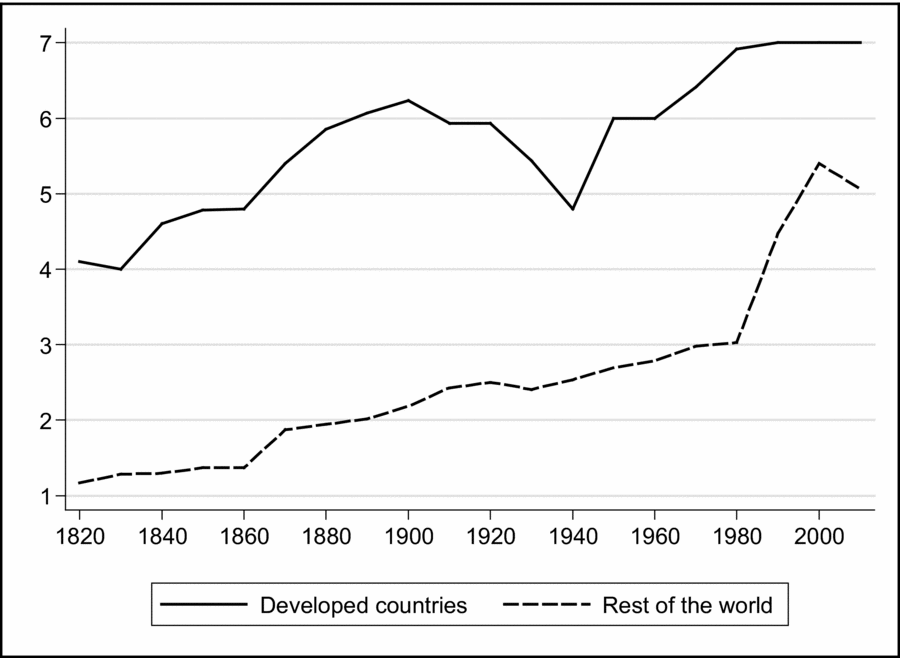
As this paper analyzes the association between civil liberties and growth focusing in the long run, we use data on civil liberty from Polity IV. More specifically, we use the variable XCONST (Constraints on the Executive) since it is the closest indicator to the concept of civil liberties we are interested in. XCONST is defined as the limits established by the authority in each country to keep this authority from violating the vital space belonging to each human being (Polity IV, 2012). Thus, these executive power constraints implicitly pick up the extent to which human beings do not have their liberty of action restrained (Berlin, Reference Berlin1958). The variable XCONST is a score that takes integer values between 1 and 7, where 1 is the absolute lack of civil liberty and 7 is the highest liberty level. Using data from Polity IV, Figure 2 shows the evolution of this liberty indicator throughout time in developed countries and the rest of the world.Footnote 6
Civil liberty (XCONST), 1820–2010. Note: Authors’ computation from Polity IV (2012) datasets.
Figures 1 and 2 show the parallelism, from the 19th century, between the rise of individual civil liberties in developed countries and the economic growth in those countries, and consequently, the increase in inequality between blocks. Also, from the last decades of the 20th century, the extraordinary growth in GDP per capita in the countries in rest of the world coincide with an important rise in their individual freedoms, even more if we consider the extraordinary increase of the population in these countries.
All of the above points to the existence of an association between the appearance and consolidation of civil liberties and the beginning and later consolidation of economic growth and development.
3. Civil liberty as a factor of change: a theoretical approach
According to De Long and Shleifer (Reference De Long and Shleifer1993), freedom that drives individual options is reflected in prosperity increases.Footnote 7 Those societies more inclined to allow their citizens individual freedom of action within the framework of established norms and more open to anonymous and impersonal migratory flows were the most apt to prosper. From the start of the 18th century, significant freedom of action began to take shape in Europe. Migratory flows were found within different territories through individuals participating in business, arms, law, or religion (Gat, Reference Gat2006; Geary, Reference Geary2002). These geographical flows allowed the movement of new ideas to be contrasted and evaluated and, eventually, to choose the best ones and transmit them to their respective geographical areas or societies. In this horizontal dynamic process, some societies were more permeable to new ideas, which in time became a comparative advantage. Most importantly, a general characteristic of ideas is that they can be encapsulated in institutions, rules, or norms, needed to create a specific product, conduct public affairs, or enact the law (North and Weingast, Reference North and Weingast1989; North et al., Reference North, Wallis and Weingast2006, 2009). Moreover, during the competition among ideas, some are selected over the others for implementation. But, more importantly, the implementation of the resulting ‘winning institution’ inevitably brings with it the disruption, and eventual substitution, of the old system (North, Reference North1990).
The process involved in becoming a society that accepts new ideas is slow, arduous, and plagued with ups and downs. This is due to the fact that throughout much of history, institutions controlled by elites have systematically limited the options of the majority of the population, depriving them of the minimum space needed to exert their liberty or exploit their ideas in a social setting (Acemoglu and Robinson, Reference Acemoglu and Robinson2012).
Eventually all these horizontal movements will inevitably create vertical mobility. That is witnessing the initial steps toward social mobility in societies. In the receiving society this is observed in the social displacement of those individuals who benefit from the status quo but are now, after struggling to maintain their position, forced to look for new employments in which to apply their know-how. Their new economic and social position could result in a better or worse situation after adjustment.
Europe contributed to this mobility and was unintentionally destined to participate in the rupture of the Malthusian equilibrium. This would not have been possible without the basic ingredient of civil liberty as a public non-exclusive good. The territories, regions, or countries most inclined toward liberty are those that eventually have a greater accumulation of ideas. The most important aspect of this process is that the accumulation of ideas, whether they are created or acquired, will generate increasing returns for society (Romer, Reference Romer1990). Ideas originated by individuals in a specific area or country are to be added to all those originating in the rest of the countries.
Nevertheless, ideas are not always diffused. In these cases, the resistance to ideas will bring about losses in productivity in those territories that limit the reception of new ideas. Individuals and organizations will try to stop the incorporation of new designs that are against their political or social position even though this would be better for the whole. Those retaining political and economic power will attempt to decide which ideas are worth being assimilated and which are not, in relation to their own interests and control over the executive branch. The restriction of initiative is found everywhere, even in developed countries, but differences in the range of possibilities for taking action in developed countries and the rest of the world are vast (Parente and Prescott, Reference Parente and Prescott2000; World Bank, 2013).
For example, let us suppose that prior to the Malthusian rupture, there were 30 European territories. Suppose each one could generate an idea. With mobility and competition, the final result would be a combination of 30 ideas within the reach of all the territories, whereas in complete autarky, each territory could only take advantage, at the most, of its own idea. If all ideas could flow freely between the territories, the global result for citizens would be a multiple growing in geometric progression for the good of society. This is the true motor of well-being and is potentially at the service of all societies, although conditioned by the institutional restrictions.
Between the maximum – the free flow of ideas – and the minimum – total autarky – there is a vast difference in the potential for social, political, and economic development among countries.
Even though the tendency to accept foreign ideas was already apparent since the renaissance, the process was not uniform in Europe. It was in England and the Netherlands where these strengths caught on earlier, generating a more favorable social climate in which to create, collect, and implement ideas, than in the rest of Europe (North and Weingast, Reference North and Weingast1989). In these territories, individuals were able to act to transform new ideas into new institutions with greater degrees of relative liberty, and were consequently able to achieve social change and increased well-being (North, Reference North1981; North et al., Reference North, Wallis and Weingast2006, 2009). Later on, the proclamation of civil liberty was made in France with universal consequences at the end of the 18th century.
4. Empirical analysis
The dataset used in this paper to analyze the relationship between civil liberty and economic growth is the result of the combination of two different databases: data from the Maddison Project (Bolt and van Zanden, Reference Bolt and van Zanden2013; Maddison, Reference Maddison2010) and data from Polity IV (2012). The Maddison database provides data on GDP and population in the world economy between 1 AD and the present. The Polity IV database provides data on the characteristics of the political authorities of each country in the world since 1800.
The records in both databases have been matched according to country and year. After excluding some records that could not be matched, our final dataset is an unbalanced panel of 149 countries for the period 1850–2010.Footnote 8
To provide a measure of liberty, the academic literature has traditionally used the following data sources: Fraser Institute, Heritage Foundation, Freedom House, and Polity IV. Since we gather data on civil liberty from a long time period (1850–2010), we use the variable XCONST from Polity IV, as we have already mentioned.
There are other works in the literature that use this liberty variable. Benyishai and Betancourt (Reference Benyishay and Betancourt2010) use XCONST as well as some other alternative measures of civil liberties to explain their impact on economic development. The measure that performs best in their specifications is Personal Autonomy and Individual Rights, one of the subcategories of the Gastil Index of Civil Liberties from Freedom House. Their second best measure in terms of statistical significance is XCONST from Polity IV. For the time span we consider, XCONST is the best available proxy for the concept of civil liberty we focus on.
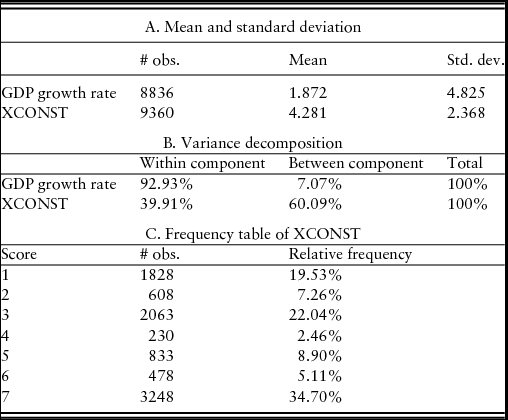
As it has been mentioned, the score XCONST takes integer values ranging from 1 (absolute lack of civil liberty) to 7 (the highest liberty level). Table 1 offers basic statistical information on our main variables of interest: GDP growth and XCONST. In Panel A we show the mean and standard deviations. Panel B reports a variance decomposition of both variables into within and between components. The within component refers to the time variability within each country, while the between component captures the variability across countries. Both components are orthogonal by construction. Thus, the total variance is the sum of the variance of each component. As it is shown, most of the variability of the GDP growth rate, around 93%, comes from the within component.Footnote 9 In the case of the civil liberty score XCONST, the between component is more important, accounting around 60% of the total variance. In Panel C we report a frequency table for the variable XCONST. We can see that more than 75% of the observations correspond to only three values: 1 (the lowest level of civil liberty), 3 (a medium level), and 7 (the highest level). The rest of the values are reported with a much lower frequency.
Descriptive statistics
GDP, gross domestic product; Obs., observations; Std. dev., standard deviation; XCONST, Constraints on the Executive.
The model
In order to see the relationship between civil liberty and economic growth, a dynamic panel data model is estimated. Our dependent variable is the real GDP growth rate, and the explanatory variables are related to the civil liberty score over the time span 1850–2010. There are, of course, other variables besides civil liberty that can be relevant to explain economic growth, such as human capital, fixed capital investment, technology, openness, and many others. However, for the majority of the countries in the sample, these variables are not available for the time period considered. As we will explain below, we correct the potential omitted variable bias.
Taking into account the very low frequencies observed for some values of XCONST (see Table 1, Panel C), the seven values of this score have been grouped into three categories: low liberty (corresponding to values 1 and 2 of XCONST), high liberty (corresponding to values 6 and 7), and medium liberty (corresponding to XCONST values 3 to 5). As will be explained later (in the ‘Sensitivity analysis’ subsection), alternative categories have also been considered as a robustness check.
It is worth noting that including the civil liberty variable through a set of dummy indicators allows us to capture non-linearities in the relationship between economic growth and civil liberty. Barro (Reference Barro1996), in a related paper that focuses on growth and democracy, also considers a possible non-linear relationship between these two concepts.
Let us consider the following econometric model:
 \begin{equation}
\Delta \ln (GDP)_{it} = \alpha _0 + \alpha _1 MedCL_{it} + \alpha _2 HighCL_{it} + \lambda _t + \eta _i + u_{it} ,\end{equation}
where the subindex i refers to the countries (i = 1, . . ., N) and the subindex t represents time, measured in years (t = 1, . . ., T). The economic growth rate, measured by the log first-difference of real GDP per capita, is represented by Δln(GDP)it for country i at time t. Concerning liberty, MedCLit is a binary indicator that takes the value 1 if country i is in the medium level of civil liberty at time t, and 0 otherwise. HighCLit is a binary indicator taking the value 1 if country i reports high civil liberty level at time t, and 0 otherwise. The low level of civil liberty (LowCLit) is considered the reference category and thus, it is not included in the model.
We allow for the presence of country effects, denoted by ηi, that capture the unobservable time-invariant country heterogeneity. We consider that they are ‘fixed’ effects, i.e., we assume that they are correlated with the explanatory variables.Footnote 10 We also consider in the model the presence of time effects, denoted by λt, that represent aggregate shocks that affect all countries, and that will be included in the model by a set of year dummies. The error term uit represents idiosyncratic shocks that have both time and country variability.
The specification (1) explains the economic growth rate for country i at period t in terms of the contemporaneous civil liberty indicators and the country and time effects. However, it is reasonable to think that the past economic growth rate, as well as the past liberty level, is also relevant to explain the economic growth rate at the period t. Thus, we consider a dynamic model that incorporates as explanatory variables the lagged economic growth rate Δln(GDP)i, t − 1 and the lagged liberty indicators MedCL i, t − 1 and HighCL i, t − 1. Again, at period t − 1, the lowest liberty level LowCL i, t − 1 is the reference category. How many lags of growth and liberty should be included in the model? We try different specifications and test whether the residuals from the estimation pass the test of no autocorrelation. If the specification fails the test, this provides evidence that the model has not captured all the autocorrelation structure, and thus, more lags are needed. We will go back to this discussion when presenting the estimation results in the next subsection.
Our panel dataset is characterized by a large number of periods and non-stationarity can be present. Two types of unit root tests on the economic growth rate have been performed, both accounting for the panel structure of the data. The first test, proposed by Levin et al. (Reference Levin, Lin and Chu2002), assumes that there is a common autoregressive structure for all the countries. The second test, proposed by Im et al. (Reference Im, Pesaran and Shin2003), overcomes this assumption, thus allowing for varying autoregressive coefficients across countries. Both tests consider as null hypothesis the presence of unit roots, i.e., non-stationarity.Footnote 11 In our data, the results from both the Levin-Lin-Chu (LLC) test and the Im-Pesaran-Shin (IPS) test lead to reject the null hypothesis of a unit root in the economic growth rate. The statistic for the LLC test is −27.17 (p-value: 0.000) and the statistic for the IPS test is −37.27 (p-value: 0.000). Thus, based on this evidence, we can conclude that economic growth rate is a stationary variable.
Regarding the estimation strategy, we will obtain the fixed effects (FE hereafter) estimator. This estimator is based on the within-groups transformation, which can briefly be explained as follows. Since the time-invariant country effects ηi in equation (1) are assumed to be correlated with the explanatory variables, the ordinary least squares (OLS) estimation of equation (1), treating the unobservable ηi as part of the error term, would lead to inconsistent estimates, since the composite error term would be correlated with the regressors. The within-groups transformation considers the equation (1) in deviations with respect to the country means for each variable. Since the country effects ηi are time-invariant, this transformation allows to get rid of them. The OLS estimator in the within-groups transformation is the FE estimator. Baltagi (Reference Baltagi2008) offers an excellent survey on panel data models and the econometric issues involved.
In principle, the FE estimator is biased and inconsistent in dynamic panel data models, i.e., in models that include as explanatory variables some lags of the dependent variable. In our case, it is plausible, as has been explained, that the lagged economic growth rate significantly affects the current growth, thus leading to a dynamic model. Nevertheless, it is worth noting that although the bias of the FE estimator in dynamic models can be important in panels with few temporary observations (small T), it tends toward zero for relatively large panels. In the panel dataset used in this paper, the large number of time periods allows us to neglect this potential bias. For details on the consistency of the FE estimator in dynamic panel data models with large T, see, for example, Wooldridge (Reference Wooldridge2002), Alvarez and Arellano (Reference Alvarez and Arellano2003), or Baltagi (Reference Baltagi2008).
Another econometric issue that can be important in our analysis is the potential endogeneity of the regressors. There can be some sources of endogeneity, such as potential simultaneous correlation between contemporaneous economic growth and liberty, or omitted variables bias. One must use caution when dealing with this issue. As pointed out earlier, variables that could be relevant in explaining economic growth (physical capital, human capital, technology, openness, etc.) are not available for the time period considered, 1850–2010. Most of the literature focusing on the relationship between economic growth and some measures of liberty in a variety of contexts (civil liberty, democracy, economic freedom) has used more recent periods, mainly focusing in the last decades of the 20th century (see Acemoglu et al., Reference Acemoglu, Johnson, Robinson and Yared2009; Aixalá and Fabro, Reference Aixalá and Fabro2009; Faria and Montesinos, Reference Faria and Montesinos2009; or Benyishai and Betancourt, Reference Benyishay and Betancourt2010; Xu and Li, Reference Xu and Li2008, among others). In our long-run context, it is difficult to find either additional variables to include in the model or external instruments to account for endogenous regressors. However, one advantage of panel data is that we can use information within the model. Thus, we have handled with endogeneity issues by performing instrumental variables estimation, taking as instruments some transformation of the explanatory variables, as we explain in the next section.
Estimation results
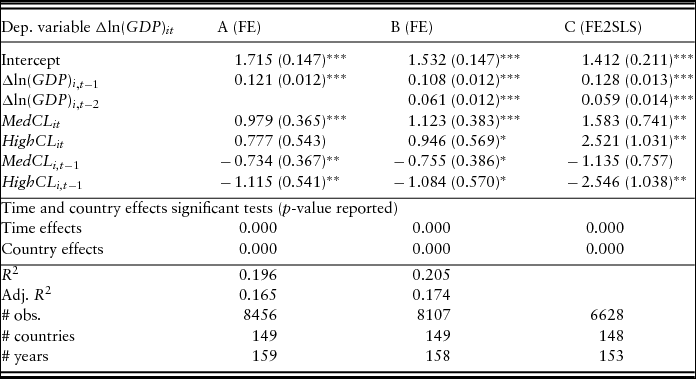
Table 2 displays the estimation results for different specifications. In all columns, a FE model is assumed, that accounts for time (yearly) effects and individual (country) effects. Columns A and B report the FE estimates for models that do not account for potential endogeneity, while column C offers a fixed effect two-stage least squares (FE2SLS hereafter) estimation based on a set of instruments.
Panel data estimation results
Adj., adjusted; Dep., dependent; FE, fixed effects; GDP, gross domestic product; FE2SLS, fixed effect two-stage least squares; Obs., observations.
Notes: The reference category for the civil liberty indicators at t and t−1 is ‘low level’.
Standard errors in parenthesis. *, **, ***: significant at 10%, 5% and 1%, respectively.
The standard errors in all the estimated models are based on a variance-covariance matrix that corrects for both period heteroskedasticity and correlation of observations within countries.
For all models, we test whether the time and country effects are significant or not by performing two different tests: (1) on the significance of the time effects and (2) on the significance of the country effects. In both cases, the null hypothesis is that these effects are not significant. As shown in the middle panel of Table 2, this hypothesis is clearly rejected (p-value: 0.000), which allows us to conclude that an estimation that does not consider time and country effects would lead to biased and inconsistent estimates.
We offer, for the estimations in columns A and B, the R 2 coefficient. It is quite low, but in line with other works in the related literature. See, for example, Benyishai and Betancourt (Reference Benyishay and Betancourt2010) or Compton et al. (Reference Compton, Giedeman and Hoover2011).Footnote 12
Column A offers the estimation results of a model that includes as explanatory variables the first lag of the economic growth rate and the contemporaneous and one-lagged civil liberty indicators. We find that, as expected, the growth rate in t − 1 has a positive and significant effect on the growth rate in period t. Civil liberty indicators are also significant to explain growth rate. Positive coefficients are found for the level indicators and negative coefficients for the lagged indicators. This result, also found for the alternative specifications we estimate, will be explained below. When analyzing the residuals from this estimated model, we show evidence of autocorrelation, which suggests that this model fails to capture all the serial correlation in the data, and it is therefore necessary to include more lags. To solve this problem, we considered different models: (1) a model that includes second lags of both growth rate and liberty and (2) a model that considers one additional lag for both variables, i.e., the third lag. From the estimation of these models, we found that the third lag of the growth rate, as well as the second and third lags of the liberty indicators, was not significant.Footnote 13
Based on this evidence, we considered a model that includes two lags of the growth rate and one lag of the civil liberty indicators. The estimation results are reported in column B. The first and second lags of the growth rate have a positive and significant effect, which suggests the growth rate inertia that has been extensively noted in the literature in many different contexts. Focusing on pooled data from a group of countries, see, for example, García-Ferrer et al. (Reference García-Ferrer, Highfield, Palm and Zellner1987). As for the civil liberty indicators, it can be seen that the levels and first lags are significant and show the same signs as in the model in column A. The country and time effects are found to be significant. The residuals from this model do not show evidence of autocorrelation.
As mentioned above, we are concerned about the potential endogeneity of the variables included in the model, for example, due to omitted variables bias or the potential simultaneity between the contemporaneous growth rate and civil liberty, which would cause the FE estimators in column B to be biased and inconsistent. In our large T context, it is very difficult to find available instruments to perform instrumental variables estimation. The only available information for the time span and the large set of countries considered can be based in internal instruments, i.e., instruments from within the model. Wooldridge (Reference Wooldridge2002) or Baltagi (Reference Baltagi2008) address the issue of the estimation of dynamic panel data models and the available valid instruments that can be considered.
We have taken this approach and have performed FE2SLS by taking, as instruments for the civil liberty indicators at time t, some differences of these indicators, up to the second-order difference. The estimation results based on a set of seven instruments for each liberty indicator are shown in Table 2, column C.Footnote 14 Although, in principle, any function of the civil liberty indicators could be correlated with the error term in the within-groups transformation, thus leading to invalid instruments, our approach can be a valid strategy. The potential problems derived from this correlation are less important in our large T context.
We have tested the validity of the set of instruments considered: (1) To check the instrument relevance, we have run FE first-stage regressions for the potential endogenous variables MedCLit and HighCLit and have tested the joint significance of the set of instruments. The null hypothesis of irrelevant instruments has been clearly rejected in both cases (p-values: 0.000). (2) To check the instrument exogeneity, we have performed a test of overidentifying restrictions. To do this, we have run a FE regression of the residuals of the instrumental variables estimation on the set of instruments and the non-endogenous regressors. The null hypothesis of exogenous instruments has not been rejected at 5% significance level (p-value: 0.075). As an additional analysis, we have performed a Hausman test that compares the FE (column B) and FE2SLS (column C) estimators. The p-value is 0.017, thus rejecting at 5% the consistency of the FE estimator.
Finally, as we have mentioned, we think that a random effects approach is not appropriate in our context. We have tested this argument by means of a Hausman test. We have compared the FE results in column C with the random effects estimator on the same specification. The p-value of the test is 0.000, thus rejecting the random effects hypothesis.
How can the coefficients of the main variables of interest, the civil liberty indicators, be interpreted? From the estimation results in Table 2, column C, we have computed the average estimated effect on the growth rate at time t associated with changes in the civil liberty from t − 1 to t, ceteris paribus, i.e., keeping other things constant. We consider several scenarios, depending on the civil liberty score at period t − 1.
Scenario 1: low level of civil liberty at t − 1
Let us consider three groups of countries: (1) the benchmark group, composed of countries that do not experience changes in liberty, thus remaining at the low civil liberty level at period t; (2) countries that move to the medium level of civil liberty, i.e., they have low level at t − 1 and medium level at t; and (3) countries that move to the high civil liberty level, i.e., they have low level at t − 1 and high level at t. The estimates from Table 2, column C, allow us to compute the estimated average change in the economic growth rate of countries in groups (2) and (3) with respect to the benchmark group (1), keeping other things constant.Footnote 15 The GDP growth rate of those countries in the second group is, on average, 1.583 points higher than that in the benchmark group (the difference is significant at 5% level). For the countries in the third group, the difference with respect to the benchmark group is higher, about 2.521 points (significant at 5% level). Thus, other things equal, the greater the movement toward more civil liberty, the higher the expected annual GDP growth rate. When we compare countries in the third group (liberty movements from the low to the high level) with those in the second group (liberty movements from the low to the medium level), the estimated difference in the GDP growth rate is around 0.938 points in favor of the third-group countries, but this estimated difference is not significant at the usual levels.
Scenario 2: medium level of civil liberty at t − 1
Let us consider now these groups of countries: (1) the reference group, composed of countries that remain at the medium liberty level at t (no liberty movements); (2) countries that experience a downward movement, reporting medium liberty level at t − 1 and low level at t; and (3) countries that experience an upward movement, from the medium level of civil liberty at t − 1 to the high level at t. Following an analogous argument to that stated in the previous scenario, we find, from the estimates in Table 2, column C, that the average GDP growth rate in the second group is, other things equal, 1.583 points lower than in the benchmark group (the difference is significant at 5%). However, when we compare countries in the third group and those in the reference group, we find that the GDP growth rate is 0.938 points higher in the former than in the latter, but the difference is not significant at the usual levels. Thus, from these figures, we show that movements from medium to low liberty significantly decrease the growth rate, while movements in the opposite direction, from the medium to the high liberty level, have a positive but not significant effect on the growth rate. When comparing countries in the second and third groups, we find that the expected GDP growth rate of those countries that move from medium to high liberty scores is, other things equal, 2.521 points higher (the difference is significant at 5%) than in countries that experience downward movements in liberty, from medium to low scores.
Scenario 3: high level of civil liberty at t − 1
Again, let us consider three groups of countries: (1) the benchmark group, composed of countries that do not experience movements in liberty, thus remaining at the high level at period t; (2) countries that have a downward movement from the high to the medium level; and (3) countries reporting a more pronounced downward movement, from the high level at t − 1 to the low level at period t. Other things equal, the estimated GDP growth rate in the countries in the second group is around 0.938 points lower than in the benchmark group (but not significant at the usual levels). If the movement is from the high to the low level of liberty, the difference is significant and more striking, being the estimated GDP growth rate 2.521 points lower (significant at 5%) in the third-group countries than in the countries that do not experience changes in the liberty level. Thus, the more pronounced the downward movement in civil liberty, the higher the negative effect on the annual growth rate.
Finally, note that the coefficients of a given level of civil liberty indicators at t − 1 and t are quite similar in absolute value and have opposite sign. From Table 2, column C, for the medium-level indicator, the coefficients at t − 1 and t are −1.135 and 1.583, respectively. For the high-level indicator, the figures are −2.546 and 2.521, respectively. In both cases, the sum of the coefficients at t − 1 and t is close to zero and moreover, is not statistically significant. This means that, keeping other things constant, if the liberty level does not change, the expected growth rate neither does.Footnote 16
From our estimation results we can conclude that, once we control for time effects (aggregate shocks that affect all countries), country effects (unobservable time-invariant country heterogeneity), and the lagged growth rate, civil liberties have a positive and significant effect on the expected GDP growth rate. Upward (downward) movements in the civil liberty score are associated with increases (decreases) in the expected economic growth rate. Moreover, the greater the movement, the higher the effect on growth. We also find that, to observe significant gains in the GDP growth rate, it seems more important to escape from the low level of civil liberty than to move from the medium to the high level.
Our findings are in line with Benyishai and Betancourt (Reference Benyishay and Betancourt2010), who estimate different models in a cross-section setting using a sample of countries in 1995, considering different measures of civil liberties and also accounting for the potential omitted variable bias. Our results confirm their findings in a panel data context that exploits information on a large number of countries and time periods and allows for dynamic relations.
Sensitivity analysis
Some additional analyses have been carried out to test the robustness of our results. First, different groups of countries were selected according to the availability of data. The results shown in Table 2 are based on all the available information, meaning that for some countries we have only a few periods, while for others there is quite a lot of information. We have also performed the estimation considering countries with available information for at least 25, 50, and 75 or more consecutive years. It should be noted that this non-random selection involves considering groups of countries with specific characteristics. For example, those countries observed over 75 or more consecutive years are, with some exceptions, developed countries, whereas in the other two groups, countries with information on at least 25 or 50 consecutive years, there is more heterogeneity. The estimation results are quite similar to those reported in Table 2. Although there are slight differences in the magnitude of the coefficients, the qualitative findings on the positive and significant relationship between growth and civil liberty remain the same.
Second, an alternative definition of the civil liberty indicators has been considered. From the Polity IV score XCONST, the following categories were defined: low level (value 1 of XCONST), medium level (values 2 to 6), and high level (value 7). The estimation results are qualitatively similar to those in Table 2, showing a positive relationship between civil liberty and growth, although there are some differences in the magnitude of the coefficients. Regarding significance, the results with this alternative definition of the civil liberty indicators are even more precise (the coefficients show lower variances). As stated earlier, the very low frequencies observed for some values of XCONST (see Table 1, Panel C) made it necessary to consider some aggregation, since otherwise, the variability of some of the binary indicators for each category would be very low.
Third, regarding the estimation, alternative corrections of the variance-covariance matrix were considered. More specifically, a covariance matrix was used that corrects for both cross-section heteroskedasticity and contemporaneous correlation across countries. The results on the standard errors of the estimators are very similar to those reported in Table 2.
Fourth, we have performed our FE2SLS estimator with alternative sets of instruments. More specifically, we have considered sets that include from two to 10 differences of each of the civil liberty indicators, up to the second-order difference. In all cases, we analyzed the estimation results as well as the validity of the instruments used. Two comments are worth mentioning: (1) In all cases, the instruments used are relevant. In all cases, except for one set of instruments, the exogeneity was not rejected at 1% significance level. However, we must say that the p-values for the test of overidentifying restrictions were quite low. (2) Overall, the estimation results with the alternative instruments considered are very similar to those reported in Table 2, column C. Although for some sets of instruments, the magnitude of the coefficients is slightly different, the main qualitative findings on the estimated effects on growth of movements in the amount of civil liberties still hold.
Our results should be taken with caution since our instruments, although seem to be valid, according to the results from the relevance and exogeneity tests, are not perfect. Unfortunately, it was not possible to find external instruments to account for the potential sources of endogeneity. However, the results from the sensitivity analysis show that the main findings on the relationship between growth and civil liberty movements are robust.Footnote 17
5. Conclusion
Since the 18th century, when the world began to undergo two episodes, economic growth and the birth and consolidation of civil rights, a silent revolution spread throughout the world with regard to the spaces gained in civil liberty. In those territories where greater levels of civil liberty existed, it was easier to generate and implement new ideas and/or businesses, which, in turn, generated growth and greater levels of well-being.
To investigate this idea, this paper has focused on the relationship between civil liberties and economic growth. We are interested in a long-run setting and have used an unbalanced panel of 149 countries for the period 1850–2010. We have combined two sources of data: (1) data on GDP growth rate from the Maddison database and (2) data on civil liberty from the Polity IV database. We have estimated a dynamic panel data model, accounting for endogeneity issues. The results of the analysis show that, once both year effects and country effects are accounted for, movements to higher levels of civil liberties are associated with increases in economic growth. Analogously, downward movements to lower levels of liberty lead to a decrease in growth rates. Moreover, we show that the greater the liberty movement, the larger the impact on growth. We also show that escaping from the low level of civil liberty leads to more significant gains in growth than moving from the medium to the high liberty level. Our results are robust to different specifications, regarding the definition of the liberty indicators and some alternative estimation approaches.
These findings show that civil liberty is an element to take into account in understanding the development of well-being in countries. Also, these findings are in line with those of Benyishay and Betancourt (Reference Benyishay and Betancourt2010), recognizing that it is possible to grow if the level of civil liberty increases although staying under non-democratic regimes. Future lines of research in this sense could explore the long-run dynamic relationship between civil liberty, democracy, and growth, which is beyond the scope of this paper.