1. Introduction
Minimally invasive surgery (MIS) is increasingly popular nowadays and has received lots of support and favor from surgeons and patients. It is performed by inserting long, thin surgical tool into the patient’s body through small incisions. Operations are carried out by manipulating the tool handles from outside of the body cavity. The benefits of this kind of operation to patients include less pain and blood loss, small scars, and shorter hospital stays. However, due to the motion constraint imposed upon the surgical tool by the almost stationary incisions, several drawbacks still exist in the current MIS technique. These include limited dexterity, restricted vision, and uncoordinated hand-eye motion. Thus, the MIS demands considerably more training and practice for surgeons compared to the traditional open surgeries.
The effectiveness of MIS can be significantly improved by introducing robotic technology. It can overcome the drawbacks involved in MIS, and it has led to momentous change in and generates a tremendous impact on surgery [Reference Dai1]. The da Vinci surgical robotic system is the most successful commercial system, which has received clearance from the US Food and Drug Administration [Reference Guthart and Salisbury2]. Regarded as a milestone, it is well received by clinical community. Currently, more than 5000 da Vinci robots are used in hospitals and medical centers over the world. The great success of da Vinci surgical system has stimulated the research of robot-assisted MIS technology in both engineering and clinical fields.
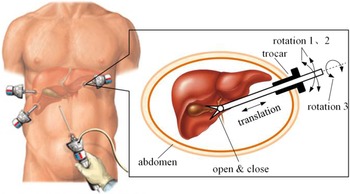
The kinematic design is one of the most important phases in a MIS robot design. Due to the fixed incision, DOFs of the tool are restricted to four (the Open & Close is not included) as shown in Fig. 1. They are rotation 1, rotation 2, rotation 3, and the translation. For safety reasons, the rotations of the surgical tool should always pivot against the incision point, while the translational motion should always along the line that passes through the incision point. The direction of the translation is determined by rotation 1 and rotation 2. This kind of motion is called the remote center-of-motion (RCM), which is the fundamental requirement of a MIS robot.
The incision point constraint in the MIS surgery [Reference Li, Zhang, Xing, Liu and Wang3].

Current methods to make the MIS robot pass through the incision point include (a) controlling redundant joints, such as the MIRO system developed by DLR [Reference Hagn, Konietschke, Tobergte, Nickl, Jörg, Kübler, Passig, Gröger, Fröhlich, Seibold, Le-Tien, Albu-Schäffer, Nothhelfer, Hacker, Grebenstein and Hirzinger4] and the improved version of PARAMIS robot [Reference Pisla, Szilaghyi, Waida and Plitea5–Reference Gherman, Pisla, Vaida and Plitea7]; (b) adding passive joints, such as the Zeus system [Reference Ghodoussi, Butner and Wang8] and the MicroHand S robot [Reference Wang, Li and Wang9]; and (c) mechanically constrained structure, such as the da Vinci system. The robot based on the first method can provide high stiffness but is considered unsafe in a surgery [Reference Locke and Patel10]. Which one is safer between the latter two methods is still in debates, but the safety of the adding passive joints method is achieved at the expense of compromising the motion accuracy and stiffness [Reference Taylor and Stoianovici11].
For the mechanically constrained structure, the introduction of a circular arc is probably the structurally simplest way to generate an RCM. The movement of a slider on a spherical arc is a 1-DOF remote center of motion. If the arc is driven by a revolute joint whose axis passes through the RCM, then another rotational DOF is added. The robotic camera holder “freehand” [Reference Stolzenburg, Kallidonis, Minh, Dietel, Häfner, Dimitriou, Al-Aown, Kyriazis and Liatsikos12] and the light weight robotic scope holder “ViKY” [Reference Voros, Haber, Menudet, Long and Cinquin13] are developed based on this principal. If two or more links are connected serially by rotation joints with all axes intersecting at a single point, then the links can rotate on a sphere about this point. If a shaft is fixed on the tip of the last linkage, it will be forced to pass through the center of the sphere, which is the RCM. A portable MIS robot [Reference Zhang and Nelson14], the force reflecting robot MC2E [Reference Nabil and Guillaume15, Reference Shi, Pascal, Viviane, Guillaume and Wang16], and the Raven robot [Reference Lum, Friedman, Sankaranarayanan, King, Fodero, Leuschke, Hannaford, Rosen and Sinanan17] are based on this method. Zoppi et al. proposed a class of 4-DOF parallel RCM manipulators and presented its analytical kinematic models and geometries [Reference Zoppi, Zlatanov and Gosselin18].
The double parallelogram mechanism is the most widely used RCM mechanism in MIS robots [Reference Taylor, Funda, Eldridge, Gomory, Gruben, LaRose, Talamini, Kavoussi and Anderson19–Reference Hanly and Talamini26], including the da Vinci surgical system which has been successfully applied in many robot-assisted MIS fields. Zong et al. proposed a type synthesis method to generate parallelogram based 1-DOF RCM mechanisms [Reference Zong, Pei, Yu and Bi27]. Several novel mechanisms were developed based on this principle. The deformation types of double parallelogram are important in this context and were analyzed in [Reference Li, Wang, Wang and He28, Reference Li, Wang, Wang, He and Zhang29]. The typical feature of MIS robots based on this kind of mechanisms is that they have two rotational DOFs about two orthogonal axes at the RCM point [Reference Kuo, Dai and Pasgupta30]. A spatial 3-DOF RCM mechanism, which is also based on parallelograms, was proposed by Ricardo et al. [Reference Beira, Santos-Carreras, Sengül, Samur, Clavel and Bleuler31]. Due to its large volume, it is difficult to arrange several around the patient table. However, it can be used as an external positioner for assisting single port laparoscopic surgeries. For spatial RCM mechanisms, Li et al. have proposed a type synthesis method based on intersecting movable planes to generate novel RCM mechanisms [Reference Li, Zhang, Muller and Wang32], Kuo and Dai proposed a fully decoupled 4-DOF RCM mechanism for MIS [Reference Kuo and Dai33].
It needs to point out that an active prismatic joint is needed to drive the tool move in-out of the patient’s body, whether a circular arc or double parallelogram is used. In the prototype design, the active prismatic joint generally needs to use ball screw. Therefore, for the same scale workspace, the active prismatic joint has heavier mass, larger volume, and less flexibility than the active rotating joint. And it is difficult to realize the integration of driving parts on the static platform, and the increase of motion inertia will lead to the increase of driving force. This requirement makes the transmission system complex and reduces the back-drivability of the surgical robot. Under this condition, a class of 2-DOF planar RCM mechanisms is proposed by constructing virtual parallelograms [Reference Li, Zhang, Xing, Liu and Wang3]. Considering that the actuated joints of the obtained mechanisms are revolute joints, they have better back-drivability and flexibility than the standard double parallelogram. Therefore, the proposed mechanisms have great application potential in MIS robots.
In this paper, the three-dimensional version of the above mentioned 2-DOF planar RCM mechanism is investigated. Compared to the existing spherical parallel mechanisms, the advantage of the proposed design is that each of spatial RCM mechanism has a translational motion that passes through the RCM. This can be used to driven the surgical tool move in-out of the patient’s body cavity. Other scholars have proposed RCM mechanisms which can realize translational degrees of freedom. Long et al. proposed an RCM mechanism without active prismatic joint [Reference Long, Yang, Jingjing and Peng34]. Although the structure of the mechanism in reference [Reference Long, Yang, Jingjing and Peng34] is simple, it does not realize the integration of the motor on the static platform, and the stiffness perpendicular to the paper direction is low. In contrast, the three actuators of the mechanism proposed in this paper are fixed on the static platform, which is easy to realize modular design. In addition, the overall structure has the characteristics of high stiffness and isotropy. The basic principle, the sufficient conditions that make the mechanism be spatial RCM mechanism, and the forward kinematics are analyzed in the following sections.
2. Double parallelogram mechanism
The double parallelogram is the most widely used mechanism in MIS robots. It is a 1-DOF RCM mechanism which is formed by combining two parallelogram linkages together, as shown in Fig. 2. This constraint makes the movement of a part of the mechanism, i.e., the End-link shown in the figure, perform pure rotation around a fixed point which is not physically belonging to the mechanism, this is the RCM point.
The double parallelogram mechanism.

By investigating the constraint feature of the double parallelogram, it can be seen that the End-link is always parallel to link AB due to the constraint of the second parallelogram labeled in Fig. 2. The motion of the two horizontal links of the second parallelogram is purely translational motion due to the constraint of the first parallelogram labeled in Fig. 2. In such a construction, since one end of link AB is installed on the base through a revolute joint, i.e., joint A, end-point of the entangled End-link always passes through an RCM (see Fig. 2) when the mechanism works. Inspired by this design, a method that can generate new RCM mechanisms raises. In this method, we construct two lines, connected by a parallelogram, one of which passes through a fixed point under the physical constraint. Then if the motion of the parallelogram is restricted to be pure translation, the other line will always pass through a virtually fixed point that needs not to be physically belonging on the mechanism. Such a point is coined the RCM point. Based on this idea, the authors proposed a class of 2-DOF planar RCM mechanisms [Reference Li, Zhang, Xing, Liu and Wang3], and several other kinds of 2-DOF planar RCM mechanisms were developed based on the consistent method [Reference Clavel35–Reference Dai, Huang and Lipkin38]. Based on our previous work, in this paper, we proposed a 3-DOF spatial RCM mechanism.
3. A 3-DOF spatial RCM mechanism
Based on the construction of RCM mechanisms in parallelogram mechanisms in form, we aim to construct spatial RCM mechanisms according to the same design principle.
3.1. Design of a 3-DOF spatial double-Delta mechanism with RCM
As mentioned above, a key step to generate new RCM mechanisms is to find a suitable mechanism that can drive a parallelogram to execute pure translation. The Delta mechanism proposed by Clavel [Reference Clavel35] is the most famous parallel mechanism that can generate purely translational motion. This feature makes the mechanism suitable as the basis to generate spatial RCM mechanisms.
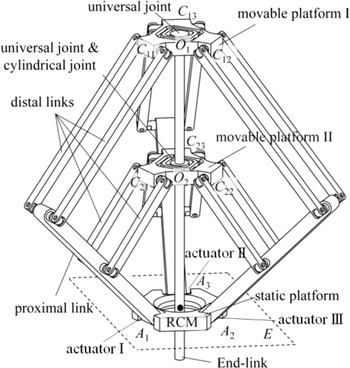
Based on the mechanism constructing method proposed in [Reference Li, Zhang, Xing, Liu and Wang3], and the principle proposed in Section 2, a kind of spatial mechanism based on the Delta mechanism is constructed in this paper, as shown in Fig. 3. From the figure, it can be seen that this spatial mechanism contains two layers of Delta-like linkages. In this design, to make the motions of the two Delta linkages coupled with each other, the parallelograms in the two Delta linkages share the same proximal linkage. Three platforms, i.e., movable platform I, movable platform II, and static platform are used in the mechanism. To fulfill the mobility constraint, the End-link is mounted on the movable platform I through a universal joint and connected with the movable platform II via a universal joint together with a cylindrical joint. The actuators used for driving the mechanism can be set stationary on the static platform, as shown in Fig. 3. The End-link is the end-effector of the proposed double-Delta mechanism with remote center of motion. Different with the common Delta mechanism in the literature, in this design, the three proximal links and the three groups of distal links in each Delta linkage have different lengths, and the dimensions of the three platforms, the static platform and the two movable platforms are identical.
A spatial 3-DOF double-Delta mechanism with RCM.

There are n = 36 links and j = 42 joints (including 39 revolute joints, 2 universal joints and 1 cylindrical joint) in the proposed mechanism. Through the test in the model, it is found that once any joint constraint is removed, the remote center of motion cannot be realized, so there is no redundant constraint. Therefore, according to the Grülber–Kutzbuch formula [Reference Dai, Huang and Lipkin38], the mobility of the mechanism is
 \begin{equation} m=\lambda \left(n-j-1\right)+\sum _{i=1}^{j}f_{i}=6\left(36-42-1\right)+39+2+2+2=3 \end{equation}
where m denotes the mobility of the mechanism and λ is the dimension of the space in which the mechanism is presented, λ = 6 for spatial mechanism and λ = 3 for planar and spherical mechanisms.
3.2. Conditions for remote center of motion
To realize remote center of motion for the End-link of the proposed mechanism, there are two conditions need to be satisfied: first, lengths of all the proximal links and lengths of all the distal links in each Delta linkage are same, respectively; and second, the corresponding distal links in the two Delta linkages are parallel with each other. Based on these two conditions, kinematic analysis of the mechanism will be investigated in Section 4 to verify whether the mechanism can execute the RCM motion.
The schematic model of the mechanism is shown in Fig. 4, from the first condition, it is expected that the two movable platforms, simplified as points C1 and C2 in the figure (it is noted that the static platform is also simplified as a point A), will have pure translational motion due to the constraints of the parallelograms.
The schematic model of the mechanism under the first condition.

From Fig. 4, it can be seen that line C1E1 is the normal line of the plane formed by points B11, B12, and B13 (denoted as ΠB11B12B13), and line C2E2 is the normal line of the plane formed by points B21, B22, and B23 (denoted as ΠB21B22B23). Then, based on the conditions that
 $C_{1}E_{1}\bot \unicode{x03C0} B_{11}B_{12}B_{13}$
and
 $C_{1}B_{11}=C_{1}B_{12}=C_{1}B_{13}$
, it has
 \begin{equation} E_{1}B_{11}=E_{1}B_{12}=E_{1}B_{13} \end{equation}
thus point
 $E_{1}$
is the circumcenter of triangle
 $\unicode{x03B4} B_{11}B_{12}B_{13}$
.
Similarly, with the conditions that
 $C_{2}E_{2}\bot \unicode{x03C0} B_{21}B_{22}B_{23}$
and
 $C_{2}B_{21}=C_{2}B_{22}=C_{2}B_{23}$
, it yields
 \begin{equation} E_{2}B_{21}=E_{2}B_{22}=E_{2}B_{23} \end{equation}
hence, point
 $E_{2}$
is the circumcenter of triangle
 $\unicode{x03B4} B_{21}B_{22}B_{23}$
.
Similarly, we can prove that line AE
1 is perpendicular to plane
 $\unicode{x03C0} B_{11}B_{12}B_{13}$
with point E
1 and line AE
2 is orthogonal with plane
 $\unicode{x03C0} B_{21}B_{22}B_{23}$
with point E
2. With these results, it can be seen that the two lines, i.e.,
 $AE_{1}$
and
 $C_{1}E_{1}$
, are both perpendicular to the plane
 $\unicode{x03C0} B_{11}B_{12}B_{13}$
, which means lines
 $AE_{1}$
and
 $C_{1}E_{1}$
are collinear. Similarly, it can be concluded that lines
 $AE_{2}$
and
 $C_{2}E_{2}$
are collinear.
Further, considering that the lengths of the corresponding links in the two Delta linkages are the same, there exist the following relations:
 \begin{equation} \frac{\overline{AB_{21}}}{\overline{AB_{11}}}=\frac{\overline{AB_{22}}}{\overline{AB_{12}}}\text{ and }\frac{\overline{AB_{21}}}{\overline{AB_{11}}}=\frac{\overline{AB_{23}}}{\overline{AB_{13}}} \end{equation}
which leads to the relations that
 $B_{11}B_{12}//B_{21}B_{22}$
and
 $B_{11}B_{13}//B_{21}B_{23}$
, and thus
 $\unicode{x03C0} B_{11}B_{12}B_{13}//\unicode{x03C0} B_{21}B_{22}B_{23}$
. Moreover, with the relations that
 $AC_{1}\bot \unicode{x03C0} B_{11}B_{12}B_{13}$
and
 $AC_{2}\bot \unicode{x03C0} B_{21}B_{22}B_{23}$
, it can be found that lines
 $AC_{1}$
and
 $AC_{2}$
are collinear.
Therefore, from the above derivation, it can be found that the three points
 $A, C_{1}$
, and
 $C_{2}$
in Fig. 4 are collinear. Further, since points A, C1, and C2 in Fig. 4 stand for the corresponding static and movable platforms in Fig. 3, there exist the relations that the three points C11, C21, and A1 in one branch of the mechanism (see in Fig. 3) are always collinear. Similarly, points C12, C22, and A2 and points C13, C23, and A3 in the other two branches are also collinear, respectively.
Considering the above relations, in the mechanism, three generalized double parallelograms can be formed denoting as P
1:
 $C_{12}A_{2}A_{3}C_{13}\,\& \, C_{22}A_{2}A_{3}C_{23}$
, P
2:
 $C_{11}A_{1}A_{2}C_{12}\,\& \,C_{21}A_{1}A_{2}C_{22}$
, and P
3:
 $C_{11}A_{1}A_{3}C_{13}\,\& \,C_{21}A_{1}A_{3}C_{23}$
as shown in Fig. 5(a). Then referring to Fig. 5(a), the End-link that passes through points C1, C2, and A is parallel with lines A
1
C
11, A
2
C
12, and A
3
C
13 and always has point A (which is the circumcenter of triangle
 $\Delta A_{1}A_{2}A_{3}$
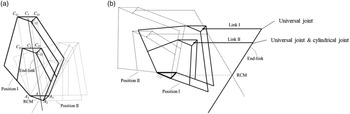
) as is remote center of motion. The remote center of motion is visually located in the center of the static platform, but does not need to be supported by physical links or joints. The operation space can be reserved by expanding the size of the static platform, so that human surgeons can clearly enter the incision. Based on the above constraints, the size of platform C1 can be kept unchanged and the size of platform C2 and base a can be expanded in proportion to ensure that the volume is not excessively expanded. It is important to point out that the End-link can also be located outside of the mechanism, as illustrated in Fig. 5(b). In this configuration, two links of equal length, i.e., Link I and Link II, are fixed on the movable platform I and movable platform II, respectively. The joint connect Link I and the End-link is a universal joint and a universal joint and a cylindrical joint are adopted to connect Link II and the End-link. For practical application, if the mechanism is to be used as the end effector of a surgical robot, for the case in Fig. 5(b), the mechanism body can be set away from the patient, making the mechanism better adapted to the surgical environment.
The mechanism can execute RCM motion under the mentioned constraint.

The second condition is that the corresponding distal links in the two Delta linkages are parallel with each other. This condition will secure that the three points A, C1, and C2 are collinear. To provide this, we simplify the kinematic model of the mechanism into a schematic model as shown in Fig. 6 and assume that three points A, C1, and C2 are not collinear. Based on the condition, it has lines B
21
C
2 and B
11
C
1 are parallel with each other, and lines AC
2 and B
11
C
1 are in the same plane. Then point
 $C^{\prime}_{1}$
is used to denote the intersection of the extension of the line
 $AC_{2}$
and the line
 $B_{11}C_{1}$
under the above assumption.
The schematic model of the mechanism under the second condition.

The mathematical description of the studied condition is
 \begin{equation} \left\{\begin{array}{l@{\quad}l} \dfrac{AB_{21}}{AB_{11}}=\dfrac{AB_{22}}{AB_{12}}=\dfrac{AB_{23}}{AB_{13}}=k & \left(0\lt k\lt 1\right)\\ \\[-6pt] B_{2j}C_{2}//B_{1j}C_{1}& j=1,2,3 \end{array}\right. \end{equation}
Based on the intercept theorem of parallel lines, we have
 \begin{equation} \frac{AB_{21}}{AB_{11}}=\frac{AC_{2}}{AC^{\prime}_{1}} \end{equation}
Further, considering that the line
 $B_{22}C_{2}$
is parallel with the line
 $B_{12}C_{1}$
, these two lines can form a plane, i.e., the plane
 $\unicode{x03C0} C_{1}B_{12}B_{22}C_{2}$
. Obviously, point
 $A$
and point
 $C_{2}$
locate in that plane. It can be seen that line
 $B_{12}C_{1}$
and line
 $AC_{2}$
are the two intersecting lines within that plane. Let us assume that the intersecting point of the two lines is point
 $C^{\prime\prime}_{1}$
, as shown in figure. Then, based on the same theorem, it yields
 \begin{equation} \frac{AB_{22}}{AB_{12}}=\frac{AC_{2}}{AC^{\prime\prime}_{1}} \end{equation}
According to Eq. (5) throughout Eq. (7), it is straightforward to find that
 \begin{equation} \frac{AC_{2}}{AC^{\prime}_{1}}=\frac{AC_{2}}{AC^{\prime\prime}_{1}} \end{equation}
Since both of the points
 $C^{\prime}_{1}$
and
 $C^{\prime\prime}_{1}$
are on the extension of line
 $AC_{2}$
, Eq. (8) implies that points
 $C^{\prime}_{1}$
and
 $C^{\prime\prime}_{1}$
are coincide. This result indicates that there is a unique intersecting point among three lines
 $AC_{2}, B_{12}C_{1}$
, and
 $B_{11}C_{1}$
. Since
 $C_{1}$
is the intersecting point of lines
 $B_{12}C_{1}$
and
 $B_{11}C_{1}$
, the above-mentioned unique intersecting point is point
 $C_{1}$
. Similarly, it can be found that point
 $C_{1}$
is also the intersecting point of lines
 $AC_{2}$
and
 $B_{13}C_{1}$
. From above analysis, it can be proved that under the second condition, the three points
 $A, C_{1}$
, and
 $C_{2}$
are collinear.
Further, it should be pointed out that the RCM feature for the proposed mechanism is independent with the inputs of the mechanism as long as the proposed mechanism satisfies the two conditions discussed above. In addition, RCM mechanisms with similarly topology but different geometric constraint as the one illustrated in Fig. 6 can also be obtained. The famous external positioning mechanism named Dion is proposed by Ricardo et al. for robotic single port surgery [Reference Clavel35] is a typical application example of this kind of RCM mechanism.
4. Forward kinematics and workspace of the proposed spatial RCM mechanism
Although it is easy to get the closed-form mathematical solution of the inverse kinematic problem for a parallel manipulator, the forward kinematic problem lacks a closed-form solution, due to the number of equations is less than the number of unknowns and the high degree of nonlinearity in the kinematic formulations [Reference Parikh and Lam37]. The forward kinematic problem has posed a difficult problem for parallel manipulator researchers. In each of the proposed spatial RCM mechanisms, there are two parallel mechanisms, i.e., the two Delta linkages, that are coupled withremote center-of-motioneach other, which makes the constraint even more complex. Therefore, it is essential to solve the forward kinematic problem to find the final position and orientation under a given set of joint angles and dimensional parameters. This can be used for monitoring the running status of an MIS surgical robot based on the proposed RCM mechanism.
4.1. Forward kinematic analysis
To carry out the forward kinematic analysis, the mathematical model of the mechanism is established, as shown in Fig. 7. In this model, the coordinate system
 $A-xyz$
is the reference coordinate system. The x-axis coincides with the projection of the link
 $AB_{11}$
on the horizontal plane, z-axis points upward, and the y-axis complies with the right-hand rule. The values of the dimensional parameters are defined as follows: The length of link
 $AB_{1j} \left(j=1,2,3\right)$
is
 $l_{i}$
, the length of link
 $AB_{2i}$
is
 $kl_{i} \left(0\lt k\leq 1\right)$
, the length of link
 $B_{2i}C_{2}$
is
 $l_{2i}$
, the length of link
 $B_{1i}C_{1}$
is
 $l_{1i}$
, and the length of the End-link is
 $l$
.
The kinematic model of the RCM mechanism based on two Delta linkages.

Since the End-link, usually is the surgical tool in a MIS robot, has a fixed value of length, the position of at the end of the End-link, i.e., point
 $O'$
, can be expressed by the position of points
 $C_{1}$
and point
 $C_{2}$
as
 \begin{equation} \boldsymbol{{r}}_{O'}=\boldsymbol{{r}}_{C1}-l\left(\frac{\boldsymbol{{r}}_{C1}-\boldsymbol{{r}}_{C2}}{\left\| \boldsymbol{{r}}_{C1}-\boldsymbol{{r}}_{C2}\right\| }\right) \end{equation}
where
 $\boldsymbol{{r}}_{O'}$
is the position vector of reference point
 $O', \boldsymbol{{r}}_{C1}$
, and
 $\boldsymbol{{r}}_{C2}$
denote the position vectors of points
 $C_{1}$
and
 $C_{2}$
, respectively.
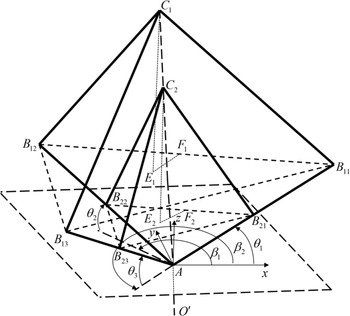
The mathematic model of the tetrahedron.

Then the kinematic analysis of the mechanism is equivalent to find the final positions of point
 $C_{1}$
and point
 $C_{2}$
under a given set of input joint angles, i.e.,
 $\theta _{1}, \theta _{2}$
, and
 $\theta _{3}$
of the three proximal links, as shown in Fig. 8. To carry out the calculation, two auxiliary lines are employed, they are lines
 $C_{1}E_{1}$
and
 $C_{2}E_{2}$
(see Fig. 7), which are perpendicular to plane
 $\unicode{x03C0} B_{11}B_{12}B_{13}$
and plane
 $\unicode{x03C0} B_{21}B_{22}B_{23}$
, respectively. Then the position vectors of points
 $C_{1}$
and
 $C_{2}$
can be expressed as
 \begin{equation} \boldsymbol{{r}}_{C1}=\boldsymbol{{r}}_{E1}+\overline{{{E_{1}C_{1}}}} \end{equation}
 \begin{equation} \boldsymbol{{r}}_{C2}=\boldsymbol{{r}}_{E2}+\overline{{{E_{2}C_{2}}}} \end{equation}
where
 $\boldsymbol{{r}}_{E1}$
and
 $\boldsymbol{{r}}_{E2}$
are the position vectors of points
 $E_{1}$
and
 $E_{2}$
expressed in the reference coordinate system
 $A-xyz$
. The coordinates of point
 $B_{ij} \left(i=1,2;\ j=1,2,3\right)$
can be determined by the input joint angles as
 \begin{equation} \boldsymbol{{r}}_{B1j}=l_{j}\mathrm{Rot}\left(z\mathit{,}\beta _{\left(j-1\right)}\right)\mathrm{Rot}\left(y\mathit{,}-\theta _{j}\right)\boldsymbol{{e}}_{1} \end{equation}
 \begin{equation} \boldsymbol{{r}}_{B2j}=k_{j}l_{j}\mathrm{Rot}\left(z\mathit{,}\beta _{\left(j-1\right)}\right)\mathrm{Rot}\left(y\mathit{,}-\theta _{j}\right)\boldsymbol{{e}}_{1} \end{equation}
where
 $\beta _{\left(j-1\right)}$
is the dimensional parameter, it is the angle of the projections of link
 $AB_{ij}$
and link
 $AB_{i\left(j+1\right)}$
on the horizontal plane, and
 $\beta _{0}=0, \beta _{1}\neq \beta _{2}$
and
 $\beta _{0}+\beta _{1}+\beta _{2}=2\pi$
. In addition,
 $\mathrm{Rot}\left(z\mathit{,}\beta _{\left(j-1\right)}\right)=\left[\begin{array}{c@{\quad}c@{\quad}c} \cos \beta _{\left(j-1\right)} & -\sin \beta _{\left(j-1\right)} & 0\\ \sin \beta _{\left(j-1\right)} & \cos \beta _{\left(j-1\right)} & 0\\ 0 & 0 & 1 \end{array}\right], \mathrm{Rot}\left(y\mathit{,}-\theta _{j}\right)=\left[\begin{array}{c@{\quad}c@{\quad}c} \cos \left(-\theta _{j}\right) & 0 & \sin \left(-\theta _{j}\right)\\ 0 & 1 & 0\\ -\sin \left(-\theta _{j}\right) & 0 & \cos \left(-\theta _{j}\right) \end{array}\right]$
, and
 $\boldsymbol{{e}}_{1}=\left[\begin{array}{l} 1\\ 0\\ 0 \end{array}\right]$
.
So far, all the lengths of the links in tetrahedrons
 $C_{1}-B_{11}B_{12}B_{13}, C_{2}-B_{21}B_{22}B_{23}, A-B_{11}B_{12}B_{13}$
, and
 $A-B_{21}B_{22}B_{23}$
are known. Then,
 $\overline{{{E_{1}C_{1}}}}$
and
 ${\overline{{E_{2}C_{2}}}}$
can be calculated in
 $C_{1}-B_{11}B_{12}B_{13}$
and
 $C_{2}-B_{21}B_{22}B_{23}$
, respectively, while
 ${\overline{{AE_{1}}}}$
and
 ${\overline{{AE_{2}}}}$
can be calculated in
 $A-B_{11}B_{12}B_{13}$
and
 $A-B_{21}B_{22}B_{23}$
, respectively. Let us solve the expression of
 ${\overline{{E_{1}C_{1}}}}$
and
 ${\overline{{E_{2}C_{2}}}}$
first. Their directional vectors can be obtained by
 \begin{equation} \boldsymbol{{n}}_{{\overline{{E_{1}C_{1}}}}}=\frac{{\overline{{B_{11}B_{12}}}}\times \overline{{{B_{11}B_{13}}}}}{\left\| \overline{{{B_{11}B_{12}}}}\times \overline{{{B_{11}B_{13}}}}\right\| } \end{equation}
 \begin{equation} \boldsymbol{{n}}_{{\overline{{E_{2}C_{2}}}}}=\frac{\overline{{{B_{21}B_{22}}}}\times \overline{{{B_{21}B_{23}}}}}{\left\| \overline{{{B_{21}B_{22}}}}\times \overline{{{B_{21}B_{23}}}}\right\| } \end{equation}
where
 $\overline{{{B_{11}B_{12}}}}=\boldsymbol{{r}}_{B12}-\boldsymbol{{r}}_{B11}, \overline{{{B_{11}B_{13}}}}=\boldsymbol{{r}}_{B13}-\boldsymbol{{r}}_{B11}, \overline{{{B_{21}B_{22}}}}=\boldsymbol{{r}}_{B22}-\boldsymbol{{r}}_{B21}$
, and
 $\overline{{{B_{21}B_{23}}}}=\boldsymbol{{r}}_{B23}-\boldsymbol{{r}}_{B21}$
.
To solve the length of
 $\overline{{{E_{i}C_{i}}}}$
which is perpendicular to the plane
 $\unicode{x03C0} B_{i1}B_{i2}B_{i3}$
, the mathematic model of the tetrahedron is established, as shown in Fig. 8. The thin-dotted lines in the model are the auxiliary lines and both of the two lines
 $B_{i2}G_{i1}$
and
 $B_{i2}G_{i2}$
are perpendicular with the line
 $B_{i1}B_{i2}$
. Line
 $G_{i1}B_{i2}$
locates in the plane
 $\unicode{x03C0} C_{i}\hspace{0pt}B_{i1}B_{i2}$
, while the line
 $B_{i2}G_{i1}$
locates in the plane
 $\unicode{x03C0} B_{i1}B_{i2}B_{i3}$
. According to cosine theorem,
 $\gamma _{i1}$
which is the angle formed by line
 $C_{i}B_{i1}$
and the line
 $B_{i1}B_{i2}$
can be calculated, it is
 \begin{equation} \gamma _{i1}=\arccos \frac{\left\| {\overline{{B_{i1}C_{i}}}}\right\| ^{2}+\left\| {\overline{{B_{i1}B_{i2}}}}\right\| ^{2}-\left\| {\overline{{B_{i2}C_{i}}}}\right\| ^{2}}{2\left\| {\overline{{B_{i1}C_{i}}}}\right\| \left\| {\overline{{B_{i1}B_{i2}}}}\right\| } \end{equation}
Then the length of
 $\overline{{{B_{i2}G_{i1}}}}$
can be solved by
 \begin{equation} \left\| \overline{{{B_{i2}G_{i1}}}}\right\| =\left\| \overline{{{B_{i1}B_{i2}}}}\right\| \tan \gamma _{i1} \end{equation}
By using same method, the length of
 ${\overline{{B_{i2}G_{i2}}}}$
can be obtained
 \begin{equation} \left\| \overline{{{B_{i2}G_{i2}}}}\right\| =\left\| \overline{{{B_{i1}B_{i2}}}}\right\| \tan \gamma _{i2} \end{equation}
where
 $\gamma _{i2}=\arccos \frac{\left\| \overline{{{B_{i1}B_{i2}}}}\right\| ^{2}+\left\| \overline{{{B_{i1}B_{i3}}}}\right\| ^{2}-\left\| \overline{{{B_{i2}B_{i3}}}}\right\| ^{2}}{2\left\| \overline{{{B_{i1}B_{i2}}}}\right\| \left\| \overline{{{B_{i1}B_{i3}}}}\right\| }$
.
The length of
 $\left\| \overline{{{G_{i2}G_{i1}}}}\right\|$
can be calculated by
 \begin{equation} \left\| \overline{{{G_{i2}G_{i1}}}}\right\| =\sqrt{\left\| \overline{{{B_{i1}G_{i1}}}}\right\| ^{2}+\left\| \overline{{{B_{i1}G_{i2}}}}\right\| ^{2}-2\left\| \overline{{{B_{i1}G_{i1}}}}\right\| \cdot \left\| \overline{{{B_{i1}G_{i2}}}}\right\| \cos \gamma _{i3}} \end{equation}
where
 $\cos \gamma _{i3}=\frac{\left\| \overline{{{B_{i1}C_{i}}}}\right\| ^{2}+\left\| \overline{{{B_{i1}B_{i3}}}}\right\| ^{2}-\left\| \overline{{{B_{i3}C_{i}}}}\right\| ^{2}}{2\left\| \overline{{{B_{i1}C_{i}}}}\right\| \left\| \overline{{{B_{i1}B_{i3}}}}\right\| }, \left\| \overline{{{B_{i1}G_{i1}}}}\right\| =\frac{\left\| \overline{{{B_{i1}B_{i2}}}}\right\| }{\cos \gamma _{i1}}$
, and
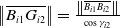 $\left\| \overline{{{B_{i1}G_{i2}}}}\right\| =\frac{\left\| \overline{{{B_{i1}B_{i2}}}}\right\| }{\cos \gamma _{i2}}$
.
Then the angle form by plane
 $C_{i}\hspace{0pt}B_{i1}B_{i2}$
and plane
 $B_{i1}B_{i2}B_{i3}$
can be calculated by
 \begin{equation} \phi _{i}=\arccos \frac{\left\| \overline{{{B_{i2}G_{i1}}}}\right\| ^{2}+\left\| \overline{{{B_{i2}G_{i2}}}}\right\| ^{2}-\left\| \overline{{{G_{i2}G_{i1}}}}\right\| ^{2}}{2\left\| \overline{{{B_{i2}G_{i1}}}}\right\| \left\| \overline{{{B_{i2}G_{i2}}}}\right\| } \end{equation}
Then the length of
 $\overline{{{E_{i}C_{i}}}}$
can be calculated consequently, it is
 \begin{equation} \left\| \overline{{{E_{i}C_{i}}}}\right\| =\left\| \overline{{{C_{i}F_{i}}}}\right\| \sin \phi _{i} \end{equation}
where
 $C_{i}F_{i}\bot B_{i1}B_{i2}$
and
 $\left\| \overline{{{C_{i}F_{i}}}}\right\| =\left\| \overline{{{B_{i1}C_{i}}}}\right\| \sin \gamma _{i1}$
. Till now, the directional vector and the length of
 $\overline{{{E_{i}C_{i}}}}$
are solved.
The position vector of point
 $E_{i}$
can be calculated in tetrahedrons
 $A-B_{i1}B_{i2}B_{i3}$
 \begin{equation} \boldsymbol{{r}}_{Ei}=\boldsymbol{{r}}_{Bi1}+\overline{{{B_{i1}F_{i}}}}+\overline{{{F_{i}E_{i}}}} \end{equation}
where
 $\overline{{{B_{i1}F_{i}}}}=\left\| \overline{{{B_{i1}C_{i}}}}\right\| \cos \gamma _{i1}\frac{\overline{{{B_{i1}B_{i2}}}}}{\left\| \overline{{{B_{i1}B_{i2}}}}\right\| }, \overline{{{F_{i}E_{i}}}}=\left(\left\| \overline{{{C_{i}F_{i}}}}\right\| \cos \phi _{i}\right)\frac{\overline{{{E_{i}C_{i}}}}\times \overline{{{B_{i1}B_{i2}}}}}{\left\| \overline{{{E_{i}C_{i}}}}\times \overline{{{B_{i1}B_{i2}}}}\right\| }$
.
Since all the unknowns are expressed by the dimensional parameters and the input joint angles of the mechanism, the positions of points
 $C_{1}$
and
 $C_{2}$
can be derived by Eqs. (10), (11), (14), (15), (21), and (22). And consequently, the forward position analysis result, the final position of the reference point
 $O'$
at the end of the End-link, can be derived by Eq. (9). It can be seen that the unique solution of the forward kinematic problem can be obtained based on the employed geometrical analysis method. One advantage of this process is that it can avoid the choosing procedure in the analytical technique, which may yield multiple solutions. Another advantage is that it can also avoid the time-consuming iteration calculation in the forward kinematic analysis based on numerical techniques.
4.2. Numerical simulation and verification
To verify the validity of the forward kinematic calculation process, a numerical example is employed in this section. The RCM mechanism is generated based on the second condition, which means the corresponding distal links in the two Delta mechanisms are parallel to each other, the forward kinematics of which is more complicated than the first condition. The dimensional parameters in this example are listed in Table I.
The dimensional parameters of the research object.

The dimensional parameters of the research object.

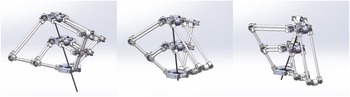
The verification process is that a set of reference positions whose values and the corresponding input joint angles were measured from SolidWorks® software were given first. After that, the forward kinematic analysis was carried out to solve the positions of the reference point based on the joint angles. Then comparison between the given reference positions and the positions obtained through forward kinematic calculation was carried out to check the accuracy of the procedure. The comparison results are listed in Table II. It can be seen that the forward position calculation method is effective. For the third calculation, however, the error between the given position and the calculated position is large. The reason is that the absolute values of two angular positions are small, which makes the relative measured errors of these two angles large, and consequently results in a relative larger calculation error. The configurations of the mechanism with the 3 given angular positions are shown in Fig. 9.
Different configurations of the mechanism with the given positions in Table II.

4.3. Workspace analysis
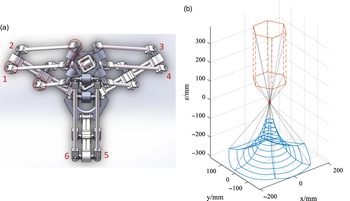
In the process of motion, the boundary of workspace is determined by the limit position of rotating joint. Number the outer circle joints in sequence as shown in Fig. 10(a), and the diagonal joints of each parallelogram interfere at the same time. When joint 1 reaches the limit position, the joints in the four circles reach the limit position at the same time. Drag the moving platform clockwise in a plane, and every two pairs of joints 1 and 4, 1 and 6, 6 and 3, 3 and 2, 2 and 5, 5 and 4 interfere at the same time. The moving track of the moving platform is a regular hexagon, and the sides of the hexagon are equal in different planes. Figure 10(a) shows the interference state of joints 1 and 4. The moving range of the moving platform in the vertical direction is 119–393 mm, from which the working space can be calculated. As shown in Fig. 10(b), the orange hexagonal prism is the motion range of the top moving platform, and the blue part is the space that can be reached at the end of the instrument. When the insertion depth of the instrument is the maximum, the maximum deflection angle is 62.6°. When the insertion depth of the instrument is the smallest, the maximum deflection angle is 23.7°. Obviously, the rotation range of the rotating joint can be increased by optimizing the connecting rod structure, so as to effectively increase the adjustment angle of the RCM mechanism. Chen et al. proposed a parallel RCM manipulator with a workspace of 60° and explained the reliability of this workspace by analyzing the human body size [Reference Chen, Wang, Wang, Chen, Parenti-Castelli and Angeles39].
Interference configuration and workspace of the proposed mechanism.

4.4. Prototype manufacturing and principle verification
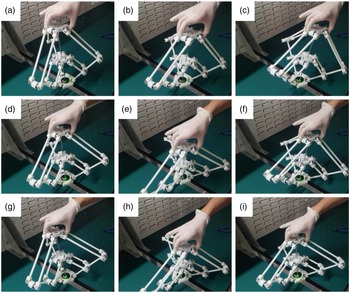
To verify the correctness of the proposed mechanism, a prototype of the mechanism was fabricated, as shown in Fig. 11(a). All the linkages have been manufactured by 3D printing, and all the revolute joints are connected by bearings. The parameters of the prototype are identical with those in Table I. The diameter of the End-link is 4.3 mm. A laser pointer with green laser was utilized to point the remote center of the prototype. Once the End-link cross the remote center, the green spot will be observed on the End-link.
Different configurations of the proposed prototype.

Different configurations have been reached manually, and the positions of End-link relative the remote center have been captured. For each configuration in Fig. 11, the End-link is always with the green spot, verifying the motion of the End-link is restrained by the remote center.
5. Conclusion
A class of spatial RCM mechanisms is introduced in this paper. And the essential conditions that make the mechanism be an RCM mechanism are proved. Due to the parallel kinematic configuration, the proposed mechanisms are quite suitable to be used in the areas that require the surgical robots with high load capacity. The proposed RCM mechanism is promising to be used as a guidance device in robot assisting needle insertion applications or be used as an external positioner in robotic single-port surgeries. To satisfy the real-time monitoring requirement during robotic surgeries, the forward kinematic problem of the proposed mechanism was solved based on geometrical method. Based on this method, the unique forward kinematic solution of the spatial RCM mechanism can be obtained. This technique avoids the choosing the valid result from the multiple solutions procedures in an analytical calculation or implementing the computational expensive iterative numerical methods. Further research will be focused on quantitative evaluation of the motion accuracy based on alignment sensor, stiffness analysis, and prototype design for MIS.
Author contributions
Yuan Bian and Jianmin Li conceived and designed the study, Jianchang Zhao made the prototype for experiment, Jianmin Li and Jinhua Li wrote the paper, and Guowu Wei reviewed and edited the manuscript.
Financial support
This paper is supported by grants from National Natural Science Foundation of China under grants 52122501, 51875394, and 52075277.
Conflicts of interest
The authors declare that there is no conflict of interest.
Ethical considerations
No ethical approval was required.