


Introduction
The central construct within cognitive behavioural theory (CBT) and therapy of depression is that of the schema (Beck, Reference Beck1967; Beck et al. Reference Beck, Rush, Shaw and Emery1979). There are a number of different terms used to describe schemas [e.g. interpersonal schemas (Safran, Reference Safran1990); person and self-schemas (Horowitz, Reference Horowitz1991); early maladaptive schemas (Young, Reference Young1994)]; however, it is the ‘Beckian’ definition of schema (Clark et al. Reference Clark, Beck and Alford1999), often referred to as core beliefs (Beck, Reference Beck1995), that is most widely used and has received most attention. This definition has been criticized for being too narrow with its focus on cognition (James et al. Reference James, Reichelt, Freeston and Barton2007).
James and colleagues suggested a revision that reconnects schema with the memory literature based on the cognitive psychology concept of schema, which is traced back to the work of Bartlett (Reference Bartlett1932), Minsky (Reference Minsky and Winston1975), and Schank & Abelson (Reference Schank and Abelson1977). There are two main aspects to the revision. First, the diathesis-stress model leads one to view schema as memories, as they are features that have been encoded in the past, are being stored, and can be activated in the presence of an appropriate cue. Second, clinical observation suggests that once a person has been depressed, future episodes are likely to share many characteristics with the first across the different modes in which information is stored: repeating cognitive themes, behavioural strategies, sensitivities relating to smells and noise, etc. Hence multimodal information relating to a person's depression is stored as a unitary concept, and is reactivated during subsequent episodes of depression. James and colleagues argue that this multimodal representation should be called the schema (James et al. Reference James, Southam and Blackburn2004, Reference James, Reichelt, Freeston and Barton2007).
The perspective outlined above has many similarities with multi-representational accounts like Interacting Cognitive Subsystems (Teasdale & Barnard, Reference Teasdale and Barnard1993) and Schematic Propositional Analogical Associative Representation Systems (SPAARS; Power & Dalgleish, Reference Power and Dalgleish1997). It is also consistent with work conducted over the last two decades by clinicians who have attempted to use models taken from cognitive psychology to understand disorders such as depression (e.g. Brewin, Reference Brewin1989; Rehm & Naus, Reference Rehm, Naus and Ingram1990; Williams et al. Reference Williams J, Watts, MacLeod and Mathews1997; Ingram et al. Reference Ingram, Miranda and Segal1998; Barry et al. Reference Barry, Naus and Rehm2004, Reference Barry, Naus and Rehm2006).
In addition to this theoretical underpinning, evidence within the depression literature also implies support for the revised perspective. Brewin and colleagues conducted research into the existence of intrusive autobiographical memories (AM) in depression (e.g. Kuyken & Brewin, Reference Kuyken and Brewin1994; Brewin et al. Reference Brewin, Reynolds and Tata1999). They argue that the evidence supports AM's relevance in depression and that the cognitive model cannot account for this. In particular, their research suggests that depression may only be fully understood by addressing specific memories and the ways in which they affect the individual, as opposed to purely the cognitive, belief-based representation proposed by CBT theory (A. G. Howarth, unpublished observations).
James and colleagues (Reference James, Reichelt, Freeston and Barton2007) contend that when a CBT therapist attempts to change a schema s/he must work on all of its modalities, not purely the verbal cognitions. They argue that the revised definition will result in more thorough assessments, enabling the development of more complete formulations that would lead the therapist to addressing a greater range of targets (i.e. aspects of a client's presentation) and the use of a wider range of therapeutic interventions. The additional targets and techniques would be concerned with a range of modalities, rather than purely beliefs.
In summary, the revised perspective argues that core beliefs, the content of the traditional Beckian view of schema, are merely one component. The revised perspective views schema as representations of previous experiences (i.e. memories) that are stored multimodally, containing details about emotional, kinaesthetic, olfactory, sensory, physiological, neural and cognitive processes. Thus a person who has previously been depressed will have a stored representation of what it is like to be depressed. The more episodes of depression s/he experiences, the more familiar this state of being depressed will be. As a consequence there may be a lowering of the threshold for activation of future depression and a more elaborate network of depression-related information (Segal et al. Reference Segal, Williams, Teasdale and Gemar1996; Teasdale, Reference Teasdale1988), thus making relapse more likely.
Despite the theoretical underpinning and implied support within the evidence base for the revised perspective, to date there has been no real debate regarding the credibility or utility of the proposed revisions. This study addresses this gap by investigating clinicians’ views of the clinical utility of the revised definition, and whether its use would alter what they would do in therapy, relative to the traditional Beckian perspective. The term ‘clinical utility’ in this context broadly refers to the extent to which the definition of schema would be useful in therapy. It incorporates the concept of face validity (i.e. what it looks like) as the participants read the definition and decide if it meets their understanding of a definition of schema but goes further in that it also assesses if using the definition would change what is done in therapy. In order to achieve this both a Beckian and a revised definition of schema were developed for use within the study. It was necessary to develop these definitions specifically for the study as it was essential that all the participants were utilizing exactly the same definitions. The preliminary objective was to determine whether the revised definition would be viewed as possessing clinical utility by the participants. It was anticipated that the Beckian definition would also be perceived as possessing clinical utility (indeed the Beckian definition could be considered the gold standard among CBT therapists) so it was hypothesized that the revised definition would not be perceived to have significantly less clinical utility than the Beckian definition. The main objective was to examine whether the revised definition enables the participants to identify a greater range of potential therapeutic targets and techniques than the Beckian definition. It was hypothesized that following exposure to the revised definition, participants would endorse more targets and techniques that are explicitly linked to the definition relative to targets and techniques that are either linked to the Beckian position or are generic to the treatment of depression.
Method
Design
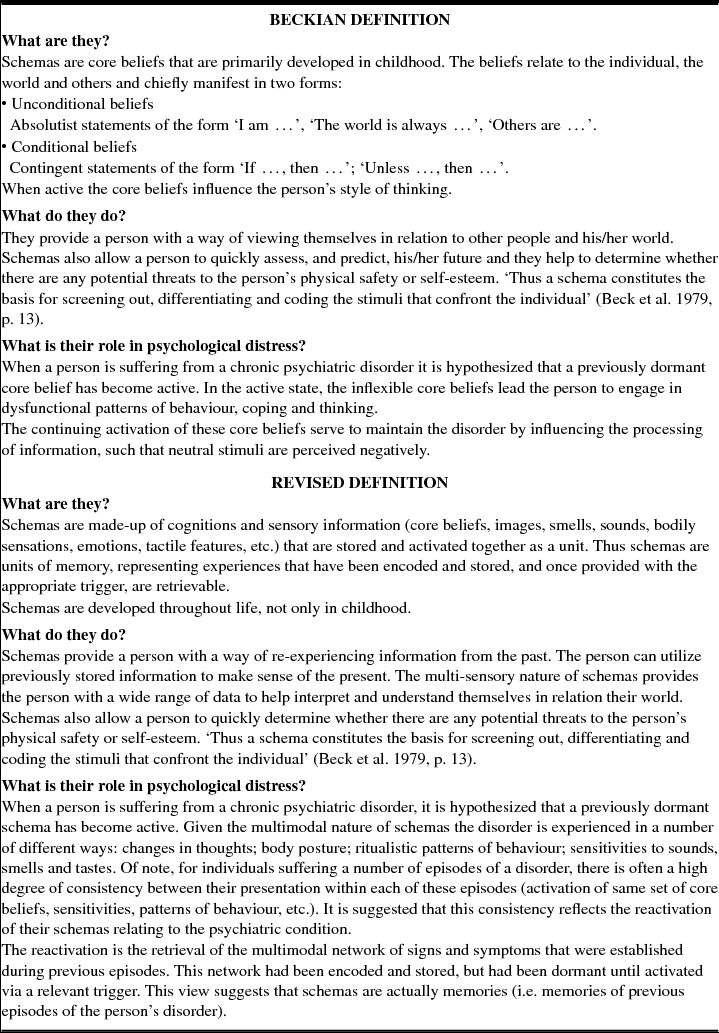
This was a survey of clinicians’ opinions conducted within a workshop format. Prior to the running of the workshops, expert advice was sought concerning the definitions of the schema. The definitions were developed by three experts in CBT, who were all lead professionals working at the Newcastle Cognitive Therapy Centre. The experts met for 3 hours, were given access to literature on schemas, and produced two definitions; one reflecting a Beckian perspective, and one detailing a multimodal perspective (i.e. revised). The survey data were collected during four free workshops on CBT for schemas facilitated by the last author (I.J.). The participants were recruited with the knowledge that they would be participating in a research project. A presentation relating to the traditional Beckian perspective was given, after which participants received the first pack of materials and measures (see below), which included the Beckian definition. They then completed the measures. In the second part of the workshop the revised perspective was outlined and then the second pack of measures was completed. This order was chosen as it was assumed that the participants would have prior knowledge of the Beckian perspective and that knowledge was expanded upon during the presentation on the revised perspective, which also encompasses the Beckian perspective.
Participants
All participants were mental health clinicians recruited to the study during their attendance at one of four workshops on schemas led by I.J. A total of 56 individuals were recruited. Of that total 50 provided at least one set of questionnaires, 47 provided data on both definitions and are included in the final analysis. The participants that were not included misunderstood the instructions and did not complete the questionnaires correctly.
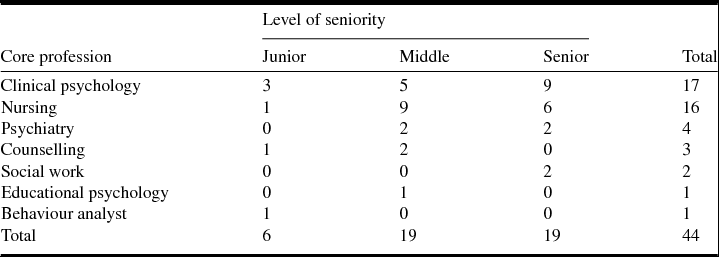
The number of participants within each core profession and their level of seniority is outlined in Table 1. Participants placed in the junior level were still at the training stage as regards their core profession, those in the middle level had qualified and those at a senior level were at a managerial/consultative level. It is clear that most of the participants came from a nursing or clinical psychology background. The majority of participants were qualified with a large proportion in senior roles.
Core professions and seniority of participants

Information was also collected on the client groups the participants worked with, whether they had a diploma in CBT and whether they were supervisors on a diploma course. As regards client group, 29 participants gave this information: twenty-one (72.4%) worked within adult mental health; four (13.8%) worked in child and adolescent mental health; and the remaining five participants were spread between older adults (n = 2, 6.9%), learning disability (n = 1, 3.4%) and addiction (n = 1, 3.4%). As regards diplomas in CBT, 45 participants provided this information: 11 (24.4%) did not have a diploma in CBT; 19 (42.2%) were training; and 15 (33.3%) had a diploma. Of the 43 participants that provided the information, 12 (27.9%) were supervisors on a CBT diploma course.
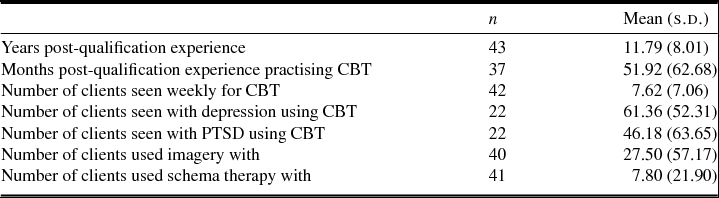
The information regarding the clinical experience of the participants is outlined in Table 2. The information shows that, while on average the participants were experienced mental health practitioners and had significant experience using CBT, there is a large standard deviation for each element of experience. This suggests that, as a group, the participants had varying degrees of experience. The one element where the participants had less experience is schema therapy. It is evident that, relative to the other areas of practice, fewer participants provided information about their experience with depression and post-traumatic stress disorder (PTSD). This was due to an error in the questionnaire used to collect the data that was remedied for the final two workshops.
Clinical experience of the participants

s.d., Standard deviation; PTSD, post-traumatic stress disorder.
Measures and materials
Each participant received two packs containing information and two questionnaires. The first pack contained the Beckian definition (see Appendix), a copy of the Schema Clinical Validity Questionnaire (SCVQ), and a copy of the Targets and Techniques Questionnaire (TTQ); both questionnaires were developed for the study. The second pack contained the revised definition (see Appendix) and copies of the SCVQ and TTQ. The development of the two questionnaires will now be described in detail.
SCVQ
The SCVQ was used to assess the perceived clinical utility of each definition. The development of the SCVQ went through two phases; draft development and piloting. During the first phase literature regarding the development of questionnaires was searched (e.g. Gillham, Reference Gillham2000). Following this, definitions of validity were obtained and the use of the term in other research was investigated. Criterion (or known-groups) validity tends to be defined as the ability of a test to distinguish affected and unaffected populations, including a determination of the probability of being affected. It refers to the clinical sensitivity, specificity and predictive value of a test. Where possible, these features were considered when developing the SCVQ.
Following this, 20 third-year trainee clinical psychologists were asked what they thought the most important aspects of a definition of schema are. Other questionnaires assessing the nature of schema [The nature of schema; M. H. Freeston, 2002 (unpublished questionnaire)] and schemas within clinical populations (e.g. Young & Brown, Reference Young and Brown1990) were also sourced for relevant information. Other literature deemed to be relevant concerning the parameters of models (Warr, Reference Warr, Chapman and Jones1980) and the key components of psychological formulations (Butler, Reference Butler, Bellack and Hersen1998; Bieling & Kuyken, Reference Bieling and Kuyken2003; Kuyken et al. Reference Kuyken, Fothergil, Musa and Chadwick2005) was also researched.
This process resulted in a draft that was tested out during the piloting phase. The draft was piloted on 10 third-year trainee clinical psychologists and four qualified clinical psychologists. Initial feedback suggested the questionnaire was too long and it was recommended that some questions be dropped. Based on this feedback a number of changes were made to both the content and design.
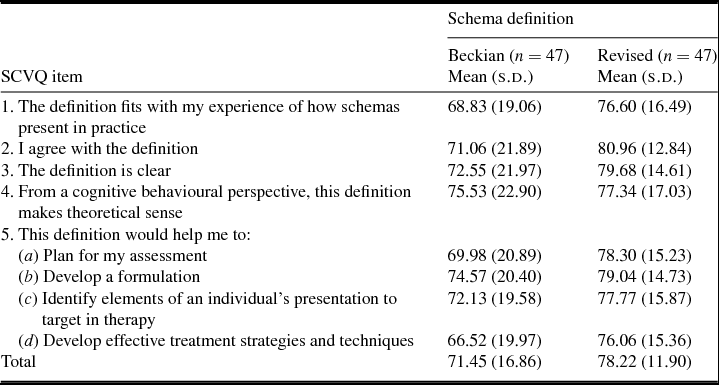
The finished SCVQ consists of eight statements, which the participant rates according to how much they agree with it, on a scale of 0–100. The first four statements refer to the extent to which the definition fits with the clinical experience of the participant, whether s/he agrees with the definition, whether the definition is clear and whether it makes theoretical sense. The last four statements are focused on how the definition would help the participant clinically, focusing on assessment, formulation, aspects of a client's presentation they would address in therapy (i.e. targets) and techniques they could use. Finally, there is an open question regarding what the participant found most helpful or unhelpful about the definition. Principal components analysis was conducted and all showed strong evidence of a single component (large eigenvalue on first component, small on subsequent). The present study found the SCVQ to have good internal consistency (eight items, Cronbach's α = 0.891, n = 46).
TTQ
The TTQ was also developed specifically for this study. The questionnaire had two distinct sections; one investigating the aspects of a client's presentation the participant would target in therapy (e.g. lethargy, beliefs of worthlessness, memories of being chastised at the dinner table), and another investigating the techniques they would use to do this (e.g. behavioural experiments testing intrusive memories, graded exposure addressing beliefs). The development of each section of the TTQ went through a draft development and piloting phase.
Targets
In order to develop a draft of this section of the questionnaire the definitions were used to ensure that they were both fully represented in terms of all possible targets being present. Relevant literature (e.g. Beck et al. Reference Beck, Rush, Shaw and Emery1979; Beck, Reference Beck1995) and clinical experience was also sourced to ensure that the relevant targets were present in the questionnaire.
Review of the content with respect to the two definitions indicated that the targets section consists of three subscales; Core Belief, Multimodal, and Generic. The Core Belief subscale, containing six targets, consists of targets that represent core beliefs and were identified as related specifically to the Beckian definition. The Multimodal subscale consists of targets unique to the revised definition as they were sensory and memory features of the presentation. The Multimodal subscale consists of six targets. The Generic subscale consists of the remaining targets that could have been applicable to either definition and contains 10 targets. Participants indicated ‘yes’ or ‘no’ to identify if they would address the specific target.
Following the development of the subscales, four clinical psychologists were recruited to ensure that the appropriate targets were placed in the appropriate subscale. In order to do this, the psychologists were given copies of the definitions and the TTQ and asked to assign each target to the subscale they felt most appropriate. All of the targets belonging to both the Core Belief and Multimodal subscales were assigned to the appropriate subscale. On average, eight of the ten targets belonging to the Generic subscale were appropriately assigned, with two being assigned to either the Core Belief or Multimodal subscales. This demonstrates that the target subscales had content validity.
There was good internal consistency for each treatment target subscale (Core Belief subscale, six items, Cronbach's α = 0.851, n = 48; Multimodal subscale, six items, Cronbach's α = 0.808, n = 48; Generic subscale, 10 items, Cronbach's α = 0.823, n = 48).
Techniques
During the development phase, relevant literature (e.g. Beck, Reference Beck1995; Leahy, Reference Leahy2003; Young et al. Reference Young, Klosko and Weishaar2004) was sourced to ensure that all possible techniques were included. For a technique to be deemed relevant it had to be related to at least one of the definitions of schema. The techniques contained in the questionnaire are those routinely used to treat depression using CBT. Additionally, others that may be used specifically when doing ‘schema therapy’ or when working with PTSD or anxiety were also included as they were potentially relevant to one, or both, of the definitions.
Review of the content with respect to the two definitions indicated that the techniques section consists of three subscales; Core Belief, Multimodal and Target-free. The Core Belief subscale consists of techniques that are thought to relate specifically to the Beckian definition, in that they are techniques generally used to address beliefs, and contains six techniques. The Multimodal subscale consists of 20 techniques which address sensory and memory features. These were deemed to be unique to the revised definition. The Target-free subscale consists of the remaining four techniques that could have been applicable to each definition. At the end of the techniques section space was given for participants to note any techniques they felt they would have used that had not been listed.
Following the development of the subscales, four clinical psychologists were recruited to ensure that the appropriate techniques were placed in the appropriate subscale. In order to do this, the psychologists were given copies of the definitions and the TTQ and asked to assign each technique to the subscale they felt most appropriate. All of the techniques belonging to both the Core Belief and Multimodal subscales were assigned to the appropriate subscale. On average, three of the four techniques belonging to the Target-free subscale were appropriately assigned, with one being inappropriately assigned to either the Core Belief or Multimodal subscales. This demonstrates that the technique subscales had content validity.
The present study reports good internal consistency on both the Core Belief (six items, Cronbach's α = 0.800, n = 47) and Multimodal (20 items, Cronbach's α = 0.850, n = 47) subscales but moderate internal consistency on the shorter Target-free subscale (four items, Cronbach's α = 0.569, n = 47).
Ethical approval
The proposal to carry out this research was subject to a process of independent peer review and was revised. Following approval by the review panel as to the viability of the project, ethical approval was sought and granted by a local NHS Ethics Committee to conduct the research. The project was registered and indemnity provided by the Research and Development Department of the NHS trust who employed the first author.
Analysis
Given that the prevailing Beckian understanding is extremely well-established in the literature, it was expected that both definitions would be judged to possess clinical utility and both would receive favourable ratings on the SCVQ. Therefore predicting that the revised definition would be superior to the Beckian is unrealistic and unwarranted because it would assume that the Beckian definition lacks clinical utility; in fact ceiling effects were possible. As a result a non-inferiority analysis was conducted. In a non-inferiority analysis a margin of interest is first determined and if the difference between the existing established condition and the new condition is less than this margin the new condition is considered as not inferior. The non-inferiority design also allows for superiority to be established if the new condition is outside of that margin in the direction of superiority. In this case, given the clinical utility is rated on 0–100 rating, the margin was specified as ±5 points; although this is arbitrary it was based on the idea that this covers 10% of the range of possible scores. Thus, if the mean of the difference ratings were within a 10-point band around the mean of the Beckian definition, the revised definition would be considered as non-inferior.
Given that the target and technique subscales were of different length, the percentage of items endorsed was used in all cases. The selection of treatment targets and techniques were compared using a 2×3 group×scale mixed-model repeated methods analysis of variance (ANOVA). Main effects and the interaction were tested at α = 0.05. Significant interactions were followed up with interaction 1 degree of freedom interaction contrasts; there are three contrasts so Bonferroni correction was used so α = 0.05/3. To control for experience and knowledge, a principal components analysis was conducted on the training and experience variables. Component scores were used as covariates.
Results
Clinical utility
The mean expressed agreement with the Beckian definition was 71.5 (s.d. = 16.9). The a priori 10-point margin around the mean (±5 points) is thus 66.5–76.5; coincidentally this effectively corresponds to the 95% confidence intervals (±4.95; lower CI = 66.5, upper CI = 76.4). The mean expressed agreement with the revised definition was 78.2 (s.d. = 11.9), falling outside the upper margin and so the definition is considered not only non-inferior, but superior to the Beckian definition. Further, this is supported by a paired-sample t test that indicates that the revised definition was rated significantly higher (t 46 = 2.65, p = 0.011). The means and standard deviations of the SCVQ items can be found in Table 3.
Means and standard deviations (s.d.) of SCVQ items
SCVQ, Schema Clinical Validity Questionnaire.
Targets and techniques
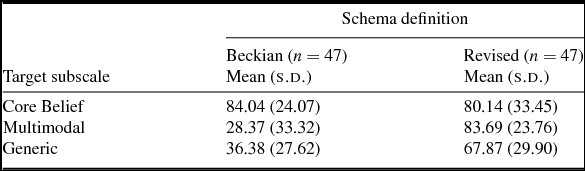
The mean percentage of targets endorsed and standard deviations of items selected from each target subscale for each definition can be found in Table 4. There was a significant main effect of definition (F 1,46 = 51.392, p = 0.000, η p2 = 0.528), with significantly more targets being identified following the revised definition, relative to the Beckian definition. There was also a significant main effect of subscale (F 2,92 = 29.487, p = 0.000, η p2 = 0.391). Critically, there was a significant interaction effect between definition and subscale (F 2,92 = 51.323, p = 0.000, η p2 = 0.527). This indicates that the definitions presented to participants led them to indicate different targets on the TTQ.
Mean percentages and standard deviations (s.d.) of targets selected
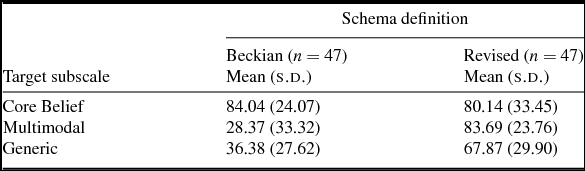
For the critical interaction effect, interaction contrasts were significant (α = 0.05/3) comparing the revised definition to the Beckian definition for the Core Belief subscale compared to the Multimodal subscale (F 1,46 = 89.313, p = 0.000, η p2 = 0.660), and the Generic subscale (F 1,46 = 44.855, p = 0.000, η p2 = 0.494), and for the Multimodal subscale compared to the Generic subscale (F 1,46 = 15.510, p = 0.000, η p2 = 0.252). The significant interaction contrasts along with examination of the means indicates that, following exposure to the revised definition during the workshop, the number of targets selected belonging to both the Multimodal and Generic subscales increased significantly, relative to the Beckian definition. Additionally, although there were more treatment targets endorsed across all subscales, the relative increases were greatest for the treatment targets consistent with the revised definition. Finally, the effect sizes were very large, both for the main effect but critically for the interactions, suggesting that a large proportion of the variance in the scores was due to the presentation and discussion of the revised definition.
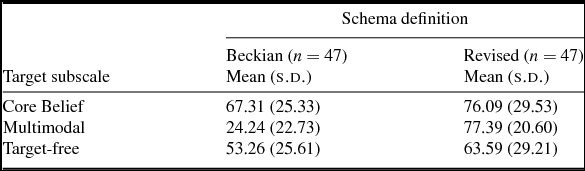
The mean and standard deviations of the percentage of treatment techniques endorsed by the participants for each subscale for each definition can be found in Table 5. There was a significant main effect of definition (F 1,45 = 68.183, p = 0.000, η p2 = 0.602), with significantly more techniques being identified following the revised definition, relative to the Beckian definition. There was also a significant main effect of subscale (F 2,90 = 18.458, p = 0.000, η p2 = 0.291). Importantly there was a significant interaction effect between definition and subscale (F 2,90 = 45.009, p = 0.000, η p2 = 0.500). This indicates that the definitions presented to participants led them to differentially endorse items on the three subscales of the TTQ.
Mean percentages and standard deviations (s.d.) of techniques selected
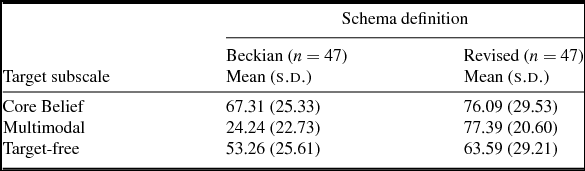
For the critical interaction effect, interaction contrasts were significant (α = 0.05/3) when comparing the revised definition to the Beckian definition for the Core Belief subscale compared to the Multimodal subscale (F 1,45 = 73.419, p = 0.000, η p2 = 0.620), but not the Target-free subscale (F 1,45 = 0.109, p = 0.743, η p2 = 0.002). The interaction contrast was also significant when comparing the revised definition to the Beckian definition for the Multimodal subscale relative to the Target-free subscale (F 1,45 = 54.798, p = 0.000, η p2 = 0.549). The interaction indicates that, following the revised definition, the percentage of techniques identified belonging to the Multimodal subscale increased relatively more than for the Core Belief subscale and the Target-Free subscale; the latter two increased to a similar degree. These results demonstrate that the revised definition led participants to differentially increase the range of treatments specific to the definition.
Principal components analysis with varimax rotation was conducted on ten ordinal or scale sociodemographic and professional items. Three components with eigenvalues >1 were identified. These were interpreted as CBT Expertise (six items), Experience (two items), and Role (two items), respectively. When the component scores were entered into the ANOVA as covariates, the effect sizes decreased slightly, but all previously significant main effects, interactions and interaction contrasts remained significant. Thus there is no evidence that these sociodemographic and professional variables influenced the results in any significant way.
Discussion
The results show that following presentations the revised definition was rated as possessing clinical utility (with average per cent agreements above 76% for all items) and through a non-inferiority analysis, it was judged as not inferior to the Beckian definition and indeed was rated as superior (non-inferiority analysis) and significantly higher (paired t test).
There was a significant interaction between definition and target, with a significantly greater increase in the percentage of Multimodal targets selected relative to the Core Belief and Generic targets following the revised definition. There was also a significant interaction between definition and technique, with a significantly greater increase in percentage of Multimodal techniques being selected than the Core Belief and Target-Free techniques following the revised definition compared to the Beckian definition. These results were independent of expertise or experience. Each of these findings will now be discussed in more detail.
The revised definition being rated as possessing clinical utility is vital for the study as it provides the foundation for considering the impact it could have on clinical practice. It was expected that it would be viewed as possessing no less clinical utility than the Beckian definition; however, the results demonstrate that it was viewed more favourably as assessed on the SCVQ.
The hypotheses regarding targets and techniques were also supported. Were the participants to use the revised definition, they would address more targets and utilize additional techniques during therapy, relative to the Beckian definition. The very large effect sizes suggest that a substantial amount of the variance was due to the training related to the revised definition. Importantly, analysis of the interactions demonstrated that the targets and techniques selected following the revised definition were relevant to that definition, in that they primarily belonged to the Multimodal subscales. For the targets, although the revised definition produced greater increases for Generic targets than Core Belief targets, the increases were greater again for the Multimodal subscale, suggesting that the revised definition had the desired specificity. With regard to techniques, the greater increase was only seen for the Multimodal subscale, as there was no differential increase between the Core Belief and Target-free subscales.
These results add weight to the argument that the revised definition has clinical utility and suggests that the definition would have important implications for treatment if it is used. However, it is important to note that this specificity effect is superimposed on an overall increase in endorsement of both targets and techniques across all scales, with greater specificity for the techniques. While the results (the main effects) do indicate that participants selected ‘more of everything’ the interactions and interaction contrasts show a degree of specificity, more so for techniques, and somewhat less for targets.
Overall, the results are supportive of the revised definition. It was rated as possessing clinical utility and participants reported that adopting it in clinical practice would lead to targeting a greater range of aspects of a client's presentation and using a greater range of therapeutic techniques to do so. The results would therefore appear to add weight to the theoretical underpinnings of the revised definition highlighted in the Introduction. If, as reported by the participants in this study, the revised definition has clinical utility, it could be argued that the use of that definition in therapy would lead to more elements of the schema being addressed, rather than purely beliefs. Whether this improves outcomes is of course an empirical question and would need development of manuals and a comparative trial conducted. Given that Beckian CBT is effective for depression (but perhaps less so for recurrent depression), a large trial may be necessary.
This would potentially have significant implications for CBT at a theoretical level and the practical levels of assessment, formulation and intervention. Theoretically, the results suggest that following the workshop, the participants agreed with the notion that schemas are memories that are represented through our senses and recollections, in addition to our beliefs. If this notion is to be adopted within CBT it would mean less emphasis being placed on beliefs which would represent a significant theoretical shift. Adopting the revised perspective would lead to broader assessments, routinely investigating the sensory experiences of clients and investigating in greater detail the memories that they feel are important in their presentation. Such elements would then have to be included in the formulation and linked to the current presentation. In turn, if these additional features were felt to be significant by the client they would be targeted in therapy with the use of a wider range of techniques.
Before concluding, it is important to acknowledge that the study has a number of limitations. First, it is possible that the study investigated the quality of the teaching, as opposed to the definitions. However, the levels of significance and specificity demonstrated by the results would be unlikely to occur were participants simply rating the teaching.
Second, it could be said that the results reflect a self-fulfilling prophecy, leading people to complete the questionnaires as hypothesized. Attempts were made to address this issue at the design stage. First, each definition was developed in conjunction with the expert panel to ensure they were both accurate representations of the theoretical positions. Second, the same questionnaires were used following each definition. Additionally, it is important to remember that the Beckian definition was rated as possessing high clinical utility and the Beckian targets and techniques were selected at higher rates than the alternatives after the initial presentation of the Beckian position. However, future studies could address this limitation more thoroughly by adopting a between-subjects design and presenting each definition to separate groups of clinicians and comparing the results.
A further potential limitation involves the motivation of the participants. They attended of their own free will and had information regarding the nature of the workshop and who was going to be presenting. Some of these participants may be more knowledgeable about schemas than the average clinician. It is possible that clinicians particularly interested in the area, or more specifically interested in the last author's ideas, were more likely to attend. Thus the degree to which these results would generalize to other samples of clinicians is unknown. This issue could also be addressed in future studies. For example, clinicians could be asked to attend without being given as much detail about what is on offer. Alternatively their affiliation towards the different definitions could be assessed prior to presenting the definitions and introduced as a covariate in the analysis to identify if that does in fact impact upon the results.
Finally, there are also limitations inherent in the measures. First, the limited information about the psychometric properties of the measures has to be acknowledged as a potential limitation. The study only provides information on the internal consistency and content and face validity of the measures. As such, test–retest reliability and criterion and/or predictive validity are not addressed. Second, the scales are of different lengths and may be differentially sensitive. Third, there is also the possibility of ceiling effects for the Core Belief subscales with high endorsement rates and so less room for increase.
Given the perceived clinical utility of the revised definition it would seem that future research into the definition is warranted. In particular, this research should be aimed at ensuring that the limitations identified above are addressed to provide a more stringent test of the definition and its utility. In addition, it is important to note that this study only compares the revised perspective to the Beckian definition. The Introduction highlighted the existence of other definitions of schema and future research could compare the revised definition to those perspectives to identify if it is also perceived as having greater clinical utility than those definitions. Finally, further work needs to be done to increase the links between the understanding of schema presented here and the other elements of CBT theory.
Conclusion
The results of the current study provide strong support for the revised definition of schema as it is viewed as possessing clinical utility. Clinicians reported that the use of it would lead to different targets being addressed in therapy and different techniques being used to do so. While there are a number of limitations of the study, the results are viewed as promising and further research into the revised perspective is warranted. Such research should focus on replicating the results using designs that address the limitations discussed and increasing the links with other elements of the CBT model.
Beckian and revised definitions of schema
Declaration of Interest
None.
After reading this paper people will be able to:
(1) Understand the Beckian concept of schema.
(2) Appreciate the potential role of memory in schema and have an understanding of a revised definition of schema which views schemas as memories.
(3) Appreciate the way in which adopting the revised definition of schema might change what we do in therapy.



Comments
No Comments have been published for this article.