Introduction
Depression and significant depressive symptoms are common clinical features in nursing home residents. While reported prevalence rates of depression vary across studies due to definitional and methodological differences, there is cumulative evidence that approximately one-third of U.S. nursing home residents suffer from significant depressive symptoms (Parmelee et al., Reference Parmelee, Katz and Lawton1989; Wagenaar et al., Reference Wagenaar, Coleenda, Kreft, Savade, Gardner and Povereja2003). Estimates of the prevalence of depression among assisted living residents are also high, with many studies indicating rates between 20% and 30% (Watson et al., Reference Watson, Garrett, Sloane, Gruber-Baldini and Zimmerman2003; Watson et al., Reference Watson2006). Less studied is the prevalence of anxiety in nursing home and assisted living residents. Available data indicate that the prevalence of anxiety disorders and sub-threshold anxiety symptoms in nursing home residents are approximately 5%–10% and 20%–30%, respectively (Beekman et al., Reference Beekman1998; Smallbrugge et al., Reference Smallbrugge, Pot, Jongenelis, Beekman and Eefsting2005). Similar prevalence rates have been reported in assisted living residents (Smith et al., Reference Smith2008; Cheng et al., Reference Cheng, Chen, Yip, Hua, Yang and Chiu2009; Neville and Teri, Reference Neville and Teri2011).
The fact that depression and anxiety are common among long-term care residents is concerning, as problems in mood have been associated with numerous negative outcomes. Diminished quality of life (de Beurs et al., Reference de Beurs, Beekman, van Balkom, Deeg, van Dyck and van Tilburg1999; Mendlowicz and Stein, Reference Mendlowicz and Stein2000), increased risk of falls, greater risk of poor rehabilitation outcomes (Givens et al., Reference Givens, Sanft and Mercantoni2008), greater lengths of stay in hospitals (Lenze, Reference Lenze2004), increased healthcare costs (Callahan et al., Reference Callahan, Hendrie and Tierney1995), and increased risk of mortality (Wagenaar et al., Reference Wagenaar, Coleenda, Kreft, Savade, Gardner and Povereja2003; Onge et al., Reference Saint Onge, Krueger and Rogers2014) are examples. Unfortunately, both depression and anxiety appear to be under-recognized and under-treated in long-term care settings (Wagenaar et al., Reference Wagenaar, Coleenda, Kreft, Savade, Gardner and Povereja2003; Smallbrugge et al., Reference Smallbrugge, Pot, Jongenelis, Beekman and Eefsting2005).
To better understand how depression and anxiety are assessed and treated in long-term care settings, we conducted a national online survey of healthcare professionals working in these clinical environments. One hundred sixty-four professionals from 34 U.S. states, representing primary care, psychiatry, psychology, psychiatric social work, nursing, and rehabilitation therapy, completed the survey. Ninety-eight percent responded that assessing MDE is important, but 44% reported that they do not utilize a formal depression instrument. Ninety-eight percent of the respondents also said that assessing generalized anxiety is important, but only 20% used a formal anxiety measure. One potential barrier to routinely administering formal mood instruments, even those that are relatively brief, is the limited time healthcare providers can spend on assessments (Yarnall et al., Reference Yarnall, Pollak, Østbye, Krause and Michener2003). This point is well made by Østbye et al. (Reference Østbye, Yarnall, Krause, Pollak, Gradison and Michener2005), who report that providers simply do not have adequate time to assess co-occurring medical problems, inclusive of depression and anxiety. Of course, to assess both depression and anxiety typically requires two separate measures, and places additional demands on time. In our survey, 96% of respondents reported that an instrument that rapidly assesses both depression and anxiety is needed, but a premium must be placed on brief administration for it to be used.
This paper describes the development and validation of the BADS, a new screening tool that can identify possible MDE and GAD in long-term care residents. The BADS was designed so that it: (a) can be administered by paraprofessionals and clinicians alike; (b) can be completed in three minutes or less; (c) is sensitive to both MDE and GAD; and (d) can be utilized for residents without and with dementia. Our primary goal was to design a brief mood screening tool that can accurately and rapidly identify possible MDE and GAD, and therefore identify residents who can be referred for a more comprehensive evaluation of mood.
We believe that an integrated mood scale that produces separate depression and anxiety factor scores for long-term care residents is unique. A review of the literature reveals that the three most commonly used depression scales in long-term care settings, the Patient Health Questionnaire-9 (PHQ-9; Saliba et al., Reference Saliba2012), the Geriatric Depression Scale Short Form (GDS-SF; Sheikh and Yesavage, Reference Sheikh and Yesavage1986), and the Cornell Depression Scale for Dementia (CSDD; Alexopoulos et al., Reference Alexopoulos, Abrams, Young and Shamoian1988) assess depression, but not anxiety. Similarly, anxiety scales, such as the Generalized Anxiety Disorder 7-item scale (GAD-7; Spitzer et al., Reference Spitzer, Korenke, Williams and Löwe2006), assess anxiety, but not depression.
Methods
Participants
A total of 277 individuals residing in a skilled nursing facility (n = 179) and two assisted living facilities (n = 98) in Maryland were referred for neuro-cognitive evaluation (October 2012–June 2014). Two hundred twenty-four of those individuals met inclusion criteria for data analysis, which required a completed BADS and Brief Cognitive Assessment Tool – Short Form (BCAT-SF; Mansbach and MacDougall, Reference Mansbach and MacDougall2012), proficiency in English, and age > 59 years. Patients with any medical or psychiatric symptoms that would prevent completion of the tests (e.g. global aphasia, psychosis) were excluded.
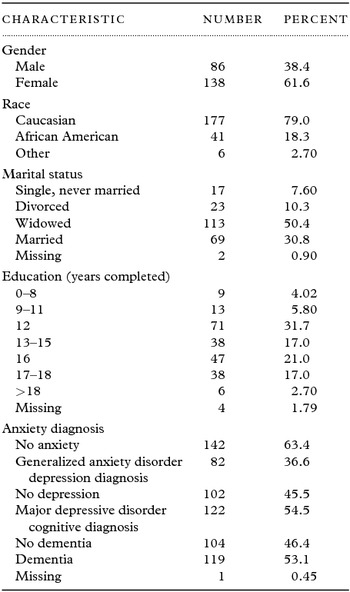
Participants ranged in age from 61 to 102 years, with a mean age of 80.52 (± 9.07). As presented in Table 1, 62% of participants were female, 79% were Caucasian, 50% were widowed, 42% had up to 12 years of education, and 58% had at least some post-secondary education. Participant cognitive and mood diagnoses are also presented in Table 1. Fifty-five percent of participants met diagnostic criteria for MDE, 36.6% percent of the sample met diagnostic criteria for GAD, and 30.8% had both. Fifty-four percent of participants met diagnostic criteria for dementia (mild, moderate, severe) while 46% did not have a diagnosis of dementia (including mild cognitive impairment) (see Table 1).
Select demographics and diagnoses of participants

Note: N = 224.
We compared participants from the assisted living and skilled nursing facilities to determine if there were significant differences in depression and anxiety diagnoses and key demographic variables. Non-significant χ 2 tests for independence indicated no significant differences between participants from the nursing home and assisted living subsamples. This aligns with aforementioned prevalence studies that suggest similar rates of depression and anxiety in nursing homes and assisted living facilities (Parmelee et al., Reference Parmelee, Katz and Lawton1989; Beekman et al., Reference Beekman1998; Wagenaar et al., Reference Wagenaar, Coleenda, Kreft, Savade, Gardner and Povereja2003; Watson et al., Reference Watson, Garrett, Sloane, Gruber-Baldini and Zimmerman2003; Smallbrugge et al., Reference Smallbrugge, Pot, Jongenelis, Beekman and Eefsting2005; Watson et al., Reference Watson2006; Smith et al., Reference Smith2008; Cheng et al., Reference Cheng, Chen, Yip, Hua, Yang and Chiu2009; Neville and Teri, Reference Neville and Teri2011). Therefore, for the purposes of the present study, the skilled nursing and assisted living subsamples were combined for data analysis.
Procedure
The facilities’ Medical Affairs Committee approved all procedures, and all participants or their responsible parties completed appropriate consent agreements. Participants were referred for evaluation of current mood and cognitive status by facility attending physicians. Mental health professionals with specific expertise in the evaluation of mood and cognitive disorders conducted all evaluations. Evaluations consisted of: a clinical interview with the patient; comprehensive review of the medical chart, inclusive of hospital discharge summaries; administration of the GDS-SF, and GAD-7, BCAT-SF, and BADS; staff interviews, and interviews with family members. Diagnoses were made using the Diagnostic and Statistical Manual of Mental Disorders (4th ed., text rev.; DSM-IV-TR; American Psychiatric Association, 2000) criteria to diagnose mood disorders. MDE and GAD were diagnosed based on the DSM-IV-TR criteria. The Clinical Dementia Rating Scale (CDR; Morris, Reference Morris1993) criteria were used for the diagnosis of dementia. Mood diagnoses were made without knowledge of BADS scores.
Measures
Brief anxiety and depression scale (BADS)
The BADS is an eight-item scale that can be individually administered in three minutes or less. It was developed over a two-year period, and the individual items were selected to address symptoms of anxiety and depression. Initially, 30 items were selected, 22 of which represented depressive symptoms and eight represented indications of anxiety. Items were consistent with diagnostic symptoms for both MDE and GAD, but also included somatic and behavioral symptoms (e.g. physical complaints, signs of agitation) as these are often reported by depressed older adults. Three psychologists trained in geriatric behavioral health screened these items for face validity, and 20 items were deleted based on their feedback. Next, five healthcare professionals (one professional representing the disciplines of psychiatry, psychology, psychiatric social work, occupational therapy, and speech therapy) were interviewed to provide a second round of feedback regarding the face validity and clarity of the 10 remaining items. Two items were deleted based on redundancy, and two items were rewritten to make them less technical. The final eight items of the BADS were then pilot tested in clinical situations, and several items were revised to improve their clarity. Total BADS scores range from 0 to 16, with respondents answering “no”, “somewhat”, or “yes” for each item.
Geriatric depression scale short form (GDS-SF)
The GDS-SF (Sheikh and Yesavage, Reference Sheikh and Yesavage1986) was selected as a validity measure for this study because it was the most frequently used depression measure as reported in our survey. Scores on the 15-item GDS-SF range from 0 to 15, with higher scores indicating a greater likelihood of depression. Researchers have reported validity data for the GDS-SF from a variety of settings. A reliability generalization study reported average GDS reliability (including all short forms) to be 0.85 (Kieffer and Reese, Reference Kieffer and Reese2002). de Craen et al. (Reference de Craen, Heeren and Gussekloo2003) reported good sensitivity and adequate specificity in the oldest-old (>85 years). However, de Craen et al. (Reference de Craen, Heeren and Gussekloo2003) also stated that the GDS-SF is most useful for older adults with minimal to no cognitive impairment.
The GDS-SF had an internal consistency reliability of 0.76 (Cronbach's α based on standardized items) in the current study.
Generalized anxiety disorder 7-item scale (GAD-7)
The GAD-7 (Spitzer et al., Reference Spitzer, Korenke, Williams and Löwe2006) was designed to identify GAD and symptom severity, as anxiety disorders are common in general medical practice (Spitzer et al., Reference Spitzer, Korenke, Williams and Löwe2006). It was included as a validity measure for this study because it was the most frequently used anxiety measure as reported in our national survey. GAD-7 scores range from 0 to 27, and points are derived in self-reported anxiety symptom frequency. In the GAD-7 development study conducted in 15 primary care facilities (N = 2,740), Spitzer et al. (Reference Spitzer, Korenke, Williams and Löwe2006) found preliminary evidence for reliability (Cronbach's α = 0.92), as well as criterion, construct, and factorial validity. Wild et al. (Reference Wild2013) investigated the psychometric properties of the GAD-7 in a community-dwelling sample of older adults (N = 438). Using a recommended cut-score of 5, the GAD-7 has a sensitivity of 0.63 and specificity of 0.90 for identifying GAD in older adults (Wild et al., Reference Wild2013). Despite the high prevalence of anxiety symptoms in long-term care (Smallbrugge et al., Reference Smallbrugge, Pot, Jongenelis, Beekman and Eefsting2005), the GAD-7 has not been fully validated in skilled nursing or assisted living settings.
The GDS-SF had an internal consistency reliability of 0.81 (Cronbach's α based on standardized items) in the current study.
Brief cognitive assessment tool – short form (BCAT-SF)
The BCAT-SF (Mansbach and MacDougall, Reference Mansbach and MacDougall2012) was designed as a shorter version of the full BCAT to be utilized when time for cognitive screening is constrained (e.g. primary care settings). The BCAT-SF was selected as the divergent validity measure as it is commonly used in long-term care settings to rapidly assess cognitive functioning. The BCAT-SF can be easily administered in less than five minutes with scores ranging from 0 to 21. Using a cut-score of 16, the BCAT-SF differentiated between MCI and dementia with a sensitivity of 0.90 and a specificity of 0.81 (AUC = 0.93) (Mansbach and MacDougall, Reference Mansbach and MacDougall2012).
The BCAT-SF had an internal consistency reliability of 0.81 (Cronbach's α based on standardized items) in the current study.
Statistical analysis
The statistical analyzes in this study were performed using SPSS. Descriptive statistics were used to report participant characteristics, validity measures, and participant diagnoses. A principle component analysis (PCA) was used to explore factor loadings and communalities with an oblique rotation for the eight items of the BADS. The non-orthogonal direct oblimin rotation was selected because it allowed the BADS Anxiety Factor and Depression Factor scores to be somewhat correlated. Internal consistency reliability was estimated by Chronbach's α coefficient based on standardized items. Pearson correlation coefficients were used to address convergent and divergent validity. Pearson correlations were also used to examine the potential overlap between the Anxiety Factor and Depression Factor for individuals without and with dementia. Logistic regression analyzes were used to estimate the amount of variance in MDE and GAD diagnoses explained by the BADS factor scores. Independent-sample t-tests were used to measure mean differences in BADS factor scores between key variables. The predictive validity was addressed with analyzes of sensitivity, specificity, positive predictive value (PPV), and negative predictive value (NPV). Cut-scores for were selected that yielded the optimal balance between sensitivity and specificity in identifying participants with GAD and MDE, respectively. Receiver operating characteristic (ROC) curves and area under the ROC were calculated for differentiating MDE and GAD from sub-threshold symptoms of anxiety and depression.
Results
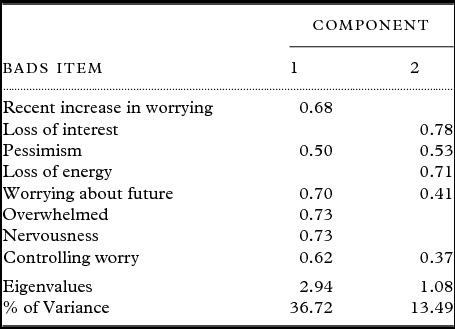
The eight items of the BADS were subjected to a PCA with oblique rotation (direct oblimin). The Kaiser–Meyer–Olkin (KMO) measure verified that the sample size was adequate (KMO = 0.82), and Bartlett's Test of Sphericity indicated that correlations between items were sufficiently large for factor analysis (p < 0.001). The PCA revealed two components with eigenvalues exceeding Kaiser's criterion of 1. Together, these components explained a total of 50.26% of the variance, with Component 1 contributing 36.72% and Component 2 contributing 13.49%. As presented in Table 2, the varimax-rotated structure-matrix clearly confirmed the original allocation of the items in the BADS. The anxiety items had the highest factor loadings on component 1 (0.62–0.73) and the depression items had the highest factor loadings on component 2 (0.53–0.77). There was a positive correlation between the two factors (r = 0.44). The results of the PCA support the use of the anxiety and depression items as separate factor scores within the BADS. Subsequently, Component 1 and Component 2 were retained for further analyzes as the Anxiety Factor and the Depression Factor, respectively. (see Table 2)
Summary of exploratory principal components analysis results (PCA) for the Brief Anxiety and Depression Scale (BADS)

Note: Rotated factor loadings are shown. Only factors greater than 0.50 are reported. The Kaiser–Meyer–Olkin measure of sampling adequacy was 0.82 and Bartlett's Test of Sphericity was significant (p < 0.001). Component 1 and Component 2 were extracted as the Anxiety Factor and the Depression Factor, respectively.
BADS raw scores in this sample (range = 0–16) were normally distributed. Mean BADS scores were not significantly different for race (African-American, Caucasian), marital status (married, widowed, divorced, single), education, facility (assisted living, skilled nursing), and sex. When classifying patients using CDR, BADS mean scores were not significantly different for individuals with dementia (M = 6.88, SD = 0.40) and those without dementia (M = 7.27, SD = 0.40), t(222) = −0.91, p = 0.36. However, total BADS scores were significantly negatively correlated with age (r = −0.20, p < 0.01). The mean inter-item correlation for the BADS was 0.27, which is consistent with the recommendations made by Clark and Watson (Reference Clark, Watson and Kazdin1995).
Reliability
The internal consistency reliability of the BADS, as estimated by Cronbach's α based on standardized items, was 0.75. This coefficient is well within the acceptable range for tests that will be used for clinical decision-making (Nunnally and Bernstein, Reference Nunnally and Bernstein1994).
Validity
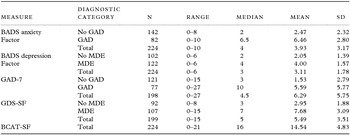
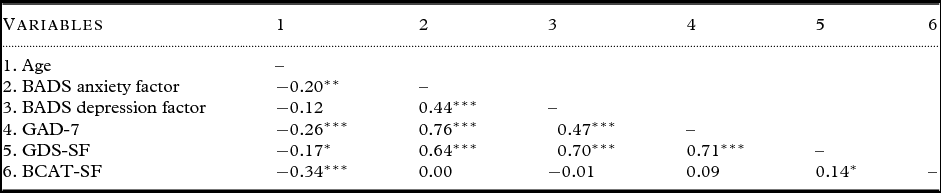
Table 3 presents descriptive statistics for all validity measures used in the current study. Construct validity of the BADS factor scores was supported by significant correlations with measures of mood and non-significant correlations with a measure of cognitive functioning. As presented in Table 4, convergent validity was demonstrated by the significant correlation of the Anxiety Factor with the GAD-7 (r = 0.76, p < 0.001). Moreover, the Depression Factor was significantly correlated with the GDS-SF (r = 0.70, p < 0.001). In individuals without dementia (r = 0.43, p < 0.001) and with dementia (r = 0.45, p < 0.001), the Anxiety Factor and Depression Factor scores had similar positive and significant correlations. Discriminant validity was demonstrated by the absence of a significant relationship between the Anxiety Factor (r = 0.07, p = 0.31) and Depression Factor (r = −0.01, p = 0.99) with the BCAT-SF. Regression analyzes provided further evidence of the construct validity of the BADS factor scores in the current study context. The Anxiety Factor was a significant predictor of anxiety as measured by the GAD-7, accounting for 58.7% of the variance in GAD-7 scores (R 2 = 0.59, F (1, 197) = 278.11, p < 0.001). Similarly, the Depression Factor was a significant predictor of depression as measured by the GDS-SF, accounting for 57.5% of the variance in GDS-SF scores (R 2 = 0.58, F (1, 197) = 265.38, p < 0.001). Finally, an independent-sample t-test revealed that mean Anxiety Factor scores were significantly different for participants identified with GAD (M = 6.46, SD = 2.80) from those who did not meet criteria for GAD (M = 2.47, SD = 2.32), t(222) = −11.49, p = 0.00. Likewise, mean Depression Factor scores were significantly different for participants with MDE (M = 4.00, SD = 1.57) from those who did not meet criteria for MDE (M = 2.05, SD = 1.39), t(222) = −9.76, p = 0.00. BADS and factor scores by diagnostic category are also presented in Table 3. (see Tables 3 and 4)
Descriptive statistics by diagnostic category for the validity measures

Note: BADS (Brief Anxiety and Depression Scale); GAD-7 (Generalized Anxiety Disease 7-item Scale); GDS-SF (Geriatric Depression Scale Short Form); BCAT-SF (Brief Cognitive Assessment Tool – Short Form); MDE (Major Depressive Episode); GAD (Generalized Anxiety Disorder).
Matrix of Pearson correlation coefficients

Note: BADS (Brief Anxiety and Depression Scale); GAD-7 (Generalized Anxiety Disease 7-item Scale); GDS-SF (Geriatric Depression Scale Short Form); BCAT-SF (Brief Cognitive Assessment Tool – Short Form).
Significance levels: *p < 0.05, **p < 0.01, and ***p < 0.001 (two-tailed test).
The predictive utility of the BADS factor scores were addressed with analyzes of sensitivity, specificity, PPV, and NPV. Two separate ROC curve analyzes were conducted to identify: (1) GAD versus sub-threshold anxiety or no anxiety, using the Anxiety Factor score; and (2) MDE versus sub-threshold depression or no depression, using the Depression Factor score. As presented in Table 5, cut-scores were selected that yielded the optimal balance between sensitivity and specificity. For the Anxiety Factor, a cut-score of > 4 (scores 4 and below indicating no GAD) yielded the optimal balance of sensitivity (0.73) and specificity of (0.81) for identifying GAD (PPV = 0.69, NPV = 0.84). For the Depression Factor, a cut-score of > 2 (scores 2 and below indicating no MDE) yielded the optimal balance of sensitivity (0.76) and specificity of (0.73) for identifying MDE (PPV = 0.77, NPV = 0.72). A ROC curve was calculated from sensitivity and 1-specificity values. The area under the ROC curve for the Anxiety Factor was 0.85, p < 0.001, 95% CI [0.80, 0.90]; and for the Depression Factor was 0.81, p < 0.001, 95% CI [0.75, 0.86]. (see Table 5)
Predictive utility of the BADS factor scores based on receiver operating curve (ROC) analysis

Note: AUC (Area Under the Curve); PPV (Positive Predictive Value); Negative Predictive Value (NPV). 95% confidence interval in parentheses.
aBADS anxiety cut-scores to identify participants with GAD versus no GAD.
bBADS depression cut-scores to identify participants with MDE versus no MDE.
Discussion
The BADS is an eight-item mood scale designed to rapidly identify long-term care residents with probable MDE and GAD. The need for such a tool was clearly identified in an online national survey of geriatric healthcare providers. This screening tool yields separate anxiety and depression factor scores that can identify residents who would benefit from a more comprehensive evaluation of mood. The eight items are simply presented, with easy to understand rating instructions for screened residents, which may explain why we found no education bias. As such, both professionals and non-licensed facility staffs can administer and interpret the scale. The instrument can be administered in three minutes or less. The BADS mood factors demonstrated robust psychometric properties for their intended use as a screening tool, with evidence of strong reliability, construct validity, and predictive validity.
BADS factor scores did not significantly differ between residents with and without dementia. In addition, the significant correlation between the BADS factor scores was maintained in both individuals without dementia and with dementia. Perhaps, this provides evidence that depression and anxiety share common features of psychological distress independent of cognitive functioning. This is noteworthy given the high base rate of cognitive impairment in both nursing homes and assisted living facilities. In fact, the prevalence of cognitive impairment and dementia in nursing homes and assisted living facilities is estimated to be 70%–80%, and 50%–60%, respectively (Samus et al., Reference Samus2013; Mansbach et al., Reference Mansbach, Mace and Clark2014). Therefore, it is important that a mood screening tool has adequate ability to identify depression and anxiety in both residents with dementia and without dementia. One concern about the commonly used GDS-SF is that is has been shown to be less sensitive to detecting depression in older adults with dementia (de Craen et al., Reference de Craen, Heeren and Gussekloo2003).
One interesting finding from this study is that we found a significant inverse relationship between age and the Anxiety Factor scores. That is within our sample, relatively older residents tended to have lower Anxiety Factor scores than younger residents (r = −0.20, p < 0.01). However, this relationship was not found between age and the Depression Factor (r = −0.12, p = n.s.). In this study, both the GAD-7 (r = −0.26, p < 0.001) and GDS-SF (r = −0.17, p < 0.05) also were significantly and inversely associated with age. It is unclear why the Depression Factor was not significantly negatively associated with age, as underreporting of mood symptoms has long been documented (Lyness et al., Reference Lyness, Cox, Curry, Conwell, King and Caine1995). One possible explanation is the fact that the Depression Factor items were constructed with less stigma-associated words. For example, the factor items do not use the word depression. In the Anxiety Factor, GAD-7, and GDS-SF, more clinically oriented words are used.
From a clinical standpoint, we recommend for the Anxiety Factor a cut-score of 4/5 for differentiating probable GAD from sub-threshold anxiety or no anxiety. That is, scores of five and above indicate probable GAD and the need for further evaluation. For the Depression Factor, a cut-score of 2/3 is recommended for differentiating between MDE and sub-threshold depression or no depression. Residents with scores of 3 or higher have a probable MDE and should be further assessed. The sensitivity and specificity values for these cut-scores achieve an optimal balance in minimizing inaccurate judgments about mood functioning and in making appropriate referrals for further evaluation. The concomitant PPV and NPV values were strong. Still, the BADS is a screening tool and the actual diagnosis of MDE and GAD should be made only with confirmatory assessment procedures administered by a licensed professional. Furthermore, one should exercise caution in assessing persons with dementia as severe cognitive impairment can limit insight and communication of mood symptoms. In such circumstances, the clinician might place more value on proxy information. Finally, the clinician should identify and address co-morbid or underlying medical conditions (e.g. thyroid disease, Parkinson's disease, insomnia) that are often associated with depression. Failure to do so could result in false diagnoses of depression or “pseudo-depression.”
There are important caveats and study limitations that bear consideration. First, the BADS was developed for and its psychometric properties were investigated on a long-term care population. A useful next step would be to explore the utility of the BADS in community-based and hospital settings. PPV and NPV values are dependent on base rates of impairment, and both depression and anxiety may be less or more prevalent in other settings. Second, the BADS is sensitive to MDE and GAD. It was not designed to assess sub-threshold states of depression and anxiety, or other mood features such as mania and hypomania.
In conclusion, the BADS appears to be a reliable and valid screening instrument for MDE and GAD in long-term care residents. Consistent with the time constraints of clinicians who are evaluating older adults for possible depression and anxiety, the BADS can be completed in a brief amount of time. In the current study, the average administration time for without dementia residents was approximately three minutes, and the average administration time for residents with dementia was just under five minutes. The recommended cut-scores for the Depression Factor and Anxiety Factor scores can be used clinically to identify probable mood diagnoses that can be confirmed by a subsequent or concurrent mood evaluation.
Conflict of interest
None.
Description of authors’ roles
-
1. W. Mansbach designed the study, supervised a portion of the data collection, and wrote the Introduction and Discussion sections.
-
2. R. Mace assisted with the design of the study, entered and analyzed the data, wrote the Methods and Results sections.
-
3. K. Clark assisted with the design of the study, supervised data collection, collected data, and assisted with reviewing and revising the manuscript.
-
4. All authors read and approved the final paper.