Introduction
Intestinal parasitic infections (IPIs) impose a great burden on the underprivileged populations in developing countries especially those with poor hygienic conditions and particularly among school-aged children (Forson et al., Reference Forson, Arthur and Ayeh-Kumi2018; Sitotaw et al., Reference Sitotaw, Mekuriaw and Damtie2019). The impacts of these parasitic diseases have traditionally been given low priorities in public health planning and in control. This deaf ear attitude has left people in endemic areas without any comprehensive effort to combat these infections (Opara et al., Reference Opara, Udoidung, Opara, Okon, Edosomwan and Udoh2012; Liao et al., Reference Liao, Fu, Kao, Lee, Chen, Chuang, Naito, Chou, Huang, Bonfim and Fan2016; Gadisa and Jote, Reference Gadisa and Jote2019). Currently, this approach has improved and a variety of strategies focus on preventive chemotherapeutic interventions. Proper diagnosis is the key element for adequate patient management as well as for monitoring control programmes (WHO, 2012).
The Kato-Katz thick smear and the formalin ether concentration method (FECM) remain the preferred techniques for the diagnosis of helminths eggs and protozoa oocysts and cysts in many parasitology laboratories (Qian et al., Reference Qian, Yap, Yang, Liang, Jiang, Li, Utzinger, Zhou and Keiser2013; Zenu et al., Reference Zenu, Alemayehu and Woldemichael2019). Owing to its simplicity and relatively low cost, the Kato-Katz thick smear from fresh stools has been recommended for the diagnosis of intestinal schistosomiasis and soil-transmitted helminthiasis. However, limitations of low sensitivity and the necessity of diverse clearing times for the different eggs, to obtain reliable results still exist. Moreover, Kato-Katz is not suitable for the diagnosis of protozoa (Speich et al., Reference Speich, Ali, Ame, Albonico, Utzinger and Keiser2015; Bärenbold et al., Reference Bärenbold, Raso, Coulibaly, N'Goran, Utzinger and Vounatsou2017). FECM is commonly used as a valid diagnostic method, particularly for preserved stool samples which can be examined in the laboratory several days or even weeks after stool collection. This procedure allows for the diagnosis of both helminths and intestinal protozoa, but results were inconsistent in the different laboratories (McHardy et al., Reference McHardy, Wu, Shimizu-Cohen, Couturier and Humphries2014; Garcia et al., Reference Garcia, Arrowood, Kokoskin, Paltridge, Pillai, Procop, Ryan, Shimizu and Visvesvara2018).
FLOTAC is based on the centrifugal floatation of a fecal suspension with subsequent translation of its apical portion (Cringoli et al., Reference Cringoli, Rinaldi, Maurelli and Utzinger2010). It was introduced to detect parasitic elements present in 1 g of feces 24 times more than with a single Kato-Katz thick smear with high accuracy and precision. Nine flotation solutions (FSs); FS1-FS9 with different compositions and specific gravity (s.g.), varying between 1.2 and 1.45 have been tested by FLOTAC (Cringoli et al., Reference Cringoli, Rinaldi, Maurelli and Utzinger2010). FLOTAC technique can be performed both on fresh feces, stored feces at 1–4 ○C for up to 3 days or 5–10% formalin preserved stool samples for weeks or months (Barda et al., Reference Barda, Zepherine, Rinaldi, Cringoli, Burioni, Clementi and Albonico2013; Sarhan et al., Reference Sarhan, Shaaban, Hassan and Salem2018). This technique was found to be useful for processing large numbers of samples requiring rapid laboratory diagnosis. It has also been developed with the aim of combining sensitivity and low cost in order to allow laboratories in resource-limited settings to rely on a good method both for diagnostic and epidemiological purposes (Becker et al., Reference Becker, Lohourignon, Speich, Rinaldi, Knopp, N'Gora, Cringoli and Utzinger2011; Abdel-Gaffar et al., Reference Abdel-Gaffar, Sadek, Oshiba and Esmail2018).
The aim of this study was to evaluate the diagnostic performance of the Kato-Katz, FECM and FLOTAC, using three flotation solutions (Sheather's sugar solution-FS1, saturated sodium chloride-FS2 and zinc sulfate-FS7) for the diagnosis of intestinal parasites (protozoa and helminths) among school children in a rural area in Egypt. Particular emphasis was laid on the prevalence and intensity of Schistosoma mansoni as detected by the three techniques.
Material and methods
Study setting
This study was carried out in a primary school in Motobus district in Kafr El Sheikh Governorate, 100 km East of Alexandria. In this area, farming is the major source of economic activity and agriculture employs most of the workforce.
Ethics statement
The study was approved by the Egyptian Ministry of Health and the Ethical Committee of the Medical Research Institute, Alexandria University (IORG 0008812). The outlines of the study were explained to the teachers, parents and students. Samples were collected after informed consents were obtained from school guardians and children's parents. Children diagnosed positive by any of the used methods for IPIs were treated according to the protocol followed by the Egyptian Ministry of Health.
Collection and examination of stool samples
Out of a total of 150 school children selected randomly from all grades and asked to provide stool samples, 90 students from the 2nd to the 6th grades agreed to participate in the present study.
The school was visited on two consecutive days every week. On the first day, tightly closed plastic containers labelled with the student's name, class and an identification number were distributed. On the next day, the containers were collected and brought to the Parasitology Laboratory of the Medical Research Institute for preparation of stool samples and microscopic examination. All collected stool samples were examined in parallel by the Kato-Katz method (duplicate smears, each of 41.7 mg) for fresh stool sample, FECM (Suwansaksri et al., Reference Suwansaksri, Nithiuthai, Wiwanitkit, Soogarun and Palatho2002; Garcia et al., Reference Garcia, Arrowood, Kokoskin, Paltridge, Pillai, Procop, Ryan, Shimizu and Visvesvara2018) and FLOTAC technique using the three flotation solutions; FS1: Sheather's sugar solution (C12H22O11), s. g. = 1.20, FS2: saturated sodium chloride, s. g. = 1.20, and FS7: zinc sulphate, ZnSO4.7H2O, s. g. = 1.35. All prepared FSs were stored at room temperature (20 −25°C) in black bottles until used (Cringoli et al., Reference Cringoli, Rinaldi, Maurelli and Utzinger2010).
One gram of each stool sample was preserved in 10% formalin (1: 3) in falcon tubes to be processed by FLOTAC and formalin ether concentration techniques. The FLOTAC apparatus was dedicated to the Parasitology Department, Medical Research Institute by Professor Giuseppe Cringoli, Department of Veterinary Medicine and Animal Production, University of Naples Federico II, Italy.
For processing the FLOTAC technique, a modified protocol was used where each preserved sample was poured through a wire mesh. The filtered suspension was centrifuged at 1500 rpm for 3 min. The supernatant was discarded. Each tube was refilled with 10 mL of FS. Every chamber of the FLOTAC apparatus was filled with 5 mL fecal suspension (0.5 g of feces) using a pipette. The FLOTAC apparatus was centrifuged for 5 min at low speed (the centrifuge was manufactured manually in the Medical Research Institute). The FLOTAC was then translated to detect the IPIs (Cringoli, Reference Cringoli2006).
Statistical analysis
Data were coded, tabulated and analysed using IBM SPSS for Windows, Version 20.0 (Armonk, NY, USA: IBM Corp). For descriptive analyses, the prevalence by different methods was articulated in percentages. The χ 2 test was used to compare frequency data. The results were considered statistically significant when P value was ⩽0.05. Kappa index (κ) was employed to determine the strength of agreement, interpretation of κ value was as follows: κ < 0.2 poor agreement, κ = 0.2–0.4 fair agreement, κ = 0.4–0.6 moderate agreement, κ = 0.61–0.8 good agreement, κ = 0.81–1.0 very good agreement (Ashby, Reference Ashby1991). The results of all specimens collected were classified and all diagnostic parameters were calculated at 95% CI using MedCalc 12.4.0 (MedCalc Software, Belgium). Currently, there is no ‘Gold’ standard method to detect IPIs; however, the combined results of duplicate Kato-Katz, FECM and FS7 were used as a ‘Gold’ standard diagnostic test for helminths. Meanwhile, the combined results of FECM, FS1 and FS2 were considered the ‘Gold’ standard for protozoa. Sensitivity, specificity, positive predictive value (PPV), negative predictive value (NPV) and accuracy of Kato-Katz, FECM and FLOTAC technique were calculated against the ‘Gold’ standard.
Results
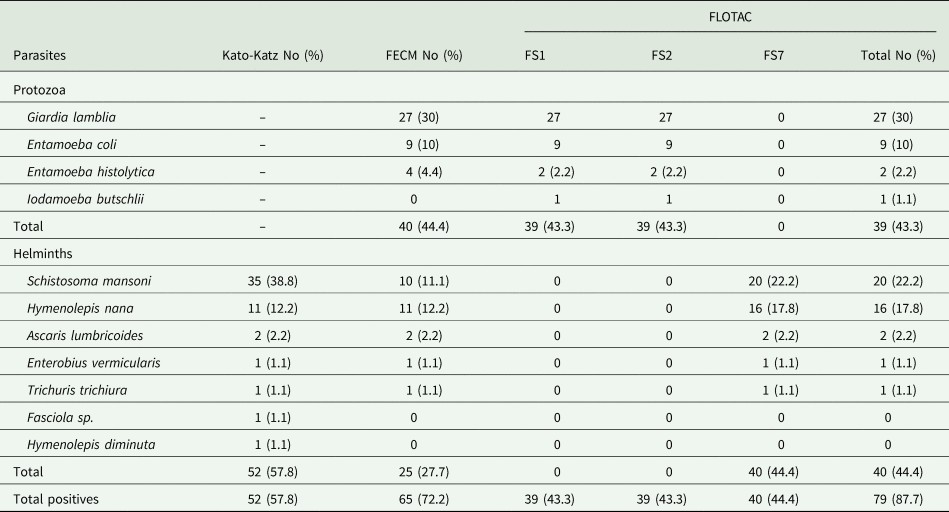
The study sample comprised 90 school children; their ages ranged between 7 and 12 years with a mean age of 8.89 ± 1.40 years. Boys represented 59% of the study sample, while girls' participation was 41%. The overall percentages of IPIs were 57.8%, 72.2% and 87.7% by Kato-Katz, FECM and FLOTAC (combined results of FS1, FS2 and FS7), respectively (Table 1).
Prevalence of IPIs among the 90 examined school children as diagnosed by the three techniques

Regarding protozoan infections, FECM and FLOTAC (FS1, FS2) detected almost equal infection rates (44.4% and 43.3%, respectively). Giardia lamblia showed the highest prevalence (30%), followed by Entamoeba coli (10%), Entamoeba histolytica (4.4%) and the lowest infection rate was (1.1%) for Iodamoeba butschlii. No protozoa were detected with Kato-Katz or with FLOTAC using FS7.
For helminthic infections, frequency by Kato-Katz was the highest amounting to 57.8% followed by FLOTAC (FS7) (44.4%) while FECM showed the lowest helminthic infection rate (27.7%). FLOTAC (FS7) showed higher infection rate (17.8%) for Hymenolepis nana vs Kato-Katz (12%), whereas Kato-Katz showed a higher infection rate of S. mansoni (38.8%) vs FLOTAC (22.2%). In a declining order, S. mansoni was the most prevalent parasite followed by H. nana and Ascaris lumbricoides. Enterobius vermicularis and Trichuris trichiura exhibited the bottommost infection rate. However, no helminths were detected by FS1 and FS2.
Concordance between the employed techniques
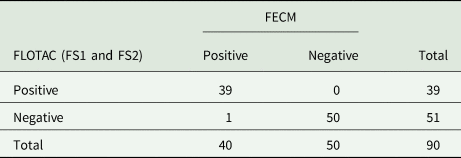
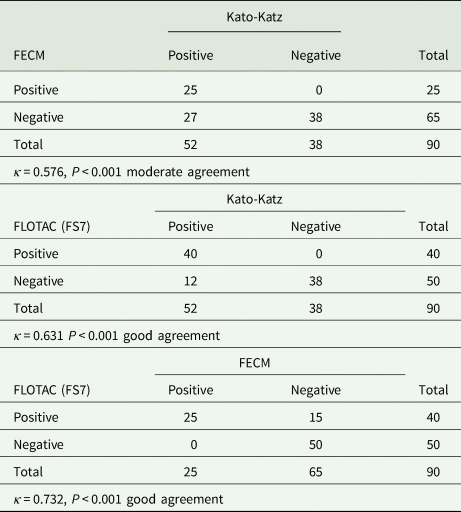
Agreement analyses between the three coproparasitological methods for the diagnosis of IPIs were considered. For protozoa, agreement was calculated only between FECM and FLOTAC (FS1 and FS2). Among the 90 cases analysed by FECM and FLOTAC, 39 positive cases gave concordant positive results and only one case was missed by FLOTAC and diagnosed by FECM. A κ index of 0.954 indicating very good agreement between the two techniques was found (Table 2). Regarding helminths infection, a κ index of 0.576 indicating moderate agreement between Kato-Katz and FECM was found. The duplicate Kato-Katz and FS7 techniques diagnosed 40 intestinal helminths infected cases concurrently, with a κ index of 0.631 signifying a good agreement between both techniques (Table 3).
Agreement between FECM and FLOTAC techniques for detection of protozoan infections

Kappa index (κ) = 0.954, P < 0.001 very good agreement.
Agreement between Kato-Katz, FECM and FLOTAC (FS7) techniques for the detection of helminths infections

Comparison of the performance of the used diagnostic techniques
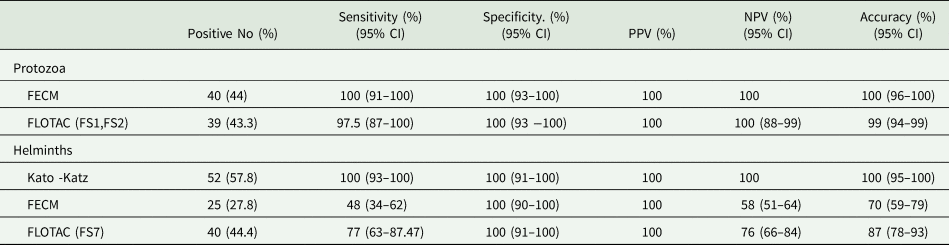
On calculating different diagnostic modalities for protozoa infections, FECM tested more sensitive than FLOTAC (FS1 and FS2) (100% vs 97.5%), with an almost equal diagnostic accuracy of 100% vs 99%. In helminths, Kato-Katz had the upper hand with 100% sensitivity and accuracy, followed by FS7 (77% and 87%) ending with FECM (48% and 70%) (Table 4).
Calculated parameters for the assessment of the different methods used in the diagnosis of the intestinal parasites

PPV, positive predictive value; NPV, negative predictive value; CI, confidence interval.
Capacity detection of S. mansoni cases by the different tests, based on egg counts by Kato-Katz
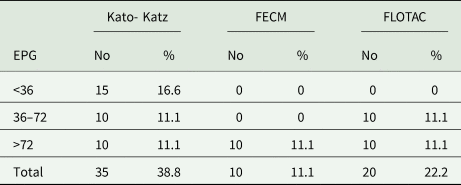
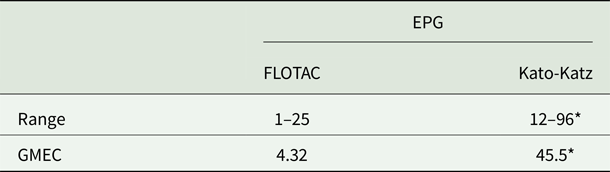
Table 5 revealed that FLOTAC and FECM failed to identify any S. mansoni cases of intensity less than 36 eggs per gram (EPG) as perceived by Kato-Katz. Meanwhile, both Kato-Katz and FLOTAC detected an equal percentage of infection (11.1% each) when counts ranged from 36 to 72 EPG. Similar infection rates (11.1%) were detected by the three techniques when counts were over 72 EPG. Significantly lower geometric mean egg count (GMEC) was identified by FLOTAC (4.32) when compared to that of Kato-Katz (45.5), P < 0.05 (Table 6).
Schistosoma mansoni cases detected by the different tests, based on the Kato-Katz egg counts

EPG, eggs per gram.
The geometric mean egg counts according to Kato-Katz and FLOTAC techniques

EPG, eggs per gram.
*Statistical significance at P < 0.05.
Discussion
IPIs are still a major public health problem worldwide, with approximately 3.5 billion people infected (Tigabu et al., Reference Tigabu, Taye, Aynalem and Adane2019). Sensitive diagnostic tools are required for accurate assessment of prevalence and intensity of IPIs in areas undergoing regular treatments and hopefully monitoring control programmes that are shifting from morbidity control to infection and transmission control, and eventually local elimination (Hotez et al., Reference Hotez, Fenwick, Savioli and Molyneux2009). In the present study, the performance of Kato-Katz, FECM and FLOTAC using different FSs (FS1, FS2 and FS7) with various s. g. was compared. Collectively, the FLOTAC technique detected the highest IPIs (87.7%) followed by FECM, Kato-Katz (72.2% and 57.8%, respectively).
For protozoan infections, it is accepted that the Kato-Katz method was never appropriate. FECM is broadly considered the diagnostic standard technique for the identification of intestinal protozoan infections in humans. It is a widely used technique for detection of oocysts and cysts, both in epidemiologic surveys and reference laboratories (Nematian et al., Reference Nematian, Gholamrezanezhad and Nematian2008; Ouattara et al., Reference Ouattara, N'Guéssan, Yapi and N'Goran2010; Utzinger et al., Reference Utzinger, Botero-Kleiven, Castelli, Chiodini, Edwards, Köhler, Gulletta, Lebbad, Manser, Matthys, N'Goran, Tannich, Vounatsou and Marti2010). It is extremely remarkable to disclose that both FLOTAC FS1 and FS2 detected almost equal protozoan infection rate (43.3%) to that diagnosed by FECM (44.4%). FS2 has the advantage of being of lower cost compared to FS1. There was very good agreement between FECM and FLOTAC in the detection of protozoan infections. Similar results were obtained by Gualdieri et al. (Reference Gualdieri, Rinaldi, Petrullo, Morgoglione, Maurelli, Musella, Piemonte, Caravano, Coppola and Cringoli2011) who reported the first rigorous comparison of diagnostic accuracy between the FLOTAC technique and FECM. They reported that both methods achieved comparable recovery rates in the diagnosis of intestinal protozoa.
As for helminths diagnosis, Kato-Katz gave the highest infection rate (57.8%), followed by FLOTAC FS7 (44.4%); FECM showed the lowest helminthic infection rate (27.7%). FLOTAC diagnosed more positive cases of H. nana. These results go in line with those of Jeandron et al. (Reference Jeandron, Abdyldaieva, Usubalieva, Ensink, Cox, Matthys, Rinaldi, Cringoli and Utzinger2010) who reported FLOTAC as a promising technique for the diagnosis of helminths infections in Kyrgyzstan.
Although Kato-Katz technique has long been the backbone of helminth diagnosis in endemic areas and was recommended by the WHO as a standard measure to evaluate the prevalence and intensity of helminthic infections in endemic areas, yet, single FLOTAC FS7 provided reasonable sensitivity (77%) and accuracy (87%) for the diagnosis of helminths and detected more H. nana cases compared to double Kato-Katz. On the other hand, FECM diagnostic sensitivity (48%) and accuracy (70%) were substantially lower than those of both techniques. Similar findings were reported by Booth et al. (Reference Booth, Vounatsou, N'Goran, Tanner and Utzinger2003) and Cringoli et al. (Reference Cringoli, Rinaldi, Maurelli and Utzinger2010). Comparing the results of the used techniques, a good agreement was found between Kato-Katz and FLOTAC in the diagnosis of helminthic infections. These results support previous findings reported by Knopp et al. (Reference Knopp, Speich, Hattendorf, Rinaldi, Mohammed, Khamis, Mohammed, Albonico, Rollinson, Marti, Cringoli and Utzinger2011) and Barda et al. (Reference Barda, Zepherine, Rinaldi, Cringoli, Burioni, Clementi and Albonico2013).
In the present study, special attention was paid to S. mansoni owing to its public health prominence in Egypt and many developing countries. Kato-Katz detected the highest S. mansoni infection rate, followed by FLOTAC and FECM. Kato-Katz was the sole technique to diagnose cases of very low intensity below 36 EPG. Kato-Katz and FLOTAC diagnosed equal numbers of schistosomiasis cases when the egg count was more than 36. Kato-Katz, FECM and FLOTAC detected the same infection rate for S. mansoni when the number of eggs was more than 72 EPG. It is extremely remarkable to note that all three categories (<36 EPG, 36–72, >72 EPG) lie in the area of low infection intensity, i.e. less than 100 EPG. These results disagree with those of Glinz et al. (Reference Glinz, Silué, Knopp, Lohourignon, Yao, Steinmann, Rinaldi, Cringoli, N'Goran and Utzinger2010) who reported that FLOTAC using FS7 gave the highest sensitivity for S. mansoni as compared to Kato-Katz.
Regarding intensity, Kato-Katz showed the highest GMEC for S. mansoni, while FLOTAC showed significantly lower counts. Knight et al. (Reference Knight, Hiatt, Cline and Ritchie1976) reported that all concentration methods lose some eggs in the procedural steps. On the contrary, Kato-Katz overestimates fecal egg counts due to the used multiplication factor. Also, straining of fecal samples through a wire mesh allows the passage of all ova resulting in concentration of the eggs. Regarding FLOTAC, helminths eggs are not considered ‘inert elements’, thus, interactions may occur between different compartments of floating fecal suspension (e.g. FS components, parasitic elements, the fixative and ether) which might decrease the number of obtained eggs (Cringoli et al., Reference Cringoli, Rinaldi, Veneziano, Capelli and Scala2004). Also, formalin 10% is not the best fixative for subsequent flotation and recognition of parasitic elements, in fact as reported by Cringoli et al. (Reference Cringoli, Rinaldi, Maurelli and Utzinger2010) better results can be obtained with formalin 5%.
Concerning the performance of the different FLOTAC FSs (FS1, FS2 and FS7), the present study revealed that FS7 successfully diagnosed human helminthic infections, while FS1 and FS2 were unreliable for their diagnosis. This observed trend relatively matches that of previous studies undertaken with different FSs. Cringoli et al. (Reference Cringoli, Rinaldi, Maurelli and Utzinger2010) reported that the flotation solution is a strategic determinant of the sensitivity of any copromicroscopic technique that is based on flotation. They confirmed that FS7 was the optimal floating solution for detecting human helminthic infections as compared to a panel of tested floating solutions.
Results indicated that FLOTAC represents a hopeful multivalent and non-invasive tool for estimating prevalence and intensity of IPIs in resource-constrained settings, either for monitoring public health programmes or for investigating their epidemiology. The potential to perform FLOTAC on a preserved stool sample, unlike Kato-Katz thick smears preparation from fresh stool samples, allows for additional flexibility in the organization of surveys, as specimen collection and preservation can be done in the field, while sample preparation and examination can be performed at a later stage. Moreover, FLOTAC examines a larger amount of stool than Kato-Katz technique.
In conclusion, results suggest that Kato-Katz and FLOTAC when applied together might give optimal detection rates for IPIs. FLOTAC is offered as an auspicious technique for the detection of protozoan infections and supersedes Kato-Katz in the diagnosis of H. nana. It showed a higher sensitivity for helminths and S. mansoni diagnosis compared to FECM. It can be used concurrently or in replacement to other diagnostic techniques for epidemiological studies. Validation of the technical steps regarding the choice of preservative, flotation solutions and cost effect needs further optimization.
Acknowledgements
The authors wish to thank Professor Giuseppe Cringoli, Department of Veterinary Medicine and Animal Production, University of Naples Federico II, Italy, for his generous donation, we truly appreciate it. Our regards also go to the study participants and their parents for giving consent to participate in the study.
Financial support
No funding was obtained for the execution of the study.
Conflict of interest
No conflict of interest to declare.