Counterfactual thought (CT) corresponds to how we imagine what could have happened in a situation that has already occurred, modifying elements of the real facts for different of those experienced. Generally are expressed through conditional sentences such as starting with “What if...” or “What might have happened if...” and it involves antecedents and consequences. For example: “And if the car had not exceeded the red signal,“ or, ”And if the woman was not crossing the street at that moment?” (Byrne, Reference Byrne2005; Roese, Reference Roese1994, Reference Roese1997). This kind of thinking is critically important for cognitive function and is regarded as an essential tool for problem solving and good social functioning of the individual to assist in redesigning experiences and feelings, allowing the person to imagine different ways of dealing with the most diverse situations (Roese, Reference Roese1994).
In spite of being considered as an imaginative thinking, the ability to redo events or counterfactual thinking is being presented in a predictable manner (Byrne, Reference Byrne2005; Wong, Galinsky, & Kray, Reference Wong, Galinsky, Kray, Markman, Klein and Suhr2009). Byrne (Reference Byrne2005) refers the predilection by certain events such as “fault lines of reality.” In the words of the author “a surprising aspect of counterfactual thinking is that there is a similarity in what people think” (p. 3). Thus there is, in the occurrence of actual events, fault lines, i. e., aspects that seem to be more changeable than others, namely: action/inaction, obligation, time and cause.
The first fault line that was highlighted by Byrne (Reference Byrne2005) refers to action/inaction. In other words, people tend to generate more counterfactual thoughts when they perform an action than when they are no longer doing it (inaction). Another aspect that appears as the fault line, the obligation, refers to the tendency for people to imagine alternatives to events that are under their control more often than for those that are out of control and that are socially acceptable (Byrne, Reference Byrne2005). Studies that have demonstrated the mutability of a controllable action raised the idea that the people change not only the controllable actions, but also the socially unacceptable of the controllable event (McCloy & Byrne, Reference McCloy and Byrne2000).
The third fault line actually refers to the time once people think of possibilities in a temporal order of events occurring in the world. This temporal order can affect what is most readily modified when alternatives are imagined. Thus, people tend to think of alternatives to more recent events, such as losing a plane delayed by 5 minutes than for a one-hour delay (Byrne, Reference Byrne2005; Roese & Olson, Reference Roese, Olson, Roese and Olson1995). The latter approached by Byrne (Reference Byrne2005) is the question of the relation of counterfactual thoughts and causal thoughts, i. e., the modified facts are viewed as the reason of a given result, so when a person creates an imaginary alternative, there is the identification of an important factor in causal sequence of events. In the sentence “If only I had not left the bathroom window open, the thief would not have entered the house” people tend to believe that the thief entered the house because the window was left open (Byrne, Reference Byrne2005; Roese, Reference Roese1997). The last aspect of reality present in the literature is the predilection for changing unusual or extraordinary events. When a person engages in the formulation of a counterfactual thinking, the focus usually falls on different events that normally don’t happen in everyday life (Byrne, Reference Byrne2005; Byrne & Girotto, Reference Byrne, Girotto, Markman, Klein and Suhr2009).
Besides the fault lines of reality, information from the literature suggests some ways of classifying these thoughts. According to Roese (Reference Roese1994, Reference Roese1997), counterfactual thinking can be classified as direction (up or down), as structure (additive, subtractive or substitute) and as function (preparatory and affective).
The first classification (direction) refers to the result of the alternative imagined to the fact. Thus given direction may be upward, which means that the thought imagined describes a better result to what has happened in reality (for example: If I had studied harder, I would have gotten a best score in the test), or downward, which describes a worse result to reality (for example: If I had not taken the umbrella, I would have been completely wet). The two types of direction lead to different affections and consequently to the different functions of counterfactual thinking. When a person engages in upward thought, such as “if I had studied harder for the test”, he can feel bad or sorry. This negative sentiment tends to lead to a better engagement in the future, like to study harder for the next test, for example, what defines a preparatory function of counterfactual thinking. The second function, the affective, leads the individual to feel different about the fact that occurred, helping to understand their own emotions and feelings. Depending on the kind of affection that the thought yields in the individual, there is a greater possibility of engagement in future behaviors (Roese, Reference Roese1994, Reference Roese1997).
Roese and Olson (Reference Roese, Olson, Roese and Olson1995) reported that depression and other states of dysphoria may be associated with the non-functional or even dysfunctional thoughts, i.e., ruminative thoughts in which population is generally engaged (APA, 2002; Beck, Rush, Shaw, & Emery, Reference Beck, Rush, Shaw and Emery1997; Roese & Olson, Reference Roese, Olson, Roese and Olson1995). According to Markman, Karadogan, Lindberg and Zell (Reference Markman, Karadogan, Lindberg, Zell, Markman, Klein and Suhr2009), works in this area has suggested that upward counterfactual thoughts may be less functional for individuals who suffer from depression.
A study sought to relate the cognitive approach of depression with counterfactual thinking, starting from the idea that this type of thinking can maintain or worsen depressive symptoms (Juhos, Quelhas, & Senos, Reference Juhos, Quelhas and Senos2003). The authors evaluated the sense of preparation, the perception of control and dysphoric feelings of people with and without depression. Participants were divided into groups with and without depression, and they were led to believe in a factual way (by summarizing) or counterfactual form (thoughts of what might have been different) regarding a pre-drafted scenario. Finally, the participant was asked to respond an instrument for evaluating the feeling of control, preparation, guilt and shame before the events of the scenario (Juhos et al., Reference Juhos, Quelhas and Senos2003).
The results showed that the level of depression did not significantly alter the pattern of change in the scenarios. It was noted that people without depression had higher number of modifications when referring to a transient characteristic of personality (24%) than in the group of people with depression (in which this mutation was not presented). Although it appears in few cases, only participants with depression presented a focus of mutation in another person (hetero-referent). All counterfactual thoughts fit in the upward direction and 83.67% of the thoughts presented subtractive structure, while 16.32% were of additive structure. No differences in the structure of thought of the two groups were observed. Associating the level of depression with the type of counterfactual thinking, it was found that, regardless of the level of depression, people feel more prepared when they generate counterfactual thoughts than when they think about the form of factual scenario. It was also noticeable that the effect of the level of depression in relation to the perception of control was not significant, which confirms the hypothesis of the authors that people with depression do not perceive a greater control over the situation when compared with those without depression. These results suggest that the counterfactual thinking can be useful in the clinical treatment of people with depression, once it was not observed increase in the negative affection or difference in the perception for the future in both groups of comparison (Juhos et al., Reference Juhos, Quelhas and Senos2003).
A similar study sought to evaluate the role of counterfactual thinking in depression (Quelhas, Power, Juhos, & Senos, Reference Quelhas, Power, Juhos and Senos2008). Through two experiments using different scenarios and real situations to induce CT and to compare the affective and cognitive consequences. The authors found a similar style of CT in both groups, with and without depression. At the first experiment, the authors pointed out that the perception of preparation for future situations increased in both groups after the generation of counterfactual thoughts. In the second experiment, non-depressive participants showed greater tendency to generate counterfactual thoughts when asked about five spontaneous thoughts about a negative event that they had experienced. Quelhas et al. (Reference Quelhas, Power, Juhos and Senos2008) found more negative emotions associated with upward than related to downward counterfactual thoughts, which agrees with the literature. An important result counters the findings of literature on CT and depression, showing that both participants with and without depression displayed counterfactual thoughts with preparatory function. However, depressive participants, even after identify the root of their bad result and how to improve the future, did not benefit from the feeling of preparedness to modify their behavior (Quelhas et al., Reference Quelhas, Power, Juhos and Senos2008).
Thereby, it is conceivable that in subjects suffering from some cognitive and social dysfunction, such as people with depression, the form and function of counterfactual thinking may represent an important way of regulating dysfunctional thoughts. The counterfactual thinking seems to be beneficial for events that have potential to recur because it can stimulate corrective action and reduce the intensity of regret (Markman et al., Reference Markman, Karadogan, Lindberg, Zell, Markman, Klein and Suhr2009).
In view of some depressive symptoms, like the worsening of feelings such as guilt, worthlessness and low self-esteem (OMS, 1993), the constant rumination of small errors of the past and the misinterpretation of everyday events (APA, 2002), it is important to understand how this kind of thinking is characterized in people with depressive disorders.
The study aimed to investigate whether there are differences in the style of counterfactual thinking of people with and without signs of depression, considering the structure (additive, subtractive and substitutive), the direction (upward or downward), the target of change (self-referent and hetero-referent) and the most modified aspects of reality, accordingly to the literature (action/inaction, obligation, time and unusual event).
Method
Forty-two adults of both genders participated of this study, divided in two groups: participants with signs of depression (N = 21) and without signs of depression (N = 21). For the group of people with signs of depression, the age ranged from 23 to 58 years, with a mean of 43.5 years. Among these 21 participants, 18 were female and 3 were male. In the group without indicative of depression, the age ranged from 22 to 59 years, with a mean of 43.04 years, of which 18 were female and 3 male participants. The literacy level in the sample ranged from elementary school to college, wherein a greater number of participants (N = 8) had completed the higher level, in both groups of comparison, and a smaller number of participants had completed only elementary education (no one in the group with indicative of depression and two in the group without signs of depression) and had incomplete secondary education (one participant in each group).
Part of the sample from group with signs of depression (11 participants) was composed by people treated in a school of health of a city in the state of São Paulo, Brazil, and was previously diagnosed with depression or in treatment for depression. Four participants were indicated by clinical psychologists (upon previous permission) and the remaining six participants were found in the control group, having scored more than 12 on Beck Depression Inventory (BDI, Cunha, 2001). The mean BDI score in the group of participants with indications for depression was 24.85 (SD = 8.9, Min. = 12, Max. = 48) and the BAI was 22.38 (SD = 9.8; Min. = 8, Max. = 44). The mean BDI score is indicative of a moderate degree of depression among participants. For this group, the minimum found in BAI score was eight, which does not indicate anxiety, but the mean indicates to a moderate degree of anxiety among participants.
The group without signs of depression consisted of a control group, recruited through print and electronic dissemination, and the application of BDI and BAI was used in order to verify the absence of warning signs of depression. Thereby individuals with scores lower than 11 composed the sample of people without signs of depression. In this group, the mean BDI score was 6.61 (SD = 3.29, Min. = 2, Max. = 11) and BAI was 7.38 (SD = 5.03, Min. = 2, Max. = 20). In BDI, the mean score of the participants (and even the maximum) indicate the absence or minimal level of depression. In BAI, the average score for this group indicates no anxiety, but an equal to 20 score was obtained by one of the participants, which is indicative of moderate anxiety.
The participants answered the Free and Informed Consent, a semi-structured interview (name, age, place of birth, occupation, and use of medication for depression), the Beck Depression Inventory (BDI - Cunha, Reference Cunha2001) and the Beck Anxiety Inventory (BAI - Cunha, Reference Cunha2001). The use of BAI was indicated due to the high co morbidity between depressive disorders and anxiety disorders (Teixeira, 2001; Teng, Humes, & Demetrius, Reference Teng, Humes and Demetrius2005).
In addition to these instruments, the material for collecting counterfactual thoughts of adults was used (Justino, Faccioli, & Schelini, Reference Justino, Faccioli and Schelini2013), which contains five stories and questions about them. The stories were adapted from reports from newspapers and magazines and fictitious scenarios present in literature. Each story presented a different context, where in the two first, unexpected and negative situations with negative endings were described (“The Temptation”, adapted from Juhos et al., Reference Juhos, Quelhas and Senos2003 and “On the way home”, adapted from McCloy & Byrne, Reference McCloy and Byrne2000), whereas the last three stories narrated situations of overcoming, i.e., difficult times faced by the characters, but with a positive outcome (“Mountain dilemma” and “Reborn to live” adapted from Super Interessante Magazine, Special Edition and “Cell phone and elevator saved assistant worker in Rio, adapted from globo.com – electronic journal”).
The questions were about thoughts concerning the story read, wherein the first question (“As you read the story, was there any thought about what you were reading?”) required from participants spontaneous counterfactual thoughts, the second one (“If you passed through the same situation, would you think of something different compared to what happened? Think of what could be different so that the story has a different ending. If you could change one thing in this situation, what would you change?”) sought to evoke directed counterfactual thoughts, and third question required the choice of pre-made alternatives containing changes in the facts of the stories. In the Appendix 1, there are all the five stories and their respective alternatives.
Results and Discussion
Responses of the participants were considered as representative of counterfactual thought when they presented a change in the facts of the story, i.e., thoughts that seek an alternative to the situation experienced by the narrator and/or the character. Counterfactual thoughts generated from questions 1 and 2 were categorized in accordance with literature, in terms of direction (upward and downward), structure (additive, subtractive or substitute), target of mutation (self and hetero directed) and aspects of reality to which the modification refers (action/inaction, obligation, time and unusual event).
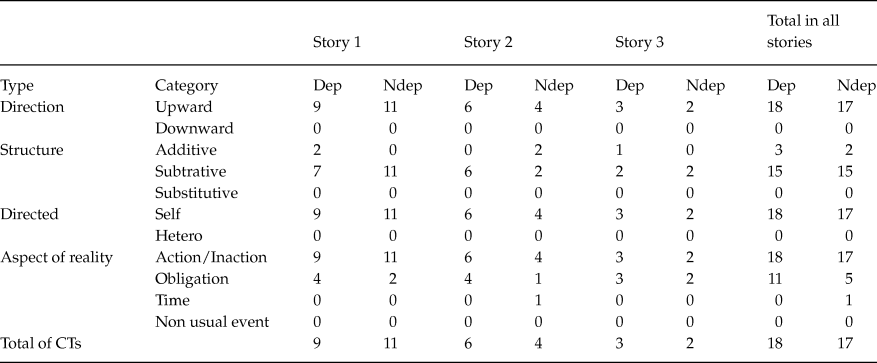
Table 1 illustrates the number and types of counterfactual thoughts spontaneously reported by the participants of the two comparison groups, and the stories that promoted this type of thinking. It’s important to mention that the number of thoughts does not correspond to the number of participants.
Total Number of Counterfactual Thoughts Spontaneously Elaborated from the First Question of the Material

Note: Dep: participants with signs of depression; Ndep: participants with no signs of depression.
The 1st story (“The Temptation”) was, among the five, the one that most fostered the emergence of spontaneous counterfactual thoughts, i.e., reports that demonstrated a change in events that have occurred. This result can be explained by the proper format of the story, which involved treason scenario and was narrated in a fashion to help the participant to imagine himself in the story. Thus, when requested to draft more spontaneously thoughts about actions narrated, participants seem to have been influenced by the “The Temptation” story.
The total number of counterfactual thoughts spontaneously reported from the first question of the material was 35, considering both groups, wherein 18 are from the depressed group and 17 from the non-depressed group. No participant generated downward, substitutive, hetero-directed or counterfactual thoughts referring to an unusual event.
The last two stories of the material did not yield spontaneous counterfactual thoughts, i.e., none of the participants in the two groups spontaneously mentioned changes to the course of the story. CTs that appeared for the first three stories exhibited some trends. All CTs generated showed upward direction (better alternatives than the reality) and target of mutation was self directed (it referred to a possible change to their own character). The majority of CTs presented spontaneous subtractive structure (that withdraws some element of the story) and is related to an action/inaction of the character. The 1st story fostered more thoughts in the non-depressed group, while the 2nd and 3rd stories aroused a higher number of CTs in the depressed group.
An important fact to be emphasized, considering the category “aspect of reality”, is that both CTs present in the responses to the 2nd story as well as in the replies to the 3rd story showed, besides the aspect of action/inaction, high frequency of aspect obligation (according to the number of occurrences). The modifications cited were related to a socially less accepted action (stop at the bar for a beer/abandon a friend in a difficult situation), what corroborates the findings of McCloy and Byrne (Reference McCloy and Byrne2000), who presented a discussion on the greater propensity of people to mentally change socially unacceptable events when they are related to socially acceptable events. Their studies concluded that the mutability of controllable events depends on how socially appropriate this event is. Furthermore, the results indicate that people tend to think counterfactually as to socially inappropriate situations, even when the outcome is positive (McCloy & Byrne, Reference McCloy and Byrne2000).
In general, spontaneous CTs, found in the reports of the participants to the first question, were 100% upward, i.e., none of the research participants reported CTs worse than the realities presented when challenged to think counterfactually, what corroborates data from the literature (Roese, Reference Roese1994, Reference Roese1997), which displays a greater frequency of this type of thought. Another fact that is in accordance with the literature is that most of the participants with signs of depression tended to generate spontaneous CTs, in comparison to the participants without signs of depression, as shown in the study of Quelhas et al. (Reference Quelhas, Power, Juhos and Senos2008). It is important to note that significances of the differences were not analyzed in the answers to the first question.
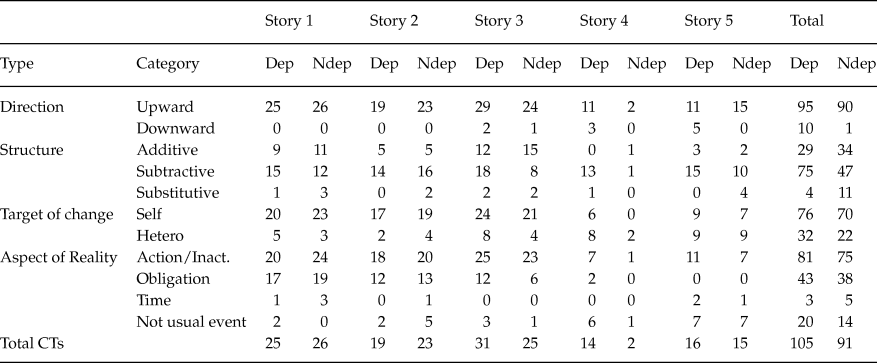
Table 2 presents data of CTs collected from question 2 for the five stories, containing the categorization of all directed CTs to the participants with and without signs of depression.
Frequency of Directed Counterfactual Thoughts Generated from All the Stories for People With And Without Signs of Depression

Note: Dep: participants with signs of depression; Ndep: participants with no signs of depression.
As seen in Table 2, people with depression generated more directed at the 3rd Story (“Dilemma of the mountain”), which had a positive ending; while it was the 1st story (“The Temptation”), which had a negative outcome that elicited this type of thought in the non-depressed group.
Table 2 also shows that the majority of directed CTs generated by participants was upward direction and represented 94.4 % of the participants’ responses in both groups. With respect to the structure, the category that most tended to present responses were the subtractive, representing 62.2 % of the counterfactual thoughts for both groups. Regarding the mutation target, the category with the highest frequency for the two groups was the self-referent, with 146 of the responses for both groups (74.5 % of responses). In the case of reality, the majority of the directed CTs referred to action/inaction category and represented 79.6 % of the responses in the two groups.
To evaluate statistical meaning of the differences observed between the scores related to the categories (types) of CTs of the participants with and without indications of depression, an analysis of variance was conducted by using Student t test for independent samples. Most of the differences between the mean score of all categories of CT analyzed were not significant. Few significant differences observed are presented and discussed below.
For the 1st and 2nd Stories (“The Temptation” and “On the way home”), there were no significant differences in the patterns of responses between the two groups of participants, which indicates that there is no difference between the 2 groups in how they generate CTs when challenged to do so. The results regarding the aspect of the reality most modified for these two stories (action/inaction and obligation) corroborate data from the work of McCloy and Byrne (Reference McCloy and Byrne2000). It’s noted that more people without indications of depression made changes directed in these stories than people with indications of depression.
In the 3rd story, there were more directed CTs in the group of participants with indications of depression. Significant difference exists between the subtractive category, t(40) = 2.33, p < .05, i. e., the directed CTs reported by the participants with no signs of depression showed the most of the additives CTs, while CTs reported by the group of people with indications of depression were mostly subtractive. Studies by Roese and Olson (Reference Roese and Olson1993) suggest that people tend to generate more additive thoughts after passing through situations of failure, and more subtractive thoughts after encountering a win-win situation. In the case of the 3rd story, majority of the modifications (for both groups) referred to a situation of failure. It is noticeable that, unlike what was described by Roese and Olson (Reference Roese and Olson1993), people with indications of depression tended to generate more subtractive thoughts (18) than people in the comparison group (8), what may indicate a trend of possible failure in the preparatory function of counterfactual thinking for the group of people with indicatives of depression.
The preparatory function of CTs seems to be an important tool that can help people to understand their past and to prepare for future similar events (Roese & Olson, Reference Roese, Olson, Roese and Olson1995; Well & Gavanski, Reference Wells and Gavanski1989). Thus, a student who got a bad grade in an examination would think that he could have done better if he had studied harder. This thought may cause a temporary pain, as regret, but tends to drive the student to be better prepared for future examinations (Quelhas et al., Reference Quelhas, Power, Juhos and Senos2008). According to Roese (Reference Roese1994), the upward thought of additive structure indicates a greater inclination for this function of counterfactual thought, once it offers better ways than the reality and it provides more options for action. In the case of subtractive answers given to the 3rd story (“Dilemma of the mountain”), the modifications do not offer new options for coping with the condition, but only eliminate the unpleasant facts, unlike the more structured propositions, that indicate a form of more concrete action that can serve as a form of behavior in future situations.
With reference to the 3rd story, there was a high frequency of CTs that withdraw an experience to “improve” the story, what showed up with a higher number of occurrences among participants with indications of depression (six participants made changes of this nature, while only one member of the group with no signs reported that he would not have done something more), and thus demonstrates a trend in the group of people with indications of depression. This data may prompt a discussion on the importance of experience, even when negative, for individual survival and may denote a likely belief among people with indications of depression that the problems do not present anything positive. For depressed people, negative experience may exacerbate symptoms of guilt and ideas of worthlessness (OMS, 1993), leading them to misinterpret everyday events and thereby leads them to unrealistic negative evaluations of self-esteem (APA, 2002).
The 4th story (“Reborn to live”) was the one that most favored significant differences between the mean scores of participants with and without indications of depression in the categories of: (a) upward, t(40) = 2.92, p < .001; (b) subtractive, t(40) = 3.72, p < .001; (c) self-referent, t(40) = 2.33, p < .05; (d) hetero-referent, t(40) = 1.97, p < .05; (e) action-inaction, t(40) = 2.12, p < .05; (f) and unusual event. t(40) = 2.13, p < .05. This may indicate a pattern of different cognitive responses between people with and without indications of depression when they think about events involving diseases, such as cancer. Given that negative events, for people with depression, appear or are felt more intensely, which may indicate a kind of exaggerated sense of responsibility towards life adversities (APA, 2002), the exclusion of the problem becomes the best alternative to solve it. There is no room to understand the problem as something to be overcome, because it is solely sorrow and ruminations by have a problem.
In the 4th story, the majority of the participants without indication of depression (19 of 21) did no directed modification, what means that there was registered more counterfactual thoughts between people with indicatives of depression than between people without this indicative. The CTs of the group with indication of depression were characterized mainly, as upward, subtractive, hetero-referent and related to the aspect action/inaction, followed by the aspect of unusual event. There was a large number of CTs eliminating cancer character story, which is regarded as upward thinking (improves the story), subtractive (eliminate cancer element), hetero-referral (not dependent on the control of the character) and unusual event (because it is not something you would expect in everyday life of people).
This pattern of thought, although upward, may indicate a failure in the preparatory function of counterfactual thinking, once it is exhibited as hetero-referral function, i. e., regarded as a change that is out of the control of the participant, what makes it difficult for the individual to think in different ways of acting in the future. The removal of cancer as well as the withdrawal of escalation of the 3rd story may indicate the belief that negative experience does not have benefits in the survival of people.
With regard to the 5th story (“Cell phone and elevator saved assistant worker in Rio”), significant differences were observed in the downward categories, t(40) = 2.02, p < .05, and substitutive, t(40) = –2.16, p < .05, wherein only group with depression generated worse thoughts than the reality. In addition, the group without depression proposed an alternative with substitutive structure, i. e., that removed and aspect and replaced it by another by proposing a change in the story.
With respect to all the stories presented, it can be concluded that the majority of directed CTs presented an upward direction, what agrees with findings in previous studies (Faccioli & Schelini, Reference Faccioli and Schelini2009; Juhos et al., Reference Juhos, Quelhas and Senos2003; Justino & Schelini, Reference Justino and Schelini2010; Quelhas et al., Reference Quelhas, Power, Juhos and Senos2008; Roese, Reference Roese1994, Reference Roese1997). The most commonly found structure in both groups was the subtractive, although it was more significant among participants with depression (75 occurrences for participants with depression and 47 for non-depressives). A majority of self-referent thoughts which referred to the aspect of action/inaction was also noted for both groups.
Figure 1 represents the frequency of CTs in both groups, considering the direction of thoughts formulated for the second question.
Directed counterfactuals thoughts generated by people with (Dep) and with no (Ndep) signs of depression, in all Stories, according to the direction of CT.

According to Figure 1, unlike what was observed in the 1st and 2nd Stories, the last three (“Dilemma Mountain”, “Reborn to live” and “Cell and elevator saved assistant worker in Rio”) had a greater number of counterfactual thoughts in people with indicatives of depression. What can be inferred from this is that when a story had a negative outcome (which is the case of the first and second), more people without depression sought to make changes to the events, whereas, when the outcome was positive, more people with depression think counterfactually to modify the situation. These findings provide a significant reflection regarding the depressive phenomenon, once people with depression preferred to make modifications to difficult situations, even when they were resolved in the end, while for events with negative outcomes, more people without depression engaged in this kind of thinking.
Figure 1 also show that participants with signs of depression elaborated more downward CTs than people without signs of depression and that direction just appear at the last three stories. The presence of this type of thought could indicate some signal of affective function of counterfactual thinking, whereas when a person think about a worse alternative to reality, can feel better about what happened (Roese, Reference Roese1994, Reference Roese1997). This kind of thought could be beneficial for people with depression, by helping them to get out of the cycle of guilt and bad feelings, and restructure their emotional condition.
The CTs chosen by previously formulated alternatives showed certain uniformity among the participants in the two groups. The first two stories had most of the responses in the Obligation category, while the others presented the categories Time (“Dilemma of the mountain”), Action/Inaction (“Reborn to live”) and Unusual Event (“Cell phone and elevator saved assistant worker in Rio”). The frequency of alternatives did not show any significant difference between the mean scores of the two groups for any of the stories presented, indicating that there is no difference in the way the participants, with and without signs of depression, chose alternatives. In general, different stories led to similar results, setting CTs in the same styles: mostly upward, subtractive, self-referent and modification of action/inaction.
Conclusions
Through the results presented and discussed in this research, it can be said that it was possible to access and compare the CT of people with and without signs of depression. Depression is a worldwide phenomenon which is expected to have a significant increase in the next years (WHO, 2011), thereby the emergence of studies that contribute to its understanding are relevant. Research on CT may serve as potential ways for easing the understanding on how people with depression think and what is the role of those thoughts for the establishment or maintenance of the depressive state.
One of the limitations found in this study has to do with availability of participants with indication of depression, once, despite the high rate of incidence of this disorder in the population, few people are being attended in public health institutions, and only few out of the found people accepted to participate of the research. Despite this difficulty, the samples encountered for the two groups were homogeneous in terms of age, sex and literacy, therefore it was possible to draw a parallel between the thoughts of the participants in both groups.
The results, although demonstrate few statistically significant differences in the patterns of thoughts, indicate a tendency in the patterns of people’s thinking, what makes it necessary more studies with a larger population sample, which can compare a larger number of responses between people with and without signs of depression.
An important factor of CT, the function – both affective and preparatory –, was not evaluated in this research, emphasizing the importance of the inclusion of methodologies that aim to understand which is the function of the counterfactual thinking for people with signs of depression. According to some authors, counterfactual thoughts cannot have the same functions for people with depression (Markman et al., Reference Markman, Karadogan, Lindberg, Zell, Markman, Klein and Suhr2009), wherein upward counterfactual thoughts, which are presented as fosterers for future engagement, may be less functional for people with depressive symptoms.
Finally, it is worth mentioning the importance of further researches in this area that would involve different groups, different age groups and similar or different methodologies as used in the present study in order to enrich this field of knowledge.
The present work has received funding in the form of a scholarship for Master's Degree granted by CAPES, and financial aid of regular type by FAPESP (Process no. 2013/11439–3).
Appendix 1
Story 1: The temptation (“A Tentação”)
A good female friend of yours who is somewhat shy with boys asks you out with her and a dude, Joao, to party. As usual, you accept the invitation. Nowadays your friend and Joao are spending much time together, though this was the first time they happened to go out at night. Before going, your friend tells you that she is completely in love with him.
During the party, you realize that Joao is very attractive and, furthermore, he is interested in you, and that amuses you. At the end of the night, without thinking, you give him your phone number. When the weekend comes, Joao calls you and asks you out for dinner. You happen to accept the invitation. A few moments before you leave home, your friend calls you and tells you, crying, that Joao avoided to speak with her during the whole week and called off the cinema they had matched before the party, because he had a lot of things to do.
Adapted from de Juhos, C.; Quelhas, A. C.; Senos, J (2003)
Alternatives
-
a) I wouldn’t have gone to the party nor have met Joao.
-
b) I wouldn’t give him my phone number to a friend’s date.
-
c) Joao would ask me out before my friend tells that she was in love with him.
-
d) I wouldn’t have gone out with my friend, as usual, and wouldn’t have met Joao.
-
e) None of the above.
Story 2- On the way home (“No caminho de casa”)
After finishing his day of work, on the usual way, Daniel arrives home too late due to several events that happen in his way. First, he finds a very big tree fallen and blocking the street that leads to his house.
Seeing the blocked street, Daniel solves to change his way and turns the corner to avoid the traffic. When shifting his path, he meets a friend going to bar and decides to stop for drinking a beer. After 20 minutes, Daniel goes back to his way home. When he is finally arriving at his house, he is surprised by an asthma attack and, therefore, has to stop a little more until he can breathe normally. When he gets home, he finds his daughter desperate saying that your wife has just been taken to the hospital by the neighbors because she had a heart attack a few minutes ago.
Adapted from McCloy e Byrne, R. (2000).
Alternatives
-
a) Daniel would have finished his day of work earlier.
-
b) Daniel would not have stopped for a beer and would have arrived home in time for taking his wife to the hospital.
-
c) Daniel would have taken a different way from the usual that day and would not have arrived home late.
-
d) Daniel would not have stopped the car because of an asthma attack.
-
e) None of the above.
Story 3 - Mountain dilemma (“Dilema da Montanha”)
Until the fourth day of climbing of Luiz and Marcos was fine. The friends were tied one to each other by a rope that, in case of a fall, could help to save the partner’s life. After facing avalanches, blizzards, deepfreeze and fall of body’s temperature in the first days, the third day of climbing dawned sunny and then they reached the mountaintop.
The only thing left to do was to climb down and, in one or two days, they would be back in the camping. When they were climbing down, clouds began to quickly approach – it was an enormous avalanche getting closer. All they could see was an endless white and, in less than half an hour, they were lost. The night fell and the plan to climb down in the same day did not work. When they started to climb down again, Luiz fell and the impact broke his leg. Marcos should leave his friend or die with him, but he stayed and tried to save his friend. He sat on a snow hole while waited Luiz to climb down by the rope. And, step by step, they continued to climb down.
It was then that Luiz, unaware, fell down in a precipice, into a large crack that ended in an abysm. He was struck by the rope that was tied to Marcos, who, in an attempt to save the friend, tried to lift the rope, but he could not afford to it. Marcos began to freak out up there, thinking that, if Luiz fell, he would fall together. It was then that Marcos decided to cut the rope and, leaving Luiz to fall into the abysm and thinking that his friend was dead, left.
Luiz had survived, but with a broken leg it was impossible to climb the rope. Then he took a bold decision: climbed down deeper into the crack expecting to find another exit. There, he found kind of a ramp, which led him to other exit. After leaving, Luiz saw Marcos’ footprints and started his journey of almost 3 days, crawling, to the camping, dehydrated, with no food and with the skin burnt from sun and ice.
When he reached the camping, Marcos was still there. After two years and six surgeries, he got back to climbing and has not stopped anymore.
Adapted from Revista Super Interessante. Special Edition. Dec/2011
Alternatives
-
a) Even after falling into the crack, Luiz would not break his leg and would reach the camping faster.
-
b) Marcos would not cut the rope that was binding him to the friend and would happen to fall along with him.
-
c) Marcos would not stay for rescuing Luiz when he broke the leg and, therefore, Luiz would not survive.
-
d) The avalanche would happen soon, in the first day, and the two friends would give up of climbing to mountaintop.
-
e) None of the above.
Story 4- Reborn to live (“Renascido para Viver”)
“It was the best thing that ever happened”, says Lauro often. He does not refer to the awards that made him records in cycling, but to the cancer he found out when he was 25 years old. The prostate cancer reached lung and brain, and forced him to retire from sport, which was then part of his routine. The chances of recovery were 50% and the chances of returning to be an athlete were null. It was then that he embraced an idea: “the pain I now feel is temporary. It may last one minute, one hour, one day, one year and, in the end, it will end and gives room for something else. On the other hand, if I give up, it will last forever.”
His body already was a machine – whilst the best marathoners could use only 70 mL of oxygen per second for each Kg of body mass, Lauro could use 85. But an athlete is not only genetics. Surviving brought to him what was missing: discipline and obstinacy.
Two years later, Lauro showed that he is not used to dismay in front of challenges, and got back to pedal. After one more year, he was the winner in the 6630 Km of Tour de France, the main challenge in world cycling. From 2000 up to 2005 he became the chief winner of this competition.
During these years, another ghost was threatening his life. Besides the yet overcome cancer, and ex-colleague said the he was using growth hormone, testosterone and a drug that enhances the transport of oxygen. However, blood tests displayed negative results and, even after accusations of doping, Lauro attended to the most important bike race in France, winning the award seven times in a row.
In 2005 he decided to retire for taking care of his five children – three from artificial insemination, with frozen semen before chemotherapy, and two came naturally, despite it is rare for people who are submitted to this kind of treatment. In 2009, at the age of 37, raced in France again, earning the third place in podium. It was only in 2011 that, when he was almost 40, Lauro decided to retire for real, happy with the way his career began and finished.
Adapted from Revista Super Interessante. Special Edition. Dec/2011
Alternatives
-
a) Lauro’s ex-colleague would not have done the complaint and he would not have to overcome more this problem in his life.
-
b) In the beginning of his career, Lauro would find out about the cancer and would not overcome the disease with such determination.
-
c) Doping tests would display a positive result and, disobeying the orders of the sportive committee, Lauro would keep racing.
-
d) Different from what he has done, Lauro would give up on sport and would not participate of the bike races in France.
-
e) None of the above.
Story 5 - Cell phone and elevator saved assistant worker in Rio (“Celular e elevador salvaram ajudante de obras de desabamento no Rio”)
“This is the cell phone that saved me,” said the assistant worker Alexandre, showing the mobile that rang right after being discharged and leaving the hospital.
Alexandre is one of the survivors to the collapse of three buildings in center of Rio de Janeiro (RJ). “When I looked at the window, I saw plaster falling. The first thing I thought was that to enter the elevator,” told the man, who was working in the ninth floor of the building. “When I entered it, the elevator fell down. I could only think of my family and that I would die,” he says.
Inside the elevator, Alexandre tells that he called to a friend, who was out of the building. “At each ten minutes I spoke with him,” he remembers. “Until the time when he put me to speak with one of the firemen,” he says. It took two hours to rescue the assistant worker, with no scratch.
“The firemen yelled: ‘Is anyone there?’, and I answered, from inside the elevator: ‘I am here!’”, Alexandre tells. When the firemen heard his response, they strived even harder to take him out of there. “When they found me, they cut an iron bar of elevator’s upside. It’s different to use the way of the elevator’s cables as exit route, but I, who am very slim, accomplished to get out of there,” reminds. “When they grabbed me, they rapidly gave me a mask for me to breathe better. I was calm,” completes.
Alexandre said that he did not feel the smell of any gas during the time he was working on the 9th floor. “I also heard no explosion, only the noise of building falling apart,” added. “It’s hard to explain what happened,” said. “I asked God for it. I prayed very much. I have four kids and my wife, and now, all I want is to hug them. After my birthday, now I have to celebrate yesterday, when I was reborn,” concluded, smiling.
Adapted from: http://g1.globo.com/rio-de-janeiro/noticia/2012/01/celular-e-elevador-salvaram-ajudante-de-obras-de-desabamento-no-rio.html. Recovered in: January 26th 2012.
Alternatives
-
a) Alexandre would arrive in the building 10 minutes after the collapse and would not suffer the accident.
-
b) Somebody would have seen, checked and fixed the mistakes on the construction and the building would not have collapsed.
-
c) The firemen, even after hearing the Alexandre’s yells, would ignore his calls.
-
d) As it should be, the building would not collapse during the reform and everything would be normal.
-
e) None of the above.