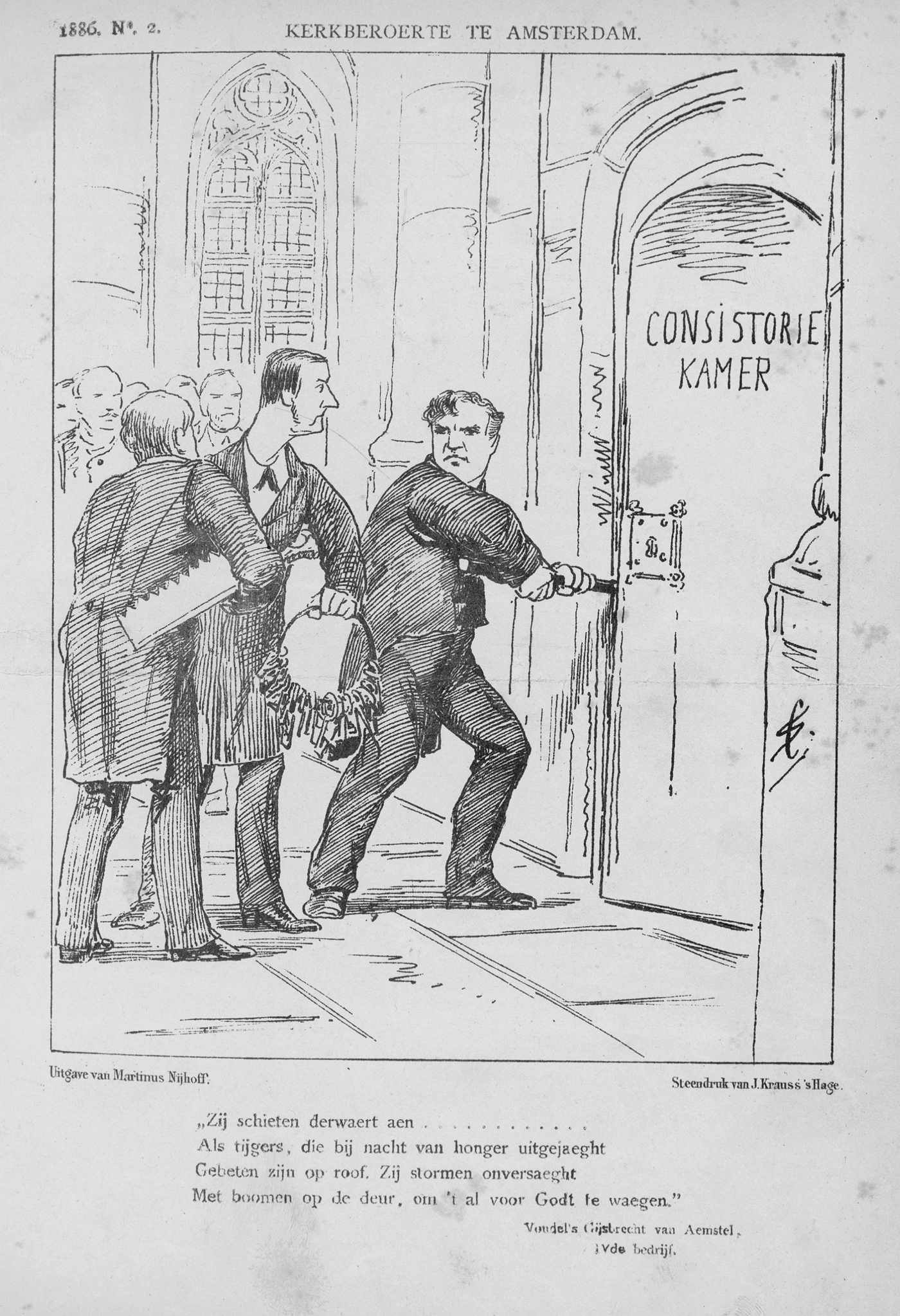
As a pastor in the Dutch national Church, Abraham Kuyper was undoubtedly not accustomed either to sneaking around or to burglary, but those were the circumstances in which he found himself on the morning of 6 January 1886. When Kuyper had arrived at the New Church in Amsterdam the day before, he had found the doors to the consistory chamber, where the pastors and church officers met, locked. While it was surely not uncommon to lock the doors, it must have been surprising to Kuyper to discover that his keys did not work. After all, he was a member of the consistory. The locked doors now had new locks, installed for the very purpose of forbidding Kuyper entrance. He came back on 6 January better prepared, this time bringing lawyers and locksmiths with him. A formidable showing was necessary because not only had the locks been changed, but the door had been reinforced with metal plates, and a guard had been set, all on the suspicion that Kuyper might try something drastic, as of course he did. Undaunted, Kuyper's crew tricked the guards and the police constable, and forced their way into the church by dismantling the door (see Figure 1). Eventually, however, the courts ruled against Kuyper's bid to seize the New Church.
The ‘panel sawing’ incident, 6 January 1886.

Abraham Kuyper has enjoyed a resurgence of scholarly interest in recent decades, punctuated by studies from America, England and the Netherlands and by the establishment of the Abraham Kuyper Center for Religion and Public Life at Princeton Seminary.Footnote 1 Much of the interest, especially among English-language scholars, continues to focus on Kuyper's public theology. Absent from this discussion, however, is an account of the ‘church problem’, as Kuyper called it, and judging from bizarre events at the New Church, it was indeed quite a problem. In fact, Kuyper regarded the church problem as ‘none other than the problem of Christianity itself’.Footnote 2
The ‘church problem’ arose amid the transition in western society that Charles Taylor calls the transition from the ancien régime to the ‘age of mobilisation’, that is, from an organically and hierarchically connected society to a fragmented society based on mass participation, charismatic leaders and organisational tactics.Footnote 3 Abraham Kuyper was a key instigator in this cultural transformation as the populist organiser of the Netherlands' first modern political party (and eventually prime minister), as a newspaper editor who used modern media to educate and mobilise his popular base, as one who broadened enfranchisement in Church and political society, and as the founder of the Free University of Amsterdam, the Netherlands' first private university.Footnote 4 Before any of these things, however, Kuyper was a pastor in the Netherlands Reformed Church and, in the transition to the ‘age of mobilisation’, the Netherlands Reformed Church faced an unprecedented problem, as historians Fred van Lieburg and Joris van Eijnatten explain: ‘orphaned by the withdrawing of the state and no longer obvious symbol of the existing order, the church needed a new legitimation’.Footnote 5 The Church would have to ‘go Dutch’, so to speak. It would have to pay its own way, metaphorically and in some respects literally. Abraham Kuyper's Free Church ecclesiology offered just such a legitimation for the Church in the ‘age of mobilisation’.
Histories of nineteenth-century theology regularly treat the secularisation of the mind, rationalism, as the primary theological challenge, especially when beginning from matters of Scripture and theological prolegomena.Footnote 6 Viewing nineteenth-century theology through the window of Church and ecclesiology opens up a new vista, demonstrating that social changes, at least as much as theoretical ones, also precipitated a crisis for theology. Commenting on Taylor's account of the ‘age of mobilisation’, Clark Gilpin says that the problem was ‘how would persons experience transcendence when the most immediate experience of religious participation arose from personal choice or agency?’Footnote 7 In examining the development of Abraham Kuyper's Free Church theology, this article finds that the church problem was, in fact, not a single problem but a set of interrelated problems brought on by the new era. First, as Gilpin suggests, there was the problem of the human and the divine. Disestablishment and democratising trends, which Kuyper championed, remade the Churches into voluntary institutions. Amid these pressures, Kuyper struggled to explain the Free Church as a sacramental institution but, as Gilpin might predict, he was eventually forced to give up that ideal. Related to this was the question of belonging versus belief. Severed from the nation, Kuyper's voluntary Church emphasised individual belief over communal belonging, and that had various implications, poignantly for infant baptism, which Kuyper reconstrued. Separate from nation and state, and dependent on voluntary participation, Kuyper's Free Church was virtually a sect, except for one obvious difference: Abraham Kuyper – newspaperman, member of parliament, university founder – was hardly calling for a Christian withdrawal from society. The third theological crisis precipitated by the ‘age of mobilisation’ was how to construe the public role of the Church. Abraham Kuyper's public theology arose to address the questions of the public and private aspects of religion that his Free Church ecclesiology raised. Thus, to the various studies of the ‘what’ of Kuyper's public theology, this article adds the historical and ecclesiological ‘why’.
The public Church and the young Kuyper
The Netherlands Reformed Church (Nederlandse Hervormde Kerk [NHK]), also referred to as the national Church or volkskerk) never enjoyed the numerical dominance that the national Churches of Scandinavia did, for example; none the less it was a privileged and a public Church in Dutch society, a status that many were loath to give up.Footnote 8 In 1816 King William i had taken the loose confederation of Dutch Reformed Churches and combined them into a single administrative unit under the national synod, reflecting the centralising tendencies of the post-Napoleonic era. A governmental department of public worship oversaw church life in the Netherlands. Pastors, including Abraham Kuyper, were often paid by the government. The state universities housed the departments of theology, and they were the only permissible educational institutions for prospective ministers in the national Church. Besides the Netherlands Reformed Church, the Roman Catholic Church, and several smaller communions, such as the Lutheran and Remonstrant Churches, were tolerated and even received some support from the state, but they did not enjoy the public prestige of the NHK. The NHK was, therefore, an established Church, but not a state Church insofar as it was not the sole Church sanctioned by the state. None the less, the Netherlands Reformed Church was so closely tied to national life that when a small group of dissenters broke away from it in 1834 soldiers were quartered in dissidents' houses, and minister Hendrik de Cock was imprisoned.Footnote 9 A break with the national Church was a matter of national security, especially after the separation of Belgium, with its Roman Catholic majority, from the Dutch federation.
Constitutional disestablishment and religious freedom were important turning points in the transition from the ancien régime. In 1848 the Netherlands definitively achieved disestablishment, earlier than many of its neighbours. Correlatively, whereas most European theologians still believed in the unity of Church and State at the end of the nineteenth century,Footnote 10 Kuyper did not, but that meant that there was little theological precedent to go on. Granting the separation of Church and State, many in the NHK still aspired to be a national Church. While not a state sponsored Church, a national Church would none the less be a Church uniquely responsible for the whole of the Dutch people. Volkskerk (i.e., national Church) became the watchword in the late nineteenth century.Footnote 11
No concern dates further back in Kuyper's theological corpus than the Church, but his early ecclesiological statements as a theological student and young pastor were inchoate as he wrestled with the Church in its new social situation. Initially he accepted the position of the Dutch modernists who, following Richard Rothe, believed that the Church had outlived its usefulness.Footnote 12 Then, as a graduate student, in his Commentatio (1860) on the ecclesiologies of John Calvin and the Polish reformer, John á Lasco, Kuyper accepted the Church on strict terms. Institutional forms could remain, but under suspicion. The Church was not the cultus but the society of Christians gathered together, and Calvin had incorrectly ascribed a ‘magical power’ and ‘excessive stability’ to the sacraments. Overemphasis, like Calvin's, on the institution, hindered human freedom, Kuyper said.Footnote 13 The Church was not an institution, but an organic society, a point attributable to the influence of Friedrich Schleiermacher. As for the Church's social position, at this early stage Kuyper believed in a public Church for the nation, though not a state Church. Instead, like many of his Protestant compatriots Kuyper hoped for a renewal of the national Church, the Church of the fatherland.Footnote 14 Kuyper's earliest sermons exhibited a certain ambivalence, however. Although he wanted a fatherland Church, and though he disdained the Calvinist sects that seceded from it, he also criticised the spiritual lethargy that had come upon European state and national Churches.Footnote 15
The emergence of a Free Church
The emergence of Kuyper's Free Church ecclesiology was an attempt to reconcile the various interests found in his early writings – the spiritual vitality of the members and the public and social significance of the Church – with a new commitment to the institutional Church. Free Churches are typically associated with the premium that they place on freedom of conscience, but Kuyper had already accepted that. The emergence of Kuyper's Free Church ecclesiology in the late 1860s and 1870s was, instead, marked by his embrace of the Church as a divine institution with a divine mission. Several things prompted this: confrontation with modernist theologians; a novel arising out of John Henry Newman's Oxford Movement, The heir of Redclyffe, by Charlotte Yonge; and a rereading of Calvin's ecclesiology.
As a theological student, Richard Rothe's views had entranced Kuyper, but pastoral exigencies eventually led him to defend the institutional Church against modernists like Allard Pierson, who claimed that ‘what actually lays in the beautiful dream of the Kingdom of God on earth can be fulfilled in and through the state’.Footnote 16 Even before that, seeds of the image of the Church as mother had been planted, when at the request of his then-fiancée, Jo Schaay, Kuyper had read Yonge's novel in February 1863. Finally, this idea came to flower under a reappraisal of Calvin in the late 1860s and early 1870s.Footnote 17 Kuyper recalled casting about for a suitable account of the Church, searching thinkers like H. L. Martensen, K. I. Nitzsch, A. Vinet and Dutch luminaries J. H. Gunning and Daniel Chantepie de la Saussaye (father of the famed theorist of religion P. D. Chantepie de la Saussaye), but he was not sated until he came to (or, came back to) Calvin. For Calvin had ‘founded a church, and through his fixed church form he succeeded in spreading blessings and peace to receptive hearts among all the nations of Europe and across the sea’.Footnote 18 Calvin's Church was ‘a mother … whose womb not only bears us, whose breast not only nourishes us, but whose tender care leads us to the endpoint of faith’.Footnote 19 Kuyper now set this High-Church Calvinist ecclesiology over against both theological modernism, with its Kantian idealism, and revivalism, with its ‘one-sided spiritualism’; since both misunderstood the importance of church forms like sacraments, doctrine and liturgy.Footnote 20
In order to maintain the tension between a divinely-given institutional Church and his call for spiritual vitality, Kuyper offered a multiform ecclesiological formula: the Church as organism and institution. This he took from Paul's metaphor of the Church as ‘rooted and grounded’ in love (Ephesians iii.17).Footnote 21 ‘Rooted’ described the inner, spiritual, organic aspect of the Church, which required freedom, while ‘grounded’ described the external, institutional forms of the Church. These two aspects of the Church existed in a complementary relationship that approximated the body-spirit model of the Church common in nineteenth-century theology.Footnote 22 Like the human spirit, the organism was the source of life, but the life of the spirit was necessarily an embodied life. Kuyper's own metaphor was the Church as a river. The organism could no more be the Church without the institution than a river could be a river, for all its rushing water, without the banks that formed it. This multiform model reflected both the spontaneity and democratic ethos of Schleiermacher's ecclesiology and the sacramental character of Calvin's Church.
Kuyper's ecclesiology had several distinctly sacramental features.Footnote 23 As mother of believers and a divine institution, the Church was a means of grace. It had a hidden side, the Mystical Body of Christ, but the Mystical Body was inseparable from the visible form of the Church. Only through this visible Church did one come into contact with the Mystical Body.Footnote 24 Kuyper combated the false notions that communion with God was strictly between the individual and God and that the work of grace was a purely hidden work of the Spirit.Footnote 25 It was not surprising then, that Kuyper took up the ‘church question’ with such fervour, when some of his contemporaries regarded it as an administrative issue, because he believed that nothing less than the honour of God and the salvation of souls was at stake.Footnote 26
As a divinely established institution, the Church was also the arbiter of doctrine. Although a champion of more democratic church government, Kuyper none the less believed that democratisation could be taken too far. He worried that if biblical interpretation was taken from the Church and given to individuals, ‘even the first principles of religion are unscrewed and a Babylonian confusion ensues’.Footnote 27 The antidote was a correct understanding of the Keys of the Kingdom. In giving the Keys of the Kingdom to Peter, Jesus had established the institutional Church and delegated to it the power to decide doctrinal disputes.Footnote 28
Kuyper's theology of baptism and his covenant rationale for baptism further exemplified this sacramental ecclesiology. Baptism, like the preaching of the Word and the Supper, was part of God's ‘preparing grace’,Footnote 29 even for infants who had not yet come to faith. Baptism prepared the way for the Holy Spirit's work of regeneration, whereby the Spirit restored fallen human nature. Kuyper explained that ‘through baptism a mystical bond between the one baptized and the body of Christ is created, through which the terrain before personal regeneration is smoothed. … Therefore there is no regeneration except from the church’.Footnote 30 Supporting this rationale was Kuyper's concept of the external covenant.
The external covenant dignified the institutional Church with a divine constitution, and it provided for a broad baptismal policy. Children were baptised based on their relationship to the external covenant community, not any hidden work of the Spirit (as was the case with the sectarian Labadists, the archetypal sect of Dutch church history).Footnote 31 Kuyper construed this relationship in the broadest possible terms – ‘Baptize all who enter the house of baptism.’Footnote 32 ‘Even slave-children were baptised by our fathers’, Kuyper observed.Footnote 33 Except in very special circumstances, baptism may never be refused, even to those of Islamic or Jewish parentage, so long as a church member sponsors them.Footnote 34
The Church as organism, on the other hand, was composed of freely consenting believers. Kuyper gained national notoriety – his first of any sort – in the Netherlands Reformed Church with a polemical piece entitled ‘What should we do?’ (1867) which argued for a church government that would allow the laity to vote for their own church officers.Footnote 35 Previously, the board of church elders and deacons (the consistory) selected its own members. The piece marked Kuyper as a church reformer and garnered him a call from the prominent Utrecht congregation. The doctrine of the organism supported a democratic polity, because the Spirit, which dwelled in the organism, empowered the people to select their own leaders, and moreover, Kuyper's democratic church polity opened the way for broadened enfranchisement in the civil sphere as well.Footnote 36
The Free Church was a voluntary Church, in contrast to the national Church (volkskerk) or state Church ideals, which Kuyper now regarded as the chief failure of the Reformation. Other conservative theologians like Philip Hoedemaker, for all their efforts at reform, would not abandon the national Church: ‘The whole of the church and the whole of the nation!’Footnote 37 This ideal found support in historic Calvinist theology, which identified the Church as the continuation of the nation of Israel, but Kuyper rejected this idea.Footnote 38 Pentecost ended the Israelite national Church. Instead, Kuyper envisioned something like the denominational system in America, which he had read about in Tocqueville, a picture of boundless freedom and fervent religiosity that Kuyper took to be pure Calvinism.Footnote 39
Calvin had offered precedent for the separation of Church and State, but Kuyper went further. Calvin had still permitted cooperation between Church and State even while separate institutions, but Kuyper came to reject all cooperation.Footnote 40 This meant abolishing article 36 of the Belgic Confession, which enjoined the magistrate to protect the sacred ministry and prevent idolatry and false worship.Footnote 41 It also meant overturning the national synod, the supreme court of the NHK. Kuyper deemed the synod, a creation of King William i, an illegitimate imposition of the state, and in its place he proposed a system of local congregations in non-binding federation. Kuyper even offered quantitative data that ongoing state subsidies hindered the Church. With precise figures, he showed that keeping the Church on what amounted to public welfare had yielded laziness and lethargy in the pews.Footnote 42
There were, however, tensions in this sacramental Free Church model, which were perhaps most apparent in Kuyper's theology of baptism. The voluntary principle called for ‘the Church of Christ … [to] be free … to choose a definite form and confession and way of life, and yet the right of freedom would remain for every man and woman not to participate in any form that did not satisfy the needs of the heart’.Footnote 43 The practice of infant baptism obviously, abridged the freedom of the child, who had little say in the matter. Kuyper also demanded greater discipline of parents bringing their children for baptism so that children were not baptised out of mere superstition.Footnote 44 Between these calls for greater discipline and his broad covenantal arguments, it was not clear whether Kuyper wanted to loosen or tighten baptismal policies in the Netherlands Reformed Church.
Making the public Church private
The combination of sacramental and voluntary elements in Kuyper's ecclesiology was an unstable one. Indicative of his voluntarism, Kuyper demanded that ministers and members fully and sincerely accept the Church's doctrinal confessions, but this ran afoul of both modernists, who no longer held to traditional Protestant beliefs, and conservative supporters of the national Church (‘irenicals’, Kuyper contemptuously called them), who had striven hard to maintain the unity of the Church in spite of theological differences.Footnote 45 Disputes came to a head in 1885 and 1886, when Kuyper and his Amsterdam consistory refused to grant the necessary membership certificates to modernist students. Sensing an opportunity, members of the Classical church board (a higher, regional church board) suspended Kuyper and the consistory and literally locked them out of the consistory chamber, thus provoking the infamous incident at the New Church.Footnote 46 These events prompted Kuyper's formation of the Nether-German Reformed Church (Nederduitsche Gereformeerde Kerken) in 1886. Kuyper had been preparing for such a break through his theological polemics for several years, and in these polemics the voluntary principle triumphed over the sacramental. In order to justify breaking with the Netherlands Reformed Church, Kuyper had to delegitimate the formal institutional structures of the Church, and in his revised Free Church ecclesiology the will of believers, acting as the organic Church, trumped all institutional impediments.
Like other organicist ecclesiologies of the day, in Kuyper's original account, the organic Church was an invisible entity transcending institutional lines, corresponding instead to the Church as mystical body of Christ.Footnote 47 In the early 1880s, as Kuyper began to explain how the Church might be reformed, he began to speak of a visible gathering of believers that was not yet the institution but which none the less existed in organic relation. This body, not the institution, was the first manifestation of the Church: ‘Christ reveals the presence of his church already in this circle of persons (appearing in the organic connection that they claim to have from the Corpus Christi) and not first through the appearance of office.’Footnote 48 In his later dogmatic lectures on the Locus de ecclesia, Kuyper put the distinction in scholastic terms, explaining the difference between the appearance (apparatio) and the institution (institutio) of the Church. Following the seventeenth-century theologian Gisbert Voet, Kuyper said that the apparatio, not the institutio, was the first visible form of the organism of the Church.Footnote 49 This formulation provided for believers to form an institution, even without strict institutional continuity. Such a body had, of itself, the ability to establish ecclesiastical office.Footnote 50
The ‘office of believers’ took on new importance as well. Calvin and Luther had over their ecclesiastical careers grown sceptical of the priesthood of all believers, having realised the abuse to which it could lead, but Kuyper's ecclesiology followed the reverse trend.Footnote 51 Earlier, in the 1870s, Kuyper himself had hardly (if ever) appealed to the priesthood of believers,Footnote 52 but the doctrine provided a useful tool for empowering a democratic base as his church reform movement gained momentum. On the basis of this official capacity endowed by the Holy Spirit, believers could form a new Church where there was none: ‘In a church on a solitary island, where a plague drags all the office bearers to the grave, the believers themselves, by virtue of their office, would have to take the place of these office bearers and execute the official work of the church.’Footnote 53 More pertinent to the situation in the Netherlands, believers, by virtue of their office, could also reform an existing institution when necessary.Footnote 54
Kuyper also desacralised the institution by describing it as a mere ‘contingent’ feature of the Church.Footnote 55 In his original Free Church ecclesiology, the institution resembled the body's role with respect to the spirit, giving the spirit the form necessary for life. Now Kuyper's institution seemed more like the clothes that covered the body rather than the body itself. Such outer garments were necessary for the well-being (‘bene esse’) of the Church, but they were not the being or essence (‘esse’) of the Church.Footnote 56 It followed that the true Church was the spontaneous gathering of believers – the organism – rather than the institution, as he explained in the Lectures on Calvinism: ‘The Church consisted not in office, nor in an independent institute, the believers themselves were the church.’Footnote 57 The Church required some kind of institutional garb, but such clothes were not the Church itself. This principle went hand-in-hand with the concepts of the visible organic Church and the general office of believers in providing the institutional flexibility necessary to delegitimise the NHK as the one true Protestant Church.
Kuyper's baptismal theology exhibited a parallel change, wherein he subordinated the institutional Church to individual religious experience. The true basis for baptism, even infant baptism, Kuyper now said, was not membership in the covenant community but the presumed prior work of the Holy Spirit regenerating the child.Footnote 58 Regeneration was said to have taken place before the sacrament of baptism and, therefore, to be the ground for baptism. Regeneration itself consisted in the Holy Spirit's immediate implanting of the ability of faith, though not yet active faith.Footnote 59 It was a quasi-baptistic explanation insofar as faith was demanded of all who were baptised, either actual faith or, in the case of infants, potential.
In his Tract on the reformation of the Churches (1883), written with his impending break with the NHK in mind, Kuyper had not worked out the full implications of his revised ecclesiology, but by the time of his Lectures on Calvinism (1898), he had. In the Tract he still accepted the Church's authority to hand down binding interpretation of Scripture.Footnote 60 In the Lectures, however, he explicitly rejected any mediating role for the Church, either as a sacramental institution or as ecclesia docens, styling these notions as Roman Catholic and Lutheran errors. Instead he insisted that the genius of Calvinism was the recognition of the immediate communion between God and humanity.Footnote 61 Elsewhere, he rejected the concept of the external covenant, by which he had once attributed divine sanction to the Church, as a mere contrivance for maintaining the state and national Churches.Footnote 62
Until this time, the Netherlands Reformed Church, the smaller Christian Reformed Church and the Roman Catholic Church had generally all viewed themselves as the one true Church in the Netherlands. Kuyper's Free Church was neither a national Church that aspired to be the dominant society-wide Church, nor one like the Roman Catholic or the minority Protestant Churches, which none the less each viewed themselves as the only true Church. Instead, Kuyper's Free Church, founded on the cornerstone of conscience, introduced a new ecclesiastical paradigm to the Netherlands. The institutional aspect of the Church existed as an expression of conscience and social contract rather than an institution divinely given with its own objective existence.Footnote 63 Although, Kuyper ideally wished for one congregation for each city, his ecclesiology introduced new possibilities for ecclesiastical tolerance, acknowledging the possibility of multiple legitimate churches or congregations with differing confessions in a given place without government approval.Footnote 64 The Free Church legitimised a religiously plural society.Footnote 65 In short, it was a modern denomination, a voluntary, private religious institution.Footnote 66
Making the private Church public
Although the Free Church may have solved Kuyper's ‘church problem,’ it raised another unique dilemma. National and state Churches had automatic access to the public realm. Their influence in all areas of life was taken for granted. Churches like the New Church in Amsterdam stood as visible, concrete symbols of the Church's public presence, but Kuyper was calling for an end to that system. His Free Church model privatised and circumscribed the Church. That was not a problem for the various sects dotting the European hillsides, which had withdrawn themselves from the world, but it was a problem for ‘Holland's foremost citizen’, as one American brochure introduced Kuyper.Footnote 67 Kuyper had to explain how Christianity could be public, when the Church was not. This, José Casanova says, is the problem of public religion in the modern world as faced by modern denominations (roughly what Kuyper's Free Church was):
Can there be a modern form of public religion that does not aspire to being an ‘established’, state or societal church? … The question that needs to be addressed … is whether the denomination, as the modern, voluntary form of religious association based on religious freedom and religious pluralism, can also assume a different kind of ‘publicity,’ a political one, in modern differentiated societies.Footnote 68
The distinctive aim of Abraham Kuyper's public theologyFootnote 69 was to provide an account and a strategy for Christianity's public role, all the while maintaining the Church's status as a private institution.
In 1896 Kuyper, almost sixty years old, stood before the synod of his young Church. His break-away Church had recently joined with another confessional Reformed Church, the Christian Reformed Church (Christelijke Gereformeerde Kerk), which had seceded from the national Church several decades earlier. Even with their combined strength, however, the Church remained a minority in Dutch society. Some at the synod may have expected Kuyper to pass the baton to a new generation. In fact, he said the work was only half complete. Protestantism seemed disoriented and dispirited. It had adopted the spirit of the age at just the time when the spirit of the age was hostile to it. Therefore, ‘what Calvinism must do in our day is to set itself again at the head of Protestantism, and to do what neither Lutherans nor Anabaptists, what neither the Ethical mediating theologian nor Methodist zealot is able, that is, to erect a life- and worldview composed from the root of Protestantism over against the wisdom of our age and partly over against Rome’.Footnote 70 By Calvinism, Kuyper meant the pure confessional Calvinists of his Free Church. In fact, only such a Church could be the foundation for true Christian engagement of society and the world. ‘For whatever shall be Christian in the highest sense, its starting point can lie nowhere else than in Christ, and it must thus also always seek its focus in his pure church. Only where that Church as institute stands pure again, can she also act as organism, again shining light, enlivening, preserving.’Footnote 71 It was, therefore, at this late stage in life that Kuyper devoted himself to consolidating and elaborating his public theology in works such as his Lectures on Calvinism and his three-volume Common grace, ideas which had till then had remained inchoate.Footnote 72
Kuyper explained the private Church's public presence with three theological concepts: common or public grace, his Calvinistic world- and life-view, and the visible organic Church. The latter concept had already figured in Kuyper's account of the reformation of the Church, but as he hinted in his speech to the synod, the visible organic Church had still more responsibilities. Whereas national Church supporters continued to maintain a direct public role for the institutional Church, transforming home missions and evangelism into tools of social welfare, for example,Footnote 73 Kuyper's institutional Church had a narrowly prescribed religious role. ‘The institute does not cover everything that is Christian. … This extra-institutional influence in society points us to the church as organism.’Footnote 74 The organic Church, appearing visibly in society, had the responsibility of engaging in the various spheres of life: education, politics, commerce, etc.
In practice, the public work of the organic Church took shape in the myriad para-church Christian organisations that Kuyper established.Footnote 75 This distinguished Kuyper from Calvinist traditionalists like Philip Hoedemaker. Hoedemaker wanted a distinctly Christian government, a state with the Bible,Footnote 76 whereas Kuyper wanted a Christian political party, not a Christian government. The establishment of such organizations, be they political parties, Christian universities, or something else, was not the responsibility of the church institution, Kuyper said, but of the organic Church. This tendency to Christian party-forming revolted Hoedemaker and others, who viewed the whole Dutch nation, not just one group within it, as a Christian-Protestant nation.Footnote 77
Second, Kuyper's doctrine of common grace opened a public space where the organism could do its cultural work. Kuyper broached his doctrine of common grace first in 1887 in response to the problem created by the appearance of his Free Church a year earlier. The Free Church severed the Church from the nation. The question was how one could be true to the nation, the Dutch people, if one was not a member of the national Church, the NHK. Kuyper explained that, in fact, the Christian had a dual citizenship in two fatherlands: the fatherland of particular grace, the Church, and the fatherland of common grace, the nation.Footnote 78
Kuyper was sensitive to accusations that his Free Church looked very much like a sect and might portend a withdrawal from society.Footnote 79 The national Church had a broad cultural impact but at the unfortunate cost of admitting and accommodating all kinds of unChristian elements. The sect, in contrast, maintained Christian purity but was forced to withdraw from the world. Therefore Kuyper presented his doctrine of common grace explicitly as an alternative to both. In order to mark off the grace that properly belonged to the Church and yet not cut off the Church from society, Kuyper distinguished between particular and common grace. Particular grace was the saving grace experienced only by God's elect. Common grace was public grace that, while it did not save, restrained evil in the world, making civil (burgelijk) or extra-ecclesial (buiten-kerkelijk) life possible and even dignified.Footnote 80
Further, the institutional Church was one source of common grace. While particular grace and its saving effects were limited to the elect, particular grace still had broader effects. This public, nonsaving effect was common grace. Kuyper adapted the ‘city on a hill’ metaphor to his own ends here. The Church resided as a city in the world, but resisted the tide of the world to enter it. Instead, its light, the light of common grace, shone through open windows into the world around it.Footnote 81 The Church thus exercised a public influence through the indirect leavening of society via common grace. Thereby the world was not brought into the Church, yet the Church remained in the world.Footnote 82
The doctrine of common grace and the cultural mandate of the visible organic Church led Kuyper to claim that the ‘secularisation of state and society is one of the most basic ideas of Calvinism.’Footnote 83 ‘Secularisation’, by which Kuyper meant the secularisation of social structures especially the separation of Church and State,Footnote 84 did not entail the ideological secularism of the French Revolution. In fact, Kuyper envisioned a scenario more like the one that played out in the United States, where the separation of Church and State actually benefitted the cause of religion.Footnote 85 No state Church or established religion was necessary to ensure the vitality of Christianity, Kuyper believed, if the people themselves were Christian, that is, if society was permeated with the organic Church. Kuyper's Christendom, in contrast to the medieval and Reformation-era synthesis, was a democratic, grassroots one: ‘Not a national church [volkskerk], but rather a church-people [kerkvolk].’Footnote 86
Finally, Kuyper explained Christianity's public role through his concept of worldview. Although Kuyper succeeded in privatising the Church, Calvinism was for him far more than a Church. It was a ‘life-system’, or in more contemporary terms, a worldview.Footnote 87 The Church and religion was only one area where the principles of a Calvinist worldview ought to be applied. Kuyper's Lectures on Calvinism drew out these principles into all spheres of human culture: history, religion, politics, art and science. It was an argument that Calvinism could not be kept at home or in the church. Rather, this Calvinistic worldview was universal, public and a form of cultuurprotestantisme,Footnote 88 but – crucially – it was not a Church.
When Kuyper arrived at the New Church in January 1886, pastor G. J. Vos said he came with ‘carpenters,’ ‘panel-sawers,’ ‘lock-cutters’ and ‘the French Revolution in heart, vulgarities on his lips, and a pry bar in hand’.Footnote 89 In retrospect, Vos was quite right. Kuyper's ideas and actions bore with them a religious and social revolution. Although Kuyper decried the atheism of the French Revolution, he was none the less proceeding towards a rupture in Dutch society as a whole. One could not break with the national Church without at the same time tearing the social fabric of which it was a part. The tear in the social fabric was between a Church and society organically and hierarchically joined and one voluntarily and democratically arranged, Charles Taylor's contrast between an ancien régime and the oncoming ‘age of mobilisation’. The Free Church severed the Church's link with the state, the nation, hierarchy and, finally, with grace. Believers were thrown back upon themselves. They held to the Reformed Free Church out of conviction rather than convention. The divine was no longer located in the institution but strictly in the believers themselves. In reconceiving the Church along these lines, Kuyper introduced another radical shift in Dutch religious culture by reframing the Church's public role. If religion was not to become strictly privatised, it had to have some public outlet, but that could hardly be the private institution outlined in Kuyper's theology. The task of Kuyper's public theology was to explain Christianity's public relevance in a way that did not implicate the Church. In so doing, Kuyper's ecclesiology and his public theology became products and heralds of a new day.