The day before Christmas in 1872, the painter Il΄ia Repin wrote a letter to the art critic Vladimir Stasov, expressing his excitement at the prospect of leaving St. Petersburg, where he had been training at the prestigious Imperial Academy of Arts: “I have to run from Petersburg; to escape in order not to be frozen up completely…. Quickly, quickly I must get to anywhere in Europe—Paris, Rome … it doesn't matter…. Yes, to Europe, to Europe, there we are needed more than here… . Europe needs us, she needs a flood of fresh strength from the provinces …”Footnote 1 “Europe needs us.” This is not the way we usually think of the relationship between eastern and western European art in the 1870s. Moreover, Repin's excited exclamation is not what we have come to expect from a young Russian artist longing for the artistic centers of the west.Footnote 2 His sentiment was not that he needed Europe (and one might assume all sorts of reasons for this—to gain greater technical proficiency, to learn modern methods), but that Europe needed Russian artists. Europe needing fresh blood “from the provinces” is a striking reversal of the usual notions of how artistic influence operated in the second half of the nineteenth century. These lines tell us that certain assumptions about the way artistic centers and peripheries functioned need to be reassessed.
A year later, the artist was to get his initial wish. He arrived in Paris, twenty-nine years old, at the very beginning of October in 1873.Footnote 3 Born the son of an army private in the small Ukrainian town of Chuguev, the artist had only recently experienced his first success with the magisterial Barge Haulers on the Volga (1870–73).Footnote 4 Critics had lauded the work throughout its exhibition at the St. Petersburg Academy of Arts in 1873. “Just one look at Mr. Repin's Barge Haulers,” wrote that same critic Stasov in Sankt-Peterburgskie vedemosti, “will convince you that no other Russian has yet dared to tackle such a subject and that you have never before seen such a deeply moving picture.”Footnote 5 Buoyed by this support, Repin travelled to Paris and began writing home of his impressions: “What a matchless people are the French!!”Footnote 6 This was Repin writing to Stasov after being in Paris a mere two weeks. By November, he said: “It's terrible, but very true, my first impression of Paris was that I was frightened at the sight of it all.”Footnote 7 Around the same time, he summed up what lay ahead: “It's frightening to begin a big thing, nevertheless I will venture.”Footnote 8
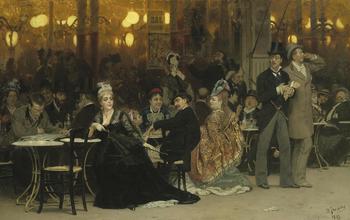
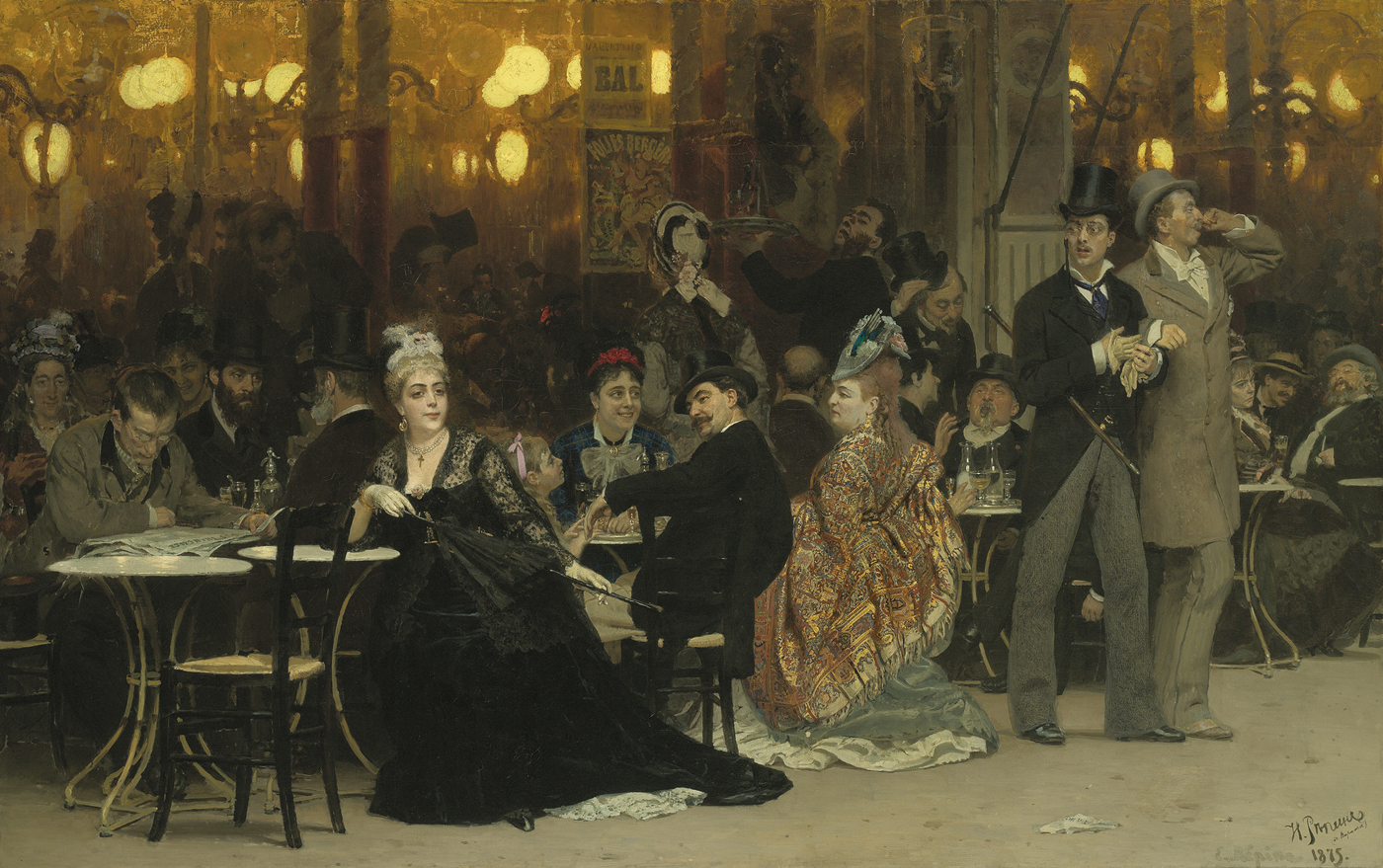
Sometime in early 1874, Repin did indeed venture to begin “a big thing.” The work, first known as Un café du boulevard and now most often referred to as A Parisian Café, would occupy Repin for much of the next year (see Figure 1). He described the subject of the painting in a letter to the art collector Pavel Tret΄iakov in March: “I wish I could show you my painting: it depicts the main types of Paris in their most typical place. But I know you don't buy foreign subjects. Nonetheless, I think it will be found interesting here and will sell.”Footnote 9 Modern commentators of the work have described it in various ways. The art historian Grigory Sternin called it “a sort of experiment, an attempt to put down on canvas his impressions of French life and French painting.”Footnote 10 This is certainly true, Repin's painting of the café and its inhabitants was an “experiment,” but, I will argue, in much more than recording impressions. Un café was ultimately an experiment in a very singular kind of mediation—one in which Repin sought, through painting the main types of Paris, to intervene in another culture's artistic language via what he referred to as “content.”
Il΄ia Repin, A Parisian Café, 1875. Oil on canvas, 120.6 × 191.8 cm. Private collection.
In so doing, Repin encountered a number of complications that have been difficult for historians to assess, but that might ultimately lead to a reevaluation of how we understand modernist paintings. For investigating the problems that Repin encountered as he sought to bring his work about serves to enrich our understanding of what it meant to be a painter of modern life, despite one's geographical origins, in the 1870s. For Repin, artistic and cultural plurality was a given in this moment and such plurality was not seen as an inhibitor to modernist prowess, but an opportunity. Repin's Paris painting thus demonstrates a singular instance of transcultural connection, one that allows us to see how painters—regardless of their country of origin—grappled alike with ways of describing the modernity that made life so exciting (and terrifying) in this moment.
Repin as Flâneur—“E. Répine”
Repin began sketching for the café painting almost as soon as he arrived in Paris. A bound sketchbook dated 1872–75 attests to his eagerness to record his impressions of the French capital. The book contains no less than 120 pencil drawings, seven colored pencil drawings, and two in ink. There are also stand-alone studies in various media—watercolor and oil etudes of striding gentlemen, seated women in magnificent shawls and dresses—all signed and dated 1874.Footnote 11 Paris takes shape in these studies. One sees Repin grappling with costume details and the subtlety of gestures; he is sensitive to the nuances of facial expression, to the weight of gravity as it fights with the momentum of movement. These studies embody something he wrote not long after he first arrived: ” … never before have so many pictures swarmed in my head: there is no time even to sketch, you don't know what to pause on—the climate here is such that everyone works fervently and relentlessly.”Footnote 12
At the same time, Repin must have been seeing art throughout that first winter. He had arrived too late in 1873 to see the works in the Salon de Paris, the preeminent official exhibition of the Académie des Beaux-Arts and arguably the chief semi-annual art event in the western world. Yet we know he visited the first Impressionist show in the spring of 1874. It was an exhibition that deeply challenged the status quo of the French Academy, counteracting the strictures of the official Salon by being conducted without juries, awards, or restrictions. It coincided with the formation of the Société Anonyme Coopérative des Artistes, Peintures, Sculpteurs, et Graveurs—a group of artists which had formed around Claude Monet in January of the same year and would ultimately become the vanguard known as the Impressionist circle.
Repin wrote home throughout these months of the art he was seeing around him: “Generally speaking, the French have a completely different principle in art… . Beauty and the overall effect [vpechatlenie tselogo] are their goals.”Footnote 13 By March of 1874, things were becoming clearer for him: “Yes, we're an entirely different people… . And here is our task—content [soderzhanie]. The face, the soul of man, the drama of life, the impression of nature, its life and meaning, the spirit of history—these are our themes it seems to me; our paints are our weapons, they must express our thoughts …”Footnote 14 This is a man shoring up his goals, projecting outcomes—for himself and the Russian art he represented. It is significant that he believed in this early moment that the central difference between French and Russian art was content. The word he used for describing the Russian artist's task, however, is complicated. Soderzhanie is more than just content; it can also mean substance, even subject matter. What was this “content” that Repin was so adamantly focused on? “The face, the soul of man, the drama of life, the spirit of history.”
Each figure in the painting indeed resonates with intense individuality, creating a panorama of affect and physiognomy across the canvas. An actress sits next to a child adjacent to a writer; he takes no notice of the cocotte who is gawked over by an artist, and all of them are next to tens of nameless someones sitting, striding, and looking. Each figure is emotively resonant and diverse, packed with typological and expressive significance. Such overabundance goes straight to the heart of Repin's professed task: his desire to seize the drama of life and the spirit of history. It also says something about modern life: that capturing it was bound to lead to a surplus, one that was at the same time centered around a vague kind of emptiness.
The business of how to handle “content” was a high stakes game in this moment. Repin not only had high hopes of impressing the French, but knew he also needed to satisfy the artistic and cultural establishments back home. Much of Repin's thinking seems to intersect with rhetoric that had been growing in force since the 1850s, when Russia's intelligentsia had begun issuing calls for the establishment of a national school of art, one that would reflect quintessentially Russian values and focus on contemporary content as opposed to merely aping western styles. There was great debate in these years as to how such a transformation was to be achieved. The more conservative Slavophiles, many of whom supported the autocracy and upheld the traditions of the Academy, espoused content that would act as a panegyric to Russia's uniqueness. They called for a general celebration of what they perceived as singular values distinct from the west's supposed decadence. In opposition were the more liberal Westernizers who celebrated Russia's engagement with Europe from the early eighteenth century on. They called for content in art that was outwardly critical as well as utterly contemporary, desiring above all that artists be engaged with socio-political issues singular to Russia at the time.Footnote 15
Nikolai Chernyshevskii was one of the strongest voices in these debates in the 1850s and 60s and he specifically addressed the role that form and content needed to take if Russian art was to find its new purpose. Chernyshevskii believed art was not meant for mere decoration or beautification, but that it should fulfill the needs of humanity by putting forth content that reproduced reality: “… the sphere of art is not limited only to beauty and its so-called elements, but embraces everything in reality … that is of common interest—such is the content of art… . the artist (consciously or unconsciously, it makes no difference) tries to reproduce for us a certain aspect of life …”Footnote 16 Thus, Repin's idea that his task as a painter was to put forward content that reflected the “drama of life” and find forms that embraced reality was steeped in critical ideas being put forward by the Russian intelligentsia at the time.
But he knew his task in Paris did not end there. Repin needed not only to find a content that would be “of common interest” (and would thus satisfy critics like Chernyshevskii), but he also wanted to make a painting that the French would take note of—that would be modern in the sense that word was beginning to have. How could a young man from Chuguev, however, find forms that contributed to the recording of modernity in this moment? He knew he had to find the right content and the Parisian café must have seemed a solution. The café encapsulated an element quintessential to modernity—different levels of society muddled and confused, impossible to delineate as they rubbed elbows in compressed space.Footnote 17 The café was the miasma of the demimonde and painting it allowed Repin to grapple with the impossible kind of flux that was Paris in this moment. Modernity in 1874–75 was change; it was constant and immitigable fluidity—of social class, of politics, and of art.Footnote 18
Marshall Berman has written about modernity along similar lines, describing it as “a world where meanings melt into air.”Footnote 19 He summons a range of literary and philosophical voices to substantiate this claim for inherent evanescence, building from Karl Marx's now famous dictum: “All that is solid melts into air.”Footnote 20 But as a painter, and especially as one committed so strongly to content, Repin had to find a means for conveying modern life's contingent unrest, what the art historian T.J. Clark calls “things in modernity incessantly changing their shape, hurrying forward, dispersing, and growing impalpable.”Footnote 21 In this sense, Repin's work on the café scene also aligns with Henri Bergson's thinking on modernism and the role of flux within perception. For Bergson, artists were able to “show us … things which did not immediately strike our senses and consciousness” because they perceived the gaps in perception that most of us habitually elide.Footnote 22 In Bergson's system, Repin might serve as an ideal example of how artists “perceive in order to perceive,—for nothing, for the pleasure of doing so.”Footnote 23 This type of perception also aligns with Charles Baudelaire's description of the flâneur, who like Bergson's artist, is absent-minded in a way that differs from “those of us focused on action and living who have ‘been obliged to narrow and drain’ our view of the world.”Footnote 24
For Baudelaire, that quintessential theorist of the intersection between modernité and the city, the crowd was the epitome of modern life's changeability: “For the perfect flâneur, for the passionate spectator, it is an immense joy to set up house in the heart of the multitude, amid the ebb and flow of movement, in the midst of the fugitive and the infinite.”Footnote 25 The painting Repin produced places us in just such a multitude. His café too ebbs and flows—the two gentleman drifting outwards as they stroll forward, the man in shadow behind them cresting downward like a wave as he bows, the open-mouthed waiter behind him straining upward to perilously balance a tray above the crowd. Every form here is, as Baudelaire wrote, “fugitive and infinite”; the painting has an incredible temporal extensiveness to it, everything is instantaneous and yet also endless and immeasurable.
Similarly, those quintessential Parisians, the Goncourt brothers, saw the café as the embodiment of the modern condition in 1860: “I see women, children, households, families in the café… . The club for those on high, the café for those below, this is what society and the people are come to. All of this makes me feel like a traveler. I am a stranger to what is coming, to what is …”Footnote 26 Compare the Goncourt brothers’ feeling of rootlessness in their own native city to Repin's thoughts in 1875: “I'm so accustomed to everything that is done here, so reconciled with the many delusions of the French, … I'm even uncovering the meaning and value of things that seemed to me at first just meaningless and empty, and this meaninglessness now seems to me the very essence of things.”Footnote 27 Repin understood Paris and its modernity well; in centering his painting on the café and the crowd, he was aligned with some of the most prominent French thinkers who believed these to be the hallmarks of modern life.
The Impressionist painters were also wrestling with ways to convey modern life's mutability in these years. For them, form itself was largely the answer; the openness of their brushwork became a way to capture the flux of the world around them. Repin could have aped this mode, but he did not. Perhaps this was where the misreading of his work began. Repin's Paris painting has nothing of the formal qualities that have come to be associated with modern art—it does not deliberately state the facticity of its flatness or make a spectacle of its inherent planarity. It is instead almost pedantically academic. This has blinded scholars to its peculiar modernism.
Instead of making a painting that imitated the formal experimentation of the Impressionists, Repin stayed close to the task he had highlighted in March: “the face, the soul of man, the drama of life.” He staked everything on content and on finding the quintessential Parisian places and types that would fulfill his realist task. The flâneur must have struck him as an ideal type for capturing the flux of the city. He was the ultimate symbol for the way the city dispossessed its inhabitants. He fetishized the urban center's unknowability and made a spectacle of his supposed neutrality to the metropolis’ wonders. Repin acted the role of just such a passionate spectator as he roamed the streets, internalizing them in the pages of his sketchbook.
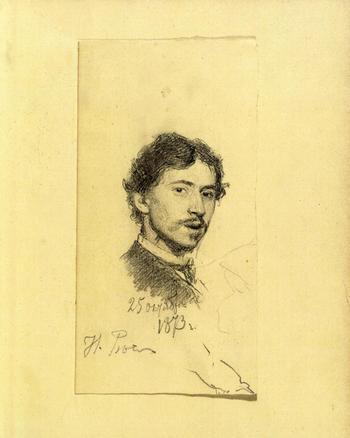
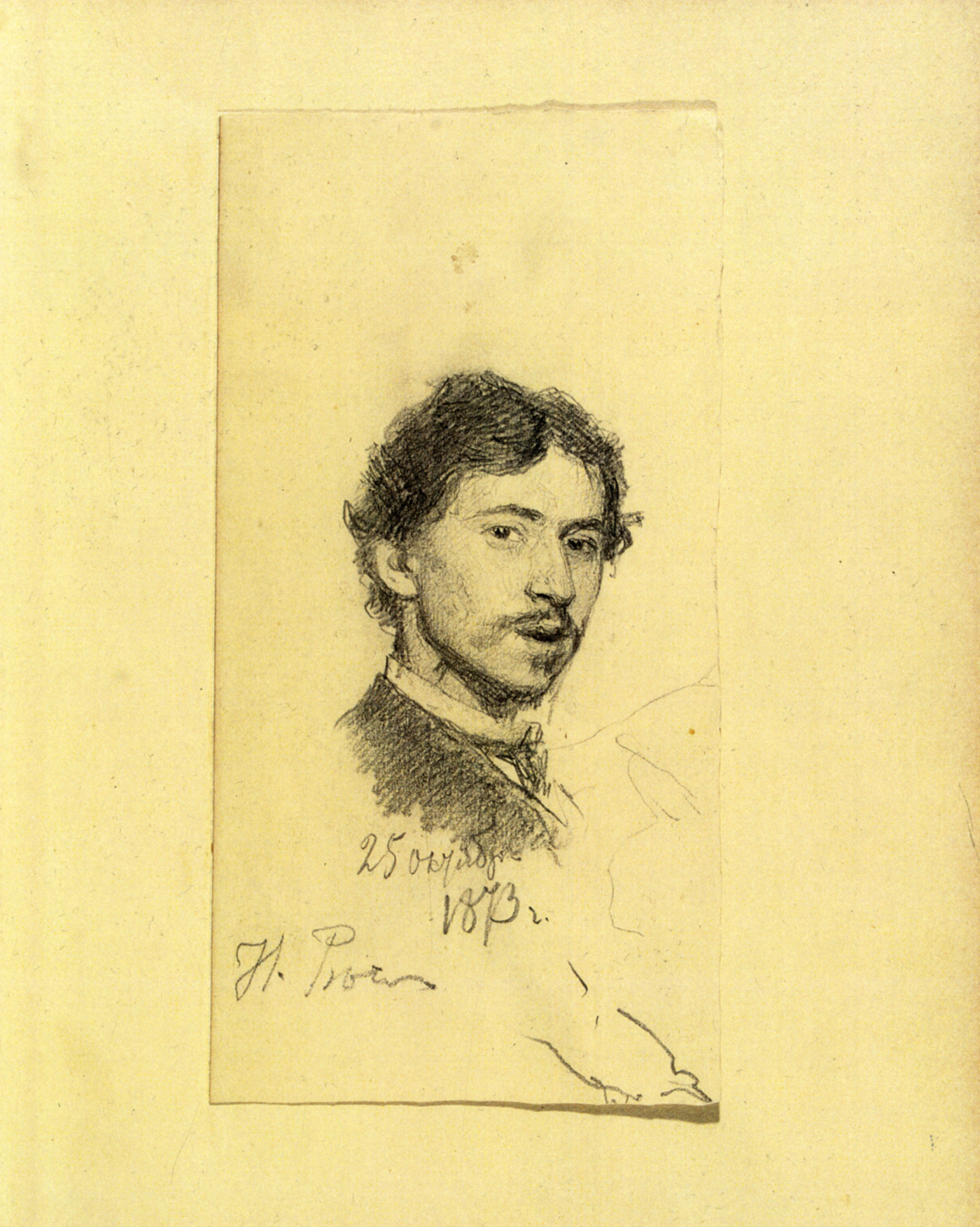
The two flâneurs on the right side of the canvas mimic Repin's own artistic wanderings as he explored Paris in the winter of 1873–74. The top-hatted figure especially is evocative of the wonders of the capital, his mouth agape as he tentatively removes his glove. In this figure I think we might see a pseudo-self-portrait of the artist (see Figure 2). The same awe is embedded in a sketch he made of himself in October of 1873—the mouth slightly open, the keenness of the gaze directed outward, quick strokes delineating an arm. The flâneur in the café scene is also depicted in this way—lips slightly parted, a faint goatee, eyes moving to the right as his friend pulls him to the left. This is Repin as flâneur, as artist of but not quite in the crowd, strolling arm in arm with a man so jaded he yawns before the excitement of the café.
Il΄ia Repin, Self-Portrait from sketchbook dated 1872–75. Pencil on paper, overall album size 21.5 × 18.1 cm. Private collection.
Repin marks this area of the canvas with a further signal of his presence by signing his name directly in the path of the two flâneurs. His signature is made not once, but twice—in prominent Cyrillic which reads “I. Repin (in Paris) 1875” and in now deeply faded (or painted over) Franco-Latin letters: “E. Répine.” This dual emphasis—Repin and Répine, Repin and Paris—places the artist himself firmly in the café space. The twinned signatures mirror the doubling of the flâneurs above, but they are also a sign of something larger than Repin envisioning himself in the scene. On one hand, they show him actively trying out a new role as a painter—Répine—the Russian artist working in Paris on a “foreign subject.” On the other, he was (and knew he always would be) Repin—born in Ukraine, trained at the Academy, writing home to Petersburg. Un café is the one moment—perhaps the only moment to be pulled off with any success—where the two coexisted; where Repin as Répine spoke with fluency in two modern artistic languages.
The Russian Reaction—“We are not Frenchmen”
In February 1875, Repin was almost finished with Un café and decided to submit it to that year's Salon de Paris.Footnote 28 Storm clouds gathered when a letter from his friend and fellow painter Ivan Kramskoi arrived from Petersburg in May: “Fortunately or not, we are not Frenchmen. We should never forget this… . You're not unaware of that strange phenomenon whereby a thing that garners good reviews over there in Paris, abroad, arouses entirely different reactions in Russia. Why do you think that might be?”Footnote 29 There is something ominous in Kramskoi's admonition that Repin must remember that the Russian reaction to his new work will not be whatever it is in Paris, and in his warning that Repin must never forget that he is not a Frenchman. The storm only worsened in August:
You hadn't mentioned the subject of your painting [Un café], and I've only heard about it [from the artist Arkhip Kuindzhi]. Well and good. What I don't understand is how you happened to paint it. It's an impudent gesture, don't you think? … I thought that you had formulated a cast-iron conviction regarding the principal tenets and methods of art, and especially the national strain. Whatever you may say, art is not a science, it is only strong when it is national.Footnote 30
Something big was at stake here. Kramskoi was above all admonishing his young friend for deviating from the national strain. By depicting another people, by getting under a culture's skin in this way, Kramskoi believed Repin was essentially trying to speak in a language foreign to him. The hybrid double signature would likely only have been a further sign of the problem for Kramskoi. To him, Repin had put on an alien artistic skin and Kramskoi was convinced it was impossible for a Russian artist to assume this subject matter and speak in this mode.Footnote 31 Kramskoi's rhetoric echoed the thinking of the liberal intelligentsia from decades before. In his 1841 essay on “The Idea of Art,” the literary critic Vissarion Belinskii had charged art with such nationalist duties: to “defend civilization, enlighten the human spirit, resist autocracy and obscurantism, and to formulate a national character.”Footnote 32 These ideals were reiterated by Stasov from the 1860s on; he issued repeated calls for art to be centered on popular themes and to bear signs of the national character (narodnost΄).Footnote 33 Kramskoi was deeply embroiled in these debates, even beyond his correspondence with Repin. As early as 1864, he had announced: “The Russian [artist] should finally stand on his own feet in art…. It's time to think about the creation of our own Russian school, about our own national art!”Footnote 34 Kramkoi's letter to Repin thus was not without a lineage in Russian thinking. It takes us back to the writings of Chernyshevskii and Repin's original self-professed task to capture “the drama of life” via soderzhanie. In the same letter, Kramskoi drove deeper into the heart of the matter:
… a man with Ukrainian blood in his veins is even more capable (because he understands it effortlessly) of depicting a heavy, sturdy, and almost wild organism, but not cocottes [kokotok]! I'm not saying it's not a subject, by no means! But just not for us; we should need to have heard French chansons from our cradles … in a word, we'd need to be Frenchmen. In short … you are not yet able to speak in the language that everyone speaks, and so you are unable to attract the attention of the French to your ideas … Footnote 35
Kramskoi's specific accusation was that Repin had assumed a language not his own, one that, in fact, could not be learned. He had chosen a subject (cocottes) that for Kramskoi was so far removed from Repin's (Ukrainian) perceptual field of understanding that it would inevitably be a failure.Footnote 36 Repin sent back a rebuttal that was almost stunning in its simplicity:
You're a true provincial, Ivan Nikolaevich, in your assumptions about my picture's lack of success, on the language one speaks in, and so on. Everything is so much simpler … the language everyone uses is of little interest, whereas an original language is always noticed straight away, and a wonderful example of this is Manet and all the impressionists.Footnote 37
For Repin, the matter seemed simple: who cared about the language one used? It only mattered that an artist found an original language.Footnote 38 One that translated across cultures; that was “noticed straight away.” Repin wanted to find such an original language and he saw one in Manet. Kramskoi claimed there was no universal language, for him, art was only strong when it spoke in its own language, when it was centered on “national form.” For Kramskoi, Repin not only should not, but in fact could not, paint French cocottes because they were an alien form, they spoke a language Repin would never speak because he was not himself a Frenchman.
For Kramskoi (and we could add to his cohort Stasov, Chernyshevskii, probably even Belinskii), Repin could not paint cocottes—a type that was, along with the flâneur, so central to Paris in this moment—because that would mean painting in the manner of someone like Manet. What he would produce by painting such a foreign subject would not be Russian art. What Repin proved in completing his painting and getting it into the Salon, however, was that this combination of factors did amount to Russian art. Repin was an artist trained in Russia and yet he completed a work of art that painted French cocottes and flâneurs in a style evocative of Manet. The result of this combination of subject and style was not just Russian art (or Russian realism), but modernism.Footnote 39 To understand how this could be true, however, we need to look carefully at the relationship between Manet and Repin, and why the latter chose this particular French artist in his refutation of Kramskoi.
Repin and Manet
It has been said of Manet that he did not have a style. He had all of them.Footnote 40 I think for one brief moment in 1875, Repin wanted to know what it felt like to have all styles. A number of scholars have pointed out an artistic affinity between the two painters. The most sustained analyses in English of Repin's Un café were conducted by Elizabeth Valkenier and David Jackson, both in the 1990s.Footnote 41 Valkenier noted that: “Among the Impressionists, Manet appealed most to Repin.”Footnote 42 She argued further that Repin was unique among Russian artists of the period for recognizing the significance of the Impressionists. She did not, however, carry out a prolonged investigation of the ways Repin's work engaged with Manet. Jackson's important article on the café painting did much to explore the meanings and repercussions the work had in Repin's oeuvre.Footnote 43 But after a brief section comparing Repin's use of the cocotte to Manet's scandalous Olympia from a decade earlier, Jackson pivots to an assessment of Repin's engagement with Impressionist works more generally.Footnote 44
We know that on at least two occasions in 1875 Repin had seen Manet works at the Durand-Ruel gallery: “There S. M. [Sergei Mikailovich] Tret΄iakov [Pavel's brother] bought up a bunch of French paintings, among other things (he ruined himself). He bought a Roybet, the ‘Paige with Two Dogs,’ remember that one we saw at the Durand-Ruel Gallery, when we saw Manet. I did a portrait of Vera (à la Manet)—in the space of two hours.”Footnote 45 This admission is significant: he did a portrait “à la Manet.” He seems to have associated speed above all with what it meant to paint like Manet, although he must have figured out quickly that it was more than that.
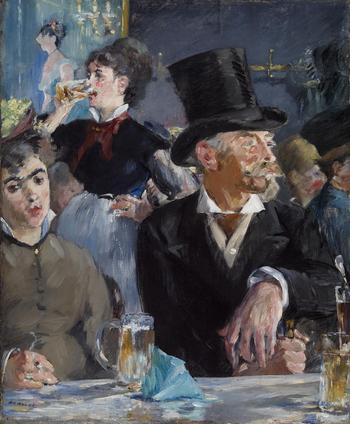
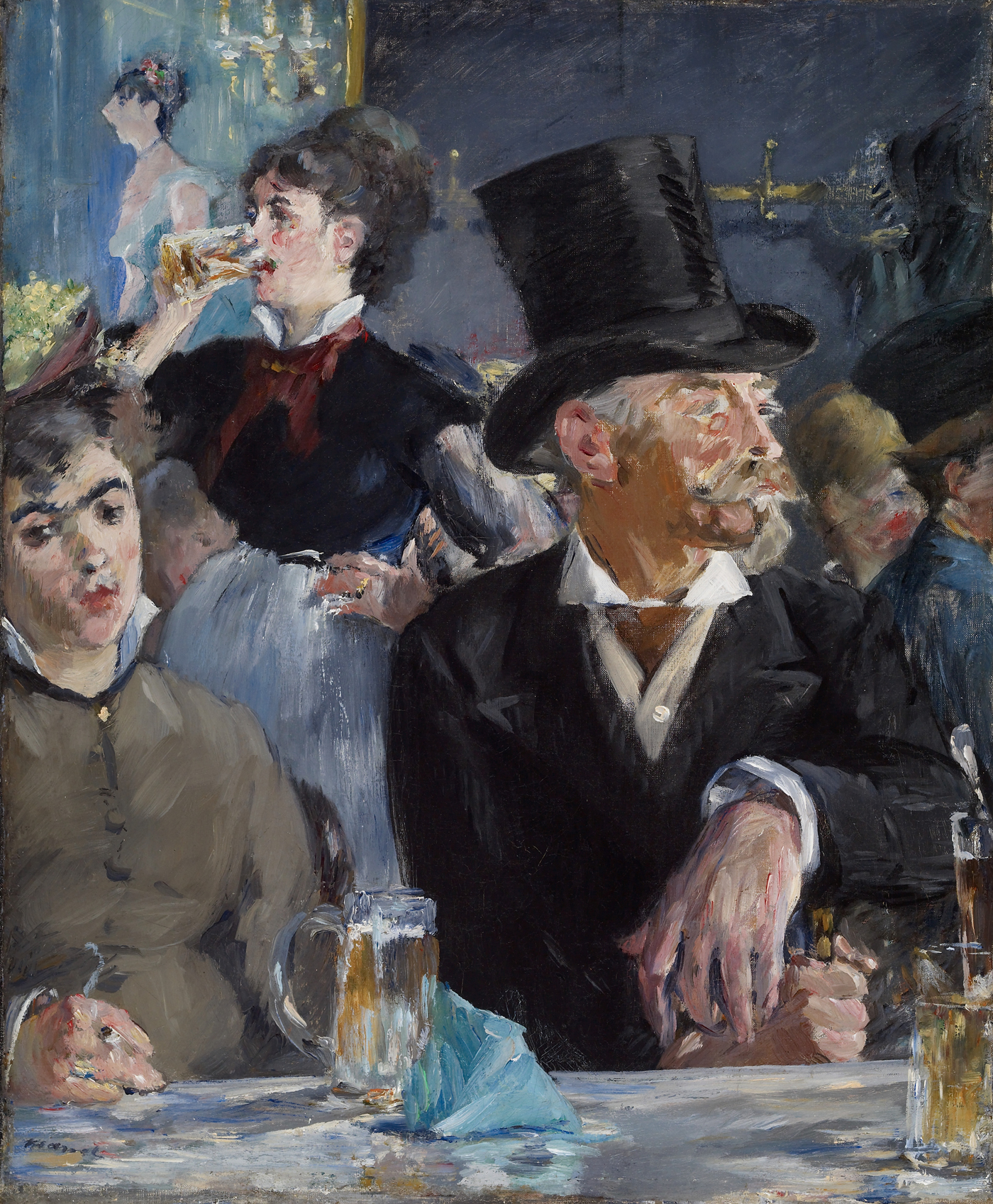
Beyond this admission though, there is a certain frisson between Manet and Repin. Both captured something so elusive—an absence of engagement, moments of human boredom.Footnote 46 The blankness of certain figures is handled differently by Repin as compared to his French counterpart though. Take for instance the female figure tucked behind the strolling flaneur at a table on the far right of Repin’s painting. Compared to the smoking woman in Manet's 1879 The Café-Concert (see Figure 3), one can see that Repin's demimondaine is a good example of what the philosopher Richard Wollheim described as “vagueness taking over” in Manet's works.Footnote 47 Repin's figure, however, does not have quite the same emptiness or resignation we associate with Manet's women. Her face registers as more than bored or vacant; the tightness of her jaw reads as even slightly angry. Repin's figure is not simple resignation; she is his search for that all important content—“the face, the soul of man, the drama of life.” None of this is Manet's goal.
Édouard Manet, The Café-Concert, 1879. Oil on canvas, 18 5/8 × 15 3/8 inches (47.3 × 39.1 cm). The Walters Art Museum, Baltimore.
This leads one to perhaps question which of Manet's paintings Repin could have seen during his three years in Paris. In a letter from 1876, he briefly references a Boater [Kanot΄e] painting that was rejected from the Salon.Footnote 48 It is unclear whether it was Manet's En bateau he was referring to or Argenteuil—both works are from 1874.Footnote 49 A more likely influence was the grand multi-figure composition Music in the Tuileries (1862). The art dealer Durand-Ruel recalled having bought the picture in 1872 and we know Repin visited his gallery with some frequency in 1874 and 1875.Footnote 50 Both Music and Un café share something of the same murky foreground, that sand-colored pavement of Baron Haussmann's new boulevards, but Manet's painting is a frieze of emotional indifference. It does not possess the same fits and starts as Repin's painting; it just does a different kind of work.
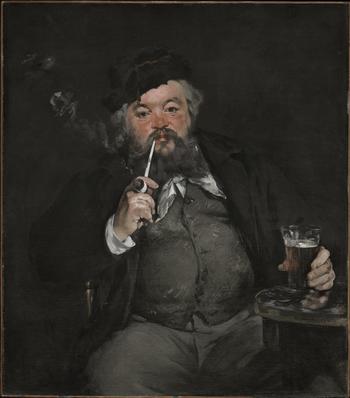
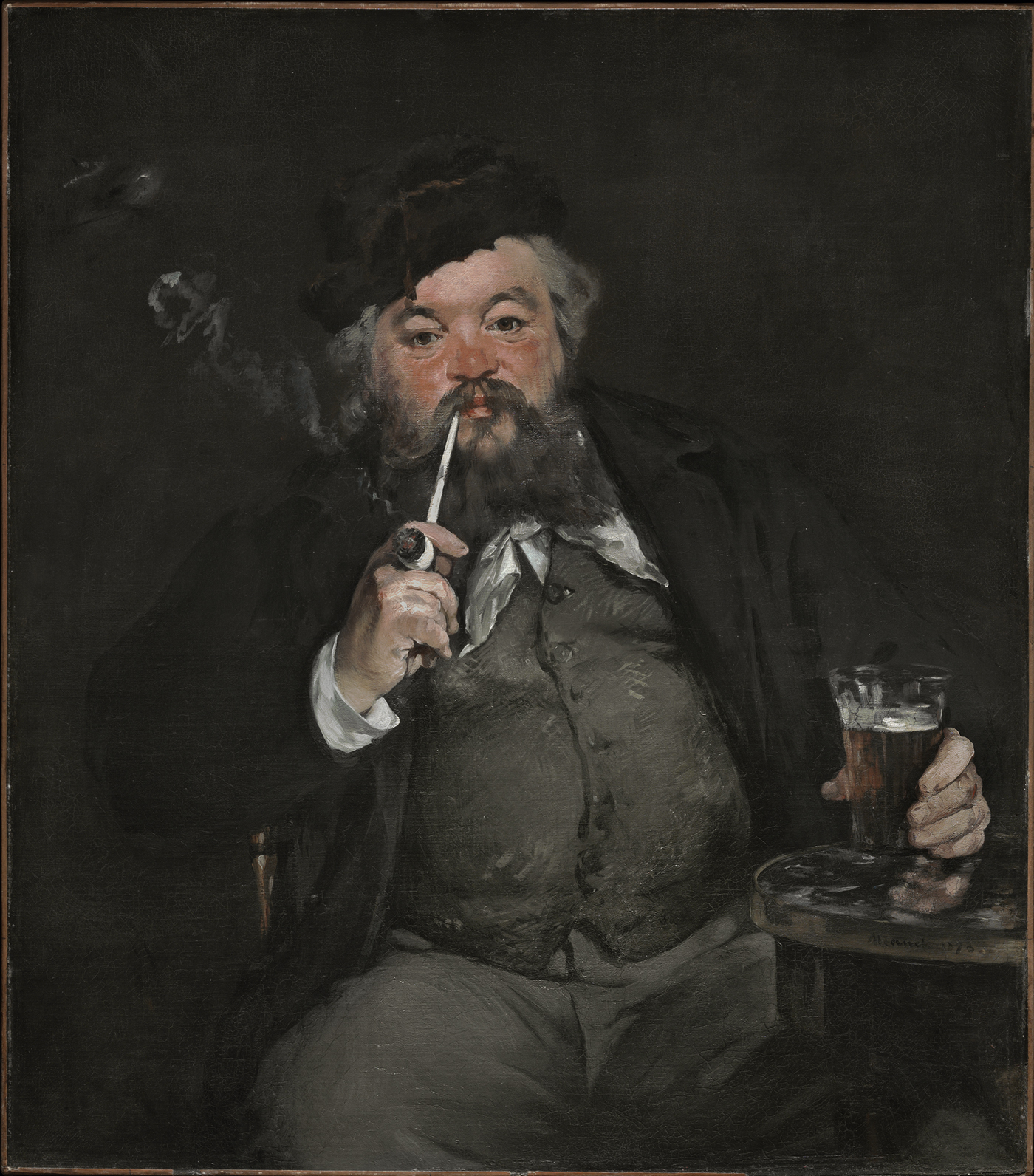
There is one more odd fact in all this. We know that Repin used a favorite model of Manet's for a figure in Un café. The gentleman with a pipe in his hand on the extreme far right of the painting was Manet's neighbor Emile Bellot; he had posed for his Le Bon Bock in 1873 (see Figure 4).Footnote 51 If there were ever a moment when Repin was channeling Manet, I think it must have been here. One simply cannot make a portrait “à la Manet” and use one of Manet's models by coincidence. Still, Manet and Repin handle the subject differently. In Repin's work the facture is looser and his Bellot is full of jovial smugness. His smirking outward gaze contrasts starkly with the cocotte seated across from him. His happiness makes her boredom all the more apparent. Manet's Bellot is, on the other hand, a naturalist tour-de-force. His figure does not possess the same blithe enjoyment as in Repin's café scene; instead he is a puffy, red-faced alcoholic, with one hand wrapped around his beer glass and the other around his pipe.
Édouard Manet, Le Bon Bock, 1873. Oil on canvas, 37 1/4 × 32 13/16 inches (94.6 × 83.3 cm). Philadelphia Museum of Art, The Mr. and Mrs. Carroll S. Tyson, Jr., Collection, 1963–116–9.
Cocottes and Flâneurs
In that same response letter to Kramskoi in August of 1875, Repin wrote lines that perhaps help solidify the links between him and Manet: “… we are all descended from Adam, and, strictly speaking, the difference between nations is not so remarkable that it cannot be understood. So now it shouldn't be difficult for you to understand why I painted [Un café]. What else could I paint here?”Footnote 52 What else indeed. How could Repin not have painted (at least a little) à la Manet in 1875? Repin's question is also one that might lead us to ask: what exactly did Repin paint in that year? We have the work's various titles: Un café du boulevard, Parizhskoe kafe, A Parisian café. Yet it is not exactly a painting of a café. There are actually sketches of just the café: studies of its space, various configurations of tables and chairs. The sketches are wonderful in their barren starkness.
These sketches tell us what Repin really painted in the final work: people. This includes the men, women, and children who occupied the café, who passed through it and by it, essentially all those who constituted the life of the boulevard. The panorama of figures in Repin's Café is like mille-feuille—gazes crisscross as they relay through the work, binding all the figures together in a rigid tension of emotional reactions, while at the same time breaking the painting apart as a single consumable story. The crowd as handled by Repin is a site of imaginary plenitude, signifiers of types and their scattered implications spill out across the canvas, producing a spectacle of modern life's alienation even in the face of tight physical proximity. In Repin's work, sight lines disappear into zones of emotional invisibility: we are unable to ascertain the stimulus for the ripple effect of smiles, frowns, laughter, and touch.
In fact, only one form of connection seems to be made at all clear in the painting, only one kind of gaze reads with any narrative coherence—that of men looking at women as objects of sexual desire. If there is a glue that binds this work together, it has to be that cocotte in the foreground, a woman we now know to be the actress Anna Judic.Footnote 53 It is not just her position within the painting, the fact that she is closest to us as viewers and that she looks out at us. She is the very center around which everything holds. Nearly every commentator on the work seems to have realized it without saying it outright; the focus is repeatedly on that figure as the locus of narrative meaning. Here is the Soviet art historian Igor Grabar΄ describing the work in 1963:
In the foreground sits a cocotte in a provocative [vyzyvaiushchei] pose, playing with a tiny [kroshechnym], which was then the term for a kind of fashionable umbrella, with languid, made-up eyes and painted lips. At the next table, beside her, sits a gentleman in a top hat turning to look at her, he turns his back on a woman of a more advanced age near him, probably his wife, his thoughtless behavior is much to the delight of his other neighbor, who is smiling from ear to ear at the same table. Two young men—also in top hats, for almost all the sitters are in top hats—have risen from their seats and are heading for the exit, one of them yawns violently, the other, with a monocle, putting on his gloves, looks at the scandalous cocotte [skandalistku-kokotku].Footnote 54
Valkenier and Jackson, the two historians discussed earlier, also largely discuss the woman in the foreground along similar lines.Footnote 55 “A self-assured demimondaine, seated, holds stage center; a young man-about-town gawks at her, a respectable father appraises her, a bonne bourgeoise looks on disapprovingly… .”Footnote 56 “Repin's blatant depiction of an unchaperoned denizen of the Parisian demi-monde—bold, confident, unapologetic, and, like [Manet's] Olympia, making brazen eye contact with the viewer—remains exceptional.”Footnote 57 Altogether a picture forms in which the cocotte consumes the action inside the painting, so much so that she obscures our ability to read much else. She is, after all, receiving the attention of so many in the painting. The men nearby stare at and appraise her. The women react to her through the men. The lady in the luxurious shawl responds to her presence with disdain as she sees the man she is perhaps there with looking this other woman over. The young girl, probably that man's daughter, gently taps his hand to bring his attention back to their familial circle.
Moreover, Repin painted her so that she demands such attention. Her pale skin contrasts starkly with all the inky, fashionable black she wears; Repin was careful to apply subtle touches of white to make her gold and pearls glisten in the gas light of the café. He did the same on the stem of the parasol she holds so theatrically, fingering its topmost point. He painted her in such a way that she refuses to be contained—both in terms of the reactions she inspires and in terms of her body in space. Her booted foot boldly breaks the bounds of her voluminous velvet skirt and points brazenly toward us.Footnote 58 As if this was not already enough, Repin arranged her dress so that a frothy spill of white lace is revealed to the dirty street below—giving us a sightly taste of her lush undergarments. Repin further configured the composition so that her gesture and positionality reverberated across the canvas. Her left hand is mirrored by the child's hand directly behind it, and the sloping angularity of the parasol's stem is echoed by the walking stick tucked under the arm of the flâneur who looks in her direction. There is something unseemly in that flâneur's removal of his gloves as he looks at her with his mouth agape, as there is in the way she holds the parasol if you look at it for too long.
These visual devices return us to the world of Manet. The taking off of a glove and the coupling of hands were frequent details in Manet's work.Footnote 59 All of these objects—parasols, ladies’ shoes, gloves, top hats—spoke a gendered language of social propriety and prescribed sex roles. The cocotte at center, however, violated these codes in the excess of attention she drew and in that she dared to look back. In this sense, we do well to remember that it was specifically the cocotte as a subject that Kramskoi singled out in 1875: “But not cocottes! I'm not saying it's not a subject, by no means! But just not for us …” He knew she was a subject, but not one for Repin, because he thought Repin was a Ukrainian peasant. What he failed to realize was that the cocotte was a problem for every man in this moment—regardless of nationality.
The cocotte transcended cultural categories and blurred class distinctions. She was the content of a universal artistic language of modernity because she was a difficulty for so many men in 1875. The cocotte was a subject, of course, but she was also a category and a stereotype: a part of a hierarchy that ran from the most destitute streetwalkers to sometime clandestine prostitutes to the most highly paid courtesans. The word itself had first appeared in the early years of the nineteenth century and only grew widespread in usage during the Second Empire. Edouard Siebecker had described the problem of the cocotte succinctly in 1867: “She is multiple, and assigning her an origin is not easy.”Footnote 60 Another anonymous writer of the time described her in similar terms: “The cocotte is indefinable. She depicts herself, as she paints herself. She is a complex, multiple, strange being that escapes analysis.”Footnote 61 She was distinctive from the lorette (essentially a kept woman) and the biche (yet another variant of prostitute), though they were all related.Footnote 62
What this barrage of terms for the cocotte and her ilk underscored was the growing disquiet about the instability of class boundaries in the second half of the century. Repin's painting was a testament to such ambiguity among urban women in the 1870s. It sought to record the multifarious roles available for feminine identity on the streets of Paris and the binaries that sought to contain them. Yet the foregrounding of the cocotte, and the making of that female type into the sole unifying bond of the painting's narrative, was significant. The importance of the role Repin created for that figure in the painting asserted that the cocotte was, in fact, the main type of Paris. She summed up the city and its modernity. Between room and street, between labor and leisure, she existed somewhere on the sliding scale between femme honnête and fille publique. She was equivocality; a spectacle of consumption that spoke to the private becoming public, the two becoming one. She was everything modern and yet nothing definable.
It would make sense then that Repin would not be satisfied with how he painted her. In perhaps the strangest twist associated with the history of this painting, Repin revisited the work in 1916, forty years after its initial completion. He seems to have repainted only one thing when he reworked it all those years later: the head of that cocotte in the foreground. Nothing about the body or overall posture was changed, but the face of that figure was entirely repainted to be more forlorn.Footnote 63 This is singular, not to mention decidedly rare, in the history of art.Footnote 64 What greater sign of the power (and opacity) of the cocotte is there than Repin's alteration of her long after the fact? The cocotte was what was still mutable in the painting after all those years, her fluctuation in reality—the fact that on the boulevard she was largely indistinguishable from other (honest) fashionable women—meant that she would always remain something unsettled. This was what made her so modern; and the recognition is also what makes Repin a great modernist.
So perhaps we need to think again about what made this subject so terrifying to Kramskoi. Maybe it was not so much that Repin was painting French types which deviated from the national school, but that painting a cocotte meant recognizing the power directly linked to female sexuality—a power that exceeded national borders. Being on the street and in the café meant being a locus for masculine desire, and the sheer amount of terms for different kinds of women in the period testify to the longing for control over this desire. No matter whether in Paris or Petersburg, a woman in 1875 was meant to be the public property of the masculine gaze—a thing to be examined, admired, and acquired. That is precisely what is on display in Un café. That and the spectacle the men around her make of themselves with their blatant weakness and brute instinctuality. Women in Un café are not depicted as the weaker sex—men are. Paintings were not supposed to say so in 1875, however. They were supposed to help categorize women, not heighten the ambiguity of their newly-public lives and the license it contained.Footnote 65
This had been the problem that Manet's Olympia raised a decade earlier, and now here was Repin's cocotte posing a similar threat to society's self-esteem. His painting starkly showed the same displacement of power at the heart of modern urbanity. In this sense, I think Repin might actually be more avant-garde than Manet—not formally, but in terms of the audacity of his realism, in the import he gave to the story he was telling and the truth it could contain. The brazenness of Repin's cocotte is also that of Olympia's, but by including male desire as the response to a female body, and showing it as a spectacle in its own right, Repin exceeded Manet.Footnote 66 Repin's cocotte radiated a thrilling heat, not through distinctive Impressionist facture and color, but through the ripple effect of gender politics shared among nations. In this way, Repin gets closer than even Manet to the impossible truth of modernity. Repin was singular because he captured the fullness of a twofold gendered reality. He represented a wider range of identities for womanhood in 1875: women as cocottes, prostitutes, mothers, daughters, and everything in between. Yet he also expressed a reality of masculine life in the gaze of those flâneurs and their honest carnal desires.
Repin's Modernism
Un café was ultimately skied at the Paris Salon in 1875 and it received no mention from critics there. Writers in St. Petersburg also coolly received the work when it was exhibited at the Academy upon Repin's return. The critic Adrian Prakhov, writing under the pseudonym Profan, commended the artist for looking at the world “with a painter's eye” and for showing a greater range beyond just the “peasant bast shoes” of the Barge Haulers. Footnote 67 The review in the liberal periodical Golos (The Voice) was more typical. Un café was seen as too insignificant a subject compared to the Barge Haulers, which was upheld as “the pride and fame of our young school.”Footnote 68 Repin did not respond to the public discussions and the work was only exhibited once more in his lifetime. In fact, in the nearly 150 years since its completion, the painting has only been exhibited a handful of times: in Stockholm in 1919, in London in 1935, and in Helsinki in 1980.Footnote 69 It emerged triumphantly in its most recent showing, however, setting a new record for the artist when it sold in London for £4,521,250 at Christie's auction house in 2011.
This success seems to mark a shift in the reception of one of the artist's most controversial works. Un café never did find a home in Russia, it would seem, but its success on the world stage of the international art market today tells us that it may have finally become legible in terms of the modernism it contains. Though it took over a century, the original language Repin so staunchly defended in his letters to Kramskoi finally translated into the ultimate currency of modernity—money. Repin's content, mediated through his consideration of Manet, was maybe always waiting to be understood in the hindsight of postmodernism. We have the language to grapple with Repin's take on modern life now. It just took a reassessment of the painting's history as one of mediation and transaction rather than influence for us to see it.
So much of the scholarship on nineteenth-century European art depends on positing Paris as the singular hotbed of creative activity, one that made all other urban centers (no matter how large or buzzing with production) mere peripheries. What we discover in Repin, however, is that this was not necessarily the conception of artists shuttling between center and “periphery” in this moment. Piotr Piotrowski put similar issues in the context of post-colonial theory. Discussing early twentieth-century artists like Constantin Brâncuși and Pablo Picasso, he wrote: “… they did not recognize themselves as diaspora, rather they acknowledged their situation as the privilege to be in a cosmopolitan community creating new culture; they felt they were a part of larger modern and universal art milieu, that they created new international art …”Footnote 70 The same might be said of Repin and his painting of cocottes and flâneurs. These figures show his desire to find an original language that would translate across cultures.
Repin did not recognize his painting practice as secondary to a hegemonic center that was to be aped and imitated. Instead, he found ways to negotiate his position as both an artist from the eastern “periphery” and a painter of cosmopolitan modernity. Hence, these telling lines from a letter to Kramskoi in 1875: “The power of it is inescapable; the picture of Paris will be from the viewpoint of a Ukrainian peasant [khokhla]; there is no need for him to have listened to cabaret singers from the cradle or to necessarily be a Frenchman; then it would be another picture …”Footnote 71 In these lines, Repin reveals that he knew the national was inherent, that it was inevitable. No matter how many cocottes and flâneurs and cafés he painted, he would always still be the man from Chuguev. Yet it did not make it impossible for him to paint the subject. It simply meant they would be painted from his perspective. Kramskoi thought Repin was imitating the realism of another national school by painting a subject so typically French. What he failed to realize was that Repin had found a way to mediate modernism itself when he took on the subject of cocottes in a café.
Repin ultimately did this to such an extent that he ended up exploiting the French modernity that was Manet in this moment. But this idea that an artist from Russia, far from the mega-centers of western Europe, might have more insight into the particular fluidity of modern life than even the greatest of modernist painters is so foreign to our understanding of how modernism operates that it is nearly impossible to fully realize or admit.Footnote 72 Repin did not perceive himself as inherently incapable of making important artistic statements because he was from eastern Europe. On the contrary, he made strong claims about being a vital part of a shared modern culture. Recall the letter with which I began, where Repin claimed that: “Europe needs us, she needs a flood of fresh strength from the provinces …”Footnote 73 There was nothing easy about the task Repin had set for himself, painting modernity was difficult for a Frenchman or a Russian, but he knew he had a contribution to make, one that exemplified a universal language of visual truth and one that continues to challenge established narratives of the peripheral status of Russian modernism.
Exploring the development of Repin's café painting shows that contemporary conceptions of Eurocentrism do not actually reflect the feelings of artists like Repin as they negotiated movement from diaspora to cosmopolitan epicenter. In this regard, Un café du boulevard might best be seen as an intervention in modernism—one that intruded in a process that was still incomplete and unfolding, lacking in firm definitions even as the experience of it grew exponentially. Evidence of Repin's mediation abounds in the canvas itself: in Repin's negotiation of identity politics through his double signature, in his use of types and the inclusion of a pseudo-self-portrait as a flâneur, in his painting of a cocotte that violated norms of propriety and power, and in his adoption of a subject à la Manet. All this was Repin wanting to be both national and international, both universal and modern. None of this was an easy negotiation, but it was possible. Un café du boulevard allows us to see that the boundaries between center and periphery were navigable in 1875. They demand, however, a recalibration of our sense of what artists thought they were doing in these years. Repin's painting is a testament to these difficulties—then and now.