INTRODUCTION
In recent years applications of analyses that involve size-classed faunal data to investigate properties and trends in marine communities have increased (Rice & Gislason, Reference Rice and Gislason1996; Bianchi et al., Reference Bianchi, Gislason, Graham, Hill, Jin, Koranteng, Manickchand-Heileman, Payá, Sainsbury, Sanchez and Zwanenburg2000; Duplisea et al., Reference Duplisea, Jennings, Warr and Dinmore2002; Jennings et al., Reference Jennings, Warr and Mackinson2002a; Blanchard et al., Reference Blanchard, Dulvy, Jennings, Ellis, Pinnegar, Tidd and Kell2005; Greenstreet & Rogers, Reference Greenstreet and Rogers2006). These analyses are based on the assumption that body size plays a key role in structuring marine communities (Kerr & Dickie, Reference Kerr and Dickie2001; Jennings & Mackinson, Reference Jennings and Mackinson2003; Jennings et al., Reference Jennings, De Oliveira and Warr2007), where species have non-deterministic growth and often show ontogenetic changes in life habits (Cushing, Reference Cushing1975; Greenstreet et al., Reference Greenstreet, McMillan and Armstrong1998; Cohen et al., Reference Cohen, Jonsson and Carpenter2003). Marine species do not adhere strictly to the classic species-related niche differentiation often observed in terrestrial systems (Persson, Reference Persson, Ebenman and Persson1988), and it is argued that in understanding variability in marine communities, it can be more useful to consider interactions among individuals of similar body size (Cohen et al., Reference Cohen, Pimm, Yodzis and Saldana1993; Jennings et al., Reference Jennings, Pinnegar, Polunin and Warr2002b, Reference Jennings, De Oliveira and Warr2007; Jennings & Mackinson, Reference Jennings and Mackinson2003; Brown et al., Reference Brown, Gillooly, Allen, Savage and West2004; Jennings & Blanchard, Reference Jennings and Blanchard2004; Pope et al., Reference Pope, Rice, Daan, Jennings and Gislason2006). In addition, properties such as community production can be predicted from analyses of body size distributions, but such analyses usually require data on individual body weights (Brey, Reference Brey1990; Edgar, Reference Edgar1990; Brey et al., Reference Brey, Jarre-Teichmann and Borlich1996).
To carry out analyses based on individual body weight it is necessary to weigh all animals, but this can be prohibitive in terms of the time required for processing samples. In addition to this, many of the animals sampled are killed unnecessarily in the process; to weigh hermit crabs individually, for example, the animals must be removed from their shells. If relationships between a measure of body size (such as total length or longest axis) and body weight can be established, then it is possible to calculate individual body weights based on these size measurements. Size measurements are much quicker and easier to record, destructive handling of specimens can be avoided in many cases, and the need for expensive motion stabilized weighing machines on research cruises is reduced.
Published morphometric (length–weight) relationships are frequently used for size-based analyses of fish communities and routine monitoring of fish stocks. More recently, relationships have also been documented for some common hermit crab species (Paguridae) from the Irish and North Seas (Kaiser et al., Reference Kaiser, Ramsay and Hughes1998; Reiss et al., Reference Reiss, Degraer, Duineveld, Kröncke, Craeymeersch, Rachor, Aldridge, Eggleton, Hillewaert, Lavaleye, Moll, Pohlmann, Robertson, Vanden Berghe, van Hoey and Rees2005). This study presents length–weight relationships for commonly recorded North Sea epibenthic invertebrates and fish species. Since compilations of length–weight relationships for fish that are caught by the international bottom trawl surveys in the North Sea are already available (Coull et al., Reference Coull, Jermyn, Newton, Henderson and Hall1989; www.fishbase.org), we focused our analysis on those fish species and size-classes that are not regularly recorded on these surveys. The relationships were generated from data collected over two years by an international 2-m beam trawl epifaunal survey. Our hope is that the availability of these data might encourage the more frequent application of size-based analyses to benthic invertebrate survey data, and so enhance understanding of the ecology of the benthic/demersal component of marine ecosystems and food webs.
MATERIALS AND METHODS
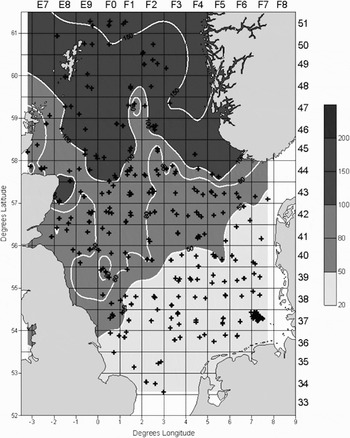
Five institutes carried out sampling across the North Sea between July and September in 2003 and 2004. Epifauna was sampled at 283 stations (Figure 1) using a 2-m beam trawl with a cod-end mesh size of 4 mm (Jennings et al., Reference Jennings, Lancaster, Woolmer and Cotter1999; Callaway et al., Reference Callaway, Alsvag, de Boois, Cotter, Ford, Hinz, Jennings, Kröncke, Lancaster, Piet, Prince and Ehrich2002a). All samples were washed through a 5-mm sieve to remove the majority of the unwanted sediment material. All but the smallest organisms taken in the net were retained by this mesh size (Callaway et al., Reference Callaway, Alsvag, de Boois, Cotter, Ford, Hinz, Jennings, Kröncke, Lancaster, Piet, Prince and Ehrich2002a,Reference Callaway, Jennings, Lancaster and Cotterb). Each sample was sorted first by species, and then individuals of each species were counted, and where possible, measured (to the nearest mm, 0.1 mm, or 0.01 mm depending on measurement taken, see Appendix 1) and weighed (blotted wet weight to the nearest 0.2 g, 0.1 g or 0.01 g) with a motion compensated marine scale. All species that could be separated into measurable individuals were measured and weighed. A list of the specific size measurements used for each species is given in Appendix 1. In all cases weights were recorded for undamaged individuals only. More details on the sampling methodology are available in Callaway et al. (Reference Callaway, Robinson, Greenstreet, Reiss, Fraser, Kröncke, Craeymeersch, de Boois, Robertson, Lancaster and Goffin2007).
Map of the North Sea showing the positions of the stations sampled by epifauna surveys in 2003 and 2004.

On completion of the cruises all data were combined and relationships between weight and length were described for all species with more than five individuals recorded, using linear regression on log-transformed data. For a number of species that were both widespread in their distribution and particularly abundant (>500 measurements per species), differences in slopes and intercepts were explored in relation to spatial (between region) and temporal (between year) effects using analysis of covariance. For the spatial analyses, the North Sea was split into two regions, approximately north and south of the 50 m bathycline that corresponds with the boundary between two major epibenthic assemblages determined by depth, temperature, food availability and substrate type (Frauenheim et al., Reference Frauenheim, Neumann, Thiel and Türkay1989; Callaway et al., Reference Callaway, Alsvag, de Boois, Cotter, Ford, Hinz, Jennings, Kröncke, Lancaster, Piet, Prince and Ehrich2002a; Reiss et al., in press).
RESULTS AND DISCUSSION
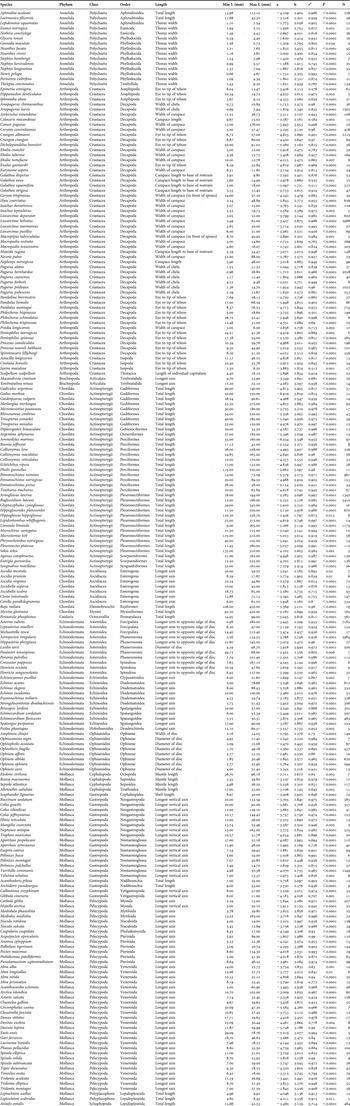
A total of 497 benthic fish and invertebrate taxa were recorded. Length–weight relationships could not be determined for 213 of these because they were too scarce to meet our abundance threshold for inclusion (>5 individuals), or because it was not possible to take measurements of either their length and/or weight (e.g. bryozoans and hydrozoans). For the 284 fish and invertebrate species that remained, there was a weak or non-significant relationship for 68 (r 2 values were <0.5 and/or P > 0.05). Weak relationships were mainly associated with taxa that had extremely variable water contents (e.g. the sea squirt Polycarpa scuba) and/or that were difficult to take precise and accurate repeated size measurements from (e.g. the polychaete worms Lagis koreni and Eunoe nodosa). Appendix 1 lists the regression functions for the specific size and weight measurements recorded for the 216 significant relationships observed.
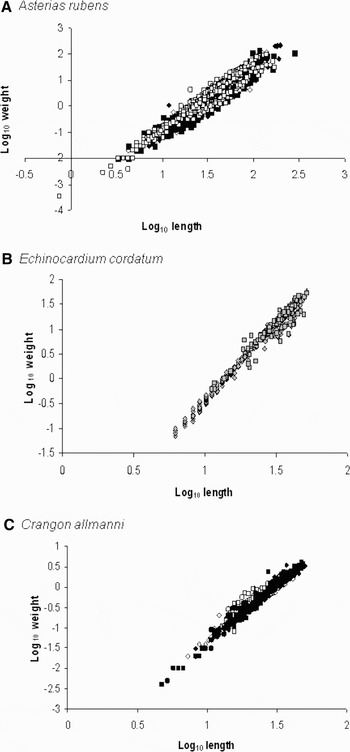
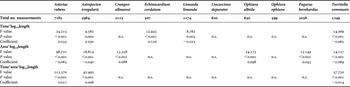
Ten species met the criteria for wide spatial distribution and high numbers of individuals. For eight of these species there were significant differences in the length–weight relationship among years or regions (Appendix 2). Spatial or temporal differences in intraspecific morphometrics are possible due to the effects of spatial or interannual differences in food availability, life history characteristics or feeding mode. Previous studies on hermit crabs had found neither sex-specific (Kaiser et al., Reference Kaiser, Ramsay and Hughes1998), nor spatial differences in morphometric relationships (Reiss et al., Reference Reiss, Degraer, Duineveld, Kröncke, Craeymeersch, Rachor, Aldridge, Eggleton, Hillewaert, Lavaleye, Moll, Pohlmann, Robertson, Vanden Berghe, van Hoey and Rees2005). In contrast, we detected significant differences for eight out of ten species analysed (Figure 2; Appendix 2). However, the absolute differences were small (small coefficients when compared with the effect of length alone—see Appendices 1 and 2) and we conclude that the single regression functions, based on the pooled data (Appendix 1), would be adequate for estimating body weight of the species concerned across the whole North Sea.
Variation in weight–length relationships for three epifaunal species among North Sea regions (North, open symbols; South, filled symbols; pooled regions, grey fill) and/or year (2003, diamonds; 2004, squares; pooled years, triangles) that the data were collected in. (A) Asterias rubens; (B) Echinocardium cordatum; (C) Crangon allmanni.

Use of the weight at length coefficients supplied here should dramatically reduce the time and costs involved in collecting adequate data for size-based analyses of benthic invertebrates. The availability of such data will enable the more frequent application of size-based analyses to benthic invertebrate survey data, and so improve understanding of the role of benthic animals in food webs and marine ecosystems.
ACKNOWLEDGEMENTS
All data used here were collected under the EC 5th framework funded project MAFCONS. We acknowledge the assistance of our colleagues and crew on board the summer groundfish surveys in 2003 and 2004 in collecting and processing the epifaunal samples. We are also grateful to the referees of this manuscript who provided useful comments and suggestions for improvements.
Regression coefficients (a, b), r 2 and P values for linear regression of length (L, mm) against blotted wet weight (W, g) of 216 North Sea benthic species. The length measurement taken is given, along with the minimum (Min L) and maximum (Max L) size of the individuals covered by the data, where N = number of individuals sampled. All regression equations are based on the form log10(W) = a+b*log10(L).

Significance of differences in length–weight relationships of some key widely distributed benthic invertebrates from the North Sea, with analysis of covariance F values and P values given, where significant effects are found to occur when P < 0.05. Coefficients for the interactions are also given to illustrate the amount of variation in the data that is explained by the factor. Factors include the effect of area (samples taken north or south of the 50 m bathycline) and year (data recorded in 2003 or 2004), and the interaction of area and year.