INTRODUCTION
A growing body of evidence suggests that obsessive-compulsive disorder (OCD) is a brain disorder that is subserved by the neural loops connecting the orbitofrontal area and the basal ganglia (Rauch, Reference Rauch2000). However, neuropsychological studies have yielded inconsistent findings regarding associations between cognitive dysfunctions and OCD. For example, some studies have found verbal memory deficits in OCD patients, but other studies have not observed such deficits in these patients (see Muller & Roberts, Reference Muller and Roberts2005, for a review). In addition, some studies have found deficits in attentional set-shifting ability and response inhibition, as measured by the Wisconsin Card Sorting Test (WCST), whereas others have observed that OCD patients performed at levels comparable to those of healthy controls on this task (see Greisberg & McKay, Reference Greisberg and McKay2003, for a review). Furthermore, research has suggested that the nonverbal memory deficits observed consistently in OCD patients might reflect deficits in executive functioning, including strategic planning and organizing abilities, rather than memory deficits per se (Savage et al., Reference Savage, Baer, Keuthen, Brown, Rauch and Jenike1999). Recently, it has been suggested that the neuropsychological profile of OCD is one of primary executive dysfunction (Olley et al., Reference Olley, Malhi and Sachdev2007).
These conflicting neuropsychological findings may be explained by heterogeneity in patient selection criteria, including those pertaining to clinical state, medication regimen, and OCD symptoms (Mataix-Cols et al., Reference Mataix-Cols, Junque, Sanchez-Turet, Vallejo, Verger and Barrios1999). The use of nonclinical or subclinical obsessive-compulsive samples represents one approach to enhancing the understanding of the underlying pathophysiology of OCD (Mataix-Cols et al., Reference Mataix-Cols, Junque, Sanchez-Turet, Vallejo, Verger and Barrios1999).
A number of studies have investigated the neuropsychological functioning of subclinical obsessive-compulsive participants (OCs) and have found that subclinical OCs have similar deficits in several cognitive domains as do people with OCD. For example, Sher et al. (Reference Sher, Frost and Otto1983) reported that college students who demonstrated compulsive checking behaviors showed decreased memory for prior actions and underestimated their ability to distinguish memories of real versus imagined events compared to noncheckers. Recently, Cuttler and Graf (Reference Cuttler and Graf2007) reported impaired prospective memory in a sample of subclinical compulsive checkers. Subclinical compulsive checkers also showed significantly worse performance on the Wisconsin Card Sorting Test (WCST) than did noncheckers (i.e., they made greater numbers of total and perseverative errors and required more time to complete the test; Goodwin & Sher, Reference Goodwin and Sher1992). In addition, Mataix-Cols (Reference Mataix-Cols2003) reported that subclinical OCs showed impaired performance on the Tower of Hanoi task; subclinical OCs required a significantly greater number of moves than did non-OCs to reach the solution, indicating less acute spatial problem-solving ability. These results indicate that subclinical OCs demonstrate the deficits in memory and executive functioning that affect patients with OCD.
Despite the high prevalence of obsessions and compulsions in nonclinical populations, the neuropsychological profile of nonclinical OCs has not been thoroughly investigated. Previous studies that involved subclinical or nonclinical OCs focused almost exclusively on compulsive checkers, and most of these investigated only limited cognitive domains such as memory or executive functioning. In addition, most previous studies did not control for the effect of anxiety or depression on neuropsychological functioning, despite suggestions that subclinical OCs are anxious or depressed and that these affective states could affect performance on neuropsychological tests (Roth & Baribeau, Reference Roth and Baribeau1996). Previous studies have used various subject-selection criteria (ranging from the top 25% to 2% in scores obtained by those in the subclinical obsessive-compulsive group). However, Burns et al. (Reference Burns, Formea, Keortge and Sternberger1995) suggested that subclinical obsessive-compulsive samples should include only the top 2–3% because more valuable information about the underlying pathophysiology of OCD would be obtained from participants with symptoms that more closely match the severity of symptoms demonstrated by patients with OCD. Thus, we examined the neuropsychological profiles of subclinical OCs who obtained extremely high scores on measures of obsessive-compulsiveness using comprehensive neuropsychological tests that evaluated the cognitive functions that are known to be compromised in OCD. We expected that results obtained from subclinical OCs would provide valuable information about basic deficits or trait markers of OCD, because subclinical OCs would not be affected by the confounding factors associated with clinical samples.
METHODS
Participants
Forty-three female college students were recruited from a pool of 670 students based on their scores on the Korean version of the Padua Inventory (PI; Min & Won, Reference Min and Won1999) and the Maudsley Obsessive-Compulsive Inventory (MOCI; Min & Won, Reference Min and Won1999). The subclinical OC group (n = 21) was composed of those with scores ≥ 124 on the PI and ≥ 44 on the MOCI (i.e., the highest 3% in the distribution of scores). The control group (n = 22) was composed of those who obtained average scores on both the PI and MOCI. The Structured Clinical Interview for DSM-IV Non-Patient (SCID-NP; First et al., Reference Frist, Spitzer, Gibbon and Williams1996) was also administered to ensure that none of the participants had a history of psychiatric, medical, or neurological disorders, or drug/alcohol abuse. All participants were right-handed. No participants were taking medication at the time of testing. All participants provided written informed consent after receiving a complete description of the study. The study was approved by the Sungshin Women’s University Institutional Bioethics Review Board.
Measures of Obsessive-compulsiveness
Padua Inventory
The Padua Inventory (PI) is a 60-item self-reported inventory that measures obsessions and compulsions (Sanavio, Reference Sanavio1988). Each item is rated on a five-point scale on which zero means “not at all” and four means “very much” and measures the degree of disturbance caused by the obsessive and compulsive behavior. The total score is the sum of the 60 items, and a higher total score indicates greater obsessive-compulsiveness. We used the Korean version of the PI (Min & Won, Reference Min and Won1999), which is characterized by the same four-factor structure as the original version of the PI (F1: impaired mental control, F2: urges and worries, F3: checking, F4: contamination) and by acceptable internal consistency, and discriminant and convergent validity.
Maudsley Obsessive-Compulsive Inventory
The Maudsley Obsessive-Compulsive Inventory (MOCI) is a 30-item self-reported questionnaire that is designed to measure obsessive-compulsiveness (Hodgson & Rachman, Reference Hodgson and Rachman1977). All items are answered “true” or “false” We used the Korean version of the MOCI (Min & Won, Reference Min and Won1999). In the original version of the MOCI, 15 of the 30 items are scored in reverse order; however, in the Korean version of the MOCI, all items are scored in the same order such that one and two points indicate “false” and “true,” respectively. Therefore, higher scores indicate greater obsessive-compulsiveness. Factor analysis revealed four factors: washing, checking, slowness, and doubting (Hodgson & Rachman, Reference Hodgson and Rachman1977; Min & Won, Reference Min and Won1999).
Neuropsychological Tests
The following neuropsychological tests were administered during a single session that lasted approximately 1.5 h: the Rey-Osterrieth Complex Figure Test (ROCF), the California Verbal Learning Test (CVLT), the Wisconsin Card Sorting Test (WCST), the Trail-Making Test (TMT), the Controlled Oral Word Association Test (COWA), and the d2 test.
The ROCF was administered to evaluate visuospatial constructional ability and visuospatial memory. The test involved four conditions (copy, immediate recall, delayed recall, and recognition). Accuracy was scored for each condition.
The CVLT was administered to measure verbal memory. We recorded the total number of responses to the five trials using list A; the total number of responses to the free recall trial using list B; the responses to the short-term free recall trial using list A; and the responses to the long-term free recall trial using list A.
The WCST was administered to measure abilities with regard to such areas as abstract thinking, problem solving, and shifting of mental sets. The total numbers of errors, perseverative responses, and perseverative errors were scored.
The TMT consisted of two parts. Part A involved connecting digits with a continuous line, and part B involved alternately connecting digits and letters. The total number of errors was scored.
The COWA was administered to evaluate fluency with words. The total numbers of responses for each letter and category were scored.
The d2 test (Brickenkamp & Zillmer, Reference Brickenkamp and Zillmer1998) was administered to evaluate selective attention. This test required the participants to detect the target (letter ‘d’ with two dashes) as fast and accurately as possible. We recorded the total numbers of commission and omission errors.
In addition, the Korean version of the Wechsler Adult Intelligence Scale (K-WAIS; Yum et al., Reference Yum, Park, Oh, Kim and Lee1992) was administered to measure the intelligence quotient (IQ). Depression and anxiety were assessed using the Beck Depression Inventory (BDI; Beck et al., Reference Beck, Ward, Mendelson, Mock and Frbaugh1961) and the Beck Anxiety Inventory (BAI; Beck & Steer, Reference Beck and Steer1990), respectively.
Statistical Analysis
The demographic characteristics of members of the subclinical OC and control groups were compared using one-way analysis of variance (ANOVA). For the statistical analysis of neuropsychological performance, raw scores were transformed to z-scores based on data from the controls who were assigned a mean of 0 and a standard deviation of 1. We computed an average of z-scores from subtests comprising each neuropsychological test. The following subtests of each neuropsychological test were included in averaging: accuracy scores of copy, immediate recall, delayed recall, and recognition of ROCF; list A trials 1–5, list A short-term free recall, list A long-term recall, and list B recall of CVLT; total numbers of error, perseverative response, and perseverative error of WCST; total numbers of errors of TMT parts A and B; total numbers of responses for letter and category of COWA; and total numbers of commission and omission errors of the d2 test. Higher scores were indicative of better performance for ROCF, K-CVLT, and COWA, and higher scores were indicative of worse performance for WCST, TMT, and the d2 test. Subclinical OCs were compared to controls on neuropsychological performance using ANOVA.
To test the effects of depression and anxiety on neuropsychological performance, analysis of covariance (ANCOVA) with BDI and BAI scores as covariates was performed. In addition, relationships between the performances on neuropsychological tests and those on the PI or MOCI were examined using partial correlations with BDI and BAI scores as covariates.
RESULTS
Demographic Characteristics
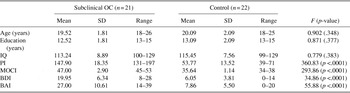
The subclinical OC and control groups did not differ significantly in demographic characteristics such as age, education level, and IQ (Table 1). However, they differed significantly in PI scores, F(1, 42) = 360.83, p < .0001 and MOCI scores, F(1, 42) = 293.86, p < .0001 (Table 1). The subclinical OC group had significantly higher scores on both the PI and MOCI compared to the control group. In addition, the subclinical OC group had significantly higher scores than the control group on both the BDI, F(1, 42) = 34.86, p < .0001 and BAI, F(1, 42) = 55.88, p < .0001 (Table 1), suggesting that subclinical OCs were more depressed and anxious than the controls.
Demographic characteristics of subclinical obsessive-compulsive and control groups

Note.
PI = Padua Inventory, MOCI = Maudsley Obsessive-Compulsive Inventory, BDI = Beck Depression Inventory, BAI = Beck Anxiety Inventory.
Neuropsychological Tests
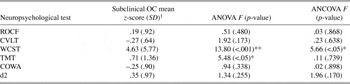
According to the analysis of variance (ANOVA) results, participants in the subclinical OC group obtained poorer scores on the WCST, F(1, 41) = 13.80, p < .001, than did those in the control group (Table 2). The subclinical OCs scored significantly higher total errors, perseverative errors, and perseverative responses than did the controls.
Neuropsychological performance of subclinical obsessive-compulsives (OC) compared to controls

Note.
1 Z-score relative to control mean of 0.0 with a standard deviation (SD) of 1.0. ROCF = Rey-Osterrieth Complex Figure Test, CVLT = California Verbal Learning Test, WCST: = Wisconsin Card Sorting Test, TMT = Trail Making Test, COWA = Controlled Oral Word Association.
* p < .05, **p < .001.
The subclinical OC and control groups also differed significantly on the TMT, F(1, 41) = 5.48, p < .05 (Table 2). Participants in the subclinical OC group had significantly more errors than did those in the control group.
Analysis of covariance (ANCOVA) with BDI and BAI scores as covariates showed significant differences in performances on the WCST between the subclinical OC and control groups, F(1, 39) = 5.66, p < .05 (Table 2). The subclinical OCs scored significantly higher total errors, perseverative errors, and perseverative responses than did the controls. After controlling for the effects of depression and anxiety on neuropsychological performance, no differences in the TMT between the two groups were observed, F(1, 39) = .11, p = .739 (Table 2).
Correlations between Obsessive-Compulsive Symptoms and Performance on Neuropsychological Tests
No significant associations were observed between obsessive-compulsive symptoms and the performance on neuropsychological tests in subclinical OCs
DISCUSSION
It has been suggested that the vast majority of individuals in nonclinical populations experience intrusive thoughts and demonstrate compulsive checking behaviors similar to the pathological obsessions and compulsions observed in patients with OCD. For this reason, studies of subclinical OCs should provide valuable information about the underlying pathology of OCD. We investigated the neuropsychological profiles of a sample of psychometrically defined subclinical OCs.
Subclinical OCs showed impaired performances on the WCST compared with those in the control group. These results were consistent with those of previous studies that reported that compulsive checkers commit greater numbers of total and perseverative errors and require more time to complete the test (Goodwin & Sher, Reference Goodwin and Sher1992). Our subclinical OCs demonstrated greater numbers of total errors, perseverative errors, and perseverative responses than did the controls, indicating that subclinical OCs found it difficult to use feedback to shift mental sets. Poorer performance on the WCST was observed even after controlling for the effects of depression and anxiety. Although previous studies that used the WCST to investigate executive functioning in OCD patients have reported conflicting results, a large number of either perseverative errors or responses and a reduced ability to shift cognitive categories in response to feedback have been shown to characterize OCD patients (Roh et al., Reference Roh, Shin, Kim, Ha, Shin, Lee and Kwon2005). Based on a review of neuropsychological test data obtained from OCD patients, Olley et al. (Reference Olley, Malhi and Sachdev2007) suggested that the neuropsychological profile of OCD consists of impaired executive functioning. Our finding that executive dysfunction afflicted even subclinical OCs further supports the primary role of such impairment in OCD.
Differences between subclinical OCs and controls were also observed in the TMT; subclinical OCs made significantly more errors than did controls. However, after controlling for the effects of depression and anxiety, the difference between the groups on the TMT was not observed. Therefore, the symptoms of depression and anxiety in our subclinical OCs could have affected performance on the TMT, and impaired performance on the TMT seems to reflect emotional disturbances, rather than underlying OCD, in those with subclinical OC.
Although a number of studies have observed memory deficits in subclinical OCs (Cuttler & Graf, Reference Cuttler and Graf2007; Sher et al., Reference Sher, Frost and Otto1983), there were no significant differences between the two groups in terms of verbal and nonverbal memory, as measured by the CVLT and ROCF, respectively. These inconsistent findings may be a result of the different instruments used to measure memory across studies. For example, previous studies that observed memory deficits in subclinical OCs used experimentally constructed memory tasks, rather than structured and standardized memory tests such as those we used.
Our study has some limitations that should be addressed in future studies. First, the inclusion of only female participants limits the generalization of these findings. Second, because it has been reported that different patterns of brain activation are observed in OCD patients as a function of age at onset or comorbidity (Busatto et al., Reference Busatto, Buchpiguel, Zamignani, Garrido, Glabus, Mcguire and Miguel2001), future studies that use both structural-functional brain imaging techniques and neuropsychological tests should be conducted to understand the neurophysiological mechanisms underlying OCD.
In summary, subclinical OCs had impaired performance on the WCST. The subclinical OCs had greater numbers of total errors, perseverative errors, and perseverative responses than did the controls. The subclinical OCs also made more errors on the TMT than did the controls. However, the performance difference on the TMT between the groups was not observed after controlling for the effects of depression and anxiety. Thus, the subclinical OCs had deficits in executive functioning including attentional set-shifting. In particular, executive dysfunction, recognized as one of the primary cognitive impairments associated with OCD, seems to pre-date the emergence of fully developed clinical obsessive-compulsive symptoms.
ACKNOWLEDGMENTS
This work was supported by the Korea Science and Engineering Foundation (KOSEF) grant funded by the Korean government (MOST), M10644000002-06N4400-00210.