Introduction
Vestibular schwannoma is the most common tumour of the cerebellopontine angle, and originates from the vestibular nerve. Vestibular schwannomas are benign and have a low mortality risk, but can grow to compress the surrounding neural and vascular structures, causing significant morbidity. Resection and treatment of the tumour can also cause morbidity, with damage to local structures such as the cochlea and cochlear nerve being the most common complications. The most common outcome of damage to these structures is permanent hearing loss.Reference Evans, Moran, King, Saeed, Gurusinghe and Ramsden1
There are several treatment modalities available for vestibular schwannoma, including conventional microsurgery techniques and stereotactic radiosurgery. The CyberKnife® robotic radiosurgery system is one of the most well-known stereotactic radiosurgery systems, and is an excellent alternative to microsurgery.Reference Sakamoto, Sinclair, Gibbs, Adler, Chang, Timmerman and Xing2 This study retrospectively evaluated the effects of CyberKnife therapy on the hearing of patients after treatment of vestibular schwannoma.
Materials and methods
Case selection and evaluation
A total of 26 patients were clinically and radiologically diagnosed with vestibular schwannoma and subsequently treated with CyberKnife radiosurgery in our hospital between 2012 and 2014. Patients with vestibular schwannoma who were initially treated with microsurgery, those who received microsurgery following initial CyberKnife therapy, and patients with tumours that had not been growing were not included in the study.
All patients diagnosed with vestibular schwannoma underwent magnetic resonance imaging screening before treatment, in order to measure tumour size and volume. Audiological tests were performed on all patients before and after treatment, regardless of treatment modality.
Patients with non-cystic tumours smaller than 40 mm were enrolled for CyberKnife therapy. Patients were selected for cochlea-sparing CyberKnife stereotactic radiosurgery treatment by a multidisciplinary team that included input from the departments of neurosurgery, oncology, radiology, radiation oncology and otology. Ethical approval for this study was granted by the institutional ethics committee.
Audiological assessment
All patients with diagnosed vestibular schwannoma who were treated with CyberKnife therapy (n = 26) underwent audiological testing before and one year after treatment. Assessment included: pure tone audiometry, auditory brainstem response (ABR) testing, and determination of maximum speech discrimination scores. For each patient, pure tone average (PTA) and maximum speech discrimination score were used to grade hearing according to the Gardner–Robertson classification (Table 1).Reference Gardner and Robertson3 The PTA represented the average hearing threshold at a set of specific frequencies. In this study, the PTA was calculated using three tones at 0.5, 1 and 2 kHz.
Gardner–Robertson hearing classification systemReference Gardner and Robertson3

Together, the PTA and speech discrimination scores were used to establish a pre-treatment audiometric grade, as previously described.Reference Gardner and Robertson3 This grade was assessed according to: (1) the absence of an evoked response despite a compatible auditory threshold (pure tone threshold of less than 75 dB); (2) the presence of wave I alone, with the other waves being desynchronised; (3) an inter-peak latency between waves I–III of longer than 2.5 ms; (4) an inter-peak latency between waves I–V of longer than 4.4 ms; (5) an inter-aural latency difference in wave V of longer than 0.2 ms; and (6) an inter-aural difference in the inter-peak latency of waves I–V of longer than 0.2 ms.
Statistical analysis
Statistical analyses were completed using the Number Cruncher Statistical System and the Power Analyses and Sample Size statistical software packages (NCSS, Kaysville, Utah, USA). Descriptive analyses included the mean, standard deviation, median, frequency, ratio, minimum and maximum. Qualitative analyses included a within-group comparison using the Wilcoxon signed-rank test and a between-group comparison using the Mann–Whitney U test. Results were deemed statistically significant if p < 0.01 or p < 0.05.
Results
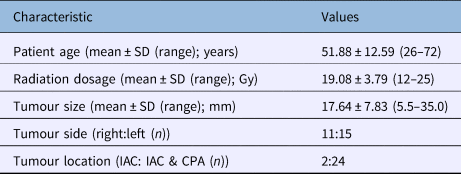
A total of 26 patients (15 males and 11 females) with diagnosed vestibular schwannoma were treated with CyberKnife stereotactic radiosurgery. The mean (±standard deviation (SD)) patient age was 51.88 ± 12.59 years (range, 26–72 years). The mean follow-up period was 16.4 months (range, 12–30 months).
Tumours were unilateral, and right-sided in 11 patients. In 24 patients, the tumour involved both the internal acoustic canal and the cerebellopontine angle. In the remaining two patients, the tumour was localised within the internal acoustic canal. The mean (±SD) tumour size was 17.64 ± 7.83 mm (range, 5.5–35 mm) (Table 2).
Patient data summary

SD = standard deviation; IAC = internal acoustic canal; CPA = cerebellopontine angle
The mean (±SD) stereotactic radiation dosage was 19.08 ± 3.79 Gy (range, 12–25 Gy). Three patients were treated with a single dose of radiation totalling 12 Gy, as described previously. The remaining patients received fractionated doses across three to five sessions. Tumours under 1 cm in diameter were treated by a single dose.
Clinical features
Hearing loss was the most common pre-treatment symptom, and was the chief complaint in 65.3 per cent of patients (n = 17). In decreasing order of frequency, other symptoms included: tinnitus (n = 15; 57.6 per cent), headache (n = 12; 46.1 per cent), poor balance (n = 8; 30.7 per cent) and facial hypoesthesia (n = 1; 3 per cent). Multiple symptoms were present in 21 patients. None of the patients had facial paralysis or symptoms of facial nerve damage.
Following CyberKnife therapy, facial nerve function was preserved in all patients. Headache and facial hypoesthesia symptoms increased in the immediate post-treatment period, but these increases were temporary. Post-operative complications were rare. One patient suffered deep vein thrombosis following therapy, but had significant cardiovascular risk factors, including a previous myocardial infarction and a previous insertion of a coronary artery stent.
Audiological assessment
Before treatment, 16 patients (61.5 per cent) had a Gardner–Robertson hearing classification of grade I or II, indicating good or serviceable hearing, respectively. Reassessment of the post-treatment hearing thresholds was completed only for this group of 16 patients, who were sorted into two groups according to post-treatment Gardner–Robertson classification. The serviceable hearing group (n = 11; 69 per cent) retained a post-treatment Gardner–Robertson classification of either grade I or II. The unserviceable hearing group (n = 5; 31 per cent) experienced a worsening of Gardner–Robertson classification to grade III or IV. The serviceable and unserviceable groups were then compared for differences in age, therapy dosage, tumour size, pure tone audiometry results and ABR results.
Pre-treatment PTA assessment of all 26 patients revealed a mean (±SD) bone conduction intensity of 38.76 ± 33 dB on the same side as the tumour. The mean (±SD) speech discrimination score was 66.09 per cent ± 27.19 per cent. In two patients, the pre-treatment hearing level was too poor to be assessed by PTA (Gardner–Robertson grade V). Following treatment, the mean (±SD) bone conduction PTA intensity was 44.42 ± 23.79 dB, and the mean (±SD) speech discrimination score was 59.96 ± 24.25 per cent. Both the mean bone conduction PTA intensity and the mean maximum speech discrimination score increased significantly post-treatment compared with pre-treatment (p = 0.002 and p = 0.003, respectively).
The ABR was analysed before and after treatment in all patients (n = 26). Pre- and post-treatment ABR was normal in three patients. No wave formation was observed in five patients. The values for inter-peak latency between waves I–III, inter-peak latency between waves I–V, inter-aural latency difference in wave V, and inter-aural latency difference for waves I–V revealed impairment in all remaining patients (n = 18).
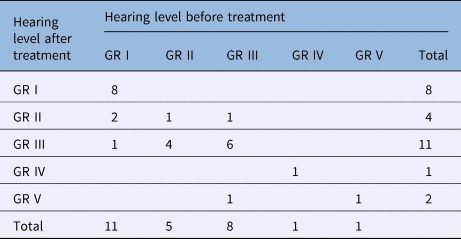
All patients were given a Gardner–Robertson classification based on PTA and speech discrimination scores. Before treatment, 11 patients had Gardner–Robertson hearing grade I, 5 patients had grade II, 8 patients had grade III, 1 patient had grade IV and 1 patient had grade V (Table 3). Before treatment, 16 patients had a serviceable hearing level (Gardner–Robertson grade I or II). Post-treatment, 5 of these patients experienced a degradation of hearing to Gardner–Robertson grade III or IV. Therefore, hearing was protected in 11 patients, giving a mean protection rate of 69.23 per cent.
Gardner–Robertson classification of hearing level before and after treatment

Data represent numbers of patients. GR = Gardner–Robertson grade
Comparison of pre- and post-treatment Gardner–Robertson hearing grades in all 26 patients revealed that 9 patients had a grade change. Hearing improved in one patient (Gardner–Robertson grade III to grade II) (Table 3). For the five patients with degraded hearing following treatment, the post-treatment PTA intensities were 33 dB, 47 dB, 20 dB, 33 dB and 35 dB. The maximum speech discrimination scores were 80 per cent, 54 per cent, 90 per cent, 76 per cent and 88 per cent.
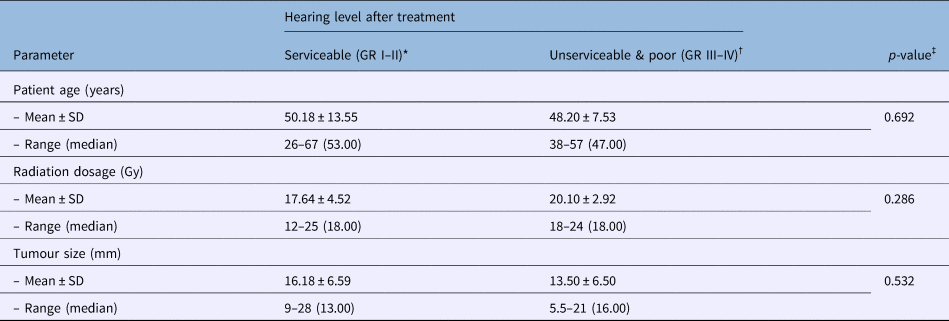
Patients with serviceable post-treatment Gardner–Robertson hearing grades (grades I and II) were compared with patients with unserviceable post-treatment grades (grades III and IV) across a number of parameters, including audiological test results, age, radiation dose and tumour size. No significant differences were observed between these groups for any parameter (p > 0.05 for each comparison) (Table 4).
Effects of age, radiation dose and tumour size on post-treatment hearing level

*n = 11; †n = 5. ‡Mann–Whitney U Test. GR = Gardner–Robertson grade; SD = standard deviation
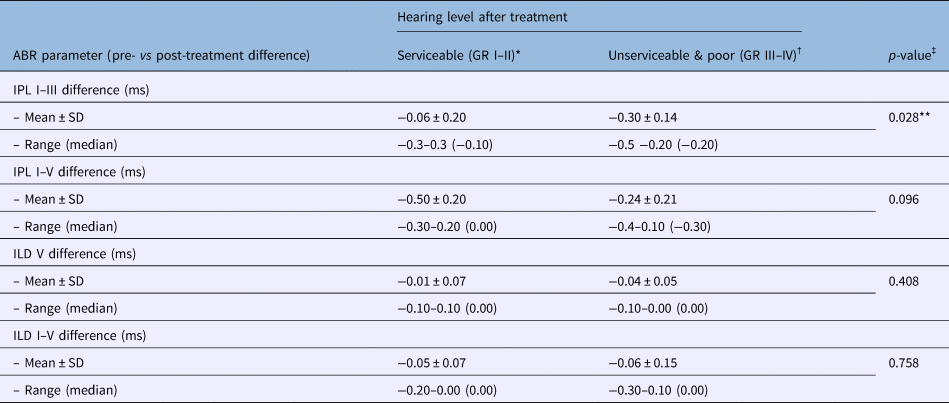
Comparison of ABR results between the serviceable and unserviceable post-treatment groups revealed a significant increase in inter-peak latency between waves I–III (p = 0.028). No significant differences were observed in the other ABR measurements between these groups (p > 0.05 for each comparison) (Table 5).
Relationship between post-treatment ABR results and post-treatment hearing impairment

*n = 11; †n = 5. ‡Mann–Whitney U Test. **p < 0.05. ABR = auditory brainstem response; GR = Gardner–Robertson grade; IPL = inter-peak latency between waves; SD = standard deviation; ILD = inter-aural latency difference
Discussion
There are no widely accepted, validated guidelines for the treatment of vestibular schwannoma.Reference Arthurs, Fairbanks, Demakas, Lamoreaux, Giddings and Mackay4 The choice of treatment approach and modality typically depends on a variety of factors, including the presenting signs and symptoms, patient age, tumour size and location, and the preferences of both the patient and clinician. The increasing number of modalities available to treat vestibular schwannoma, paired with the lack of robust clinical trials guiding treatment, make thorough assessment and multidisciplinary input a necessity when diagnosing and treating this disease.Reference Fusco, Fisher, McGrew and Walters5
Stereotactic radiosurgery is an alternative to conventional microsurgery in the treatment of vestibular schwannoma. This technique involves the precise and localised administration of radiation, either as a large dose in one session, or a fractionated dose delivered across multiple sessions. This radiation either directly destroys the tumour or prevents its continued growth.Reference Sakamoto, Blevins and Gibbs6 The most frequently used stereotactic radiosurgery systems are Gamma Knife® and CyberKnife.Reference German, Zardouz, Sina, Ziai and Djalilian7
In our institution, patients with vestibular schwannoma are evaluated by a multidisciplinary team that includes clinicians from a number of specialties including neurosurgery, oncology, radiology, radiation oncology and otology. Treatment choice is discussed among these departments, and post-treatment follow up is completed across these clinics. Typically, patients with confirmed vestibular schwannoma and a tumour diameter smaller than 3 cm are initially treated with CyberKnife radiosurgery. CyberKnife therapy may also be used in cases of residual or recurrent vestibular schwannoma, or in patients who are not suitable for microsurgical resection.Reference Sakamoto, Sinclair, Gibbs, Adler, Chang, Timmerman and Xing2
In patients with vestibular schwannoma, symptoms occur as a result of compression or damage to local structures. Symptoms occurring at the time of presentation may be due to compression of these local structures by the tumour. Following treatment, damage and localised inflammation from the stereotactic radiosurgery itself can cause symptoms to persist or even worsen. Cranial nerves are the most likely to be affected by the tumour mass. In order of decreasing frequency, the most commonly affected nerves are the cochlear (95 per cent), vestibular (65 per cent), trigeminal (9 per cent) and facial (6 per cent) nerves.Reference Matthies and Samii8 In the current study, cochlear nerve dysfunction was present in 65.3 per cent of patients, vestibular nerve dysfunction in 30.7 per cent and trigeminal nerve dysfunction in 46.1 per cent. The facial nerve was functionally intact in all cases.
The cochlear nerve is supplied by the internal auditory artery, and compression of this artery by the growing tumour may cause arterial thrombosis and ischaemia, resulting in nerve damage.Reference Delbrouck, Hassid, Massager, Choufani, David and Devriendt9 Damage to the cochlear nerve causes hearing loss. In some cases, delayed hearing loss may also be caused by obliteration of the microvasculature and axonal injury via radiation.Reference Nagel and Schäfer10 Hearing loss may also occur following radiation exposure due to adhesion between the tumour and the peri-neural tissue. In cases of vestibular schwannoma where tumour enlargement continues despite stereotactic radiosurgery, subsequent microsurgery has shown significant adhesions between the tumour and the surrounding neural tissue.Reference Couldwell and Mohan11
Johnson conducted a retrospective analysis of the audiological tests of 500 patients with vestibular schwannoma, and observed that pure tone thresholds were between 5 dB and 130 dB, with a mean value of 66.5 dB.Reference Johnson, House and Luetje12 Johnson also found that 16 per cent of patients had total hearing loss on the side ipsilateral to the tumour.
The factors affecting the hearing of patients treated with stereotactic radiosurgery have been extensively studied. One of the most variable factors across studies is patient age. Brown et al. suggested that patient age is the most important predictor of hearing level following the treatment of vestibular schwannoma by Gamma Knife stereotactic radiosurgery.Reference Brown, Ruckenstein, Bigelow, Judy, Wilson and Alonso-Basanta13 Kano et al. observed that hearing could be better preserved in patients below the age of 60 years.Reference Kano, Kondziolka, Khan, Flickinger and Lunsford14 Conversely, a review by Yang et al. found no association between patient age and the degree of hearing loss following vestibular schwannoma treatment.Reference Yang, Aranda, Han, Chennupati, Sughrue and Cheung15 In our study, the five patients with impaired hearing were aged 38–57 years. We observed no statistically significant effect of age on post-treatment hearing loss.
Pre-treatment hearing thresholds may significantly affect the level of post-treatment hearing preservation. Patients with normal hearing (Gardner–Robertson grade I or II) before treatment are known to be more likely to have preserved or serviceable hearing following treatment.Reference Yang, Aranda, Han, Chennupati, Sughrue and Cheung15–Reference Tamura, Carron, Yomo, Arkha, Muraciolle and Porcheron18 Previous studies have shown that patients with a pure tone threshold of 20 dB and a maximum speech discrimination score of 80 per cent or more have significantly preserved post-treatment hearing when compared with other patients.Reference Yang, Aranda, Han, Chennupati, Sughrue and Cheung15, Reference Roos, Potter and Zacest16 In our study, post-treatment hearing in the short term was preserved in 85.7 per cent of patients (6 out of 7) with pure tone thresholds of 20 dB or less, and was preserved in 70 per cent of patients (7 out of 10) with a maximum speech discrimination score of 80 per cent or more.
The quantity of radiation to which the cochlea is exposed during treatment can also affect hearing. High doses of radiation cause larger decrements in post-treatment hearing.Reference Linskey19–Reference Tsai, Lin, Lin, Chen, Ma and Jen21 Linskey advised that the cochlea should be exposed to less than a 4–5.33 Gy dose of radiation during treatment, for optimal hearing preservation.Reference Linskey19 Tamura et al. assessed 74 patients with good hearing before Gamma Knife treatment (Gardner–Robertson grade I or II), and observed post-treatment hearing preservation (Gardner–Robertson grade I or II) in 90.9 per cent of cases where the cochlea was exposed to less than a 4 Gy dose of radiation.Reference Tamura, Carron, Yomo, Arkha, Muraciolle and Porcheron18 Tsai et al. analysed 65 patients with serviceable hearing before CyberKnife therapy and found that the radiation dose to the cochlea was high in all patients with unserviceable hearing following treatment.Reference Tsai, Lin, Lin, Chen, Ma and Jen21 In the current study, the five patients with unserviceable post-treatment hearing levels were exposed to 18–24 Gy of radiation, and there was no significant relationship between radiation dose and post-treatment hearing preservation.
Several previous studies have found no significant relationship between tumour size and post-treatment hearing preservation.Reference Roos, Potter and Zacest16, Reference Franzin, Spatola, Serra, Picozzi, Medone and Milani17, Reference Thomas, Di Maio, Ma, Vollans, Chu and Clark22, Reference Kim, Chung, Kong, Nam, Park and Kim23 Yang et al. conducted a review, and reported no significant difference in post-treatment hearing preservation between patients when grouped by a tumour volume greater or less than 1.5 cm3.Reference Yang, Aranda, Han, Chennupati, Sughrue and Cheung15 However, one study reported that when grouped by tumour size, patients with a tumour volume of less than 0.75 cm3 had significantly better hearing preservation than patients with larger tumours.Reference Roos, Potter and Zacest16 Another study found that tumour size differed significantly between patients with serviceable and unserviceable post-treatment hearing levels.Reference Smouha, Yoo, Mohr and Davis24 Finally, Timmer et al. found no difference between tumour size and hearing preservation following Gamma Knife therapy, but they did observe an inverse ratio between tumour size and pure tone threshold level.Reference Timmer, Hanssens, van Haren, Mulder, Cremers and Beynon25 In our study, we found no significant difference in tumour size between patients with serviceable or unserviceable post-treatment hearing levels.
Several additional factors may affect hearing preservation in vestibular schwannoma patients treated with stereotactic radiosurgery. Paek et al. compared vestibular schwannoma patients treated with Gamma Knife across a wide array of parameters, including age, gender, pre-treatment hearing level, any temporary increase in tumour size, the total treatment radiation dose, and the quantity of radiation applied to the cochlea, vestibular nerve and cochlear nucleus during treatment.Reference Paek, Chung, Jeong, Park, Kim and Kim26 They found that post-treatment hearing preservation was only significantly affected by the cochlear nucleus radiation dose. However, this finding remains controversial in the literature.Reference Linskey19 Kim et al. treated 27 patients treated with Gamma Knife therapy and found that post-treatment hearing levels were significantly preserved in patients with normal pre-treatment ABR results.Reference Kim, Chung, Kong, Nam, Park and Kim23 In the current study, we observed that patients with impaired post-treatment hearing had significantly increased values for inter-peak latency between waves I–III when compared to patients with preserved post-treatment hearing. Pathological values for inter-peak latency between waves I–III can be observed in patients with an injured cochlear nerve in the posterior fossa and lower brainstem.Reference Hall, Antonelli, Bailey, Johnson and Newlands27 Although there is some disagreement in the literature, our results are compatible with those of Paek et al.,Reference Paek, Chung, Jeong, Park, Kim and Kim26 indicating that only the radiation dose received by the cochlear nucleus is significantly related to post-treatment hearing levels.
• CyberKnife therapy modestly protects hearing
• Mean post-treatment hearing preservation rate was 69.23 per cent
• There was no significant relationship between post-treatment hearing loss and patient age, radiation dosage, or tumour size
• Regarding auditory brainstem responses, patients with post-treatment hearing loss had higher inter-peak latency between waves I–III than those with preserved hearing
Several studies have demonstrated that the use of stereotactic radiosurgery systems such as Gamma Knife or linear accelerator therapy can result in preserved hearing for 50–96 per cent of patients.Reference Paek, Chung, Jeong, Park, Kim and Kim26, Reference Hall, Antonelli, Bailey, Johnson and Newlands27 In previous CyberKnife therapy studies, hearing could be preserved in 50–93 per cent of patients with serviceable hearing prior to treatment. In our study, the mean rate of preserved hearing following CyberKnife therapy was 68.75 per cent. Flickinger et al. demonstrated a 10-year local control rate of greater than 95 per cent in patients treated with Gamma Knife therapy, when given a marginal dose of 22 Gy.Reference Flickinger, Lunsford, Linskey, Duma and Kondziolka28 However, because hearing loss occurred in 40 per cent of patients, they suggested that this radiation dose may need to be reduced. In 1989, Noren decreased the marginal dosage to 12 Gy, and observed an increase in functional hearing preservation rate to 75 per cent and a local tumour control rate of 97 per cent.Reference Noren29 Still, this level of hearing preservation may not persist long-term. While preservation levels of 60–70 per cent have been reported immediately after treatment in patients treated with Gamma Knife therapy, who were given a marginal dose of 12–13 Gy, long-term follow-up findings suggest that hearing preservation at 10 years is only around 25 per cent.Reference Yang, Sughrue, Han, Aranda, Pitts and Cheung30
The main limitation of our study was the restricted number of patients and the retrospective design. Ethical restrictions prevented us from performing a cohort study with a control group. The short follow-up period was another limitation in our study.
Finally, many studies have compared hearing preservation between conventional surgical techniques and Gamma Knife stereotactic radiosurgery. Pollock et al. compared the hearing preservation in 82 patients treated with either microsurgery or Gamma Knife therapy over a period of 3.5 years.Reference Pollock, Driscoll, Foote, Link, Gorman and Bauch31 Hearing in the Gamma Knife therapy group was significantly more preserved at all time points (3 months, 12 months and final follow up) when compared to that in the conventional treatment group.
Conclusion
This study revealed that treatment of vestibular schwannoma with CyberKnife stereotactic radiosurgery modestly protects hearing. While this finding is consistent with previous results, the predicted hearing protection varies based on the exact stereotactic radiosurgery system technology used. In the current study, no significant relationships were observed between hearing preservation and patient age, treatment dose, or tumour size. While these results show that CyberKnife stereotactic radiosurgery is an acceptable modality for the treatment of vestibular schwannoma, further prospective, randomised controlled trials are required, particularly with longer follow-up periods, to further define the extent and duration of hearing protection attributable to this intervention. Although this is a reliable study, prospective studies with control groups are required.
Competing interests
None declared