INTRODUCTION
Cancer is a devastating illness diagnosed in more than 1.5 million adults each year in the United States (American Cancer Society, 2016). Although it is the second leading cause of death nationwide, improvements in the detection and treatment of cancer have dramatically increased the population of cancer survivors (American Cancer Society., 2016). Therefore, the well-being of cancer survivors has been of growing interest to the research, clinical, and survivorship communities.
Cancer has a profound impact on the psychological health of survivors and their families. Beyond the physical impacts of the disease and its treatment, cancer influences psychological well-being, financial well-being, functional ability and independence, and family relationships, among other areas (Hewitt et al., Reference Hewitt, Greenfield and Stovall2006; Institute of Medicine, 2008). Survivors frequently experience distress following the cancer diagnosis, and levels of distress tend to decline over time (Henselmans et al., Reference Henselmans, Helgeson and Seltman2010; Kyranou et al., Reference Kyranou, Puntillo and Aouizerat2014; Stanton et al., Reference Stanton, Rowland and Ganz2015). Psychological well-being, however, does not consist solely of the absence of distress (Andrykowski et al., Reference Andrykowski, Lykins and Floyd2008; Bech et al., Reference Bech, Olsen and Kjoller2003). Often referred to as posttraumatic growth or benefit finding, positive psychological responses to cancer (referred to here as positive byproducts; McMillen et al., Reference McMillen, Howard and Nower2001) frequently fall into the domains of enhanced social or personal resources, or improved coping skills (Jim & Jacobsen, Reference Jim and Jacobsen2008). This growth is believed to be a dynamic process that occurs when individuals reinterpret a distressing experience as an opportunity for personal growth (Jim & Jacobsen, Reference Jim and Jacobsen2008; Tedeschi & Calhoun, Reference Tedeschi and Calhoun2004).
Theory suggests that psychological well-being (both growth and distress) is a function of the stressors and resources that inform how individuals perceive and respond to the challenges in their lives (Tedeschi & Calhoun, Reference Tedeschi and Calhoun2004; Lazarus & Folkman, Reference Lazarus and Folkman1987). One cancer-specific conceptual framework (Andrykowski et al., Reference Andrykowski, Lykins and Floyd2008) highlights five domains of stressors (physical, psychological, interpersonal, financial, and existential stressors) and four domains of resources (intrapersonal, interpersonal, informational, and tangible resources) emerging from or surrounding the cancer experience that may contribute to psychological outcomes in cancer survivors. Of these, there is a rich literature evaluating the effect of intrapersonal factors (e.g., sociodemographics, optimism, coping strategies) and interpersonal factors (e.g., social support), as well as clinical and medical factors (e.g., stage of cancer at diagnosis, treatment, perceived threat) on psychological growth after cancer (Shand et al., Reference Shand, Cowlishaw and Brooker2015; Moreno & Stanton, Reference Moreno and Stanton2013; Koutrouli et al., Reference Koutrouli, Anagnostopoulos and Potamianos2012; Jim & Jacobsen, Reference Jim and Jacobsen2008). Little research, however, has examined how cancer-related stressors and resources in other domains might be associated with reports of positive byproducts in cancer survivors. In addition, much of this research been conducted in convenience samples.
There has been a call for research that identifies the correlates of good psychological health (Andrykowski et al., Reference Andrykowski, Lykins and Floyd2008). Understanding the correlates of cancer-related positive byproducts is important to elucidate the process by which cancer survivors experience psychological growth and to inform our ability to support holistic psychological well-being in cancer survivors. Our study therefore sought to explore how diverse cancer-related stressors and resources were associated with the positive byproducts of cancer in a population-based sample. Given theory and empirical work suggesting that positive byproducts may take time to emerge (Tedeschi & Calhoun, Reference Tedeschi and Calhoun2004; Kolokotroni et al., Reference Kolokotroni, Anagnostopoulos and Tsikkinis2014), we focused on longer-term survivors. The findings from our exploratory study will inform future research seeking to support the long-term psychological well-being of cancer survivors.
METHODS
This cross-sectional study used publicly available data from the Medical Expenditures Panel Survey (MEPS) Experiences with Cancer Survivorship Supplement. The MEPS is a nationally representative sample of the civilian non-institutionalized population in the United States. The data were collected on each individual in sampled households at five timepoints (“rounds”) over a 2.5-year period, with a new panel beginning each year. Our study included data from panels 15 and 16, collected in 2011. Additional information about MEPS methodology and data can be obtained at http://meps.ahrq.gov. The Experiences with Cancer Survivorship Supplement was administered at a single timepoint.
Eligibility
MEPS participants were eligible for this study if they were diagnosed with cancer (except non-melanoma skin cancer) by a doctor after the age of 18 (n = 1,060). In order to capture growth following the cancer experience, those still receiving treatment or <1 year from diagnosis were excluded (n = 223). Those with missing data on the outcome variables (n = 48) or incomplete sociodemographic data (n = 4) were also excluded. This resulted in a final sample size of 785 cancer survivors. Missing data for all other variables were coded as “unknown/unreported” and included as such in the analyses, except where noted below.
Measures
Dependent Variables: Positive Byproducts
Subjects responded to this question: “Have any of the following been positive things about your experiences with your cancer: its treatment, or the lasting effects of that treatment?” Four items were available: (1) “It has made me a stronger person”; (2) “I can cope better with life's challenges”; (3) “It became a reason to make positive changes in my life”; and (4) “It has made me have healthier habits.” Survivors selected yes or no for each item (Yabroff et al., Reference Yabroff, Dowling and Rodriguez2012). These questions overlap broadly, but not completely, with other similar constructs such as benefit finding and posttraumatic growth. We therefore selected the term “positive byproducts” as an umbrella term to represent this overall construct, as asked in the survey. The items included in the Experiences with Cancer Questionnaire were selected based on cognitive testing of the survey.
Independent Variables: Resources and Stressors
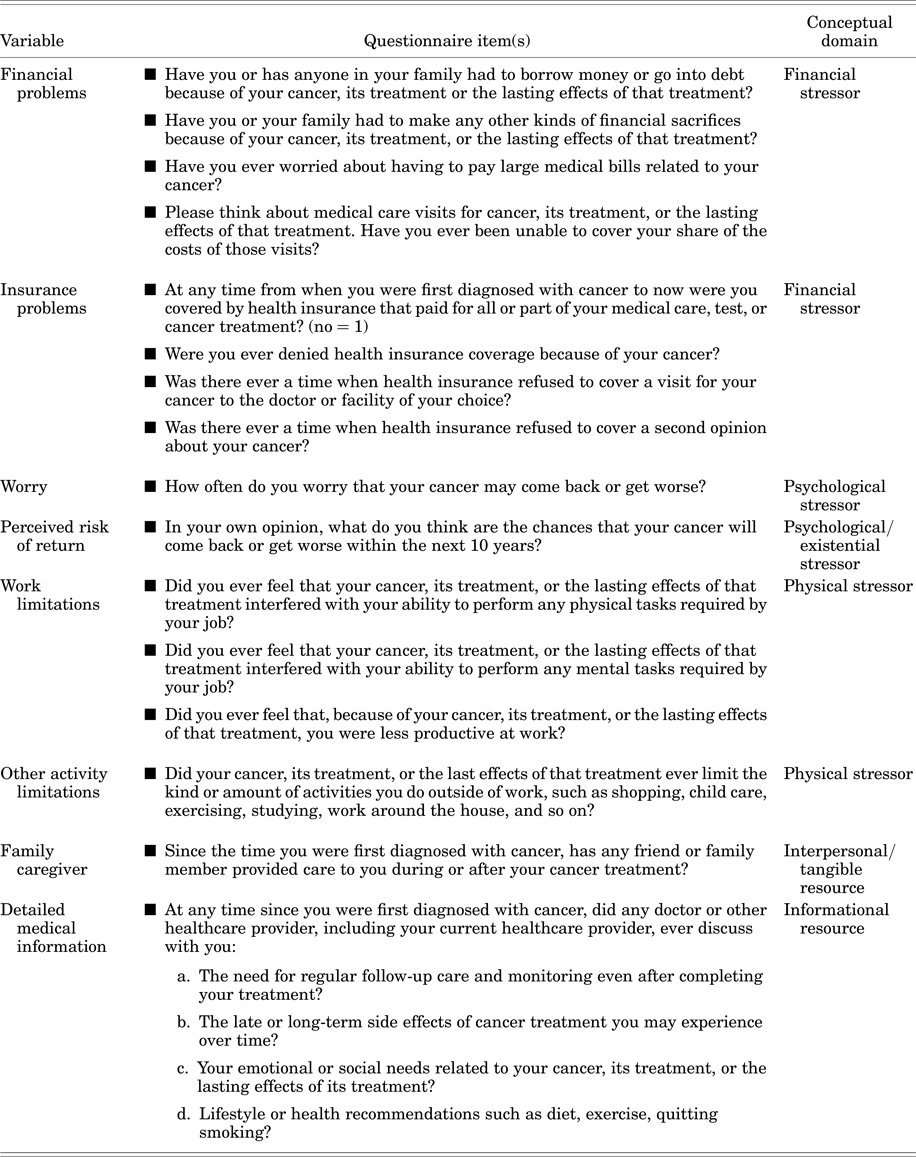
The following resources and stressors were evaluated from the survey: (1) had a family caregiver during or after treatment (yes, no, unknown/unreported); (2) received detailed information from the medical team (yes, no, unknown/unreported); (3) financial problems due to cancer (yes, no, or unreported/unknown); (4) insurance problems due to cancer (yes, no, or unreported/unknown); (5) worry that the cancer would come back or get worse (never, rarely, sometimes vs. often or all the time); (6) perceived chances that the cancer would return or get worse (very low, fairly low, or moderate vs. fairly high or very high); (7) work limitations due to cancer (yes, no, unknown/unreported); and (8) other activity limitations due to cancer (yes, no, unknown/unreported) (see Table 1). Survivors who reported going into debt, making financial sacrifices, worrying about paying large medical bills, or being unable to cover their medical bills related to their cancer, its treatment, or the lasting effects of treatment were coded as having financial problems. Survivors who reported having no insurance coverage, being denied insurance coverage, or that their insurance refused to cover a cancer-related visit or a second opinion were coded as having insurance problems. Survivors who reported that their healthcare provider had discussed four issues with them in detail (the need for regular follow-up care and monitoring; later or long-term side effects; emotional/social needs related to cancer; and lifestyle or health recommendations such as diet, exercise, and quitting smoking) were coded as receiving informational support from a healthcare provider.
Items assessing resources and stressors

Covariates
Cancer Characteristics
Time since diagnosis was calculated by subtracting the reported age at diagnosis from the age at the time of the interview and dichotomized (<5 years, 5+ years, or unknown/unreported). Survivors reported whether they were in remission or had a cancer recurrence. Survivors reported the type(s) of cancer with which they had been diagnosed, coded as breast or prostate versus other/multiple types of cancer due to the high prevalence of breast and prostate cancer in our sample.
Health Status
Survivors rated their perceived mental and physical health status, coded as excellent/very good versus good/fair/poor.
Sociodemographic Characteristics
Survivors reported their age, gender, marital status (coded as married vs. divorced, widowed, separated, or never married), income, education (years), and race and ethnicity (coded as non-Hispanic white vs. other). MEPS coded the region (Northeast, Midwest, South, or West) and urbanicity (metropolitan statistical area, yes or no) of residence. Family income was coded with a floor of $1,000 and logged to account for skewness.
Statistical Analysis
Cancer survivor characteristics were examined using descriptive statistics. Agreement between the positive byproducts was evaluated using unweighted kappas (κ). Possible collinearity among the independent variables and covariates was assessed using Cramer's V calculated from unweighted crosstabulations. We then used multivariable logistic regression to evaluate the association between the resources/stressors and each positive byproduct (i.e., a separate regression was performed for each positive byproduct), controlling for sociodemographic and cancer characteristics and health status. All analyses were conducted in SAS (v. 9.3) using survey weighting procedures.
RESULTS
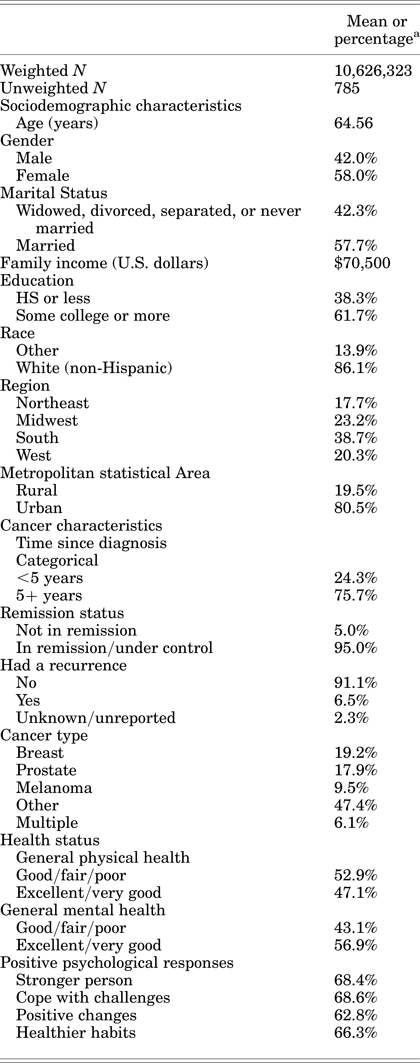
Table 2 presents the characteristics of the cancer survivors. Cancer survivors had a mean age of 64.6 years. More than half were female. Most were married (58%), had more than a high school education (62%), and were non-Hispanic white (86%). More than three-quarters of survivors were 5 or more years from diagnosis (76%). Most survivors reported having either breast (19%) or prostate (18%) cancer, and 6% reported multiple cancers.
Sociodemographic and cancer-related characteristics of cancer survivors

a Weighted values.
Data are from the Medical Expenditures Panel Survey Cancer Supplement (Yabroff et al., Reference Yabroff, Dowling and Rodriguez2012; N = 785).
Nearly all survivors (87%) reported at least one positive byproduct (becoming a stronger person, coping better with challenges, making positive changes in life, and/or developing healthier habits), and nearly half (47%) reported all four positive byproducts. The agreement between pairs of positive byproducts was moderate, with unweighted κ ranging from 38 to 68%.
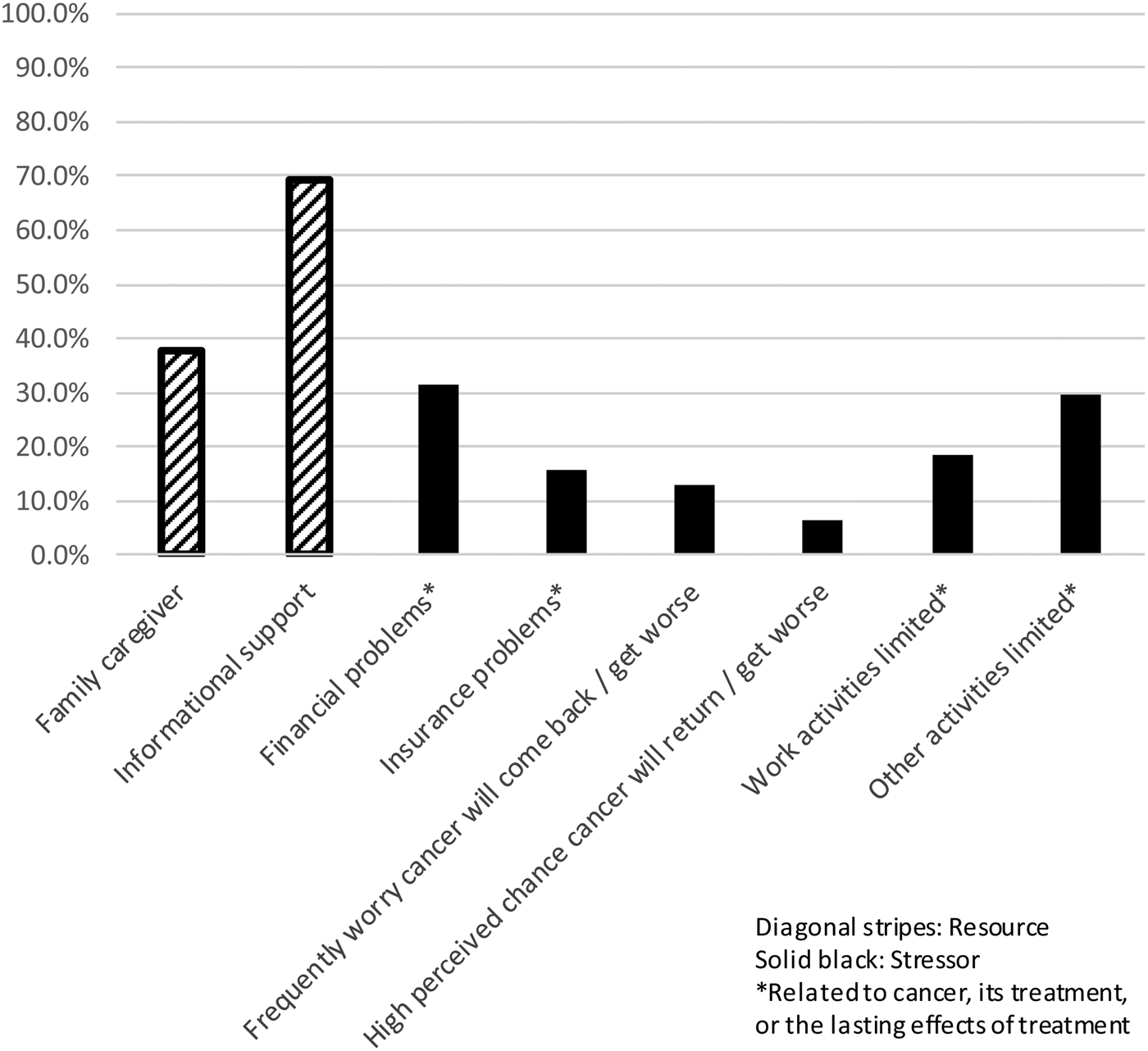
Figure 1 depicts the proportion of survivors with each resource and stressor. Some 38% of survivors reported having a family member care for them, and most (69%) revealed that they had received detailed informational support from their healthcare provider(s). Fewer than a third (31%) reported experiencing financial or insurance problems (16%). Some 13% reported frequently (often/all the time) worrying that their cancer would come back or get worse, and 6% perceived the chances of their cancer returning or getting worse to be fairly or very high. A total of 18% reported work limitations due to their disease, and almost 30% reported other activity limitations due to their cancer.
Proportion of cancer survivors reporting resources and stressors related to their cancer (N = 785). The data are from the Medical Expenditures Panel Survey Experiences with Cancer Survivorship Supplement (Yabroff et al., Reference Yabroff, Dowling and Rodriguez2012).

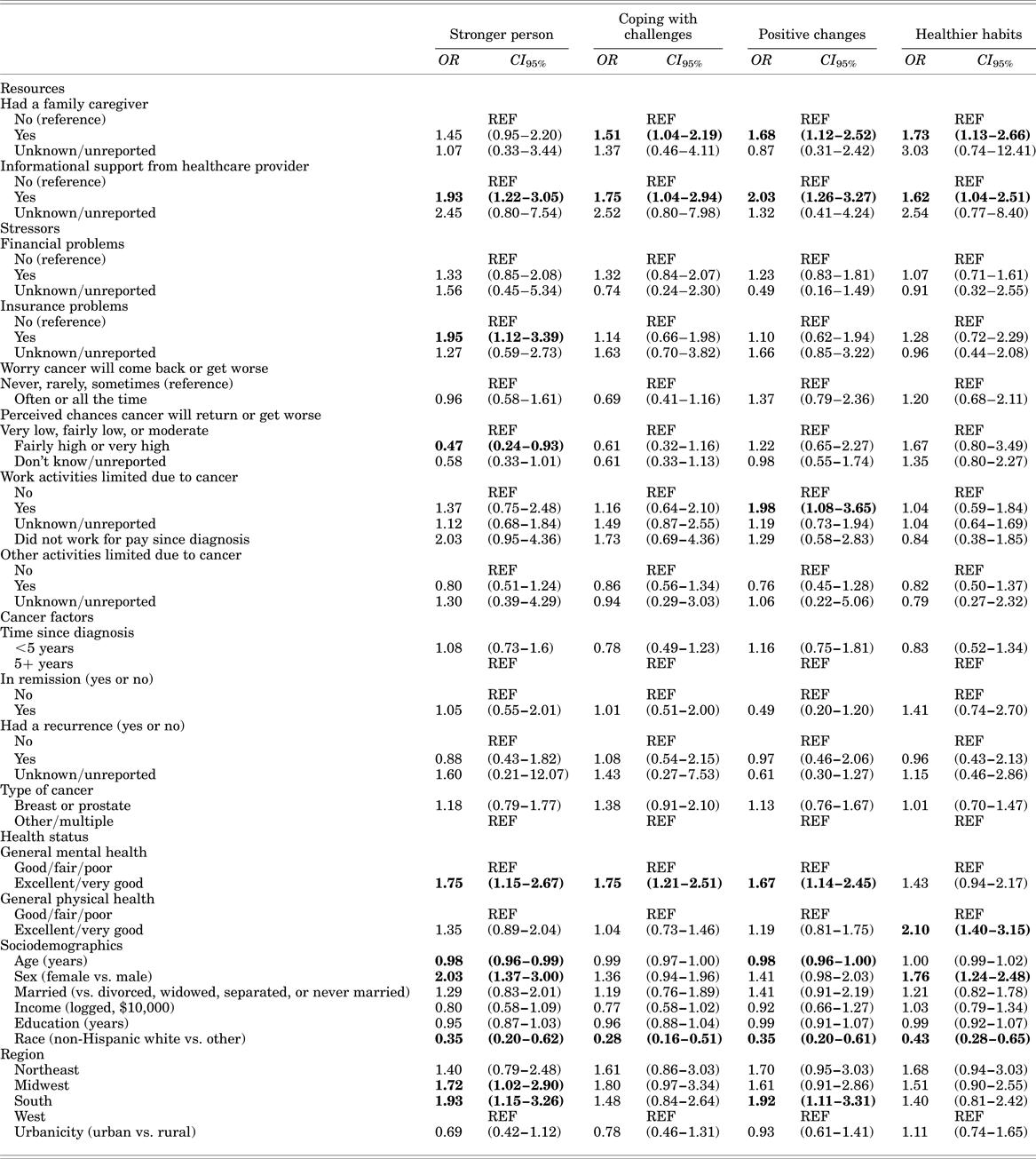
Table 3 gives the results of the multivariable logistic regressions. Having a family caregiver was significantly associated with coping better with challenges (odds ratio [OR] = 1.51, 95 percent confidence interval [CI 95%] = 1.04–2.19), making positive changes in life (OR = 1.68, CI 95% = 1.12–2.52) and adopting healthier habits (OR = 1.73, CI 95% = 1.13–2.66). Receiving informational support from healthcare providers was also consistently associated with positive byproducts (stronger person: OR = 1.93, CI 95% = 1.22–3.05; coping with challenges: OR = 1.75, CI 95% = 1.04–2.94; positive changes: OR = 2.03, CI 95% = 1.26–3.27; healthier habits: OR = 1.62, CI 95% = 1.04–2.51). Few of the stressors were associated with positive byproducts: those with a high perceived chance of cancer recurrence were less likely to report becoming a stronger person (OR = 0.47, CI 95% = 0.24–0.93). Having insurance problems due to cancer was associated with becoming a stronger person (OR = 1.95, CI 95% = 1.12–3.39), and work limitations were associated with making positive changes in life (OR = 1.98, CI 95% = 1.08–3.65).
Associations between economic, psychological, and functional sequelae of cancer and four positive psychological responses to cancer, controlling for covariates

CI 95% = 95% confidence interval; OR = odds ratio; REF = reference group.
An OR above 1.00 indicates that the category is MORE likely to report the outcome compared to the reference group; an OR below 1.00 indicates that the category is LESS likely to report the outcome compared to the reference group. The data are from the Medical Expenditures Panel Survey Cancer Supplement (Yabroff et al., Reference Yabroff, Dowling and Rodriguez2012; N = 785).
DISCUSSION
Our study examined how resources and stressors were associated with positive experiences related to cancer using a nationwide sample. Overall, 60 to 70% of survivors reported each positive byproduct. This is broadly consistent with findings among head and neck (Llewellyn et al., Reference Llewellyn, Horney and McGurk2013) and breast cancer patients (Kolokotroni et al., Reference Kolokotroni, Anagnostopoulos and Tsikkinis2014), where survivors reported moderate to high levels of benefit finding or posttraumatic growth. Resources—having a family caregiver and receiving detailed informational support from healthcare providers—were associated with a greater likelihood of reporting positive byproducts. In addition, having insurance problems was counterintuitively associated with a higher likelihood of reporting becoming a better person, and having work limitations was associated with reports of making positive changes in life.
To our knowledge, this is the first study to examine the association between family caregiving and positive survivor byproducts or other similar constructs. Family caregiving may be indicative of improved social support, which has consistently been associated with greater posttraumatic growth, benefit finding, and perceived positive changes (Shand et al., Reference Shand, Cowlishaw and Brooker2015; Moreno & Stanton, Reference Moreno and Stanton2013; Harding et al., Reference Harding, Sanipour and Moss2014; Pascoe & Edvardsson, Reference Pascoe and Edvardsson2013; Pinquart et al., Reference Pinquart, Frohlich and Silbereisen2007). Support from a partner, in particular (who make up a large proportion of cancer caregivers; Weaver et al., Reference Weaver, Rowland and Augustson2011), has been associated with posttraumatic growth (Koutrouli et al., Reference Koutrouli, Anagnostopoulos and Potamianos2012). Family caregiving may also be related to positive byproducts through other pathways. For example, care recipients may benefit from feeling valued or through feelings of gratitude for their caregiver (Strack et al., Reference Strack, Lopes and Gaspar2010; Sekse et al., Reference Sekse, Raaheim and Blaaka2010). In our study, we were unable to assess the independent effects of social support and having a caregiver. Research further exploring this relationship is needed to assess causality and mechanisms, and to identify whether caregiving can increase personal growth or positive reinterpretation of the experience with cancer and improve adjustment and long-term outcomes.
Informational support from healthcare providers (i.e., receiving detailed information about the need for regular follow-up care, long-term side effects, emotional or social needs related to cancer, and lifestyle or health recommendations) was also consistently correlated with positive byproducts. Although we could not assess directionality or causality in this cross-sectional study, we posit that adequate information may help cancer survivors process and cope with the threat presented by their diagnosis and treatment. This may in turn serve as a buffer against an overly high level of threat that may overwhelm survivors' capacity to process their experience and perceive growth (Jim & Jacobsen, Reference Jim and Jacobsen2008; Tedeschi & Calhoun, Reference Tedeschi and Calhoun2004). Conversely, those with a higher perceived chance of cancer recurrence were less likely to report becoming a stronger person because of their cancer. It is possible that these survivors remain mired in an overwhelmingly high level of threat.
The association of insurance problems and work limitations with greater likelihood of reporting individual positive byproducts (becoming a stronger person and making positive changes in life, respectively) seems counterintuitive, given the supposition that stressors contribute to worse psychological well-being, not better. However, the theory of growth following challenge suggests that struggle and adversity are critical to psychological growth (Tedeschi & Calhoun, Reference Tedeschi and Calhoun2004). It is possible that dealing with insurance problems related to their cancer facilitated survivors' perceptions that they had become a stronger person. More concretely, work limitations may have forced survivors to reevaluate their priorities and abilities, which may have directly contributed to making changes in their life that were later seen as positive. As these findings are not consistent across positive byproducts, however, we remain cautious with our interpretation.
Limitations and Future Directions
Several limitations of our study should be considered. This exploratory work is primarily meant to be hypothesis-generating, especially given the single-item measurement of positive byproducts. The data in this study were collected cross-sectionally, and we could not evaluate the temporality or trajectories of positive byproducts and the correlates identified in our study. The findings may also be subject to reporting bias, as survivors were asked to report retrospectively on the factors related to their cancer, its treatment, and the aftereffects of treatment, as well as survival bias, given that only those who were off treatment and those more than a year from diagnosis were included. In particular, only 38% of survivors reported having a family caregiver, and the proportion differed by cancer type (48% of breast cancer survivors reported having a family caregiver compared to 27% of prostate cancer survivors and 20% of melanoma survivors). It is possible that this item was subject to recall bias, which would suggest that the family caregiving finding may only be generalizable to those survivors who needed and were strongly impacted by their family caregiver (and thus remember and report having one). We were unable to control for some characteristics, such as the severity of the disease or the magnitude and type of treatment, and such social factors as social support. The sample combines survivors of many different types of cancer, which may mask important heterogeneity. Nevertheless, our study provided evidence for previously unexplored correlates of positive experiences with cancer that can be followed up in other datasets and with other constructs. This was one of the first studies of these concepts in a population-based U.S. sample (although the respondents were predominantly non-Hispanic white, well-educated, and high-income, and generalizability should be interpreted accordingly). A further strength of our study is the questionnaire's focus on factors directly stemming from the cancer experience (i.e., questions asked about the impact of the cancer and its treatment).
Opportunities for Future Research
The findings from this study suggest how important to the psychological well-being of cancer survivors it is to have a family caregiver and receive adequate cancer-related medical information. Future research might therefore wish to explore directionality and the pathways by which family caregiving may impact positive byproducts and growth in cancer survivors (e.g., whether the caregiving serves a social support function, or if there is an independent effect that may further explain the process by which psychological growth develops after cancer). Testing the impact of increased informational support from the medical system may also elucidate how stressors and resources are linked to positive byproducts. This and other research may also reveal whether these factors can be utilized to improve cancer survivor outcomes over the long term.
In addition to being positive outcomes in and of themselves, higher levels of positive psychological responses to cancer (e.g., benefit finding and/or posttraumatic growth) have been associated with better adjustment (Ben-Zur et al., Reference Ben-Zur, Cohen and Gouzman2015), more positive affect (Ben-Zur et al., Reference Ben-Zur, Cohen and Gouzman2015), and enhanced quality of life (Morrill et al., Reference Morrill, Brewer and O'Neill2008; Tomich & Helgeson, Reference Tomich and Helgeson2012), as well as lower levels of depression (Morrill et al., Reference Morrill, Brewer and O'Neill2008), distress (Ruini et al., Reference Ruini, Vescovelli and Albieri2013), and somatization (Ruini et al., Reference Ruini, Vescovelli and Albieri2013), not to mention such physiological outcomes as better immune functioning (McGregor & Antoni, Reference McGregor and Antoni2009; Bower et al., Reference Bower, Moskowitz and Epel2009) (although conflicting findings also exist; Stanton et al., Reference Stanton, Bower, Low, Calhoun and Tedeschi2014). The development of positive byproducts may help reduce emotional discomfort among survivors, making their development a potentially worthy clinical and psychological goal (Sumalla et al., Reference Sumalla, Ochoa and Blanco2009). In addition, while positive psychological responses and psychological distress or posttraumatic stress can and do co-occur, some research indicates that higher positive responses may buffer the impact of cancer or posttraumatic stress on such outcomes as adjustment (Ben-Zur et al., Reference Ben-Zur, Cohen and Gouzman2015), depression (Silva et al., Reference Silva, Crespo and Canavarro2012), and quality of life (Silva et al., Reference Silva, Crespo and Canavarro2012). Clinical interventions—e.g., telephone-based counseling (Chambers et al., Reference Chambers, Girgis and Occhipinti2014), individual self-exploration (Henry et al., Reference Henry, Cohen and Lee2010), or meaning-centered group therapy (Breitbart et al., Reference Breitbart, Rosenfeld and Gibson2010) as well as support and/or counseling from healthcare professionals (Jeon et al., Reference Jeon, Yoo and Kim2015)—can improve personal growth in cancer survivors. Interventions that focus on instrumental rumination (i.e., active processing of events) may be particularly effective (Soo & Sherman, Reference Soo and Sherman2015). However, it is important to note that focusing on positive byproducts, benefit finding, or posttraumatic growth to the exclusion of other emotional or cognitive experiences may alienate or disenfranchise some survivors whose reactions to cancer do not fit this prevailing cultural narrative (Bell, Reference Bell2012). Therefore, this should be emphasized only as long as it improves the well-being or adjustment of survivors and their families.
CONCLUSIONS
Our study showed that having a family caregiver and receiving detailed informational support from healthcare providers is associated with reporting positive experiences with cancer. The hypotheses and future research inspired by these findings may improve our understanding of the process by which positive byproducts develop and may ultimately help support psychological well-being among cancer survivors.
DISCLOSURES
The authors have no conflicts of interest to report. This work was conducted while the lead author was a federal employee (National Cancer Institute, National Institutes of Health) and did not receive any specific funding. The findings and conclusions of this report are those of the authors and do not represent the official position of the National Cancer Institute.
ACKNOWLEDGMENTS
We wish to express our thanks to the Medical Expenditure Panel Survey (MEPS) Experiences with Cancer Working Group for their feedback on this work.