





Impact statement
Despite the effectiveness of human papillomavirus (HPV) vaccination and cervical cancer screening for prevention, the uptake of these methods remains poor in African settings. Along with practical obstacles such as limited access and financial constraints, stigma continues to be a barrier to the prevention and care of cervical cancer across the continent. Given the limited literature available to guide stigma-reduction interventions, we explored the research landscape of HPV and cervical cancer stigma in Africa. Our scoping review identified common themes, gaps in geographic representation and a lack of stigma-related interventions and adoption. Identified interventions included addressing misinformation at the individual, spouse, community (social and religious), health system and government levels. Incorporating patient navigation and trusted agencies also emerged as key strategies to eliminate stigma. We lay a foundation for developing culturally relevant stigma-reduction interventions, which are critical for scaling HPV vaccination as well as cervical cancer screening and treatment. It is imperative for policymakers, health workers, religious leaders, public health entities and communities to design well-informed and cost-effective interventions to reduce cervical cancer mortality and morbidity, especially in underrepresented African regions.
Introduction
Cervical cancer is the fourth most common cancer and the fourth leading cause of cancer death among women worldwide, with more than 600,000 new cases and 340,000 deaths each year (Sung et al., Reference Sung, Ferlay, Siegel, Laversanne, Soerjomataram, Jemal and Bray2021). This burden disproportionately affects low- and middle-income countries, where at least three-quarters of cases occur (Sung et al., Reference Sung, Ferlay, Siegel, Laversanne, Soerjomataram, Jemal and Bray2021). In sub-Saharan Africa, cervical cancer is the most common cancer, accounting for 22.2% of all cancers, and remains the leading cause of cancer-related mortality (Anorlu, Reference Anorlu2008; International Agency for Research on Cancer, 2020).
Stigma, defined as a negative social attitude that leads to discrimination, exclusion and reduced social participation, plays a substantial role in shaping health behaviors (American Psychological Association, 2018; Mwobobia et al., Reference Mwobobia, Knettel, Headley, Msoka, Tarimo, Katiti, Juhlin and Osazuwa-Peters2024). In the context of cervical cancer, stigma may involve myths about disease causation, shame related to sexual health, fear of social isolation and avoidance of healthcare due to anticipated judgment (White et al., Reference White, Mulambia, Sinkala, Mwanahamuntu, Parham, Moneyham, Grimley and Chamot2012; Watt et al., Reference Watt, Suneja, Zimba, Westmoreland, Bula, Cutler, Khatri, Painschab and Kimani2023). Stigma related to sexually transmitted infections (STIs) can further compound these challenges, especially in settings with high HPV prevalence where intersectional stigmas overlap (Earnshaw et al., Reference Earnshaw, Smith, Chaudoir, Amico and Copenhaver2013; Knettel et al. Reference Knettel, Minja, Msoka, Tarimo, Katiti, Pan, Mwobobia, Juhlin, Knippler, Watt, Suneja, Kimani, Abouelella, Mmbaga and Culturally-informed2024).
Human papillomavirus (HPV) is the most common sexually transmitted infection worldwide and nearly all cases of cervical cancer are attributable to the virus (Ferlay et al., Reference Ferlay J, Ervik, Dikshit, Eser, Mathers, Rebelo, Parkin, Forman and Bray2012; National Cancer Institute, 2025). Prevention of cervical cancer relies primarily on HPV vaccination, which protects against at least 80% of high-risk HPV subtypes (Saraiya et al., Reference Saraiya, Unger, Thompson, Lynch, Hernandez, Lyu, Steinau, Watson, Wilkinson, Hopenhayn, Copeland, Cozen, Peters, Huang, Saber, Altekruse and Goodman2015), and on secondary prevention through cervical cancer screening via Pap smear and HPV testing (Arbyn et al., Reference Arbyn, Weiderpass, Bruni, de Sanjosé, Saraiya, Ferlay and Bray2020; Centers for Disease Control and Prevention, 2020; Prevention, 2020).
The HPV vaccine was approved for use in the United States and other Western countries between 2006 and 2008 (Markowitz et al., Reference Markowitz, Dunne, Saraiya, Lawson, Chesson and Unger2007; Petrosky et al., Reference Petrosky, Bocchini, Hariri, Chesson, Curtis, Saraiya, Unger and Markowitz2015; Falcaro et al., Reference Falcaro, Castañon, Ndlela, Checchi, Soldan, Lopez-Bernal, Elliss-Brookes and Sasieni2021). Evidence increasingly demonstrates reductions in cervical cancer and cervical intraepithelial neoplasia (CIN) following vaccine introduction (Lei et al., Reference Lei, Ploner, Elfström, Wang, Roth, Fang, Sundström, Dillner and Sparén2020; Falcaro et al., Reference Falcaro, Castañon, Ndlela, Checchi, Soldan, Lopez-Bernal, Elliss-Brookes and Sasieni2021; Tabibi et al., Reference Tabibi, Barnes, Shah, Osazuwa-Peters, Johnson and Brown2022). However, in most of sub-Saharan Africa, HPV vaccination uptake has been suboptimal. While countries like Rwanda have achieved high vaccination coverage for more than a decade (Binagwaho et al., Reference Binagwaho, Wagner, Gatera, Karema, Nutt and Ngabo2012), countries such as Nigeria and Tanzania have only recently launched national vaccination programs or have only done so within the past 5 years (Mphuru et al., Reference Mphuru, Li, Kyesi, Mwengee, Mazige, Nshunju, Shayo, Giattas, Loharikar and Lyimo2022).
Multiple systemic and societal barriers hinder cervical cancer prevention efforts in the region. These include limited health system capacity for vaccination and screening, shortages of trained personnel, inadequate facilities, insufficient funding and quality control challenges (Gakidou et al., Reference Gakidou, Nordhagen and Obermeyer2008). Screening affordability is another major constraint (Aswathy et al., Reference Aswathy, Quereshi, Kurian and Leelamoni2012). Public education efforts remain inadequate, with low awareness of HPV, the HPV vaccine and cervical cancer screening (Kassaman et al., Reference Kassaman, Mushani, Kiraithe, Brownie and Barton-Burke2022) and negative attitudes and beliefs that lead to avoidance of services (Haque et al., Reference Haque, Kouriba, Aïssatou and Pant2020). Individual-level and cultural barriers, such as shame, misinformation, stigma surrounding the causes of HPV and cervical cancer, fear of being seen at clinics, transportation barriers and lack of autonomy in healthcare decision-making, further impede service uptake (McFarland et al., Reference McFarland, Gueldner and Mogobe2016; Dzobo et al., Reference Dzobo, Dzinamarira, Jaya, Kgarosi and Mashamba-Thompson2024).
Additionally, HPV’s status as an STI contributes substantially to stigma, with concerns about sexual behavior, infertility and associations with other stigmatized conditions such as HIV (Rosser et al., Reference Rosser, Njoroge and Huchko2016; Deignan et al., Reference Deignan, Swartz, Cooper and Colvin2021). Stigma, including enacted, internalized and anticipated stigma, is associated with delays in screening, avoidance of treatment and poor mental health outcomes such as anxiety and depression (White et al., Reference White, Mulambia, Sinkala, Mwanahamuntu, Parham, Moneyham, Grimley and Chamot2012; Knettel et al. Reference Knettel, Minja, Msoka, Tarimo, Katiti, Pan, Mwobobia, Juhlin, Knippler, Watt, Suneja, Kimani, Abouelella, Mmbaga and Culturally-informed2024). These experiences can exacerbate later presentation, poor prognosis and increased mortality (McFarland et al., Reference McFarland, Gueldner and Mogobe2016).
Given the complex interplay of individual, social and structural barriers to HPV vaccination, screening and treatment, there is a pressing need for integrated approaches that include education, stigma reduction and awareness-building in African settings. However, limited research has examined stigma-reduction interventions specifically targeting HPV or cervical cancer, and no structured reviews currently synthesize this evidence in the African context. This study aims to characterize the research landscape on HPV and cervical cancer stigma in Africa to inform future interventions aimed at reducing stigma and improving cancer prevention, screening and treatment outcomes.
Methods
We conducted a scoping review of studies exploring HPV and cervical cancer stigma in Africa. We used the Covidence platform and guidelines from the Preferred Reporting Items for Systematic Reviews and Meta-Analysis for Scoping Reviews (PRISMA-ScR) (Tricco et al., Reference Tricco, Lillie, Zarin, O’Brien, Colquhoun, Levac, Moher, Peters, Horsley, Weeks, Hempel, Akl, Chang, McGowan, Stewart, Hartling, Aldcroft, Wilson, Garritty, Lewin, Godfrey, Macdonald, Langlois, Soares-Weiser, Moriarty, Clifford, Tunçalp and Straus2018). The review protocol for this study is registered on the Center for Open Science OSF database.
Search strategy and selection criteria
The search strategy for this review was developed in collaboration with trained librarians, balancing search inclusiveness and study relevance. Databases searched included MEDLINE (via PubMed), Embase (via Elsevier), CINAHL (via Ebscohost), Global Health (via Ebscohost) and CABI, using a combination of database-specific keywords and subject headings associated with the constructs of Africa, cancer and stigma. See Supplementary Material for detailed reproducible search strategies for all searched databases, including specific search filters used.
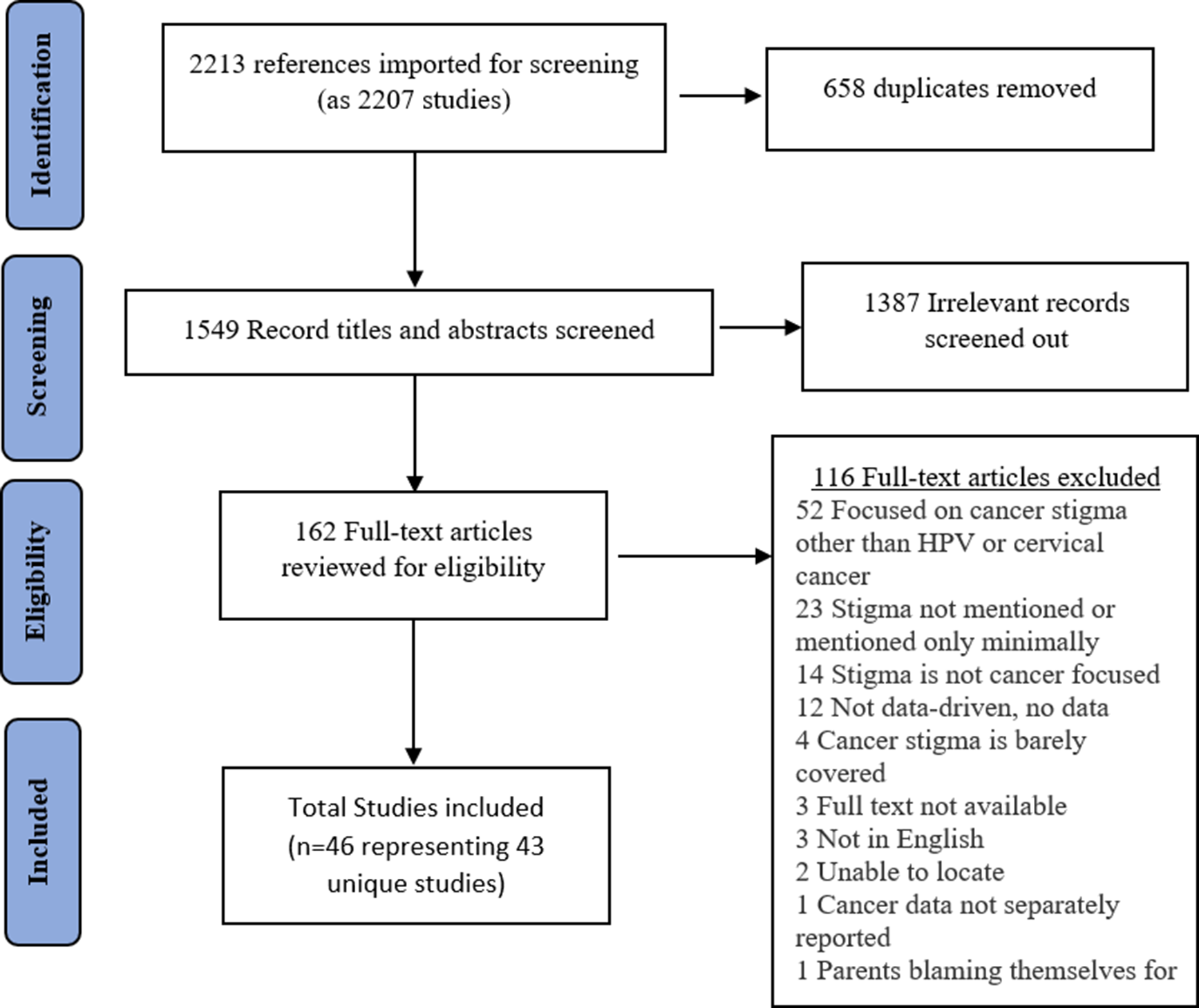
Initial search yielded 2,213 records, reduced to 1,549 after the removal of 658 duplicate records. Titles and abstracts of the remaining 1,549 records were reviewed and voted upon for preliminary relevance by two research team members. Disagreements were reviewed, discussed and resolved in weekly full team discussions. During title and abstract screening, 1,387 publications were deemed irrelevant and 162 were advanced for full-text review. Full texts were then reviewed and voted upon by two team members and disagreements were once again discussed and resolved by the full team. A total of 116 publications were excluded during full-text screening, yielding our final pool of 46 publications representing 43 unique studies, as three studies were derived from the same data set and were therefore combined for this analysis. The flowchart in Figure 1 illustrates the details of the study selection process.
Flow diagram showing study selection, including identification, screening, eligibility and the final studies included in the review.

Figure 1. Long description
The flowchart is organized into four vertical phases labeled on the left.
1. Identification phase. A central box states 2213 references imported for screening (as 2207 studies). An arrow points right to a box stating 658 duplicates removed.
2. Screening phase. A central box states 1549 Record titles and abstracts screened. An arrow points right to a box stating 1387 Irrelevant records screened out.
3. Eligibility phase. A central box states 162 Full-text articles reviewed for eligibility. An arrow points right to a large box listing 116 Full-text articles excluded for the following reasons: 52 Focused on cancer stigma other than H P V or cervical cancer; 23 Stigma not mentioned or mentioned only minimally; 14 Stigma is not cancer focused; 12 Not data-driven, no data; 4 Cancer stigma is barely covered; 3 Full text not available; 3 Not in English; 2 Unable to locate; 1 Cancer data not separately reported; 1 Parents blaming themselves for.
4. Included phase. The final central box states Total Studies included (n=46 representing 43 unique studies).
Inclusion and exclusion criteria
Included studies needed to be data-driven research articles or abstracts that used quantitative or qualitative methods. To meet the inclusion criteria, studies had to describe a form of stigma directly related to HPV or cervical cancer experienced by individuals living in Africa or of African descent. Eligible perspectives included those of patients or from others with insight into the experiences of HPV or cervical cancer stigma, such as members of the general public, family members, caretakers and healthcare providers. Studies focused on health issues strongly related to cancer-associated stigma, such as deformity or palliative care, were included if they described at least one type of HPV- or cervical cancer-related stigma.
Studies that focused exclusively on the stigma of other cancer types or other conditions, such as HIV and mental health challenges, were excluded. Commentaries, case studies or case series, editorials, reviews and scale validation studies were all excluded. Studies with a sample size less than 10 were also excluded. Studies not available in English or that were conducted in a non-African setting were excluded from our review (Figure 1).
Results
Summary of included studies
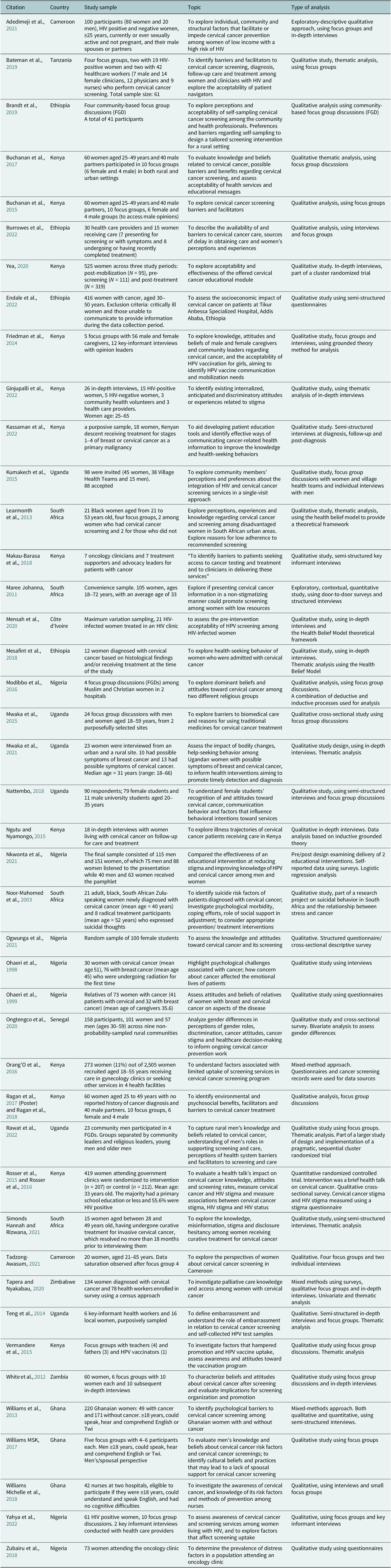
A total of 43 studies met the inclusion criteria, representing diverse populations across 12 sub-Saharan African countries (Kenya n = 12; Nigeria n = 7; Uganda n = 6; South Africa n = 4; Ethiopia n = 4; Ghana n = 3; Cameroon n = 2; Tanzania n = 1; Côte d’Ivoire n = 1; Senegal n = 1; Zambia n = 1; Zimbabwe n = 1). Sample sizes varied widely, ranging from 12 to 700 participants. Most studies were qualitative, with 12 focus groups, 12 individual interviews, 9 studies combining focus groups and interviews and 5 structured questionnaires or surveys. Qualitative studies included four cross-sectional surveys (Rosser et al., Reference Rosser, Njoroge and Huchko2015, Reference Rosser, Njoroge and Huchko2016; Mesafint et al., Reference Mesafint, Berhane and Desalegn2018; Ginjupalli et al., Reference Ginjupalli, Mundaden, Choi, Herfel, Oketch, Watt, Makhulo, Bukusi and Huchko2022) and three mixed-methods studies combining qualitative and quantitative approaches (Williams et al., Reference Williams, Kuffour, Ekuadzi, Yeboah, ElDuah and Tuffour2013; Orang’O et al., Reference Orang’O, Wachira, Asirwa, Busakhala, Naanyu, Kisuya, Otieno, Keter, Mwangi and Inui2016; Tapera and Nyakabau, Reference Tapera and Nyakabau2020). Only two studies evaluated stigma-related interventions: a pre-/post-test educational intervention (Nkwonta et al., Reference Nkwonta, Hilfinger Messias, Felder and Luchok2021) and a brief educational talk assessed via a randomized controlled trial (Rosser et al., Reference Rosser, Njoroge and Huchko2015). Full study characteristics are summarized in Table 1.
Description of included studies

Table 1. Long description
The table consists of 43 rows of study data organized into five columns.
* Adedimeji et al., 2021 (Cameroon): 100 participants (80 women, 20 men); explores factors impeding cervical cancer prevention; exploratory-descriptive qualitative approach.
* Bateman et al., 2019 (Tanzania): 61 participants (HIV-positive women and healthcare workers); identifies barriers to screening and treatment; thematic analysis of focus groups.
* Brandt et al., 2019 (Ethiopia): 41 participants; explores acceptability of self-sampling; qualitative focus groups.
* Buchanan et al., 2017 and 2015 (Kenya): 100 participants (60 women, 40 men); evaluates knowledge and barriers; qualitative thematic analysis.
* Burrowes et al., 2022 (Ethiopia): 30 providers and 15 women; describes availability and barriers to care; qualitative interviews and focus groups.
* Yea, 2020 (Kenya): 525 women; explores educational module effectiveness; qualitative in-depth interviews.
* Endale et al., 2022 (Ethiopia): 416 women with cancer; assesses socioeconomic impact; semi-structured questionnaires.
* Friedman et al., 2014 (Kenya): 56 caregivers and 12 leaders; explores H P V vaccination acceptability; grounded theory analysis.
* Ginjupalli et al., 2022 (Kenya): 26 interviews; identifies stigma-related attitudes; thematic analysis.
* Kassaman et al., 2022 (Kenya): 18 women; aids development of education tools; semi-structured interviews.
* Kumakech et al., 2015 (Uganda): 88 participants; explores integration of H I V and cervical cancer services; focus groups and interviews.
* Learmonth et al., 2013 (South Africa): 21 Black women; explores low adherence to screening; Health Belief Model framework.
* Makau-Barasa et al., 2018 (Kenya): 14 clinicians and supporters; identifies barriers to testing; semi-structured interviews.
* Maree Johanna, 2011 (South Africa): 105 women; explores non-stigmatizing information; quantitative door-to-door surveys.
* Mensah et al., 2020 (Côte d’Ivoire): 21 H I V-infected women; assesses H P V screening acceptability; Health Belief Model.
* Mesafint et al., 2018 (Ethiopia): 12 women; explores health-seeking behavior; in-depth interviews.
* Modibbo et al., 2016 (Nigeria): 4 focus groups; explores religious beliefs and attitudes; deductive and inductive analysis.
* Mwaka et al., 2015 and 2021 (Uganda): Focus groups and interviews; explores traditional medicine use and impact of bodily changes; qualitative thematic analysis.
* Nattembo, 2018 (Uganda): 90 students; understands attitudes and communication behavior; focus groups.
* Ngutu and Nyamongo, 2015 (Kenya): 18 interviews; explores illness trajectories; inductive grounded theory.
* Nkwonta et al., 2021 (Nigeria): 266 participants; compares educational interventions; pre/post design with logistic regression.
* Noor-Mahomed et al., 2003 (South Africa): 29 women; identifies suicide risk factors; qualitative study.
* Ogwunga et al., 2021 (Nigeria): 100 students; assesses knowledge and attitudes; structured questionnaire.
* Ohaeri et al., 1998 and 1999 (Nigeria): Women with cancer and their relatives; highlights psychological challenges and attitudes; qualitative interviews and questionnaires.
* Ongtengco et al., 2020 (Senegal): 158 participants; analyzes gender differences in stigma; bivariate analysis.
* Orang’O et al., 2016 (Kenya): 273 women; understands limited screening uptake; mixed-method approach.
* Ragan et al., 2017/2018 (Kenya): 100 participants; identifies psychosocial benefits and barriers; focus groups.
* Rawat et al., 2022 (Uganda): 23 men; captures rural men's knowledge and roles; thematic analysis.
* Rosser et al., 2015/2016 (Kenya): 419 women; evaluates health talk impact on stigma; randomized controlled trial.
* Simonds Hannah and Rizwana, 2021 (South Africa): 15 women; explores disclosure hesitancy; thematic analysis.
* Tadzong-Awasum, 2021 (Cameroon): 20 women; explores perspectives on screening; focus groups.
* Tapera and Nyakabau, 2020 (Zimbabwe): 134 women and 78 workers; investigates palliative care; mixed methods.
* Teng et al., 2014 (Uganda): 22 participants; understands role of embarrassment; thematic analysis.
* Vermandere et al., 2015 (Kenya): Teachers, fathers, and vaccinators; investigates H P V vaccine uptake; thematic analysis.
* White et al., 2012 (Zambia): 60 women; characterizes beliefs after screening; focus groups and interviews.
* Williams et al., 2013, 2017, 2018 (Ghana): Women, men, and nurses; identifies psychological barriers and spousal support; mixed-methods and focus groups.
* Yahya et al., 2022 (Nigeria): 61 H I V-positive women; assesses awareness and uptake; focus groups.
* Zubairu et al., 2018 (Nigeria): 73 women; determines prevalence of distress factors; qualitative questionnaires.
Study participants represented diverse perspectives, including women in the general public (Gakidou et al., Reference Gakidou, Nordhagen and Obermeyer2008; Aswathy et al., Reference Aswathy, Quereshi, Kurian and Leelamoni2012; Rodríguez and Salmerón, Reference Rodríguez and Salmerón2017; Haque et al., Reference Haque, Kouriba, Aïssatou and Pant2020; Yea, Reference Yea2020; Baussano et al., Reference Baussano, Sayinzoga, Tshomo, Tenet, Vorsters, Heideman, Gheit, Tommasino, Umulisa, Franceschi and Clifford2021; Kassaman et al., Reference Kassaman, Mushani, Kiraithe, Brownie and Barton-Burke2022; Mphuru et al., Reference Mphuru, Li, Kyesi, Mwengee, Mazige, Nshunju, Shayo, Giattas, Loharikar and Lyimo2022), women who underwent or declined cervical cancer screening (Learmonth et al., Reference Learmonth, De Abreu and Horsfall2013), women living with HIV (Bateman et al., Reference Bateman, Blakemore, Koneru, Mtesigwa, McCree, Lisovicz, Aris, Yuma, Mwaiselage and Jolly2019; Mensah et al., Reference Mensah, Assoumou, Duchesne, Pourette, Debeaudrap and Dumont2020; Yahya et al., Reference Yahya, Mustapha, Kolawole, Oguntayo and Lawal2022), HIV-positive and negative women (Adedimeji et al., Reference Adedimeji, Ajeh, Pierz, Nkeng, Ndenkeh, Fuhngwa, Nsame, Nji, Dzudie, Anastos and Castle2021; Ginjupalli et al., Reference Ginjupalli, Mundaden, Choi, Herfel, Oketch, Watt, Makhulo, Bukusi and Huchko2022), women with current or past cervical cancer diagnoses (Noor-Mahomed et al., Reference Noor-Mahomed, Schlebusch and Bosch2003; Williams et al., Reference Williams, Kuffour, Ekuadzi, Yeboah, ElDuah and Tuffour2013; Ngutu and Nyamongo, Reference Ngutu and Nyamongo2015; Mesafint et al., Reference Mesafint, Berhane and Desalegn2018; Simonds Hannah and Rizwana, Reference Simonds Hannah and Rizwana2021; Endale et al., Reference Endale, Demelew and Habte2022; Kassaman et al., Reference Kassaman, Mushani, Kiraithe, Brownie and Barton-Burke2022), male partners (Buchanan Lunsford et al., Reference Buchanan Lunsford, Ragan, Lee Smith, Saraiya and Aketch2017; Ragan et al., Reference Ragan, Buchanan Lunsford, Lee Smith, Saraiya and Aketch2018; Adedimeji et al., Reference Adedimeji, Ajeh, Pierz, Nkeng, Ndenkeh, Fuhngwa, Nsame, Nji, Dzudie, Anastos and Castle2021), teachers and fathers of adolescents (Vermandere et al., Reference Vermandere, Naanyu, Degomme and Michielsen2015), health professionals (Teng et al., Reference Teng, Mitchell, Sekikubo, Biryabarema, Byamugisha, Steinberg, Money and Ogilvie2014; Makau-Barasa et al., Reference Makau-Barasa, Greene, Othieno-Abinya, Wheeler, Skinner and Bennett2018; Williams Michelle et al., Reference Williams Michelle, Isaac, iA and Kevin2018; Tapera and Nyakabau, Reference Tapera and Nyakabau2020; Burrowes et al., Reference Burrowes, Holcombe, Leshargie, Hernandez, Ho, Galivan, Youb and Mahmoud2022), caregivers and community leaders (Friedman et al., Reference Friedman, Oruko, Habel, Ford, Kinsey, Odhiambo, Phillips-Howard, Wang, Collins, Laserson and Dunne2014) and men in the general public (Rawat et al., Reference Rawat, Mithani, Sanders, Namugosa, Payne, Mitchell-Foster, Orem, Ogilvie and Nakisige2022).
Knowledge and perceptions of HPV and cervical cancer screening and treatment
Seventeen studies examined awareness, knowledge and perceptions regarding HPV and cervical cancer screening and treatment. Across populations, gaps in knowledge were common among women, caregivers and community leaders, often contributing to delayed care and fear of screening (Mesafint et al., Reference Mesafint, Berhane and Desalegn2018; Ragan et al., Reference Ragan, Buchanan Lunsford, Lee Smith, Saraiya and Aketch2018; Tapera and Nyakabau, Reference Tapera and Nyakabau2020). Women described shame, embarrassment and stigma associated with cervical cancer and its link to reproductive anatomy (Learmonth et al., Reference Learmonth, De Abreu and Horsfall2013; Friedman et al., Reference Friedman, Oruko, Habel, Ford, Kinsey, Odhiambo, Phillips-Howard, Wang, Collins, Laserson and Dunne2014; Modibbo et al., Reference Modibbo, Dareng, Bamisaye, Jedy-Agba, Adewole, Oyeneyin, Olaniyan and Adebamowo2016; Mesafint et al., Reference Mesafint, Berhane and Desalegn2018; Tadzong-Awasum, 2021). Religious and cultural factors influenced screening behaviors, with Christian women more likely than Muslim women to endorse screening (Modibbo et al., Reference Modibbo, Dareng, Bamisaye, Jedy-Agba, Adewole, Oyeneyin, Olaniyan and Adebamowo2016). Male partners played a crucial role in facilitating or limiting engagement with care (Williams, Reference Williams MSK2017; Rawat et al., Reference Rawat, Mithani, Sanders, Namugosa, Payne, Mitchell-Foster, Orem, Ogilvie and Nakisige2022). Facilitators included prior health education, community support and partner encouragement, while barriers included fear of screening procedures, low awareness, stigma and cultural/religious norms (Ragan et al., Reference Ragan, Buchanan Lunsford, Lee Smith, Saraiya and Aketch2018; Burrowes et al., Reference Burrowes, Holcombe, Leshargie, Hernandez, Ho, Galivan, Youb and Mahmoud2022). These findings suggest that interventions addressing both knowledge and social norms are needed to improve uptake.
Practical barriers and facilitators of screening and treatment
Ten studies highlighted practical barriers and facilitators to cervical cancer screening and treatment. Barriers included time constraints, poor accessibility, financial costs, lack of decentralized services and limited provider availability (Learmonth et al., Reference Learmonth, De Abreu and Horsfall2013; Makau-Barasa et al., Reference Makau-Barasa, Greene, Othieno-Abinya, Wheeler, Skinner and Bennett2018; Mesafint et al., Reference Mesafint, Berhane and Desalegn2018; Nattembo, Reference Nattembo2018; Burrowes et al., Reference Burrowes, Holcombe, Leshargie, Hernandez, Ho, Galivan, Youb and Mahmoud2022; Endale et al., Reference Endale, Demelew and Habte2022; Rawat et al., Reference Rawat, Mithani, Sanders, Namugosa, Payne, Mitchell-Foster, Orem, Ogilvie and Nakisige2022). Multi-level barriers were identified, spanning individuals (knowledge, risk, perception), community (social norms, familial networks) and structural (health system policies, service availability) levels (Buchanan Lunsford et al., Reference Buchanan Lunsford, Ragan, Lee Smith, Saraiya and Aketch2017; Adedimeji et al., Reference Adedimeji, Ajeh, Pierz, Nkeng, Ndenkeh, Fuhngwa, Nsame, Nji, Dzudie, Anastos and Castle2021). Facilitators included wellness motivation, symptom relief and social support. Financial and social barriers, including poverty and stigma, also delayed care and impacted treatment adherence, highlighting the need for context-sensitive interventions.
Acceptability of education and interventions promoting screening and treatment
Although only 2 studies specifically addressed stigma reduction,10 studies described broader educational interventions promoting HPV and cervical cancer screening. Patient navigators were well accepted among women living with HIV, facilitating referrals and improving communication (Bateman et al., Reference Bateman, Blakemore, Koneru, Mtesigwa, McCree, Lisovicz, Aris, Yuma, Mwaiselage and Jolly2019). HPV vaccine acceptability was high when supported by trusted agencies (Friedman et al., Reference Friedman, Oruko, Habel, Ford, Kinsey, Odhiambo, Phillips-Howard, Wang, Collins, Laserson and Dunne2014). Educational messages improved knowledge but did not consistently increase screening uptake or pre-cancer detection (Buchanan Lunsford et al., Reference Buchanan Lunsford, Ragan, Lee Smith, Saraiya and Aketch2017). Interventions emphasizing non-stigmatizing language and addressing social concerns, faith, finances and side effects were recommended (Maree Johanna, Reference Maree Johanna2011; Kumakech et al., Reference Kumakech, Andersson, Wabinga and Berggren2015; Yea, Reference Yea2020; Mensah et al., Reference Mensah, Assoumou, Duchesne, Pourette, Debeaudrap and Dumont2020; Nkwonta et al., Reference Nkwonta, Hilfinger Messias, Felder and Luchok2021; Kassaman et al., Reference Kassaman, Mushani, Kiraithe, Brownie and Barton-Burke2022).
Stigma and associated discrimination as a contributor to emotional distress
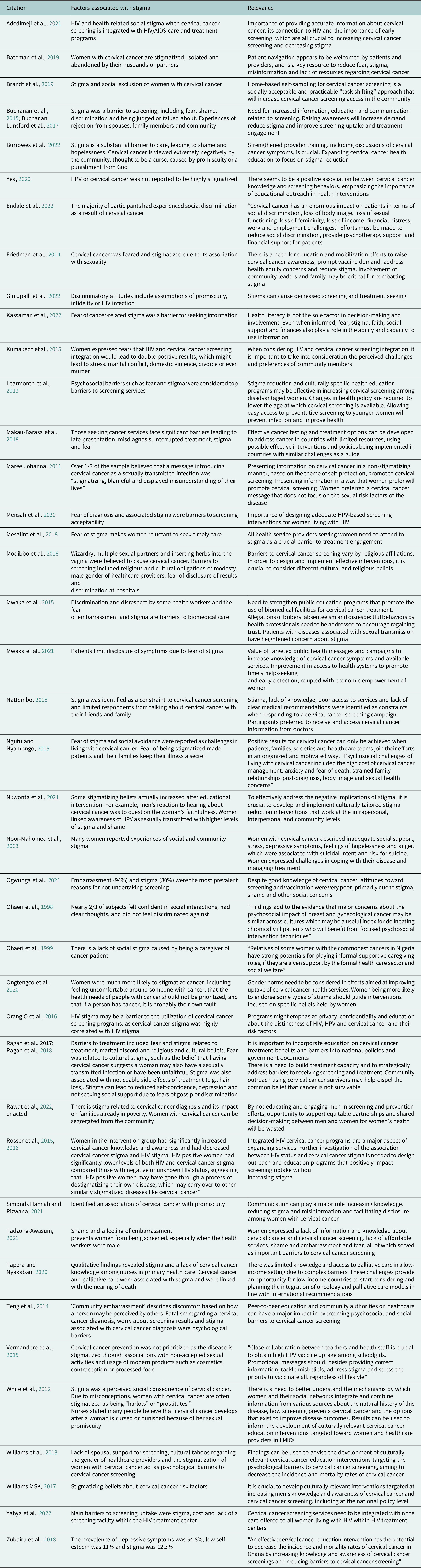
Stigma related to HPV and cervical cancer was frequently reported and contributed to emotional distress, delayed care and social isolation (Noor-Mahomed et al., Reference Noor-Mahomed, Schlebusch and Bosch2003; Mwaka et al., Reference Mwaka, Walter, Scott, Harries, Wabinga and Moodley2021; Endale et al., Reference Endale, Demelew and Habte2022; Ginjupalli et al., Reference Ginjupalli, Mundaden, Choi, Herfel, Oketch, Watt, Makhulo, Bukusi and Huchko2022). Internalized, anticipated and discriminatory stigma were often linked to misconceptions about HPV, associations with sexual behavior and HIV (Orang’O et al., Reference Orang’O, Wachira, Asirwa, Busakhala, Naanyu, Kisuya, Otieno, Keter, Mwangi and Inui2016; Mensah et al., Reference Mensah, Assoumou, Duchesne, Pourette, Debeaudrap and Dumont2020; Adedimeji et al., Reference Adedimeji, Ajeh, Pierz, Nkeng, Ndenkeh, Fuhngwa, Nsame, Nji, Dzudie, Anastos and Castle2021; Burrowes et al., Reference Burrowes, Holcombe, Leshargie, Hernandez, Ho, Galivan, Youb and Mahmoud2022; Ginjupalli et al., Reference Ginjupalli, Mundaden, Choi, Herfel, Oketch, Watt, Makhulo, Bukusi and Huchko2022). Fear of stigmatization influenced decisions to seek care, disclose diagnoses and participate in screening programs (Williams et al., Reference Williams, Kuffour, Ekuadzi, Yeboah, ElDuah and Tuffour2013; Learmonth et al., Reference Learmonth, De Abreu and Horsfall2013; Modibbo et al., Reference Modibbo, Dareng, Bamisaye, Jedy-Agba, Adewole, Oyeneyin, Olaniyan and Adebamowo2016; Orang’O et al., Reference Orang’O, Wachira, Asirwa, Busakhala, Naanyu, Kisuya, Otieno, Keter, Mwangi and Inui2016; Buchanan Lunsford et al., Reference Buchanan Lunsford, Ragan, Lee Smith, Saraiya and Aketch2017; Nattembo, Reference Nattembo2018; Ogwunga et al., Reference Ogwunga, Anyadoh-Nwadike, Ahumibe and Nwakwasi2021; Tadzong-Awasum, 2021; Yahya et al., Reference Yahya, Mustapha, Kolawole, Oguntayo and Lawal2022). Enacted stigma was observed at family, community and health system levels, with women experiencing social exclusion, discrimination and negative perceptions from healthcare providers (Mwaka et al., Reference Mwaka, Okello and Orach2015; Williams Michelle et al., Reference Williams Michelle, Isaac, iA and Kevin2018; Bateman et al., Reference Bateman, Blakemore, Koneru, Mtesigwa, McCree, Lisovicz, Aris, Yuma, Mwaiselage and Jolly2019; Brandt et al., Reference Brandt, Wubneh, Handebo, Debalkie, Ayanaw, Alemu, Jede, Von Knebel Doeberitz and Bussmann2019; Burrowes et al., Reference Burrowes, Holcombe, Leshargie, Hernandez, Ho, Galivan, Youb and Mahmoud2022). Notably, stigma was not universal; some studies reported rare experiences of discrimination (Ohaeri et al., Reference Ohaeri, Campbell, Ilesanmi and Ohaeri1999; Yea, Reference Yea2020). These findings underscore the complex interplay among knowledge, social norms and stigma in shaping cervical cancer-related health behaviors. See Table 2 for a summary of studies and their public health relevance.
Study findings related to stigma and public health relevance

Table 2. Long description
The table consists of three columns: Citation, Factors associated with stigma, and Relevance.
Key findings include:
* Adedimeji et al. 2021: H I V and health-related social stigma in integrated care. Relevance: Importance of accurate information to increase screening.
* Bateman et al. 2019: Stigmatization and abandonment by partners. Relevance: Patient navigation as a resource to reduce fear.
* Brandt et al. 2019: Social exclusion. Relevance: Home-based self-sampling as a practicable approach.
* Buchanan et al. 2015 and 2017: Barriers including fear, shame, and judgment. Relevance: Need for increased communication and education.
* Burrowes et al. 2022: View of cancer as a curse or punishment. Relevance: Strengthened provider training and health education.
* Endale et al. 2022: Social discrimination and loss of femininity. Relevance: Need for psychotherapy and financial support.
* Friedman et al. 2014: Association with sexuality. Relevance: Involvement of community leaders to combat stigma.
* Ginjupalli et al. 2022: Assumptions of promiscuity or infidelity. Relevance: Stigma causes decreased treatment seeking.
* Kumakech et al. 2015: Fears of marital conflict or domestic violence from H I V and cervical cancer screening integration.
* Maree Johanna 2011: Messages focusing on S T I risk are perceived as blameful. Relevance: Non-stigmatizing messages promote screening.
* Modibbo et al. 2016: Beliefs in wizardry and cultural obligations of modesty as barriers.
* Mwaka et al. 2015 and 2021: Discrimination by health workers and limited disclosure of symptoms.
* Nkwonta et al. 2021: Stigmatizing beliefs increased after some interventions when H P V was linked to unfaithfulness.
* Ragan et al. 2017 and 2018: Treatment side effects like hair loss contribute to stigma.
* Rosser et al. 2015 and 2016: H I V-positive women may have lower cervical cancer stigma due to prior destigmatization processes.
* White et al. 2012: Misconceptions of patients as harlots or prostitutes.
* Zubairu et al. 2018: High prevalence of depressive symptoms 54.8 percent and stigma 12.3 percent.
Discussion
This review identified 43 studies examining stigma related to HPV and cervical cancer in Africa, spanning four decades. However, studies were concentrated in only a dozen sub-Saharan African countries, with none from North Africa, highlighting major geographical gaps in the understanding of cancer stigma. Notably, only two studies described interventions focused on cancer stigma reduction, representing a major gap in the literature and an important area for future programs and research.
The theoretical framing of stigma in these studies largely mirrored frameworks from other fields, including mental health and HIV, which conceptualize internalized, enacted and anticipated stigma operating at the individual, family and community levels (Earnshaw et al., Reference Earnshaw, Smith, Chaudoir, Amico and Copenhaver2013; Knettel et al. Reference Knettel, Minja, Msoka, Tarimo, Katiti, Pan, Mwobobia, Juhlin, Knippler, Watt, Suneja, Kimani, Abouelella, Mmbaga and Culturally-informed2024). Within this framework, four main themes emerged. First, knowledge and perceptions of HPV and cervical cancer strongly influenced stigma: lack of accurate knowledge drove avoidance of screening and vaccination, and delayed care-seeking. Second, stigma interacted with practical barriers to screening, vaccination and treatment, including financial, logistical and structural challenges. Third, studies highlighted the acceptability of education and interventions aimed at reducing stigma and promoting vaccination, screening and treatment. Fourth, stigma and discrimination contributed to psychosocial distress, including anxiety, depression and psychological trauma and often influenced behavioral outcomes, such as delayed care-seeking or disclosure of diagnosis. In extreme cases, cancer-related stigma triggered interpersonal conflict, including marital tension, such as physical harm or homicide, leading women to conceal diagnoses and avoid care (Kumakech et al., Reference Kumakech, Andersson, Wabinga and Berggren2015).
The findings have important implications at the individual, societal and community levels. While the burden of cervical cancer in Africa is often attributed to limited access to high-quality screening and treatment, this may oversimplify the interplay of medical and socio-cultural factors, including stigma. Fear of judgment, social isolation, abandonment and mistreatment strongly affect decisions to screen, seek care or disclose symptoms (Kumakech et al., Reference Kumakech, Andersson, Wabinga and Berggren2015). From partners’ perspectives, misinformation and cultural attitudes about HPV and cervical cancer also drive stigma, with concerns about infidelity or judgment leading to potential mistreatment or abandonment (Williams et al., Reference Williams, Kuffour, Ekuadzi, Yeboah, ElDuah and Tuffour2013; Williams, Reference Williams MSK2017; Ragan et al., Reference Ragan, Buchanan Lunsford, Lee Smith, Saraiya and Aketch2018). These dynamics contribute to delayed care, increased risk of HPV or cervical cancer and poorer outcomes (Burrowes et al., Reference Burrowes, Holcombe, Leshargie, Hernandez, Ho, Galivan, Youb and Mahmoud2022).
Future programs should aim to improve cancer-related knowledge and reduce stigmatizing misinformation. HPV vaccination is an effective preventive measure, yet vaccine hesitancy remains a global health challenge (Bussink-Voorend et al., Reference Bussink-Voorend, Hautvast, Vandeberg, Visser and Hulscher2022). Community-level educational interventions should address misinformation and societal stigma, reduce parental and patient hesitation and engage influential stakeholders such as community leaders, policymakers, educators and religious leaders to foster trust in vaccination, treatment and the healthcare system (Kutz et al., Reference Kutz, Rausche, Gheit, Puradiredja and Fusco2023).
Targeted interventions with healthcare workers and people living with HPV or cervical cancer are also critical. Health care facilities and providers play a central role in creating compassionate, informed and non-stigmatizing environments, whereas stigma from healthcare workers cancer undermines patient trust and motivation (Mwaka et al., Reference Mwaka, Okello and Orach2015; Modibbo et al., Reference Modibbo, Dareng, Bamisaye, Jedy-Agba, Adewole, Oyeneyin, Olaniyan and Adebamowo2016; Mesafint et al., Reference Mesafint, Berhane and Desalegn2018; Mwaka et al., Reference Mwaka, Walter, Scott, Harries, Wabinga and Moodley2021). Integrated models of care that combine biomedical treatment with patient education, care navigation, peer support, mental health counseling and attention to social determinants have been successful in improving outcomes (Rosser et al., Reference Rosser, Njoroge and Huchko2015, Reference Rosser, Njoroge and Huchko2016; Bateman et al., Reference Bateman, Blakemore, Koneru, Mtesigwa, McCree, Lisovicz, Aris, Yuma, Mwaiselage and Jolly2019). Although resource-intensive, stepwise or resource-efficient adaptations could meaningfully improve cancer outcomes in low-resource settings (Friedman et al., Reference Friedman, Oruko, Habel, Ford, Kinsey, Odhiambo, Phillips-Howard, Wang, Collins, Laserson and Dunne2014; Rosser et al., Reference Rosser, Njoroge and Huchko2015, Reference Rosser, Njoroge and Huchko2016; Nkwonta et al., Reference Nkwonta, Hilfinger Messias, Felder and Luchok2021).
This review is not without limitations. First, heterogeneity in study methods and measures precluded meta-analysis or direct comparisons. Second, many studies only briefly mentioned stigma without detailed exploration. Finally, only English-language studies were included, adding a possibility of a language bias.
Conclusions
This review highlights that stigma related to HPV and cervical cancer is a significant barrier to screening, early diagnosis and treatment in sub-Saharan Africa. Evidence from the included studies indicates that stigma, manifesting at the individual, family, community and healthcare system levels, is associated with delays in care-seeking, lower vaccination and screening uptake and poorer treatment adherence, which collectively contribute to the burden of cervical cancer in the region. Despite its impact, interventions specifically designed to reduce cancer-related stigma remain extremely limited. Future research should focus on developing culturally appropriate and feasible interventions that address stigma as a key determinant of cervical cancer outcomes in Africa.
Open peer review
To view the open peer review materials for this article, please visit http://doi.org/10.1017/gmh.2026.10182.
Supplementary material
The supplementary material for this article can be found at http://doi.org/10.1017/gmh.2026.10182.
Data availability statement
Data availability is not applicable to this article as no new data were created or analyzed in this study.
Author contribution
All authors listed on the title page have met the four principal criteria outlined in the Cambridge University Publishing Ethics Guidelines.
Financial support
This project was conducted with pilot funding from the Duke Global Health Institute.
Brandon Knettel is supported by a Career Development Award from the NIH National Institute of Mental Health (K08 MH124459). Nosayaba Osazuwa-Peters is supported by a Career
Development Award from the NIH National Institute of Dental & Craniofacial Research (K01 DE030916; R01 DE032216; R21 DE32531) outside of the submitted work. We also acknowledge support received from the Duke Center for AIDS Research, an NIH-funded program (P30 AI064518).
Competing interests
Dr. Brandon Knettel is a scientific advisor for the Cancer Support Community and Dr. Osazuwa-Peters received consulting fees from Navigating Cancer and from Merck.


 Open access


Comments
Greetings,
RE: Submission of a Review Article
Please consider our scoping review article, “Examining stigma associated with human papillomavirus (HPV) and cervical cancer screening and treatment in Africa: A scoping review” by Dina K Abouelella, Brandon A Knettel, Judith Mwobobia, Suhana Posani, Leila Ledbetter, Margaret Graton, and Nosayaba Osazuwa-Peters, for publication in Cambridge Prisms: Global Mental Health Journal.
Cervical cancer is the fourth most common leading cause of cancer death among women worldwide, and the most common cancer in women in sub-Saharan Africa. It is also the most common cause of cancer deaths among women in this region. Nearly all cases of cervical cancer are caused by human papillomaviruses (HPV), and although both HPV vaccine and screening for cervical cancer have been available for decades, the fatality rate due to cervical cancer remains very high in sub-Saharan Africa. Some of the well-studied factors that underlie this high burden include inadequate healthcare system capacity for cancer screening, lack of public awareness, and negative attitudes and beliefs. An important and culturally relevant, but highly understudied barrier is cancer stigma.
In this scoping review, we conducted an extensive search of the cancer literature in Africa, yielding a total of 43 studies, which explored HPV and cervical cancer stigma in Africa. We found evidence of internalized, enacted, and anticipated stigma. Additionally, these forms of stigma created multilevel barriers at the individual, family, and community levels. We found that cancer-related stigma directly hindered HPV and cervical cancer screening efforts; however, there was a paucity of studies focused on stigma interventions, which makes this review an important addition to the cancer prevention and survivorship literature in Africa.
Given the global scope of your journal and the topic, we believe our work could be of general interest to the broad readership of Cambridge Prisms: Global Mental Health. As previously stated, we are of the opinion that this scoping review contributes to the cancer epidemiology literature by providing a novel, comprehensive description of the stigma landscape for a type of cancer that is of the highest burden of disease and mortality in the African region.
We hereby declare the following:
1. We have declared our conflicts of interest, as well as the funding source for this study.
2. This is an original work not being considered for publication elsewhere, either in whole, or part.
3. The views and opinions stated in this work are solely the authors and do not represent the view of employers, or any organization or corporation or funders.
4. We confirm that all authors had full access to all aspects of the research, participated in writing and approving this manuscript for publication, and take final responsibility for the paper.
Thank you very much for considering our manuscript.
Sincerely,
Nosayaba Osazuwa-Peters, BDS, PhD, MPH, CHES
Associate Professor
Duke University School of Medicine
Department of Head and Neck Surgery & Communication Sciences
Member, Duke Cancer Institute
Department of Population Health Sciences (Secondary appointment)
Duke Global Health Institute (Secondary appointment)
40 Duke Medicine Circle, Duke South Yellow Zone 4080
DUMC 3805, Durham, NC 27710-4000