The decadent movement is known as much for its cosmopolitanism as its Orientalism. Criticism on the movement, as a result, has struggled with how to categorize its relationship to racialized difference, linking Oscar Wilde and his circle to both ethical engagement with alterity and troubling forms of exoticization. Elleke Boehmer, for example, in her discussion of the cross-pollination between Indian and British poetry at the fin de siècle, stresses the decadents’ admiration for and apprenticeship of the poetic production of Sarojini Naidu and Manmohan Ghose, but she also notes the manner according to which India could signify in the fin de siècle imagination as “both the effete beauty of decadence, and its wild freakishness.”Footnote 1 As Boehmer's work indicates, the decadent movement's love of the stranger was often bound up with its fetishization of anything deemed strange. At the same time, while decadence's appetitive ethos certainly tended to foster the objectification and appropriation of difference, many members of the movement worked to detach themselves from more bombastic forms of jingoism, nationalism, and ignorance, and, in their perpetual quest for new sensations, they often approached cultural difference with curiosity rather than disdain.Footnote 2 Foregrounding this element of decadent openness to the other and apartness from the British colonial project, Leela Gandhi has linked Wilde's “xenophilia” with his “relentless wider critique of imperial narcissism.”Footnote 3 Wilde carefully distanced himself from imperial power by stressing that he was not English but Irish, which was, according to him, “quite another thing,” and forged friendships and desires that crossed national and racial boundaries.Footnote 4 However, decadent xenophilia, as we all know, could just as often move in the direction of annexation and objectification of cultural objects and human beings outside of Europe, and decadent skepticism and detachment did not always allow fin de siècle dandies to disentangle themselves entirely from white supremacy. Wilde, for example, could speak in mindless, outrageous, and deeply offensive ways about distant places and people. Contrary to his assertions, there is such a place as Japan.Footnote 5 Michèle Mendelssohn's recent account of Wilde's time in America, which stresses the extent to which he was coded as racially other during his 1882 lecture tour, also points to moments in his correspondence when he references slavery and minstrelsy with a levity that can be shocking.Footnote 6 Citing Wilde's assertion in a letter from Algiers that “the beggars here have profiles, so the problem of poverty is easily solved,” Ian Fletcher concludes: “the soul of Wilde under imperialism remains a terrible paradox of privileged transgression.”Footnote 7 With all this in mind, the treatment of decadence can at times feel as if it's reached an impasse, faltering at the question of whether the movement is or is not racist, imperialist, radical, conservative, cosmopolitan, Orientalist, etc.
One recent alternative has been to think less about what decadence is as opposed to what it can be used for, and this can help us move from reexamining and recasting the ethics of the more well-known texts associated with British decadence to paying closer attention to the retooling of decadent aesthetics by writers outside of Europe. Regenia Gagnier, for example, has shown us how decadent strategies were implemented to critique the relation of part to whole, especially the individual's relation to the state or subordinate states’ relation to the dominant, during changes and crises in China, Japan, Latin America, and Russia. And Robert Stilling has drawn our attention to postcolonial poets and artists who made “use of the fin-de-siècle decadents’ most critical and oppositional tools—their wit, satire, paradoxical formulations, attention to form, resistance to realism, sexual dissidence, and revisionist approach to history—to critique what they saw as the failures of postcolonial society.”Footnote 8 While Stilling's work provides insight into the many ways in which decadence was remade to postcolonial ends in the second half of the twentieth century and into the twenty-first, here I would like to look more closely at the reworking of decadence by writers of color and colonial subjects working in closer historical proximity to the fin de siècle. And, whereas Gagnier focuses on the repurposing of decadence by thinkers who understood the “decompositions or deformations of the relationship between part and whole” as a central preoccupation of decadence, I am interested in particular in writers for whom decadence's tendency to Orientalism is more central.Footnote 9 What might have attracted an early twentieth-century Black or Sinhalese writer to an aesthetic practice so associated with exoticization and the fetishization of cultural difference? To what uses did writers from Harlem or Sri Lanka put decadent style while engaging in anticolonial critique, antiracist resistance, or the negotiation of racial trauma?
As I approach these questions, I consider how the implementation of decadent aesthetics by early twentieth-century writers of color might be understood as an on-the-ground form of decadent criticism. Writing directly in the wake of the 1890s, the writers on whom I focus exhibit a decadent capacity to dwell in ambivalence and contradiction while teasing out the troubles and potentialities of thinking race and empire through the lens of decadence. At once detached from and embedded within decadence, they ironically and playfully translate the aesthetic into new national and historical contexts. My mode of inquiry here is informed by Leela Gandhi's approach to the relationship between Manmohan Ghose and British writers such as Laurence Binyon and Oscar Wilde. Gandhi asks, “What was it in a colonial subject like Manmohan Ghose that rendered him . . . so very susceptible to the culture of aestheticism, especially in its Wildean exemplification? What were the costs, the gains, if any, of such susceptibilities for a young Indian foreigner in the heart of Empire? And what might aestheticism have looked like to a subject such as Ghose?”Footnote 10 However, while Gandhi is most interested in drawing larger conclusions about the postcolonial dismissal of the concept of autonomous art, I am interested in what the reinterpretation and repurposing of decadent practices by writers of color might teach us about decadence itself and how their work might model more thoughtful models of political and literary analysis. If early twentieth-century writers of color working in the immediate shadow of 1890s decadence can see the utility of the movement and its practice (along with its Orientalism) so clearly, if they can have a nuanced and open-ended relationship with its politics, why, over a hundred years later, can't we? Attending to the manner in which their reiterations of decadence are able to make the aesthetic mean differently, I argue, might allow us to move the conversation about the politics of decadence in a slightly different direction. I take these playful retoolings and repurposings of decadent aesthetics as a model for how we, as contemporary scholars of the period, might attain a richer understanding of decadence.
The remaking of decadence by the figures under discussion here, Harlem Renaissance writer and artist Richard Bruce Nugent and Sinhalese writer Lionel de Fonseka, forces us to ask a larger question about whether we understand decadence to be an ideology or a practice. In answering this question, the problem and, as their works indicate, the possibility stem from the fact that it is both. The key, foundational texts of decadence—works like Walter Pater's conclusion to The Renaissance and Arthur Symons's “The Decadent Movement in Literature”—stress modes of being as much as they highlight stylistic practices. In the five-paragraph essay that came to function as the movement's manifesto, Pater exhorts his readers to forever court new impressions while modeling a kind of writing that is serpentine, intricate, and rococo. Symons foregrounds the reversal of classical ideals of proportion in decadent style while at the same time stressing the restless curiosity and diseased refinement of the decadent sensibility. It is no wonder then that current criticism struggles in categorizing decadence as either an ethos or a form. When we conceptualize decadence as an ethos, it is easy to see how its insatiable desire, subjectivism, and perpetual curiosity might slip into Orientalism and the voracious consumption of difference. When it is understood as a set of practices, it becomes a little simpler to envision disentangling those practices from the ideologies of empire. The writers under discussion here acknowledge and dwell within this split understanding of decadence; they camp, critique, and at times succumb to the exoticizing, Orientalist tendencies of decadence while practicing decadent methods and styles that seem to hold within them the capacity to combat, or at least hold at bay, the violence and trauma of racism and colonialism. These reiterations of decadence seem to argue that there is something at once essentially Orientalist and deeply mutable about the way this aesthetic approaches difference. It is simultaneously a form that offers liberatory imaginative possibilities and a way of thinking about exoticism of which one should remain permanently suspicious. And it is a camp mode of conceptualizing subjectivity that allows writers of color to deploy play and ironic detachment to deride, contest, and combat rigid categories of power and identity as well as Orientalist condescension.
1. Decadent Poetics and Decadent Color in Richard Bruce Nugent's “Geisha Man”
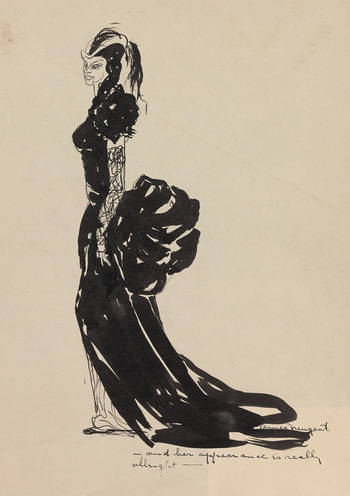
The Harlem Renaissance writer and artist Richard Bruce Nugent is most well known, particularly to scholars of decadence, for his decadent modernist short story “Smoke, Lilies, and Jade,” first published in Fire!! in 1926. In the story, a blasé, bisexual dandy, Alex, smokes a cigarette from an “ivory holder inlaid with red jade and green” and contemplates Oscar Wilde, desire, and his own disinclination to work.Footnote 11 The story positions decadence as the antidote to the coercive pressures that dictate life trajectories and delimit the reimagination of affiliation. It centers on a dream in which Alex, pressed to choose between his desire for a beautiful young man, Adrian (or “Beauty”), and his girlfriend Melva, settles instead upon the ivory cigarette holder, an object that has come to stand, within the story, for reverie, openness, and the aesthetic posture. In the story's final paragraph, Alex comes into an epiphanic understanding of the fact that “one can love two at the same time[,] . . . one can.”Footnote 12 Electing to dwell in a kinetic, agile, Paterian space of perpetually mobile desire, a posture Nugent elsewhere referred to as “duo-sexuality,” Alex refuses to succumb, not only to pressures to settle, mature, and enter the workforce, but also to the ideological pressures that led him to conceive of his attraction to both Beauty and Melva as a predicament that must conclude with a choice.Footnote 13 “Smoke, Lilies, and Jade” demonstrates the utility of the decadent posture to queer subjects, to dissident subjects, subjects who wish to extricate themselves from the heteronormative narratives that entrap and delimit desire. This story is the work of Nugent's that has received the most critical attention, notably from scholars interested in decadent modernism, such as Michèle Mendelssohn and Elisa Glick.Footnote 14 The material in the Richard Bruce Nugent archives at the Beinecke Library and the Amistad Research Center, however, reveals a much deeper and more extensive preoccupation with the decadent aesthetic on Nugent's part. His Salomes and geishas, his Beardsleyesque ladies (see fig. 1) and sexually dissident clergy, and his persistent queering of biblical stories reveal him turning continuously to British decadence, Wildean models, and decadent Orientalism as he generates a queer Black modernist aesthetic that is dizzying in its treatment of polymorphous desire and fragmented, mixed-race identities.Footnote 15 Here I would like to consider Nugent's implementation of decadent verse within his longer, unpublished prose work “Geisha Man” in order to raise larger questions about what British decadence, and decadent poetics in particular, might have offered queer writers of color in the United States in the early twentieth century.Footnote 16
Richard Bruce Nugent, illustration for “Milady” (1932), Beinecke Rare Book & Manuscript Library.

“Geisha Man” centers on incestuous desire and the suturing of fragmented, mixed-race families. It tells the story of Kondo Gale, the son of a married Japanese woman, Yetsin Matzuika, and a white American, Gale Barrows, with whom she had an affair. (Though Kondo does state in the opening pages of the text, “I was the son of Yetsin Matzuika,” as Tyler Schmidt argues, Kondo's gender identity is “not assuredly fixed, but fluid and destabilized.” I have therefore chosen to use they/them pronouns to refer to Kondo throughout the essay.)Footnote 17 While dressed as a geisha, Kondo inadvertently sleeps with their father, finds that they are “in love with [their] mother's lover,” and spends the rest of the novel moving through Paris and then New York to find their way back to their father.Footnote 18 As the novel concludes, they encounter Gale Barrows once more while cross-dressed at a costume ball, and Barrows confesses that he too cannot forget their night together and invites Kondo into his home. As Schmidt has suggested, the text—focusing on a child who is “the outcome of a secret transcultural affair, . . . defined by paternal absence, and forced to reconstitute notions of family and community”—seems ripe for reading through the lens of Hortense Spillers's theories concerning the incest plot and its relation to slavery's rupture of familial structures.Footnote 19 What I would like to investigate is the manner in which the decadent idiom and decadent poetics function within this narrative, which centers on the profusion of color as an antidote to the American privileging of whiteness, the capacity of decadent poetics to remake pain into beauty, and decadence's camp notions of identity.
The manuscript, written in pencil in a stenography notebook, envisions for itself an intoxicating material future in which each page is a different color printed in ink of a different hue: violet ink on canary paper, blue ink on heavy cream, crimson ink on white, white ink on black moiré paper, lemon yellow paper with sky-blue ink, yellow rose paper with silver ink, mauve ink on pearl. And the text itself is a riot of eroticized color. Kondo announces that they see “life thru the parted iridescence of peacock feathers” (“Geisha Man,” BNP, 44). They bring into their home “a lad of very dark olive skin and dark brown hair. . . . [U]nder a red light he seemed silver.” Many of Nugent's works are similarly saturated in a decadent profusion of wild, shifting, luxurious color. The queer dream sequence in “Smoke, Lilies, and Jade,” for example, finds its hero moving through “a field of blue smoke and black poppies and red calla lilies” as he finds his way first to Beauty's “strong white legs” and then Melva's “small feet olive-ivory.”Footnote 20 Another unpublished manuscript at the Beinecke, “Half-High,” similarly concerned with divided mixed-race families finding their way back to one another, provides a key to the political valence of Nugent's deep investment in rich color. “America,” Nugent notes in an introductory epistle to the story, “is White—and white is the absence of all color.”Footnote 21 While many of Nugent's visual works mimic Beardsley's black-and-white aesthetic, his literary works insist on the presence and significance of an infinite range of shifting colors brought into startling contact with one another.Footnote 22 The decadent cataloging of shades, tints, and dyes—echoing Dorian Gray's eleventh chapter, awash in a profusion of brilliantly hued gems and textiles, as well as the vivid enumeration of rich hues in Salome—allows Nugent to repopulate America with kaleidoscopic pigmentation and to insist, in a decadent vein, on the superiority of ever-shifting color to whiteness. As Caroline Goeser has noted, Nugent's works often “satirized presumptions about mixed race identity in order to dismantle the fixity of racial identity,” and, as J. Edgar Bauer argues, he conceived of race as an “inexhaustible continuum.”Footnote 23 In stark contrast with the blacks and whites of his drawings of the 1920s, his literary works of this period, which often focus on mixed-race subjects, are drawn to intricate shading, peacock feathers, tints that shift in the light, insisting on color as infinite and overwhelming, almost incomprehensible in its complexity.Footnote 24
Situated within this wildly colorful manuscript are poetic interludes that further theorize the political utility of decadence for queer subjects and subjects of color in America. The narrative is interspersed with lines of decadent dimeter that force a reflection on the power of poetic form for remaking, ordering, and distancing, on the godlike power of verse to give form to fragmentation. Poets such as Lionel Johnson, Ernest Dowson, and Arthur Symons made dissolution and decay exquisite, pursued “new expressiveness” in the “deliberately abnormal,” and sculpted fleeting moments of pleasure, the “chance romances of the streets,” into fixed forms that allowed them to win “an instant from oblivion.”Footnote 25 And, as Nick Freeman has demonstrated, contradicting the conventional association of decadent style with prolixity and linguistic excess, they often did so in a highly compressed, attenuated style that anticipates imagism.Footnote 26 The verse interludes in “Geisha Man” perform a pastiche of this style in an effort to theorize the larger project of the novel, its efforts to fix, remake, and reorder, to aestheticize Kondo's trauma, confusion, and loss. These poetic interludes often appear at particularly fraught moments within the narrative, moments when Kondo's complex and shifting racial or gender identity operates as a source of pain. When, for example, Kondo reflects on the men who “never stayed after they found I was—a man—many kisses on the eyelids lips and throat until they saw that I was—,” the manuscript shifts into verse: “Oh I can make love / Of a sun dyed cloud / And an ivory bead / And a peacock fan / For I am God” (“Geisha Man,” BNP, 5, 6). These highly compressed lines of dimeter draw attention to poetry's capacity to hold and form experience, to place the poet in the position of a god. The poetry here seems to operate as a reflection on decadence as the most highly aesthetic mode of artistic production, foregrounding its power to control and remold sadness and transmute pain into beauty. Nugent's inclusion of verse marked by falling meter followed by spondees highlights poetry's capacity for facilitating the halted contemplation of trauma, as in the case of the poem by Lewis Alexander that appears immediately following Kondo and Gale's first night together, when Kondo asks Gale for one final kiss and Gale slaps Kondo, when Kondo looks into their father's wallet and sees the name “Gale Barrows” and realizes this man is their father: “Avenues of dreams / Boulevards of pain / Moving black streams / Shimmering like rain” (“Geisha Man,” BNP, 13).Footnote 27 The move within a single line from falling dactylic meter to rising iambs in Alexander's poem also foregrounds the utility of poetic form in building beauty up out of fallen or tainted moments, a practice that might be understood as part of the decadent tradition.
If these poetic intrusions highlight the godlike power of the poet, the poet's capacity to fix and order and make exquisite forms, they also reflect on Kondo's godlike remaking of their gender identity, their vision of subjectivity as shifting and malleable. Decadence, with its emphasis on sexual and gender dissidence and performativity, insists that identity can be a poetic process, that one can perpetually make and remake the self. Throughout the novel, Kondo generates, performs, and moves between multiple racial and gender identities. Feeling unloved at home due to the white skin that their mother's husband abhors, they run away at fourteen to be an actor and perform as a maiden. These early experiments in cross-dressing open into their time as a geisha in Japan. When Kondo travels to New York, they come into contact with the Harlem Renaissance and begin to pass as Black; as Kondo puts it, “I became a ‘New Negro’” (“Geisha Man,” BNP, 66). The night that Kondo reconnects with Gale, they dress for the costume ball, remaking themselves into a potential lover for their absent father: “I pulled on transparent silver hose. Slid into silver slippers with very high heels. . . . Then I stepped into the skirt and snapped it around my waist. It fell in heavy folds of blossoms to my ankles and trailed in a silver moon a yard behind me.”Footnote 28 In the face of perpetual pain and humiliation, rejected by their mother's husband who detects their racial impurity, abandoned by lovers disgusted by their gender identity, slapped in the face and deserted once again by their father, Kondo insists nevertheless that they are a god because they can make verse and remake themselves. As the novel indicates, the decadent aesthetic, with its camp vision of being-as-playing-a-role, privileges the nonbinary or mixed-race subject who is able to move most easily across race and gender distinctions.
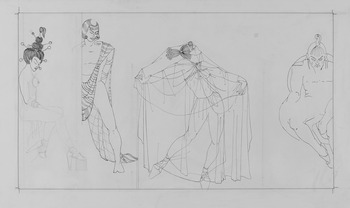
At the same time, while all this sounds marvelous, it seems worth asking how a text like “Geisha Man” might be reflecting on or enacting the Orientalism of the decadence upon which it draws. To what extent is Nugent replicating the exoticized vision of East Asia so central to the decadent tradition? The manner in which Nugent imagines “the Geisha district” and its “Geisha girls with the bows of their kimonos spread before them like butterflies,” the pleasure the text takes in the manner in which an Englishman fetishizes “the slant of [Kondo's] grey eyes,” the attention lavished on interiors in which “cushions with familiar Japanese designs created in soft and curiously dyed furs were scattered about in profusion” all echo Dorian Gray's accumulation of “Japanese Foukousas, with their green-toned golds and their marvellously plumaged birds,” and construct a visual universe that resembles Beardsley's Japonisme.Footnote 29 In this sense, “Geisha Man” calls to mind a later drawing, Salome before Herod (see fig. 2), that similarly implements Orientalism to near-pornographic ends, equating East Asia with excessive eroticism, remaking “the East” into an exotic and arousing texture. This raises once again the question of whether decadence should be understood as an ideology or a practice. If Nugent located in decadent style a rich set of strategies for fixing and staving off violence and dissolving and undoing categories of identity, did something fundamental to the aesthetic nevertheless draw him back into the very modes of thinking about and representing difference he seems, in another register, to be working so hard to combat?
Richard Bruce Nugent, Salome before Herod (n.d.), Amistad Research Center.

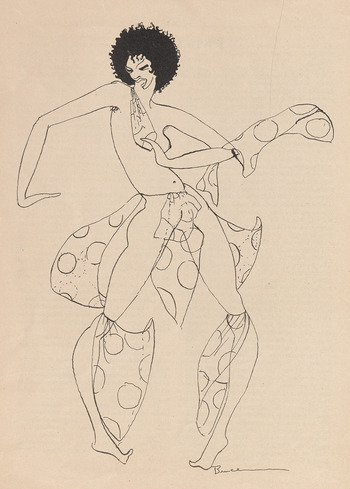
The answer to this might be tied to Nugent's understanding of the concept of the “exotic.” In a recording housed at the Beinecke, Nugent notes that “the Black man in America is an exotic,” adding that it is “tiresome” to be an exotic, and “that's a polite phrase.”Footnote 30 Nugent's use of this terminology to describe the experience of Blackness in the United States might inflect our understanding of the mutability of race in a text like “Geisha Man,” in which the half-Japanese Kondo might come to Harlem and suddenly be read as Black. Moving through the United States, Kondo becomes subject to American forces of understanding difference that collapse Black and Japanese individuals into the category of the “exotic,” making clear the structural similarities that underwrite Orientalism and the apprehension of Blackness in America. As Fiona I. B. Ngô argues, the shifting apprehensions of Kondo's identity speak to “modes of racialization that do not discriminate between bodies of color.”Footnote 31 In “Half High,” the mixed-race protagonist, who identifies as “Nordic” and “Negro” and “of the chameleon race,” similarly travels to Taos and writes a book of “Indian poems,” insisting that he can “become a part of emotions . . . Indian.”Footnote 32 This could be read as a cynical move on the protagonist's part, a co-opting of Indigenous identity in order to respond to an early twentieth-century market for “Indian poems” and pander to a modernist fetish for Native culture. However, the ease with which he is able to “become a part of emotions . . . Indian” might signify something different for Nugent, something about shared experiences of denigration and exoticization as opposed to appropriation. Here I'd like to return to another Salome by Nugent, his Salome: Negrotesque I (fig. 3), first published in Harlem: A Forum of Negro Life in 1928. Like Kondo and the protagonist of “Half-High,” Salome seems to be in Nugent's imagination a “chameleon” who can move between Judaea and Japan and also be Black, and these transitions speak to a potential sense of alliance with or likeness to Salome that makes the Orientalist gaze evident in the later Salome before Herod image slightly more complicated, for it is a gaze that turns upon Blackness as well, that turns back on Nugent as a fellow exotic.Footnote 33 The slippage between Salomes in his work makes the Orientalism in his writing and his illustrations signify differently, placing him within that gaze at the same time that he levels it outward at the dancing girl. Playing with and reproducing Orientalism is never for Nugent a straightforward process, and it engenders new ways of conceptualizing how identity distinctions are understood and misunderstood in the country to which he has transplanted and for which he has translated decadent Orientalism. He orientalizes Salome, but he also identifies with her, knowing full well how tiresome it is to be that exotic dancing girl.Footnote 34
Richard Bruce Nugent, Salome: Negrotesque I (1928), in Harlem: A Forum of Negro Life.

“Geisha Man” along with Nugent's Salome drawings can operate, then, as keys to the potential attractions decadent poetics might have held for queer writers of color in the early twentieth-century United States. Decadence's camp ethos, compressed poetics, and kaleidoscopic color offered a way out of ossified visions of racial distinction and a tool for transmuting trauma into aestheticized splendor: to make “Boulevards of pain” into “Moving black streams / Shimmering like rain.” And entering into a knowing relationship with and practice of decadent Orientalism could illuminate the “tiresome” exoticizing gaze that eroticized and alienated Black subjects during the modernist period.
2. Finding Orientalism Foolish: Lionel de Fonseka and Anticolonial Decadent Practice
The Sinhalese writer Lionel de Fonseka is more vexed than Nugent in his relationship to decadence but similarly playful, speaking in a decadent tongue in order to articulate an incisive critique of aestheticism. His 1912 volume, On the Truth of Decorative Art: A Dialogue between an Oriental and an Occidental, exhibits a deep preoccupation with Victorian decadence. Its pages are littered with references to Walter Pater and Oscar Wilde, with citations of and rebuttals to their works. De Fonseka's defense of “Oriental” decorative art is, however, grounded in a denigration of the decadent ethos. Referencing Pater's exhortation to “discriminate every moment some passionate attitude in those about us, and in the brilliancy of their gifts some tragic dividing of forces on their way,” he calls for a recognition of the “essential inhumanity of this point of view.”Footnote 35 It is, he insists, the “gospel of egoism” (67). De Fonseka positions Pater's cultivation of endless and insatiable desire as inferior to the discipline and control he associates with “Eastern” thought. “In the East,” he notes, “we habitually repress our emotions and so we have not exhausted our emotional capacity” (76). Citing Pater's assertion that “not the fruit of experience, but experience itself is the end,” he links Western aestheticism to “emotional bankrupt[cy]” and argues that the decadent approach to existence, which demands excessive outpouring of emotion and the relentless pursuit of desire, depletes rather than nourishes the modern subject. And not only does he condemn what he calls “emotion for the sake of emotion” (76), he also denounces the dissociation of art from life celebrated by Wilde, privileging instead the Eastern vision of art as a “natural excrescence of life”: “In the East all our arts are useful and decorative, so that when we make a building, we make it beautiful. ‘All art is useless,’ says Oscar Wilde, in the preface to ‘Dorian Gray.’ We say on the contrary, ‘All art is useful’” (45, 53). “We Orientals,” he asserts, “believe that life and art are one. We say that in the beginning they were wedded, and it is our aim never to part them asunder” (29). In countering the art for art's sake ideal, de Fonseka positions the East as in fact more aesthetic than the West, for, he argues, in the former, where art and life are wedded, one is always surrounded by beauty, always in contact with pleasure. “In the East,” he states, “life remains beautiful because art is decorative” (129).
The dialogue's unpaginated prefatory note indicates that de Fonseka's rebuttal to Western aestheticism should be understood as an anticolonial argument. The dialogue is written, he states, “primarily for the people of Ceylon.” “As a Sinhalese,” he notes, he “views with regret the modern tendency in Ceylon, under Western influences, to abandon our traditions in art and life.” The work is designed to counteract the infection of Ceylon with British aesthetic principles and the decline of decorative Ceylonese art that accompanied “the rise of Western commerce” on the island. Aestheticism, in divorcing art from life, operates as the most pronounced threat to the artistic modes of Ceylon, and, in its cultivation of insatiable desire, seems to stand here as the barest and most aggressive expression and culmination of the ethos underwriting both Orientalism and empire. Defending Ceylonese art and insulating Ceylon from the exoticizing and appetitive tendencies that brought the British to the island demands a direct confrontation with British aestheticism and decadence.
While the dialogue mounts a counteroffensive to Pater and Wilde, as contemporary critics noted, the work is nevertheless composed in the decadent idiom. De Fonseka skillfully, and somewhat affectionately, inhabits the decadent style as he pulls at the threads of its “emotionally bankrupt” approach to existence. A review in The Dial, for example, asserts that, though de Fonseka “inveighs against Wilde's dictum of ‘Art for Art's Sake,’” his style “savors of Oscar Wilde.”Footnote 36 A review in the New Statesman similarly stresses the Wildean tone of the dialogue:
Mr. Fonseka will quite probably take his place as a popular writer, for he bases his style on that of Oscar Wilde, who was rapidly becoming the most popular writer in England when his career was suddenly arrested. Not only does he base it, he builds it right up on Wilde, and though to the older generation this Oriental profusion of Oscarisms is occasionally tedious, there is little doubt that the public were disgracefully diddled out of the feast of epigrams that was suddenly snatched away from them just as they had tasted how good it was, and would like some more. Mr. Fonseka seems quite ready to supply them.Footnote 37
The dialogue performs a strange integration of British decadence and anticolonial, anti-aestheticist politics, employing Wildean forms, “an Oriental profusions of Oscarisms,” to demonstrate the absurdity of British aestheticism to Ceylonese readers. De Fonseka skewers the principle of art for art's sake and the decadent cultivation of perpetual desire while calling for a preservation of Ceylonese aesthetic practices, but his work and his thinking must be understood as underwritten by and interwoven with Paterian and Wildean decadence. De Fonseka at once mimics and mocks his aestheticist precursors yet, as he works to contradict their assertions about art and desire, nevertheless circles back continuously to their words, placing them at the center of his dialogue, itself a formal technique borrowed most immediately from Wilde.Footnote 38
As much as On the Truth of Decorative Art emerges from de Fonseka's engagement with British aestheticism and decadence, it must also be understood as the product of his intimate friendship with Alain Locke, a leader within the Harlem Renaissance and the editor of The New Negro, with whom de Fonseka became close while the two were enrolled at Oxford. While later in his career (most explicitly in condemning the turn to Wilde rather than Whitman in Fire!!) Locke articulated a more critical relationship to decadence, during his time at Oxford he, like de Fonseka, fashioned himself as an aesthete.Footnote 39 De Fonseka and Locke were also both members of Oxford's Cosmopolitan Club, a group, as the inaugural issue of its eponymous periodical announced, “started by a few undergraduates of different nationalities” (including Egypt, India, China, Japan, South Africa, Norway, Russia, and Scotland), that hosted lectures and debates “calculated to promote mutual knowledge and sympathy between members of the different nationalities.”Footnote 40 Papers were read on Toru Dutt and Walt Whitman, the British occupation of Egypt, the potential pitfalls of cosmopolitanism from the perspective of colonized subjects, and “Oscar Wilde's Place in Literature.” De Fonseka's and Locke's developing aesthetic theories were informed by this community of students of color devoted to anticolonial and antiracist critique, who, as Leonard Harris has argued, “seemed brought together as much by their marginality at Oxford as by their devotion to the cosmopolitan ideal.”Footnote 41 The conversations with which Locke and de Fonseka engaged while members of the Cosmopolitan Club spurred their progress toward their linked projects, which centered the cultural rebirth of subjugated populations in aesthetic practice.
While its name might seem to indicate otherwise, the Cosmopolitan Club fostered resistant forms of nationalism on the part of its subaltern members and, in its negotiations with cosmopolitanism, welcomed discourses that highlighted the limitations of the cosmopolitan ideal and its varying degrees of availability to and usefulness for oppressed subjects. The Indian nationalist and revolutionary Har Dayal delivered a talk to the club on “Obstacles to Cosmopolitanism,” in which he insisted that, despite increased transnational contact, nations remained delimited within tribalism and bigotry. The world might seem to be shrinking, but boundaries remained intact. As Dayal put it, “Nations which had been living an isolated life for centuries are now brought near one another by steam and electricity and gaze into one another's eyes with strange surprise mingled with contempt.”Footnote 42 This is a clear-eyed vision of the nature of international exchange as articulated by a politicized colonial subject. In an epilogue to the first issue of the Oxford Cosmopolitan, Locke similarly called into question elements of the high-minded, naïve cosmopolitan ideal that promulgates the belief that one might “enlarge [one's] horizon” through superficial and dilettantish travel.Footnote 43 Locke notes that “some of us [are] perplexed on finding that we carry our horizons with us and are unable to see through any other eyes than our own.” However, he argues, “it is the pathetic fallacy of the sympathetic temperament to think otherwise.” “Few Cosmopolitans,” he insists, “have been able to escape the exchange-formula of the simple proposition: As x is to you, so is y to me. The beautiful law of this cosmopolitan equation is that each unknown is or ought to be well known on its side of the equation. The only possible solution is an enforced respect and interest for one's own tradition, and a more or less accurate appreciation of its contrast values with other traditions.” Far from encouraging the dilution or abandonment of national or racial consciousness, Locke and his peers worked to foster deep awareness of the value of preserving and cherishing national cultures and traditions. To operate from a site of true cosmopolitan curiosity, Locke argued, one must be well versed in and connected to one's own heritage. Locke's vision of rooted cosmopolitanism emerges here as something quite distinct from the hyperkinetic curiosity promoted by Pater. This is the nuanced, skeptical, and politicized vision of cosmopolitanism that informed Lionel de Fonseka's nuanced, skeptical, and politicized response to decadence, allowing him to envision a mode of engagement with decadence that does not amount to a complete capitulation to Western aesthetics.
While Locke and the Cosmopolitan Club directly informed de Fonseka's development of a vision of politically resistant aesthetics, this vision also emerged from the aesthetic milieu and atmosphere in which de Fonseka and Locke resided while de Fonseka was composing On the Truth of Decorative Art. As Locke's biographer Jeffrey C. Stewart notes, Locke “midwifed” On the Truth of Decorative Art while he was staying, following his withdrawal from Oxford, with de Fonseka in his lodgings on Cheyne Walk. There, de Fonseka lived within half a mile of the former homes of James McNeill Whistler, Dante Gabriel Rossetti, and C. R. Ashbee, an area that had come to be understood as an “aesthetic enclave” in the late nineteenth century.Footnote 44 During his time living at Cheyne Walk, de Fonseka actively engaged with the residues of fin de siècle culture in Chelsea, sitting for the women artists in his building, including a Miss Walker who “takes me round to meet celebrities or asks them to her studio. Netta Syrett, of the Yellow Book, John Tweed, the sculptor, who talks reminiscently of Henley and Watts and Oscar Wilde, & of Rodin, & George Moore, who talks reminiscently of himself.”Footnote 45 As de Fonseka's comments indicate, the area very much retained its aesthetic reputation in the early twentieth century, and this seems to be what drew him there. (When he returned to Ceylon, he even named his home Cheyne Cottage, a nostalgic name for a site so suffused with nostalgia for the 1890s.) Thus the “midwifing” of On the Truth of Decorative Art occurred in a location suffused with the aura of the fin de siècle. This collaboration between a Sinhalese dandy and a Black aesthete, rooted in an extended confrontation with British aestheticism and decadence, was as much inflected by the “aesthetic enclave” in which it was conducted as it was critical of the principal beliefs of its inhabitants.
De Fonseka's correspondence with Locke reveals him playing with aestheticist conceits while expressing a deep awareness of decadence's troubling relationship to difference. In letters to his friend, he performs a decadent persona, self-exoticizing while satirizing aestheticist Orientalism and insisting on his own connectedness to Ceylon and his suspicion of the appetitive and imperialist decadent imagination. He often takes on the pose of the bored and blasé aesthete, speaking with Wildean derision about his aimless, bohemian life in London (“I make it a boast,” he tells Locke, “that I have never said anything important in my life”),Footnote 46 quoting the poetry of Symons, detailing his visit to a restaurant frequented by gay men where patrons studiedly hold copies of Sebastian Melmoth. He relates his intimacy with the bohemian artist “Miss Hamilton,” “a sexless person” with a “turn for making epigrams,” whose rooms possess “an Egyptian effect” with “rough uneven sea-green walls,” Egyptian figurines, and a “red coconut-oil sanctuary lamp . . . suspended by a chain from a plaster cast” of the hands of the third member of their ménage à trois, a sculptor named du Cheyne with a “Burne Jones look about him.”Footnote 47 “Our symbolist drama,” de Fonseka tells Locke, “often comes perilously near the burlesque. Once Miss H said to me ‘You are a symbol.’ Does one have that said to one outside of ‘Dorian Gray’?”Footnote 48 He conveys to Locke the racy and flirtatious conversations in which the three engage: “Miss H said ‘It is delicious to have you two here. . . . you are both so beautiful.’ . . . I summed up the situation in the immortal words of Alfred Douglas, ‘Nous avons des âmes aussi belles que nos corps sont beaux.’”Footnote 49 Throughout this correspondence, de Fonseka at once employs and expresses exasperation with the decadent vernacular. The letters to Locke highlight the thrill of moving through this heady, queer space, and yet they also read like a list of in-jokes about the absurdity of Orientalism and excess. One senses that de Fonseka is tantalized by Miss H's Egyptian setting for their symbolist drama, yet there is a note of disdain in his catalog of the anarchic mess of Orientalist bibelots within her rooms, a space in which he is clearly being exoticized and objectified (“it is delicious to have you here, you are so beautiful”), an experience to which he responds with a dizzying mode of linguistic and sexual code-switching, ventriloquizing Bosie in French. And Locke, the Black aesthete and cosmopolite similarly suspicious of the manner in which otherness is consumed in bohemian Britain, is the perfect interlocutor for this discourse.
When de Fonseka discusses with Locke his impending return to Ceylon, he employs a similarly tangled mixture of self-exoticizing decadence and satire. He feels, he tells Locke, “novels, short stories, all sorts of wonderful things struggling and kicking their feet within me”:
Only wait till I get to Ceylon & get the atmosphere. Of course I am going to be another interpreter of the wonderful east—when I have acquired the lingo & know something of the bloody natives. I feel excessively Gauguin-ish already. Do send me some of your precious decadent American books of the Huneker type to Ceylon. . . . I must cultivate this Gauguin feeling—this sentiment of the sensitive alien—or I shall become a bloody native & be unable to write about them. I am afraid of losing what the Academy called “my exquisite intimacy with the Eastern mind.” To produce literary effects you must have one of two things—blood or atmosphere. If you have the blood keep out of the atmosphere.Footnote 50
In order to properly translate and transmit his own culture back to the West, de Fonseka would need to perpetuate his own cosmopolitan aestheticism, his status as a sensitive alien to his own home, with a steady supply of American decadence “of the [James] Huneker type” and the cultivation of a “Gauguin feeling” to facilitate the creation of Orientalist, primitivist representations of his birthplace. This is one knowing aesthete of color writing to another about the absurd ways in which the movement to which he is so drawn mines his culture, simultaneously expressing and ironizing Western fears of absorption within and assimilation to the exotic atmospheres fetishized by decadence.
This correspondence operates as a key to unlocking the puzzle of de Fonseka's strange decision to compose his anticolonial rebuttal to British aestheticism in a Wildean tongue. If he were to effectively counter the kinds of desire to which decadent Orientalism subjects the East and the threat art for art's sake posed to the decorative arts of his home country, he would have to demonstrate a deep knowledge of the ethos with which he was engaging. To write an earnest and univocal critique of aestheticism posed the risk of being discounted as a humorless, moralistic “Eastern” other and attracting the derisive sneer of the decadents he sought to undermine. Instead he had to switch into their code, to camp aestheticism, and lovingly laugh it to pieces. For de Fonseka, occupying the arch and derisive stance of the dandy-aesthete as he obliquely condemned the appetitive decadent ethos insulated him from charges of ignorance and embarrassing earnestness. (In fact, when Locke began dividing his time between Howard and Harlem, de Fonseka wrote urging him to disconnect from these more earnestly political activities: “You will be doing far more for the cause if you remain aloof and strictly academic at Howard instead of mingling riotously in the throng at Harlem. Détache-toi et dépêche-toi, mon cher! ”)Footnote 51 His relationship to the decadence that inspired his ire yet engendered his aesthetic was always deeply ambivalent. In 1916 he wrote to Locke, who was then working on his dissertation at Harvard, from Cheyne Cottage in Ceylon, detailing his routine in Matara, his quiet evenings spent sitting in his study: “I take down the ‘Savoy’ or something & finger it—find that I think the Savoy foolish & go to bed.”Footnote 52 This scenario, in which de Fonseka lovingly fingers the Savoy while also sneering at it, properly encapsulates his relationship to decadence in the early decades of the twentieth century. Decadent wit and derision, in de Fonseka's hands, were powerful tools for demonstrating an arch awareness of the discourses concerning alterity that endeavored to place him in an inferior position. Decadent practices endowed him with the tools to find all this foolish, to defang Orientalist discourse with a “profusion of Oscarisms” and demonstrate his cool superiority to Orientalist condescension.
3. Conclusion
Reading Nugent and de Fonseka together demonstrates the startling political possibilities writers of color perceived within an aesthetic that we tend to associate with Orientalism, exoticization, and the fetishistic consumption of racial difference. They saw clearly that the decadent ethos, with its tendency toward absorption, unchecked egoism, and hedonism, was an imperialist ethos, but they were nevertheless drawn to the political possibilities this ethos offered. They revised it and retooled it, making it meaningful within other historical and national contexts, and their surprising and acute readings of this aesthetic can operate as models for twentieth-century readers as we learn to see a transnational decadence that persisted far after the century's turn. It also permits us to read decadence itself through a similarly knowing, arch lens that acknowledges the movement's shortcomings along with its political utility.