Introduction
Owing to their low hydraulic conductivity, high swelling capacity, and great adsorption capacity, bentonite and sand-bentonite mixtures have been used widely in solid waste landfills (Ashmawy et al. Reference Ashmawy, El-Hajji, Sotelo and Muhammad2002), municipal and industrial waste disposal sites (Hoeks et al. Reference Hoeks, Glas, Hofkamp and Ryhiner1987; Du et al. Reference Du, Fan, Liu, Reddy and Jin2015), and deep geological disposal repositories of highly radioactive nuclear waste materials (Villar, Reference Villar2007; Hayakawa et al. Reference Hayakawa, Minase, Fujita and Ogawa2016). In these applications, alkaline leachates are relatively common and are discharged generally from production processes such as papermaking, dyeing, tanning, and metal processing. In addition, highly alkaline solutions can originate from the degradation of concrete occurring in landfills or nuclear repositories (Nakayama et al. Reference Nakayama, Sakamoto, Yamaguchi, Akai, Tanaka, Sato and Iida2004; Fernández et al. Reference Fernández, Cuevas, Sánchez, de la Villa and Leguey2006). The alkaline leachates tend to seep into bentonite buffers, thus interacting with bentonite which leads to significant attenuation in the overall characteristics of engineered buffer materials. An investigation into the attenuating impact of alkaline solutions on bentonite-based buffer materials is, therefore, important.
Several researchers (Ramírez et al. Reference Ramιrez, Cuevas, Vigil and Leguey2002; Cuisinier et al. Reference Cuisinier, Masrouri, Pelletier, Villieras and Mosser-Ruck2008; Ye et al. Reference Ye, He, Chen, Chen and Cui2016) have noted that alkaline porewater has a significant effect on the properties of bentonites as it can dissolve the smectite in bentonites (Charpentiera et al. Reference Charpentiera, Devineau, Mosser-Ruck, Cathelineau and Villieras2006; Cuevas et al. Reference Cuevas, De la Villa, Ramírez, Sánchez, Fernández and Leguey2006; Gates and Bouazza, Reference Gates and Bouazza2010) thereby forming secondary non-swelling minerals (Heikola et al. Reference Heikola, Kumpulainen, Vuorinen, Kiviranta and Korkeakoski2013). Zeolites such as analcime and phillipsite were detected in the reaction of smectites with NaOH solutions at elevated temperatures (Nakayama et al. Reference Nakayama, Sakamoto, Yamaguchi, Akai, Tanaka, Sato and Iida2004). Furthermore, the smectites present in bentonites could transform to illite or illite-smectite layers in a potassium alkaline medium (Cuadros and Linares, Reference Cuadros and Linares1996; Gaucher and Blanc, Reference Gaucher and Blanc2006). The presence of calcium silicate hydrate (C-S-H) gels was evidenced from the reactions of smectites in alkaline solutions containing portlandite Ca(OH)2 (Ramírez et al. Reference Ramιrez, Cuevas, Vigil and Leguey2002; Sánchez et al. Reference Sánchez, Cuevas, Ramírez, De León, Fernández, Villa and Leguey2006). As a result, the swelling characteristics of bentonite were largely vitiated by incorporation of the alkaline solution (Karnland et al. Reference Karnland, Olsson, Nilsson and Sellin2007). Savage et al. (Reference Savage, Walker, Arthur, Rochelle, Oda and Takase2007) claimed that cement solutions enhanced the rate of dissolution of smectite while inhibiting the swelling of bentonite. Herbert et al. (Reference Herbert, Kasbohm, Sprenger, Fernández and Reichelt2008) studied the swelling behavior of the MX-80 bentonite (a natural sodic bentonite from Wyoming, USA) infiltrated with a variety of solutions and observed changes in the swelling patterns, changes that were caused mainly by variations in the amount of smectite-rich montmorillonite or kaolinite. Smectite in bentonite can also be dissolved continuously over time by alkaline solutions, which causes the degradation of the buffering properties of the bentonite (Sánchez et al. Reference Sánchez, Cuevas, Ramírez, De León, Fernández, Villa and Leguey2006; Yamaguchi et al. Reference Yamaguchi, Sakamoto, Akai, Takazawa, Iida, Tanaka and Nakayama2007). For instance, Chen et al. (Reference Chen, Sun, Cui, Ye and Liu2019) argued that the increase in contact time with synthetic Portland cement solutions would decrease the swelling pressure of GMZ bentonite, which is a natural bentonite extracted from GaoMiaoZi county in the Inner Mongolia province, China.
Unlike bentonite alone, the swelling states of bentonite-sand mixtures may also be affected by the sand content (Mollins et al. Reference Mollins, Stewart and Cousens1996). Bentonite-sand mixtures with large bentonite contents (α) attained the same void ratio, e c, as that of pure bentonite (Sun et al. Reference Sun, Cui and Sun2009), unlike the mixtures with small bentonite contents (Xu et al. Reference Xu, Matsuoka and Sun2003; Xiang et al. Reference Xiang, Yu, Xu, Fang and Xie2019a). At greater vertical pressure, the sand skeleton, which refers to an interconnected network in which the sand grains are touching each other, would form in the case of low-α mixtures while bearing part of the vertical stress, thus leading to a greater clay–void ratio. Due to smectite dissolution in the alkaline solutions, the smectite content in bentonites and the bentonite content in mixtures tended to decrease over the reaction time. The differences in respective void ratios exhibited greater tendencies to occur between the bentonite-sand mixtures and the pure bentonite. The swelling states of bentonite-sand mixtures generated due to reaction with alkaline solutions are poorly understood.
Numerous modeling studies of the swelling of bentonite-aggregate mixtures have been undertaken. Some fitting relationships were proposed based on the swelling-test results in order to describe the expansion mechanism of pure bentonite or the bentonite-sand mixtures as a function of either the final dry density (Wang et al. Reference Wang, Tang, Cui, Delage and Gatmiri2012) or the void ratio of smectites (Komine and Ogata, Reference Komine and Ogata1996). Such expressions were limited to particular cases and, hence, have complexities when used for predicting swelling characteristics of other types of bentonites. By contrast, some eminent phenomenological models can be found in the literature, such as the modified Cam-Clay model (Roscoe and Burland Reference Roscoe, Burland, Heyman and Leckie1968) and the Barcelona Model (Alonso et al. Reference Alonso, Vaunat and Gens1999) that employ physico-chemical parameters to predict the macroscopic behavior of expansive clay soils. The aforementioned models are rather complex as they need a variety of parameters. Until now, diffuse double-layer (DDL) models have been used widely to describe the volumetric behavior of bentonite-based materials (Bolt Reference Bolt1956; Komine and Ogata Reference Komine and Ogata1996; Tripathy et al. Reference Tripathy, Sridharan and Schanz2004). The DDL models were found to be more efficient for Na-dominant bentonites in dilute solutions, however, in contrast to calcic bentonites of relatively high density (Schanz and Tripathy Reference Schanz and Tripathy2009) or bentonites soaked in concentrated solutions (Yong Reference Yong1999). Moreover, the DDL models do not explain effectively the swelling of bentonite-sand mixtures with large sand contents after the formation of a sand skeleton. According to Xu et al. (Reference Xu, Xiang, Jiang, Chen and Chu2014), a fractal relationship exists between the void ratio of clay, e c, and the vertical stress, σ, in distilled water, and this relation has been validated by the experimental data from numerous swelling clays (Xu et al. Reference Xu, Xiang, Jiang, Chen and Chu2014; Sun et al. Reference Sun, Wei, Sun, Liu, Fatahi and Wang2015). The e c-σ relationship offers a simple method to predict the swelling of bentonite; the application of this relationship under the condition of alkaline dissolution is a question which still remains, however.
The objectives of the present study were, therefore, to investigate the effects of long-term alkaline dissolution on the swelling properties of bentonite-sand mixtures and to propose a method for estimating the variation in swelling, which will provide a theoretical direction for the performance evaluation of bentonite-based buffer materials under alkaline conditions.
Materials and Methods
Materials
The bentonite and sand used in the present study were obtained from Henan Province, China. Their physical properties are listed in Table 1. The cation exchange capacity (CEC) of the bentonite was 0.517 meq/g and the exchange cations in meq/g were 0.344 Na+, 0.105 Ca2+, 0.053 Mg2+, and 0.015 K+. The Na+ was dominant in the bentonite tested. The swelling of bentonite depends mainly on the smectite content and on the exchangeable cations. The alkaline leachates may be of complex compositions that could lead to multiple chemical reactions with the bentonite. In this study, NaOH solution was used because cation replaceability occurs typically in the order Na+ < K+ < Mg2+ < Ca2+ < NH4 +. The exchange of other cations by Na+ was relatively difficult, so for the purposes of the present study the type of cation exchange was ignored while the effects of OH– were considered.
Physical properties of the bentonite and sand used

The bentonite powder and sand were oven dried at 105°C for 24 h, and were combined by weight at prescribed bentonite-sand ratios of 100:0, 70:30; 50:50, and 45:55. Then, bentonite and sand were inserted into a stainless steel drum and stirred for 30 min to achieve a uniform mix. After that, 1.0 kg of oven-dried bentonite or its sand mixture was stirred and mixed with 1.0 L of 1.0 mol/L NaOH solution, then sealed in a stainless steel reaction kettle with a Teflon inner sleeve for 6, 12, and 24 months. At the end of each reaction period, the solid and the liquid phases of bentonite-sand mixtures were separated using a centrifuge (TG 5427 R, Eppendorf, Merck, Darmstadt, Germany) operated at 3400×g for 30 min. The pH of the residual solution in the pure bentonite was measured after separation. The pH recorded was 13.80, 13.61, and 13.38 for pure bentonite dissolved by NaOH solution after 6, 12, and 24 months, respectively, whereas the residual concentration of OH– was 0.63, 0.41, and 0.25 mol/L, respectively.
Swelling Deformation Tests
After dissolution in the alkaline solution, the samples were washed carefully three times with water and then compacted inside a stainless steel ring (50 mm in diameter and 10 mm tall) at a loading rate of 0.2 kN/min. The applied load and displacements of the piston were recorded. When the target dry density of 1.70 g/cm3 was reached, the maximum load was maintained for 1 h to attain homogeneity of the sample.
Next, the sample, together with confining ring, was placed in the experimental device (Fig. 1). This device had a hermetically sealed swelling cell within which water percolated from the inlet into the sample and then flowed out to a filtrate bottle. In the swelling tests, the samples were subjected to various target vertical pressure levels (25, 50, 100, 200, 400, or 800 kPa). Distilled water was passed through the porous samples to achieve hydration. A dial gauge was used to record the swelling strain, defined as the ratio of height increment to initial height of samples. Samples were considered to be fully saturated when the dial gauge reading remained constant for 24 h, and the final swelling strain was at a maximum. Hydration using distilled water lasted for 15–20 days and ~200 mL of water was consumed. After full saturation, the pH values of sample leachates were measured (~7.6̶8.7) which revealed that only a small amount of the NaOH was left in the samples.
Schematic diagram of the experimental device for swelling deformation

Mineral Composition and Microstructure Tests
After allowing the samples to swell in distilled water, the pure bentonite samples were dried at 105°C for 24 h and ground into powder using a rubber pestle. The microstructure of the NaOH-treated bentonite-sand samples was examined using a Hitachi H-9000NAR transmission electron microscope (TEM) (Hitachi, Tokyo, Japan). Before recording TEM observations, the bentonite powder was applied to and spread uniformly over an electron microscope slide. Care was taken to ensure that each slice of sample was between 0.1 and 0.2 mm thick.
The untreated and NaOH-treated pure bentonite samples were tested after different reaction times using a Bruker D8 Advance X-ray powder diffractometer (XRD) (Bruker, Billerica, Massachusetts, USA) with CuKα radiation, and the mineral compositions were analyzed using X’Pert HighScore software.
RESULTS AND DISCUSSION
Mineral Composition
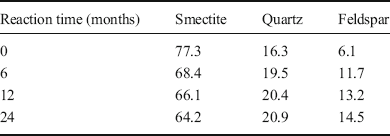
Based on the error analysis of XRD, the greater the mineral content, the lesser the relative error. The variations in mineral compositions of pure bentonite after various dissolution processes are listed in Table 2, and the accuracy of X'Pert HighScore software is also mentioned. After each reaction time, the mineral contents of five samples tested were averaged. Because the swelling of the bentonite tested was observed to depend largely on the smectite content rather than on other minerals, only the smectite content was taken into consideration. The smectite content exceeded 60% in the case of all pure bentonite specimens during the dissolution process, and it decreased with the increase in reaction time. The dissolution rate of smectite was faster early in the reaction process, but slowed as the concentration of OH– in porewater decreased gradually under the testing conditions.
Mineral compositions (wt.%) of pure bentonite samples during dissolution over various reaction times

Mineral content ≥40%, relative error ≤10%; Mineral content = 20–40%, relative error ≤20%; Mineral content = 5–20%, relative error ≤30%
Results of Swelling Tests
The maximum swelling strain was observed to be influenced by the vertical pressure, the reaction time, and the bentonite content (Fig. 2). The maximum strain decreased with an increase in vertical overburden pressure, but increased with increases in the bentonite content of the bentonite-sand mixtures. When other prevailing conditions were kept constant, the untreated bentonite and the bentonite-sand mixtures exhibited greater εmax values than the samples treated with alkaline NaOH solution. As the reaction time increased, the bentonite content dropped continually in the mixtures due to smectite dissolution that ultimately led to a decrease in the maximum swelling strain.
Maximum swelling strain vs. vertical stress on a untreated bentonite-sand mixtures and mixtures dissolved by alkaline solution for b 6, c 12, and d 24 months with ρd = 1.7 g/cm3

e c -σ Relationship for Mixtures
The swelling of bentonite-sand mixtures can also be described by the void ratio parameter (Studds et al. Reference Studds, Stewart and Cousens1998; Sun et al. Reference Sun, Cui and Sun2009). The void ratio of a clay mixture, e c, at full saturation is expressed as:

where V w and V c are the volume of water and bentonite, respectively; e is the total void ratio of the bentonite-sand mixture, d c is the relative density of bentonite, and d M is the average relative density of the bentonite-sand mixture.
The void ratio of pure bentonite decreased with increasing reaction time (Fig. 3). In addition, for samples dissolved in NaOH solution for the same reaction time, the plots of void ratio vs. pressure can be expressed by a uniform fractal e c-σ relationship expressed as (Xu et al. Reference Xu, Matsuoka and Sun2003):

where λ is the swelling coefficient of bentonite, σ is the vertical pressure, and D s is the surface fractal dimension.
Void ratio at saturation vs. vertical pressure on pure bentonite samples

According to the e c-σ relationships for the untreated pure bentonite and alkaline-dissolved samples (Table 3), the swelling coefficient, λ, was found to decrease gradually with an increase in reaction time, such that the λ value was smallest for samples treated with alkaline solution for 24 months. By comparing Tables 2 and 3, the λ value decreased with the decrease in smectite content.
e c-σ relation for pure bentonite samples dissolved by alkaline solution for various reaction times

The D s values increased slightly with increases in reaction time, as shown in Table 3. D s was introduced to represent the complexity of the microstructure based on the similarity of surfaces at different scales; D s ≈ 2−3, and rougher surfaces have larger D s values (Xiang et al. Reference Xiang, Ye, Yu, Wang and Fang2019b). For bentonite, D s was dependent mainly on the morphologies of the minerals, the smectite in particular. One layer of smectite is almost 0.96 nm thick and 100–1000 nm wide. Examination of the surface morphology of smectite must, therefore, be undertaken at the nanoscale. The resolution of TEM approaches the sub-Ångstrom level because this technique uses an electron beam of much shorter wavelength than an optical light source. Furthermore, TEM offers a unique opportunity to visualize directly the morphology of the nanoparticles. Transmission electron microscopy images at a resolution of 20 nm were selected for observing the surface morphology of smectite dissolved by the alkaline solution (Fig. 4). Dissolution by alkaline solution caused dissolution traces on the surface of smectite which increased the irregularity and the fractality of the bentonite surface.
TEM images of a untreated bentonite and samples reacted with NaOH solution for b 6, and c 24 months

The estimation values from the e c-σ relation (listed in Table 3) also fitted well with the experimental data for the bentonite-sand mixtures with large bentonite contents (α = 70%) after the respective reaction times (Fig. 5). This type of mixture possessed the same e c value as that of the pure bentonite upon dissolution by the alkaline solution over the same time and under the same vertical pressure.
Comparison between estimates and experimental data for the void ratio of clay in mixtures with 70% initial bentonite content

Threshold of Sand-Particle Contact
The void ratio of clay in the mixtures with intermediate bentonite contents (α = 50%) also decreased with increased reaction duration (Fig. 6). For the untreated samples and the samples dissolved by alkaline solution over a period of 6 months, the experimental data can be arranged with the e c-σ curves as expressed for the pure bentonite. For samples after treatment with alkaline solution for 12 and 24 months, the tested plots deviated from the e c-σ curves once the vertical pressure exceeded the threshold.
e c-σ relationship for mixtures with 50% initial bentonite content

The void ratios of clays in the low-bentonite (α = 45%) mixtures began to deviate from the predicted values when the pressure exceeded a threshold (Fig. 7).
e c-σ relationship for mixtures with 45% initial bentonite content

The pressure threshold also decreased as the reaction time increased. According to the results, the pressure threshold, above which the deviation began, depended on the initial bentonite content in the mixtures as well as the reaction time in the alkaline solution. Generally, the pressure threshold decreased with the decrease in the bentonite content in the case of deviation occurring. A threshold of bentonite content also emerged, below which the deviation of void ratio can occur, but above which deviation did not occur. In the case of mixtures with large bentonite contents, the bentonite was able to swell against the vertical pressure and separate the sand particles. The pressure was, therefore, all borne by the swelling clay particles, and the volume changes of the mixtures followed the e c-σ curve. On the other hand, in the case of mixtures with small bentonite contents, under greater pressure, the sand particles were still in contact with each other and formed a skeleton of sand particles. In that case, not all of the pressure was borne by the bentonite alone and a larger e c than in the case of pure bentonite developed. For the tested condition, the alkaline solution had little effect on the sand content of bentonite-sand mixtures but had a significant effect on the bentonite content. As the clay content decreased with the increase in reaction time, the deviation was more likely to occur.
The skeleton void ratio e s can be expressed as (Sun et al. Reference Sun, Wei, Sun, Liu, Fatahi and Wang2015):

where V c is the volume of bentonite in the mixture, V sd is the volume of sand particles, and V w+V c represents the volume excluding sand particles in the mixture. According to Eq. 1, V w = e c V c is satisfied at full saturation, and thus the relationship between e c and e s can be expressed as:

with

where d sd is the relative density of sand particles. In this study, d c = 2.71 and d sd = 2.65.
The sand skeleton can only be formed when V sd > (V w+V c) (Xiang et al. Reference Xiang, Yu, Xu, Fang and Xie2019a); the measured data are bound to follow the e c-σ curve at e s ≥ 1.0, whereas the discrepancy appears when e s < 1. If, for instance, the deviation begins from the unique e c-σ curve, the e s is expected to approach 1.0, where the fractal e c-σ relation is simultaneously satisfied as depicted in Eq. 6. That is:

The bentonite content at which the sand skeleton starts breaking apart can be calculated on the assumption that it happens as soon as the bentonite starts to take up water (e c = 0); according to Eq. 6, the limit of bentonite content in the tested bentonite was estimated to be ~50%. Therefore, at this intermediate bentonite dosage of 50%, deviation is not likely to occur. Due to the dissolution by the alkaline solution, however, the bentonite content decreased continually, and, therefore, the deviation varied with reaction time, as illustrated in Fig. 6.
Rearranging Eq. 6 gives:

The threshold of vertical pressure, σs, can be calculated from Eq. 7. For the mixture with 45% initial bentonite content dissolved in alkaline solution over 0, 6, 12, and 24 months, the estimated thresholds of pressure, σs, are 92.2, 77.7, 61.2, and 43.2 kPa, respectively.
Many experimental data indicated that the e c-σ relations for bentonite-sand mixtures were still a straight line in the double logarithmic scale after the sand skeleton forms (Sun et al. Reference Sun, Wei, Sun, Liu, Fatahi and Wang2015; Xiang et al. Reference Xiang, Yu, Xu, Fang and Xie2019a), which can also be expressed as:

with

where e cm is the clay void ratio of mixtures under the starting deviation stress, σs. Also shown in Fig. 7 is the e c-σ relation for mixtures with 45% initial bentonite content, while the solid lines and dotted lines are the estimated values calculated using Eqs. 4 and 8, respectively, which agreed well with the experimental data.
Conclusions
The bentonite contents of bentonite-sand mixtures decreased gradually with increased reaction times in alkaline NaOH solution, which ultimately decreased the swelling deformation. The void ratio of pure bentonite which reacted with NaOH solution for the same reaction time can be expressed as
 . The swelling coefficient, λ, decreased with increase in reaction time due to bentonite dissolution. The increase in the fractal dimension, D s, was caused by increased dissolution traces on bentonite particle surfaces, as observed by TEM.
The volumetric change in bentonite-sand mixtures with large bentonite contents (α = 70%) followed the fractal e c-σ curves, as the pure bentonite reacted with the alkaline solution for the same amount of time. For mixtures with α = 45% under greater pressure, sand-skeleton formation occurred and this sustained part of the load. Consequently, the experimental data deviated from the e c-σ curve relationship and, thus, resulted in a larger e c value than that for pure bentonite. The bentonite limit of the tested bentonite was estimated to be ~50%. No deviation in the void ratio was found in untreated mixtures containing 50% bentonite. However, with increased alkaline solution reaction times, the bentonite content decreased continuously. The void ratio deviation was found in bentonite-sand mixtures that reacted with alkaline solution over periods of 12 and 24 months. In addition, the vertical pressure threshold values were also estimated using the e c-σ relation. Under the test conditions, the vertical pressure threshold decreased with decreasing initial bentonite content, as well as decreased with increasing reaction time.
These conclusions were based on limited experimental conditions because the bentonite-sand mixtures and alkaline solution were tested in a closed system at room temperature. Hence, further studies are required to apply the aforementioned experimental results to other conditions.
Acknowledgments
The National Natural Science Foundation of China (Grant No. 41702311) and China Postdoctoral Science Foundation (2019M660096) are acknowledged for their financial support.
Funding
Funding is as stated in the acknowledgments.
Compliance with ethical standards
Conflicts of interest
The authors wish to confirm that no known conflicts of interest are associated with this publication and no significant financial support of this work had any influence or bias on the conclusions.