Introduction
Disasters and mass-casualty scenarios may overwhelm medical resources regardless of the level of preparation or prediction. A myriad of situations such as disasters due to natural hazards, infectious respiratory disease, and human-made incidents including terrorism and war can leave those with medical needs with limited resources. Responses to these situations require providers to do the most good for the most people with the resources available.Reference Wilgis1
The H1N1 influenza of 2009 demonstrated how quickly a virus can go from “contained” to a pandemic. Though the majority of cases were mild and self-limited, there was a spectrum of disease with refractory hypoxemia and severe acute respiratory distress syndrome (ARDS),2 which created a strain on intensive care unit (ICU) resources. After Hurricane KatrinaReference Gray and Herbert3 and Tropical Storm Allison,4 some hospital generators were inundated with flood waters, leaving those hospitals entirely without electrical power. At one facility, nurses had to train family members to ventilate their loved ones manually.Reference Gray and Herbert3 These events highlight that both trained personnel and equipment can be limited. Disaster responses require medical equipment, such as ventilators, that can be operated under adverse circumstances.
In 2006, the CDC maintained a stockpile of approximately 4,000 ventilators and the American Association for Respiratory Care recommended the inventory be expanded by an additional 5,000–10,000 units.5 The current stockpile now contains approximately 8,000 ventilators. Ideally, these ventilators could provide ventilatory support for a variety of patient populations from pediatric to adult, and operate for 4–6 hours when supplies electricity and gas are unavailable. Other desirable features include the ability of the ventilator to control tidal volume, ventilatory rate, and inspired oxygen concentration (FiO2).5 Using a laboratory setting, three portable ventilators designed to provide ventilatory support outside the hospital setting and in mass-casualty situations were evaluated. The data produced from this evaluation could prove valuable for purchasers of ventilators intended for use in mass-casualty situations as well as end-users.
Device Descriptions
This study involved the evaluation of three portable ventilators: (1) the SAVe (AutoMedx, Germantown, MD); (2) the MCV 200 (Allied Healthcare Products, St Louis, MO); and (3) the Uni-Vent 73X (Impact Instrumentation, West Caldwell, NJ). Only one unit of each ventilator model was tested.
The SAVe has a single pre-set tidal volume (VT) of 600 ml, and a respiratory rate of 10 breaths per minute (bpm) with a set inspiratory time of 2.25 seconds. The SAVe does not accept a 50 psig oxygen source but utilizes an internal compressor that provides a constant flow at 16 lpm of room air. The SAVe provides audible and visual alarms to indicate low airway pressure, occlusion, and high positive end-expiratory pressure (PEEP). The device also has a visual indicator of approximate remaining battery life.
The MCV 200 provides a VT range of 400–1200 ml. The inspiratory time has a separate control setting and is available at either 1.0 second for pediatric patients or 2.0 seconds for adults. The ventilatory rate ranges from 8 to 28 bpm. The MCV 200 utilizes an internal compressor, will accept a 50 psig oxygen source, and has a Venturi system that mixes room air with oxygen that can be set to deliver an FiO2 of either 0.65 or 1.0 when 50 psig oxygen is used. The MCV 200 provides audible and visual alarms to indicate low or high airway pressure and low source gas. The device also has an audible alarm that indicates the airway pressure relief mechanism has been activated plus a visual indicator for low battery power.
The Impact 73X provides a VT range of 300–1000 ml with a ventilatory rate range of 10–20 bpm. Inspiratory time is determined by the tidal volume and ventilatory rate settings. The 73X utilizes an internal compressor, and can accept a 50 psig gas source. The device operates at an FiO2 of 0.21 or 1.0. The 73X provides audible and visual alarms indicating low external power, low battery, low oxygen, low or high airway pressure, system failure, and incorrect VT setting. Additionally, the device has a visual indicator of battery charge level.
Methods
Each ventilator was attached to a test lung (Training Test Lung, Michigan Instruments, Grand Rapids, Michigan) using the manufacturer-supplied ventilator circuit. A pneumotachograph (Hans-Rudolph 3700, Shawnee, KS) was placed between the ventilator circuit and the test lung for measurement of pressure, volume, and flow. The output was recorded from the pneumotach system (Hans-Rudolph RSS 100, Shawnee, KS) to a computer (PC) for later analysis. A fast response O2 analyzer (Oxigraf, Mountain View, CA) was used to measure delivered FiO2.
Tidal Volume Accuracy
Set versus delivered VT were measured with each device at lung compliance settings of 0.02, 0.08, and 0.1 L/cm H2O with corresponding resistance settings of 10, 25, and 5 cm H2O/L/sec. These settings were used to simulate patients with ARDS, severe asthma, and normal lungs. All devices were evaluated for delivered VT accuracy at a ventilatory rate of 10 bpm and a VT of 600 ml at all compliance/resistance combinations, since these were the only settings available on the SAVe.
The 73X and MCV 200 also were evaluated across their range of operation using the lowest ventilatory rate and highest VT and highest ventilatory rate and lowest VT combinations. The 73X was evaluated at a VT of 300 ml with a respiratory rate of 20 bpm and a VT of 1,000 ml with a rate of 10 bpm. Both combinations were evaluated at an FiO2 of 0.21, and were repeated for all VT and compliance/resistance settings at an FiO2 of 1.0. The MCV 200 also was evaluated at a VT/ventiltory rate combination of 400 ml/20 bpm and 1,200 ml/8 bpm. The same compliance/resistance settings were used for each VT with each device.
FiO2 and Compliance Effects on Tidal Volume
At each combination of VT and compliance settings, different FiO2 settings with each device (if applicable) were evaluated to determine accuracy of FiO2 delivery and to evaluate the effect on VT. The SAVe had no mechanism other than the addition of low-flow oxygen to change the FiO2, thus all trials were conducted at an FiO2 of 0.21. After a one minute stabilization period, one minute of continuous data was recorded at each combination of tidal volume, compliance/resistance, and FiO2 settings. Delivered VT and FiO2 were recorded to a PC for later evaluation. Depending on the set respiratory rate for each test, the number of breaths delivered in one minute was used for evaluation.
Effects of Battery Life
Ventilators were tested for duration of battery life at a VT of 600 ml and ventilatory rate of 10 bpm due to the limitations of the settings available with the SAVe. Each ventilator was connected to a test lung with a compliance of 0.05 L/cm H2O and a resistance of 5 cm H2O/L/sec and run to exhaustion. Pressure, volume, and flow were recorded for analysis. Prior to testing, each battery was fully discharged, recharged for 24 hours, and run to exhaustion. Battery life for each ventilator was tested with a minimum of two trials.
Results
Tidal Volume Accuracy
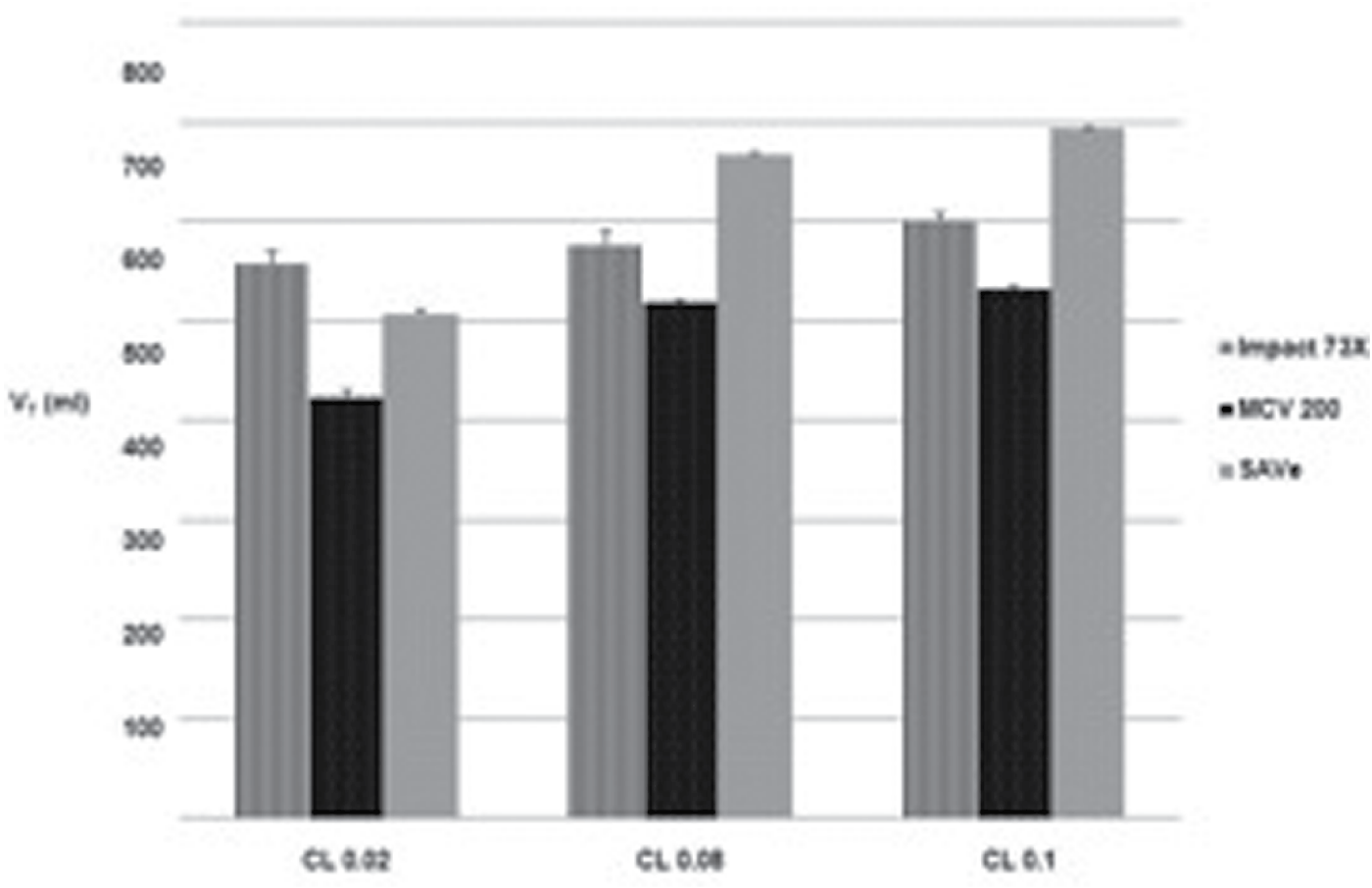
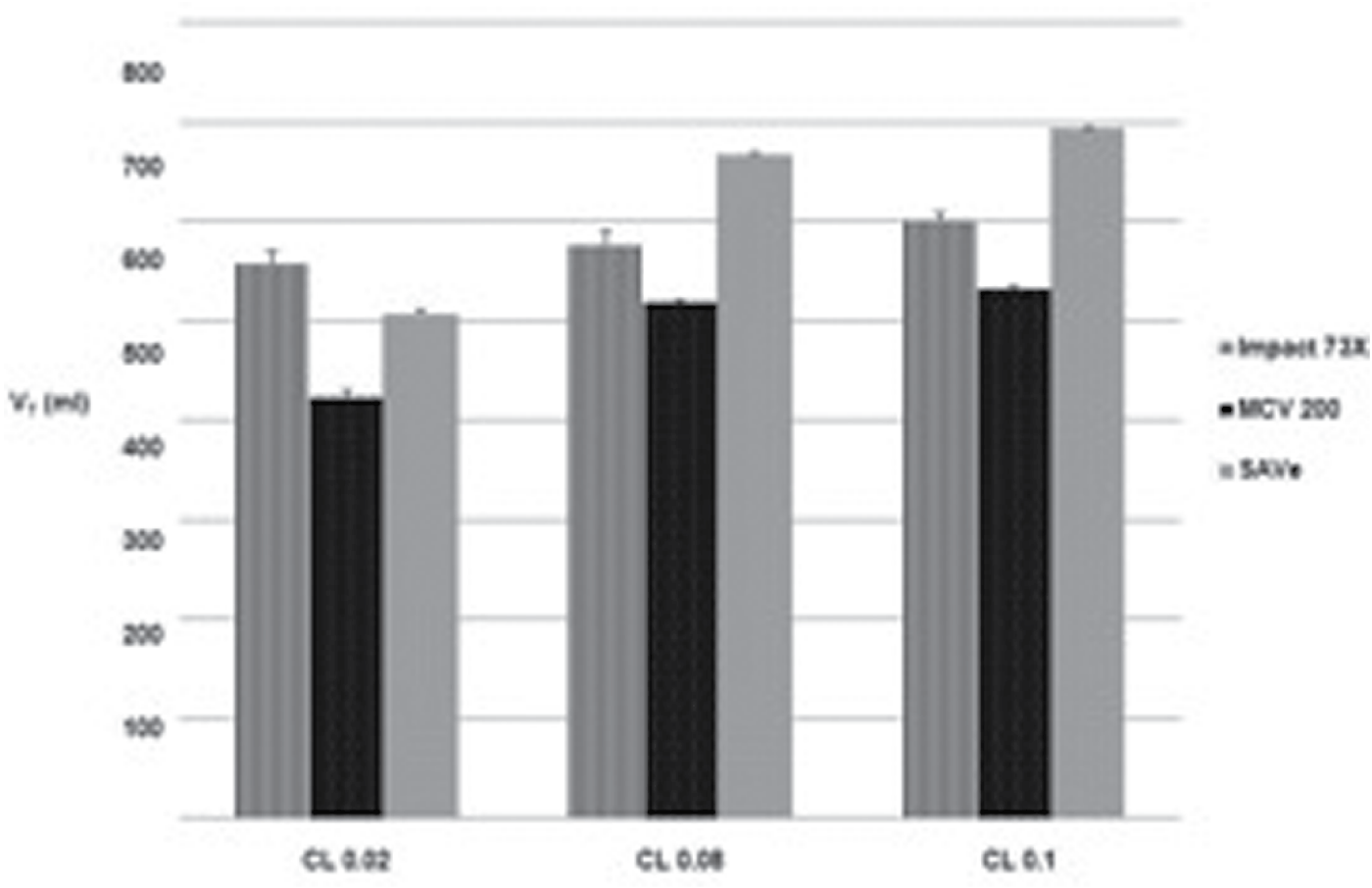
At the set VT of 600 ml and FiO2 of 0.21, the VT range was 424-694 ml across all devices and compliance settings. Figure 1 shows VT accuracy at set VT of 600 ml and FiO2 of 0.21 and compliance of 0.02, 0.08, and 0.1 L/cm H2O. At a set VT of 400 ml on the MCV 200, the delivered VT ranged from 256–394 ml and from 834–1,151 ml at the set VT of 1,200 ml. At the set VT of 300 and 1,000 ml on the 73X, the measured VT range was 268–316 ml and 884–1035 ml, respectively.
VT accuracy at set VT of 600 ml and FIO2 0.21
FiO2 and Compliance Effects on Tidal Volume
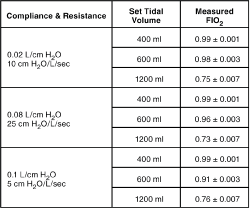
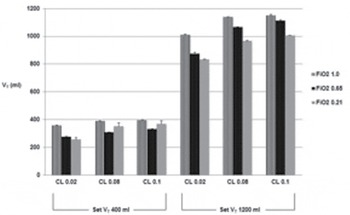
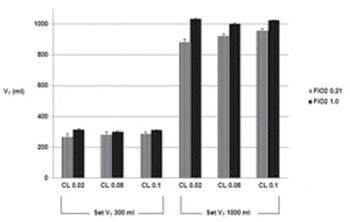
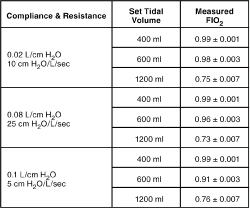
At the 0.65 FiO2 setting, the measured FIO2 ranged from 0.99 to 0.73 depending on the VT and compliance/resistance settings. Table 1 shows the measured FiO2 versus set FiO2 of 0.65 at different VT and compliance/resistance settings on the MCV 200. The variations in measured VT with all combinations of FiO2 and compliance settings are in Figures 2 and 3. Figure 2 shows the VT accuracy of the MCV 200 at VT settings of 400 and 1200 ml using FiO2 0.21, 0.65, and 1.0, at compliance of 0.02, 0.08, and 0.1 L/cm H2O. Figure 3 shows the VT accuracy of the 73X at VT settings of 300 and 1000 ml using FiO2 0.21 and 1.0, at compliance of 0.02, 0.08, and 0.1 L/cm H2O.
Measured FiO2 versus set FiO2 of 0.65 at different VT and compliance/resistance settings on the MCV 200
MCV 200 minimum and maximum VT accuracy at different FIO2/compliance combinations

73X minimum and maximum VT accuracy at different FIO2/compliance combinations

Effects of Battery Life
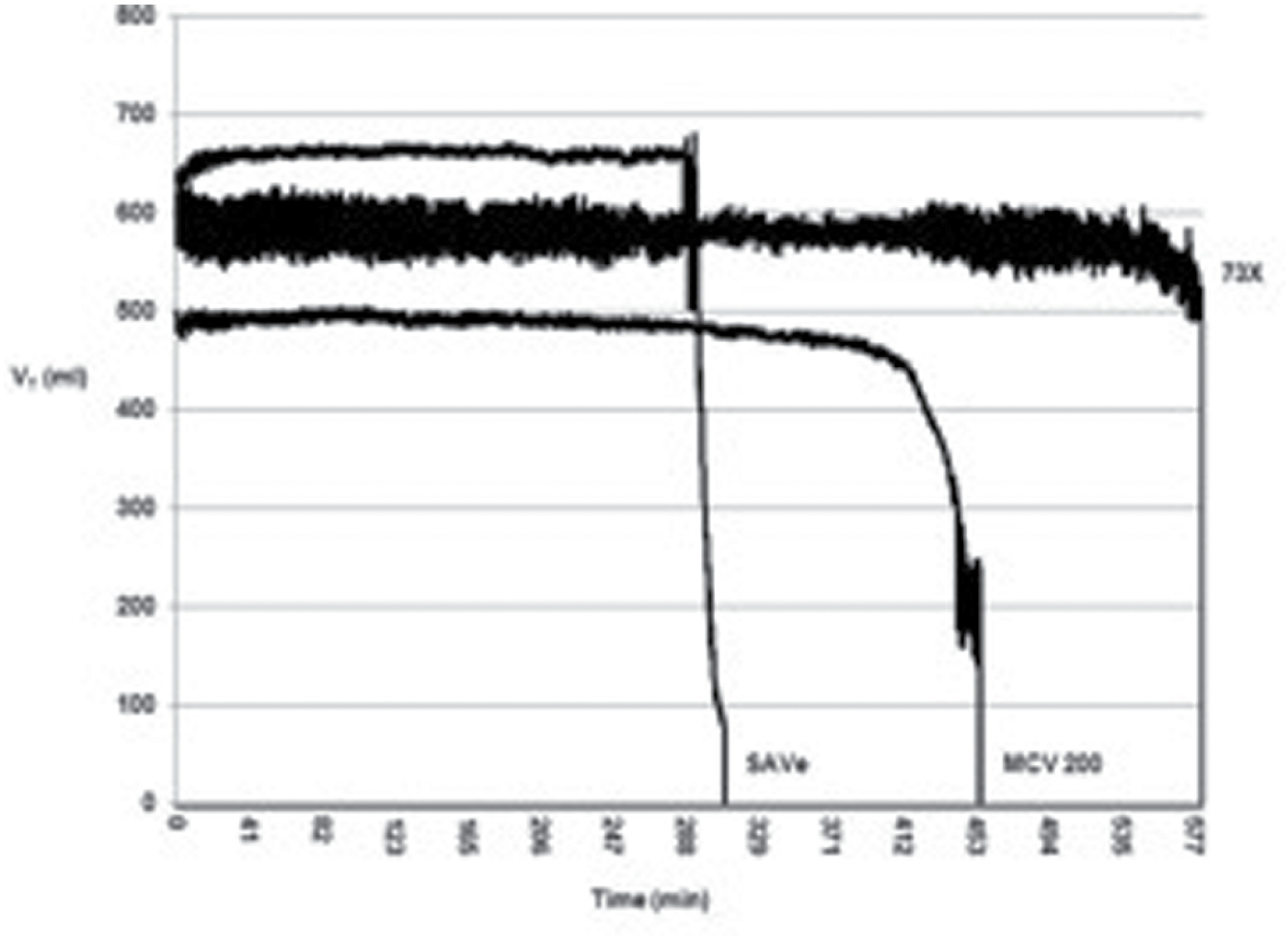
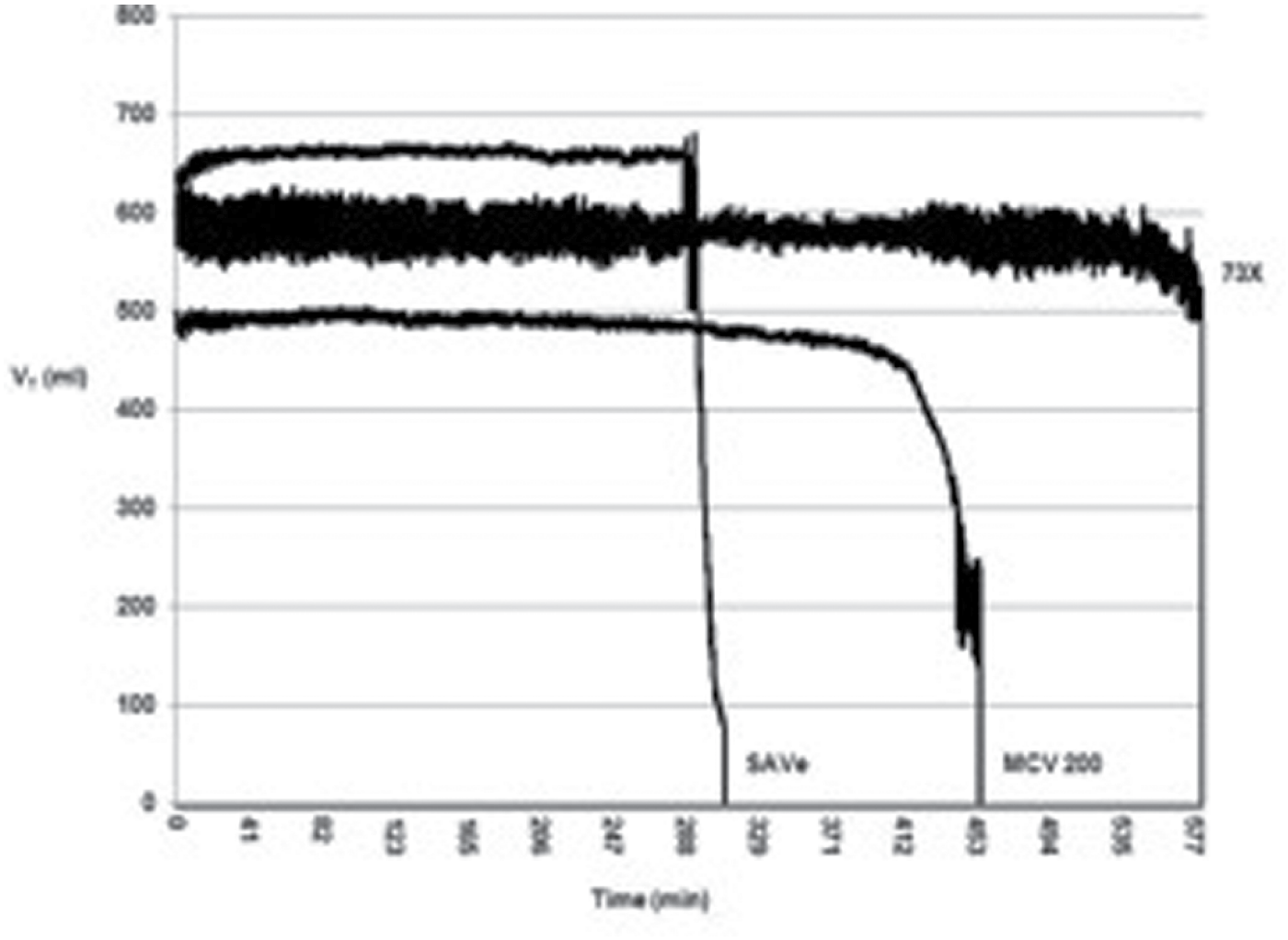
Battery life varied widely among devices, ranging from 311–582 minutes. When nearing the end of battery life, tidal volume progressively decreased with each device, although the decrease was not as pronounced with the 73X. Figure 4 shows battery duration and VT with each device with the internal compressor engaged and FiO2 of 0.21. In addition the SAVe set respiratory rate decreased during the last 28 ± 6 minutes of operation with all tests. During two of the tests with the SAVe, the inspiratory time decreased during the last 48 ± 27 minutes of operation and was associated with a decrease in VT. There were no changes in ventilatory rate or VT with either the 73X or MCV 200.
Battery duration with compressor engaged
Statistical Analysis
The three ventilators were compared in terms of a common measure of performance using the absolute percent discrepancy (APD) which is defined as:

Analysis of variance (mixed model) was used to estimate the effects of ventilator type, FiO2 and lung compliance on APD. All three effects evaluated were statistically significant (p <0.001).
Averaged over different combinations of FiO2 and lung compliance, the 73X delivered the best performance (point estimate of APD = 7.8%). The SAVe was next best (13.0%) and the MCV200 was the worst (16.4%). In pairwise comparisons, the 73X was statistically significantly better than the MCV200. The difference between the 73X and the SAVe was not statistically significant, nor was the difference between the MCV 200 and SAVe.
Another way to compare the three ventilators is to use a common tidal volume of 600 ml and an FiO2 of 0.21. These were the only settings available on the SAVe. Restricting the data to just those settings and re-running the APD analysis of variance revealed that both the ventilator effect (p = 0.03) and the compliance effect (p = 0.01) were statistically significant. In addition, there was a statistically significant interaction between ventilator and compliance. In other words, the differences in APD among ventilators varied according to compliance (0.02, 0.08, and 0.1).
Finally, the interaction was “sliced” so that inter-ventilator comparisons could be made at each lung compliance value separately. This revealed statistically significant differences between ventilators only at the compliance of 0.02 L/cm H2O (p = 0.01). Table 2 shows the statistical comparison of VT accuracy among ventilators at a compliance of 0.02 L/cm H2O. The difference between the MCV 200 and the SAVe was statistically significant (p < 0.05).
Statistical comparison of ventilator VT accuracy at a lung compliance of 0.02 L/cm H2O

Discussion
All three ventilators delivered tidal volume decreased with decreasing compliance. Tidal volume delivery was more accurate on the two devices that utilized 100% oxygen from a 50 psig gas source than when driven by the compressor alone. On the device that had an FiO2 setting of 0.65, measured FiO2 was much higher than set FiO2 on the lower VT settings at all compliances. Finally, delivered tidal volume decreased with two of the three devices when nearing the end of battery life. These results suggest that all ventilators intended for use in mass-casualty situations do not perform equally and caregivers should be aware of the limitations of each device.
With the threat of terrorism, disasters due to natural hazards, and epidemic illnesses, the potential requirement for ventilatory support for numerous victims, a number of manufacturers have focused on developing ventilators to meet surge capacities.Reference Branson, Johannigman, Daugherty and Rubinson6 Although no definitive requirements exist for mass casualty ventilators, the Task Force for Mass Critical Care recommends that the devices:Reference Rubinson, Hick and Curtis7
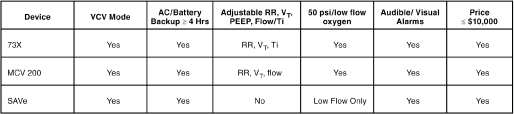
1. Operate on AC power with a backup battery capable of ≥ 4 hour operating duration;
2. Operate in volume control mode, preferably providing assist/control and synchronized intermittent mandatory ventilation;
3. Provide adjustable respiratory rate, tidal volume, PEEP, and inspiratory flow;
4. Are capable of operating from a 50 psi and/or low flow oxygen source;
5. Provide audible and visual alarms;
6. Be purchased for ≤$10,000;
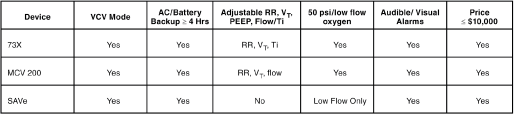
This laboratory study evaluated the performance of the devices relating to the recommendations of the task force. Table 3 shows how the devices adhere to each of the six task force recommendations.
Recommended mass casualty ventilator criteria (Ti = Inspiratory Time; VT = Tidal Volume; RR = ventilatory rate)
Delivered VT decreased as lung compliance decreased with all devices. The decrease was more pronounced when operating the devices with the internal compressor alone (FiO2 0.21). This can be explained by the increase in compressible volume in the ventilator circuit created by the increased pressure required to deliver the tidal volume at lower compliances, the inability of the compressor to generate set inspiratory flow under increased load, or a combination.
The VT delivered by the MCV 200 decreases further under these conditions when FiO2 is 0.65. The device uses a Venturi mechanism that entrains ambient air mixing with the 50 psig oxygen gas source to achieve the desired FiO2 setting. As lung compliance falls, the pressure increase downstream decreases the volume of entrained ambient air, decreasing the delivered tidal volume and increasing FiO2. The manufacturer acknowledges deficiencies of the Venturi system with low compliance and recommends using the 1.0 FiO2 setting for more accurate VT delivery in this case.8 In the event of limited oxygen supplies, this strategy could prove to be problematic.
The MCV 200 was the only device tested that could provide an FiO2 other than 1.0 or 0.21 but the FiO2 delivered was inconsistent across the range of set VT. The reported FiO2 was 0.65 ± 0.12. At VT settings of 400 ml and 600 ml, the measured FiO2 was greater than 0.9, indicating inadequate ambient air entrainment. At the highest VT the measured FiO2 was within the reported range, although a 1,200 ml VT is clinically irrelevant in current practice. The inability of the device to deliver the reported FiO2 negates the air-entrainment feature and any oxygen requirement by the patient will result in a delivered FiO2 of 1.0.
Low-flow oxygen can be entrained into each device to meet patient needs. The SAVe provides an oxygen connector on the device that accepts low-flow oxygen tubing. The device is limited to 6 lpm per the operator’s manual9 and will provide a reported maximum FiO2 of 0.62. At 6 lpm, testing revealed an FiO2 of 0.56 ±0.03. If >6 lpm is used, the SAVe will operate erratically and at flows >20 lpm, the device fails to deliver breaths.Reference Blakeman, Rodriquez, Petro, Dorlac and Branson10 Low-flow oxygen can be entrained into the ventilator circuit of the 73X and MCV 200 by placing a reservoir on the air inlet and is only limited by the flow capability of the oxygen source and the oxygen reservoir used. Higher delivered FiO2 can be achieved through this method depending on reservoir size, VT, and minute ventilation.
Ventilator operation duration from the internal battery is an important consideration in a mass-casualty situation due to the potential shortage of commercial electrical power. Although the battery duration varied widely among devices (311–582 min), they all exceeded the four-hour duration recommended by the Task Force for Mass Critical Care. The battery duration of portable ventilators depends on the use of a pneumatic or electrical drive system, lung impedance, type of battery, and ventilator settings.Reference Campbell, Johannigman, Branson, Austin, Matacia and Banks11 The 73X and MCV 200 become pneumatically powered when using an FiO2 of 1.0 (and 0.65 on MCV 200) because the compressor is disengaged. In this case, the battery duration reportedly increases up to 30 hours on the MCV 2008 and up to 12 hours with the 73X.12 The downside to this strategy is the increase in oxygen usage. Depending on the situation, the clinician must decide whether to utilize the compressor and conserve oxygen or vice versa. The SAVe does not accept a 50 psig oxygen source.
Limitations of this study include that only one unit of each device was evaluated. It was assumed that additional devices would perform in a similar manner. Since the SAVe only offers one combination of settings and operates exclusively from the compressor, the battery duration of all devices was only evaluated at these settings. Battery duration of the 73X and MCV 200 was assessed with the compressor disengaged.
Conclusions
In the event of a mass-casualty situation, portable, mechanical ventilators may be utilized in the care of victims in the prehospital setting. If local resources are depleted, caregivers must look elsewhere for ventilators to support patients. The [US] federal government maintains a stockpile of portable ventilators to use in this situation, if needed. Portable ventilators such as those evaluated in the current study are marketed to fill the need for mass-casualty ventilation in the field. Making these ventilators more affordable comes at the expense of fewer features that may often be required to care for critically ill patients. Our testing showed that the 73X and MCV 200 were the closest to satisfying the Task Force requirements for mass casualty ventilators, although neither had the capability to provide PEEP. The 73X provided the most consistent tidal volume delivery across all compliances, had the longest battery duration, and the least decline in VT at the end of battery life. All of these ventilators are relatively simple and would require minimal training on their operation. Since the majority of the caregivers that will be using these ventilators will likely have minimal training and troubleshooting skills, purchasers and end users both must be aware of the capabilities and differences between portable ventilators and carefully select the appropriate device to deliver ventilator support for their patients.
Abbreviations:
VT: tidal volume
ARDS: adult respiratory distress syndrome
FiO2: inspired oxygen concentration
PEEP: positive end expiratory pressure