Introduction
The house dust mite has a known role in the aetiology of persistent allergic rhinitis and allergic asthma.Reference Platts-Mills, Erwin, Heymann and Woodfolk 1 , Reference Sporik, Chapman and Platts-Mills 2 The prevalence of allergic rhinitis and allergic asthma is increasing steadily, and is strongly associated with the presence of the house dust mite, a common allergen.Reference Eifan, Calderon and Durham 3 These atopic diseases increase healthcare costs, especially for patients with uncontrolled or poorly controlled allergies.Reference Masoli, Fabian, Holt and Beasley 4 – Reference Canonica, Bousquet, Mullol, Scadding and Virchow 6
The development of allergic rhinitis and allergic asthma can be partially prevented by avoiding allergens and by using certain pharmacotherapeutic agents, but it is difficult to change the course of allergic diseases associated with the house dust mite. Allergen immunotherapy or specific immunotherapy are effective treatments for allergic rhinitis associated with the house dust mite.Reference Eifan, Calderon and Durham 3
Allergen-specific subcutaneous immunotherapy has been used effectively as a treatment for allergic rhinitis and/or allergic asthma. However, because of the discomfort of injections and serious side effects, non-injectable alternative options have been studied.Reference Bahceciler and Cobanoglu 7 House dust mite extracts delivered via subcutaneous immunotherapy is an effective method for treating allergies.Reference Pevec, Pevec, Markovic and Batista 8
The present study investigated the long-term effects of allergen-specific immunotherapy delivered via subcutaneous immunotherapy. Skin prick tests demonstrated positive results for house dust mite species Dermatophagoides pteronyssinus and Dermatophagoides farinae. Subcutaneous immunotherapy was applied over the course of 3 years, and our study was based on a 10-year follow up of the allergic rhinitis patients. Skin prick test results and symptom scores were evaluated before and after 3 years of allergen-specific immunotherapy, and 10 years after allergen-specific immunotherapy had ended.
Materials and methods
This study was conducted between 2001 and 2015. We used data collected for a previously published study comparing the effects of three years’ allergen-specific immunotherapy (20 of 26 patients) with pre-immunotherapy findings (26 patients).Reference Sahin, Taş, Dağtekin Ergür, Cuhali and Gürsel 9 This comparative study was also the focus of the thesis by the first author,Reference Şahin 10 which used data from 20 of the patients in the studies by Platts-Mills et al.Reference Platts-Mills, Erwin, Heymann and Woodfolk 1 and Sporik et al.Reference Sporik, Chapman and Platts-Mills 2 to attain values pre-immunotherapy and after 3-years of immunotherapy. Ten-year follow-up data were also obtained for these 20 patients, and this dataset is the focus of the present study. This approach enabled comparisons of the results before and after allergen-specific immunotherapy and those obtained after 3 and 10 years’ allergen-specific immunotherapy.
The study protocol was approved by the ethics committee (approval number 2016/01) and was conducted in accordance with the Declaration of Helsinki.
Subjects
Twenty patients (3 males, 17 females) with allergic rhinitis, admitted to the otolaryngology department of the Dr Sadi Konuk Training and Research Hospital, Istanbul, Turkey, in 2001 and 2002, were included in this study. The initial evaluation of these patients had been performed in both the otolaryngology and pulmonary diseases departments.
In 2001, the patients were aged 23–42 years. At the end of the study (2015), their mean age (± standard deviation) was 35.7 ± 1.0 years (range, 27.0–56.0 years). These 20 patients had positive skin prick test results for D pteronyssinus and D farinae house dust mites. They were treated with allergen-specific immunotherapy for three years via subcutaneous immunotherapy, receiving subcutaneous injections once per week over the three years.
Inclusion criteria
The study included adult patients with a diagnosis of allergic rhinitis, with continuous moderate or severe symptoms, who consented to undergo a skin prick test, and subsequently demonstrated house dust mite allergy (D pteronyssinus and D farinae). All patients had suffered symptoms for at least one season, and symptoms could not be sufficiently reduced with antihistamines or topical nasal corticosteroids.Reference Sahin, Taş, Dağtekin Ergür, Cuhali and Gürsel 9 – Reference Cingi, Bayar, Ulusoy, Acar, Şirin and Çobanoğlu 11
Exclusion criteria
Patients with malignancy, immune system disorders, adrenaline-related contraindications, coronary heart disease, hypertension, acute tuberculosis or any psychiatric condition that would prevent co-operation with long-term treatment, pregnant individuals, or those using beta-blockers or angiotensin-converting-enzyme inhibitors, were excluded.Reference Sahin, Taş, Dağtekin Ergür, Cuhali and Gürsel 9 – Reference Cingi, Bayar, Ulusoy, Acar, Şirin and Çobanoğlu 11
Instrumentation
Skin prick test
The skin prick test had been performed before allergen-specific immunotherapy and after 3 years of allergen-specific immunotherapy.Reference Sahin, Taş, Dağtekin Ergür, Cuhali and Gürsel 9 , Reference Şahin 10 For this study, the skin prick test was performed again 10 years after allergen-specific immunotherapy.
The skin prick test (Prick Test Kit; Stallergenes, Antony, France) contained the following eight allergens: (1) positive control, (2) negative control, (3) D pteronyssinus, (4) D farinae, (5) grass pollens, (6) cereals, (7) tree pollen mixture and (8) moulds. Patients did not use antihistamines during the 10 days prior to testing. A prick lancet (Mizollen; H Herenz, Hamburg, Germany) was used for standardised skin pricking. Témoin was used as the negative control, and 10 mg/ml histamine hydrochloride was administered as the positive control.
Reactions were examined by the researcher 20 minutes after the test. The induration diameter was assessed; values of 3 mm or more were considered positive.Reference Cingi, Bayar, Ulusoy, Acar, Şirin and Çobanoğlu 11 , Reference Lachapelle and Maibach 12 All patients had positive skin prick test results for D pteronyssinus and D farinae house dust mites.
Symptom scores
Nasal congestion, nasal discharge, nasal itching, sneezing, eye discomfort and headaches were considered symptoms. These were rated on a 0–3 points scale (0 = no symptoms and 3 = severe symptoms).Reference Sahin, Taş, Dağtekin Ergür, Cuhali and Gürsel 9 , Reference Şahin 10
Comparison
The skin prick test results for D pteronyssinus and D farinae were compared according to time of measurement (before and after 3 years of allergen-specific immunotherapy, and 10 years after allergen-specific immunotherapy).
Statistical analysis
SPSS statistical software, version 16.0 (SPSS, Chicago, Illinois, USA) was used. The Friedman test was employed to analyse differences among measurements taken before and after 3 years of allergen-specific immunotherapy and 10 years after allergen-specific immunotherapy. A p-value of less than 0.05 was deemed to indicate statistical significance.
When statistically significant differences were obtained, pairwise comparisons were performed using the Wilcoxon signed-rank test with the Bonferroni adjustment, to identify the value causing the difference. An adjusted p-value of less than 0.0175 was considered to be statistically significant.
Results
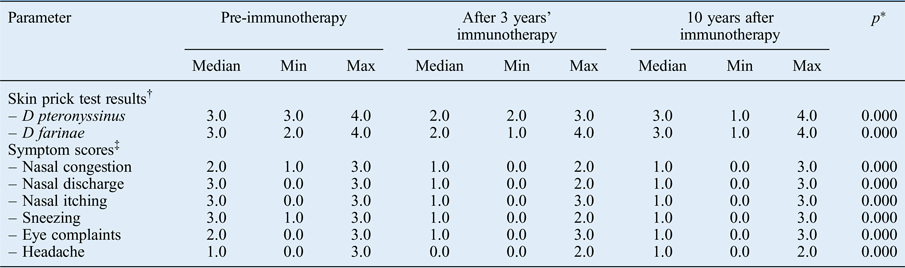
The skin prick test results and symptom scores obtained before and after 3 years of allergen-specific immunotherapy, and 10 years after allergen-specific immunotherapy, are displayed in Table I. Differences among these values were analysed using the Friedman test, and all differences were significant (p < 0.05) (Table I).
Skin prick test results and symptom scores

*Analysed using the Friedman test. †Induration diameter (mm). ‡Rated on a 0–3 points scale, whereby 0 = no symptoms and 3 = severe symptoms.
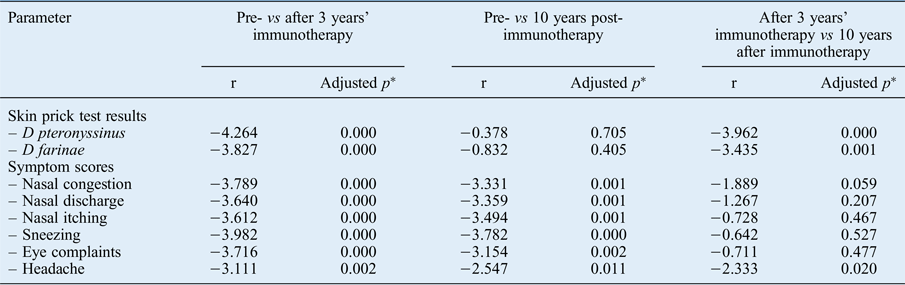
In order to identify the value causing the difference, pairwise comparisons were performed using the Wilcoxon signed-rank test with the Bonferroni adjustment. An adjusted p-value of less than 0.0175 was considered to indicate statistical significance (Table II).
Pairwise comparison by wilcoxon signed-rank test with bonferroni adjustment

*An adjusted p-value of less than 0.0175 was considered statistically significant.
Regarding the positivity of D pteronyssinus and D farinae, the mean ranks of the pre-immunotherapy values were significantly higher than those of the values after 3 years of allergen-specific immunotherapy; furthermore, the latter were significantly higher than the values 10 years after allergen-specific immunotherapy (p < 0.0175) (Table II). In terms of D pteronyssinus, the mean rank for 3 years of allergen-specific immunotherapy was 10.53, and that for 10 years after allergen-specific immunotherapy was 10.00. For D farinae, the mean rank for 3 years of allergen-specific immunotherapy was 10.12, and that for 10 years after allergen-specific immunotherapy was 4.50.
The symptom scores obtained pre-immunotherapy were significantly higher than those obtained after 3 years of allergen-specific immunotherapy and 10 years after allergen-specific immunotherapy (p < 0.0175). There were no significant differences between the scores obtained after 3 years of allergen-specific immunotherapy versus those 10 years after allergen-specific immunotherapy (p > 0.0175) (Table II).
Discussion
An allergy-induced late response is decreased by allergen immunotherapy, and levels of interleukin (IL)-4, IL-13 and IL-5 are reduced via inhibitory type 2 helper T cell responses. Overall, type 2 helper T cell response reduction is complemented by a switch in the immunological response towards ‘protective’ type 1 helper T cell pathways. Allergen immunotherapy causes a reduction in IL-10 and transforming growth factor-β, leading to the suppression of type 2 helper T cell responses. Additionally, IL-10 is involved in the change of immunoglobulin (Ig) isotypes to IgG4, and transforming growth factor-β is involved in changes to IgA.Reference Aricigil, Muluk, Sakarya, Sakalar, Senturk and Reisacher 13 – Reference Yaz, Cingi, Gürbüz and Bal 15
Reductions in the allergic response of a patient treated with allergen immunotherapy can be attributed to increased IgG1, IgG4 and IgA, and to decreased IgE. This change is associated with reductions in the number of infiltrating T cells, basophils, eosinophils and neutrophils. In the long-term, allergen-specific IgE levels are reduced as a result of allergen immunotherapy. A significant reduction in early-phase response has also been reported.Reference Aricigil, Muluk, Sakarya, Sakalar, Senturk and Reisacher 13 , Reference Ying, Barata, Meng, Grant, Barkans and Durham 16 – Reference Sampson 20
The administration of increasing amounts of a specific allergen is the staple method of immunotherapy for allergic diseases. This approach modulates the immune response to the allergen and alleviates allergic symptoms. Immunotherapy is a unique type of therapy that alters symptoms caused by abnormal immune responses.
A period of pharmacotherapy and particular life changes are recommended before commencing subcutaneous immunotherapy. Drugs are relatively easy for most patients to use and, when effective, provide faster relief than immunotherapy.Reference Creticos, Esch, Couroux, Gentile, D'Angelo and Whitlow 21
Allergens known to be effective for use in subcutaneous immunotherapy include various trees, grasses, and pollens, cat or dog hair, dust mites, cockroaches, and moulds.Reference Creticos, Esch, Couroux, Gentile, D'Angelo and Whitlow 21
The present study investigated the long-term effects of allergen-specific immunotherapy, specifically subcutaneous immunotherapy. It evaluated the skin prick test results for the house dust mite (D pteronyssinus and D farinae) and the symptom scores before and after 3 years of allergen-specific immunotherapy and 10 years after allergen-specific immunotherapy. After three years of allergen-specific immunotherapy, skin prick test positivity for the house dust mite decreased compared with the pre-immunotherapy values. Moreover, 10 years after allergen-specific immunotherapy, skin prick test positivity for house dust mites was reduced further compared with the results after 3 years of allergen-specific immunotherapy. Hence, the decrease in skin prick test positivity continued after the cessation of the three-year allergen-specific immunotherapy.
The symptom scores after 3 years of allergen-specific immunotherapy and those 10 years after allergen-specific immunotherapy were significantly lower than those before allergen-specific immunotherapy. It can be concluded that allergen-specific immunotherapy for the house dust mite was effective, and that skin prick test positivity and symptom positivity decreased over time, even though the treatment was stopped after three years. In other words, although treatment was interrupted, the positive effects of allergen-specific immunotherapy continued.
In line with our results, Pevec et al. reported that the improvement observed may continue for months, or even years, after completion of house dust mite subcutaneous immunotherapy.Reference Pevec, Pevec, Markovic and Batista 8 In their study, 56 allergic patients were treated using subcutaneous immunotherapy with house dust mite extracts. However, it was highlighted that sensitisation to tropomyosin is not clinically reduced by using house dust mite subcutaneous immunotherapy. In cases of combined allergies, such as seafood and mites, this treatment can lead to diminished food allergy symptoms. Levels of specific IgE to Der p 10 and pen 1 allergens may be useful monitoring indicators.
The potency of house dust mite subcutaneous immunotherapy has been demonstrated during the treatment period via: reductions in the severity of symptoms and skin reactivity; increased production of specific IgG4 and total IgE; and specific IgE dynamics. Alterations in the production of some T regulatory genes and FcεRI pathway genes was also observed.Reference Pevec, Radulovic, Stipic, Batista, Rijavec and Silar 22
-
• Allergen-specific immunotherapy is an effective way to treat allergic rhinitis
-
• Subcutaneous immunotherapy is effective for house dust mite induced allergy, even 10 years after treatment
The long-term effects of subcutaneous immunotherapy were assessed in a follow-up analysis of 147 patients aged 16–25 years, who had participated as children (10 years previously) in a randomised 3-year subcutaneous immunotherapy study, with grass and/or birch pollen as allergens.Reference Jacobsen, Niggemann, Dreborg, Ferdousi, Halken and Høst 23 Allergic rhinoconjunctivitis was noted in all patients at the beginning of the study. Statistically significant improvements in rhinoconjunctivitis symptoms were observed in patients treated with subcutaneous immunotherapy compared with those treated with standard therapies, even after seven years. In the subcutaneous immunotherapy patient group, 16 of 64 patients developed asthma, compared with 24 of 53 in the control group (25 per cent vs 45 per cent; odds ratio = 0.4, 95 per cent confidence interval = 0.2–0.9).Reference Jacobsen, Niggemann, Dreborg, Ferdousi, Halken and Høst 23 It has also been shown that patients with sensitivity to perennial allergens, such as dust mites or indoor animals, can benefit from subcutaneous immunotherapy.Reference Bousquet, Lockey, Malling, Alvarez-Cuesta, Canonica and Chapman 24 – Reference Li, Bernstein, Calderon, Casale, Cox and Passalacqua 26
Conclusion
This study showed that subcutaneous immunotherapy is an effective treatment for house dust mite induced allergic rhinitis; both the symptoms and skin prick test positivity values decreased during the treatment period. These positive effects continued for 10 years, even though subcutaneous immunotherapy was stopped after 3 years of treatment. Therefore, given appropriate indications, we would recommend subcutaneous immunotherapy as a treatment for house dust mite induced allergic rhinitis.