

Introduction
There is a long and distinguished history of research in forest entomology in Canada. Many reviews of the history of Canadian entomology have been published (see Timms Reference Timms2014 for references) and will not be repeated in detail here. In this paper we examine general trends in forest entomological research during the first 145 years of this country (1867–2012) and the relative contributions to that research by the federal government and universities. But first, it is important to briefly describe the expanse and diversity of Canadian forests.
Canadian forests
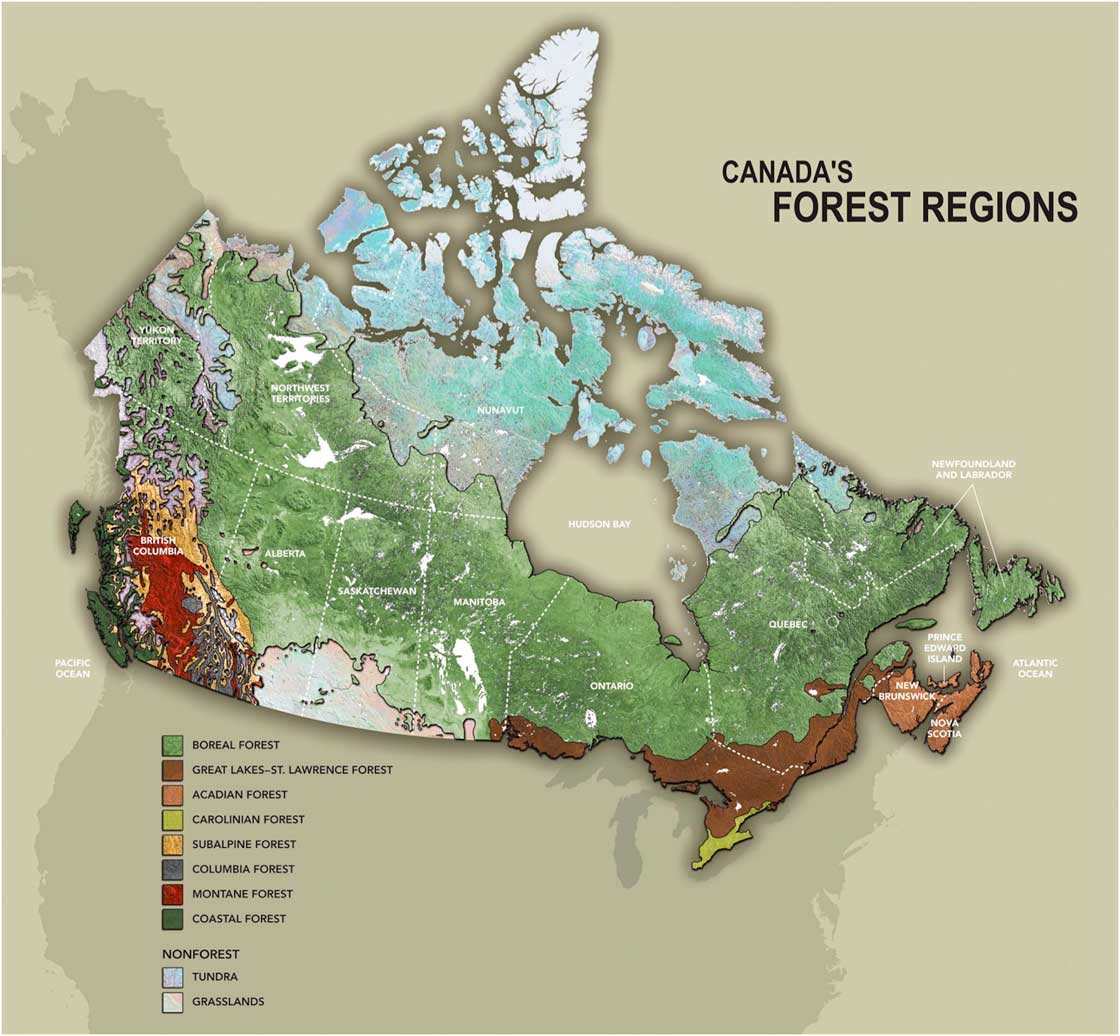
Canada has 397.3 million hectares of forest, other wooded land, and other land with tree cover. This represents 10% of the world’s forest cover and 30% of the world’s boreal forest (Anonymous 2012). Spanning over 5000 km from coast to coast and from tree-line in the north to Carolinean forest in the south, Canadian forests have been categorised by physiography, vegetation type, and cover into eight forest regions (Anonymous 2013) (Fig. 1). The Acadian region is concentrated in the Maritime provinces in eastern Canada and is comprised primarily of red spruce (Picea rubens Sargent; Pinaceae), balsam fir (Abies balsamea (Linnaeus) Miller; Pinaceae), and yellow birch (Betula alleghaniensis Britton; Betulaceae). The boreal forest, which stretches from Newfoundland in the east to northern British Columbia and the Yukon in the west, and comprises 80% of Canada’s forest lands, is primarily composed of white spruce (Picea glauca (Moench) Voss; Pinaceae), black spruce (Picea mariana (Miller) Britton, Sterns, and Poggenburg; Pinaceae), balsam fir, jack pine (Pinus banksiana Lambert; Pinaceae), white birch (Betula papyrifera Marshall; Betulaceae), trembling aspen (Populus tremuloides Michaux; Salicaceae), tamarack (Larix laricina (Du Roi) Koch; Pinaceae), and willow (Salix Linnaeus; Salicaceae). Red pine (Pinus resinosa Aiton; Pinaceae), eastern white pine (Pinus strobus Linnaeus; Pinaceae), eastern hemlock (Tsuga canadensis (Linnaeus) Carrière; Pinaceae), yellow birch, maple (Acer Linnaeus; Sapindaceae), and oak (Quercus Linnaeus; Fagaceae) are the most abundant tree species in the Great Lakes-St. Lawrence forest region, which occurs in southern Québec and Ontario. Beech (Fagus Linnaeus; Fagaceae), maple, black walnut (Juglans nigra Linnaeus; Juglandaceae), hickory (Carya Nuttall; Juglandaceae), and oak predominate in the Carolinian forest region in the most southern tip of Ontario. The subalpine (Engelmann spruce (Picea engelmannii Parry ex Engelmann; Pinaceae), subalpine fir (Abies lasiocarpa (Hooker) Nuttall; Pinaceae), and lodgepole pine (Pinus contorta Douglas ex Loudon; Pinaceae)) forest region occurs in mountain uplands of British Columbia and western Alberta. The montane forest region (Douglas-fir (Pseudotsuga menziesii (Mirbel) Franco; Pinaceae), lodgepole pine, ponderosa pine (Pinus ponderosa Lawson and Lawson; Pinaceae), and trembling aspen) is situated in several valleys along the Alberta/British Columbia border and in the central plateau of British Columbia, where the climate is relatively dry. The Columbian forest region, where western red cedar (Thuja plicata Donn ex Don; Cupressaceae), western hemlock (Tsuga heterophylla (Rafinesque) Sargent; Pinaceae), and Douglas-fir predominate, is in an interior wet belt between the Rocky Mountains and the central plateau in British Columbia. The predominant tree species in the Coastal forest region, found along the coast of British Columbia, are the same as those found in the Columbian forest region, with the addition of Sitka spruce (Picea sitchensis (Bongard) Carrière; Pinaceae).
A map of Canada showing the spatial distribution of eight forest regions in the 10 provinces and three territories. Map obtained from Natural Resources Canada, http://www.nrcan.gc.ca/forests/canada/classification/13179.
Approximately 93% of Canada’s forest land is publicly owned by the provinces or territories (77%) or by the federal government (16%) (Anonymous 2012). Thus the management of forests, including pest insects in forests, is primarily the concern of governmental agencies. Although <0.2% of Canada’s forests are harvested annually, by value, Canada is the world’s leading exporter of softwood lumber, newsprint, and wood pulp, and the fifth largest exporter of wood panels and printing and writing papers.
The role of the federal government in forest entomological research in Canada
The beginnings of forest entomology in Canada are rooted in the country’s history of settlement and agriculture. Prior to Confederacy, the Union Act of 1841, which divided Upper and Lower Canada, shared the responsibility over agriculture among both the local and federal governments, setting forth a partnership still in effect today. In the 1880s, the settlement of western Canada created a need for more information on insect pests within the Dominion of Canada (Castonguay Reference Castonguay2004). The management of insect pests, both within agriculture and forestry, remained under the jurisdiction of the Department of Agriculture. Following the Morgan Commission on the protection of forests, which called for a more centralised system of regulation, James Fletcher was named the first Dominion Entomologist, an honorary appointment, in 1884 and took on the role officially in 1886 (Castonguay Reference Castonguay2004). Entomology, until this date, still remained heavily focussed on taxonomy (see Langor et al. Reference Langor, Hammond, Pohl, Williams, Lee and Bergeron2015).
Two years after Fletcher took up his appointment as honorary entomologist, the Department of Agriculture opened its first Experimental Farms Branch, the first foray into experimental entomology in Canada (Riegert Reference Riegert1980; Castonguay Reference Castonguay2004). The opening of the Experimental Farms Branch was a response to pressure from fruit tree growers who needed to find a way to prevent the arrival of invasive alien insects such as the San José scale (Quadraspidiotus perniciosus Comstock; Hemiptera: Diaspididae) from crossing the border from the United States of America into Canada (Riegert Reference Riegert1980; Castonguay Reference Castonguay2004). The Act Respecting Experimental Farm Stations of 1886 gave entomology recognition as an important branch of biology.
Although entomological research was initially agriculture-focussed, research on forest entomology issues soon followed. In 1898, Clifford Sifton, the Minister for the federal Department of the Interior, allocated $1000 to the creation of an agency that would look into protecting the forests of western Canada (Simpson Reference Simpson1999). Two different federal departments were therefore responsible for the forests of Canada, the Department of the Interior, which protected the forests from fires and other damaging conditions, and the Department of Agriculture, which was responsible for research on pests that damaged the forests. Having two separate departments was confusing. The departments had mandates that were somewhat overlapping and bringing the issue at hand to the right department was a difficult task. There was continued confusion over who was responsible for specific programmes and initiatives, a confusion that resulted in duplication and continued difficulty in obtaining funds for projects. In 1899, Elihu Stewart, Chief Inspector of Timber and Forestry, organised the Dominion Forestry Service to ensure stronger regulations and programmes to protect forests. He also played an important role in the founding of the Canadian Forestry Association (Simpson Reference Simpson1999). The Forestry Service was mainly concerned with issues of conservation of federal lands (Drushka and Burt Reference Drushka and Burt2001). Stewart created this new entity to protect federal lands from the timber industry and settlement. During a tour of European forests, he had seen and examined ways to maintain and conserve the Canadian forests. The forests would need to be protected from fires and pests, and a programme of tree planting needed to be implemented to ensure the conservation of Dominion forests and a source of timber. That same year, the Department of the Interior founded the Forestry Branch, which expanded the control that the department had over care of Crown forests and housed the Federal Forestry Service while the Department of Agriculture continued to provide most of the research on pests.
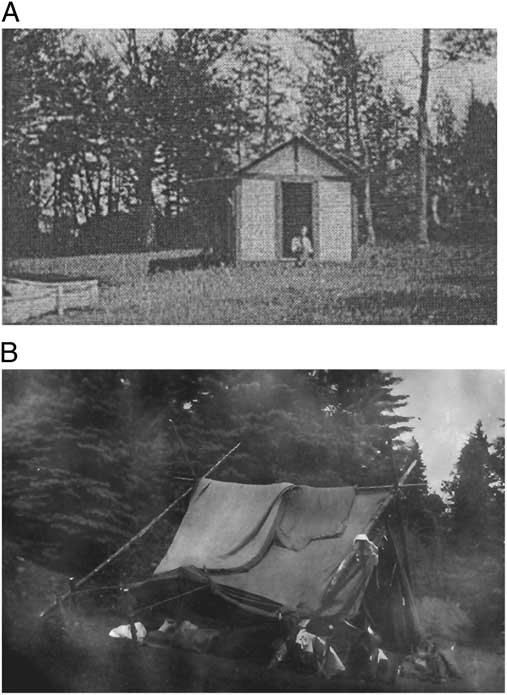
With the birth of the Federal Forestry Service, now the Canadian Forest Service, more emphasis on collaboration with the other departments housing a forestry division was possible and research stations began to appear. After a recommendation by the Forestry Advisory Committee in 1906 to the Council for Scientific and Industrial Research, it was decided to establish Forest Experimental Stations (Simpson Reference Simpson1999). These stations, established a few years after the recommendation was submitted, were the first in Canada to provide surveys and establish research plots. The Destructive Insect and Pests Act of 1910 further cemented the role that research and federal agencies would play in the control of insect populations deemed injurious. In 1911/1912, Forest Experimental Stations in Agassiz, British Columbia and Fredericton, New Brunswick were opened (Riegert Reference Riegert1980; Simpson Reference Simpson1999) (Fig. 2). A few years later, the federal entomological branch opened a research laboratory at Indian Head, Saskatchewan. Research facilities were often not large or extremely well equipped and field infrastructure was often “rustic” (Fig. 2).
(A) The first building (6×10 feet) of what later became the Canadian Forest Service-Atlantic in Fredericton, built in 1912, with John Tothill sitting in the entrance; and (B) a temporary field camp near Upsalquitch, New Brunswick in the 1920s.
Shortly thereafter, specialised responsibilities for federal forest insect research and management were assigned to three laboratories. The Dominion Forest Laboratory that opened in Vernon in 1919 under Ralph Hopping and operated until 1970, carried out studies in forest insect biology and bark beetle (Coleoptera: Curculionidae: Scolytinae) control programmes (Taylor Reference Taylor1999). A laboratory that opened in 1923 at Indian Head, Saskatchewan, became responsible for insect-caused problems affecting shelterbelts and the parkland areas of the three prairie provinces. The Forest Insect Laboratory, built in Fredericton in 1923, following the dissolution of the Natural Control Investigations Laboratory, initially focussed its research efforts on the eastern spruce budworm (Choristoneura fumiferana (Clemens); Lepidoptera: Tortricidae), bark beetles, and bark and tip weevils (Coleoptera: Curculionidae).
In 1936, two years after he had been appointed Director of the Division of Entomology, a unit of the Department of Agriculture, J.J. de Gryse established the Canadian Forest Insect Survey. Regional units were established in Fredericton (1937), Vernon (1937), Winnipeg (1939), Indian Head (1940), Sault Ste. Marie (1945), Calgary (1948), Halifax and Victoria (1949), and Corner Brook (1952). Contemporaneously, a quarantine laboratory was built in Belleville, Ontario (1936) and the Acadia research forest was established just outside Fredericton (1946) (Simpson Reference Simpson1999).
Regional forest insect laboratories were established in Winnipeg in 1937, in Victoria in 1940, in Sault Ste. Marie in 1944, and in Ville de Québec in 1952 (Prebble Reference Prebble1956). The Victoria laboratory was created by moving a “sub-laboratory” in Vancouver, which was under the administrative control of the laboratory in Vernon. The Victoria laboratory was elevated in importance to assume administrative control of federal forest research in British Columbia in 1948, the same year that a regional laboratory was built in Calgary, Alberta, and given responsibility for forest insect problems in Alberta and the Northwest Territories.
Like many of its allies, Canada enjoyed unprecedented economic growth and prosperity in the years following the Second World War. “Unparalleled government revenues, liberal economic policies, and optimism regarding the benefits of science and technology prevailed” (Taylor Reference Taylor1999). The Canada Forestry Act was proclaimed in 1949 and permitted the federal government to increase its role in forest research and economic development. In 1960 the Dominion Forest Branch and the Forest Biology Division of the Department of Agriculture were amalgamated and a regional structure was established across Canada (Taylor Reference Taylor1999).
The Canadian Forest Service carried out many projects but the longest project was the Forest Insect and Disease Survey. The project initially started in the mid 1930s to better follow the trends and habits of the European spruce sawfly (Gilpinia hercyniae Hartig; Lepidoptera: Diprionidae), which was wreaking havoc in eastern Canada (Simpson Reference Simpson1999; Castonguay Reference Castonguay2004) and was continued until 1996 (Magasi Reference Magasi2003), when provinces assumed the responsibility for annual surveys. However, the Canadian Forest Service has continued to carry out annual surveys in some national parks (D. Langor, personal communication).
To increase critical mass in different areas of forest entomological research, the Canadian Forest Service established several research institutes. For example, growth in the research activities of the Laboratory for Insect Pathology, established in Sault Ste. Marie in 1950, resulted in the creation of the Insect Pathology Research Institute in the same city in 1965 (Jamieson Reference Jamieson1988). During the same year, the Chemical Control Section, which had opened in Suffield, Alberta in 1950 before moving to Ottawa, Ontario in 1953, was expanded to create the Chemical Control Research Institute. Personnel from the Chemical Control Research Institute were moved from Ottawa to Sault Ste. Marie in 1977, when these two institutes were amalgamated into the Forest Pest Management Institute (Jamieson Reference Jamieson1988). The latter institute was closed in 1995, after which entomological research was concentrated in regional research centres.
Over the years, the Canadian Forest Service has undergone name changes, changed departments on multiple occasions, opened and closed research centres, and participated in many joint programmes (Table 1). The quality of research made the Canadian Forest Service, which until recently was responsible for the majority of forest entomology research in Canada (see below), a world leader in forest entomology (Quiring Reference Quiring2012). There are currently five very productive Canadian Forest Service research centres located in Victoria, Edmonton, Sault Ste. Marie, Ville de Québec, and Fredericton (substation in Corner Brook) that are maintaining their traditional leading role in many areas of forest entomology while increasing their collaborations with universities in cooperative research projects.
Summary of changes in the laws and department names of the federal government that influenced the development of the Canadian Forest Service (CFS).

Note: The dates of important appointments and construction of research centres are also listed.
General trends in publication of forest entomology articles in peer-reviewed journals (1926–2012)
When several eastern provinces joined to form the confederation of Canada in 1867, there were few peer-reviewed journals in entomology or in related disciplines anywhere in the world. The Canadian Entomologist, the oldest entomological journal in North America, was created by the Ontario Entomological Society in 1868 (Baker Reference Baker1939) and became the primary venue for publications by Canadian forest entomologists. During the first several decades of the journal, many of the papers were summaries of anecdotal information and natural history observations and appeared quite different from the concise and precise wording describing experimental studies common in the literature of today. However, they were (and still are) very enjoyable to read as they contained valuable natural history insights and evoked a joy of nature that seems rare in today’s publications.
To discern any general trends in the publication of Canadian forest entomology papers we carried out a literature review with Biosis (including Biological Abstracts) for the period 1926–2012. Our objective was to examine general trends and not to do an exhaustive search of all research in Canadian forest entomology. To this end, only papers on the major forest pests of Canada, as described in “Forest insect pests of Canada” (Martineau Reference Martineau1984) or in the list of 300 insect species in the “Trees, insects, and diseases of Canada's forests” database of Natural Resources Canada (available at http://tidcf.nrcan.gc.ca/en/insects/all) were included. Only publications in peer-reviewed journals for which the first author listed a Canadian address were included in the literature review. All other documents were excluded, including: federal and provincial government documents (this includes, for example, all Federal Insect and Disease Survey publications); books; and conference and symposium proceedings. Although many important books and provincial and federal government publications were excluded from the review, many will be discussed in subsequent papers in this special edition where different subject areas are reviewed in more depth. Similarly, the literature search has likely missed some of the articles on natural enemies of forest insect pests, but many papers listed the insect that the natural enemy attacked and consequently were included in the review.
Two other groups of papers were excluded from the literature review. The distinguished history of research in the systematics of forest insects was not included as it is reviewed in another paper in this volume (Langor et al. Reference Langor, Hammond, Pohl, Williams, Lee and Bergeron2015). Also, articles that were primarily concerned with a discipline other than entomology, but which happened to include a forest insect pest or its host tree(s) were also excluded. Decisions to exclude papers were often difficult to make but we took a conservative approach and excluded many studies. Although this reduced the total number of publications in the study, and particularly influenced our selection of the more recent literature, it provides a general picture of forest entomological research. Certainly the subsequent papers in this special edition will cover individual topics in more depth and will include literature that we have excluded.
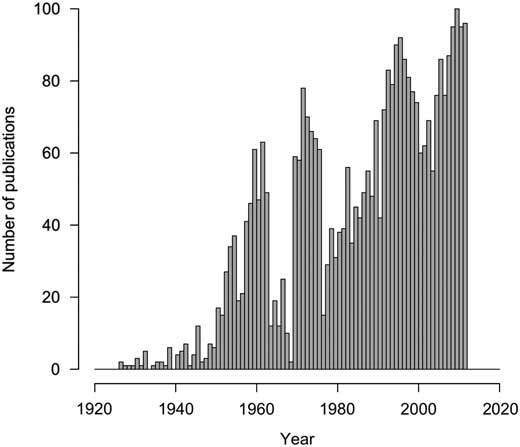
The number of forest entomological studies carried out in Canada and published in peer-reviewed journals has steadily increased since 1926 (Fig. 3). There were very few publications until the end of the Second World War in 1945, after which publication rates increased markedly (Fig. 3). Four distinct peaks in publication activity occurred around 1960, the early 1970s, mid 1990s and 2012 (Fig. 3). The first three peaks were primarily attributable to publications on defoliators (Fig. 4A), although a large increase in the number of publications on shoot borers (Fig. 4B) contributed to the third peak. Articles on the eastern spruce budworm, comprised the vast majority of publications on defoliators. The most recent peak in publications was attributable to a large increase in the number of papers on wood borers (Coleoptera: Buprestidae, Cerambycidae) and bark beetles (Figs. 4D, 4F).
Annual number of peer-reviewed papers in forest entomology published by Canadians between 1926 and 2012. Only papers describing research carried out in Canadian laboratories or Canadian forests are included.
Annual number of peer-reviewed papers in forest entomology published by Canadians between 1926 and 2012 that describe research on: (A) defoliators; (B) shoot borers; (C) other phloem/xylem feeders; (D) bark beetles; (E) seed and cone insects; and (F) wood borers. Note that axis scales vary among graphs.

Most publications before 1950 described research carried out on defoliators (Fig. 4A). This was due, in large part, to the larger research effort expended in eastern versus western Canada during this period (Figs. 5A, 5B, 5C versus Figs. 5D, 5E) combined with a strong tendency of forest entomologists in eastern and central Canada to study defoliators and most forest entomologists in western Canada to study bark beetles. This tendency has been maintained throughout the history of forest entomology in Canada. In our review of the literature between 1926 and 2012, ~74% of Canadian peer-reviewed papers on bark beetles described studies from British Columbia whereas >75% of papers where defoliators were the primary focus came from regions east of Manitoba.
Annual number of peer-reviewed papers in forest entomology published between 1926 and 2012 by Canadians in: (A) Atlantic Canada; (B) Québec; (C) Ontario; (D) Prairies; and (E) British Columbia.
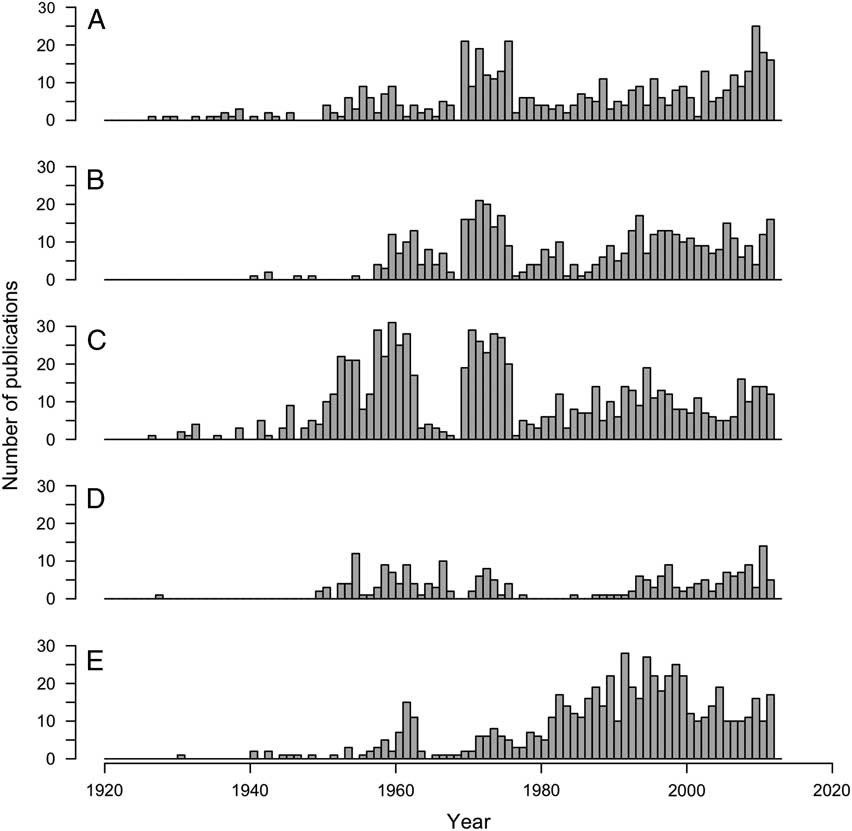
Publications on sap suckers and gall makers occurred primarily between 1955 and 1980 (Fig. 4C), mainly due to a large research effort to understand the ecology and impact of the exotic balsam woolly adelgid (Adelges abietis (Ratzeburg); Hemiptera: Adelgidae), which had colonised the east coast. Publications of seed and cone insects (Fig. 4E) and of shoot borers (Fig. 4B), peaked in the late 1990s, the latter coinciding with the publication of many papers on the ecology and management of the white pine weevil (Pissodes strobe (Peck); Coleoptera: Curculionidae), on the west coast. The number of papers on bark beetles (Fig. 4D) and wood borers (Fig. 4F) has recently greatly increased beyond all previous levels due, respectively, to research following a recent outbreak of mountain pine beetle (Dendroctonus ponderosae (Hopkins); Coleoptera: Curculionidae), in western Canada and to the introduction of several exotic wood borers to central and eastern Canada. Papers on defoliators comprised >74% of all papers in our survey, followed by bark beetles (13%), shoot borers (5%), and other phloem/xylem feeders (2%). Note that papers on parasitoids, predators, diseases, or pest management were categorised under the guild of their primary host/prey or target.
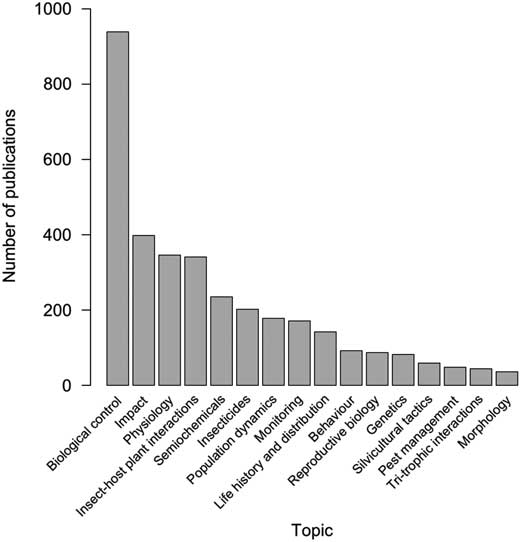
The majority of papers examined the ecology, physiology, and biological control of major forest pests, as well as their impact (Fig. 6). The preponderance of biological control papers in Figure 6 is somewhat misleading as “biological control” not only includes all papers on biological control with predators, parasitoids, and diseases but also all papers on the natural history of natural enemies. In contrast, “ecological” studies have been subdivided into several different groups (i.e., insect – host plant interactions, population dynamics, tri-trophic interactions, and life history and distribution).
Number of forest entomology papers published by Canadians between 1926 and 2012 categorised according to the type of research conducted. Note that all papers on parasitoids, predators, and diseases are grouped with papers on biological control.
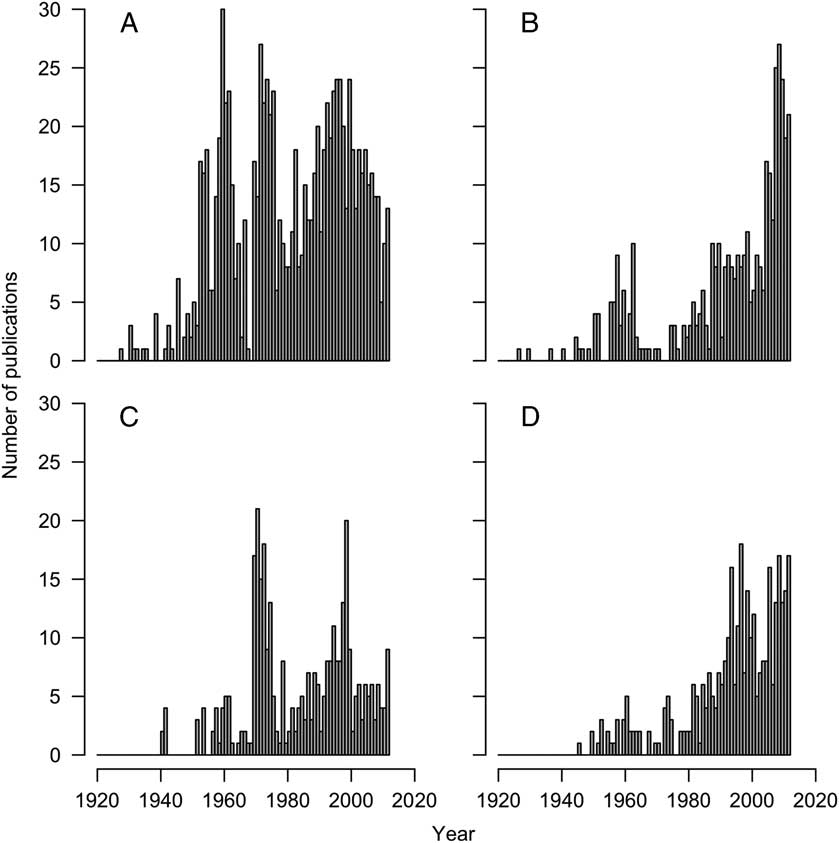
Papers on biological control or on natural enemies peaked in the late 1960s, early 1970s, and late 1990s (Fig. 7A), coincident with peaks in publications on defoliators (Fig. 7A). More than a third of papers on defoliators described studies on the physiology, behaviour, and ecology of natural enemies or on their use in biological control. Publications on the impact of forest insect pests peaked in 1960 and in the 1990s (Fig. 7B), largely due to studies on the impact of defoliators. The number of papers evaluating the impact of forest insect pests doubled during the last few years of the literature survey period, primarily due to papers investigating the impacts of bark beetles and exotic wood borers. While studies on the physiology of forest insect pests, or of their natural enemies (Fig. 7C), were highest during the second and third (of four) publication peaks shown in Figure 3, and corresponded with peaks in publications on defoliators, the number of publications evaluating insect-host plant interactions (Fig. 7D) were high only during the last two general peaks of publication, corresponding to peaks in publications on defoliators and on bark beetles/wood borers, respectively.
Annual number of peer-reviewed papers in forest entomology published by Canadians between 1926 and 2012 that describe research on: (A) biological control; (B) impact; (C) physiology; and (D) insect–host plant interactions.
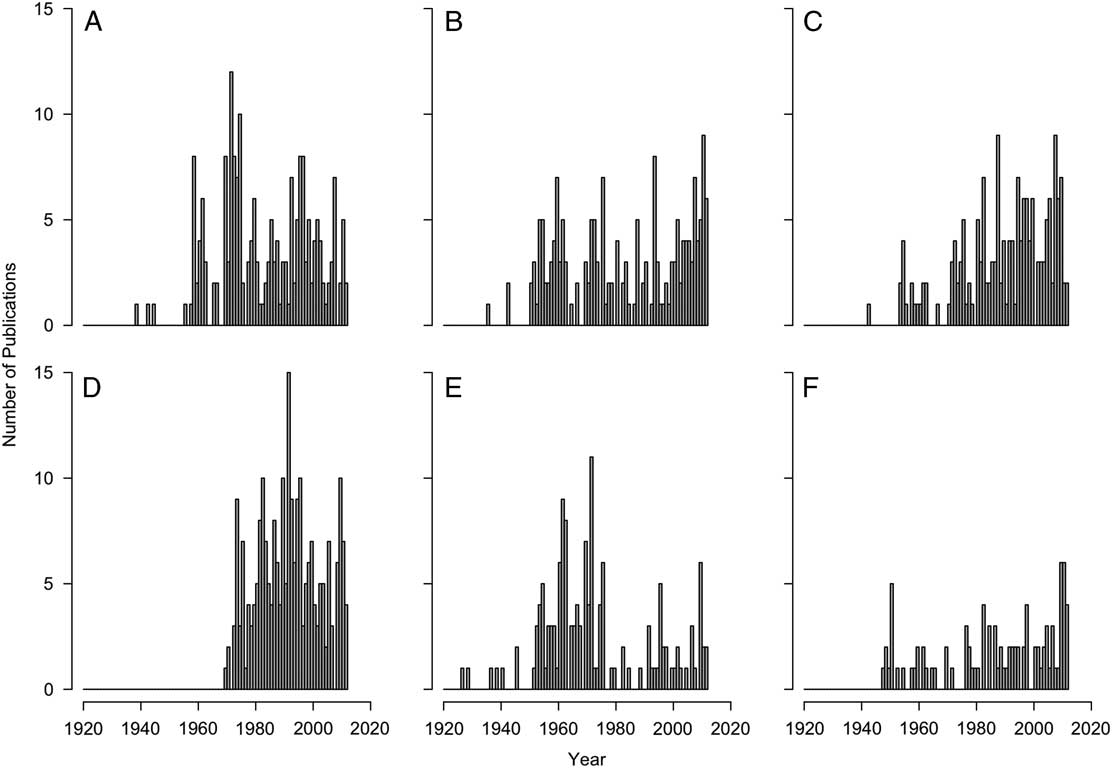
Papers evaluating insecticides (Fig. 8A) or describing insect life histories and distribution (Fig. 8E) peaked in the late 1970s and decreased thereafter. Although publications on semiochemicals were infrequent until the late 1970s, they peaked in the late 1990s and decreased markedly thereafter. The number of publications describing population dynamics (Fig. 8B) and behaviour (Fig. 8F) have remained relatively stable, although displaying peaks similar to those in Figure 1. The rate of publication of papers on monitoring (Fig. 8C) has generally increased since the early 1950s.
Annual number of peer-reviewed papers in forest entomology published by Canadians between 1926 and 2012 that describe research on: (A) insecticides; (B) population dynamics; (C) monitoring; (D) semiochemicals; (E) life history and distribution; and (F) behaviour.
Transition of research activity from Canadian forest service to universities
Before 1970, almost all publications in forest entomology in Canada resulted from research carried out by the Canadian Forest Service (Fig. 9). Consequently, Figure 9 tracks Figure 3 almost perfectly for the years 1926–1970. After a very large peak in publications in the early 1970s, publications from Canadian Forest Service scientists decreased, and then gradually increased again.
Annual number of papers in forest entomology published by Canadians between 1926 and 2012 for which the address of the first author was: (A) the Canadian Forest Service; or (B) a Canadian university.
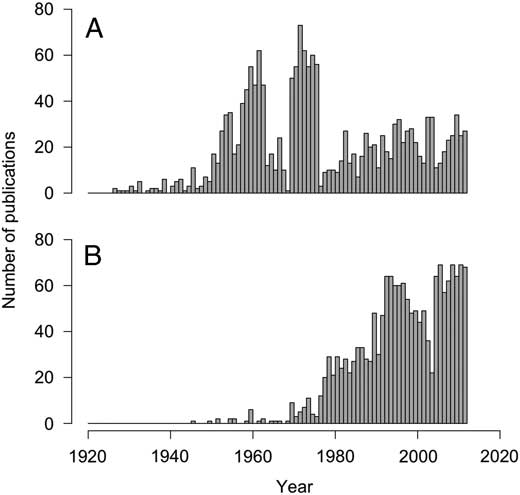
Research in forest entomology in Canadian universities increased markedly from 1970 to 2012 (Fig. 9), and was primarily responsible for the last two peaks in publication evident in Figure 3. There are probably several reasons for the transition in research activity from federal to university laboratories. Two of the most probable reasons are decreases in the number of forest entomologists employed as research scientists by the federal government and a large increase in the number of graduate students and graduate programmes in forest entomology at Canadian universities. A recent study by Timms (Reference Timms2014) showed that the number of student members in the Entomological Society of Canada increased markedly in the 1960s, remained high until the mid-1980s and then stabilised at a moderate level, lending partial support to the latter hypothesis.
The transition in research activity from the federal government to the universities is probably overstated in Figure 9. A large proportion of forest entomological research in Canadian universities has been carried out collaboratively with scientists from the Canadian Forest Service. This has been a very fruitful collaboration, as often the Canadian Forest Service provided field infrastructure, field vehicles, expensive laboratory or insect rearing facilities, and experienced research personnel while university collaborators provided students, library and other academic facilities, and different funding sources. However, as most studies were part of the theses of graduate students, they were first authors of publications and thus the publications are listed as “university” publications in Figure 9.
Transition in the role of women in Canadian forest entomology
As in many fields of science, few women carried out research in forest entomology until relatively recently. A perusal of the list of authors of older publications in Canadian forest entomology, or of photographs of researchers at scientific meetings, such as the Spruce Budworm meeting in 1967 (Fig. 10), illustrate that forest entomology was a male-dominated discipline. This has changed greatly in the recent past. For example, a perusal of the web site (http://cfs.nrcan.gc.ca/employees) listing employees of the five research centres of the Canadian Forest Service in August 2014, indicates that >30% (n=32) of research scientists in forest entomology are women.
Photo of participants at a Spruce Budworm Research Conference held at the Atlantic Forestry Centre in Fredericton, New Brunswick in 1967. Participants, from left to right: front row – Frank Webb, W.A. (Ed) Reeks, Dick Belyea, George Green, Jim Fettes, and Bob Blais; second row – J. McBain Cameron, Lloyd Sippell, Anton Stehr, and Ross McDonald; last row – Doug Eidt, Chris Sanders, George Harvey, Ian Outram, and Charlie Miller.

Transition in journals selected by Canadian forest entomologists
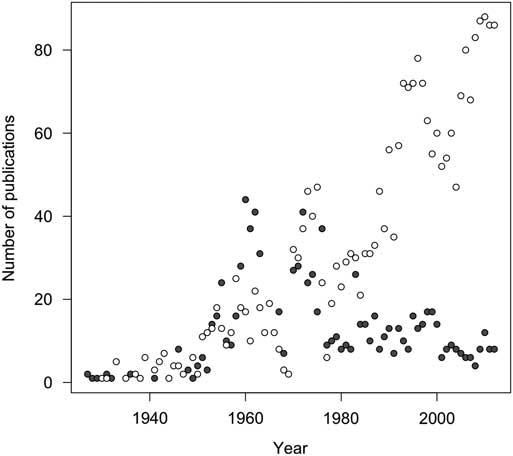
Up until the late 1970s, approximately half of all Canadian studies in forest entomology were published in the Canadian Entomologist. Shortly thereafter, however, the number of studies published in the Canadian Entomologist declined to a modest level and has remained stable at that level since (Fig. 11). In contrast, the number of papers published in other journals has steadily increased, so that in 2012 results from ~90% of Canadian studies in forest entomology were published in journals other than The Canadian Entomologist. It is probably not coincidental that the transition from publishing in the Canadian Entomologist to other journals coincided with the change in first authorship from scientists at the Canadian Forest Service to graduate students from Canadian universities (Fig. 9). Graduate students often place a very high priority on publishing in a variety of international journals with high impact factors, a phenomenon brought about in part by the high ratio of graduate students to employment opportunities in forest entomological research.
Annual number of papers in forest entomology published by Canadians between 1926 and 2012 in The Canadian Entomologist (closed circles) or in other peer-reviewed journals (open circles).
Conclusions
As Canada contains a large proportion of the world’s forests, it is not surprising that it has a long and rich history of forest entomological research. Most forest entomologists in the late 19th and early 20th centuries were men. Typically they hiked, canoed, rode on horseback, or walked throughout forests while investigating economically important pests. Research publications were usually very descriptive and often contained details of the challenges involved in carrying out the field studies. The number of peer-reviewed publications emanating from studies in forest entomology in Canada greatly increased following the Second World War and has continued to increase since then. Much of the outstanding historical success in Canadian forest entomological research is attributable to the work of entomologists employed by the Canadian Forest Service, who authored the majority of studies until the mid 1970s and usually published them in the Canadian Entomologist. Since that time the majority of publications have been authored by forest entomologists at Canadian universities, often in collaboration with the Canadian Forest Service, and published in a broad range of journals.
Men carried out most of the early research in forest entomology in Canada but the proportion of forest entomological research carried out by women has increased significantly. The majority of research in central and eastern Canada focussed on the natural history and management of defoliators whereas the majority of research in western Canada examined bark beetles and their management. Although publications on defoliators and their natural enemies have occurred continuously throughout the historical development of forest entomology in Canada, the numbers of publications on wood borers and bark beetles and their natural enemies have never been higher than they are presently.
Several trends revealed in this study will likely continue. A continuation of the relative increase of entomological research in university versus government laboratories will most likely bring a sustained change in the types of research undertaken. Due to time constraints on the length of university research grants, and on the length of projects carried out by graduate students and post-doctoral fellows, research will concentrate on short-term projects. Long-term studies, such as research on population dynamics and ecosystem functioning, will be increasingly rare and remain primarily dependent on funds from the Canadian Forest Service.
The increase in the number of women in forest entomological research should continue for some time until a new equilibrium between the relative number of men and women is established. Similarly, the increased emphasis in recent years on research of invasive pests and on the effects of climate change will likely continue. Although the future directions of research in forest entomology will surely involve areas that we have not anticipated, that research will be built on an outstanding base of research that has been carried out by Canadian forest entomologists that preceded them.
Acknowledgements
The authors thank Leah Flaherty, Melissa Fulton, Allison Quiring, and Natasha Quiring for assistance with the literature search; Karen Jamieson, Caroline Simpson, and Jean Turgeon for access to historical Canadian Forest Service documents; the Atlantic Forestry Centre (CFS) for historical photographs; Rene Alfaro, David Langor, Vince Nealis, Roy Shepherd, Jacques Regnière, Caroline Simpson, and Alan Van Sickle for help identifying entomologists in Figure 10; Steve Heard, David Langor, Rene Alfaro, and two anonymous reviewers for comments on an earlier version of the manuscript; and the Natural Sciences and Engineering Research Council (Discovery grant), Entomological Research Services Inc. and the University of New Brunswick for financial support.



