In a well-known essay on the ‘invisible technician’, Steven Shapin discusses Robert Boyle's experimental practice and the role of his assistants in laboratory work. As an exception to the invisibility of the technicians, Shapin cites the preface to the Experimentorum novorum physico-mechanicorum continuatio secunda (1680), where ‘most unusually, Boyle gives the name of his paid assistant’.Footnote 1 This unique case of the ‘visible technician’ concerns the French Huguenot Denis Papin (1647–1713). In the Continuatio secunda, Boyle recounts that Papin used ‘a pneumatick-pump of his own, made by himself’, for the experiments on vacuum.Footnote 2 Moreover, Boyle had left some of the interpretive work to the assistant: ‘Though, to speak the truth, some few of those inferences own [sic] themselves more to my assistant than to me.’Footnote 3 Demonstrating his relative independence in the laboratory, as well as the work done for Boyle, Papin had also performed experiments on ‘the preservation of fruits, and of flesh in liquors’ which were made ‘for a particular end of his own’.Footnote 4 These experiments were part of a larger project Papin was working on in the 1670s, which culminated in the invention of the digester, a rudimentary pressure cooker used to soften hard bodies by boiling them at high pressure.
In a recent publication David Wootton suggests that Papin's work on the digester has largely been forgotten – ‘one could easily form the impression that no one has read it in the past century’.Footnote 5 Wootton notes that ‘there is not a single citation of it in Google Scholar, or in Thomson Reuters Web of Science’.Footnote 6 In the eighteenth century, however, Papin's writings seem to have been very successful, not only in commercial terms (‘judging by the number of the surviving copies, the books sold well when first published’), but also for their influence on Thomas Newcomen and James Watt in the invention of the steam engine.Footnote 7
The best extant account of the digester and its eighteenth-century reception has been provided by Emma Spary. Spary presents a fully detailed history of the ‘economical use’ of the digester in France, namely the use French practitioners had made of the device as a ‘philanthropic apparatus’ useful for turning bones into ‘a nutritive resource for the poor and invalid’.Footnote 8 The digester could in fact extract from bones an edible jelly that served as the basis for preparing an inexpensive and nourishing soup. In France, none of the projects involving the digester ‘achieved lasting commercial success’: from this fact Spary concludes that, while the digester ‘provoked comparisons between alimentary science in the laboratory and alimentary practice in the household … it embodied the difficulty of transferring a technology from the laboratory to the domestic setting’.Footnote 9 Spary's account is less detailed when it comes to Papin's work on the digester. Relying on a consolidated historiographical tradition, she states that ‘Papin laid less emphasis on its [the digester's] natural philosophical uses than on its potential for culinary and naval food preparation and preservation.’Footnote 10 Papin's treatise, Spary continues, ‘contained so many recipes that it was in essence a sort of cookbook, rather than a work of natural philosophy.’Footnote 11
In the first section of this paper, I will propose a novel interpretation of Papin's work on the digester, claiming that it represents the intersection of laboratory and cooking practices. The digester was, for Papin, a chemical instrument, whose functions could be rationalized through quantification. This rationalization, however, did not merely serve to acquire new natural-philosophical knowledge, but also to highlight the economic potential of the digester: it could save time and fuel, reduce material waste, and make cooking easier.Footnote 12 In this sense, Papin's invention is a good instance of what Simon Werrett has called ‘thrifty science’. The device was meant to promote efficient household management based on a careful use of the available resources, of central importance in an age constantly threatened with dearth.Footnote 13 At the same time, the recipe collections resulting from Papin's engagement with the digester are a testimony to the codification process of the culinary art in the early modern period. The emergence of new technological devices, and the growing interest of natural philosophers in cooking practice, contributed to the standardization of recipes by defining accurately – through measurement and quantification – the ingredients and procedures involved.Footnote 14 Recipes thus formulated progressively lost the private or familiar dimension traditionally associated with them, and became vehicles of knowledge transfer across communities of cooking practitioners.
In the second section, I will assess the eighteenth-century reception of the digester, presenting documents that demonstrate its wide circulation in several regions of Europe other than France. I will argue that there is a strong continuity between Papin's work on the digester and its eighteenth-century reception, especially in terms of the relevance of the device from an economic standpoint. The digester, as I will show, does not embody the lack of communication between the laboratory and the kitchen, but rather highlights their intertwined nature. Alongside its use in chemical research, the device was in fact variously employed to cook large quantities of food in the framework of projects for poverty relief; eighteenth-century authors also insisted on its potential role as a cooking pot for ordinary kitchen use. These manifold uses, both attested and potential, of the digester required a reworking of its material structure, which was carried out in different fashions. Also, many of the eighteenth-century digester's users adopted the same ‘quantifying approach’ that had characterized Papin's work. This is to be understood in relation to the economic virtues attributed to the device: quantification was indeed meant to give a solid foundation to the promise of the economic efficiency of the device, which mostly consisted in saving time and fuel and in a responsible use of the available material resources. At the same time, the major role played by the digester in philanthropic food programmes suggests that, in the early modern age, the question of the social value of technological innovation was extremely relevant. In the eighteenth century, savants and artisans were constantly confronted with the question of ‘social progress’, with particular regard to urban planning and public health.Footnote 15 In this context, a central issue was that of providing food supplies for the destitute, who were often dependent on public charity for their survival.Footnote 16 In discussions of the ‘charitable use’ of the digester, the accurate calculation of the quantities of ingredients and products went together with reflections on the costs and benefits of collective cooking, as well as with attempts at organizing rationally the work of large kitchens. This shows once again the deep intertwinement of natural-philosophical inquiry with economic concerns and the implications which this had for broader social management.
Denis Papin's digester
In the third volume of the History of the Royal Society (1757), Thomas Birch mentions the first discussion of Papin's experiments with the digester at the Royal Society of London on 22 May 1679. As Birch recounts, there was ‘a gentleman, who stayed in the outer room with an intention to shew an experiment to the Society, which was singular and new’.Footnote 17 At that moment, the invention was materially complete, but the possible uses and functions of the device required some more experimental work to be properly understood.
He [Papin] being brought in shewed a small glass, which he had in his pocket, wherein were contained several small pieces of hartshorn, which he had softened by a new way, that he had found out, of boiling them[Footnote 18] … He affirmed, that he had a method of softening other bones also by boiling, and likewise ivory. Being demanded, whether any of the substances so softened would by keeping, or any other way, that he knew of, be again hardened? He answered, that he was not sure of that effect; though he thought, that these substances, which were this way softened, could scarce be reduced to their former solidity. He was desired to try what effect this kind of boiling might have upon barley, wheat, malt, or the like for making liquors: as also, to let the Society see an experiment of its effects upon other kinds of bony substances and flesh; which he promised to do.Footnote 19
Although the interest of the Royal Society in Papin's machine seems to have been in both its contribution to natural philosophy (the clarification of the properties of softened substances) and artisanal uses (the preparation of liquors), in subsequent meetings Papin focused exclusively on the experiments he had performed on food. As Birch reported on 12 June 1679,
The Society did not sit, but were entertained with the examination of several experiments: the first was the body of a mackerel boiled by Mons. Papin after his new way … the second was a parcel of hartshorn, which had been formerly softened … The third were the chips of oranges softened by the same art …Footnote 20
In the same months, Papin announced his invention to Christiaan Huygens. In a letter of 25 May 1679, Papin recalled that he had been working ‘over three years’ with Boyle in London, studying ‘the properties of rarefied, compressed, and artificial air’.Footnote 21 As the result of these years of experimentation, Papin related that he had invented a machine – which had been presented only in England so far, but was soon to be communicated to the Paris Academy of Sciences – ‘that can serve an infinity of new experiments on any kind of body, since through it I can increase dramatically the intensity of fire without the body losing anything of its substance’.Footnote 22 In presenting the invention to Huygens, Papin did not restrict its use to cookery, but mentioned the possibility of a large spectrum of applications, since, he argued, any natural body could be submitted to its action. In other texts of the same years, Papin was even more explicit on the potential of the new machine for the advancement of knowledge of natural phenomena. In a letter to William Croon of 1 March 1681, Papin affirmed that the device could serve to ‘discover some properties of heat’ but that presently he ‘had no time to work upon such things’ and would have afterwards referred to the Royal Society ‘whether or no such things be worth trying’.Footnote 23
The first printed treatise on the digester was published in 1681 under the title A New Digester or Engine for Softning Bones. In the preface, Papin recalled that a prototype of the digester, namely a ‘screwed balneum mariae’, had been presented in Boyle's Continuatio secunda. Boyle's book, however, was written in Latin and the engine was not fully described, so that it was of no utility for ‘housekeepers and tradesmen’, to whom Papin's treatise was specifically addressed.Footnote 24 Papin believed that the digester could improve the ‘ancient art’ of cookery, ‘the use whereof is so general and so frequent … that it seems if any could be brought to perfection, this should be it’.Footnote 25 The contribution of the digester to the evolution of cookery consisted in the fact that ‘the oldest and hardest cow-beef may be made as tender and as savoury as young and choice meat’.Footnote 26
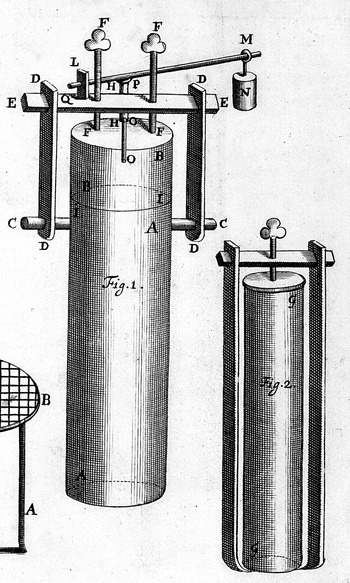
The digester was made of a hollow brass cylindrical container, and a brass cover that could hermetically close the container by means of big screws (Figure 1). The substances to be boiled in this closed bain-marie were to be put in a smaller hollow cylindrical container, made of either glass or pewter. While Papin addressed household practitioners, the digester's context of use seems to have been the expert laboratory rather than the kitchen. Papin stressed that the digester should be heated in ‘a furnace built on purpose for it’, such that the engine would be ‘almost all closed in the furnace’ in order to ‘better receive and keep the heat’.Footnote 27 Also, the digester's use was far more complicated than other kitchen utensils: ‘the mischief is that it [the digester] is much more troublesome to look into than into ordinary pots … it may sometimes happen, that you will draw your meat before it is ready enough; and sometimes too you may burn it’.Footnote 28
Denis Papin, A New Digester or Engine for Softning Bones, London: Bonwicke, 1681 (detail). Wellcome Collection, London. Public domain mark.

Since it was impossible to see directly whether the cooking was done, the user of the digester needed to measure the inward pressure and the degrees of heat as accurately as possible to know how the cooking was going. Concerning the measurement of the inward pressure, Papin proposed to leave an opening on the digester's cover and wedge in a ‘little pipe open at both ends’ (PO).Footnote 29 On top of this pipe there was a valve (HP). The valve was kept down by an iron bar (QM), attached at one extreme to the metallic structure of the digester (L), and free at the other. A weight (N) was applied to the free extreme of the bar, so that – according to its mass and its position on the bar – it could counterbalance the pressure coming from within the digester, which strove to lift the valve. In Papin's model, the bar was twelve inches long, and the distance between the extreme attached to the machine and the valve (LH) was one inch. Based on Boyle's experiments, Papin could determine that the air pressure against the aperture of the little pipe (where the valve was located) was two pounds. Therefore, if one charged the free extreme of the bar with a one-pound weight ten inches away from the valve, this weight pressed the valve as much as twelve pounds would do; in order for this weight to be lifted up, the inward pressure had to be ‘six times stronger than the ordinary pressure of air’.Footnote 30 Relying on these data, the inward pressure could then be measured by ‘increasing or lessening the weight, or by removing it from one place to another’.Footnote 31 This technique, for its theoretical complexity as much as for its delicate practical implementation, seems to be more a laboratory procedure to be performed by an experienced technician, rather than an operation that anybody could carry out in their kitchen.
The method used to determine the degrees of heat was more empirical than that employed to measure inward pressure and explained in less detail. Papin seemed in fact to be struggling between, on the one hand, the need for a ‘very easy’ technique that anybody could understand and adopt, and, on the other, an accurate quantification of all the parameters as the foundation of a truly scientific procedure.Footnote 32 To measure the degrees of heat, one needed to hang a weight on a three-foot thread, and let it swing so that its period was one second. At the top of the weight, there was a little cavity where the practitioner poured a drop of water. According to the number of times the weight swung before the drop evaporated, one could determine the corresponding degree of heat. Papin did not give precise indications on the height at which the weight should be hung, or on how to establish an exact relationship between the degrees of heat and the oscillations of the weight. He rather stuck to an empirical approach, suggesting that ‘it will be enough to keep always the same quantity of water in the engine, and find by experience what degree of heat will be necessary for every operation with such a quantity of water’.Footnote 33 This empirical attitude suggests Papin's intention of simplifying the digester's use, showing that it could be easily manipulated and used effectively even without calculating all of the parameters with accuracy.
After describing the machine and giving instructions on the method of use, Papin expounded a long series of experiments, divided into sections addressed to different practitioners: cooks, sea travellers, confectioners, distillers, chemists and dyers. Amongst the experiments, some are typical instances of chemical laboratory trials:
We put into a little glass pot salt of tartar with rectified spirit of wine: into another pot we put amber with some of the same spirit of wine. We continued the fire till the drop of water would dry away in 3 seconds, with an inward pressure twelve times stronger than the ordinary pressure of the air, and then we did put it out presently. The vessels being cooled, we found in the first pot that the tincture of tartar was as strong as it could have been made in a month's time after the ordinary way, and its taste was lixivious; in the other pot the tincture of amber was a great deal stronger than usually it is.Footnote 34
The attention was here focused on the chemical properties of the substances involved in the experiment, studied from a natural-philosophical angle. Inward pressure and the degrees of fire – as an equivalent to the evaporation time of the drop of water – were also accurately quantified.
Other experiments – which are in fact the majority – concerned cooking practices. While the interest in quantification was still present in these experiments, the digester's economic potential represented here Papin's major concern. Consider the following example:
June 2. Having filled my pot with a piece of a breast of mutton, and weighed seven ounces of coals, I lighted the fire; the heat came to such a degree as to dry up a drop of water in 3 seconds time, and the inward pressure was about nine times stronger than the ordinary pressure of the air: I let the fire go out of itself, and the vessels being cooled, I found the remaining coal to weight about half an ounce: so that there had been but 6½ ounces consumed; nevertheless the meat being taken out, was found to have contracted an empyreumatic taste, and the juice of it did not turn to jelly so strong as when the meat is not overdone.Footnote 35
Here again, the determination of inward pressure was accompanied by the measurement of the evaporation time of the drop of water. Besides these two values, Papin gave a precise indication of the quantity of charcoal employed for the experiment. Saving fuel was indeed a desideratum for any practitioner working with fire, especially in a domestic setting, as charcoal was hard to get, and was generally expensive.Footnote 36 In Papin's view, the possibility of saving fuel was a central advantage of his invention, so much so that he dedicated a whole chapter (the ninth and last of the treatise) to ‘A calculation of the price that a good big engine may come to, and of the profit it may afford’. In this section, the quantifying approach was extended to the financial gain that could be acquired with a digester, when one used it to prepare great quantities of food:
Now such an engine is able to make above 50 pounds of the jelly at a time, and may do the same quantity at least twice in 24 hours, (for I have tried that my great engine, which is 6 inches in diameter, may in less than an hour's time be heated enough to make jelly of bones) therefore one may make 100 pounds of jelly every day. Now in Paris where people constantly keep jelly ready to sell, the price of it is 20 pence a pound; but in London, where they make none, unless it is bespoken, apothecaries use to sell it at 2 shillings a pound; therefore it would be a very good thing for the public, if any one would sell jellies for a groat a pound: yet at that price the aforesaid engine would make jelly for above 33 shillings every day.Footnote 37
Alongside fuel consumption and financial gain, the digester's power of saving time was also an important feature for Papin. In the ‘Postscript’, he insisted on the rapidity of the digester by referring to Edmund King's use of the device for pharmaceutical preparations: ‘Besides many good dishes of meat and fish, he [King] had prepared several medicines, and found that in this engine [the digester] the operation may be performed in less than the tenth part of the time that is required in his other furnace.’Footnote 38
In Papin's treatise, the presentation of the digester as a tool for chemical research ran in parallel with indications for its use in cookery. The rationalization of the digester's functions, through the quantification of inward pressure, the degrees of fire and the quantity of charcoal, resulted in an accurate evaluation of the benefits it may bring, which mainly consisted in saving fuel and time, and the consequent financial benefits.
The hybrid nature of the digester – laboratory apparatus and cooking pot – and the intertwinement of natural-philosophical research and economic thinking, were further articulated in Papin's work on the invention after 1681, which culminated in the publication of a second treatise, A Continuation of the New Digester of Bones, in 1687. Papin's work on the digester after 1681 dealt with two aspects in particular. First was the improvement of the material structure of the device. Papin had indeed developed a new model that required no inner pot, and that, with respect to the old one, had enhanced performance. As Papin wrote in a manuscript note dated 5 May 1686,
Although the digester such as it was publish't five years ago may be of a great advantage for saving fire and time, and for extracting gellys even out of bones that would never yield any by the ordinary way's, I have been endeavouring to improv'it further, and I believe by a small alteration I shall mak'it cheaper, more commodious especially for sea, of a greater <execution> \effect/ in less time, and with less fire than it was at first. For that purpose I need but take a brass hollow cylinder shut at the bottom and open at the top[.] I line it with pewter pretty thik, that the brass may not give any bad impression to the gelly: so ther is no need of an inward pot …Footnote 39
Second, the preoccupation with the systematic quantification of the digester's functions – time and fuel consumption, and the resulting financial gain – became a constant trait of all of Papin's experimental reports, which now dealt almost exclusively with food transformation. Consider the following excerpt from the Continuation:
I increased the fire to the new digester, till it was come to the ordinary heat to make six pounds of jelly, and being left about a quarter of an hour to cool, I took out the jelly and filled the engine again immediately with new materials: I did put afterwards the fire to it with equal weight of coals, and I found, that whereas the first time it could not be heated in less than 36 minutes; this second time it required no more but 27, and there was but seven ounces and a half of charcoal consumed; and so I conclude, that by this new manner, there would be a sixth part of coal less spent, than I had found by the preceding experiment; there is no doubt also, but the engine would complete its operation, and make six pounds of jelly in less than an hour's time; and therefore it is easy to see it can afford about 150 pounds in four and twenty hours, by consuming but about eleven pounds of charcoal, and if the furnace is made fit to burn sea coal, the charges will be yet much diminished.Footnote 40
The evolution of Papin's work after 1681 is even more evident testimony that the digester should be understood in the framework of early modern ‘thrifty science’. While simplifying the material structure of the device, Papin kept on rationalizing the digester's use by systematically quantifying its functions. Such a quantification concerned values – fuel, time, financial gain – that were particularly relevant to the use of the device in house management or manufacturing practices, rather than to purely natural-philosophical investigations.
Papin's invention was immediately successful and made a noise even outside Britain. As a matter of fact, from the end of the seventeenth century, the digester was reappropriated and reshaped by several Continental practitioners in manifold ways and with different aims.Footnote 41 In the next section, a few cases in point from the eighteenth-century reception of the digester will be considered, insofar as they showcase the variety of debates and practices fostered by Papin's invention.
The circulation of the digester in eighteenth-century Europe
In the first half of the eighteenth century, the digester was mostly mentioned in the context of natural-philosophical studies of the elastic force of vapour at high pressure. After the contributions of Hermann Friedrich Teichmeyer, Petrus van Musschenbroek, John Clayton, Jean-Antoine Nollet and Andreas Leopoldus Haan, the most comprehensive discussion of the digester from the standpoint of natural philosophy is to be found in the Swiss Johann Heinrich Ziegler's Specimen physico-chemicum inaugurale de digestore Papini eius structura, effectu et usu (1769).Footnote 42 Ziegler's use of the device was embedded in a consolidated laboratory practice: for instance, he combined the use of the digester with other measuring tools, such as a thermometer and an elatrometer.Footnote 43 Ziegler presented the results of experiments on the rarefaction of vapour in the digester at different temperatures, using both water and spirit of wine; he also described experiments on a variety of substances, amongst which are wine vinegar (acetum vini), spirit of wine (alcohol vini), camphor (camphora), spirit of vitriol (spiritus vitrioli), oil of turpentine (oleum terebinthinae) and others.Footnote 44 Ziegler insisted on the importance that his studies might have for domestic practices, referring in particular to a number of flowers and vegetables which could be treated in the digester to produce remedies. On the whole, however, the Specimen remained a highly technical treatise, addressed to an audience of experts. As stressed in a review (anonymous) of the work published in the Gazette salutaire on 22 November 1770, ‘this essay deserves to be read by chemists and physicists’.Footnote 45
At mid-century, however, a widespread interest in the economic potential of the digester emerged in several regions of Europe. Whereas the digester's reception in France has already been studied in depth, the penetration of the device in other areas has been overlooked. I will focus on three territories – Sweden, Italy and the Netherlands – that seem emblematic for understanding the variety of the modes of penetration of the digester into eighteenth-century experimental and artisanal culture.
In 1773, the Swedish savant Johan Carl Wilcke (1732–96) published in the Vetenskaps Academiens Handlingar (Transactions of the Swedish Academy of Sciences) a paper on the economic use of Papin's digester, entitled ‘Försök till en ny inrättning af Papini digestor, til Oeconomiska behof’ (Trials with a new model of Papin's digester, for economic use). Wilcke recounted the genesis of the invention and the main attempts at use made before his time, referring especially to the French practitioners. Wilcke, however, lamented that his contemporaries had mistaken Papin's intentions: ‘For a long time, Papin's actual intentions have been almost completely forgotten.’Footnote 46 What was conceived as a ‘useful cooking pot’ (en nyttig kokgryta) had been turned into a ‘philosophical instrument’ (philosophiskt instrument), with the result that ‘the simple economic benefits have been set aside, and digesters have ultimately become a notorious but unknown rarity’.Footnote 47 Once the meaning of Papin's digester was understood correctly, the machine could be highly useful ‘partly in the kitchen, partly in several artisan productions’, for its principal advantage consisted in ‘saving wood and fuel’.Footnote 48 On a social level, the potential of the digester for cooking practices lay in the possibility of preparing meals ‘for the needs of the less fortunate’.Footnote 49
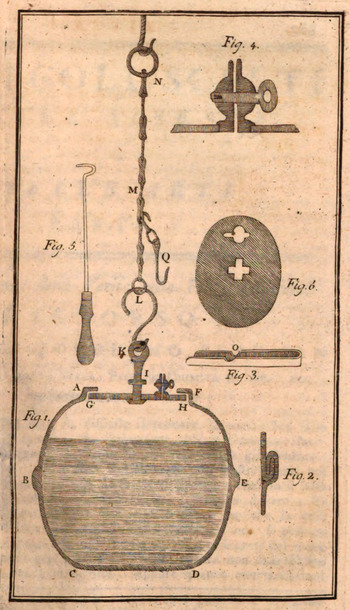
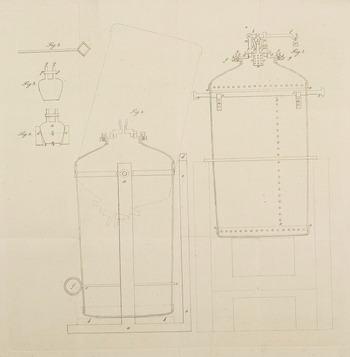
Wilcke recalled that, in the 1760s, the digester was already well known in Sweden, as shown by the ‘precious metal-cast digester’ donated to the Swedish Academy of Sciences by Gerhard Meyer, knight of the Royal Order of Vasa. In the first available description of Meyer's digester (1762), capitaine-mechanicus (head of education in the Fortification Corps) Carl Knutberg explained that the device could serve to perform ‘several beautiful and useful experiments’ and that it would enrich the instrument collection of the academy's chemical laboratory.Footnote 50 Ten years later, Wilcke noticed that the digester had failed to penetrate Swedish society and that, consequently, no ‘general application thereof’ had been made.Footnote 51 The cause was to be sought ‘in certain secondary circumstances’ which concerned the material of the digester: the device was expensive to build, and dangerous to manipulate.Footnote 52 Wilcke recalled the ‘the untimely eruption of the vapours, or the pressure of the air at the opening of the lids’, as well as the fact that ‘the cooking itself did not always proceed as desired’.Footnote 53 The solution advanced by Wilcke consisted in reshaping the material structure of the device, in order to make it easily manoeuvrable, safe and cheap to construct. The essential change concerned the lid, and therefore the closing system of the digester: Wilcke's lid was elliptical, and slightly bigger than the vessel's mouth, so that it was inserted obliquely, and held in place during the cooking by the steam pressure from inside (Figure 2).
I have fallen upon the idea, that, by applying the lid from within [inifrån], the very power of the vapours themselves could be used to block their way; and have hence, amongst other things, found the advantage that, when the closure of the vessel, after the old dispensation, becomes more incurable and more difficult, the more the heat and the pressure from within increase; so the same growing force, according to the new way of closing, contributes more and more to the arrival at a good conclusion and to the containing of the vapours themselves, on which the whole effect really depends.Footnote 54
‘Estratto di una memoria sulla macchina papiniana semplificata per l'uso economico del Sig. Wilcke’, in Opuscoli scelti sulle scienze e sulle arti, 21 vols., Milan: Marelli, 1778–9, vol. 2. New York Public Library. Public domain mark.

Wilcke then listed the four main advantages of his new model of the digester: it was ‘less costly’ (mindre kostsame) and ‘very easy to use’ (mycket lättbrukade), untimely explosions were avoided, and it was suitable for all ‘economic needs’ (economiska behofven).Footnote 55 Based on these considerations, yet without proposing any precise financial quantification (as Papin had done at the end of the 1681 treatise), Wilcke affirmed that this new digester could provide an outstanding contribution to poverty relief in a city like Stockholm: ‘I dare to guess that in all probability if all the bones that are thrown away daily in a city like Stockholm were collected, more soups could be prepared from them by means of digesters, than there are poor people to consume them.’Footnote 56
Unfortunately, there is no record of an actual use of the digester in philanthropic programmes operating in Stockholm.Footnote 57 In the archives of the Swedish Academy of Sciences, however, a few documents are preserved that show Wilcke's attempts to circulate the machine in his country, even beyond the discussion presented in the 1773 paper. Wilcke left two lists of digesters he had built, of different sizes, with the names of several buyers. Most digesters were sold to members of the academy to make experiments, but some were also destined for the royal kitchens and infirmary. Of the thirty digesters completed by Wilcke in collaboration with coppersmiths Ronsenberg, Nohrberg and Adolph, three exemplars are still in the possession of the History of Science Collections of the academy.Footnote 58
It is also to be noted that incidents with the device were not completely avoided by Wilcke's modifications of the digester. In a letter dated 25 September 1773, coppersmith Elias Pfeiffer informed Wilcke about an explosion that had occurred with a digester he built after the description published in the academy's Transactions.Footnote 59 The lack of security was probably caused by the absence of a properly conceived safety valve that could reduce the pressure inside the pot.
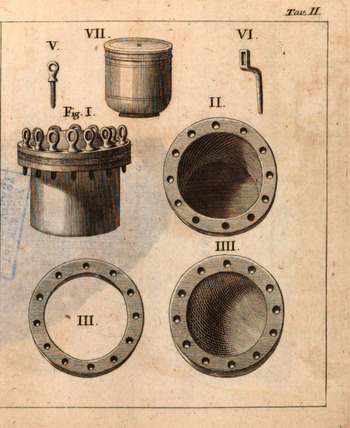
A few years after Wilcke's engagement with the digester, two Italian authors became interested in the device. Both of them belonged to the milieu of the Società Patriottica of Milan. This was a cultural institution promoting ‘agriculture, the useful arts, and manufactures’, created by Maria Theresa of Austria in 1776 and ended in 1796 (the year of Bonaparte's triumphal entry into Milan).Footnote 60 In 1778, apothecary Giann'Ambrogio Sangiorgio (?–1782) published La macchina di Papinio riformata all'uso economico, e farmaceutico (Papin's Machine Adapted to Economic and Pharmaceutical Use) in an anthology of Opuscoli scelti sulle scienze e sulle arti (Selected Papers on Sciences and Arts). In his pamphlet, Sangiorgio pointed to the imperfection of the digesters employed so far, both for the danger associated with their use and for the empyreumatic taste of food cooked with them.Footnote 61 Sangiorgio decided, therefore, to develop a new digester model, working with the ‘famous mechanic’ (celebre macchinista) Angiolo Maria Sangiusto. Sangiorgio's digester was made of two pots, the one slightly bigger than the other, their height equal to their diameter, and several screws to hold them together (Figure 3).
Giann'Ambrogio Sangiorgio, ‘La macchina di Papinio riformata all'uso economico, e farmaceutico’, in Opuscoli scelti sulle scienze e sulle arti, op. cit., vol. 1. Public domain mark.

The small size, light weight and efficient closing system of this digester made it ‘more secure, more manoeuvrable, and of a more determinate effect’.Footnote 62 Sangiorgio insisted on the enhanced performance of his digester, which consisted mainly in saving time and fire for the preparation of decoctions and broths:
The advantage drawn from the use of this pot consists in the fact that, whereas any hard body, plant or animal, would require three or four hours of continuous boiling to be cooked, and therefore much fire and attention; with a half-hour of fire, and little attention, you get to the same – or an even better – result, saving much fire and trouble.Footnote 63
In Sangiorgio's opinion, the expertise required to use the device consisted of two basic elements. The first was the knowledge of the appropriate ‘degree of fire’ (grado del fuoco) to which the digester ought to be heated. Sangiorgio indicated a determinate proportion between the size of the machine and the time it should have been exposed to the fire in order to reach the ideal degree of heat: ‘In seven or eight minutes, a pot with a diameter of six inches is warm enough; for a twelve-inch pot, it takes fifteen or eighteen minutes.’Footnote 64 Since there were different results one might have wanted to achieve with the digester, the required heating time might have varied with circumstances. To know about these irregularities and deal with them appropriately, the user needed to acquire a certain ‘art’ (arte). The second element was the knowledge of the quantity of water to be put in the digester. Sangiorgio complained that neither Papin nor other authors had addressed this problem, and that they had not given to practitioners any precise rule to follow. This lack of a normative dimension, Sangiorgio claimed, was the main reason why apothecaries and cooks had made little use of the device:
Since neither Papin nor others gave a rule, and the aim of this operation seemed to be only that of decomposing bones … this wrong idea was the reason why for many years one groped around to find and define the degrees of fire, the use of the machine and the quantity of water. These difficulties explain why this instrument was never used in the pharmacy, nor in kitchens.Footnote 65
Sangiorgio suggested that, for decoctions, the digester could be filled with water up to two-thirds of its capacity; to cook bones, the ratio was one-quarter part of bones to one part of water. The formulation of such a clear rule would have made the use of the digester easy for any practitioner, even ‘of mediocre intelligence’ (di mediocre ingegno).Footnote 66
The Italian discussion of the digester continued five years later with Abbott Girolamo (or Gerolamo) Ottolini's (?–1797) Il digestore di Papino ridotto ad uso di cucina (Papin's Digesters Adapted to Kitchen Use) (1783). In this short paper, Ottolini criticized Wilcke's model of the digester, and proposed a new model ‘that is simple, and of easy and safe use in the kitchen’.Footnote 67
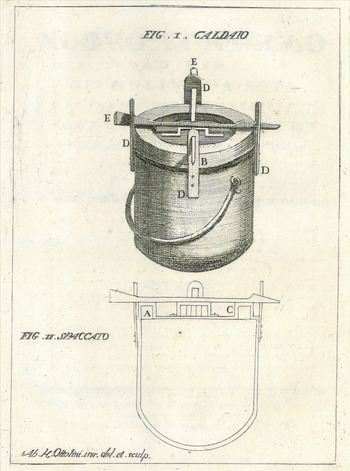
Ottolini's digester had a lid whose concavities matched perfectly with the convexities of the underlying vessel (Figure 4). The holding of the lid was secured by a ‘snap-fit’ mechanism and four deadbolts, with no need for screws. Although Ottolini did not provide the instrument with a safety valve, the risk of explosions was avoided by the fact that the closing system was not hermetic: ‘Security is provided by the fact that the lid does not close perfectly, otherwise it could burst and do harm.’Footnote 68
Girolamo Ottolini, Il digestore di Papino ridotto ad uso di cucina, Milan: Marelli, 1783. Biblioteca di Storia delle Scienze ‘Carlo Viganò’, Università Cattolica del Sacro Cuore, Brescia, VIGANÒ FA-7B-65.

Alongside these material changes, the originality of Ottolini's contribution lay in the suggestion that the digester, reckoned so far amongst the ‘chemical instruments’ (stromenti chimici), should have been turned into a ‘cooking pot’ (pentola da cucina).Footnote 69 Ottolini did not think of using it for collective cooking, in programmes of poverty relief, but rather for ordinary kitchen work. The text was in fact addressed ‘to those who work in the kitchen’ (a chi lavora nelle cucine), who could have benefited from the great advantages Papin's cooking pot would have brought to their quotidian efforts.Footnote 70 The main asset of this device consisted in the time it saved in any preparation: ‘In this [pot] … beef was perfectly cooked in less than an hour after the water started boiling, an old capon in a quarter of an hour, rice in three minutes.’Footnote 71 The quantification of time was here the result of an actual measuring practice, as Ottolini stressed that the cooking time of food had been measured ‘with watch in hand’ (con orologio alla mano).Footnote 72
Two decades after the discussions of the digester in Milanese society, the Dutch natural philosopher Martinus van Marum (1750–1837) began his research on the digester as a means to feed the poor of Haarlem, near Amsterdam. Van Marum's engagement with Papin's invention followed from the invitation of the Haarlem municipality to improve an existing programme of poverty relief. As Van Marum recalled in a journal article dated 9 December 1800,
Seeing that the Municipality have planned to distribute an inexpensive soup amongst the destitute, I thought of employing a closed cooker, usually called Papin's digester after its inventor Papin, in order to obtain readily, and in an inexpensive way, strong decoctions of bones and to make the soup more nourishing and at the same time more savoury by this means.Footnote 73
The first step to make the digester useful for the purposes of the Haarlem municipality consisted in changing the material structure of the object. Starting his experiments on small models of the digester made of brass and copper, an exemplar of which is still preserved at the Teylers Museum in Haarlem, Van Marum realized the necessity of endowing the digester with a safety valve, to let some steam out of the vessel (Figure 5):Footnote 74
In order to safeguard such a cooker against the risk of explosion, which might easily be caused by the enormous force of the enclosed, and consequently condensed, vapour, it should not only be made of thick metal, but also – the most important point – be provided with a properly made safety valve, for letting off the highly condensed vapour.Footnote 75
Martinus van Marum, Beschrijving van den Papiniaanschen Pot of Dampketel, Haarlem, 1818. Bibliotheek Noord-Hollands Archief, Haarlem, Inv. no. 3000_4074.

In the accounts of his experiments with the digester, which continued until 1818, Van Marum adopted a quantifying approach similar to Papin's, as he determined with accuracy the weights of the ingredients and the products of the cooking operations, as well as the time required to perform them. While recounting the outcome of the public demonstration of the digester performed on 26 December 1800, for instance, Van Marum noticed that ‘15 pounds of beef bones were boiled with 15 ounces of salt in 40 pounds of water for 2 hours; the jelly obtained from this weighed 36¼ pounds’.Footnote 76 The accurate determination of weights and cooking times was even more evident in accounts of the performances of larger digesters, which could be charged up to 150 pounds (c.68 kg) of water. The production of bone jelly, employed to prepare soups for the destitute, was described by Van Marum as a manufacturing activity:
The jelly from beef bones is previously cooked for a thousand portions. 100 buckets of water are then placed in a copper boiler, and 250 pounds of the best barley are poured into it. After it has soaked in there for 3 hours, the fire is started and the water is brought to boil while stirring steadily. It is left to boil for 3 hours and then the fire is removed from the stove, but stirring can continue for half an hour afterwards to prevent any burning. Half an hour before the end of the cooking, 20 pounds of salt are poured into it, and then one begins to put the jelly in the boiler by portions from time to time, and the fat obtained from cooking the bones is mixed with it. It is customary to start this cooking about seven o'clock, and the food is left in the boiler at night; the barley then expands more and more in the warm moisture, and the food retains enough heat in the closed kettle to be distributed still moderately warm the next day at eleven o'clock: this quantity is divided into 1000 portions of more than 2 and a half pounds each.Footnote 77
In this text, Van Marum did not merely portray the digester's use in the aseptic environment of a professional laboratory, but rather depicted the concreteness of large kitchens where cooks were engaged in preparing collective meals. The quantification of the digester's operations was coupled with the description of the different phases of cooking, corresponding to different hours of the day. As Van Marum stressed, these cooking operations did not necessarily have to be carried out by expert practitioners, but the digester could be operated by anybody: ‘The Papinian pot, as it is now configured, can be easily operated by ordinary workmen.’Footnote 78
The need for a large-scale production was motivated by the growing number of the Haarlem poor. The Amsterdam area in March 1799 had a population of 215,000, of which 80,000 depended on poverty relief programmes for their survival; ten years later, this number had increased to 110,000.Footnote 79 Van Marum insisted on the great number of people who benefited from the Haarlem philanthropic initiative: ‘In the winter of the previous year [1817], according to reports published in newspapers, portions of two and a half pounds of this nutritious foodstuff were distributed to 7,154 persons, three times a week for 11 weeks, and twice a week for 9 weeks.’Footnote 80
As reported by Robert J. Forbes in a 1970s essay, Van Marum's work on the digester had been successful, at least in the eyes of the Dutch government. In 1817, the secretary of the Ministry of the Interior contacted Van Marum to order the production of nineteen digesters to be distributed in several cities of the Netherlands. The coppersmith Carl Geber was selected as the artisan responsible for crafting the objects, which were actually built and were ready for dispatch on 28 April 1818. The government wished to extend the use of the digester to the whole country, and requested the dispatch of a model of the digester along with Van Marum's instructions for use to the governors of each province. Unfortunately, there is no further record attesting the success or failure of the initiative in the long term.Footnote 81
To conclude the study of the digester's circulation in eighteenth-century Europe, it should be stressed that the four authors presented in this section engaged with the problem of how to effectively implement the use of the digester in cooking (or pharmaceutical) practices. The answer was not identical in all cases, but a general tendency is to be recognized. All of the authors proposed changes to the material of the digester, in order to make it safer and easier to use even outside the controlled space of the professional laboratory. The digester, in their view, should become a tool for collective cooking, and sometimes even a substitute for ordinary cooking pots in household kitchens. At the same time, these authors kept quantifying the parameters relative to the digester's use and its performances – the ingredients to be cooked and their cooking times – in order to show the efficiency of the device, but also to provide clear rules for its use, even for non-expert users.Footnote 82 The digester was thus at the core of attempts to establish a norm for the use of new technologies, but also to ‘democratize’ innovation, granting to a large number of users access to a technology that potentially embodied the promise of improving their life conditions.
Conclusion
There is a strong continuity between Papin's presentation of the digester and the subsequent historical uses of it, especially from the mid-eighteenth century onwards. The intertwined nature of experimental research and cooking practices emerging from Papin's work is also a constant trait of the digester's subsequent uses in manifold geographical and cultural contexts. However, whereas Papin's project of introducing the digester into quotidian practices remained purely abstract, the device was actually put into practical use by these eighteenth-century authors. They planned, and sometimes implemented, the digester's use, particularly in economic cooking for whole communities. The digester thus fostered projects of social reform that well represent the philanthropic attitude of the Enlightenment, concerned as it was with ‘social progress’.
It is also remarkable that, just as with Papin's initial development, the eighteenth-century reception of the digester was characterized by attempts to rationalize the functions of the device through quantification. In addition to the ingredients and the final products, Enlightenment authors seemed to be particularly concerned with saving time. This is likely to be a manifestation of the fact that, in early modern societies, ‘time economy’ increasingly came to be perceived not only as a social virtue, but also as a central element in the culture of ‘thrift’.Footnote 83
The attempt to use the digester in several practical contexts, especially of a philanthropic inspiration, still characterized the history of the device in the nineteenth century. Many European collections preserve nineteenth-century digester exemplars whose material shapes are testimony to the wide variety of practices in which it played a role: not only cookery, but also chemistry, pharmacy and science teaching.Footnote 84 There is also evidence of an enduring interest in the digester's potential for saving time and fuel, which are quantified with increasing accuracy. In the essay ‘Der Papinische Topf und seine Anwendung in der Hauswirthschaft’ (The Papin Pot and Its Use in Housekeeping), published in 1872 in the Polytechnische Journal, Professor Junichen of Luzern compared the consumption of gas (measured in cubic feet) and time (measured in minutes) of ordinary cooking vessels and of the digester, showing that this device could save much gas and time in any cooking preparation. Junichen pleaded for a ‘general use’ (allgemeine Anwendung) of the digester ‘for private households and for public institutions, as well as for hospitals, almshouses and orphanages, mental asylums and penal institutions’.Footnote 85 The intertwinement of natural-philosophical research and economic concerns remained thus a fil rouge of the digester's history well into the nineteenth century, when the field was being prepared for the emergence of the modern pressure cooker.
Acknowledgements
This work was supported by the Swiss National Science Foundation (SNSF) as part of the research project Mesure du temps, chimie et cuisine: Formalisation des pratiques au XVIIe et au XVIIIe siècle (grant number 100011_184856). I am grateful to Anne Miche de Malleray for providing access to manuscripts held in the Royal Swedish Academy of Sciences, and to Elisabeth Thorsson and Victorine Dortu for their help with translations from Swedish and Dutch respectively.