Introduction
One in three adults dies with dementia, often receiving poorer quality care than their cognitively intact counterparts (Lawrence et al., Reference Lawrence, Samsi, Murray, Harari and Banerjee2011; Sampson et al., Reference Sampson, Burns and Richards2011a). Most people with dementia are care home residents at the end of their life (Goodman et al., Reference Goodman2010; Houttekier et al., Reference Houttekier, Cohen, Bilsen, Addington-Hall, Onwuteaka-Philipsen and Deliens2010) and usually lack capacity to decide about end-of-life care. Their families find it difficult to make these decisions for them (Livingston et al., Reference Livingston2010). At the time people with advanced dementia experience sudden, acute, serious medical problems, advance wishes about end-of-life care are usually not explicit or implemented and they are transferred to hospital, even if they and their family would prefer them to remain at home (Dening et al., Reference Dening, Jones and Sampson2011; Livingston et al., Reference Livingston, Pitfield, Morris, Manela, Lewis-Holmes and Jacobs2012; Robinson et al., Reference Robinson2012).
Advance care planning is the term often used for capacitous decisions about future care. In people without this capacity, discussions can take place with a family member on their behalf, who knows what is important to the person, so the care reflects this. Throughout this paper, we call this “advance care wishes.” It is difficult to consider and document these wishes at the time someone with dementia is in hospital, and interventions to increase their use should be considered before an admission is required (Sampson et al., Reference Sampson2011c). In hospital, people with dementia frequently experience uncomfortable interventions without known benefit, which fail to improve survival time (Sampson, Reference Sampson2010), and may die within hours in a strange place with professionals with whom they cannot communicate, and therefore without receiving adequate pain relief or comfort.
Identified barriers to improving end-of-life care in dementia in care homes, in line with residents’ and families’ wishes, have included: difficulties in staff communicating with each other and families about imminent death, staff lacking confidence, staff concern that they will be blamed if they do not send someone to hospital, and differing culture and ethnicity of family and professional carers (Dening et al., Reference Dening, Greenish, Jones, Mandal and Sampson2012; Livingston et al., Reference Livingston, Pitfield, Morris, Manela, Lewis-Holmes and Jacobs2012).
There are currently no interventions for residents of care homes who have moderate or severe dementia, which have improved families’ or residents’ satisfaction with end-of-life care planning (van der Steen et al., Reference van der Steen2010; Robinson et al., Reference Robinson2012). Studies which focused on increasing documented advanced care wishes in care home residents, including people with dementia, have increased the documented numbers and reduced hospital admissions but place of death is not reported (Hockley et al., Reference Hockley, Watson, Oxenham and Murray2010; Dening et al., Reference Dening, Jones and Sampson2011; Robinson et al., Reference Robinson2012). One small study implementing care home staff education found a non-statistically significant increase in family satisfaction with end-of-life care but did not report whether hospital admission was decreased (Arcand et al., Reference Arcand2009).
In this small study, we designed, delivered, and separately evaluated a program for care home staff to tackle barriers and enable staff to work with families to plan, document, and implement end-of-life advanced care wishes for people with dementia in care homes, in order to improve end-of-life care.
Methods
This mixed methods study was granted ethics approval by Camden and Islington Community Research Ethics Committee.
Participants
People with dementia living in a care home (details below), their family members, and staff from the same care home took part in the study. Those with dementia were asked for consent if they had capacity to give it. Where this was not present (judged from family carers’ and staff's reports as agreed by the ethics committee), we asked the family carers’ whether they thought the person with dementia would have agreed when they had had capacity.
People with dementia and their carers were invited to take part in the study through letters, face-to-face contact, or posters in the care home. Care home staff participants were made aware of the study by posters, and approached directly by researchers. Participating professionals and family participants gave written informed consent. Family members were asked to consent to be approached again by researchers if their family member with dementia died.
Setting
This was a study between Jewish Care (a health and social care charity for the Jewish community) and UCL, funded by The Kings Fund in London. Participants with dementia were all from a 120-bed nursing home for older people, providing care recognizing Jewish traditions, beliefs and cultures, for people throughout the religious spectrum. There were 90 paid nursing and care staff at the home when the research started. General practitioners (GPs) run weekly clinics at the home and are contactable by phone in-between.
Procedures of the research evaluation
The evaluation was led by researchers not involved in the implementation of the program.
1. Qualitative study of care home staff. Staff from different shifts were approached and interviewed individually, in a private room, before and after the intervention period, regarding their experience of caring for a person with dementia at the end-of-life. We explored confidence and satisfaction with the process and asked if they felt able to act in the residents’ best interest and whether they could access help. Staff members continued to be recruited and interviewed until no new themes arose and theoretical saturation was reached (Livingston et al., Reference Livingston, Pitfield, Morris, Manela, Lewis-Holmes and Jacobs2012).
2. Care home resident records. We extracted the following from the notes of residents who had died during the year pre- and post-intervention: existence of advance care wishes including “do not resuscitate” (DNR) plans; place of death; whether plans were put into place. We noted whether there was a known diagnosis of dementia, recorded symptoms which would fulfill standard criteria of dementia (suspected dementia), or diagnosis or symptoms of dementia not recorded.
3. Family members interviewed after their relative died. We evaluated the experience of the resident and their relative at the end-of-life, through the relatives of people with known dementia, who agreed to an after-death interview:
• A qualitative interview about three months after death used open questions with an interview guide to explore experiences around their relative's death.
• The quality of life (QoL)-AD; QoL-AD (Logsdon et al., Reference Logsdon, Gibbons, McCurry and Teri2002; Hoe et al., Reference Hoe, Hancock, Livingston and Orrell2006) can be rated as a proxy measure by family and family members completed it about their relative's experiences in their final weeks. Higher values suggest higher QoL.
• The GHQ (General Health Questionnaire; Goldberg, Reference Goldberg1986) is a validated self-complete questionnaire measuring stress symptoms. We asked relatives to fill this in about themselves. Higher values indicate higher stress and scoring ≥5 suggests that intervention is indicated.
• We asked family members to complete the after-death bereaved family member interview. It has an overall rating of satisfaction with care given at end-of-life on a scale of 1 to 10 with higher numbers meaning greater satisfaction (Teno et al., Reference Teno, Clarridge, Casey, Edgman-Levitan and Fowler2001).
The intervention
The intervention was a ten-session manualized interactive training program devised by a consultant physician (JM) and care home senior managers (HJ, GW, and NC). The head of home (NC) had already been trained in the Gold Standard Framework (a program for care homes in the UK, to enable generalists to provide high quality end-of-life care. It is not designed for those with dementia). The other managers undertook Gold Standards Framework training alongside this intervention. The program took into account the problems in delivering end-of-life care, which were discussed by care staff in the pre-intervention interviews (Livingston et al., Reference Livingston, Pitfield, Morris, Manela, Lewis-Holmes and Jacobs2012). The training program topics were: the challenges of dementia end-of-life care; the physical process and symptoms of end-of-life; emotional and psychological needs at end-of-life; planning for end-of-life care; (advance) care planning and communication with residents and relatives; religion and spirituality at end-of-life; holistic care for people with dementia at the end-of-life, and finally a summarizing and reflective session.
The program emphasized preferred place of care, how to have difficult conversations, structured listening, communication, observation, kindness, empathy, and compassion. It included discussion with senior unit managers and role playing around advance wishes and care plans. The training was given to residential and senior care workers and general nurses. There was a catch up day for staff who had been unable to attend or who had missed a significant number of the sessions, and a separate session for senior staff on completing an advanced wishes form and talking to relatives. Each session was given four times to ensure both day and night staff could be present.
A form was designed to be filled in by the staff about relatives’ decisions regarding advanced wishes including emergency care plans. If someone lacks capacity to make a decision then the decision maker is the person responsible for the intervention in question. In the case of medical decisions in end-of-life care in homes, this is therefore the GP, but the family must be consulted and their opinion and their knowledge of what the resident would have wanted taken into account to ensure that a decision is made in the “best interests” of the resident. It was countersigned by the GP, the legal decision maker. Residents with capacity could fill in their own advance care plans.
Funding
The study was funded by the Kings Fund. They commented on the design. They played no part in the execution, analysis, and interpretation of data, nor writing of the study.
Analysis
As this was a novel and exploratory study, a power calculation was not carried out.
Our predetermined analytic plan was to include data concerning residents with dementia, who had been living in the home for at least one month before death, so there had been an opportunity to consider wishes in the home. We compared the year before and after the intervention, employing χ2 analysis for categorical data and t-tests or Mann–Whitney for means or medians according to data distribution.
Qualitative interviews were taped and transcribed. We aimed for maximum variation samples, covering all the demographic groups and to interview until theoretical saturation, when no new themes arose. We used thematic analysis to identify the main themes. The transcripts were read and re-read, and a coding frame was devised. Five researchers (ELH, CP, DC, MM, and EC) worked on the coding over the duration of the project, with two of the five independently coding each one for validity. We report themes which occurred only before, or only after the intervention, as indicative of thematic change.
Results
Care home resident records
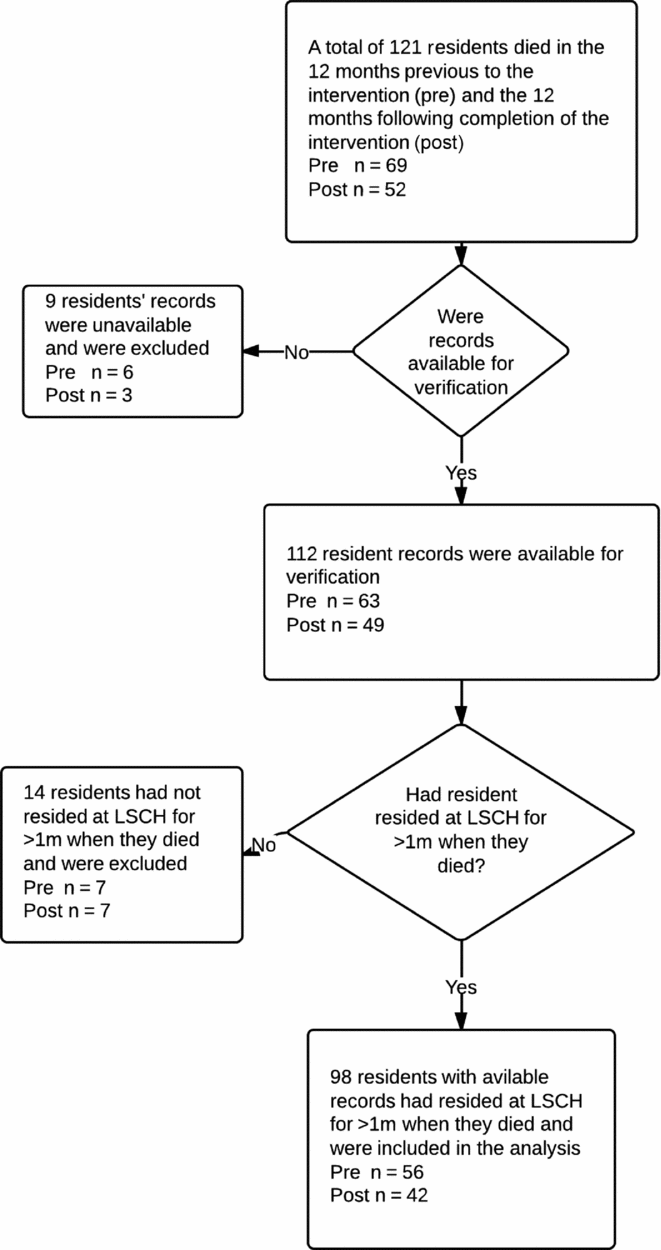
The numbers of resident records examined, and analyzed are shown in Figure 1.
Residents’ records available for analysis after death.

Residents’ deaths in the year before and after the intervention
Sixty-nine residents died in the year before intervention, of whom 56 had been in the home for more than one month before dying, and whose records were available for analysis, and analyzed. Their mean age was 85.5 years (standard deviation (SD) = 7.9, range = 63–104); 34 (61%) were female; 30 (53%) had a diagnosis or symptoms of dementia recorded in the residents’ notes. Forty-two residents died in the year after the study. Their mean age was 88.1 years (SD = 7.1, range = 73–102; 25 (60%) were female; 29 (69%) had a diagnosis or symptoms of dementia recorded in the residents’ notes.
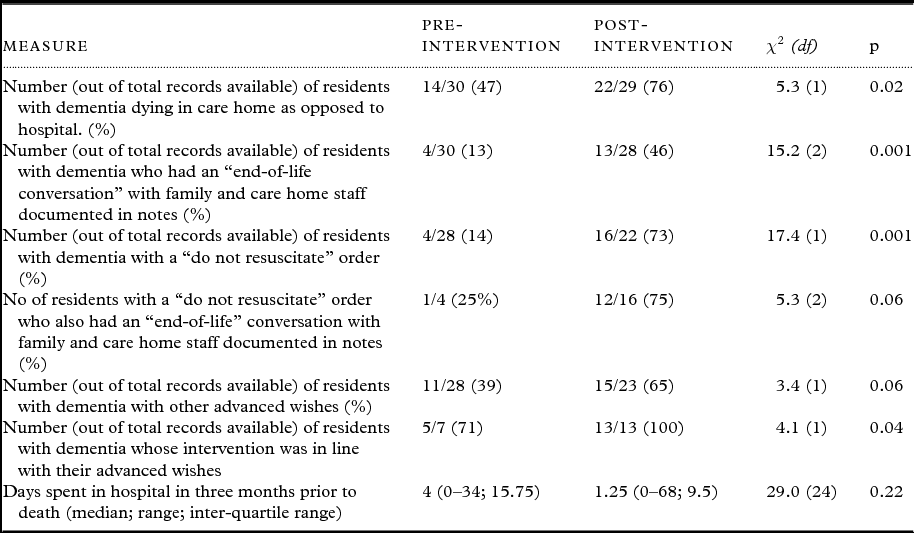
Place of death (see Table 1)
There was a significant increase in residents with dementia dying in the care home (as opposed to hospital) from 47% to 76%, χ2(1) = 5.3, p = 0.02.
Outcomes for residents in the care home before or after intervention
There was a significant increase in residents with dementia who died with documentation showing that an “end-of-life conversation” had been held by the home with their families (and the residents themselves, where capacity allowed) increasing from 13% (4/32) to 46% (15/33), χ2 (2) = 15.5, p = < 0.001. The number of DNR decisions increased from 14% (4/28) to 73% (16/22), χ2 (1) = 17.5, p = < 0.001. The percentage of people who had both an “end-of-life conversation” and a DNR decision documented increased from 25% (1/4) to 75% (12/16), χ2 (2) = 5.4, p = < 0.068. There was a similar finding for those without dementia (n = 27), with DNR decisions increasing from 2/20 (10%) to 6/7 (86%), χ2 (1) = 14.3, p < 0.001. Where it was recorded in the notes (n = 20), residents with dementia whose end-of-life care was consistent with their advanced wishes regarding hospitalization or DNR, increased from 71% to 100%, p = 0.04. There was a trend toward a decrease in number of days spent in hospital in the three months prior to death after the intervention when compared to before the intervention (median 4 vs. 1.25 days).
Family members interviewed after their relative died
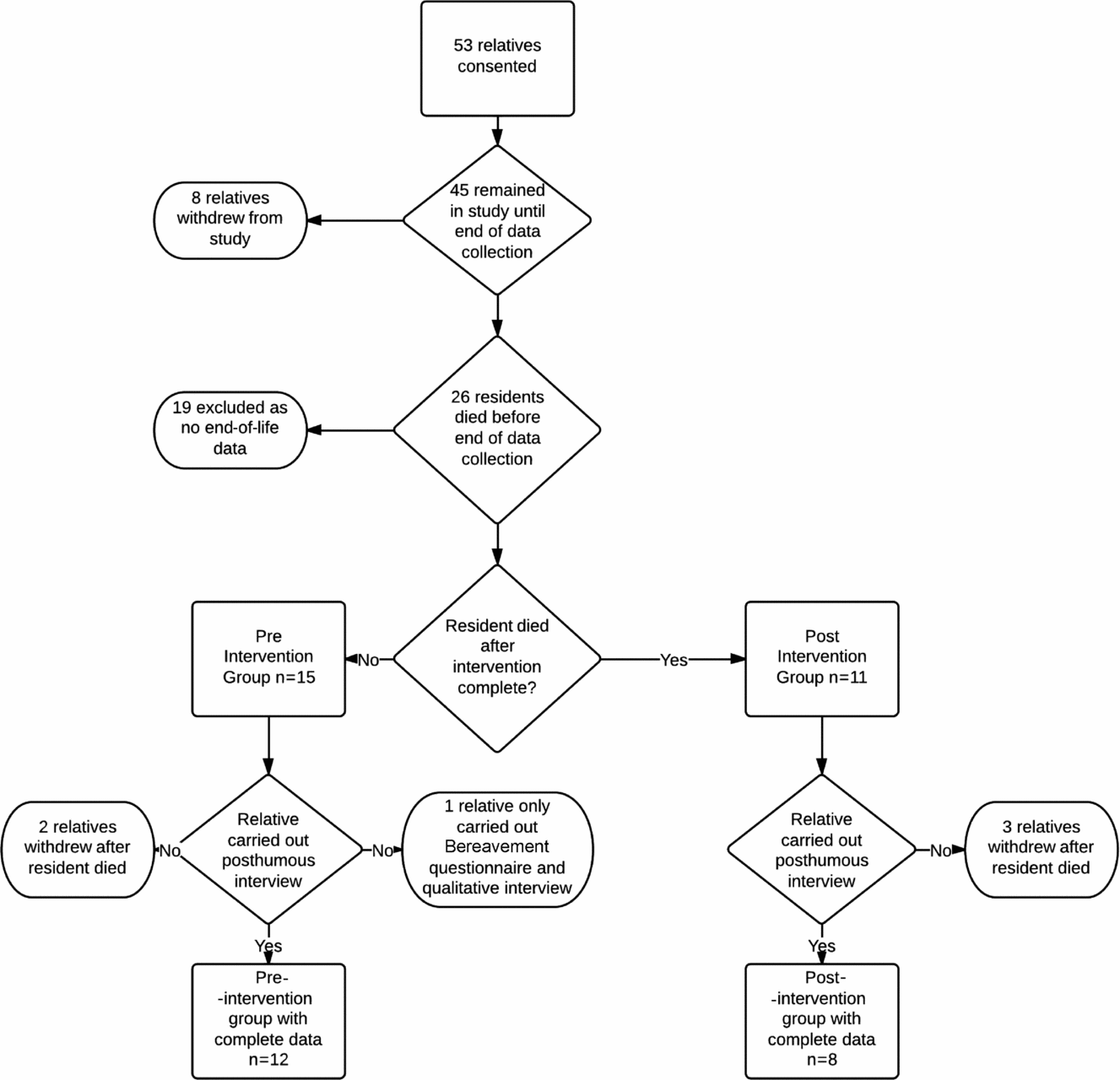
The flow of participants with dementia and their carers through the study is shown in Figure 2.
Flow diagram of relatives recruited for the study interview.
Fifty-three relatives of residents with dementia in the home participated. Twenty-six of these participating were bereaved during the study, and 20 (77%) agreed to an after-death interview (12 pre-intervention, 8 post-intervention).
Demographics of the relatives who were interviewed and their relatives at death
Pre-intervention, eight (67%) of the residents who died were women; their ages ranged from 60 to 100 (mean 88) years; their mean Mini-Mental State Examination (MMSE) score was 5.3. Their relatives ages ranged from 33 to 68 (mean 56 years); the relationship to the resident who died were child (7), spouse (1), and other relationships (4); and nine were women. Post-intervention, four (50%) of the residents who died were women; their ages ranged from 81 to 95 years (mean 88); the mean MMSE score was 7.8. Their relatives’ ages ranged from 22 to 85 years (mean 63); the relationship to the resident who died were child (4), spouse (3), and other relationships (1); and three were women.
Quality of life before death and family carer well-being
There were small numbers of after-death interviews (12 pre-intervention and 8 after intervention). There were non-significant trends for the proxy QoL-AD before death to be higher post-intervention than pre-intervention (median score post = 21 (inter-quartile range = 7.3) vs. pre = 18 (inter-quartile range = 4.5), Mann–Whitney U (20) = 27, p = 0.102), and for the family carer to report fewer anxiety and depressive symptoms (GHQ median score fell from 3.5 (inter-quartile range = 1.5) to 1.5 (inter-quartile range = 2.5), Mann–Whitney U (20) = 40.5, p = 0.579).
After-death bereaved family member structured interview
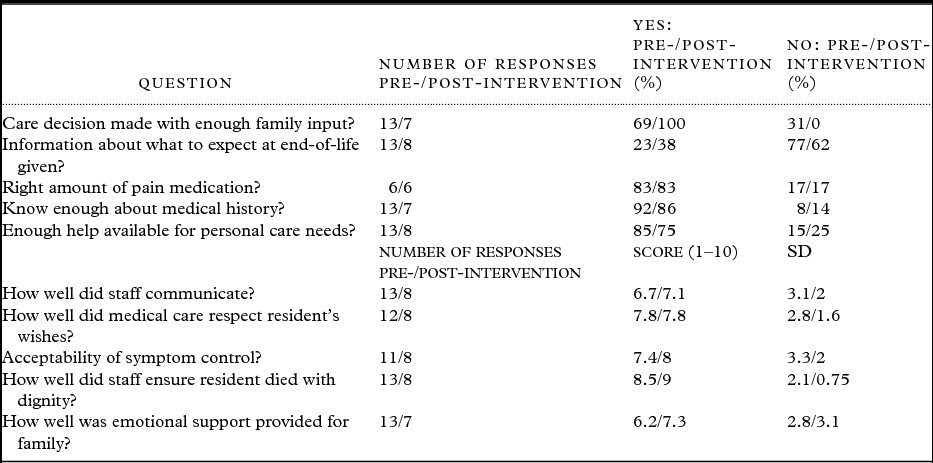
Table 2 shows results from the after-death interview with bereaved family member regarding end-of-life care. All families were satisfied with their input into care decisions after the intervention. Pain control had been good and was unchanged but symptom control improved after the intervention. Overall satisfaction increased from 7.5 (SD = 1.3) pre-intervention to 9.1 (SD = 2.4) post-intervention; t = 17.6, p = 0.06.
Pre- and post-intervention responses to after-death bereavement questionnaire
Interview using open-ended questions about experiences around the relative's death
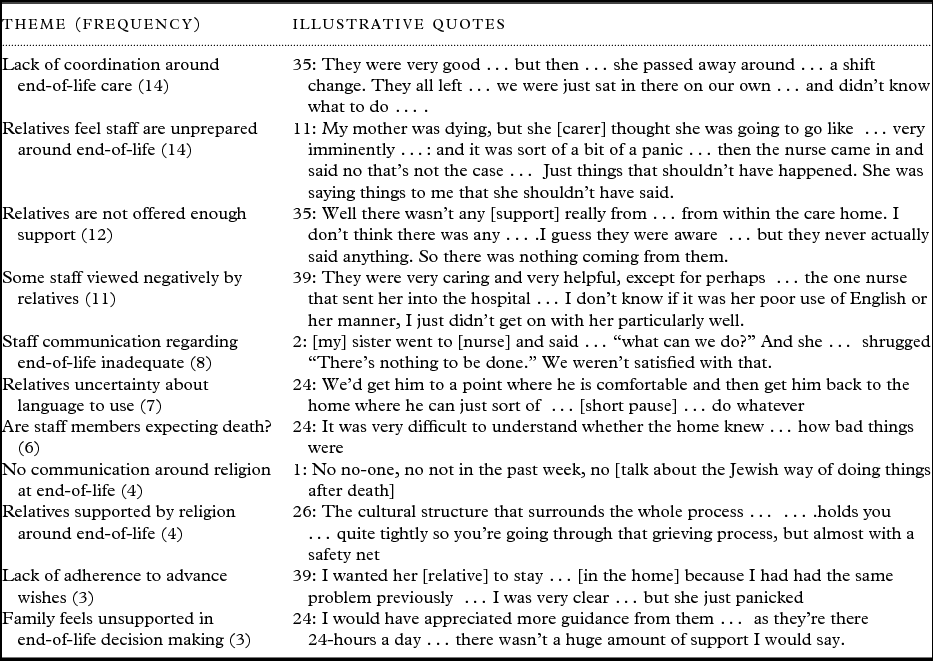
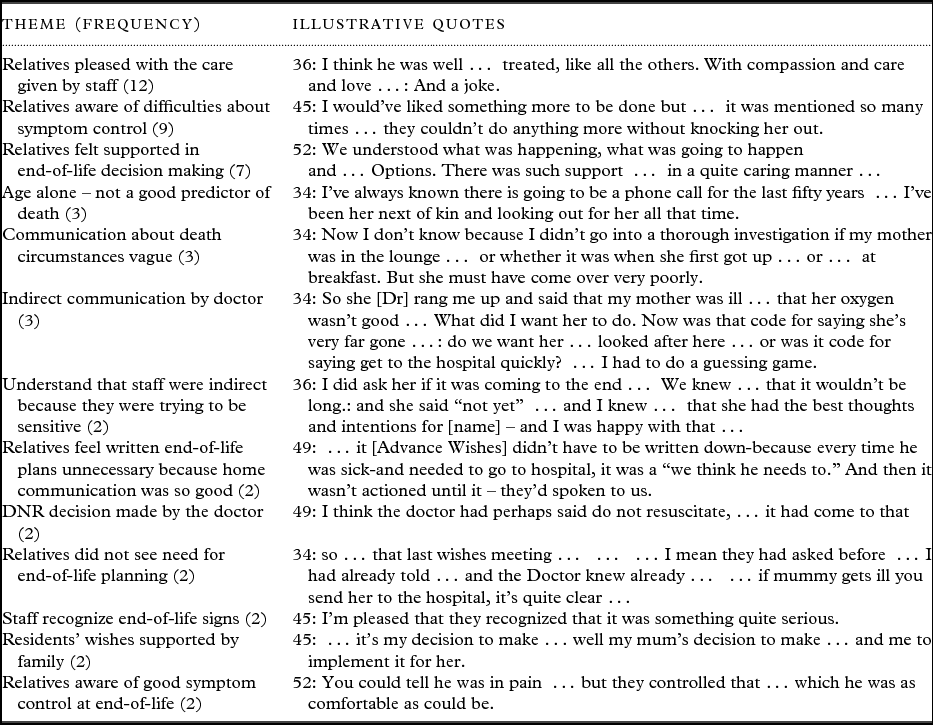
Some themes occurred solely either before or after the intervention. These themes, illustrative quotes, and number of times are given in Tables 3 and 4, respectively.
Themes which only occur in interviews before the intervention
Themes which only occur in interviews after the intervention
Themes only occurring before the intervention included staff not coordinating end-of-life care, for example, having difficulty in communicating with each other or with relatives about end-of-life, including discussion of religious wishes. In addition, there was a lack of support for families. This might explain why religion was mentioned only pre-intervention as being supportive – or people interviewed post-intervention may be less religious. Relatives also mentioned, albeit rarely, their advanced wishes being disregarded.
After the intervention, new themes included relatives being pleased with end-of-life care, specifically saying that staff understood issues around symptom control and when someone is reaching the end of their life. Families also felt supported in making decisions; most judged planning as needed as death may be unpredictable and their relative was unable to make decisions. Others did not feel planning was necessary, either because they did not want to make those decisions or because the home would guide them sufficiently.
Qualitative study of care home staff
Information about the demographics of staff involved in the study is reported elsewhere (Livingston et al., Reference Livingston, Pitfield, Morris, Manela, Lewis-Holmes and Jacobs2012). The mean length of time worked at the care home was 6.7 years (SD 3.7, range 7 months–13 years)
After the intervention, staff reported feeling more confident and comfortable with end-of-life planning and communication. They were no longer worried about blame for not sending everyone to hospital at the end of their life because they felt confident about following advanced wishes.
Discussion
This is the first intervention in end-of-life care for people with dementia living in care homes to report an increase in family satisfaction and a reduction in hospital deaths. Most residents with dementia had severe dementia (mean MMSE was 5) and were judged by the care home staff as unable to make an end-of-life plan themselves. Many more residents had documented the discussion of advance care wishes including DNR orders after the intervention than before; a 500% increase and more than three-quarters (previously less than half) died in the care homes and this is in line with results from other interventions (Hockley et al., Reference Hockley, Watson, Oxenham and Murray2010). Bereaved relatives were more satisfied with end-of-life care; more likely to report consultation regarding decisions and being supported and felt end-of-life symptom relief was either unchanged or improved. Staff members were more confident about end-of-life planning and advanced wishes implementation.
We were successful in training the care home staff to improve communication with relatives and increased advance wishes numbers and implementation, so people could die well in the care home rather than hospital, if that is what they and their families chose, and it was medically appropriate. Advance care planning is key to the UK Government's end-of-life care strategy in England and is thought to be a way of improving choice and autonomy for people with dementia (Sampson et al., Reference Sampson, Burns and Richards2011b). There is little evidence, however, about what works in this field and our preliminary evidence supports this strategy. We were concerned and were successful in ensuring that there should be no deterioration in pain relief and symptom control which had been good before. Additionally, there was an improvement in the overall QoL at end-of-life for residents with dementia. We think this success is related to the training addressing staff fears and problems, as well as increasing knowledge.
Limitations of the study
The study is limited as the numbers were small, it was not a randomized controlled trial, and there were many other changes in dementia policy at the same time, e.g. the National Dementia strategy (Department of Health, 2009) and, therefore, while a promising study, these may be chance findings. It was set in a Jewish care home and we were interested in addressing the difference in culture between the residents and staff, which is common in care homes. We think that adaptations addressing cultural differences would be needed in other homes, as it is a common but varying difference. The managers were trained in the Gold Standard Framework and this may have also been a factor. In addition, the care home management was very motivated and atypical, and staff turnover is low, which may limit generalizability.
Conclusions
Most people would regard having their end-of-life wishes known and respected as extremely important. If our findings were replicated in other care homes, this would be important not only in terms of well-being but also of medical ethics as it increases autonomy even for those who lack the ability to express their wishes. The death of a close family member is usually one of the most difficult times in any person's life. Family carers’ satisfaction with quality of care and decision making may have helped to reduce the development of complicated grief reactions, through avoidable regrets and miscommunication. Finally, the potential economic importance of avoiding futile and often distressing hospital admissions at the end-of-life is clear.
Future research
Future research should include qualitative consultation to develop the manual further for acceptability, clarity, and ease of use in diverse care homes and a large well-powered randomized-controlled trial to build on these promising preliminary results.
Conflict of interest
GW, HJ, and JC are employed by Jewish Care. The other authors declare no conflict of interest.
Description of authors’ roles
GL and JM conceived the study and applied for funding with GW. GL applied for ethics permission. CP, ELH, and EC recruited and interviewed participants. GW chaired the steering committee and ensured the study could run. JM and HW devised the intervention with comments from GW and GL. JM, HW, and NC delivered the intervention. GL, ELH, and JM extracted data from the notes. ELH, MM, CP, EC, and DC coded the qualitative interviews. ELH and GL did the quantitative data analysis. GL and ELH wrote the first draft of the paper and all authors revised it.
Acknowledgments
We thank the residents and their families and the staff who took part in the study. We also thank Jewish Care and the floor managers for facilitating the study.