Introduction: PRC theatre reform policy
The operational models of official Mainland xiqu companies are diverse and in flux. Since the establishment of the People's Republic, the model at the official level has been of large, state-owned professional companies under the auspices of national, provincial, municipal or county cultural authorities. These companies have long been cultural work units and are responsible for many aspects of their employees’ lives, from housing to political education. As units appertaining to the cultural bureaucracy, creative and administrative work has been a form of government employment and thus both stable and structurally inflexible. Stability facilitated the process of student recruitment, since entering a troupe promised lifelong employment in largely urban work units. Such conditions made a career in theatre an attractive option among the poorer – usually rural – populations, from which recruitments to opera schools were generally made. The relatively privileged, government-backed status of theatres also counteracted the traditional stigma against theatre performers.Footnote 2 In Mainland China, performers are thus almost exclusively graduates of particular theatre schools who were recruited in childhood. Consequently, actors who are now in their forties and fifties have worked together since recruitment as pre-adolescents in the late 1970s and early 1980s. As the system is restructured, the age of fixed lifelong employment is coming to an end in the theatres; actors can move more freely in and out of the profession, or between performance entities. The process of institutional change is perceived at all levels of official theatre as an opportunity and a threat.
Like other aspects of Chinese culture and society, xiqu was destabilized by contact with the West in the late Qing and the Republican period. Through contact with Western spoken theatre, xiqu lost its synonymy with the stage itself, becoming instead merely the national, traditional form of stage arts in a century that had an enduring and violently recurring suspicion of Chinese tradition and an urge to make it ‘scientific’, ‘correct’ or ‘modern’. Since that period, substantial effort has sought to create models of xiqu performance that would be ‘appropriate for the times’ by adjusting gender roles, musical systems, stage construction, set and prop conventions, theatre education and, not least, commercial models. Xiqu reform in various incarnations has been on the table for over a century, and is usually stated as a matter of life or death.
Generally speaking, official troupes and theatres in the Mainland were established in the early 1950s, disbanded during the Cultural Revolution, and formed anew in the Deng Xiaoping era. Naturally, post-1978 xiqu opera companies have seen a great deal of structural and artistic change already – most active performers today have known only the performance models of the Deng era. For a decade, the policy of the cultural bureaucracy has been to exert pressure on troupes to become financially more self-sufficient, and to cut costs and centralize administration by merging theatres into yanyi jituan (larger performance corporations). For some troupes this has been a considerable boon; for others it is regarded (informally, of course) as disastrous. Anecdotally, I know of one theatre where the leadership blames the reform for the fact that, during the first eight months of 2013, it had only three performances; on the same day in the same city, I interviewed another performer who had averaged more than two performances a day over the last month, and also attributed the theatre's increased number of performances to the reform. The entire reform process is the subject of considerable debate at academic, theatrical and bureaucratic levels.
On the ground, the push for reform generates diverse effects operating at various speeds; its intent can, however, be summed up by a July 2009 document issued by the National Ministries of Propaganda and of Culture entitled ‘Several Suggestions on Deepening the Systematic Reform of State-Owned Cultural Performance Troupes’.Footnote 3 Clause Two establishes the general problems of the old system, many of which anyone with personal experience in Mainland theatre is likely to recognize:
As the economic infrastructure, the systematic conditions and the social environment on which the performing arts sector depend have undergone profound changes, the shortcomings of the old system of state-owned performing arts theatres and troupes have become increasingly apparent. The vast majority of state-owned theatres and troupes have retained the old management system, and they have not created mechanisms to interact with the market . . . they are deficient in the internal motivation to become larger and stronger that market competition would furnish; many works make competition for prizes their central purpose of production, [they do not] enter the market and they ignore audience demand, resulting in the limitation of both social benefits and economic benefits; the existing system is to operate troupes according to administrative divisions and levels . . . making it very difficult to form powerful cultural brands, and detrimental to the efforts to bring Chinese culture ‘to the world’.
The document also outlines various measures to address the problem, encouraging on the whole the market orientation and the consolidation of theatre performance troupes. ‘Actively cultivating new market players’ is identified as a core principle, and Section 7 (content) demands:
The adoption of the commercial model should be explored in many forms. State-owned troupes in song and dance, acrobatics, folk musical arts, spoken theatre and regional xiqu will take the lead on effecting the adoption of the commercial model. Other troupes and theatres can establish project companies etc. in order to promote market-oriented operations, in order to accumulate experience for the adoption of the commercial model, and to establish the conditions for it.
The tendency of government policy is clear: the old system of state-owned troupes and theatres directing their artistic efforts toward the reward-granting mechanisms of the state is to be reoriented in order to become increasingly dependent on the market.
Troupe costumers making preparations at Nanjing University's stage. All photographs of the 2013 tour by Zhang Jingjing, used with FPLET permission.

The economy of xiqu performance on the ground
The dissociation between performance and paying audience is a real problem in Mainland Chinese theatre, and has had far-reaching social, artistic and economic outcomes. Most troupes have no reliable schedule of public performance, since troupe work remains beholden largely to the cultural bureaucracy. Moreover, many troupes have no (or very limited) public ticket sales, due to (and reproducing) the widespread expectation that tickets are to be distributed, not bought. Many troupes’ activities consist of performances for official functions, school tours, company events or tourist shows. Although these types of performance have their place, it is detrimental to the establishment of a knowledgeable fan base if performances cannot be reliably accessed. Further, exclusive orientation towards ticket sales will favour commercial productions that fail to retain the artistic particularities of a given genre. This has been widely noted with respect to the influence on xiqu of Western-derived spoken theatre (known in China as huaju); less frequently mentioned is that the dominance of certain xiqu genres (e.g. jingju) weakens the characteristics of local genres, or that tourist or rural performances with low artistic demands can degrade the skills of (especially young) performers, who lack the time and incentive to commit themselves to serious study.
It is a vicious circle: without regular shows, there is no ticket-buying public, and the reputation of xiqu as a dying art is consolidated. Moreover, both public opinion and journalistic opinion bear feebly on artistic decision-making, since official opinion distributes the prizes, awards titles and regulates salaries. In a system focused on prizes awarded for new productions, there is little material gain in producing traditional theatre. There is a severe issue in the quality of productions of new xiqu scripts, which must respect the complex musical, theatrical and metrical demands of the genre while seeking to be relevant to audiences and produce work of literary merit. It remains the case that many directors, designers and playwrights with little or no knowledge of xiqu principles or practices are engaged to work on new productions, that inferior new xiqu scripts far outnumber good ones, and that the prize system reflects as much political dynamics as quality of performance or script. Meanwhile, rhetoric such as ‘original source and flavour’ is spurred on by UNESCO and domestic efforts to safeguard theatrical tradition, but it is often so vaguely defined that it can be claimed by almost any kind of xiqu-based performance. While it is true that older repertoire practices receive some backing from academics, such as Zou Yuanjiang's defense of an actor-oriented stage, and Fu Jin's call to assert the primacy and independence of xiqu against a century of modernist critiques, the pressure remains very great to present new scripts and opulent productions.Footnote 4
Understandably, troupe management is centrally concerned with new scripts and productions, often at the expense of older repertoire. The traditional repertoire is the indisputable lifeblood of xiqu, in that its vocal and movement technique and its musical and literary systems constitute the capital that make xiqu a discrete form of theatre. Without training in and intimacy with these forms, without internalizing the system of their genre of xiqu, actors and musicians (as well as playwrights and directors) are not capable of producing theatre that maintains autonomy from Western or Westernized forms of musical theatre or from each other. The inherent logic of xiqu requires that theatres continue to perform traditional repertoire, often in the form of zhezixi (selected scenes from unrelated operas, performed without narrative sequence). For aficionados and performers of traditional theatre, a paradox exists: while the best performances are all traditional, the rewards system is set up for the artistically more problematic effort of creating new plays. In fact, there are more than a few xiqu fans who regard the creation of new xiqu plays as a thoroughgoing failure, and perhaps an impossibility. However, the prevailing official view is that only successful new xiqu scripts can redeem these genres from the status of ‘museum arts’. As a result, and usually couched in a commitment to ‘tradition’ or ‘transmission’, the status and support of troupes depends substantially on their new productions.
Here is an interesting illustration of the paradox: in 2003, this article's case study, the Liyuanxi play Scholar Dong and Madam Li (Dongsheng yu Lishi), was fitted out with a stage set and new lighting to participate in a prize competition, which it won. This occasioned a tour that kept the piece in repertoire and made it eligible for the 2013 prize competition, which in turn meant that the artistic director of a well-known Paris-area theatre, MC93 Bobigny (officially La Maison de la Culture de Seine-Saint-Denis à Bobigny) could see the show and invite it for a 2014 performance in France – provided that the play was performed without the new set and new lighting. Performances in Taiwan similarly have asked for the simplest (i.e. most traditional) treatment of set and lighting. The additions officially made it a ‘new’ play (although it had been in repertoire for ten years), which in turn gave the piece the prominence and durability to garner the interest of foreign or Taiwanese theatre arbiters – who appreciated everything about it except the new additions. There is no getting around the fact that lavish sets, props and lighting directly contradict traditional performance aesthetics, and have the effect of diluting xiqu characteristics as distinct from Western theatre.
The mechanisms for governmental support are prizes, recognition and individual professional standing, including membership in certain organizations and a class of artists, directors, technicians and musicians according to national standards; in one way or another all organizations in the Chinese official arts world are judged in this way. In the case of drama, this is centrally done by the Chinese Theatre AssociationFootnote 5 (Zhongguo xijujia xiehui), but potentially it can also involve literary, cultural, political and women's organizations. Prizes can be given for performers or for particular plays. Winning a prize may involve a great deal of horse-trading, sometimes reaching into high levels of government. Genuine artistic judgements are also relevant, but do not occur in isolation; I have attended festivals where the secret results of the judging committee were known in advance. In another case, a troupe was widely believed to have been given a prize for a mediocre play in order to prevent its dissolution by provincial authorities. Other troupes showed understanding for this decision, because it would be to the disadvantage of the genre's status as a whole if other troupes were to fold.
The official approval of a piece, as defined by prizes and projects, remains the most important element for its continuing performance. Although the discourse of the xiqu world is saturated with claims of public enthusiasm, it is seldom convincingly or objectively demonstrated, and public reaction continues to exert an uneven – at best – influence. The voices of disapproval for an officially lauded piece are necessarily scattered and cautious. While public interest is absolutely crucial at a village level of performance, its role is indirect at the more formal and national levels. Public disinterest could affect (or correspond to) local governmental support, the availability of venues, the prospects of corporate sponsorship or academic comment. Immediately, however, ticket sales form a small part of the revenue of most companies, and public performance is not a primary source of income.
Compared to theatre in the West, corporate sponsorship remains unusual for xiqu companies in the Mainland, and individual patronage is largely unknown. Xiqu troupes remain largely state-owned, directly or indirectly, and their performers and creative staff are overwhelmingly salaried employees. Thus the ranking and subsequent treatment of troupes and staff are systematically state-determined. The process in China is less transparent than Western systems of government subsidies, and is expressed not only in terms of prizes and ranks but also in terms of regular salary payments and (depending on the troupe) anything from housing to insurance to vehicles. The xiqu world is thus unduly dependent on the state, a fact which is recognized in the current (state-led) movement to reform. On the other hand, the disappearance of state support would lead to the dissolution of most xiqu troupes in a free theatre market, since private-sector arts sponsorship is not likely at present to pick up the slack.
Performance history of Scholar Dong and Madam Li: how a prize is won
The main part of this article seeks to illustrate the operations and organizations of Mainland xiqu troupes through the May–June 2013 tour of a Liyuanxi production by the Fujian Province Liyuanxi Experimental Theatre (FPLET) in Quanzhou after it was awarded the 2013 Grand Prize for Outstanding Repertory Piece (youxiu baoliu jumu dajiang).Footnote 6 This case study uses the tour of Scholar Dong and Madam Li as an example to cast light on how xiqu performance operates in political, economic and social contexts. A better comprehension of the backstage, the office and the front-of-house enriches the appreciation, resonance and intelligibility of what occurs on xiqu stages. In terms of the theatre's operations, the performance department is of course only one of several essential teams.
Methodologically speaking, researching a tour is ideal because various generations of performers and administrators are travelling together, and are at leisure to speak over meals, on excursions, during travel or over baijiu and/or snacks after the day's work is done. Besides the troupe members, prominent cultural figures, professionals of other xiqu varieties, academics, engaged fans, contract workers (from drivers to administrators), journalists and venue employees are all present and speaking formally and informally about the tour. My views are thus a synthesis of observations, structured conversation and informal social activity, supplemented by ongoing reading in xiqu texts, critiques and newspaper and online accounts. No case study can unequivocally stand in for the whole field; the troupe, the tour, the play and the genre have inevitable particularities. This article, however, provides a starting point for information regarding questions of xiqu operations in the Mainland, which is poorly understood outside professional xiqu circles, and which is seldom regarded as an aspect of academic xiqu studies in China, not least because analyses of official systems can be sensitive.
Liyuanxi (sometimes ‘Liyuan opera’) is a genre of xiqu that descends from nanxi (southern drama), and is generally considered to be one of the oldest and most conservative forms of theatre in China. The name Liyuanxi (‘Pear Garden theatre’) derives from the name of a legendary troupe founded by a Tang emperor, a term that later became a metonym for theatre in general. FPLET, based in the south Fujian city of Quanzhou, is the only professional troupe in this genre anywhere in the world. In xiqu circles, the genre and the troupe are renowned for their conservation of the musical and physical particularities of the genre, among which one might mention the yajiaogu (foot-controlled drum) or the shiba kemu (eighteen (movement) techniques).
Nevertheless, their best-known works on a national level are not traditional pieces, but the scripts of the troupe's emeritus dramatist Wang Renjie. His ability to write and stage new works in ways approved by the most conservative of commentators is a remarkable achievement.Footnote 7Scholar Dong and Madam Li has a highly unusual derivation in that it is drawn from a contemporary short story, ‘Crows’, by the Shandong author of rural fiction You Fengwei, although the sombre narrative of the original has been adapted into a playful, irreverent story.
The story begins with the death of Councillor Peng, who entrusts his young wife to the unmarried scholar Dong Siwei: he is to be responsible for her chastity. Dong, financially indebted to Peng, has no choice but to comply with the wishes of the dying man. Trailing the widow, Dong becomes enamored of her charms. Bursting into her chambers on the suspicion of infidelity, he finds her alone – or, rather, she declares coyly, he is the only man present. They enter the bedchamber together. The following day, Peng's ghost demands that Dong execute Li for her infidelity. She is willing to submit to this punishment, but instead Dong confronts and threatens to disinter Peng from his tomb, whereupon the ghost fearfully acquiesces and disappears. Love triumphs. Premiered in 1993, more than a few commentators and audience members see in the plot a rejection of older social narratives of female subservience in favour of female agency and sexual liberty.
At the time of the tour, the theatre, the play, the performers and the author were known quantities in the xiqu world. Several criteria for the Grand Prize for Outstanding Repertory Piece ensured that only frequently performed works of considerable history were eligible to apply. All, or almost all, of the applicants had won prizes at regional or festival level before receiving the 2013 award. Although several of the award-winning pieces had roots in traditional repertoire (e.g. the Kunju Fifteen Strings of Cash), no pieces performed in entirely traditional fashion were eligible. Moreover, the key artistic figures – the playwright, the principal actors, the director, the composer – were all recipients of various prizes and recognitions of professional standing. This section describes the history of the play in order to illustrate how professional success is recognized and dependent on official channels.
Performers Zeng Jingping and Lin Cangxiao familiarize themselves with the stage at Jiangnan University in Wuxi. Photograph by Zhang Jingjing, used with FPLET permission.
Certain key performances can show the play's trajectory. Scholar Dong and Madam Li premiered at the 19th Fujian Drama Festival in October 1993. In 1994, the script was published in Juben (Drama Scripts) alongside an admiring analysis by researcher Qu Liuyi, an important arbiter of official and academic xiqu taste. November 1994 featured the Beijing premiere as part of the Cao Yu Literary Prize Award Ceremony. In November 1998, again in Beijing, it was included in ‘exhibit performances’ of ancient theatre genres. In November 2000, it left the Mainland for the first time, with a thirty-nine-member troupe touring Taiwan; in May 2001, they accepted an invitation to perform in Hong Kong.
In 2003, the production was retooled under the direction of Lu Ang of the Shanghai Dramatic Conservatory, and with these changes was eligible for selection in the National Stage Arts Masterpieces Project (Guojia wutai yishu jingpin gongcheng). In 2005, it was awarded one of ten places in the project for 2003–4, which, like the 2013 Grand Prize for Outstanding Repertory Piece, provided both the money and the responsibility to tour. Over the next nine years, there were approximately forty full performances. For instance, between 2005 and 2007, the play was performed twelve times, in venues such as Beijing (Chang’an Theatre), Shanghai (Fudan University, Shanghai Theatre Academy), Fujian (Xiamen University, Quanzhou Normal University, Yang’en University, Quanzhou Yingjuyuan), Guangzhou (Youyi Theatre), Chengdu and Hong Kong, and during the 23rd Plum Blossom Prize Competition in Suzhou, as a result of which troupe director Zeng Jingping was awarded a ‘Repeat’ Plum Blossom Prize, a higher category of China's highest performance prize. This places her in the most elite category of xiqu performers, this category having been granted to only thirty theatre artists nationwide between 1994 and 2007. Between 30 July and 1 August 2008 the show was performed three times in the Mei Lanfang Theatre in Beijing as part of the artistic programme of the Beijing Olympics. Other important shows included performances in 2009 for the Jiangsu division of the Chinese People's Political Consultative Conference, followed in October by Quanzhou government performances in honour of the National Holiday.
This listing of major performances shows how a production is integrated into governmental and academic structures, and demonstrates how a script, a performance, a troupe or a genre develop their work and advance their reputations through festivals, government performances and prizes. The success of such a work in winning prizes makes a prominent play a central element of the troupe's business plan. While audience enthusiasm is desired, the success of productions does not immediately derive from audience reaction – it is generated more by academic approval, followed by (or in concert with) governmental approval. Honours guarantee financial security and the standing to apply for more honours. New funds allow theatres to establish new relationships with venues, with new audiences and with influential xiqu figures.
Performances are, in and of themselves, seldom purely commercial, and many performances are not public or ticketed. Prizes and ‘projects’ figure heavily in the development of a piece: in this case, participation in a prize determined the 2003 adjustments, funded much of the outside touring, and ultimately occasioned the 2013 tour. Mainland festivals and venues that produce the invitations for performance are also state-funded and usually state-run; the key aspects of the xiqu system of troupes, theatres, festivals and prizes are all ultimately subject to the Ministry of Culture. Relative independence is visible at the level of performance creation, scriptwriting and academic opinion, but is still limited at the level of performance organization. Non-Mainland performances, including in Hong Kong and Taiwan, represent important sources of status and legitimacy because they represent autonomous and international judgement.
The centrality of prizes in the reception and success of the play is reflected also at the level of the individual performers, which is why Chinese theatre biographies are usually listings of prizes, posts and teachers. The Grand Prize for Outstanding Repertory Piece was awarded by the Ministry of Culture to eighteen pieces in 2009 and twenty pieces in 2013, comprising both xiqu and spoken theatre, dance and geju (Western-style opera) productions. One of these was Scholar Dong and Madam Li. What did the actual 2013 selection process look like from the troupe's perspective? Early in 2011, information was passed on from the Ministry of Culture to provincial cultural authorities, who in turn passed the information on to theatres. The application materials consisted of forms, images, text and video. In June 2011 the application materials were submitted, and had to obtain provincial pre-selection – in Fujian, for instance, three pieces obtained pre-selection, but only Scholar Dong and Madam Li won the award. The list of successful applications was finalized in November 2012.
Tours had to be completed in the four months between April and July 2013. Tour schedules were a troupe responsibility, but were subject to Ministry of Culture approval. A meeting with the Ministry of Culture and all participants was held in early September 2013 in Beijing to summarize the achievements of the project. State news agency Xinhua, relaying Ministry of Culture statements, reported that the twenty productions had toured twenty-nine provinces and regions, and performed over a thousand times, earning 18 million yuan in ticket sales, and attracting over 800,000 audience members.Footnote 8 This was an increase over the figures for the first edition in 2009, in which the eighteen selected productions had toured thirty-one province-level administrative regions plus Hong Kong, Taiwan and Macau, visiting over a hundred cities, performing almost five hundred times, and earning ticket revenues of 13 million yuan, for 400,000 audience members.Footnote 9
In the case of Scholar Dong and Madam Li, Shanghai, Nanjing and Beijing were obvious choices for tour stops, with Hangzhou and Wuxi representing other convenient options in the Jiangnan area (other cities, such as Suzhou, Shaoxing and Hefei were contacted, but the schedule did not fit). Langfang and Tianjin were ways of extending a northern trip, but Xi’an (which required a flight from Tianjin, and a flight back to Xiamen) was a special effort, made specifically because Liyuanxi had never been performed there. Distance remains a crucial consideration, particularly because the set and equipment travel by truck, which is slower than rail, and this process is expensive.
Where does the tour go? The networks of a xiqu troupe
The previous section gives an indication of how a troupe might win a prize and arrange its tours outside its home theatre. Although government institutions – from local governments to state universities – are always involved in theatre invitations, it should not be assumed that specific directives regarding venue or schedule come from above. Indeed, planning is often quite ad hoc. Upon receipt of the prize, a time frame, a number of performances (ten), and a geographic restriction (outside home province) were set. It was up to the troupe to arrange when and in which cities and theatres the performances would take place. The burden between prize-winning troupes is not even. A Kunju troupe, for instance, has knowledgeable audiences and same-genre theatres in Jiangsu, Zhejiang, Shanghai, Beijing and Hunan; a Jingju troupe in Beijing is quickly out-of-province when it travels the short distance to Tianjin or Hebei; but the cultural area of Liyuanxi is restricted to a part of a single province (plus Taiwan and many overseas Chinese communities). It is thus harder to fulfil the requirements of out-of-province performance, although by the same token the nationwide exposure provided by the tour represents a higher-stakes opportunity.Footnote 10
The theatre made its choices for touring by selecting two types of city: the first was cities that already had a Liyuanxi fan base, such as Shanghai, Beijing and Nanjing, often overlapping with existing audiences for the prestige form Kunju. The second category included cities where Liyuanxi had never, or almost never, been performed: Xi’an, Tianjin and Wuxi (reportedly there was a performance in this last city in the 1950s) were selected in order to increase the exposure of Liyuanxi and to broaden the audience. These cities have an existing xiqu audience, who might be willing to ‘cross over’ into a new genre. Within each city, they looked for venues with frequent xiqu performances, hoping to attract existing audiences. Tapping into venue networks also allows for easier ticket sales and promotion processes. Equally important were the theatres’ locations and technical specifications, including size of theatre, number of seats, size of stage and cost of renting stages. In the final accounting, they paid 25,000–40,000 yuan for each commercial stage, while receiving the use of university and conservatory stages without payment.
Several formal and informal networks facilitated the tour. These networks complement one another and intertwine, but can be basically categorized as academic, fellow-troupe, fan-based and literary. Within relevant academic entities, there is a distinction between university and theatre institutions. Universities hosted performances in Wuxi (Jiangnan University) and Nanjing (Nanjing University, Southeast University). Jiangnan and Southeast University do not have theatre programmes, and those performances were not ticketed. The performances were arranged by personal connections with interested faculty, and served the purpose of making the genre more widely known. Conversely, Nanjing University has a theatre major in its School of Liberal Arts (formerly the Chinese Department), and a member of the faculty, Lü Xiaoping, has also written academically on the work of Wang Renjie. The performance there was of scenes, rather than of Scholar Dong and Madam Li (not least because many students would have seen that performance before). It was introduced by Nanjing University theatre lecturer Chen Tian, preceded by comments from Wang Renjie before the performance, and concluded with questions and answers after the performance. The tickets, though cheap (20 yuan), were mandatory: this is a general policy for visiting troupes to the university, designed to foster a paying audience.
The audience during the Scholar Dong and Madam Li performance at Shanghai Theatre Academy. Photograph by Zhang Jingjing, used with FPLET permission.
Academic connections were also important in Shanghai and Beijing. Lu Ang, the chairman of the directing department at the Shanghai Theatre Academy (STA), had revamped the original production in 2003, and so was instrumental in the inclusion of Liyuanxi in the STA programme. Not incidentally, Wang Renjie has in the past also taught dramaturgy at STA, while troupe director Zeng Jingping is also a graduate of STA's mid-career direction programme. Meanwhile, in Beijing, a partnership with NACTA (the National Academy of Chinese Theatre Arts), the first training for Liyuanxi performers outside Fujian in the context of a five-genre year group (Liyuanxi, Huangmeixi, Minju, Yuju, (Guangdong) Yueju), was established in 2012. Since twelve young actors were in training there, it was natural that performances would be held on the NACTA stages.
Zeng and Wang are well-known figures in xiqu circles, and troupes seek official alliances with other known quantities in the xiqu worlds. At certain stops, particularly in Tianjin and Xi’an, the tour was substantially facilitated by local troupes, respectively the Tianjin City Youth Jingju Troupe and the Xi’an Qinqiang Theatre. In both places, the venue, accommodation, promotion and newspaper coverage were arranged through these troupes. Since there is no Liyuanxi presence outside Quanzhou, there is no direct competition, and other troupes are likely to regard diversity of performance as beneficial to all theatres.
At several stops, Liyuanxi enthusiast networks proved equally important. Noticeably, arrangements in Shanghai were greatly facilitated by fan involvement; and in Shanghai, Beijing and Nanjing, online fan forums – many of them drawing upon existing Kunju circles – were one of the main drivers of audience. There is a substantial culture of literary celebrity in China, and at some points these contacts were also deployed to stimulate interest in the tour, particularly focusing around the figure of Wang Renjie. Thus, for instance, in Langfang the performance was preceded by comments from the author Xue Xiaochan, who described herself as a fan of Wang’s. In Beijing, the presence of the dramatic and literary heavyweight Zhang Yihe was the cause of audience excitement, and in Xi’an the young novelist and playwright Xi Lingxue, who had been a student of Wang Renjie's at the STA, was involved in the social activities surrounding the shows.
Troupe director Zeng Jingping signing programmes for fans after a performance at the Shanghai Theatre Academy. Photograph by Zhang Jingjing, used with FPLET permission.
Who goes to see the tour? Ticketing and audiences
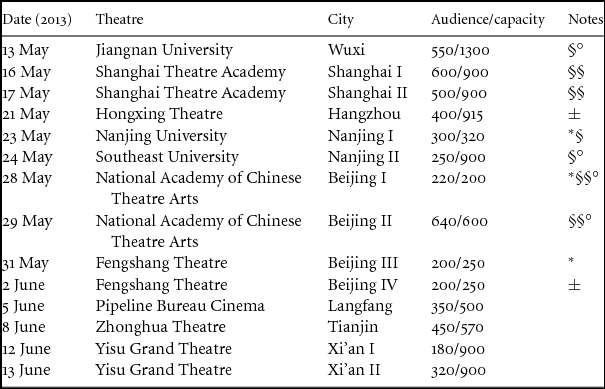
This section provides a basic idea of the scale of performances. I tried to keep an account of the audience numbers by taking into consideration seat-count, the number of theatre programmes handed out, and inquiries of ticket-takers and theatre personnel. In Table 1, the first number for each performance indicates the approximate audience, the second the approximate capacity.Footnote 11
Schedule of performances. Notes: * selected scenes (instead of Scholar Dong and Madam Li); ± small-stage version of Scholar Dong and Madam Li (simplified stage and lighting); § university; §§ theatre college/conservatory; ° unticketed/unpriced tickets
This count totals 5,160 audience members: 4,440 for Scholar Dong and Madam Li performances, and 720 for the three selected-scene performances (in smaller venues). I also distributed 3,500 questionnaires along with the free programmes, at c.70 per cent distribution, which produced an estimated 5,000 audience members.Footnote 12 Since a more accurate count is not possible, 5,000–5,200 is the best approximation of total audience.
Whether tickets were bought or distributed depended heavily on the venue. It was obvious that at the Shanghai Theatre Academy (where students who tried to sneak in were barred), Nanjing University and the commercial performance in Beijing there was a relatively young audience of xiqu enthusiasts forming a paying audience. Hangzhou and Langfang were clearly largely distributed tickets; Tianjin and Xi’an were somewhere in between. Wuxi, the second Nanjing performance, and the National Academy of Chinese Theatre Arts performances were not ticketed. However, the overflow audiences at the NACTA performances were the most raucous and appreciative, presumably because it was the only audience comprising largely xiqu professionals.
The quantitative results of the questionnaire will be the basis of a separate article. However, for the purposes of this article, we note that of the 938 audience members who returned valid questionnaires, the majority were female (64.7 per cent), born after 1980 (74.1 per cent), and students (50.0 per cent). Almost three-quarters were in the habit of watching Jingju or Kunju (73.3 per cent) while less than a third watched other forms of xiqu (29.6 per cent). Even adjusting for the higher rate of response among younger audience members, there is strong evidence for a young, national xiqu. Commercial viability will depend on whether students continue to attend (and start buying their own tickets) when they enter the workforce, but the potential for audience growth is evident, and the narrative of ageing xiqu audiences is not borne out in this instance.Footnote 13
Conclusions
The future of xiqu depends on the development of knowledgeable new audiences that are willing to pay for tickets. While xiqu aficionados are neither very numerous nor very wealthy, there is a substantial potential audience which will pay for xiqu that is actor-centred; regional in language; and metrically, dramaturgically and musically conservative.
This is probably a transitional period: while troupes are being loosened from government structures and must seek other sources of revenue, the principal mechanisms of troupe advancement, fame and revenue still depend largely on governmental approval and support. However, a project such as the Grand Prize for Outstanding Repertory Piece has as its avowed aim the development of theatre audiences, and the Ministry of Culture made a point on both occasions to announce both total audience numbers and total ticket sales (to be taken, in my view, with more than a pinch of salt). Similarly, the theatre answered my question on their goals for the tour with the following three points: to spread and transmit Liyuanxi, bringing it to more people and increasing its influence; to progress towards establishing audiences that will develop a habitual interest in Liyuanxi; and to fulfil the requirements of the Ministry of Culture's Tour for winners of the Grand Prize for Outstanding Repertory Piece. The spirit of the present transition is contained in these goals.
But the market will not sustain this or any high-quality troupe. The basic scope of the tour can give an idea of the finances of the undertaking. The troupe consisted of forty-six people, whose roles are as follows: one playwright, eight performers, one offstage singer, thirteen musicians, three lighting technicians, one sound technician, two props staff, nine set staff, two make-up staff, one costume staff, one surtitles staff, one promotional staff, one logistical staff, one materials management, one researcher (this author). Basic per diems were 100 yuan per day; steady members of the ensemble also drew their ordinary salaries. For thirty-two touring days, the per diem expenses alone reached 147,200 yuan. If one estimates the same cost for hotels, one arrives at nearly 300,000 yuan. The travel expenses on seven, mostly high-speed, trains and two flights (Tianjin–Xi’an and Xi’an–Xiamen) cannot have been much below 2,000 yuan per person, i.e. c.100,000 total. The set shipping costs would total a comparable amount. Although I am not privy to the full financial information, it is my understanding that the prize came with a financial award of 1,000,000 yuan, which more or less covered the costs. Even calculating on the unrealistic presumption that all of the five thousand tickets were bought at an average of 30 yuan, one would only reach about 15 per cent of costs. Tickets are thus likely to remain a small proportion of revenue for any large xiqu theatre.
A paying cross-regional xiqu audience is growing in Mainland China, but it is not yet enough to form a substantial source of income for most troupes. Given that corporate sponsorship remains unusual, and government support is uncertain and generally declining, there is legitimate concern for the future of many genres and troupes. Shanghai, Beijing and Nanjing (in that order) show the most potential for being places where non-local xiqu productions can sell tickets. The amount of tickets sold for this national, prize-winning show in the other stops of the tour – Hangzhou, Xi’an, Tianjin and Langfang – was negligible, although both audience attendance and reaction were sometimes excellent and always respectable. Past experience on other tours demonstrates that Hong Kong and Taipei also have a market for various xiqu genres. New media create new networks for theatre audiences to be fostered; troupes are not yet making full use of these networks, and most new media attendance is driven by fan action.
Although there is reason to be hopeful about the establishment of a highbrow nationwide xiqu audience, these art forms cannot be expected to survive at the mercy of the market. As in the West or Latin America, the argument for such performance traditions or indeed for highbrow art in general must be made from the conviction that these art forms have intrinsic value, which is vastly incommensurate with the market's assessment.
As a shift slowly occurs from government to market orientation, the challenge will be to keep away from cheap commercialism. Since the culture of corporate sponsorship is still weak, many troupes are falling between the cracks and are being dispersed. In my opinion, the central challenge of troupes will be to establish young paying audiences who are committed to traditional performance – not because I have an objection to new plays (I do not) – but because only continued focus on traditional performance can maintain the training and therefore the high technical and artistic standards which define the genres.
Based on field research on the tour of such a work, this study suggests that, even accounting for the rhetoric of official sources, there is both a genuine will at troupe, administrative and academic levels to switch models to paying audiences; as well as a potential for audiences to pay for traditional-minded xiqu, even outside their immediate cultural areas. The dogma that xiqu must technically innovate or modernize in order to attract young audience members or to ‘move with the times’ is to be doubted. Continued state support of xiqu education and the transmission of old repertoire in order to ensure performance technique and, thus, genre integrity should be considered a central duty.