1. INTRODUCTION
Universal marriage, early entrance into parenthood, and early stopping of childbearing have characterised the fertility transition in Eastern Europe since the Second World War.Footnote 1 Stopping childbearing after a first child is also argued to be the major cause of the recent lowest-low fertility trend in this part of Europe.Footnote 2 The dominant explanation for this trend suggests that individuals decide not to have a second child because of material and emotional uncertainties they face in the aftermath of the collapse of the socialist regimes.Footnote 3
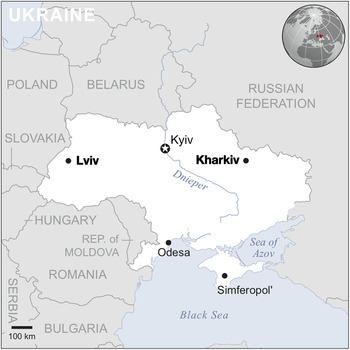
However, the exceedingly low fertility of the late 1990s and early 2000s was not only an outcome of a rapid change in reproductive strategies under the difficult economic and political conditions. Below-replacement fertility can be observed in many Eastern European regions long before anyone could have predicted that the socialist regimes would collapse. For example, the eastern regions in Ukraine experienced rapid fertility decline just before the Second World War, and by the 1960s fertility reached below-replacement levels, especially in urban areas.Footnote 4 In other regions, such as western Ukraine, fertility decline started at the end of the nineteenth century, but was more prolonged, reaching lowest-low fertility in the late-1990s, both in urban and rural areas.Footnote 5 These diverse trends, even within the borders of a single country, signal that even if declining post-war fertility was a response to changing socio-economic standards, the process of adjustment to these new standards varied between regions. Moreover, declining fertility after the Second World War occurred mainly due to changing patterns of the transition to second and later-order births rather than the transition to first birth, which has always taken place at relatively young ages in Ukraine.Footnote 6 However, not many studies have analysed the transition to second birth on a regional level, mainly because of the scarcity of (statistical) sources. This study examines individual decisions to make the transition to a second birth during the 1950s, 1960s and 1970s through a comparison of two borderland cities: Lviv in western and Kharkiv in eastern Ukraine (see Figure 1).
Map of Ukraine showing research field sites Lviv and Kharkiv. Source: http://reliefweb.int/map/ukraine/ukraine-location-map-2013. Based on OCHA/ReliefWeb.

Among various social institutions family is one of the primary social environments where the process of adjustment to socio-economic and political structures, as well as reproductive decision-making, takes place. In the context of Soviet Ukraine, the ideological changes during the later years of Stalin's regime (1935–1953) and the de-Stalinisation processes after 1953 signified the return to the traditional family.Footnote 7 Additionally, similar to other Eastern European countries, family in Ukraine has always provided an essential network for support, especially during crisis and transitional moments, such as marriage and childbirth.Footnote 8 This pattern of family relationships has long been contrasted with family types in North-Western Europe, as in the John Hajnal/Peter Laslett model.Footnote 9 In line with this model, recent studies also show that in the areas where multigenerational households and kin residence in close proximity were historically common, such as in Southern and Eastern Europe, stronger ties and support relationships between family members are also typical today.Footnote 10 The main argument these studies put forward is the path-dependence of patterns of family relationships in contemporary societies. Scholars show that traditional norms of residence and inheritance present a sense of how people should relate to each other, including both kin and non-kin.Footnote 11 As such, even after the transformation of these households and inheritance patterns, the norms underlying the relationships between generations, siblings and spouses, do not dissolve as socio-economic environments change, but rather adapt to them.
Scholars suggest that in contemporary Ukraine, differences in family values may be a vital explanation of regional reproductive trends. It was recently concluded that the ‘western regions of the country have followed a more traditional, religious and nationalistic family orientation, … and the eastern part of the country has remained under the influence of the Soviet ideology’.Footnote 12 However, these regional family values have seldom been explored thoroughly. Neither was the issue of how they could shape reproductive behaviour, such as the transition to second birth, explored on a micro-level. This study therefore asks: how did family relationships influence individual decisions surrounding the transition to second birth in post-war western and eastern Ukraine? In order to answer this question, I analyse 65 life history interviews with men and women who were parents during the 1950s through the 1970s in Lviv and Kharkiv. To describe family relationships, I refer to the mechanisms of social influence on reproductive behaviour previously developed by Laura Bernardi, which are used to some extent in other studies.Footnote 13 I use this analytical framework to trace the interplay between patterns of family relationships and individual reproductive decisions.
2. RESEARCH METHODOLOGY
2.1 Data collection
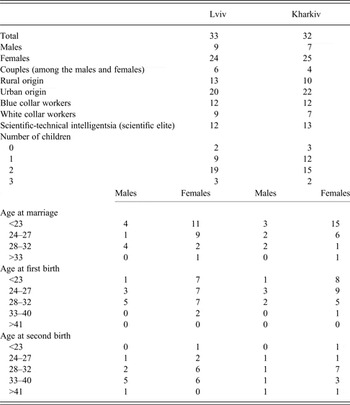
Life history interviewing constitutes the primary research method of this study. The interviews were conducted with men and women born between 1929 and 1945, residing in the Ukrainian cities of Lviv and Kharkiv during the 1950s through the 1970s, and who also were in their reproductive years during this period, which was characterised by the rapid decline of fertility rates in Ukraine. In total, 65 interviews were conducted: 33 from Lviv and 32 from Kharkiv. Fieldwork was conducted between July 2012 and April 2015.Footnote 14 For the general characteristics of the informants see Table 1.
Characteristics of the informants (numbers)

Source: Based on author’s primary research, dataset ‘Family and fertility in Soviet Ukraine’.
The interviews were open-ended, direct and personal conversations that, on average, lasted for two hours. In every interview I attempted to uncover individual experiences of various reproductive events, including courtship, marriage, childbearing and birth control. I also addressed the meanings that participants attached to significant others, namely those who influenced, helped with, or prevented them from making reproductive decisions. Finally, I tried to understand how their reproductive choices were shaped by the broader context of influential historical events and policy regulations, such as the introduction of abortion and maternity leave, as well as other social-economic conditions.
Purposeful and snowball samples were employed to recruit the informants.Footnote 15 These two sampling techniques were used to ensure that the informants came from as diverse as possible economic and educational backgrounds. I did not aim for a representative sample of the entire population of two cities, but rather interviews of a diverse enough group of individuals to enable a study of differences along a number of axes.The interview structure, sampling techniques, and recruitment of informants are discussed in my previous publication in greater depth.Footnote 16
In addition to the interviews, I collected life history calendars (LHCs) by which data on household composition, births, marriages, and employment history of the informant and spouse were recorded.Footnote 17 LHCs were filled in with every informant after the interview. Information provided in Table 1 derives from the informants’ LHCs. Finally, I used published vital event and census data to calculate crude birth rates for the regions, and reviewed the ethnographic literature on historical family systems in western and eastern Ukraine.
2.2 Data analysis
The life history interviewing method can provide incredibly rich data, in my case complete reproductive histories of men and women. However, because this method typically gathers retrospective data, life histories (the sequence of biographical events) should be analysed in line with life stories (how the biographical experiences are constructed in the situation of the interview).Footnote 18 To do so, I reconstructed life stories for each informant, by making memos of the moments of the informant's self-presentation. I paid particular attention to how these self-presentations were linked to his/her ethnicity, religion, gender, and family situation. I used these memos to interpret the values that informants attached to different life course events during the later stages of my analysis.
To perform the coding I used Atlas.ti qualitative software. I applied three coding strategies to every interview in order to reveal the main sub-categories related to transition to second birth. First, I carried out structural coding aiming at identifying life course transitions and their sequences in every interview.Footnote 19 Then, I performed domain and values coding of the transitions related to first and second births: pregnancy, childbirth, abortion, miscarriage and childcare.Footnote 20 My aim at this stage was to grasp the interpersonal connections an individual developed at every life stage discussed in the interview, attitudes and perception of the life course event itself, and structural conditions underlying this event. During the final stage of the analysis, the relationships between different codes were defined. Based on these relationships, the codes were grouped into sub-categories, such as ‘readiness and second birth’, ‘uncertainty and second birth’ and ‘companionate spousal relationships and childcare’. I then used the query tool to select the quotations according to the groups of related documents that were created in the previous steps (documents families): city (Lviv or Kharkiv) and gender (male or female). Finally, I used LHCs as a triangulation tool to reconstruct a biographical profile (life history) for every informant and link it to their narratives during the analysis.
3. SOCIO-ECONOMIC DEVELOPMENTS AND TRADITIONS OF FAMILY RELATIONSHIPS IN WESTERN AND EASTERN UKRAINE
Western and eastern Ukraine have been subjects of comparative research for decades, primarily because of the persisting differences in socio-cultural aspects, such as religion, language and traditions of family relationships.Footnote 21 The cities of Lviv and Kharkiv, located in the western and eastern Ukrainian borderlands respectively, therefore constitute interesting comparative sites in this respect.
Historically, Lviv was slower to industrialise and adopt Soviet social reforms than Kharkiv, which was comparatively an industrial and secular city. The modernisation process in Lviv started in the mid-nineteenth and early twentieth centuries, when it was part of Austro–Hungary and later of Poland. However, this process was slower than in central and eastern Ukraine, which at that time was situated under the rule of the Russian Empire. During the interwar period, Lviv was a multicultural city where ethnic Polish and Jewish groups constituted the majority of the population. Industrialisation was further reinforced when western Ukraine became part of the Ukrainian SSR in 1939, and especially after the war. By 1959, the population of Lviv had reached almost half a million (411,000), which made it the largest city in western Ukraine.Footnote 22 The city's population also became more homogeneous in the aftermath of the Soviet and German occupations during the war. During the 1950s and 1960s, the rapid influx of migrants primarily from the neighbouring rural and urban areas meant that Ukrainians came to constitute the city's majority (60 per cent in 1959).Footnote 23 During this period migrants coming from Russia were the second largest minority in the city (27 per cent in 1959),Footnote 24 however their percentage declined over the years.
Lviv after the war can thus be seen as an entirely different city from the interwar period, as mainly Ukrainian migrants populated the city. After the war, the Soviet government started the process of dissolution of private property rights, and also started russification and sovietisation campaigns in western Ukraine. These campaigns however were softer in comparison to other Belorussian or Baltic regions at that time.Footnote 25 This allowed Ukrainians of provincial origin to retain their more traditional habits, such as strong religiosity, commonly Greek Catholicism, and strong family ties. During the post-war years, these values made a significant contribution to the formation of the city's mentality, which even today is characterised by religiosity, patriotism and family values.Footnote 26 Maintaining relationships with family in villages and towns, as well as with those who also migrated to Lviv, the newcomers were able to retain their traditional life styles, and thus were slower in adopting new socialist norms.Footnote 27 Reinforcement of their often family-oriented values was also due to common opposition to the Soviet regime in this area and the idea that personal information can only be shared with those whom you could trust, usually relatives and family members.
Along with the importance of family relationships in their everyday lives, these migrants’ personal values were built around the notions of autonomy and aspirations of being able to sustain their own livelihood independently from their parents.Footnote 28 As ethnographic studies show, this notion of independence was already typical in western Ukraine in the nineteenth century. After marriage, a couple typically set up a separate nuclear household and worked their own land, which they received from their parents. Only an older son and his family stayed with the parents, worked on the same land and provided elderly care in later life. Inheritance was typically partible and equally distributed among all the sons (and occasionally among daughters as well).Footnote 29 A similar pattern of family system is also typical for Romania and is defined by Karl Kaser as a mix of the stem and nuclear family systems.Footnote 30
In Kharkiv both the family system and economic development differed from Lviv. Rapid economic development in the Kharkiv region started in 1919, when the city of Kharkiv also became the capital of the Ukrainian SSR. Machine industry and various light industries developed. The industrial developments during the interwar years, which later continued during the 1950s and 1960s, led to a rapid influx of migrants to the city from the neighbouring areas and from Russia.Footnote 31 The ethnic composition of the city, however, remained the same as before the war, and according to the 1959 census, Kharkiv was composed of 48.4 per cent Ukrainians, 40.4 per cent Russians, and 8.7 per cent Jewish residents.Footnote 32 In the mid-twentieth century, the city became one of the largest in Ukraine with a population of 950,000 people in 1959.Footnote 33
As soon as the Soviet regime was established, Kharkiv became one of the cities held up as an example of communist life. In fact, the tradition of communal life, where the entire family shares the household goods obtained from working together on the same land, was common in the Kharkiv area long before the Soviet regime was established. In this respect, it was similar to traditional patterns of family relationships found in central and southern Russia where joint family systems prevailed.Footnote 34 An important aspect of the joint family system in the Kharkiv area is that it implied co-residence of more than two married couples in one household, typically parents with more than one married son.Footnote 35 During the nineteenth century, co-residence patterns started to change and only a younger son's family remained with the parents. However, in this region, land was often family-owned, meaning that inheritance was not partible, and even when residing separately from parents, children still worked on the same land with their parents.Footnote 36 These co-residence and inheritance patterns could lead to children's economic dependency on the parents not only before marriage, but also in later life.
As described in historical perspective, the traditional patterns of co-residence and inheritance rules in Lviv and Kharkiv could be the underlying factors forming regional family values in contemporary Ukraine, described by Brienna Perelli-Harris as having a ‘more traditional, religious and nationalistic family orientation’ in western regions, and as more community oriented in the eastern regions.Footnote 37 These connections, though plausible, are still vague, as little is known about family relationships during the Soviet time. The analysis in this study addresses this lacuna. Before discussing family relationships in connection to transition to second birth as depicted in the interviews, in the next section I address the main aspects of Soviet family policy during the post-war years, as this provides the actual historical boundaries within which family relationships and second childbearing took place.
4. SOVIET FAMILY POLICY AND FERTILITY IN UKRAINE
After the death of Stalin in 1953, de-Stalinisation processes brought some relaxation in Soviet family policy, primarily that abortion and divorce became more accessible. At the same time, some aspects of Stalin's pronatalist policy were still enacted, such as the effort to promote the stabilisation of the family in order to increase fertility rates. The stabilisation of the family was mainly performed through assigning women maternal responsibilities alongside labour force participation. In order not to discourage women from participating in the labour force, the new family policy proceeded from the assumption that ‘fundamental biological differences between males and females require the adaptation of working conditions to women's distinctive needs’.Footnote 38 The policies introduced were the same for all provinces (oblasts) within a republic.
In addition to these ideological changes, women's incorporation in the labour market also started to change after the Second World War. Women started to occupy more positions in education, health care and culture, where the working week was shorter (33–39 hours), which allowed them de facto to perform part-time working duties.Footnote 39 Compared to the 1920s Soviet ideological thinking of women as being equal to men in labour force participation, the post-war ideological shift stressed women's duty as citizens to be mothers and wives, which in many ways was similar to the trend in the capitalist Western European societies.Footnote 40 Scholars argue that the rising ‘male-female income gap was more the result of the different distribution of men and women in the occupational structure than of direct wage discrimination’.Footnote 41 These changes, however, did not impact upon the overall share of female labour force participation, which was high when compared to Western European countries at that time and continued to increase. In 1950, the proportion of women among blue-collar and white-collar workers was 46.9 per cent in Kharkiv and 12.3 per cent in Lviv.Footnote 42 Women's employment in Lviv increased rapidly to 42.3 per cent in the following decade.Footnote 43
Overall, Soviet family policy after the Second World War became more supportive to mothers than to women in general.Footnote 44 As such, maternity leave introduced in 1955 was only accessible for working mothers. Maternity leave granted 112 days at full pay, 56 before delivery and 56 days after delivery. In addition, mothers could have an additional three months’ unpaid leave. Those who decided to stay at home with their infant for longer could return to work in the same position within one year of childbearing; however, this right did not always work in practice.Footnote 45 The Soviet Union extended parental life benefits to non-working mothers as well only in 1989.Footnote 46
Additional support with infant care was received from state owned nurseries, kindergartens and ‘milk kitchens’. These facilities were available for both working and non-working parents. However, working parents often had access to worksite nurseries or kindergartens. Milk kitchens provided mothers with baby food and milk during the first year after delivery, which allowed mothers to stop breastfeeding early and leave young infants at nursery. The number of milk kitchens, nurseries and kindergartens grew rapidly during the post-war years. For example, in 1957, in the city of Kharkiv there were eight milk kitchens, located in every city district, and 98 nurseries.Footnote 47 By 1968, the number of nurseries increased to 141.Footnote 48 In Lviv, these facilities were also growing, but still remained less developed than in Kharkiv. In 1950, Lviv had 1 milk kitchen and 8 distribution points, and 12 nurseries per 6 city districts.Footnote 49 By 1958, the number of nurseries had increased to 28.Footnote 50
As mentioned earlier, this pronatalism policy reflected an emerging problem for Soviet society, the problem of fertility declining below replacement levels. The fertility decline in Ukraine was rapid, but regional differences persisted.
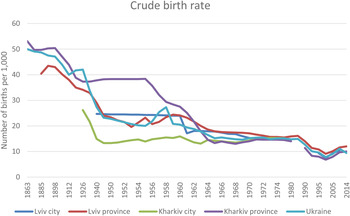
As Figure 2 shows, the Lviv region entered the fertility transition in the late nineteenth century, before it became part of the Soviet state. During the 1950s and 1960s, fertility was declining in the Lviv region, and especially in the city of Lviv. However, fertility still remained higher on average than that in Kharkiv, as well as in comparison to Ukraine as a whole. In Kharkiv, fertility was declining in the early twentieth century, and during the 1950s and 1960s fertility rates fell to as low as 13–15 births per 1,000. After the mid-1970s, the trend towards convergence in fertility rates can be observed, which could be linked to the adoption of a two-child family ideal.Footnote 51 However, the regional differences can still be observed after the 1970s and even more explicitly in the late 2000s.
Crude birth rates for Lviv (city and province), Kharkiv (city and province) and Ukraine, 1861–2014. Sources: A. G. Rashin, Naselenie Rossii za 100 let (1813–1913) Statisticheskie ocherki, http://istmat.info/node/80 [accessed 13 April 2015]; Franz Rothenbacher ‘The Central and East European population since 1850’ (Hampshire, 2013), 1244; The Human Fertility Database, http://www.humanfertility.org/cgi-bin/main.php [accessed 2 April 2015]; Lviv state archive, funds #312, #283 and #406; Kharkiv state archive funds #1962, #P-5125 and #P-5231; Population yearbooks 1991–2001; Main Statistical Office in Lviv region databases, http://www.lv.ukrstat.gov.ua [accessed 15 April 12015]; State Statistics Service of Ukraine documents publishing, http://ukrstat.org [accessed 5 April 2015].

Demographers suggest that the post-war fertility decline in Ukraine was caused by considerable spacing between births and by the tendency of stopping reproductive activities after first birth at the early age of 25–30.Footnote 52 Before 1955, spacing and early stopping practices could have been caused by the high infant mortality rates (IMRs) in the aftermath of the Second World War.Footnote 53 However after the mid-1950s, IMRs were steadily declining. In Ukraine, the IMR was 36.6 in 1960, and in Lviv and Kharkiv provinces it was 33.0 and 26.6, respectively.Footnote 54 Surprisingly, through the 1960s and 1970s, IMRs became higher in Kharkiv than in Lviv. In theory, this indicates that intentions to have more children should have been more common in Kharkiv than in Lviv. However, this does not seem to be the case among the informants, as I discuss in the following section.
5. THE SECOND BIRTH IN THE CONTEXT OF FAMILY RELATIONSHIPS
In this section I discuss individual experiences of the transition to a second birth in Kharkiv and Lviv between the 1950s and mid-1970s. I first explain what meanings individuals attached to the transition, and then I show what role relationships with family and peers played in the transition. To reveal how these relationships influenced individual decisions and attitudes regarding second childbearing, I refer to the mechanisms of social influence, particularly social learning, social pressure and social support, which are described in detail in Laura Bernardi and Andreas Klärner's 2014 article, ‘Social networks and fertility’.Footnote 55 Lastly, I focus on the role of social support with childcare in the context of intergenerational and spousal relationships. The analysis for Kharkiv and Lviv is presented separately in order to better emphasise regional aspects. For reasons of confidentiality, the names of the informants are pseudonyms.
EASTERN UKRAINE: KHARKIV
5.1 Material uncertainty and the long transition to second birth
In the European Soviet republics, including Ukraine, the two-child family norm became accepted by the 1960s.Footnote 56 This vision of family composition was also explicit in the Kharkiv informants’ narratives. However, having two children was perceived as a maximum rather than a desired number, which is similar to the contemporary situation in Ukraine and Russia.Footnote 57 Both male and female informants commonly linked their aspirations of having a small family of one or at most two children to the general material hardship and the costs of bringing up a child, as male and female informants framed this concern:
At that time having two children was, so to say, too many … . Because of the material provision issues and upbringing; it was not easy.Footnote 58
It is a lot of responsibility [to have a second child] and this made it hard, also because everyone had to work.Footnote 59
For many, to have adequate material conditions meant to achieve financial security, namely to have stable employment for both spouses and a residence independent from that of their parents. These two steps are considered among the major thresholds in the transition to adulthood. In Western European societies these are historically perceived as steps that are integral to the forming of a union.Footnote 60 In the context of the Kharkiv informants, however, marriage and first childbirth commonly preceded financial independence, and both men and women married at an early age. After getting married, couples typically co-resided with parents/in-laws before getting an independent place, and some still had to finish their educational training. First childbearing conventionally occurred within one year of marriage, and often took place under close (grand)parental supervision.Footnote 61 As such, a first child was typically also seen as a responsibility of grandparents and their support with childcare was common.
In the context of the Kharkiv informants, marriage and first childbearing were the early phases of adulthood, while material security and independence from parents were subsequent steps. Before having a second child, many couples still had to establish their own livelihoods, which often resulted in a prolonged transition to second birth.
5.2 Social influences on birth postponement
When discussing with the informants the transition to second birth, it became apparent that decisions to space childbirths were closely related to the character of spousal relationships. Both male and female informants perceived childbearing and infant care as a primary responsibility of the mother, or equally of both parents. As such, men usually referred to the decision to have a second child as made by their wives, even when it was discussed between spouses. The quote of a male informant illustrates an example of the decision-making process:
Interviewer: When she got pregnant with the second child, did either of you consider aborting it?
Viktor: No, she did not want to abort this time. Not agreeing with her, I expressed that I was not happy to have a child. But I told her ‘If you really want it, then do it.’ It was her decision, and she gave birth.Footnote 62
In women's narratives, their husbands’ role in the timing of a second child was also often invisible, and the expectation of infant care was not common. Male and female visions of childbirth and infant care were related to the ways in which spouses arranged their relationships, especially with regard to fertility control: while men held the major responsibility for birth control, they did not participate in women's abortion decisions, which in fact were closely related to the timing of second birth.Footnote 63 As such, the decision about when to have a second child, and whether to have one at all, was mainly taken by the woman.
In their reasoning about prolonging the timing of having a second child, female informants typically linked it to the difficulty of carrying a double burden: combining infant care and paid work. The female informants, regardless of their social-economic position, commonly emphasised their need to work and contribute to the family income in order to improve the material situation of the family. In this context, postponement of a second child was a rational decision, typically made by a woman, as a female informant frames it: ‘I could have had of course more [children], but I had two abortions. It was necessary to get out of this misery. It was necessary to work.’Footnote 64 Women's frequent attempts at pregnancy termination certainly derived from their experiences of carrying a double burden. However, women in Kharkiv also learned from other women's experiences, as they closely communicated with colleagues, neighbours and friends.
For women in Kharkiv, peer relationships played an important role in everyday life, even after marriage.Footnote 65 These ties were not necessarily strong and stable over the life course, and could change depending on place of work or residence. However, in those typically female close-knit settings women tended to discuss their problems and seek advice, often on family issues. In the fragment below, the female informant explains how communication with other women helped her to make her own childbearing decisions:
At work, the women told me ‘Well, are you sure you can do it [to have a second child]? Why would you do it? Your baby is still too small!’ … My female friends also had two children. We did talk about it, and all of them had abortions. We did not discuss contraception, as it was an individual matter. But if one of us got pregnant, we all would give her advice.Footnote 66
The woman shows that her reproductive choices and aspirations were similar to those of her colleagues who also had two children on average. What is important to understand here is that having a second child, although it was a woman's decision, was not necessarily planned, given that methods of contraception were unreliable, and often not carefully performed.Footnote 67 The aspirations to have fewer children, typically no more than two, were commonly achieved through prolonged birth spacing. Abortion was the most common method to achieve birth spacing, at least in part because it was the most accessible.Footnote 68 Female informants discussed these matters. However, when seeking advice from their peers, they did not learn from each other the benefits of having one or two children, as this would be a long-term learning process. Instead, they learned the advantages of birth terminations and how to choose the right moment to have a second child. For many informants, waiting for a perfect moment to have a second child took years.
In this context, the vision of abortion as the only means of birth termination was often also reinforced through social pressure – ‘the force that leads individuals to conform to accepted social norms’ in order to gain the approval from their peers.Footnote 69 In some female networks, peer judgment was a strong controlling mechanism used against those women who ‘lived following their pleasures’, as one of the informants described women who had frequent childbirths.Footnote 70
Social pressure also existed with regard to the age limit within which it was considered appropriate to have a child. Most of the female informants with a second child typically had them by the age of 35–40 (see Table 1). Among many female informants, this age was considered as a deadline for motherhood, and some linked it to the idea that having a child after the age of 40 could be dangerous for a woman's health. This concern could have derived from the Soviet medical discourse that favoured early motherhood. However, there seemed to be another part to this prejudice, which carried more of a cultural interpretation of a female's reproductive age limit. As such, the deadline for motherhood was related to the notion that parents’ and their children's childrearing years should not overlap, which is very likely to occur in the context where early marriage and early first childbearing are practiced. This consideration, even unconsciously, provided a clear understanding of a stopping moment for reproductive activities, particularly among women, as a female informant describes:
We wanted more children, and I could have given birth again at the age of 39. But Al'osha [an older son] at that moment was married, and his wife Tamara was already pregnant. And this stopped me from having a third child, which my husband and I really wanted.Footnote 71
The deadline for motherhood and pressure to space births by using abortion certainly facilitated the postponement of the transition to second birth to the mid-thirties. After first birth, there typically was no normative expectation on when to have a second child and a new family still had to establish its own livelihood. At the same time, peers’ reproductive strategies offered a more convenient model of prolonged transition to second birth, which allowed women to keep working for a longer time. By the age of 35, women started to realise that if they did not give birth again in the next few years, they might not have another child at all. This reproductive strategy of delaying the second birth due to persistent economic uncertainty is different from what demographers call birth spacing, though birth spacing and postponement are not mutually exclusive. According to Victor Agadjanian, birth postponement can be described as a ‘waiting’ strategy.Footnote 72 Among the couples in Kharkiv, this waiting strategy was characterised by frequent pregnancy terminations, due to material uncertainties. Female informants from Kharkiv typically gave birth first before or during their mid-twenties and had their second birth closer to the mid-thirties. The average gap between first and second births was between 7 to 15 years, and in some cases a second birth never occurred. This behaviour signifies that the transition to second birth was not planned and intentions changed depending on material and emotional circumstances. What is important to address further in this respect, is whether the postponement of second birth was solely linked to the lack of husbands’ help and women's hardship of bearing a double burden. In the next section, I argue that in addition to those two factors, material uncertainty was also related to the available grandparental support with childcare for the second child.
5.3 Seeking grandparental support with childcare
In Kharkiv, female informants usually arranged and provided infant and child care. They typically did not stay at home with a child after maternity leave expired, and most of them returned to work after the 56-day paid maternity leave was finished. Although nurseries and kindergartens during the 1960s were available all over the city of Kharkiv, the majority of the informants rarely considered these options as adequate alternatives for infant care. Some informants would have tried to make special part-time arrangements at work, but most commonly they first sought support from their parents or from their in-laws. Grandparental help was typically seen as the major source of support in this matter, as a female informant describes:
First I did not even think about having a second child, and later when I did want one, I had some health issues. All in all, there was always this problem of who will take care of a child. For my mother it was hard to do it, as she had to take care of Irina's Lesha [my sister‘s child], and two children would have been too much for her.Footnote 73
Although after the first birth many couples easily acquired grandparental support as many of them still lived with their parents, this support was not always possible with a second child, when a couple typically lived separately from their parents. When the informants finally considered having a second child, often while in their thirties, grandparents were not always easily available. They were more likely to be helping out other children, were too old, not in good health, or lived far away. In the interviews, I observed that the lack of grandparental support with infant and/or childcare was the major reason behind postponing having a second child and eventually not having one at all, as the quotes of two female informants describe:
I spoke with my mother-in-law about whether to keep a child or to have an abortion. But she said, ‘You both should decide yourself. You are adults and do what you think is possible.’ That was it. I had an abortion.Footnote 74
After my father told me that if we decided to have a second child it would be … that we should only count on ourselves, and that we should not expect any substantial help from them.Footnote 75
The post-war period phenomena of postponing a second birth, which in some cases resulted in early stopping, lead to the establishment of the one-child family norm in the Kharkiv region. This phenomenon could be a key explanation for why fertility declined there during the 1950s and 1960s, and then only slightly increased during the mid-1970s. More detailed analysis of this process however is still needed.
WESTERN UKRAINE: LVIV
5.4 Early self-independence and the faster transition to second birth
Among the Lviv informants, material conditions, such as housing issues and women's temporary unemployment, were also mentioned among the reasons to prolong the transition to second birth. However, this reasoning was typically indicated along with the desire to wait until the first child was older, as the following male and female informant quotes illustrate:
My wife and I did not have any objections regarding not having a child after the second one was born. Therefore, we did not think in terms of that we would not have one afterwards, as we did not reject the possibility. And even when my wife had an abortion, there was only one reason for it – that the pregnancy occurred too soon after the second child. Meaning, we wanted a third child to happen at the right moment. It was a time-related decision.Footnote 76
I did not want another child yet, because the first one was still too small. But then I got pregnant, and I thought, ‘What should happen, shall happen.’Footnote 77
The Lviv informants claimed to be more open towards having a second or a third child. Many stated that for them having two children was ‘a must’ and that ‘one child is not a child’. Lviv couples often presented a second or even third birth as planned. It might have been the case that even when a pregnancy was not expected, spouses were likely to accept the fact.
The readiness and willingness of Lviv couples to have a second child shortly after the first could be linked to material independence from parents near the time of marriage. Both male and female informants often worked when they got married, and some even lived independently from their parents. The necessary level of material security, which implied independence from the parental family, could have also been achieved if a woman married a man who had stable employment at the time of marriage. This was more likely when the husband was older than the wife. Among the Lviv couples, a fairly large spousal age difference, with men being older than women, was more common than in Kharkiv. In this context, marriage first and later order births typically took place when at least one of the spouses was economically secure. These two transitions – marriage and economic security – also signified entrance into adulthood.
5.5 Social influence on the establishment of the two-child family norm
The strong proscription against having a single child was one of the central motives among the Lviv couples to have at least two children. Informants typically justified this motive by saying that they perceived it important for a child's development to have siblings. Here are the quotes of a male and female informant that illustrate this aspiration:
If parents have only one child, then everything … all attention goes to him or her, and so to speak the child will be egoistic. But when there are two, then they tend to collaborate and they have to take care of each other as well.Footnote 78
My parents also had two children. Later, my mother-in-law also told me ‘One child is not a child. You should have a second one. I did not have a husband but had two children.’ One child is … no, no, never.Footnote 79
The informants often related the advantages of having siblings to their own experiences, as many of them grew up in families with more than two siblings. Throughout the life course, relationships with siblings played a crucial role, and the role of older siblings was particularly important. An older brother or sister was often a primary source of material support for the younger ones, and typically helped to pay education fees or to find a job. The ideal of having a larger family was also transmitted from the parents as a part of the socialisation process or from in-laws during marital life. The last quote illustrates how strong social pressure from her mother-in-law influenced the woman into thinking that having one child is not good.
Compared to their Kharkiv counterparts, the Lviv informants had more pronatalist views with regard to childbearing. However, a more rational approach to birth control, particularly after a second birth, signifies that the perception of the two-child family norm was becoming more and more accepted in this region as well. This implied using more reliable, typically male-controlled, methods of contraception. Among the methods commonly used were coitus interruptus and condoms, which worked effectively for many couples. A pro-natalist stance can also be inferred from avoidance of abortion, which was typically used only on urgent occasions rather than as a means of birth control. Overall, average abortion rates in Lviv were half those in Kharkiv.Footnote 80
Another factor that affected the establishment of the two-child norm in Lviv was that sometimes women's aspirations to limit fertility after a second chid were stronger than those of their husbands. Even though spouses often communicated on these matters, some women started to oppose their husbands’ pronatalist wishes. The quotes from the interviews with a male and female informant illustrate this aspiration:
We did talk about having another child, but she … Well, we already had two daughters and our first son died. She said, ‘We cannot make it with more [children]’ … I don't know, sometimes it happens that a husband has an opinion, but the mother may think differently.Footnote 81
I gave birth to a girl first. She is four years older than my son … four years and two months. After her the son was born. I then did not want any more children. I wanted to work.Footnote 82
Women's aspirations to limit fertility after their second birth were often linked to their intentions to return to work. In Lviv, the Soviet ideological norm that a woman has to contribute at least in part to the family income was commonly supported. However, this norm in practice was implemented differently than in Kharkiv. As stated earlier, Lviv society did not experience the radical changes regarding intense women's incorporation in sectors, such as heavy-, machine-, and light industries taking place in the Soviet Union in the 1920s and 1930s. Instead, the post-war Soviet ideological shift of seeing women primarily as mothers and wives, and only secondarily as workers, conformed with the patriarchal tradition of complementary gender relationships existing in Lviv. This type of gender relationships, where a husband performs the breadwinner role and a woman is responsible for the household duties, fitted well with Lviv couples’ ideals of marital life. This normative gender order also created less pressure on women who took an extended maternity leave and stayed with children longer, typically until the children had reached the age for kindergarten or even school.
In addition to women's aspirations to return to the labour market, social pressure regarding a deadline for motherhood was also pronounced in Lviv. Female informants typically had their first child after their mid-twenties and second (or even third) by their mid-thirties (see Table 1). This allowed for an age gap between births of a maximum of five to seven years. As such, having two children born relatively closely together helped couples preserve financial independence from their parents. Although women typically stayed at home during the first few years after delivery, and could even have resigned from work for this purpose, the shorter birth spacing still allowed them to return to work more quickly. To understand the logic behind this reproductive strategy, in the next section I review how infant and childcare responsibilities were arranged.
5.6 Spousal responsibilities for childcare
The Lviv couples presented childbirth decisions and the arrangement of childcare as a shared responsibility of both spouses. In practice, men held the major role in decision-making, while women typically conformed to their husbands. For example, couples perceived birth control as the male's primary responsibility, and a decision to abort was commonly discussed with the husband.Footnote 83 At the same time, women performed most of the infant and childcare duties. Even though some husbands could have helped their wives, couples more commonly hired a nanny who would help the wife within the household and/or with infant care. Because women usually stayed at home during the first year(s) after delivery, or switched to a more flexible work schedule, they were able to perform childcare duties themselves. A male and female informant describe their experiences in this realm:
She was at home with the child for about two years. Then … I found her a job at the laboratory. It was just across the road, so she was able to come home for a short moment any time she needed. And the child was then in a kindergarten.Footnote 84
I was at home with Myroslav [second child] for some years as well. We went to the village to my family and lived with them for some time. When he got older, I brought him to the kindergarten. It was right before the school started. … At the hospital I had patients starting at 8am, so I often was able to finish by midday. When I had home visits, which sometimes were shorter, only three hours, I could drop by the kindergarten first and bring him home. Then the boys took care of themselves.Footnote 85
Contrary to Kharkiv, in Lviv I did not observe informants’ expectations of receiving grandparental support with infant and childcare. Although grandparents could provide some support, it was not arranged on a daily basis because many couples resided separately. Sometimes, however, as a female informant also indicates above, a wife could have stayed at her parents’ place for a few months during the infant care period. This made infant care easier for a wife, as she did not have to cook and clean. However, after a short while a woman would typically return to living with her husband.
Even though spouses in Lviv performed different roles with regard to infant and childcare, they both felt equally responsible for this process: a husband in providing material support to the family, and the wife in taking care of children. This type of spousal cooperation can be seen as the underlying factor behind a short-term spacing strategy in the transition to second birth. On the one hand, this reproductive strategy allowed spouses to save material and time resources spent on childcare. On the other hand, it permitted them to internalise the norm: to have at least two children.
6. CONCLUSIONS
The findings indicate that socio-economic standards, Soviet family policy and related material uncertainty were indeed crucial factors for couples’ reproductive decisions in Soviet Ukraine. However, how these conditions were practiced in family life and, hence, in individual reproductive strategising about a second birth, differed between the regions. I associate these differences with the patterns of family relationships historically predominant in the Kharkiv and Lviv regions: the joint and nuclear-stem family systems, respectively.
It is argued that in the context of strong parental authority and prolonged multigenerational residence, which were prevalent in the joint family system in the territories of historical Kharkiv, spousal relationships were less important because negotiations of livelihood strategies constituted a concern for all family members living in the household and sharing its goods.Footnote 86 This, in turn, facilitates less cooperation between spouses, also with respect to reproductive decisions, and produces interdependencies between generations. I also observed this pattern of intergenerational relationships among the Kharkiv couples in the 1950s–1970s. Strong intergenerational ties often surrounded the transition to first birth and continued even after the family started to reside separately from the parents or in-laws. The expectation of receiving grandparental support with second childcare existed among many informants despite the separate residence. However, when it was clear that grandparents would not be able to provide immediate help because they were taking care of other grandchildren; or had health issues, were far away, were still working, or experienced other constraints, it contributed to increasing uncertainty, particularly among women. An important aspect of this family pattern was that a grandmother rather than the husband was seen as the major helper with infant care. As a result, the realisation of limited possibilities for receiving grandparental support in case of a second birth, which also coincided with other uncertainties related to a female double burden, motivated many of the female informants from Kharkiv to adopt a waiting strategy of delaying the transition to second birth, with abortion among the main means of birth control.Footnote 87 Additionally, women often also learned from each other about the benefits of adopting a waiting strategy.
Many of the Kharkiv informants practiced this waiting strategy until they reached the social deadline for parenthood, typically in the mid-thirties, and this is when the second birth was likely to take place. As such, the adoption of the waiting strategy often led to more prolonged birth intervals between first and second children, sometimes as long as 7 to 15 years. Scholars define the waiting strategy as postponement, in contrast to spacing.Footnote 88 Additionally, those women still feeling insecure about proceeding with another birth could become early stoppers if the waiting period went on too long. The appearance of early stoppers in the 1950s–1960s contributed to the emergence of a one-child family norm that undoubtedly facilitated the rapid decline in fertility rates in the Kharkiv region at that time. Scholars argue that the postponement strategy and one-child families became even more widespread in the 1990s and early 2000s, which eventually led to the decline to the lowest-low fertility.Footnote 89
When a new family does not reside with the parents, or intends to reside independently shortly after marriage, such as in the stem and nuclear-stem family system typical for the territories of the historical Lviv region, intergenerational cooperation and dependency in livelihood strategies would eventually become less strong and spouses themselves would tend to make primary decisions about their economic, social and emotional issues.Footnote 90 I also observed this behaviour among the Lviv informants, where the spouses would negotiate and arrange childbearing and childrearing responsibilities together. To do so, the Lviv informants often adopted a traditional male-breadwinner model at least at some stage of their reproductive careers. This model was based on a temporary practice of complementary gender relationships where a husband earns most of the income, while the wife either does not work or works part-time while taking care of the children. Some husbands also helped their wives with childcare. More often, however, the Lviv couples hired a nanny for this purpose. Sometimes, grandparental help with childcare was also available, but it was not central, unless the generations resided together. As such, childcare can be seen as increasing material and emotional costs for both spouses, and not only for women. Negotiations over these costs between spouses were a reinforcing factor for many couples in Lviv to adopt a shorter birth spacing strategy. At the same time, this strategy reinforced the solid establishment of the two-child family norm in practice, which possibly also helped to stabilise fertility rates in the region in the 1950s–1970s.
All in all, these findings contribute to the recently introduced debate by Agadjanian, and Ian Timæus and Tom Moultrie on spacing as contrasted to postponing reproductive strategies.Footnote 91 In the context of Eastern Europe, this distinction is particularly important as up to the present many countries in this region have been characterised by a relatively early and universal entrance into parenthood, while fertility decline mainly occurred due to changes in the transition to second and later births. While the analysis here is of a more explanatory nature on this matter, further research may use this argument to formulate hypotheses that will cover other geographic areas in other Eastern European regions, as well as in other time periods and delving more into ethnic and religious backgrounds.
ACKNOWLEDGEMENTS
This study was supported by a VIDI Innovational Research Grant from the Netherlands Organization for Scientific Research (contract grant number 452-10-013). Earlier versions of this article were presented during the 7th Day of Historical Demography, Wageningen University (4 December 2014), ESDG seminar, Radboud University (2 February 2015) and during the WASS PhD Day, Wageningen University (28 May 2015). The author wishes to thank the participants for their valuable comments and insights. Special thanks to Hilde Bras, Theo Engelen, Jan Kok, Anke Niehof, Sarah Carmichael, and three anonymous reviewers for their comments on the earlier versions of this article. The author also thanks those who assisted with recruiting informants for this study, and the informants for their participation.