Introduction
Researchers have provided abundant evidence that content knowledge alone is not sufficient for hierarchical success, that is, job advancement or upward promotion, but rather some unique combination of various capabilities and personality factors (Boudreau, Boswell, & Judge, Reference Boudreau, Boswell and Judge2001; Tharenou, Reference Tharenou2001; Ng, Eby, Sorensen, & Feldman, Reference Ng, Eby, Sorensen and Feldman2005; Yukl, Reference Yukl2012). However, other researchers have lamented the deficiency of empirical and applied research that clearly defines the relationship between managerial roles and context (Tett, Guterman, Bleier, & Murphy, Reference Tett, Guterman, Bleier and Murphy2000; Dierdorff, Rubin, & Morgeson, Reference Dierdorff, Rubin and Morgeson2009). This reinforces the argument for relevancy as opposed to esoteric scholarship and research in the debate within the business school community, which has raged for some 60 years (Porter & McKibben, Reference Porter and McKibben1988; Bennis & O’Toole, Reference Bennis and O’Toole2005; Navarro, Reference Navarro2008; Rubin & Dierdorff, Reference Rubin and Dierdorff2009; Benjamin & O’Reilly, Reference Benjamin and O’Reilly2011; Paton, Chia, & Burt, Reference Paton, Chia and Burt2014). Although the interplay between roles, capabilities, and context has been highly beneficial from a broad theoretical perspective, these studies have largely ignored the application of findings for management learning in meeting the needs of today’s practising managers or MBA’s who are soon-to-be world real practitioners. A central question remains in how to view the relevance of known work role requirements that are taught in business schools so as to expand our practical and theoretical understanding of how they may impact individual performance requirements and are requisite to managerial success (Fells, Reference Fells2000; Dierdorff, Rubin, & Morgeson, Reference Dierdorff, Rubin and Morgeson2009; Perriton & Hodgson, Reference Perriton and Hodgson2012; Yukl, Reference Yukl2012). In this study, we analyze the conceptualization and utilization of managerial roles as perceived by contemporary managers representing some 200 US companies and spanning a variety of industries. Our empirical approach investigates whether existing role taxonomies taught in business schools hold relevancy and practicality for contemporary managers. We also investigate the foundational parameters of managerial roles as related factors that may influence managerial engagement and ultimately organizational performance.
Some scholars have convincingly argued and provided corroborating evidence that many of these role requirements, with minor variations, were identified over a century ago and are essentially the same (Schor, Seltzer, & Smither, Reference Schor, Seltzer and Smither1995; DuBrin, Reference DuBrin2012). This does not mean, however, that the relevancy of these factors has also remained static during this timeframe, and by relevancy, we refer to the actual practice of management. Although the overarching taxonomies may appear stable, the additional voluminous refinements and omnibus contextual considerations suggest that the level of relevance for managerial roles and requirements would also fluctuate over time (Dierdorff, Rubin, & Morgeson, Reference Dierdorff, Rubin and Morgeson2009). Despite this acknowledgment, it is disappointing that there is little research that evaluates these theoretical, yet seminal models taught in most business schools despite the extensive requests for more clinical or practical models (Fells, Reference Fells2000; Yukl, Reference Yukl2012). It is here where our study makes a departure. We take the challenge and contribute to the existing taxonomies by examining the traditional and generally accepted managerial domains that include: roles, skills, and mindsets (Mintzberg, Reference Mintzberg1973; Dubrin, Reference DuBrin2012) and test their perceived relevance in today’s practising managers. Specifically, this study seeks to: (1) explore the extent to which contemporary managers behave or align with these generally accepted classical taxonomies; (2) offer empirical insight into levels of engagement based on newly found groupings of managerial role relevancy; and (3) gain a deeper understanding and practical insight into managerial performance requirements. To this end, our study explores managerial roles in the context of role taxonomy education and promulgation of these well-known and long-enduring managerial taxonomies.
There is, undoubtedly, a need for revising theoretical managerial research as organizations have become more competitive and confusing entities (Fells, Reference Fells2000; Dierdorff, Rubin, & Morgeson, Reference Dierdorff, Rubin and Morgeson2009). However, immediate practicality appears not to be the central focus of most business schools, nor is it an orientation widely distributed in otherwise well-intentioned faculty (Bennis & O’Toole, Reference Bennis and O’Toole2005; Benjamin & O’Reilly, Reference Benjamin and O’Reilly2011; Hughes, Bence, Grisoni, O’Regan, & Wornham, Reference Hughes, Bence, Grisoni, O’Regan and Wornham2011). This is an interesting contradiction in that business schools appear not to concentrate on what students and other important stakeholders consider most beneficial. This has been voiced by the Graduate Management Admissions Council and numerous scholars who portray graduates as unprepared, if not disoriented (Mintzberg & Gosling, Reference Mintzberg and Gosling2002). McTiernan and Flynn (Reference McTiernan and Flynn2011) underscore the over-emphasis on relatively ‘easy-to-quantify’ analytic decision making at the expense of ideation, ethics, change, critical thinking, and values. There appears an oversimplification of leadership and soft-skills training when in reality these more intangible and multifaceted capabilities sit at the core in running modern organizations, especially at a global level (Benjamin & O’Reilly, Reference Benjamin and O’Reilly2011). It is not the cognitive understanding of these skills that are in question, but rather their practical application which is not easily taught. Theoretical research with its general exemption from time-based limitations and its scant focus on practice application has also received harsh criticism. Bennis and O’Toole (Reference Bennis and O’Toole2005) note that incremental ‘scholarly’ research is of little interest to practitioners and has become a ‘vast wasteland’ of insignificance unrelated to the pace, pressure, complexity, and challenges of the business world. Thus, much research has bypassed the essence of a practicing profession under the guise of important latent and theoretical interests (Hambrick, Reference Hambrick1994; Pfeffer & Fong, Reference Pfeffer and Fong2002; Tushman & O’Rielly, Reference Tushman and O’Reilly2007; Hughes et al., Reference Hughes, Bence, Grisoni, O’Regan and Wornham2011). A stronger orientation towards research relevancy without sacrificing rigor would at least contribute to usefulness and make theory much more appealing to a practising profession. Finally, researchers, as well as educators, need to ensure that students not only understand theory, but that they develop pragmatic managerial behaviors which are core to their success in the market (Pearce & Huang, Reference Pearce and Huang2012). There is evidence that time, technology, and social progress may alter the relevancy of business domains and specific competencies nested within the broader generic taxonomic categories.
Given the changing business and social climate, continuously evolving corporate needs, interests in expansion towards emerging markets, foreign direct investments and globalization, and requests by accrediting bodies for continuous curriculum revision at business schools in the United States, it is essential to first review these well-known theoretical managerial domains. It is important to determine to what extent the role requirements upon which these frameworks were derived are still considered important and relevant. To this end, we provide a brief overview of the literature on roles, skills, and mindsets, followed by a discussion on some of the issues in nomenclature. Hypotheses linking managerial roles, skills and mindsets are set forth, followed by our methodology. We summarize our results and share a discussion on the relationship of these domains, including independence between roles, skills and mindsets, empirical evidence reflecting new role groupings of managerial roles, and novel empirical evidence suggesting disparity in levels of engagement among executives. We then conclude by reviewing the implications of our findings and make recommendations for future research and enhancement of managerial domains in management education.
Managerial Performance Requirements: Overview and Challenges
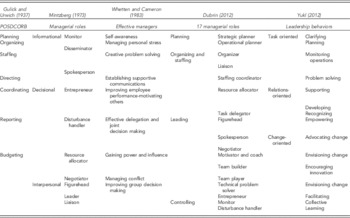
The past century has yielded numerous theories, empirical data, and practical insight into managerial performance requirements, that is, the skills, roles, and characteristics that are required of managers and how this knowledge is disseminated. Classifying the content of just managerial roles reveals a rich literature that renders the formation of an exhaustive compilation of findings unrealistic. Roles, as defined by Mintzberg (Reference Mintzberg1973) are those categories of actions or behaviors associated with job performance. Consequently, we have selected a small number of managerial typologies for comparison purposes as shown in Table 1 based upon a review of widely used managerial textbooks as shown in Appendix A and models that were identified in the literature as particularly significant (Tett et al., Reference Tett, Guterman, Bleier and Murphy2000). Some of these formulations were a response to requests for theory-driven predictors of job performance, which then led to a myriad of detailed performance taxonomies. For example, Yukl’s (Reference Yukl2012) thorough leadership behavior and taxonomy study builds upon a substantial number of these investigations and resulted in a nomenclature of meta-categories and behavioral components. Alternatively, Tett et al. (Reference Tett, Guterman, Bleier and Murphy2000) provided 53 ‘hyper-specific’ competencies contributing to a granular refinement of roles, although the overall categories remain intact. Other researchers have offered additional perspectives, criteria, and empirical data that somewhat challenge the movement towards hyper-specificity within the current taxonomies by broadening the frameworks. Golman (Reference Golman1998) has explored five areas of emotional intelligence that are correlated to hierarchical advancement; Judge, Cable, Boudreau, and Bretz (Reference Judge, Cable, Boudreau and Bretz1995) has identified hierarchical movement and linkages to demographic data; Pfeffer and Veiga (Reference Pfeffer and Viega1999) identified seven key managerial practices; Quinn (Reference Quinn2000) found eight personal attributes, and Yukl (Reference Yukl2012) provided an additional focus on change and innovation, to name only a few alternative measures. Thus, there is wealth of theoretical taxonomic research, yet despite this acknowledgment, there are few empirical studies that have explored role taxonomy in relation to applied practice or utility. For example, Tett et al. (Reference Tett, Guterman, Bleier and Murphy2000) postulate that given the growing complexity of work, the importance or relevancy of certain role requirements would likely be elevated although the taxonomic categories would remain stable. This has created a potential gap between rich theoretical taxonomies and continuously changing areas and levels of role relevancy. It is precisely this practical application for which management education has come under fire.
Managerial performance requirements and frameworks

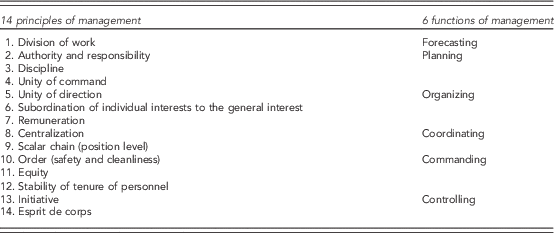
There seems little substantive variation from what Henri Fayol referred to as the six functions of management (forecasting, planning, organizing, commanding, coordinating, and controlling) in his in-depth 1916 publication, General and Industrial Administration, from the latter work of Gulick (Reference Gulick1937) known as POSDCORB. And again, there is little distinction from this, Mintzberg (Reference Mintzberg1973), Borman and Brush (Reference Borman and Brush1993), Tett et al. (Reference Tett, Guterman, Bleier and Murphy2000) and other researchers in terms of resulting taxonomies. Other researchers (Luthans, Rosenkrantz, & Hennessey, Reference Luthans, Rosenkrantz and Hennessey1985; Carroll & Gillen, Reference Carroll and Gillen1987; Kotter, Reference Kotter1990) added to the taxonomy, but Fayol’s functional list (see Table 2) remains intact in the literature (Fells, Reference Fells2000).

Dierdorff, Rubin, & Morgeson (Reference Dierdorff, Rubin and Morgeson2009) offered a comprehensive study of the managerial work and performance literature that spanned a 50-year period and included a sampling of 8,633 individuals. The authors provided further empirical confirmation that the 18 managerial roles already identified may be categorized in three areas: conceptual, interpersonal, and technical/administrative. Previously, Tett et al. (Reference Tett, Guterman, Bleier and Murphy2000) identified 53 additional ‘hyper-specific’ competencies and numerous other studies over time also contributed to our understanding of what managers do. However, these well-designed studies were focused on theoretical classifications of managerial work roles from a research perspective, but did not seek to capture the broader and more dynamic component relationships of roles, skills, and mindsets from the perspective of practising managers. This lack of research has been problematic in that the previously identified role requirements, as well as required behaviors, are not fixed. Individuals each with unique personality traits do not react with textbook precision in response to situations regardless of attempts to classify work contexts. As stated in our introduction, the central question remains in how to view the relevance of widely taught managerial roles so as to expand our understanding of how role requirements may influence individual or organization effectiveness (Yukl, Reference Yukl1989). Fells (Reference Fells2000) asks the same question noting that while Mintzberg added to contemporary management thought, he contributed little to our insights on effectiveness either organizationally or individually.
Responding to a request for a managerial taxonomy that was based upon behavioral observations (Campbell, Dunnette, Lawler, & Weick, Reference Campbell, Dunnette, Lawler and Weick1970), Henry Mintzberg set out to analyze what managers do. However, he did not focus on how well managers performed or if they were doing the right things. His well-known study of observing five executives each for 1 week has become a mainstay of business education and prompted extensive related studies. In brief, he collected some 1,250 observational data points, collapsed these into categories and subjectively determined what managers do, how they spend their time, and what pressures they face on the job. As noted, some researchers have argued that Mintzberg’s taxonomy is merely an incremental variation on already known managerial roles and provides little insight on how things might be done to improve organizational effectiveness. Further, the research appears to have been relevant at a point in time, but much has transpired since then. Nonetheless, from this formative study he drew numerous conclusions regarding job content, interpersonal skills, communication preferences, hours worked, and work fragmentation. It is not at all surprising that Mintzberg’s small sample base of four CEO’s and one top executive behaved similarly to one another in his study, but what they do should not be equated with how well they do it, nor if they are doing the right things. Our study examines this gap by exploring the interaction of roles and hypothesizing that each are not of equal relevance to practitioners as Mintzberg and many others have often presented them.
Managerial Behaviors: Roles, Skills, and Mindsets
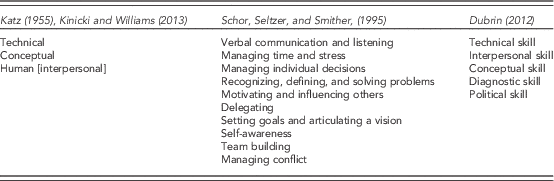
Although Mintzberg’s managerial roles are often generalized across levels, there are clear distinctions in the job content, strategies, personalities, attributes, philosophies, and execution capability required by each of the generally accepted managerial levels: top managers, middle managers, first-line managers, and team leaders (Schor, Seltzer, & Smither, Reference Schor, Seltzer and Smither1995; DuBrin, Reference DuBrin2012; Bateman & Snell, Reference Bateman and Snell2013). For example, top manager roles, according to Mintzberg, are most likely to include activities that contribute to functioning as spokesperson, figurehead, liaison, and strategic planner. Related leadership roles and enabling skills, however, span across all managerial levels. Table 3 presents a high level summary of some key managerial skills categories or frameworks commonly found in business education courses and related textbooks.
Managerial skills models

A distinction is made here by Schor et al. (Reference Schor, Seltzer and Smither1995) that the 10 characteristics found in their skills analysis are specifically related to behaviors as opposed to personality traits or managerial styles. The overlap between the skills identified by Katz (Reference Katz1955) and DuBrin (Reference DuBrin2012) would suggest the same. Unfortunately, the lack of a larger and more vertically stratified sample group in Mintzberg’s observations precluded any accurate inference as to the extent that the various roles, skills, or levels of expertise were utilized differently by managerial level. We will leave this for future research, but considering the premise that skills are based upon a distinct behavioral typology, it would be important to determine first if the five skills categories as noted by DuBrin (Reference DuBrin2012) are, indeed, a distinct domain from the 17 role classifications.
Along with roles and skills, a third means by which to understand managerial activities is that of mindsets. According to Gosling and Mintzberg (Reference Gosling and Mintzberg2003), managers have five mindsets or perspectives each linked to a key management task and applied in an integrated manner (a) managing self: the reflective mindset, (b) managing organization: the analytic mindset, (c) managing context: the worldly mindset, (d) managing relationships: the collaborative mindset, and (e) managing change: the action mindset.
Although these mindsets appear to be worthwhile and contribute to an appreciation of managerial tasks, there are several points of concern. First, there is an assumption that managers must attend to the five essential tasks, yet there is no discussion of the genesis of these particular activities, and no empirical evidence presented. In fact, these five major tasks are not linked back to the three major role categories (informational, decisional, and interpersonal) originally presented by Mintzberg in 1973. Second, the derivation of the five mindsets raises a concern as they stemmed from a need for a learning structure in the development of an in-depth global executive education program that crossed from the United States to Canada, England, Bangalore, and Japan. The interest to improve the impact and relevancy of business school executive education is quite commendable, but the widely promulgated model that highlighted the five key tasks and linked the mindsets was based primarily upon intuitive judgment, albeit sound, and commercial need rather than empirical substantiation.
Mindsets are beliefs about the nature of human behavior and open the debate regarding the extent to which humans have the capacity to adjust, transform, and develop based upon their mindsets or their ability to shift mindsets (Gardner, Reference Gardner2006; Dweck, Reference Dweck2012). Gosling and Mintzberg acknowledged their empirical limitation noting ‘we make no claim that our framework is either scientific or comprehensive’ (Reference Gosling and Mintzberg2003: 56). Notwithstanding, the five mindsets present a constructive and qualitative approach of not only what conceivably needs to be accomplished, but how managers need to think about it. The difference between hyper-specific job requirements or skills categories and mindsets, as a way of thinking, is a critical distinction. For example, as individuals ascend a managerial career ladder, they are more likely to shift from lower-level job competencies to higher-level managerial domains, or mindsets. ‘Ways of thinking’ is especially critical to management in today’s environment and is among the most challenging from a pedagogical perspective. It would, therefore, be worthwhile to determine whether the five skills categories, 17 role classifications and five mindsets are, indeed, unique capability domains.
Hypothesis 1: The relationships, namely the constructs and components, between managerial roles (17), managerial skills (five), and mindsets (five) in contemporary managers are independent.
Changing Nature of Managerial Roles and Relevancy
The nature of managerial roles has changed significantly over the past 50 years migrating from command and control models to contemporary roles that emphasize worker support, coaching, motivating, and facilitating. Team leadership has also evolved by deemphasizing the more authoritative director role to one of team player, partner, and joint owner. Similarly, Mintzberg’s taxonomy draws several interesting time-sensitive conclusions about the nature of managerial work which clearly reflect the work environment in the early 1970’s. For example, he observed that managers responded to an average of five telephone calls per day. By contrast, today’s executive has access to email, texting, voicemail, cell-phone messaging, chat rooms, discussion boards, on-line conferences, and social media outlets, as well as a number of virtual offices. Today’s managers may receive 200–300 messages/day or more which dramatically changes the nature of their role, how they function, set priorities, deal with work intensity, politics, and human relations. These few examples underscore the significant shifts that have developed due to technological progress, expansion of knowledge work, social changes, and delayering that occurred as organizations became more horizontal, and workers became more autonomous (DuBrin, Reference DuBrin2012). Thus, we need to examine whether previously accepted taxonomy for role content, with each role appearing to be of equal weight, holds relevancy and reflects the range of today’s managerial job content. The extension of Mintsbergs’s 10 roles to Dubrin’s (Reference DuBrin2012) 17 roles and Dierdorff, Rubin, and Morgeson’s (Reference Dierdorff, Rubin and Morgeson2009) 18 roles are valuable theoretical cataloging contributions, but as such, do not examine effectiveness. We propose a further look at how these roles are both quantitatively and qualitatively perceived by managers in terms of relevancy and utility.
This study focuses on Dubrin’s (Reference DuBrin2012) model with 17 role categories as it is widely cited and disseminated through management textbooks. The roles are categorized within four functional areas: planning, organizing and staffing, leading, and controlling (previously presented in Table 1). These higher-level categories of general relationships present a coherent system and reflect language of theory. Boulding’s (Reference Boulding1956) seminal work on general systems theory clearly cautions against organizing general relationships or a system ‘which does not have any necessary connection with the “real” world around us’ (Boulding’s, Reference Boulding1956: 197). Although there is considerable value to Dubrin’s (Reference DuBrin2012) theoretical contribution, this study seeks to examine whether the four traditional functional categories will similarly align when evaluated via practitioner perceptions of utility. We therefore present the following hypothesis:
Hypothesis 2: The clustering of the 17 roles of contemporary managers will differ from the traditional functional groupings (planning, organizing and staffing, leading, and controlling).
As outlined above, there is little information that empirically links the traditional role requirements to either organizational or individual effectiveness (Yukl, Reference Yukl1989; Fells, Reference Fells2000). Given the changing nature of the work environment over the last 50 years we would expect that the taxonomic system, although useful, might not be as relevant today. Contemporary researchers have noted that there is a growing influence of personal motivations based upon subjective and objective criteria and contextual factors that are impacting the relationship of individuals to organizations (Clark & Patrickson, Reference Clarke and Patrickson2008; Sullivan & Baruch, Reference Sullivan and Baruch2009; Laud & Johnson, Reference Laud and Johnson2013). This scenario has produced a new breed of pragmatic career players who value self-determination, flexibility, and independence. We postulate that a potential trend towards individually driven motives at the workplace would negatively impact the perceived relevancy, utility and level of engagement of managers, at least as reflected by the current role taxonomy. Employee engagement is critical as numerous studies have linked it to improved organizational outcomes including profitability, productivity, retention, safety, and customer satisfaction (Luthans & Peterson, Reference Luthan and Peterson2001). The term employee engagement refers to an individual’s overall involvement and satisfaction with work (Kahn, Reference Kahn1990). In particular, it is a multidimensional construct that focuses on the psychological experiences of work and the context in which it takes place. The two major dimensions of engagement include an emotional and/or cognitive connection to work. Engaged executives are those who know what is expected of them, agree to and enjoy their role, have the resources necessary to do their work, feel the impact and fulfillment in their efforts, perceive they are part of something important and also have opportunity to improve (Kahn, Reference Kahn1990). On the other hand, disengaged employees withdraw emotionally and cognitively, which results in incomplete role performance. We will use the above construct (Kahn, Reference Kahn1990) that appears to have a good conceptual fit for a better understanding and operationalizing of role requirements. This study will test empirically for the first time the degree to which contemporary managers may be viewed as engaged based upon their perspective of the utility of the 17 roles:
Hypothesis 3: Role requirement usage, namely level of engagement, will vary in contemporary managers.
Methods
Research design and procedures
This study containes three major sequential steps. First, an extensive literature search on job roles and skills was conducted that dated back to the early 1800’s in addition to reviewing leading US management textbooks used by either undergraduate or MBA students. It was found that Henry Mintzberg’s (Reference Mintzberg1973) seminal study of managerial roles continues to be cited in the literature and, with minor variations to his taxonomy, remains a mainstay of management education. We also found DuBrin’s (Reference DuBrin2012) extension of Mintzberg’s (Reference Mintzberg1973) 10 roles to 17 roles to be widely studied in business schools and, thus, we chose to examine DuBrin’s (Reference DuBrin2012) similar and more contemporary model.
Second, we were more interested in studying how the respondents related to the classical managerial role definitions than in exploring additional role classifications to add to already well-established constructs and taxonomies (Mintzberg, Reference Mintzberg1973; Zaleznik, Reference Zaleznik1977; Yukl, Reference Yukl1981; Luthans, Rosenkrantz, & Hennessey, Reference Luthans, Rosenkrantz and Hennessey1985; Carroll & Gillen, Reference Carroll and Gillen1987). We suspected that managers might have variable attitudes towards roles and requirements that Mintzberg was not able to capture through his method of small sample work observation and intuitive data collapsing of some 1,258 items. Since the research required both exploration and empirical analysis, we chose consensual qualitative research (CQR), which is a proven approach used in the social sciences for examining human experience (Polkinghorne, Reference Polkinghorne2005). This permitted an ability to access qualitative information from interview-based samples which allowed a greater range of information than predetermined variable testing would uncover (Hill, Thompson, &Williams, Reference Hill, Thompson and Williams1997; Denzin & Lincoln, Reference Denzin and Lincoln2002). This application of CQR is especially useful in a social context where human exchange is not fixed and interactions are not stable, but are sinuous in time and space (Omair, Reference Omair2010). CQR would be considered an appropriate approach to convey complex experience (Churchill, Reference Churchill1999; Gersick, Bartunek, & Dutton, Reference Gersick, Bartunek and Dutton2000; Sue, Torino, Capodilupo, Rivera, & Lin, Reference Sue, Torino, Capodilupo, Rivera and Lin2009). This procedure allowed us to gather incumbent insights beyond previous research. In addition to the CQR, the findings were also coded allowing for empirical analyses, validation of findings, and exploration of items not immediately apparent. We were careful to segment the hierarchical levels and demographics so that any comparisons to other studies would be appropriately similar.
The procedure included a semi-structured field interview protocol (see Appendix B) that investigated three main areas: 17 managerial roles (see Table 3); five managerial skills (technical, conceptual, interpersonal, diagnostic, and political); and five mindsets (managing self, managing organizations, managing context, managing change, and managing relationships). First, we collected demographic information on age, sex, educational background, position level, organization tenure as well as the size and type of organization. The interviews lasted ~1 h and were conducted by undergraduate honors students from a management course who were taking part in a field interview project at William Paterson University. The students were provided training on the interview protocol, instrument, and definitions, and were directed by one of the authors. The respondents were asked to describe the extent to which they utilized each component of the three domains as defined in DuBrin’s (Reference DuBrin2012) taxonomy. The student interviewers were responsible for writing the interviewee’s response to each question presented in the ‘Field Interview Questionnaire’ and clarifying any issues. Each of 281 completed questionnaires was then reviewed by MBA management students for quality, consistency, and usability of responses. Any deficient forms were eliminated from the analyses.
Second, the MBA students received explicit training and guidelines to help quantify the results by coding the responses to a 7-point Likert-type scale. Subsequently, 259 forms were retained for further analysis. All data was then reviewed a third time by two of the authors, each of whom holds a PhD in organization management. Any discrepancies were resolved through discussion and consensus to achieve 100% interrater reliability (Hill, Knox, Thompson, Williams, Hess, & Ladany, Reference Hill, Knox, Thompson, Williams, Hess and Ladany2005; Sue et al., Reference Sue, Torino, Capodilupo, Rivera and Lin2009). The third part of the study focused on descriptive and inferential assessments in order to test the hypotheses relative to the categories, groupings, or differentiators within the data sets. In particular, we were interested in exploring the criticism that the role taxonomy fell short of practical impact due to the emphasis on role definition as opposed to role effectiveness (Yukl, Reference Yukl1989; Fells, Reference Fells2000). Our approach allowed for empirical examination of the extent to which practitioners were aligned with the theoretical taxonomy.
Sample organizations and demographic information
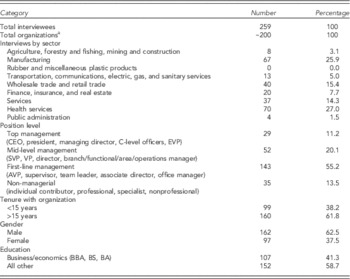
This study consisted of 259 useable questionnaires completed by individuals from ~200 diverse organizations. We utilized a convenience sample based upon specific job titles, level, position responsibility, and type of organization. To satisfy the inclusionary criteria individuals were required to: (1) have a title reflective of top, middle, or first-line management; (2) had to have earned positions as a result of a competitive career environment as opposed to family legacy businesses, bought companies, or having majority stock ownership; and (3) have earned a BA, BS, BBA or other relevant higher degree. Industry classifications were based upon the 2012 US North American Industry Classification System codes. (Demographic characteristics are presented in Table 4.) From a total of 281 interviews, a final list of 259 met all the above criteria.
Sample base and demographics (N=259)

Note.
a A number of respondents did not include their company name. Based upon the number of people interviewed, titles, and the total number of companies surveyed, we conservatively estimate the number of companies represented at 200.
Analysis
Hierarchical cluster analysis of managerial roles, skills, and mindsets
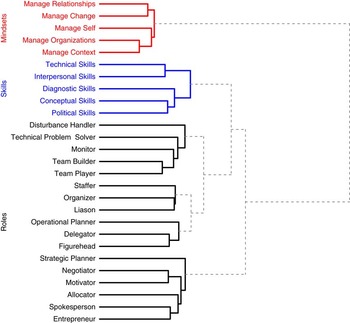
Hierarchical cluster analysis (McQuitty, Reference McQuitty1966; Everitt, Reference Everitt1974) is a method for grouping objects, in this case survey items, into homogeneous groups or clusters. We use hierarchical cluster analysis to determine whether roles, skills, and mindsets fall into clearly separable sets of managerial attributes. There are numerous methods of hierarchical cluster analysis; we chose to use agglomerative clustering with complete linkage, and utilized the correlations between pairs of items as the measure of similarity of two items. The hierarchical cluster analyses were performed using the hclust function in the MASS library in R (Venables & Ripley, Reference Venables and Ripley2002). To examine potential clusters of related skills, roles, and mindsets, we constructed one dendrogram as shown in Figure 1. This method of analysis permits a visual representation of the hierarchical cluster analysis.
Dendrogram of roles, skills, and mindsets. Dendrograms are branching diagrams frequently used to show the relationships of similarity between items. In this case we examined hierarchical clusters (based on an agglomerative hierarchical cluster analysis of the item-pair correlations using complete linkage). The arrangement of the ‘clads’ shown as red, blue, or black demonstrate which items are most similar to each other. The length of the solid line indicates how similar or dissimilar they are from each other – the greater the length of the line, the greater the difference. In this figure, the similarity/dissimilarity between items within the same cluster is represented by solid lines; dashed lines indicate more distinct clusters

Latent class analysis of managerial roles
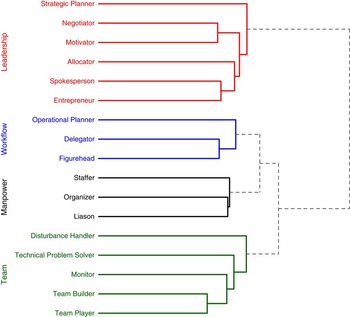
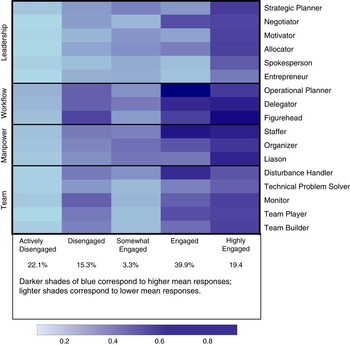
As we will discuss in more detail, our initial hierarchical cluster analysis suggested that roles, skills, and mindsets do not cluster together. As such, we performed a latent class analysis of only the roles in an attempt to identify different types or classes of managers in our sample. Latent class analysis (Dayton, Reference Dayton1998; Collins & Lanza, Reference Collins and Lanza2010) is a statistical method that attempts to identify unobservable homogeneous subgroups or classes of individuals within a larger population based on their responses to questionnaire items. In the present study we utilize the poLCAlibrary (Linzer & Lewis, Reference Linzer and Lewis2011) within the R statistical package (R Core Team, 2012) to fit a latent class analysis of the 17 managerial roles. The latent class analysis allows us to identify mutually exclusive groups of managers that produce similar patterns of responses to the questions about the 17 managerial roles. As shown in Figure 2, the results of the latent class analysis produce the proportion of the population that falls into each of the managerial classes and the distribution of responses to the 17 managerial roles within each of managerial classes.
Dendrogram of the 17 managerial roles. A second dendrogram was constructed based upon the similarity/dissimilarity of the 17 roles. This analysis produced four distinct role groups which we labeled: leadership roles, workflow roles, manpower roles, and team roles represented by red, blue, black, and green branches, respectively

Results
The relationship between the 17 managerial roles, five management skills, and five mindsets was examined using the hierarchical cluster analysis described above and previously presented in the dendrogram in Figure 1.
DuBrin (Reference DuBrin2012) stated that in order for a manager at any level to be effective they would need to combine five essential skills: technical, interpersonal, conceptual, diagnostic, and political. Gosling and Mintzberg (Reference Gosling and Mintzberg2006) as well as previous researchers hypothesized that managers also need to combine actions with a reflective mindset (managing self, managing organizations, managing context, managing relationships, and managing change) in order to accomplish the wide range of complex managerial objectives. However, as stated previously by Gosling and Mintzberg, ‘we make no claim that our framework is either scientific or comprehensive’ (Reference Gosling and Mintzberg2003: 56). In order to test the framework and its concept validity, and better understand the relationship between the roles, managerial skills and mindsets it was necessary to determine if the constructs and components were separate domains or overlapping paradigms. The dendrogram in Figure 1 demonstrates that our managers’ responses to the items relating to skills, mindsets, and roles do not cluster together and that the items appear to be measuring separate attributes of the managers, thus supporting our Hypothesis 1 that these domains are independent.
To further verify that responses to the various item domains (roles, skills, and mindsets) were in fact different we performed a within-subjects analysis of variance with fixed factors for the item domains and random factors for subject and the subject-by-domain interaction. The effect of domain (F(2, 514)=104.7, p-value<.001) and the subject-by-domain effect (F(514, 6190)=2.80, p-value<.001) were statistically significant suggesting that after accounting for subject-level differences and domain-level differences, the way that managers responded to the three domains was in fact different. Further verifying this result, we conducted pairwise comparisons to determine whether the domain-by-subject effects varied between each pair (e.g., role vs. skill). All three comparisons were statistically significant at a level of .05, see Table 5 for results.
F-test results of the pairwise comparisons of the domain-by-subject effects between roles, skills, and mindsets

In addition to determining that roles, mindsets, and skills are independent domains, the dendrogram in Figure 1 suggests that managerial roles can be split, or clustered into four role groupings. To emphasize this fact, Figure 2 dendrogram displays only the 17 managerial roles. Interestingly, this clustering did not align to the three functional areas (informational, decisional, and interpersonal) as theorised by Mintzberg (Reference Mintzberg1973) whose view, with some limited exceptions (Fells, Reference Fells2000; Pryor & Taneja, Reference Pryor and Taneja2010), remained generally supported, but unchallenged since 1973. Further, the dendrogram did not align with DuBrin’s (Reference DuBrin2012) four functional areas (planning, organizing and staffing, leading, and controlling). These results offer support for Hypothesis 2 and bring into question whether the original groupings were empirically accurate in either of the models and why they have not been reconciled or debated in the literature.
While our cluster analysis did not provide empirical evidence of DuBrin’s (Reference DuBrin2012) four functional areas, it did identify four significantly different groupings of roles that we categorized as Leadership, Workflow, Manpower, and Team roles. These descriptive labels reflect the comparable nature of activities that managers performed within each cluster and relate more closely to the 21st century managerial activity. Somewhat unanticipated, the analysis revealed distinct clustering of Team roles containing specific human relations activities such as disturbance handler, team player, and team builder. Within the Leadership cluster managers conducted strategic planning, acted as a spokesperson and led innovation and entrepreneurial events. The Workflow cluster captured activities such as operations, work delegation, and interunit coordinator (Mintzberg loosely used the term ‘Figurehead’ for work unit coordinator). Within the Manpower cluster managers concentrated upon organizing and staffing activities. Thus, this new clustering of roles based upon quantitative analysis reveals an alternative grouping that is, to date, more descriptive and consistent with actual managerial activities.
We also hypothesized that DuBrin’s (Reference DuBrin2012) list of 17 managerial roles, although high in face validity and contributory to the taxonomy, may not reflect empirically the practicality or utility of the roles (Hypothesis 3). It was conjectured that individuals may act more independently of the current taxonomy than previously thought. In order to test this hypothesis we performed a latent class analysis in an attempt to find unique groups or classes of managers that vary in terms of the roles that they have in their management position. Our latent class analysis produced five quantitatively distinct groups that spanned a continuum based upon the degree to which the practising executives considered the various role definitions to be relevant to their work. This result provides evidence and support for our Hypothesis 3 regarding the managers’ perceived relevancy of job requirements within each role. To better understand the practicality and utility of managerial roles and extent of role engagement in contemporary managers, we produced a heatmap, which color codes the mean response of each manager type to each of the managerial role items, refer to Figure 3. A heat map uses two-dimensional data where colors represent mathematical values. It is frequently used to analyze complex data in a visual format. Given the nature of our data and analysis the construction of a heat map would be considered an appropriate statistical technique. For our heat map darker shades of blue indicate that a manager group tends to produce high scores on the item associated with a specific role, and lighter shades of blue indicate low-level responses to a role item.
Heat map indicating the level of engagement for each of the required roles identified through the latent class analysis.

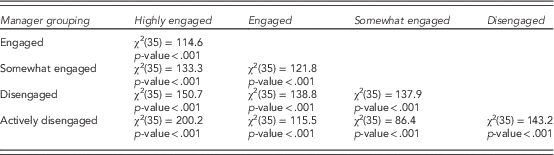
To determine if, in fact, the five groups were statistically distinct, we performed pairwise comparisons to test whether the distribution of responses to the role questions was the same across pairs of the five identified groups. This log-linear analysis produced the χ2 test results reported in Table 6 and supports Hypothesis 3. All five groups were compared and found to be statistically distinct (p-values<.005) allowing us to conclude from this evidence that the sets were clearly discrete.
Pairwise comparisons comparing the response distributions of different executive groups to the 17 roles

Note.
The χ2 statistics are likelihood ratio statistics based on log-linear model of the response distributions.
These groupings are a key finding as they provide strong empirical evidence to support emergent speculation that organizational players may participate in different role combination alternatives than previously thought, either by choice or in response to organizational constraints. This should not be construed that they are performing the ‘right’ or effective actions in support of larger organizational goals, but they have achieved personal hierarchical advancement as one measure of success. Surprisingly, the results indicated that only one group of executives (19.4%) appeared to function, that is, rated the role requirements at a high level of relevancy in all 17 roles. Accordingly, we labeled this cluster highly engaged executives. Again, the term ‘engaged’ is broadly used by researchers to indicate the emotional and cognitive attachments to work, which have implications for individual and organizational performance. Of the succeeding groups, 39.9% functioned at a high level, but only in five roles, therefore, we label engaged. The third cluster, 3.3%, had mid-level scores for four roles, thus, they were marked as somewhat engaged. The fourth group, 15.3%, had only low- to mid-level scores across roles, thus, we designated them as disengaged. Finally, 22.1% of the executives reported low scores of relevancy to all 17 roles. This group was labeled as actively disengaged executives to reflect their neither engaging in, nor finding useful many of the components of the longstanding taxonomy (see Figure 3). Although the measurements in this study are limited to theoretical job role criteria, the findings lend sufficient support to the trending data of the Gallup employee engagement studies (State of the American Workplace: Employee Engagement Insights for U.S. Business Leaders), which show a disconcerting 51% of management employees as disengaged or actively disengaged (Gallup, Reference Gallup2013).
Discussion
This study is distinctive within the numerous explorations of managerial work in several respects. Of particular interest is the empirical approach that revealed interesting role clustering and construct domain separation. The original studies largely lacked an empirical approach and the latter studies did not significantly advance an understanding of the utility or relevancy of the taxonomy apart from its continuing expansion in identifying voluminous management activities. The development of a managerial role taxonomy contributed to our understanding of theoretical and desired roles, but falls short in contributing to organizational effectiveness (Fells, Reference Fells2000). This became apparent through the CQR approach used in this study.
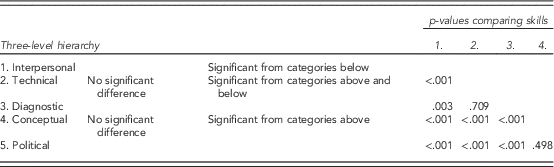
The findings with respect to the five managerial skills (interpersonal, technical, diagnostic, conceptual, and political) were found to be a separate domain from both the managerial roles and five mindsets. This study has provided empirical evidence that these skills are a distinct factor in the overall proficiency of the respondents (see Table 7). A rank ordering and grouping by significance revealed a three-level hierarchy with interpersonal skills as most important, technical and diagnostic as a distinct second grouping, and conceptual and political as a third.
Managerial skills categories by rank order and significance

This is largely consistent with other studies underscoring the importance of interpersonal skills as a primary predeterminant of career success as measured by job level, especially at more senior organizational levels (Pavett & Lau, Reference Pavett and Lau1983; Golman, Reference Golman1998). Technical skills which were the second ranked competency was found to pair with diagnostic skills, both of which are essential foundational components of career routes, but are considered more impactful at lower managerial levels (Kinicki & Williams, Reference Kinicki and Williams2013). The remaining grouping, conceptual and political skills, contributes to the uniqueness of this managerial skills model and underscores the importance of leveraging intellectual capability in order to acquire resources, relationships, and power in order to enhance the probability of reaching objectives.
The cluster dendrogram provided support for Gosling and Mintzberg’s (Reference Gosling and Mintzberg2003) five mindsets as a distinct domain. This presents an interesting triangulation between roles, skills, and mindsets as one method to understand the intricacies of managerial behavior. The five mindsets: managing self, managing organizations, managing context, managing relationships, and managing change are key tasks or ways of thinking that are used simultaneously to help managers operate in a holistic sense. Although these mindsets are to be used concurrently, the analysis revealed a two-level hierarchy with change, self and relationships as inseparable and statistically distinct from organization and content. This grouping may reflect our shifting and uncertain organizational life and perhaps the growing attention that is being placed upon change and self-preservation (Erdogan, Bauer, Truxillo, & Mansfield, Reference Erdogan, Bauer, Truxillo and Mansfield2012; Carlson, Hunter, Ferguson, & Whitten, Reference Carlson, Hunter, Ferguson and Whitten2014). Further analysis revealed that upper managerial levels were more inclined to synthesize (Fischer p=.046), perhaps reflecting the more seasoned and broader perspective of senior players.
In regard to generalized functional areas in which managers could be grouped (Hypothesis 2), our study revealed the presence of four distinct groups of roles, namely Leadership roles, Workflow roles, Manpower roles, and Team roles. The identification of a discrete Team cluster as a major role category was unexpected, but supports the view that contemporary managers are shifting from traditional command and control models to more inclusive group-oriented management styles. Thus, the development of team skills have become decidedly relevant to practicing managers. Overall, the clustering did not align with either Mintzberg’s (Reference Mintzberg1973), or DuBrin’s (Reference DuBrin2012) well-accepted functional areas. This novel finding brings into question whether the original groupings were empirically accurate in either of the models and why they have not been reconciled or debated in the literature.
The challenge of role identification is further complicated by the proliferation of leadership studies over the past 70 years and the large number of theories and approaches used in examining behaviors and constructs. These investigations have included focused studies on a narrow range of specific constructs, expansive investigations on a broad range of leadership characteristics, and examinations of traits, behaviors, situational variables, and other factors. A consequence of this array of studies is that managerial behavior and role identification has not been conclusive and the proliferation of various behavioral constructs and research approaches makes comparisons difficult.
The identification of low levels of role relevancy as determined by the majority of practitioners was a key finding. The analyses strongly suggest that practicing managers are not engaging in, nor finding relevant, the traditional roles as identified in either DuBrin’s (Reference DuBrin2012) or Mintzberg’s (Reference Mintzberg1973) taxonomy. This would suggest that the taxonomy may be limited by its focus in defining and categorizing specific managerial work behaviors at the exclusion of other activities in which executives may be equally or more intensely engaged. For example, certain alternative activities were not included in the numerous managerial roles although they are likely to be essential for hierarchical success, for instance career advancement strategies (Harris & Ogbonna, Reference Harris and Ogbonna2006).
Overall, the findings of this study provide little support to Mintzberg’s hypothesis that the organization is the primary determinant of the importance or relevance of a particular role. If the organization, as opposed to the individual, is the dominant driver, it would be expected that the scores and relevancy levels would have been significantly higher. Only one identified group (19% of the respondents) scored high in all four categories. One interpretation of the pervasive amount of low relevancy scores is that contemporary managers are not as strongly influenced by organizational forces as perhaps managers were at the time of Mintzberg’s (Reference Mintzberg1973) study. These findings also lend empirical support to the intensifying breakdown of the employer–employee compact as individuals are confronted with diminished job security and organizational stability (Bordia, Restubog, Bordia, & Tang, Reference Bordia, Restubog, Bordia and Tang2010; Hoffman, Casnocha, & Yeh, Reference Hoffman, Casnocha and Yeh2013). Thus, the identification with historic organizational roles may no longer be consistent with emerging phenomenon that in order to advance or achieve one’s personal goals, one may need to place his/her interests above the collective well-being of the organization (Laud & Johnson, 2013; Giacalone & Promislo, Reference Giacalone and Promislo2013). Somewhat ironically in support of this notion, Mintzberg (Reference Mintzberg2009) realized years later that managers generally preferred informal and less structured environments to carry out many activities. Under these circumstances where relationships, politics, and luck become more important, the usage or relevancy of the traditional systematized role taxonomy would be diminished as found in our results.
We view the results of this study as a preliminary exploration of the activities and perspectives of changing managerial interests. We suspect that the new employer–employee compact may be having a profound effect upon the relevancy of the traditional 17 roles and mindsets. We are especially interested in identifying those skills or self-advancement competencies considered more relevant by contemporary managers that might modify the traditional organizationally based typology of the 17 roles.
Limitations and Future Research
This study has several limitations, but offers a number of interesting areas for future research. To begin, the traditional nomenclature used by researchers to identify senior players and levels within organizations has been confusing and often subjective. We utilized the broad term ‘managers,’ but our sample base, that is, CEOs, presidents, SVPs, VPs, and directors, was selected to be consistent with the hierarchical level of other studies such as Mintzberg’s (Reference Mintzberg1973). Attention should be made to reconcile titles, responsibilities, and organization size to ensure valid comparisons in future studies. A second limitation is a semi-structured interview that introduces the human element in the process of data gathering. Although the interviewers received training, hard copy of questions, and definitions that were used in the interviews, there exist potential issues of bias and interrater reliability. We provided two layers of oversight and expert review to ensure minimal bias, but welcome other methods of data collection. Third, generalizations from the current study are limited, but the results suggest that further segmentation and analyses in future research would be useful in determining if role requirements, skills, and mindsets are more specific to various population interests. Fourth, our sample group was exclusively from the United States. Replicating this study in other countries and comparing results would contribute to the geographical context of managerial skills.
This study confirmed our Hypothesis 1 that the constructs of roles, skills, and mindsets are distinct domains. However, the generally low scores by respondents on role relevancy does raise a concern and add to the tension of the theory versus practice debate. These subject areas continue to be key components of both undergraduate and graduate business curriculums and provide a useful perspective on managerial activity. However, it is argued that the classroom context is largely theoretical and the application or practical relevancy tends to be minimal. This is not to say the taxonomy is not important, but the issue for students and young managers is practice application and sufficient time for reflection, discussion, and learning.
The theoretical underpinnings of the three domains generate interest for academic researchers, but the translation to improving student or practitioner advancement is questionable. Further, the taxonomy is skewed toward specific work-related tasks, but fails to address the significant effort that managers expend on soft skills such as social currency and reputational capital. It is recommended that this shortcoming, which is also reflected in many business programs that emphasize technical expertise, receives greater attention in both applied and theoretical research. This would provide for a more robust and sophisticated taxonomy that better reflects meaningful practitioner relevancy and managerial thought processes. Specifically, it would be worthwhile investigating whether managers have found alternative ways or hyper-specific skills that have enabled them to advance to their current levels that are not fully recognized in the classical taxonomy. It would also be interesting to investigate whether managers are disengaging from being organizationally committed, perhaps as a reflection of the demise of the employer–employee contract (Hoffman, Casnocha, & Yeh, Reference Hoffman, Casnocha and Yeh2013).
Implications and Recommendations
The following recommendations are offered to strengthen the relevancy of the taxonomies and enable individuals, academic research communities, business students, and schools to acquire and develop more meaningful theoretical and practical knowledge. First, Mintzberg and associated researchers advocated that the organization is the primary driver of the implementation of particular roles. Although we concur on the derivation of the roles, our study found that the relevancy of these roles had only marginal impact upon the vast majority of managers studied. Therefore, we suggest researchers and professors place greater emphasis on the individual as the primary driver for contemporary and practical role relevancy. This orientation would support the development of new managerial frameworks and next generation skill sets required for the practice of management and career self-sufficiency.
Second, this recommendation becomes especially apparent in our findings regarding the five managerial skills categories. Interpersonal skills was ranked number one (level 1) in the emerging hierarchy by both mid- and upper-level managers as the most critical competency in their activities. This further contributes to the growing concern in business and academic research that interpersonal skills learning and education needs to become a more central component within college curriculums. What was surprising in the three-level hierarchy (as shown in Table 7) was that technical and diagnostic skills (level 2) were both ranked higher than conceptual and political skills (level 3), again by both mid- and upper-level executives. One possible explanation, and implication, is that technology know-how is rapidly becoming a strategic success tool for individuals, much like it has become for organizations. This is worthy of further investigation.
Third, we found that the identified roles are not of equal importance to individuals (Hypothesis 3), and that specific skill groupings were used by different cohorts of managers, as supported by the data (Hypothesis 2). Our recommendation calls for a regrouping of roles based upon actual implementation alignment as previously shown in the heatmap in Figure 3 as opposed to the more theoretical typologies offered by Mintzberg (Reference Mintzberg1973) and DuBrin (Reference DuBrin2012). This would better serve students – soon to become aspiring managers, whose interests are in practical application.
Fourth, we suggest that business school curricula more closely reflect the requisite criteria for managerial roles as determined by practising players. This would enable other researchers to examine the importance of previously accepted role content and would help address the issue of how roles may impact effectiveness, which is an inherent weakness in the construction of the original typologies.
Conclusion
The results brought forward by this study provide empirical evidence that certain widely accepted managerial typologies created some 40 years ago may warrant modification from an exclusively organizationally driven job focus to a more holistic model that better reflects contemporary managerial interests. This presents an important opportunity for educators, practitioners, and researchers to reevaluate the delicate relationship between organization and individual needs and to provide more relevant management learning strategies. Business school pedagogy and theoretical research are at a cross-road and both would better serve students and organizations with a deeper understanding of role relevancy and its application.
Supplementary Material
To view supplementary material for this article, please visit http://dx.doi.org/10.1017/jmo.2015.48