




No CrossRef data available.
Article contents
Differential effects of Alzheimer's disease and Huntington's disease on the performance of mental rotation
Published online by Cambridge University Press: 28 January 2005
Abstract
The ability to spatially rotate a mental image was compared in patients with Alzheimer's disease (AD; n = 18) and patients with Huntington's disease (HD; n = 18). Compared to their respective age-matched normal control (NC) group, the speed, but not the accuracy, of mental rotation abnormally decreased with increasing angle of orientation for patients with HD. In contrast, the accuracy, but not the speed, of rotation abnormally decreased with increasing angle of orientation for patients with AD. Additional analyses showed that these unique patterns of performance were not attributable to different speed/accuracy trade-off sensitivities. This double dissociation suggests that the distinct brain regions affected in the two diseases differentially contribute to speed and accuracy of mental rotation. Specifically, the slowing exhibited by HD patients may be mediated by damage to the basal ganglia, whereas the spatial manipulation deficit of AD patients may reflect pathology in parietal and temporal lobe association cortices important for visuospatial processing. (JINS, 2005, 11, 30–39.)
Information
- Type
- Research Article
- Information
- Journal of the International Neuropsychological Society , Volume 11 , Issue 1 , January 2005 , pp. 30 - 39
- Copyright
- © 2005 The International Neuropsychological Society
INTRODUCTION
Although Alzheimer's disease (AD) and Huntington's disease (HD) are both neurodegenerative disorders that cause global dementia syndromes, there is considerable evidence that distinct neurobehavioral and neurocognitive deficits are associated with the two diseases (Cummings, 1990; Cummings & Benson, 1983; Heindel & Salmon, 2001). AD is characterized by a prominent amnesia with secondary deficits in language, abstract reasoning, and visuospatial functioning (for review, see Salmon & Bondi, 1999). These deficits are consistent with extensive damage to the medial temporal lobe structures important for memory (e.g., hippocampus, entorhinal cortex) and to the association cortices of the frontal, temporal, and parietal lobes (Braak & Braak, 1998; Brun & England, 1981; Terry & Katzman, 1983). HD, in contrast, is characterized by marked motor disturbance (i.e., choreiform movements), bradyphrenia, prominent executive dysfunction, moderate concentration and memory deficits, and visuospatial impairments (Brandt & Butters, 1986; Butters et al., 1978; Salmon et al., 2001a). The cognitive and motor deficits of HD are mediated by the extensive basal ganglia damage, particularly to the caudate nucleus and putamen, that occurs in the disease (Alexander et al., 1986; Bruyn et al., 1979; Vonsattel et al., 1985) and the attendant interruption of several anatomically and functionally distinct circuits that link these subcortical structures with the frontal cortex (for review, see Middleton & Strick, 2001).
Although differences and similarities in the memory, language, and executive function deficits associated with AD and HD have been well documented (for review, see Salmon et al., 2001b), the nature of the visuospatial dysfunction that occurs in the two disorders has received relatively little attention. Understanding the visuospatial deficits that result from these diseases is important, as visuospatial abilities are associated with functional competence in both normally aging (North & Ulatowska, 1981) and demented older adults (Henderson et al., 1989; Hill et al., 1995). Evidence also suggests that performance on visuospatial measures may be useful in the early detection of the dementia associated with HD (Josiassen et al., 1983) and may differentiate mild from moderate dementia in AD (Backman, 1993; Herlitz et al., 1995; Hill et al., 1992).
When comparing AD to HD patients, studies have shown qualitative differences in the disorders' effects on tests of constructional apraxia such as the Clock Drawing Test (Rouleau et al., 1992), but have not focused specifically on the visuospatial aspects of these tasks. In one of the few studies that directly compared the performances of patients with AD or HD on a comprehensive battery of visuospatial tests, Brouwers and colleagues (1984) found that patients with AD, but not those with HD, were impaired relative to control subjects on tests of visuoconstructional ability (i.e., copying a complex figure) and visuospatial learning. In contrast, patients with HD, but not those with AD, were impaired on a test of directional orientation.
These few studies suggest that distinct visuospatial processing deficits are associated with AD and HD. However, the evidence for this distinction is relatively meager and is primarily derived from tasks that involve potentially confounding factors like episodic memory, the physical manipulation of objects, or decisions regarding directionality. A visuospatial task that may circumvent many of these issues is the mental rotation of an object through space. Numerous studies have shown that the time required to identify or make a judgement about a figure that is rotated in the picture plane increases in a direct relationship to the degree of angular displacement from its upright position (e.g., Cooper & Shepard, 1973; Shepard & Metzler, 1971; for review, see Shepard & Cooper, 1982). Although counter-arguments have been proposed (Pylyshyn, 1979), this relationship has generally been taken as evidence that the figure is mentally rotated by the observer prior to making an identification or judgement. Because an object can be mentally rotated in either a clockwise or counter-clockwise direction, mental rotation speed is indicated by the slope of the function comparing reaction time to the absolute displacement between the orientation of the figure and the upright position. Studies have also shown that the accuracy of the judgement to be made about a rotated stimulus decreases with increasing angular displacement from upright (e.g., Hertzog et al., 1993), presumably because of the increasing difficulty of the visuospatial rotation. Thus, the task provides a means of assessing both the ability to mentally rotate an object through space and the facility with which such mental manipulations can be performed.
Studies of the neural substrates of mental rotation using patients with circumscribed brain lesions (Butters & Barton, 1970; Butters et al., 1970, 1972; Ratcliff, 1979) or functional neuroimaging techniques with normal individuals (Alivisatos & Petrides, 1997; Cohen et al., 1996; Harris et al., 2000; Mentis et al., 1996; Wendt & Risberg, 1994; Wilson et al., 1994) have consistently shown that parietal cortex is critically involved in the performance of mental rotation tasks. These findings support the notion that mental rotation engages the parietal and superior temporal lobe cortical regions of the dorsal visual processing stream (Ungerleider & Mishkin, 1982) that are essential for encoding the spatial position of stimuli (Cohen et al., 1996; Haxby et al., 1994), determining if two geometric figures are the same or different when they are presented in an upright orientation (Lagreze et al., 1993; Pierret et al., 1994), and perceiving motion (Livingstone & Hubel, 1988). Consequently, mental rotation tasks should provide a means of assessing the impact of damage to these brain structures on visuospatial processing while minimizing non-visual cognitive demands.
Given the distinct neurodegenerative changes that occur in AD and HD, these two disorders may differentially impact performance on a mental rotation task. The extensive damage to parietal and temporal lobe association cortices that occurs in AD may result in an impaired ability to accurately perform the imagined spatial manipulation necessary for mental rotation, even though the speed of mental manipulation may not be severely affected. In contrast, the relative lack of damage to these cortical areas in HD may allow the imagined spatial rotation to proceed accurately, but the fronto–striatal dysfunction that occurs in the disease may result in a bradyphrenia (i.e., slowed thought) that reduces mental rotation speed. If this is the case, a double dissociation may emerge in which accuracy, but not speed, of mental rotation is diminished in patients with AD, whereas speed, but not accuracy, of mental rotation is diminished in patients with HD. To address this possibility, the present study compared the performances of patients with AD or HD on a task that required them to mentally rotate an object prior to making a simple spatial decision about the object as it would appear in the upright position. Because mental rotation ability may be affected by age (Dollinger, 1995; Dror & Kosslyn, 1994; Hertzog & Rypma, 1991; Hertzog et al., 1993; Puglisi & Morrell, 1986), and AD and HD differ in the usual age of disease onset, each group's performance was compared to that of an age-appropriate normal control group.
METHODS
Research Participants
Before recruiting or enrolling participants, the procedures of this study were reviewed and approved by the Institutional Review Boards at the University of California, San Diego (UCSD), San Diego State University, and the San Diego Veterans Affairs Medical Center (VAMC). Seventy-six individuals participated in this study: 18 patients with AD, 18 patients with HD, 20 older normal control (ONC) participants, and 20 younger normal control (YNC) participants. Written informed consent was obtained from all participants after the procedures of the study had been fully explained to them. The patients with AD were recruited from the UCSD Alzheimer's Disease Research Center (ADRC) where a diagnosis of probable AD was made by a senior staff neurologist according to NINCDS-ADRDA criteria (McKhann et al., 1984). Patients with HD were recruited from the UCSD Huntington's Disease Research Group and were diagnosed by a senior staff neurologist based on a positive family history of the disease, the presence of involuntary choreiform movements, and the presence of dementia. The ONC and YNC participants were volunteers recruited from ongoing studies at the UCSD ADRC or the San Diego VAMC. Individuals with a positive history of alcoholism, drug abuse, learning disability, or severe neurologic or psychiatric illness were excluded. All participants were screened for visual impairments prior to their participation. Any participant who was unable to demonstrate the equivalent of 20/50 visual acuity (with eyeglasses when appropriate) on a near chart screening test at the time of assessment was excluded.
Demographic characteristics of the patient and control groups are presented in Table 1. The AD patients did not differ significantly from the ONC group in age, education, or gender distribution. Similarly, the HD patients did not differ significantly from the YNC group on these same factors. The AD and HD patient groups were not significantly different in education or gender distribution, but—as expected given the differing usual age of onset associated with the two disorders—the AD patients were significantly older than the patients with HD. Both patient groups performed significantly lower than their respective control group on the Mattis Dementia Rating Scale (DRS; Mattis, 1988). In addition, the patients with AD scored significantly lower on the DRS than the patients with HD.
Demographic characteristics and Mattis Dementia Rating Scale (DRS) scores of the Alzheimer's disease and Huntington's disease patient groups and their respective age-matched control groups

Materials and Procedures
The Mental Rotation Test and a battery of tests designed to assess basic visuospatial functions were administered to each participant individually in a quiet, well-lit room. The testing session lasted approximately 2 hr. The Mental Rotation Test was always administered near the beginning of the session to avoid effects of fatigue, and frequent rest breaks were allowed as needed between tests.
Basic visuospatial test battery
The test of apraxia required performance of 20 gestures that assessed each of the following four domains: upper limb apraxia, facial apraxia, instrumental action apraxia, and complex serial act pantomime. Each correctly completed gesture was awarded 3 points if to command, 2 points following a demonstration by the examiner, and 1 point if performed with the actual object. The Right–Left Orientation Test (Benton et al., 1983) required participants to identify lateralized body parts on their own bodies. Four items simply required correct identification of a body part (e.g., “Show me your left hand”), while eight items specified which hand the participant had to use to make the identification (e.g., “Touch your left ear with your right hand”). The Figure Matching Test used the five geometric figures from the Visual Reproduction subtest (VR) of the Wechsler Memory Scale–Revised (Wechsler, 1987) and required participants to identify the target figure (presented on a card) from among three similar foils. The Judgment of Line Orientation test was administered according to standardized instructions (Benton et al., 1983). However, only the 15 odd-numbered items were presented to reduce administration time.
Mental rotation test (Uecker & Obrzut, 1993)
This simple computer-based task, created for use with children, required the mental rotation of a two-dimensional stick figure person presented on the computer screen. Individual stick figures, with a blackened circle (a “ball”) covering one hand, were presented rotated in various orientations from upright (see Figure 1). The participant was asked to mentally rotate the figure into the upright position and then to indicate which side of the stick figure the “ball” was on by pressing the shift key on the side of the computer keyboard that corresponded to the location of the blackened circle. Thus, he did not have to verbally identify the side of the target, distinguish the stick figure's left from right, or determine whether the ball was on the left or right. He only had to match his response to the side of the target ball relative to the upright stick figure.

Example stick figures from the mental rotation test presented at (A) 0° (correct answer: left), (B) 90° (correct answer: right), (C) 180° (correct answer: right), and (D) 135° (correct answer: left) from vertical.
Prior to beginning the test, five paper-and-pencil practice trials and six practice trials with computer generated stimuli were administered to assure that participants were making correct rotations in the picture plane. Following the practice items, a total of 160 test trials were administered. The stick figure was presented in an upright position (0°) on 20 trials, completely inverted (180°) on 20 trials, and at each of three intermediate orientations (45°, 90°, and 135° from vertical in either a clockwise or counter-clockwise direction) on 40 trials. The order of presentation of the various trials was randomized for each participant.
The mental rotation task was presented on a personal computer (AST 486 with standard AST keyboard) using the DMASTR software developed by K.I. Forster and J.C. Forster at Monash University and the University of Arizona. The participant was seated approximately 24 inches (60 cm) from a 14-inch (36 cm) Goldmaster color monitor in a position that allowed a comfortable reach to the computer keyboard with either hand. The stick figure stimuli were approximately 15 cm in height as viewed on the computer monitor. The experimenter sat next to the participant to monitor his progress and initiate each trial by pressing the space bar on the computer keyboard.
Each trial began with the presentation of a centralized alerting stimulus, followed by presentation of the target stimulus just to the right or left of center (50% on each side in a random order). The lateralized presentation of stimuli was an inherent component of the mental rotation task developed by Uecker and Obrzut (1993) and was not a specific aspect of the design of the present study. This task was selected for use because it provided a level of difficulty that appeared appropriate for the AD and HD patients. Because tachistoscopic presentation of stimuli was not utilized, hemifield effects were not appropriate for analysis and will not be addressed further. To reduce memory demands, the stimulus remained on the screen until the participant registered a response (or time expired). The accuracy of the participant's response and the reaction time on each trial were recorded. The hardware and software utilized allowed reaction times to be registered with millisecond accuracy. Reaction times less than 200 ms were considered anticipatory and were disregarded. Correct responses were followed by the word “CORRECT” and the reaction time in milliseconds. Incorrect responses were followed by the word “INCORRECT” without notation of reaction time. If a response did not occur within four seconds, the figure was removed, the word “INCORRECT” was presented, and the trial was terminated.
Statistical Analyses
The percentage of correct responses achieved at each angle of orientation was calculated for each participant. Median reaction times (RT) for correct trials at each angle of orientation were also calculated. Trials with no response within 4 s were considered uninformative and were not included in the calculation of accuracy or RT. Overall, 12% of all trials were eliminated from the RT analyses because they either were answered incorrectly or a response did not occur within the allotted time. On average, 6% of YNC, 5% of ONC, 18% of HD, and 19% of AD trials were excluded from RT analyses.
Omnibus repeated-measures multivariate analyses of variance (MANOVA) were utilized to compare the patterns of accuracy and RT across angle of orientation produced by AD patients, HD patients, and control participants. In addition, the specific hypotheses of the study were tested with planned comparisons between each patient group and their respective control group using similar repeated-measures MANOVA. As recommended by Maxwell and Delaney (1990), a multivariate approach to repeated-measures analysis of variance was used in order to protect against violations of the assumption of sphericity (i.e., the assumption of homogeneity of treatment-difference variances). This allowed statistical significance to be determined using measures that are relatively insensitive to violations of the sphericity assumption, namely the approximation to F and the Wilks's Lambda statistic (see Hertzog & Rovine, 1985; or Maxwell & Delaney, 1990).
RESULTS
Basic Visuospatial Abilities
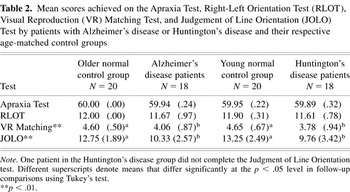
The mean scores achieved on each of the basic visuospatial tests are shown for the patient and control groups in Table 2. Ceiling effects were observed on both the apraxia test and the Right–Left Orientation Test, and no significant group differences emerged on these measures. Each patient group performed significantly worse than their respective control group on the Figure Matching test and the Judgment of Line Orientation test, but the AD and HD patient groups did not differ significantly from each other on these measures. Thus, differences observed between patient groups on the mental rotation test cannot be attributed to group differences in formulation of motor responses, right–left confusion, or basic visuoperceptual skills.
Mean scores achieved on the Apraxia Test, Right-Left Orientation Test (RLOT), Visual Reproduction (VR) Matching Test, and Judgement of Line Orientation (JOLO) Test by patients with Alzheimer's disease or Huntington's disease and their respective age-matched control groups

Speed of Mental Rotation
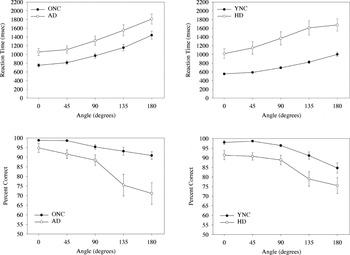
Average median RT is presented as a function of angle of orientation in the upper panels of Figure 2. These functions are shown separately for AD patients and their age-matched control group (upper left panel) and for HD patients and their age-matched control group (upper right panel). In keeping with other studies in the mental rotation literature (see, e.g., Bethel-Fox & Shepard, 1988; Shepard & Metzler, 1971), data were collapsed across angles that required the same amount of rotation regardless of whether it was in a clockwise or a counter-clockwise direction. In a preliminary analysis, no differences were observed for clockwise and counter-clockwise directions (data not shown). All groups demonstrated a pattern of RT similar to those described in previous studies of mental rotation (e.g., Shepard & Metzler, 1971; Uecker & Obrzut, 1993). Specifically, RT monotonically increased as the angle of orientation increased from 0° to 180°.

Median reaction times (upper panels) and percentage of correct responses (lower panels) on the mental rotation test as a function of degree of orientation from vertical. Patients with Alzheimer's disease (AD) and older normal control (ONC) participants are shown in the left panels. Patients with Huntington's disease (HD) and younger normal control (YNC) participants are shown in the right panels.
A 5 (angle of orientation: 0°, 45°, 90°, 135°, 180°) × 4 (group: YNC, HD, ONC, AD) repeated-measures MANOVA for median RT revealed significant main effects of angle [F(4,69) = 101.81, p < .001] and group [F(3,72) = 13.84, p < .001], and a significant angle × group interaction [F(12,182.85) = 2.06, p < .05]. Planned comparisons contrasting each patient group with its respective control group were completed to directly assess how the RT of patients compared to those of neurologically intact individuals of similar age and educational background. When the RT of AD patients were compared to those of ONC participants, the main effects of angle [F(4,33) = 49.84, p < .001] and group [F(1,36) = 10.37, p < .01] were significant. However, the angle × group interaction effect was not significant [F(4,33) = .56, p > .05]. These results indicate that AD patients were generally slower to respond than their control group and that RT increased for both groups as greater mental rotation was required. However, the magnitude of the increase in RT across increasing angle of orientation was similar for the two groups, indicating similar mental rotation speed in the two groups. Indeed, the groups did not differ significantly in the average time needed to rotate the figure through each degree of orientation: 3.83 ms (SD = 1.93) for ONC subjects and 4.19 ms (SD = 1.86) for AD patients.
A similar analysis comparing the HD patients to their control group yielded significant main effects of angle [F(4,33) = 68.74, p < .001] and group [F(1,36) = 25.09, p < .001], as well as a significant angle × group interaction effect [F(4,33) = 7.03, p < .001]. Thus, the HD patients were generally slower to respond than the YNC participants, and both groups demonstrated increasing response latencies as angle of orientation increased. However, the magnitude of the increase in RT with increasing angle of orientation was greater in HD patients than in their control group, reflecting slower mental rotation speed for HD patients, M = 3.64 ms (SD = 2.44) per degree of orientation, than for the YNC group, M = 2.48 ms (SD = 1.06) per degree of orientation.
Accuracy of Mental Rotation
The average percentage of correct responses achieved by each group is shown as a function of angle of orientation in the lower panels of Figure 2. A 5 (angle of orientation) × 4 (group) repeated-measures MANOVA for the percentage of correct responses revealed significant main effects of angle [F(4,69) = 20.46, p < .001] and group [F(3,72) = 7.92, p < .001]. The angle × group interaction approached statistical significance [F(12,182.85) = 1.63, p = .087].
Planned comparisons of the accuracy of AD patients and ONC participants revealed significant main effects of angle [F(4,33) = 9.23, p < .001] and group [F(1,36) = 11.55, p < .01], and a significant angle × group interaction [F(4,33) = 4.80, p < .01]. These results indicate that AD patients were generally less accurate than the ONC participants and that the accuracy of both groups declined with increasing angle of orientation. In addition, the magnitude of this decline was greater in the AD patients than in the ONC participants. Thus, AD patients demonstrated a disproportionate decline in the accuracy of their responses compared to healthy older adults as the demands for spatial manipulation increased.
A planned comparison of the accuracy of HD patients and their control group revealed significant main effects of angle [F(4,33) = 11.69, p < .001] and group [F(1,36) = 12.36, p < .01], but no significant angle × group interaction [F(4,33) = 0.50, p > .05]. Thus, HD patients were generally less accurate than their control group, and the accuracy of both groups declined to a similar degree as the angle of orientation increased. The response accuracy of HD patients was not differentially impacted by the increasing spatial demands of the mental rotation task.
Relationship Between Speed and Accuracy
The differential effects of AD and HD on mental rotation performance could be caused by distinct speed/accuracy trade-off propensities. HD patients may have slowed their speed of mental rotation in order to maximize accuracy, whereas AD patients may have sacrificed accuracy for speed. If this was the case, a negative correlation between speed of rotation and accuracy would be expected in each group (i.e., faster responders should be less accurate than slower responders; Berg et al., 1982, Cerella et al., 1981). To investigate this possibility, the correlations between speed of mental rotation (i.e., ms per degree of orientation) and percent correct were calculated separately for AD and HD patients. Pearson product-moment correlation coefficients were positive for both AD patients (r = .133) and HD patients (r = .308). Although neither correlation reached statistical significance, patients in each group who responded quickly were generally more accurate than those who responded slowly. Further evidence against a differential speed/accuracy tradeoff in the two groups is demonstrated by the comparable overall accuracy achieved by the AD (M = 81% correct) and HD (M = 82% correct) patients.
DISCUSSION
The results of the present study demonstrate that the ability to perform mental rotation is differentially affected in patients with AD and patients with HD. Compared to their age-matched control group, the speed, but not the accuracy, of mental rotation abnormally decreased with increasing angle of orientation for patients with HD. Although HD patients retained the ability to mentally rotate a figure through space, they suffered a deficit in information processing speed (i.e., bradyphrenia) on this visuospatial task that is independent of motoric slowing. In contrast, the accuracy of patients with AD abnormally decreased relative to their age-matched control group as the angle of orientation increased, suggesting that they were impaired in their ability to accurately mentally rotate the figure through space. This finding is consistent with previous studies that have demonstrated deficits on tasks that required matching a visual stimulus with its identical rotated counterpart in AD patients (Kurylo et al., 1996; Mendola et al., 1995). The speed of rotation exhibited by patients with AD on correct trials did not abnormally decrease, however, suggesting that they do not suffer a significant decrease in visuospatial information processing speed.
The deficits identified in the mental rotation performances of AD and HD patients are relative to their respective normal control group. As is evident from the reaction time graphs, HD patients were not slower than AD patients (or ONC participants) in their speed of mental rotation. Because the emphasis of this study is on the differential effects of AD and HD on mental rotation, specific analyses comparing the two control groups to one another were not summarized. However, clear age differences did emerge in this study, consistent with the well-documented finding in the literature that aging is associated with slower speed of processing and reaction times on many tasks (Cerella, 1985; Salthouse & Somberg, 1982; Simon & Pouraghabagher, 1978; Strayer et al., 1987), including mental rotation (Dollinger, 1995; Dror & Kosslyn, 1994; Hertzog & Rypma, 1991; Hertzog et al., 1993; Puglisi & Morrell, 1986). Although in absolute terms HD patients were not slower than AD patients, they performed mental rotation at essentially the same speed as neurologically intact individuals that, on average, were more than 30 years older, rather than at the speed expected from individuals their age.
The observed double dissociation in this study is not likely to be a reflection of different speed/accuracy trade-off propensities in the two groups as both AD and HD patients showed a positive correlation between the speed and accuracy with which they performed the task. In addition, scatterplots graphing speed versus accuracy in each patient group failed to reveal any higher-order relationships between these two factors (results not shown). Finally, a direct comparison of the percentage of long-latency errors (those responses considered errors by virtue of being completed beyond the allotted time limit) made by AD versus HD patients at each angle of orientation demonstrated that the two groups were similar in their pattern of long-latency errors (results not shown). Thus, the decreasing accuracy, but preserved speed, of AD patients' responses cannot be accounted for by a higher incidence of long-latency errors in this group. The possibility that speed/accuracy tradeoffs impacted the results at an individual level cannot be completely ruled out, however, and individual speed/accuracy operating characteristics (Hertzog et al., 1993; Lohman, 1989; Salthouse & Somberg, 1982; Wicklegren, 1977) should be examined in future studies. The presence of a double dissociation also suggests that the results are not simply a reflection of greater severity of dementia in the AD patients compared to the HD patients, and this conclusion is supported by the fact that the two groups were similarly impaired on basic visuospatial tasks (i.e., Judgement of Line Orientation Test, Figure Matching Test).
For both patient and control groups the relationship between the speed of decision about the mentally rotated figure and the degree of displacement of the actual figure from upright generally conformed to previous findings with normal individuals (Bryden et al., 1990; Dror & Kosslyn, 1994; Georgopoulos & Pellizzer, 1995; Hertzog & Rypma, 1991; Puglisi & Morrell, 1986; Shepard & Metzler, 1971; Uecker & Obrzut, 1993). As in previous studies, the patient and control groups needed increasing amounts of time to make decisions as the mental rotation requirements of the task increased. This relationship was monotonically increasing and relatively linear for patient and control groups, although the curve tended to flatten at higher angles of orientation for patients with HD. The nature of the observed relationships suggests that AD and HD patients were generally performing the basic mental rotation action despite being slower and less accurate than control participants.
The non-linearity in the relationship between decision speed and the larger angles of orientation for HD patients may reflect particularly slow patients being unable to complete the task within the allotted 4000 ms. Although the mean response times of the HD group in the 135° and 180° conditions were notably below the cut-off (i.e., approximately 1600 and 1700 ms, respectively), some patients may not have completed many trials at these angles of orientation, artificially lowering the average response time for trials requiring the most rotation. To address this possibility, analyses were repeated with subsets of participants who accurately completed at least 80% of items from each angle of orientation within the allotted time. Reaction times from all normal control participants were retained in these analyses, whereas 5 HD patients and 3 AD patients had their data excluded. Despite smaller sample sizes, all previously significant results were confirmed. Importantly, the relationship between response time and angle of orientation for this subsample of HD patients more closely resembled the linear trends observed in the other groups, yet the speed of their mental rotation abnormally decreased relative to the YNC group with increasing angle of orientation (results not shown).
Although only the HD patients exhibited a steeper than normal slope for the function relating response time to increasing displacement of the figure from upright (reflecting a deficit in their speed of visuospatial information processing), both AD and HD patients exhibited overall deficits in response latency that were constant across all conditions of the mental rotation task (reflecting a more general deficit in motor response speed). The general response slowing exhibited by both groups of patients is consistent with previous studies that have shown abnormally decreased reaction time in patients with AD (Goldman et al., 1999) and patients with HD (Jahanshahi et al., 1993). Similarly, only patients with AD exhibited an abnormal decline in accuracy with increasing displacement of the figure from upright, but both groups exhibited a general deficit in accuracy on the mental rotation task. This finding is also consistent with previous studies that have shown that AD patients (for review, see Cronin-Golomb & Amick, 2001) and HD patients (for review, see Brandt & Butters, 1986; Salmon et al., 2001a) are impaired on a variety of visuospatial tasks.
The double dissociation observed in the present study is consistent with the hypothesis that the distinct brain regions affected by AD and HD may differentially contribute to speed and accuracy of mental rotation. The spatial manipulation necessary for mental rotation has been shown to engage the dorsal visual processing stream (the visual “where” system; Cohen et al., 1996; Mentis et al., 1996), and damage to parietal and temporal lobe association cortices that are part of this system may interrupt AD patients' ability to accurately perform mental rotation. Studies of patients with parietal lobe lesions have demonstrated the importance of this cortical region to completing mental rotation tasks (Butters & Barton, 1970). The essentially normal mental rotation ability exhibited by HD patients in the present study is consistent with the relative sparing of parietal and temporal cortex in that disease (Bruyn et al., 1979; Vonsattel et al., 1997). There may be some disruption of parietal cortex function in HD, however, due to its connection to basal ganglia structures (Middleton & Strick, 2001), and this may account for the visual discrimination deficits that have been observed in this and previous studies. More extensive damage to parietal and temporal lobe aspects of the cortical visual processing system important for motion detection (as occurs in AD) may be necessary to impair mental rotation.
The damage that occurs to basal ganglia structures and related fronto–striatal circuits in HD (Alexander et al., 1986; Middleton & Strick, 2001; Vonsattel et al., 1997) most likely leads to the bradyphrenia exhibited by these patients on the mental rotation task. These fronto–striatal circuits have been implicated in the motoric slowing associated with HD and may play a similar role with regard to cognitive operations (Cummings & Benson, 1988). The relative sparing of this system in patients with AD may account for their ability to perform mental rotation at a normal speed. In summary, both AD and HD patients demonstrated deficits on the mental rotation task relative to their control groups, but they were impaired on different aspects of the test. Although replication with larger groups of patients is warranted, the present results support previous studies that show both quantitative and qualitative differences in the patterns of visuospatial dysfunction exhibited by patients with AD and HD (Brouwers et al., 1984; Rouleau et al., 1992).
ACKNOWLEDGMENTS
This study was part of a doctoral dissertation completed by the first author as a requirement of the San Diego State University/University of California, San Diego (SDSU/UCSD) Joint Doctoral Program in Clinical Psychology. She would like to thank Drs. Claire Murphy, Eric Granholm, and Edward Riley for serving as dissertation committee members. In addition, we thank Dr. Anne Uecker for providing the mental rotation program, Sonja Eberson-Shumate for help with data collection, and Dr. Richard Naugle for helpful comments on an earlier version of the manuscript. Finally, we thank the staff, patients, and volunteers of the UCSD Alzheimer's Disease Research Center and the UCSD Huntington's Disease Research Group for their cooperation. The study was supported by funds from the National Institute on Aging (AG-05131 (David Salmon), AG-12963 (David Salmon), and AG-12674 (VA grant to Mark Bondi)) to UCSD and by funds from the Medical Research Service of the Department of Veterans Affairs.
References
REFERENCES
Alexander, G.E.,
Delong, M.R., &
Strick, P.L.
(1986).
Parallel organization of functionally segregated circuits linking
basal ganglia and cortex.
Annual Reviews in Neurosciences,
9,
357–381.CrossRefGoogle Scholar
Alivisatos, B. &
Petrides, M.
(1997).
Functional activation of the human brain during mental rotation.
Neuropsychologia,
35,
111–118.CrossRefGoogle Scholar
Backman, A.O.
(1993).
Detection and staging of early clinical dementia.
Acta Neurologica Scandinavica,
88,
10–15.Google Scholar
Benton, A.L.,
Hamsher, K.deS.,
Varney, N.R., &
Spreen, O.
(1983).
Contributions to neuropsychological assessment: A clinical manual.
New York:
Oxford University Press.
Berg, C.,
Hertzog, C., &
Hunt, E.
(1982).
Age differences in the speed of mental rotation.
Developmental Psychology,
18,
95–107.CrossRefGoogle Scholar
Bethel-Fox, C.E. &
Shepard, R.N.
(1988).
Mental rotation: Effects of stimulus complexity and familiarity.
Journal of Experimental Psychology: Human Perception and
Performance,
14,
12–23.CrossRefGoogle Scholar
Braak, H. &
Braak, E.
(1998).
Evolution of neuronal changes in the course of Alzheimer's
disease.
Journal of Neural Transmission,
53
(Suppl.),
127–140.CrossRefGoogle Scholar
Brandt, J. &
Butters, N.
(1986).
The neuropsychology of Huntington's disease.
Trends in Neurosciences,
9,
118–120.CrossRefGoogle Scholar
Brouwers, P.,
Cox, C.,
Martin, A.,
Chase, T., &
Fedio, P.
(1984).
Differential perceptual-spatial impairment in Huntington's and
Alzheimer's dementias.
Archives of Neurology,
41,
1073–1076.CrossRefGoogle Scholar
Brun, A. &
England, E.
(1981).
Regional pattern of degeneration in Alzheimer's disease:
Neuronal loss and histopathological grading.
Histopathology,
5,
549–564.CrossRefGoogle Scholar
Bruyn, G.W.,
Bots, G., &
Dom, R.
(1979).
Huntington's chorea: Current neuropathological status. In
T. Chase,
N. Wexler, &
A. Barbeau (Eds.),
Advances in Neurology,
23 (pp.
83–94).
New York:
Raven Press.
Bryden, M.P.,
George, J., &
Inch, R.
(1990).
Sex differences and the role of figural complexity in determining
the rate of mental rotation.
Perceptual and Motor Skills,
70,
467–477.CrossRefGoogle Scholar
Butters, N. &
Barton, M.
(1970).
Effect of parietal lobe damage on the performance of reversible
operations in space.
Neuropsychologia,
8,
205–214.CrossRefGoogle Scholar
Butters, N.,
Barton, M., &
Brody, B.A.
(1970).
Role of the right parietal lobe in the mediation of cross-modal
associations and reversible operations in space.
Cortex,
6,
174–190.CrossRefGoogle Scholar
Butters, N.,
Sax, D.S.,
Montgomery, K., &
Tarlow, S.
(1978).
Comparison of the neuropsychological deficits associated with early
and advanced Huntington's disease.
Archives of Neurology,
35,
585–589.CrossRefGoogle Scholar
Butters, N.,
Soeldner, C., &
Fedio, P.
(1972).
Comparison of parietal and frontal lobe spatial deficits in man:
Extrapersonal vs. personal (egocentric) space.
Perceptual and Motor Skills,
34,
27–34.CrossRefGoogle Scholar
Cerella, J.
(1985).
Information processing rates in the elderly.
Psychological Bulletin,
98,
67–83.CrossRefGoogle Scholar
Cerella, J.,
Poon, L., &
Fozard, J.L.
(1981).
Mental rotation and age reconsidered.
Journal of Gerontology,
36,
620–624.CrossRefGoogle Scholar
Cohen, M.S.,
Kosslyn, S.M.,
Breiter, H.C.,
DiGirolamo, G.J.,
Thompson, W.L.,
Anderson, A.K.,
Brookheimer, S.Y.,
Rosen, B.R., &
Belliveau, J.W.
(1996).
Changes in cortical activity during mental rotation: A mapping
study using functional MRI.
Brain,
119,
89–100.CrossRefGoogle Scholar
Cooper, L.A. &
Shepard, R.N.
(1973).
The time required to prepare for a rotated stimulus.
Memory and Cognition,
1,
246–250.CrossRefGoogle Scholar
Cronin-Golomb, A. &
Amick, A.
(2001).
Spatial abilities in aging, Alzheimer's disease, and
Parkinson's disease. In
F. Boller &
S. Cappa (Eds.),
Handbook of neuropsychology, Second edition. Vol. 6:
Aging and dementia (pp.
119–143).
Amsterdam:
Elsevier.
Cummings, J.L. (Ed.).
(1990).
Subcortical dementia.
New York:
Oxford University Press.
Cummings, J.L. &
Benson, D.F.
(1983).
Dementia: A clinical approach.
Stoneham, MA:
Butterworths.
Cummings, J.L. &
Benson, D.F.
(1988).
Psychological dysfunction accompanying subcortical dementias.
Annual Review of Medicine,
39,
53–61.CrossRefGoogle Scholar
Dollinger, S.M.C.
(1995).
Mental rotation performance: Age, sex, and visual field
differences.
Developmental Neuropsychology,
11,
215–222.CrossRefGoogle Scholar
Dror, I.E. &
Kosslyn, S.M.
(1994).
Mental imagery and aging.
Psychology and Aging,
9,
90–102.CrossRefGoogle Scholar
Georgopoulos, A.P. &
Pellizzer, G.
(1995).
The mental and the neural: Psychological and neural studies of
mental rotation and memory scanning.
Neuropsychologia,
33,
1531–1547.CrossRefGoogle Scholar
Goldman, W.P.,
Baty, J.D.,
Buckles, V.D.,
Sahrmann, S., &
Morris, J.C.
(1999).
Motor dysfunction in mildly demented AD individuals without
extrapyramidal signs.
Neurology,
53,
956–962.CrossRefGoogle Scholar
Harris, I.M.,
Eagan, G.F.,
Sonkkila, C.,
Tochon-Danguy, H.J.,
Paxinos, G., &
Watson, J.D.G.
(2000).
Selective right parietal lobe activation during mental rotation: A
parametric PET study.
Brain,
123,
65–73.CrossRefGoogle Scholar
Haxby, J.V.,
Horwitz, B.,
Ungerleider, L.G.,
Maisog, J.M.,
Pietrini, P., &
Grady, C.L.
(1994).
The functional organization of human extrastriate cortex: A
PET-rCBF study of selective attention to faces and locations.
Journal of Neuroscience,
14,
6336–6353.CrossRefGoogle Scholar
Heindel, W.C. &
Salmon, D.P.
(2001).
Cognitive approaches to the memory disorders of demented
patients. In
H.E. Adams &
P.B. Sutker (Eds.),
Comprehensive handbook of psychopathology,
(3rd ed., pp.
841–878).
New York:
Kluwer Academic/Plenum.
Henderson, V.W.,
Mack, W., &
Williams, B.W.
(1989).
Spatial disorientation in Alzheimer's disease.
Archives of Neurology,
46,
391–394.CrossRefGoogle Scholar
Herlitz, A.,
Hill, R.D.,
Fratiglioni, L., &
Backman, L.
(1995).
Episodic memory and visuospatial ability in detecting and staging
dementia in a community-based sample of very old adults.
Journal of Gerontology: Medical Sciences,
50A,
M107–M113.Google Scholar
Hertzog, C. &
Rovine, M.
(1985).
Repeated-measures analysis of variance in developmental research:
Selected issues.
Child Development,
56,
787–809.CrossRefGoogle Scholar
Hertzog, C. &
Rypma, B.
(1991).
Age differences in components of mental-rotation task performance.
Bulletin of the Psychonomic Society,
29,
209–212.CrossRefGoogle Scholar
Hertzog, C.,
Vernon, M.C., &
Rypma, B.
(1993).
Age differences in mental rotation task performance: The influence
of speed/accuracy tradeoffs.
Journal of Gerontology: Psychological Sciences,
48,
P150–P156.Google Scholar
Hill, R.D.,
Backman, L., &
Fratiglioni, L.
(1995).
Determinants of functional abilities in dementia.
Journal of American Geriatrics Society,
43,
1092–1097.CrossRefGoogle Scholar
Hill, R.D.,
Storandt, M., &
LaBarge, E.
(1992).
Psychometric discrimination of moderate senile dementia of the
Alzheimer type.
Archives of Neurology,
49,
377–380.CrossRefGoogle Scholar
Jahanshahi, M.,
Brown, R.G., &
Marsden, C.D.
(1993).
A comparative study of simple and choice reaction time in
Parkinson's, Huntington's and cerebellar disease.
Journal of Neurology, Neurosurgery, and Psychiatry,
56,
1169–1177.CrossRefGoogle Scholar
Josiassen, R.C.,
Curry, L.M., &
Mancall, E.L.
(1983).
Development of neuropsychological deficits in Huntington's
disease.
Archives of Neurology,
40,
791–796.CrossRefGoogle Scholar
Kurylo, D.D.,
Corkin, S.,
Rizzo, J.F., &
Growdon, J.H.
(1996).
Greater relative impairment of object recognition than of
visuospatial abilities in Alzheimer's disease.
Neuropsychology,
10,
74–81.CrossRefGoogle Scholar
Lagreze, H.L.,
Hartmann, A.,
Anzinger, G.,
Schaub, A., &
Deister, A.
(1993).
Functional cortical interaction patterns in visual perception and
visuospatial problem solving.
Journal of the Neurological Sciences,
114,
25–35.CrossRefGoogle Scholar
Livingstone, M. &
Hubel, D.
(1988).
Segregation of form, color, movement, and depth: Anatomy,
physiology, and perception.
Science,
240,
740–749.CrossRefGoogle Scholar
Lohman, D.F.
(1989).
Individual differences in errors and latencies on cognitive tasks.
Learning and Individual Differences,
1,
179–202.CrossRefGoogle Scholar
Mattis, S.
(1988).
Dementia Rating Scale (DRS).
Odessa, FL:
Psychological Assessment Resources.
Maxwell, S.E. &
Delaney, H.D.
(1990).
Designing Experiments and Analyzing Data.
Belmont, CA:
Wadsworth.
McKhann, G.,
Drachman, D.,
Folstein, M., &
Katzman, R.
(1984).
Clinical diagnosis of Alzheimer's disease: Report of the
NINCDS-ADRDA Work Group under the auspices of Department of Health and
Human Services Task Force on Alzheimer's disease.
Neurology,
37,
939–944.CrossRefGoogle Scholar
Mendola, J.D.,
Cronin-Golomb, A.,
Corkin, S., &
Growdon, J.H.
(1995).
Prevalence of visual deficits in Alzheimer's disease.
Optometry and Vision Science,
72,
155–167.CrossRefGoogle Scholar
Mentis, M.J.,
Horwitz, B.,
Grady, C.L.,
Alexander, G.E.,
VanMeter, J.W.,
Maisog, J.M.,
Pietrini, P.,
Schapiro, M.B., &
Rapoport, S.I.
(1996).
Visual cortical dysfunction in Alzheimer's disease evaluated
with a temporally graded “stress test” during PET.
American Journal of Psychiatry,
153,
32–40.Google Scholar
Middleton, F.A. &
Strick, P.L.
(2001).
Revised neuroanatomy of frontal-subcortical circuits. In
D.G. Lichter &
J.L. Cummings (Eds.),
Frontal-subcortical circuits in psychiatry and neurology (pp.
44–58).
New York:
Guilford.
North, A.J. &
Ulatowska, H.K.
(1981).
Competence in independently living older adults: Assessment and
correlates.
Journal of Gerontology,
36,
576–582.CrossRefGoogle Scholar
Pierret, A.,
Peronnet, F., &
Thevenet, M.
(1994).
An electrophysiological study of the mental rotation of polygons.
Neuroreport,
5,
1153–1156.CrossRefGoogle Scholar
Puglisi, J.T. &
Morrell, R.W.
(1986).
Age-related slowing in mental rotation of three-dimensional
objects.
Experimental Aging Research,
12,
217–220.CrossRefGoogle Scholar
Pylyshyn, Z.W.
(1979).
The rate of mental rotation of images: A test of a holistic
analogue hypothesis.
Memory and Cognition,
17,
19–28.CrossRefGoogle Scholar
Ratcliff, G.
(1979).
Spatial thought, mental rotation and the right cerebral hemisphere.
Neuropsychologia,
17,
49–54.CrossRefGoogle Scholar
Rouleau, I.,
Salmon, D.P.,
Butters, N.,
Kennedy, C., &
McGuire, K.
(1992).
Quantitative and qualitative analyses of clock drawings in
Alzheimer's and Huntington's disease.
Brain and Cognition,
18,
70–87.CrossRefGoogle Scholar
Salmon, D.P. &
Bondi, M.W.
(1999).
The neuropsychology of Alzheimer's disease. In
R.D. Terry,
R. Katzman,
K.L. Bick, &
S.S. Sisodia (Eds.),
Alzheimer's disease
(2nd ed., pp.
39–56).
New York:
Raven Press.
Salmon, D.P.,
Hamilton, J.M., &
Peavy, G.M.
(2001a).
Neuropsychological deficits in Huntington's disease:
Implications for striatal function in cognition. In
F. Boller &
S. Cappa (Eds.),
Handbook of neuropsychology, second edition. Vol. 6: Aging and
dementia (pp.
373–402).
Amsterdam:
Elsevier.
Salmon, D.P.,
Heindel, W.C., &
Hamilton, J.M.
(2001b).
Cognitive abilities mediated by frontal-subcortical circuits. In
D.G. Lichter &
J.L. Cummings (Eds.),
Frontal–subcortical circuits in psychiatry and
neurology (pp.
114–150).
New York:
Guilford.
Salthouse, T.A. &
Somberg, B.L.
(1982).
Time-accuracy relationships in young and old adults.
Journal of Gerontology,
37,
349–353.CrossRefGoogle Scholar
Shepard, R.N. &
Cooper, L.A.
(1982).
Mental images and their transformation.
Cambridge, MA:
MIT Press.
Shepard, R.N. &
Metzler, J.
(1971).
Mental rotation of three-dimensional objects.
Science,
171,
701–703.CrossRefGoogle Scholar
Simon, J.R. &
Pouraghabagher, A.R.
(1978).
The effect of aging on the stages of processing in a choice
reaction time task.
Journal of Gerontology,
33,
553–561.CrossRefGoogle Scholar
Strayer, D.L.,
Wickens, C.D., &
Braune, R.
(1987).
Adult age differences in the speed and capacity of information
processing: 2. An electrophysiological approach.
Psychology and Aging,
2,
99–110.Google Scholar
Terry, R.D. &
Katzman, R.
(1983).
Senile dementia of the Alzheimer's type.
Annals of Neurology,
14,
497–506.CrossRefGoogle Scholar
Uecker, A. &
Obrzut, J.E.
(1993).
Hemisphere and gender differences in mental rotation.
Brain and Cognition,
22,
42–50.CrossRefGoogle Scholar
Ungerleider, L.G. &
Mishkin, M.
(1982).
Two cortical visual systems. In
D.J. Ingles,
M.A. Goodale, &
R.J.W. Mansfield (Eds.),
Analysis of visual behavior (pp.
549–586).
Cambridge, MA:
MIT Press.
Vonsattel, J.P.G.,
Ge, P., &
Kelly, L.
(1997).
Huntington's disease. In
M.M. Esiri &
J.H. Morris (Eds.),
The neuropathology of dementia (pp.
219–240).
Cambridge, UK:
Cambridge University Press.
Vonsattel, J.P.G.,
Myers, R.H.,
Stevens, T.J.,
Ferrante, R.J.,
Bird, E.D., &
Richardson, E.P.
(1985).
Neuropathological classification of Huntington's disease.
Journal of Neuropathology and Experimental Neurology,
44,
559–577.CrossRefGoogle Scholar
Wechsler, D.
(1987).
Wechsler Memory Scale–Revised manual.
San Antonio, TX:
The Psychological Corporation.
Wendt, P.E. &
Risberg, J.
(1994).
Cortical activation during visual spatial processing: Relation
between hemispheric asymmetry of blood flow and performance.
Brain and Cognition,
24,
87–103.CrossRefGoogle Scholar
Wicklegren, W.A.
(1977).
Speed–accuracy tradeoff and information processing dynamics.
Acta Psychologica,
41,
67–85.CrossRefGoogle Scholar
Wilson, G.F.,
Swain, R.A., &
Davis, I.
(1994).
Topographical analysis of cortical evoked activity during a
variable demand spatial processing task.
Aviation, Space, and Environmental Medicine,
65,
A54–A61.Google Scholar

Demographic characteristics and Mattis Dementia Rating Scale (DRS) scores of the Alzheimer's disease and Huntington's disease patient groups and their respective age-matched control groups

Example stick figures from the mental rotation test presented at (A) 0° (correct answer: left), (B) 90° (correct answer: right), (C) 180° (correct answer: right), and (D) 135° (correct answer: left) from vertical.
Mean scores achieved on the Apraxia Test, Right-Left Orientation Test (RLOT), Visual Reproduction (VR) Matching Test, and Judgement of Line Orientation (JOLO) Test by patients with Alzheimer's disease or Huntington's disease and their respective age-matched control groups
Median reaction times (upper panels) and percentage of correct responses (lower panels) on the mental rotation test as a function of degree of orientation from vertical. Patients with Alzheimer's disease (AD) and older normal control (ONC) participants are shown in the left panels. Patients with Huntington's disease (HD) and younger normal control (YNC) participants are shown in the right panels.
 You have
Access
- 28
- Cited by