


I. Introduction
Litigation is today a central tactic in the repertoire of European environmental non-governmental organisations (ENGOs). Groups such as UK-based ClientEarth, German Deutsche Umwelthilfe and Dutch Stichting Mobilisation for the Environment have even specialized in litigation as their primary tactic. A significant part of such litigation is based on EU environmental law. Much of the “legal stock” of environmental law in Europe, both procedural and substantive, has its origins in EU legislation.Footnote 1 ClientEarth and Deutsche Umwelthilfe have grown to become repeat players before the Court of Justice of the European Union (CJEU). Private litigation is now widely regarded as an essential component in European nature governance.Footnote 2
That this would be so was not self-evident, and it took some time to get “Europe’s private nature governance revolution”Footnote 3 off the ground. Unlike its US counterpart, early EU legislation on the protection of endangered species, clean air or water did not promote private enforcement mechanisms but instead relied on state-led command-and-control.Footnote 4 It was up to Member State authorities to designate special areas of conservation and to draw up air quality and water management plans. In turn, it was up to the European Commission to monitor and enforce that national authorities did this. This began to change with the implementation of the United Nations Economic Commission for Europe’s (UNECE) 1998 “Convention on Access to Information, Public Participation in Decision-making and Access to Justice in Environmental Matters” (the “Aarhus Convention”), to which the EU and its Member States were parties. The Aarhus Convention required signatories to ensure that “members of the public have access to administrative or judicial procedures to challenge acts and omissions by private persons and public authorities which contravene provisions of its national law relating to the environment” (Article 9.3) and that such procedures “provide adequate and effective remedies, including injunctive relief as appropriate, and be fair, equitable, timely and not prohibitively expensive” (Article 9.4). Although both the EU and its member states were hesitant to implement these provisions fully, they eventually bore fruit. Private nature governance is now anchored in both EU and member state legislation.Footnote 5 ClientEarth started operations in 2007 as a transplant from US public interest litigation,Footnote 6 and Deutsche Umwelthilfe gained legal standing in environmental cases in 2008.Footnote 7
At the same time that this private enforcement regime took shape, the Commission instituted changes to its own enforcement efforts. As is by now well documented, over the past decade-and-a-half, the European Commission has increasingly withdrawn from the enforcement of EU law.Footnote 8 This decisive shift from largely central to largely decentral enforcement of EU environmental law has engendered an array of work that studies the effectiveness of private enforcement.Footnote 9 This article aims to contribute to this debate. It does so by providing a systematic basis for studies of private enforcement. Based on data collected by the IUROPA project,Footnote 10 it maps all instances of environmental litigation at the Court of Justice of the European Union (CJEU). With few exceptions,Footnote 11 existing knowledge is based on case studies, and most cases are selected from a small number of countries that are generally seen as green leaders. Moreover, case studies largely focus on ENGOs, but not on the litigation efforts of other civil society actors. I adopt a broad view of civil society in this article, which includes individual citizens, interest groups, and companies.Footnote 12 This explorative work is an initial step in systematically mapping legal mobilisation in EU environmental law. It can provide a foundation for more sophisticated quantitative analyses or a basis for case selection in future case studies.
The article proceeds as follows. I will first describe the current enforcement system and review literature that has begun to evaluate its functioning. I identify geographic disparities in environmental litigation and the unclear role of individuals and companies as central questions for further analysis. I will then outline my focus on environmental litigation at the CJEU and reflect on how this relates to broader patterns of environmental litigation in the EU member states. After introducing my data, I proceed to present results, both in the form of descriptive statistics and a qualitative summary of case descriptions in a subset of cases. A final section concludes by highlighting four central take-aways from the analysis.
II. Europe’s private nature governance revolution
In its 1963 judgment in Van Gend en Loos, the CJEU stated that EU law conferred rights on individuals that national courts must protect.Footnote 13 The judgment created the foundation for a system of decentral, private enforcement unique in international law that covered all fields in which EU law conferred individual rights. This was most markedly the case in the free movement of goods, persons, services and capital, but not in the field of environmental protection. EU environmental law has been drafted as protecting a public good.Footnote 14 It does not vest citizens with individual rights – such as a right to a healthy environment. Traditionally, most European legal systems offered limited opportunities to pursue litigation in the public interest. In a 1992 special issue of the journal Environmental Politics, Ken Collins and David Earnshaw highlighted that “in several member states access to the courts, particularly in respect of the practical implementation of environment legislation, is fraught with difficulties. Litigation can be expensive, the possibility of judicial review restricted and rules relating to locus standi a major hurdle.”Footnote 15 This left the Commission as the primary enforcer of EU environmental law. For the longest time, it diligently fulfilled this role, and environmental policy was at the forefront of its enforcement efforts.Footnote 16 As has by now been well publicised, however, the Commission has retreated from enforcement since the start of the second term of president Barroso. The cause is most likely a combination of diminishing EU legislative activity and ambition, the increasing demands of dealing with major crises, a concomitant desire to garner goodwill from Member State governments, and an increased emphasis on informal compliance-promoting tools.Footnote 17
This development would have left the enforcement of EU environmental law critically defective, had it not been for the significant reduction in procedural hurdles for private litigation precipitated by the Aarhus Convention. The story is told in greater detail elsewhere.Footnote 18 The EU’s legislative implementation of the Aarhus Convention is incomplete, but case law by the CJEU incrementally chipped away at some of the more egregious obstacles to private litigation in national courts. ENGOs should not be required to show impairment of a right,Footnote 19 the hurdles to being a recognised as an ENGO with legal standing should not be too high,Footnote 20 legal arguments should not be precluded from judicial review even if they have not been voiced in administrative proceedings,Footnote 21 and bringing cases should not be prohibitively expensive.Footnote 22 In general, the CJEU asks national courts to interpret national procedural rules “to the fullest extent possible” in order to allow ENGOs to challenge all decisions “liable to be contrary to EU environmental law.”Footnote 23
As a result of this, the opportunity structure for civil society litigation has clearly improved. Suzanne Kingston and her co-authors have termed this “Europe’s private nature governance revolution.”Footnote 24 There is a growing body of research that investigates its effects. Some accounts present a generally optimistic outlook. Konstantin Reiners and Esther Versluis, focussing on clean air litigation in Germany, found that the comprehensive litigation strategy pursued by Deutsche Umwelthilfe increased the salience of poor air quality and caused public authorities to allocate greater resources to measures that improve air quality.Footnote 25 Similarly, Annette Töller found that the driving bans for older diesel cars adopted by some German cities as a response to elevated nitrogen oxide levels in ambient air would hardly have been possible without litigation pursued by Deutsche Umwelthilfe.Footnote 26 Fabio Bothner, Annette Töller and Paul Schnase further set out to test the effects of clean air litigation on measures of air quality in Germany. Using a difference-in-differences regression model, they found that litigation did in fact decrease the concentration of nitrous oxides relative to a counterfactual scenario with an absence of litigation.Footnote 27 Focusing on a different case, Yaffa Epstein and Sari Kantinkoski described how a group of individuals dissatisfied with Finnish wolf management plans purposefully founded an association to gain legal standing. This association, Tapiola, successfully litigated to limit exemptions from strict hunting bans that public authorities can rely on to authorise the hunting of species protected under the Habitats Directive.Footnote 28
Other accounts point to persistent obstacles for decentral enforcement. Mariolina Eliantonio described how the Commission excludes ENGOs from negotiations with Member State authorities in the infringement procedure and fails to go after evident obstacles to legal standing in Member State legal orders.Footnote 29 Reinhard Slepcevic pointed to disparate results in ENGO efforts to enforce aspects of the Habitats Directive in French, German and Dutch courts, owing to different degrees of organizational capacity of national ENGOs, their access to court, judicial receptivity to their argument and the willingness of national authorities to comply with court orders.Footnote 30 Tanja Börzel argued that persistent differences in resource endowment lead to the paradox that the EU’s efforts to bolster private enforcement empowers the already powerful.Footnote 31 She pointed out that “it is mostly the ‘haves’ who benefit – those actors that already command considerable resources that enable to them to broadly participate in political and legal processes, such as German citizens and environmental groups […]. Actors poor of organizational and resources capacities, by contrast, such as Spanish environmental groups […] so far stand little chance to benefit from the increased opportunities for participation through EU law enforcement.”Footnote 32
In contrast to these largely case study-based efforts, several projects have systematically collected data on ENGO participation in nature governance. In a 2003 study funded by the European Commission, Nicolas de Sadeleer, Gerhard Roller and Miriam Dross directed a systematic comparison of ENGO litigation in eight EU member states: Belgium, Denmark, France, Germany, Italy, the Netherlands, Portugal and the UK.Footnote 33 Based on court data, surveys of ENGOs and expert interviews, they showed that ENGOs in the Netherlands and France initiated substantively higher numbers of court cases than those in the other countries.Footnote 34 They did not find a strong correlation between national access to justice frameworks and the amount of ENGO litigation – a specific example were liberal standing rules in Portugal that did not translate into high rates of ENGO litigation.Footnote 35 They did find, however, that ENGOs were rather successful litigants, winning between 35% and 50% of the cases they brought,Footnote 36 and that the mere possibility of litigation compelled authorities to take account of environmental provisions that they otherwise may not have.Footnote 37
Similarly detailed studies of ENGO litigation in Germany have regularly been undertaken by the German Independent Institute for Environmental Issues (UFU). Their most recent report, from 2025, assembled data from court databases and ENGO sources to show that the number of cases brought by ENGO has steadily increased since 2013 and averaged sixty-nine cases per year for the period from 2021 to 2023.Footnote 38 They tied this to a gradual liberalisation of German standing rules.Footnote 39 They also found that German ENGOs won just over half of the cases they brought.Footnote 40 Drawing on expert interviews, they, too, found that the mere possibility of ENGO litigation can improve the quality of administrative decision-making.Footnote 41 Other litigation studies exist on a smaller scale. In a 2010 study of ENGO litigation before the highest Dutch administrative court, Jan Jans and Albert Marseille found that 12% of environmental appeals before this court were brought by ENGOs, and that ENGOs are significantly more successful than other types of litigants.Footnote 42 In a 2015 study of litigation on environmental liability before the highest French civil court, Pierre Bentala and Michael Faure found that out of 615 cases about environmental accidents, seventy-one were brought by ENGOs. They showed that ENGOs tended to focus on cases “where regulatory enforcement may be weak or where other plaintiffs (ordinary victims) would not sue.”Footnote 43
One of the broadest efforts to study the impact of decentralisation to date has been the “Effective Nature Laws” project, led by Suzanne Kingston at University College Dublin. Based on a systematic coding of international, European (EU), Irish, French and Dutch laws regulating species protection, this project created a series of “nature governance indices” that quantify the trajectory of enforcement regimes.Footnote 44 Based on comprehensive survey and interview data from Ireland, France and the Netherlands, they showed that increased opportunities for private litigation do not necessarily translate into greater action.Footnote 45 While Dutch opportunity structures did not greatly expand after a significant liberalisation in the early 1990s, the number of environmental cases brought by private litigants (as recorded in public databases) started growing rapidly only in the early 2000s and continued their upward trajectory through the end of the period of observation in 2015. The amount of recorded private litigation grew much less dramatically in France and Ireland, where opportunity structures had steadily expanded since the entry into force of the Aarhus Convention in 2003. Survey data indicate that a majority of Dutch ENGOs engage in litigation at least occasionally, whereas only very few of the Irish and French ENGOs did so.Footnote 46 In interviews, individual citizens reported little engagement with the legal system, citing a lack of interest and a lack of knowledge, prohibitive costs, restrictive standing rules and social norms that discourage offending neighbours.Footnote 47 From this, the authors concluded that “it is largely a sub-set of ENGOs, rather than citizens, which currently use [the Aarhus Convention’s] mechanisms.”Footnote 48
To my knowledge, the “Effective Nature Laws” project is one of the few efforts to pay attention to civil society actors other than ENGOs. My intention in this article is to go one step further. As Joana Seltzer and her co-authors report, companies form a significant subset of litigants in European climate litigation.Footnote 49 Sofie Fleerackers has written about the litigation strategies of companies and trade associations of the iron and steel industries in the implementation of the EU’s emissions trading system (ETS).Footnote 50 Among a broader array of court cases (she identifies 120 CJEU cases citing ETS legislation, largely initiated by corporate actors), she highlighted a coordinated effort of the Eurofer trade association and several steel producers who, on the same date, brought parallel cases challenging benchmark values in the Commission’s allocation of emission allowances. She identified this as an incidence of “simultaneous litigation,” a corporate litigation strategy previously described by Margaret McCown.Footnote 51 Such litigation may sit awkwardly with the notion of private enforcement, since it is brought by actors who are not aligned with the cause of climate change mitigation or environmental protection and who aim to challenge restrictions on their business activity. However, an assessment of private nature governance would be incomplete without regard for the complete variety of litigation.
Corporate litigation has varying effects on environmental outcomes. On the one hand, corporate lawsuits against ENGOs, such as that brought by pipeline company Energy Transfer against Greenpeace USA over the ENGO’s involvement in the protests against the Dakota Access pipeline,Footnote 52 limit the ability of ENGOs to pursue tactics of their own. The European Union has introduced legislation to restrain such “strategic lawsuits against public participation” (SLAPPs).Footnote 53 On the other hand, not all corporate interests are misaligned with environmental goals. Joana Setzer and Catherine Higham’s report on trends in climate litigation also lists litigation by wind farm operators against denied planning permissions.Footnote 54 To further muddy the waters, the expansion of wind energy operations has also been the target of litigation brought by ENGOs advocating for the protection of birds, as well as by groups using environmental protection as a pretence for combating specific local projects or renewable energy more broadly.Footnote 55 It is therefore difficult to infer motive from the type of civil society actor bringing environmental litigation alone. A systematic overview of litigation as a part of private nature governance should take a broad view on the possible protagonists.
I conclude from my overview of the literature that open questions regarding litigation as part of private nature governance specifically concern potential geographic disparities in the practice of environmental litigation and the unclear role of individuals and companies. The next section describes how I proceed to answer these questions.
III. Methodology
This article takes a judgment-based approach to assess environmental litigation, similar to Stolk and Braun (in this issue). This means that I use the actual occurrence of litigation as an indicator for the operation of the decentral enforcement regime. I focus on judgments by the Court of Justice. For the present purposes, I will ignore annulment proceedings against EU acts. This is a lively field of civil society litigation, but it concerns contestations of EU environmental policy, not its national implementation. Annulment proceedings are also subject to strict standing rules that have not followed a liberalising trajectory to the same extent as national standing rules.Footnote 56 My focus on the CJEU has advantages and drawbacks. On the positive side, there are no missing data on CJEU judgments. All judgments are documented and the IUROPA projectFootnote 57 has made data about these judgments readily available. I will say more about these data in the next section. On the negative side, it is difficult to say how representative litigation before the CJEU is of litigation on EU environmental law more generally. The bulk of environmental litigation takes place before national courts. As Stolk and Braun (this issue) and othersFootnote 58 highlight, in many legal systems only a fraction of court judgments are publicly available, so there is no easy way to test how well preliminary references to the CJEU reflect national litigation patterns.
Based on what we know about national practices of sending preliminary references, we can expect biases. Silje Hermansen and Tommaso Pavone have recently summarised these insights.Footnote 59 They highlighted that national judges who are unfamiliar with EU law or face a high workload (they name Greece and Italy as examples) are less likely to send references. Similarly, judges within hierarchically organised judicial systems (such as France) may be reluctant to “break rank” with their superiors by sending references.Footnote 60 In such contexts, litigants would need to exhaust the appeals process before a reference is sent to the CJEU. Not all litigants can sustain litigation for such long periods.Footnote 61 Hermansen and Pavone also pointed to a persistent urban-rural divide within member states.Footnote 62 Others have pointed to national legal cultures that impact reference patterns. Jens Elo Rytter and Marlene Wind, for example, highlighted the reluctance of Scandinavian judges to send references, owing to a culture of judicial restraint and the lack of a tradition of judicial review.Footnote 63 They reported that Danish judges are even required to ask advice from a government committee before they send a reference.Footnote 64 Clearly, not all national cases involving an issue of EU environmental law have an equal chance of getting referred to the CJEU. I will interpret my results accordingly.
Finally, I have restricted my analysis of civil society litigation before the CJEU to cases brought by civil society actors as applicants in the original national proceedings. Third-party interventions are a prominent legal strategy pursued by many interest groups, but the CJEU’s policy on such interventions is very restrictive. Civil society interveners are usually heard only if they intervened in the national proceedings before these were referred. National rules on interventions differ widely, which would introduce more bias. Some NGOs pursue “reactive” legal strategies in which they engage in protest actions that break the law and use ensuing criminal proceedings to try and affect legal interpretations and garner public support, but such strategies are rare.Footnote 65
1. Data
The IUROPA projectFootnote 66 is to date the largest systematic effort to collect publicly available data on CJEU proceedings and provides an excellent basis on which to pursue a more systematic approach to establish a universe of cases in EU environmental law. In order to identify this universe of cases, I first extracted from EUR-Lex all legal acts classified by their “directory code” as pertaining to “Environment” (15.10), “Protection of animals” (15.40) and “Multilateral cooperation for protection of the environment” (11.30.60).Footnote 67 While this covers the vast majority of legal acts with relevance to environmental protection (including nature protection, air and water quality, waste regulation, and rules on environmental impact assessment), it omits some contentious legal acts that I want to include in the analysis – in particular the EU’s implementation of the Aarhus Convention, which the EU’s publications office classifies as pertaining to consumer protection, and legal acts pertaining to the authorization of GMOs and pesticides, which are classified as “plant health” or consumer protection. To include these legal acts, I searched the legal acts’ titles for the terms “Aarhus,” “access to information on the environment,” “access to environmental information,” “genetically,” “pesticid|biocid|herbacid,” and “plant protection product.” The resulting list of legal acts contains 5,030 entries.
In the next step, I matched the CELEX numbers of these acts with proprietary data collected by the IUROPA team, which contain all legal acts cited by CJEU judgments since 1954.Footnote 68 These data are complete to the end of 2025. I limited my matching to infringement procedures and references for preliminary rulings. Doing so yielded a list of 1,177 judgments that cited at least one act in my selection of EU environmental law.
IV. Results
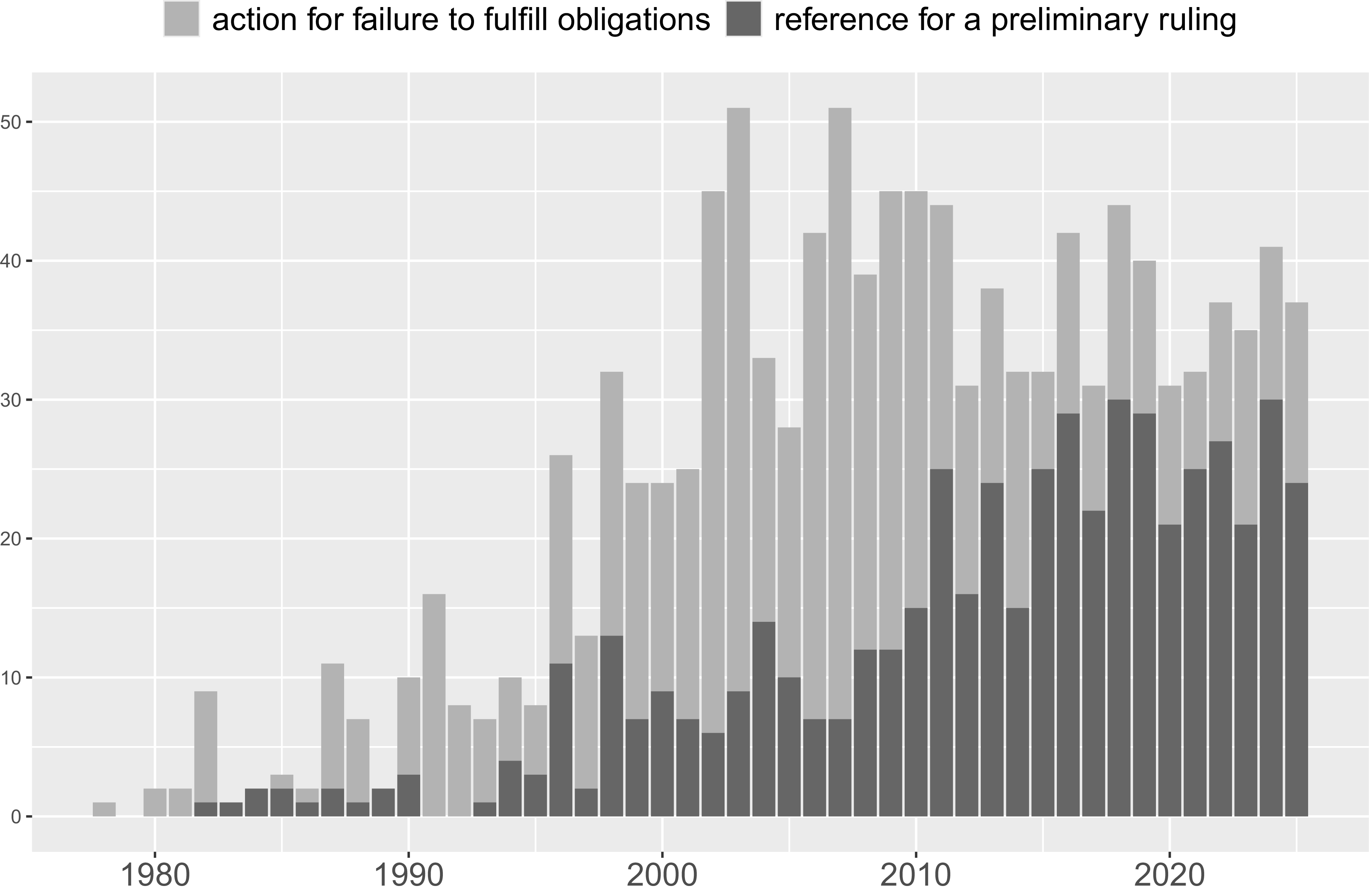
I will start with an overview of central and de-central enforcement. Figure 1 shows the yearly number of judgments in my sample, separated by type of legal procedure. The figure clearly shows the diminishing importance of infringement procedures since about 2010. While the number of preliminary references has grown markedly since the mid-2000s, the overall number of environmental cases has in fact declined, having reached its peak in 2007. This is due to the greatly diminished number of infringement cases.
Annual number of cases by type of procedure.

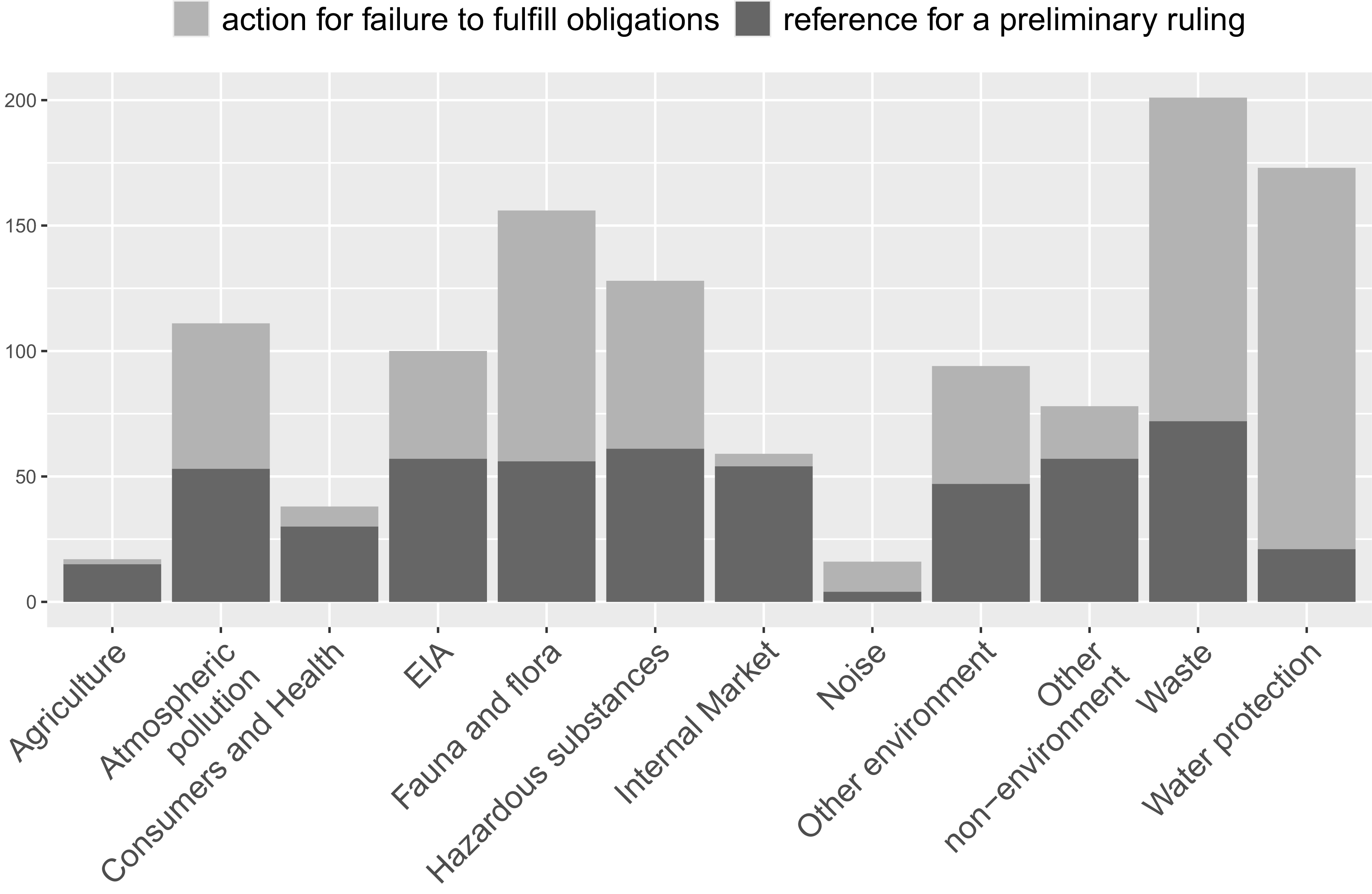
For each of the cases in my selection, I next identified the most frequently cited legal act, which allowed me to undertake a more fine-grained classification of the issue at stake. To the degree possible, I identified the specific environmental sub-category of the legal act in question. I follow directory codes except in the following cases: my category “hazardous substances” is an amalgamation of the directory codes “Chemicals, industrial risk and biotechnology” (15.10.20.50), “Nuclear safety and radioactive waste” (15.10.20.10), “Plant health” (03.50.20) and “Dangerous substances” (13.30.18). Because of their central role in environmental proceedings, I also created a separate category for cases based on the Environmental Impact Assessment directives (which are listed under code 15.10.10.00 “General provisions and programmes”). “Other environment” collects legal acts with the directory code 15.10 that could not be placed in any other categories. As Figure 2 shows, most environmental cases concern waste, water protection, fauna and flora, hazardous substances (primarily GMOs and pesticides), atmospheric pollution and environmental impact assessment (EIA). The categories agriculture, consumers and health, internal market and “other non-environment” capture cases that cite a source of environmental law, but whose most cited legal act is from another field. The traditional importance of infringement procedures in environmental cases is evident when comparing environmental categories with case primarily litigated on other legal bases. However, even within the environmental field there are distinct differences between subcategories. The field of water protection, for example, is dominated by infringement procedures.
Cases by subject matter and procedure.

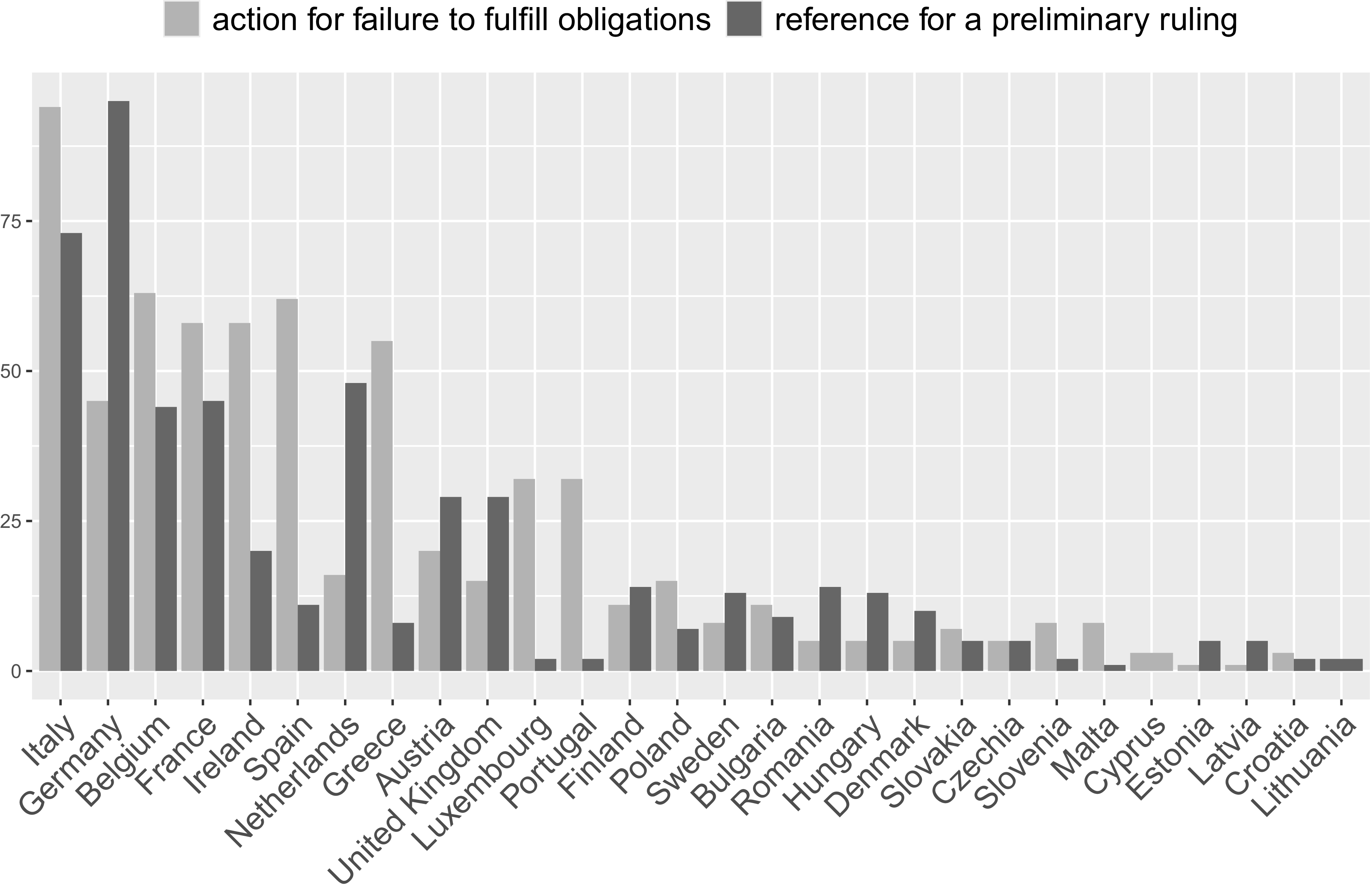
In a next step, I identified the origin of the preliminary reference cases and the target of infringement procedures in my sample. Figure 3 plots this information. For many countries with more than twenty-five cases in total, the ratio of preliminary references to infringement procedures is lopsided. In particular for Spain, Ireland, Greece, Portugal and Luxembourg, infringement procedures vastly outnumber preliminary references, whereas for Germany, the Netherlands, Austria and the UK, preliminary references predominate. To the degree that preliminary reference procedures are an indicator of decentralised enforcement at the national level, these numbers support the observation by Tanja Börzel that private litigants in some EU Member States do not (or cannot) avail themselves of new procedural opportunities.Footnote 69
Origin of preliminary reference procedures and targets of infringement procedures.

Moving on, I restricted my data to cases brought by members of civil society as applicants. Following Conant et al., I divided these civil society actors into four categories: civil society organisations (mainly ENGOs), economic interest groups (mainly industry organisations), individuals and companies.Footnote 70 This reduced the number of cases to 387. Some of these cases have multiple applicants across different types of civil society actor, such as ENGOs together with individuals. I expanded my dataset to record one row per (type of) litigant. This increased my observations to 436.
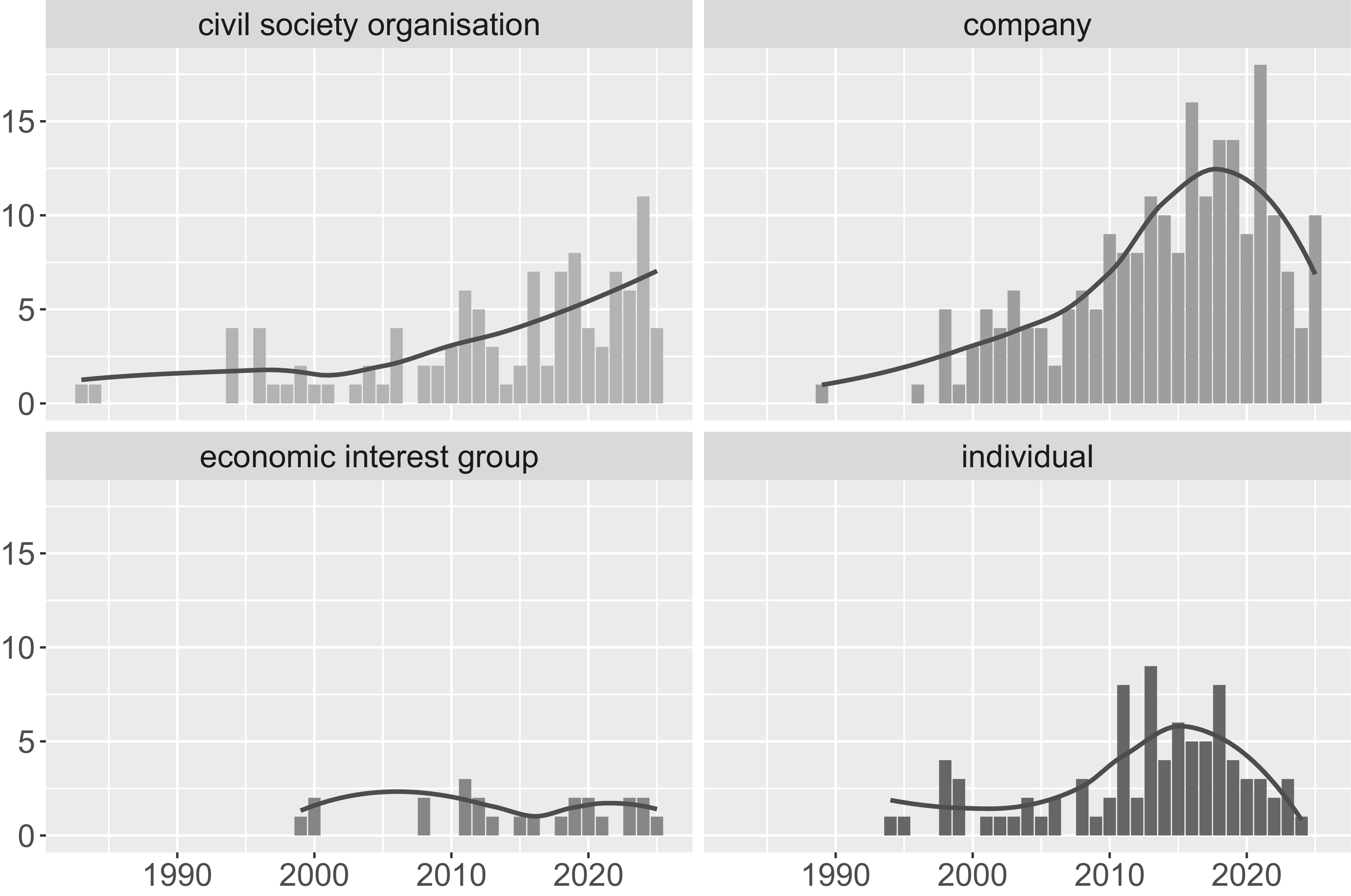
Figure 4 plots the annual number of cases litigated by the four types of civil society actor. I have added a smoothing curve to visualise trends. The figure shows that companies, the most frequent type of litigant in cases before the CJEU overall,Footnote 71 are also the most frequent litigants in environmental law. The number of cases brought by companies peaked in the late 2010s and has recently declined. ENGOs are somewhat less frequent litigants, but the number of cases brought by them has steadily increased since the mid-2000s. This may well be evidence for the impact of the Aarhus Convention. Interestingly, individuals bring almost as many cases as ENGOs. Their litigation efforts should not be overlooked, although the involvement of individuals in environmental litigation seems to have declined in recent years. Economic interest groups, in turn, are rather infrequent applicants in environmental matters.
Annual number of cases brought by civil society actors.

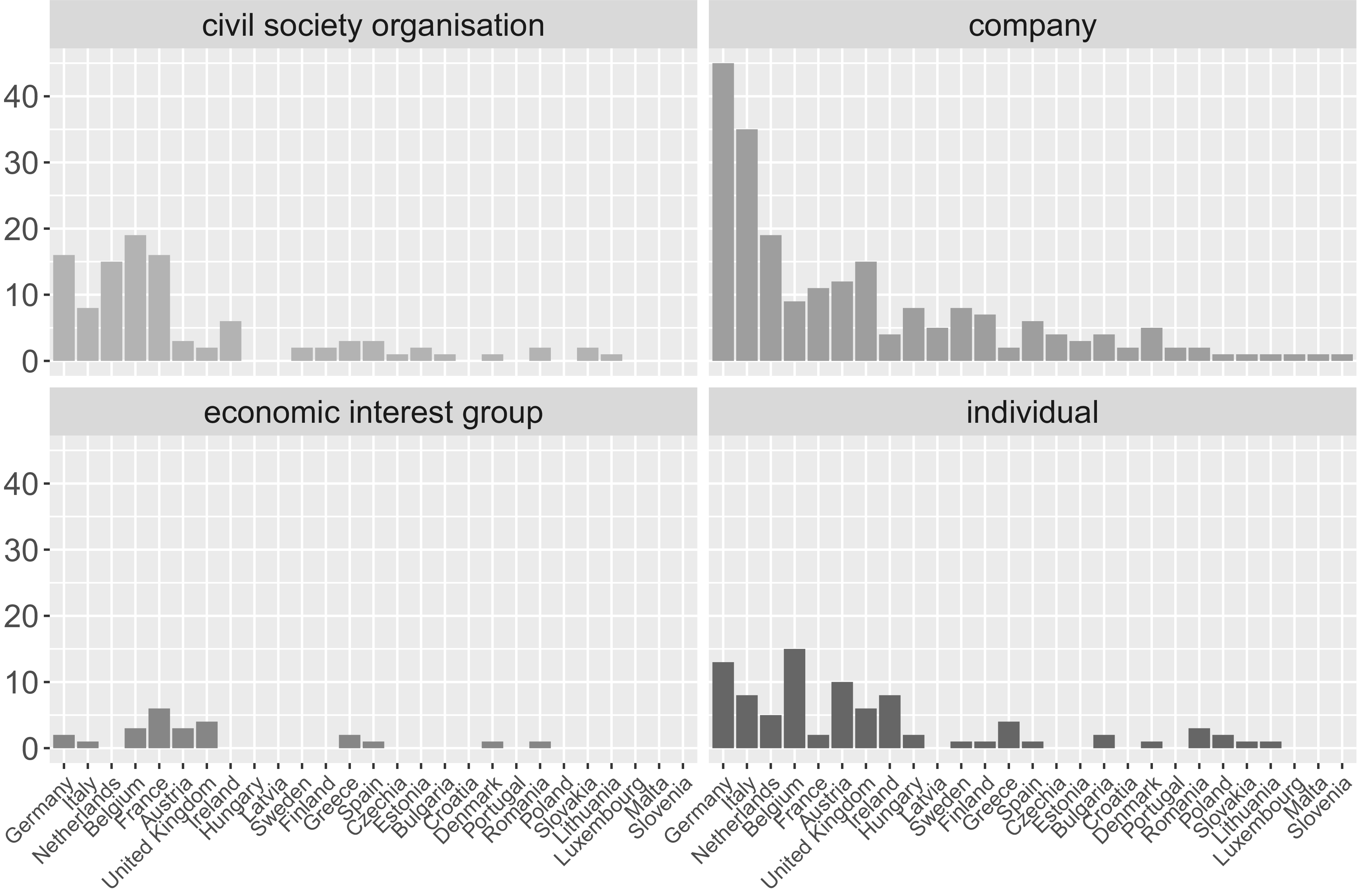
Figure 5 plots civil society litigants by country of origin. There is a clear preponderance of companies from Germany that initiate cases which have ended up before the CJEU, followed by companies from Italy. These two countries clearly stand out. ENGOs as litigants also cluster in a small number of countries: Belgium, France, Germany and the Netherlands. The comparatively large number of cases brought by Belgian and French ENGOs is not expected. Kingston and co-authors had reported low numbers of ENGO litigation in France relative to the Netherlands.Footnote 72 Belgium, in particular, appears to warrant closer attention. The origin of individuals as litigants is somewhat more diverse than that of ENGOs, including a noticeable number of cases from the UK, Ireland and Austria. Most economic interest groups as litigants come, again, from France. Clearly, French cases have a strong involvement of organised civil society. This, too, warrants closer attention. The (near) absence of cases brought by individuals and ENGOs from Spain, Greece, Portugal and Luxembourg, all countries that are frequently targets of infringement procedures in environmental law, further confirms concerns about geographic disparities in the decentral enforcement of EU environmental law.
Civil society litigants by country of origin.

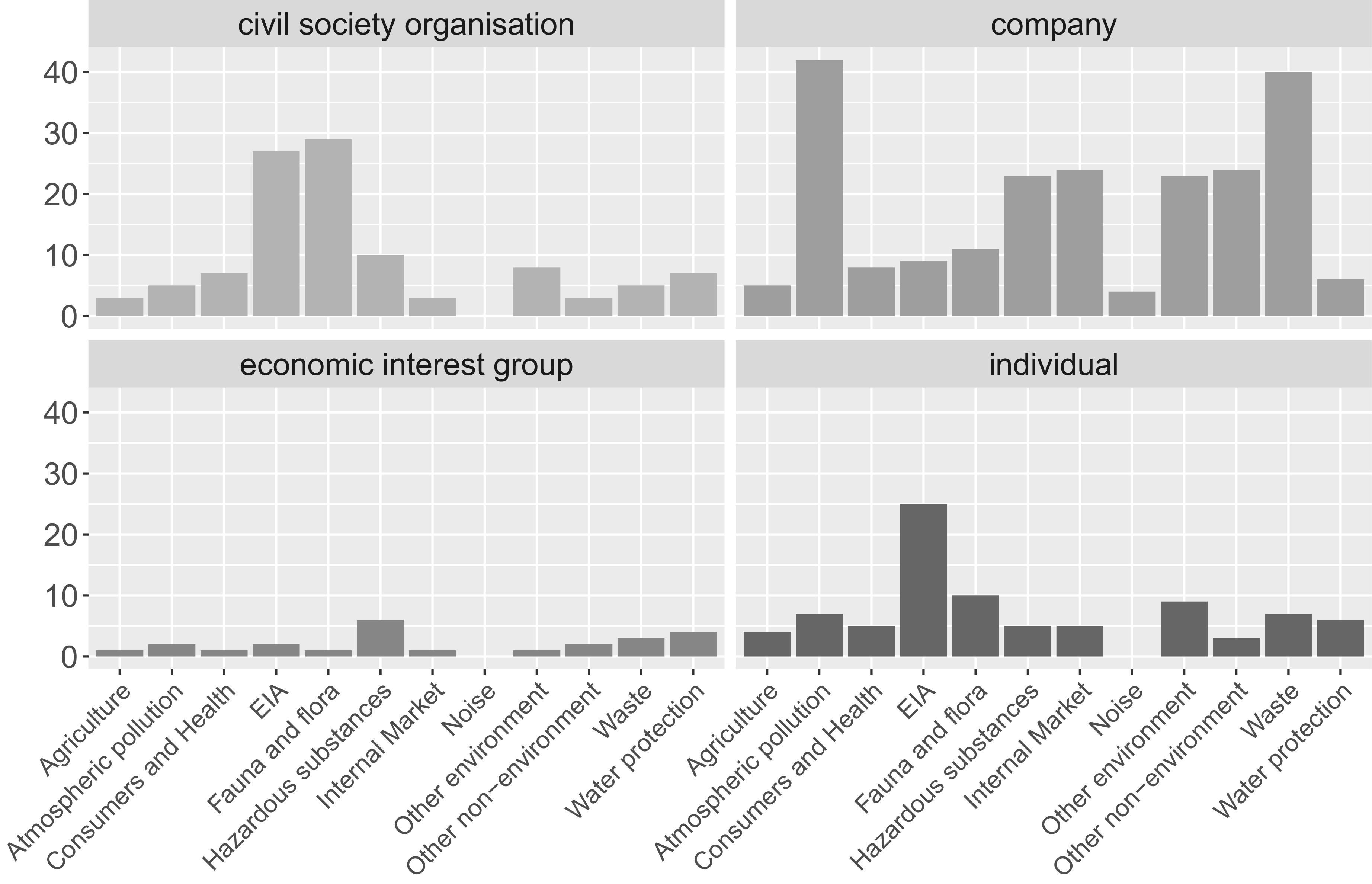
Figure 6 plots the subject matter that civil society actors litigate. Companies have a strong focus on atmospheric pollution and waste. I find this pattern in every country with a meaningful number of cases brought by companies. The cluster of cases about atmospheric pollution is largely made up of challenges to national allocations of allowances under the EU’s emission trading system (ETS). These cases are analysed more closely by Sofie Fleerackers.Footnote 73 Cases initiated by ENGOs, for their part, cluster around EIAs and the protection of Fauna and Flora. Clean air cases are fewer than expected, given the prominence of ClientEarth and Deutsche Umwelthilfe. Cases initiated by individuals are predominantly about EIAs, an area where local residents can often show individual concern to gain legal standing. Cases brought by economic interest groups largely concern hazardous substances (mainly pesticides), waste and water, but the small number of cases makes it difficult to detect patterns.
Civil society litigants by subject matter.

In the following, I undertake a closer look at some of the patterns that stand out. Since there is comparatively little literature on companies and individuals in environmental law, I randomly selected twenty cases brought by each of these two types of litigants and read the case descriptions in order to get a better idea of the motivations driving such litigation.
1. Litigation brought by companies
In my sample of twenty cases, I found only one that could be classified as a strategic case against environmental rules along the lines of efforts described by Fleerackers.Footnote 74 Most cases brought by companies appear to be routine legal conflicts.Footnote 75 Not all have negative implications for environmental protection. Two cases were brought by producers and suppliers of renewable energy, one against an apparent discriminatory fee structure for imported vis-à-vis locally produced renewable energy,Footnote 76 and another against reductions to a government subsidy scheme for solar energy.Footnote 77 Two cases were brought by producers of pesticides who had received marketing authorization for their products and who now challenged decisions by the competent national authorities on the authorisation of products by competitors, demanding that the competitors submit their own scientific evidence for the safety of their products, rather than rely on existing data for similar products.Footnote 78 If won, such cases could have the effect of strengthening protections against protentional harmful products (by requiring more scientific evidence). Other cases appeared neutral as to the outcome for environmental protection: a conflict about eligibility for tenders for public services where the service in question happens to be waste disposal,Footnote 79 or a conflict about whether peach juice qualifies for a particular agricultural aid scheme.Footnote 80
Yet other cases are equally self-interested, but litigants dispute environmental obligations: a developer who challenged the requirement for an environmental impact assessment,Footnote 81 a distributor of plastic bags who challenged the requirement to join a recycling scheme (because he did not consider plastic shopping bags to be packaging),Footnote 82 or a producer of drift nets for tuna fishing who challenged the validity of EU rules prohibiting nets of a certain size.Footnote 83 Six of the twenty cases concerned the allocation of emission allowances as part of the ETS. These were about technical details of allocating allowances,Footnote 84 national taxes on sold or unused allowances,Footnote 85 and the information companies were required to disclose to receive allowances.Footnote 86 None of them challenged the system as such, but their cumulative effect may be significant. The only overtly strategic case in the sample concerned a challenge to a German subsidy regime for renewable energy that required energy suppliers to purchase locally generated renewable energy at fixed prices above market rate. The case was brought by a German energy company against another company in which it owned a majority stake. While the formal conflict was about the allocation of the financial burden created by the subsidy scheme, the conflict was artificial and both sides in fact argued for the incompatibility of the national scheme with EU free movement and competition law.Footnote 87
Based on my reading of the cases in the sample, the overall picture of corporate litigation in EU environmental law appears mixed. About half of the relevant cases were instances of routine litigation without evident negative consequences for environmental protection. The ETS cases in my sample, individually, did not seem likely to make a difference to EU efforts at climate change mitigation. Cumulatively, however, they may well have an impact, as can repeated challenges to individual decisions protecting the environment, given the large number of corporate cases overall. Some cases, both routine and strategic, challenged policies, rather than individual decisions. These are interesting cases worth looking at more systematically. The same is true for corporate litigation that supports environmental protection, where green technology is the litigants’ business model.
2. Litigation brought by individuals
The majority of cases in my sample of twenty cases brought by individuals are cases in which the litigant(s) pursued goals congruent with environmental protection.Footnote 88 My own research into the identity of the litigants suggests that in a subset of these, individual activists brought cases with an express strategic intent. Five activist beekeepers brought an action against permits by the state of Bavaria to grow genetically modified maize on state-owned land for research purposes, arguing that genetically modified pollen made their honey unfit for consumption.Footnote 89 A member of the Austrian parliament for the Green Party challenged the government’s refusal to provide information relating to its monitoring of products manufactured from genetically modified soya and maize that she had requested via an individual access to information request.Footnote 90 A local activist, together with a local company and the local municipality, challenged the planning permission for construction works on a river embankment due to an allegedly inadequate EIA.Footnote 91 An activist veterinary surgeon, together with three Dutch ENGOs challenged a decision by a Dutch authority to permit the expansion of a large pig farm without an EIA.Footnote 92 In other cases, individuals challenged planning permissions in circumstances where motives may have been grounded in self-interest rather than environmental activism. Such challenges concerned planning permissions for construction works on airports,Footnote 93 road construction in a Natura 2000 area,Footnote 94 residential housing construction,Footnote 95 tree-felling for the construction of a power line,Footnote 96 the construction of a retail park,Footnote 97 and urban development.Footnote 98 One case was brought by a fisherman alleging environmental damage caused by a hydroelectric power station,Footnote 99 another by a property owner who demanded compensation for decreased property values due to the expansion of Vienna airport.Footnote 100 Five of these cases, moreover, concerned procedural questions about standing and material preclusion that the CJEU resolved by reference to the Aarhus Convention and its implementing legislation.Footnote 101
Five cases in my sample are instances of self-interested litigation by individuals who did not pursue objectives that promote environmental protection. Such litigants included a farmer who contested the designation of pig manure on his property as waste,Footnote 102 farmers who challenged the designation of rivers adjacent to their properties as vulnerable areas under the Nitrates Directive,Footnote 103 a forestry operator whose application for subsidies for sustainable practices was denied because the land in question was partially state-owned,Footnote 104 a parrot breeder who demanded an exemption from the prohibition of trade in certain species of wild fauna,Footnote 105 and waste operators who, as criminal defendants, challenged the designation of certain processed materials as hazardous waste.Footnote 106
In my interpretation, the cases brought by individuals look more like cases brought by ENGOs than cases brought by companies. Some strategically pursue environmental goals; others do so incidentally out of self-interest – here, too, cumulative effects may be of interest. Individuals challenging environmental obligations do so as independent economic operators – these cases are therefore comparable to cases brought by companies. Independent activists as strategic litigants warrant closer attention – as far as I see, they have so far not received much academic consideration. Individuals as self-interested litigants, moreover, may provide a counterweight against companies as self-interested litigants. Given what we know about greater success rates of individual litigants in CJEU proceedings,Footnote 107 this balance, too, demands greater attention.
V. Discussion and conclusion
This article undertook a systematic mapping of all infringement and preliminary reference cases at the CJEU that cite environmental law, based on data from the IUROPA project. I want to highlight four take-aways from the results. First, my findings confirmed concerns about geographic disparities in the occurrence of environmental litigation in Europe. I highlighted that while countries such Spain, Greece, Portugal and Luxembourg were frequently targeted by the Commission for failing to comply with environmental obligations, very few preliminary references from these countries reached the CJEU. This could be an indication of a lack of civil society engagement on environmental issues, an inability of civil society actors to mobilise the law, or a reluctance on the part of national judges to send references to the CJEU. All three scenarios are problematic but require different responses. There is a growing academic interest in the absence of legal mobilisation,Footnote 108 which could fruitfully be extended to these cases.
Second, there is a significant number of cases brought by ENGOs and individuals from Belgium and France that, based on existing English-language literature, is somewhat unexpected. Reinhard Slepcevic wrote in 2009 that “in France, the environmental movement has been traditionally weak in terms of members, resources and influence compared to other European countries.”Footnote 109 Kingston and co-authors wrote that, according to their interview data, “very few ENGOs had made use of the access to justice mechanism in Ireland or France.”Footnote 110 Florence van Durme and Alberto Nicòtina, in turn, voiced concern about the funding situation for ENGO litigation in Belgium.Footnote 111 This highlights the need for more systematic data on litigation at the national level and a closer integration of such data collection efforts with qualitative studies.
Third, to evaluate private enforcement of EU environmental law, it is helpful to consider all types of civil society actors, not just ENGOs. There are almost as many environmental preliminary reference cases initiated by individuals as by ENGOs. ENGOs do not necessarily profit more than individuals from the procedural innovations precipitated by the Aarhus Convention.Footnote 112 A closer look at the case descriptions of a randomly chosen sample of cases brought by individuals demonstrated that a majority of such cases pursue goals congruent with environmental protection, and while most of these do so for self-interested reasons (e.g., challenges to local construction projects), some of these cases were brought by individual activists with broader strategic intentions. The effects of such cases may be similar to those brought be ENGOs. Moreover, non-strategic cases, not least by their volume, may also show effects that warrant closer attention. It may be time to re-explore Francis Zeeman’s call to promote “a legally competent citizenry […] if public aims are to be realized in a system in which the implementation of public policy is highly dependent upon mobilization of the law by individual citizens.”Footnote 113
Fourth and finally, like in other areas of EU law, companies are the most frequent litigants in environmental law. Their efforts are only beginning to be studied.Footnote 114 Here, too, I find that most litigants act of out of immediate self-interest without broader strategic ambitions, although the sample also contained one important strategic case. Not all cases brought by companies aim to weaken environmental obligations. Companies invested in renewable energy technology, for example, may align with the interests of ENGOs. Nonetheless, by virtue of their greater number, routine case challenging environmental obligations deserve greater attention. Such “random noise” can have significant individual and cumulative impact.Footnote 115 Not only do I suggest that those interested in the workings of private nature governance look beyond ENGOs, but they should also direct their focus beyond strategic litigation.
Competing interests
I have no competing interests to declare.
AI declaration
I have used OpenAI GPT-5.6 Sol (Plus) to generate a parser that improves the identification of parties to CJEU cases from judgment text. I describe this process in the replication file on <https://github.com/ahofmann-eu/environmental_litigation>.

 Open access

