Introduction
An infant's waking life consists of repeated social interactions with caregivers. These scenarios allow infants to begin to create internal working models (Landry, Smith, Swank, Assel, & Vellet, Reference Landry, Smith, Swank, Assel and Vellet2001) for responsive communication (Bowlby, 1980, cited in Bretherton, Reference Bretherton1995; Smith, Reference Smith2010). In order to effectively communicate, infants and caregivers must derive a shared understanding of each other's intent, co-constructing experiences to define objects, emotions, and mental states (Murray & Trevarthen, Reference Murray and Trevarthen1986; Rogoff, Reference Rogoff2003; Bortfeld, Reference Bortfeld2004). Caregivers generate more meaningful co-constructions when they have an appropriate understanding of infant comprehension abilities. For example, a mother asking her infant to “Give me the ball!” would be more likely to expect an 11-month-old to respond to and follow this simple command than she would a 7-month-old. Responsive caregivers are therefore likely to be responsive communicators.
As in the example above, dyadic communication often involves the use of language, which has long been examined in the context of infant–caregiver interactions (e.g., Snow, Reference Snow1972; Tomsello & Farrar, Reference Tomasello and Farrar1986). These studies have examined how modulations of caregiver language, or MOTHERESE, impacts child development. For instance, guiding language, a form of caregiver speech associated with promoting joint attention with children, may organize and focus child behaviors and attention (Tomasello, Carpenter, Call, Behne, & Moll, Reference Tomasello, Carpenter, Call, Behne and Moll2005). If a caregiver is a responsive communicator, then her use of guiding language should change across her infant's cognitive development, in concert with the child's understanding of objects and use of attention. How guiding language specifically shows responsive malleability to infant development has yet to be examined, and the longer-term consequences of such responsive variability for child language development forms the crux of this study.
Caregiver communication not only consists of language but also emotional expression, or affect. The intentionality model posits that language learning requires socio-emotional engagement (Bloom, Tinker, & Scholnick, Reference Bloom, Tinker and Scholnick2001), such that communicative performance influences language acquisition. We therefore aim to examine responsive guiding language in the context of varying maternal affect, to assess if these factors independently influence child language development.
Guiding language in motherese
Snow (Reference Snow1972) was the first to posit the Motherese Hypothesis, which holds that specific qualities of caregiver speech both enhance and speed language acquisition; this hypothesis has since been widely studied (e.g., Cohen & Beckwith, Reference Cohen and Beckwith1976; Fermald & Kuhl, Reference Fernald and Kuhl1987; Bortfeld, Reference Bortfeld2004; Brodsky, Waterfall, & Edelman, Reference Brodsky, Waterfall, Edelman, McNamara and Trafton2007). The goal of motherese is to attract and focus infant attention (Carroll, Reference Carroll2007), and several features of motherese, such as increased use of questions and redundant guiding, appear to be designed for exactly this purpose.
In order to hold child attention, caregivers adjust the type of language they use with their infants responsively and contingently (Fernald & Kuhl, Reference Fernald and Kuhl1987; Estes, Evans, Alibali, & Saffran, Reference Estes, Evans, Alibali and Saffran2007). Across ordered, bi-directional maternal speech and infant behavioral responses, a shared knowledge of semantic content develops incrementally as the child learns. The role of the caregiver is to consequently recognize and accommodate changes in the developing child's cognitive and communicative capacity. Therefore, motherese is not static, but rather dynamically and continuously modified by caregivers (Dominey & Dodane, Reference Dominey and Dodane2004).
Guiding speech is thought to influence infant focus during these dyadic exchanges (Tomasello et al., Reference Tomasello, Carpenter, Call, Behne and Moll2005). Guiding commands and questions are used by caregivers to establish predictable references of joint attention (Mundy & Newell, Reference Mundy and Newell2007; Hirotani, Stets, Striano, & Friederici, Reference Hirotani, Stets, Striano and Friederici2008). Once joint attention is established, caregivers can direct child attention to one of two referents: the object the infant is focused on (known as following-in), or to a redirected object of the mother's interest (directives) (Tomasello & Todd, Reference Tomasello and Todd1983; Akhtar, Dunham, & Dunham, Reference Akhtar, Dunham and Dunham1991). When caregivers guide their infants’ attention to new objects, the infant must generate an entirely new frame of reference (i.e., infant attention to new object via an adult) prior to more elaborative communication. Consistent use of rerouting via directives has shown negative effects longitudinally, with Tomasello and Farrar (Reference Tomasello and Farrar1986) finding that mothers using less redirecting had children with larger vocabularies at 21 months of age.
Directive language may take the form of questions or commands, and studies finding negative correlations with child cognitive development (Tomasello, Mannle, & Kruger, Reference Tomasello, Mannle and Kruger1986) have typically observed behavior-driven, intrusive directive commands. In contrast, the literature on object-directed, question-based directives is more open-ended, but suggests that that there may be dissociation between directive commands and questions rooted in maternal intent (Pine, Reference Pine1992; Masur, Flynn, & Eichorst, Reference Masur, Flynn and Eichorst2005). Further, whether questions or commands are redirecting an infant to a new object or to the mother (i.e., as a source of new information) may affect the attentional outcomes of directives.
In contrast to the directive literature, Tomasello and Todd (Reference Tomasello and Todd1983) note that caregivers who use language to maintain infant attention and focus on the infant's object of interest are using an already established infant–object–adult interaction. Maintenance of joint focus to the child's interest has proven to be a reliable predictor of language development. Following-in behaviors (Brooks & Meltzoff, Reference Brooks and Meltzoff2008) and commands (Akhtar et al., Reference Akhtar, Dunham and Dunham1991) correlate with vocabulary production in children, suggesting that following-in can positively affect child cognitive development. As with directive language, question-based following-in is less understood. We aim to address whether questions and commands are correlated for both directive and follow-in language, and if following-in questions and commands yield similar downstream effects.
Beyond quantitative measures of guiding language used in early maternal communication, we also aim to address the responsivity of maternal guiding language across early communication. Between 7 to 11 months of age (and averaging at approximately 9 months), infants reach critical neural and cognitive milestones (i.e., Lalonde & Werker, Reference Lalonde and Werker1995; Kuhl, Conboy, Padden, Nelson, & Puritt, Reference Kuhl, Conboy, Padden, Nelson and Pruitt2005). Specifically, infants in this age group begin showing mimicking behaviors of sound and actions, respond to pointing and directing within dyads, and engage in nascent babbling, alongside rising visual acuity and focus (Albrecht & Miller, Reference Albrecht and Miller2001). Maternal attunement to these cognitive and linguistic developmental milestones across this time-point may result in a specific role of responsive motherese in influencing child language learning. Therefore, we will determine whether responsive infant-directed guiding language influences later language development skills.
Expression of emotional affect in dyadic communication
In addition to linguistic features of motherese, caregivers also maintain child-oriented affect, or the physical expression of emotionality during communication. Infants as young as two months of age demonstrate emotional understanding of maternal behavior, such as affective timing and appropriateness of smiling and frowning. During the first year, infants are progressively able to respond to a mother's affective communication (e.g., Murray & Trevarthen, Reference Murray and Trevarthen1986; Masur et al., Reference Masur, Flynn and Eichorst2005), especially when coupled with exaggerated speech and gesture production (Meltzoff & Kuhl, Reference Meltzoff, Kuhl, Lewkowicz and Lickliter2004; Tomasello et al., Reference Tomasello, Carpenter, Call, Behne and Moll2005). As a result, these studies suggest caregiver affective expression during communication may be a crucial component of responsive parenting.
Infants display a specific preference for positive emotion expression in caregiver communication (e.g., Fernald, Reference Fernald1993; Mumme & Fernald, Reference Mumme and Fernald2003). However, the meaning and nature of positivity in maternal speech changes as infants become more attuned to affect. Kitamura and Burnham (Reference Kitamura and Burnham2003) rated recordings of adult speech geared towards infants across the first year. They found that at 3 months of age, mother's positive affect is primarily intended for comfort; at 6 months, positive expression is typically used to demonstrate affection. By 9 months, mothers tend towards more dominant affect during motherese; this type of communication aims to capture attention and interest. Similar findings in Japanese dyads were seen in work by Niwano and Sugai (Reference Niwano and Sugai2002), showing that prosodic contours of motherese shift as infants age. These results are consistent with the role of language toward 3-, 6-, and 9-month-old infants, as motherese becomes increasingly informative (Soderstrom & Morgan, Reference Soderstrom and Morgan2007). In order to understand what maternal style resonates best with infants, Kitamura and Lam (Reference Kitamura and Lam2009) examined affective communication associated with comfort, affection, or dominance. These results indicated that 9-month-olds continued to show preference for affectionate positive affect despite the marked increase in maternal use of directive, dominant speech. Specifically, dominant affect was less associated with garnering and holding infant attention than affectionate communication at this age. While these cross-sectional studies have been illuminating in understanding affective preferences, no longitudinal studies to date have measured the downstream effects of early dominant affect, especially in combination with early motherese. Since capturing infant attention is related to the development of cognitive skills (Masur et al., Reference Masur, Flynn and Eichorst2005; Soderstrom & Morgan, Reference Soderstrom and Morgan2007), the effects of dominant affect on child language should be examined longitudinally to understand their influence on developmental trajectories.
A longitudinal approach to dyadic communication
The dynamic content of motherese across infant developmental trajectories has been documented (e.g., reviewed in Tomasello et al., Reference Tomasello, Carpenter, Call, Behne and Moll2005). Most literature assessing maternal input and child performance examines concurrent maternal input and child response to motherese (e.g., Werner & Keller, Reference Werner, Keller and Keller1994; Meltzoff & Kuhl, Reference Meltzoff, Kuhl, Lewkowicz and Lickliter2004). This methodological approach provides a non-developmental view of language acquisition that consists of distinct time-points of mother–infant interactions. However, language acquisition and learning are developmental processes, such that responsivity in early maternal speech and affect may be correlated to later time-points of child language performance (e.g., Tamis-LeMonda, Bornstein, & Baumwell, Reference Tamis-LeMonda, Bornstein and Baumwell2001; Marchman & Fernald, Reference Marchman and Fernald2008; Rowe, Raudenbush, & Goldin-Meadow, Reference Rowe., Raudenbush and Goldin-Meadow2012; Nozadi et al., Reference Nozadi, Spinrad, Eisenberg, Bolnick, Eggum-Wilkens, Smith, Gaertner, Kupfer and Sallquist2013).
Researchers have investigated the longitudinal influence of motherese on later child language development; studies conducted by Huttenlocher, Haight, Bryk, Seltzer, and Lyons (Reference Huttenlocher, Haight, Bryk, Seltzer and Lyons1991) and Hurtado, Marchman, and Fernald (Reference Hurtado, Marchman and Fernald2008) measured the quantity of unique (or distinct) word choices during naturalistic, semi-guided free play in order to predict later measures of child expressive language. The former study measured longitudinally from 14 to 26 months; the latter assessed toddlers from 18 to 24 months. These studies demonstrate prospective longitudinal relationships between qualitative aspects of maternal input and child expressive language.
While the aforementioned studies have examined the relationship between motherese and child language across the second year of life, a slew of results (e.g., Akhtar et al., Reference Akhtar, Dunham and Dunham1991; Tomasello, Reference Tomasello, Bowerman and Levinson2001; Tomasello et al., Reference Tomasello, Carpenter, Call, Behne and Moll2005; Kitamura & Lam, Reference Kitamura and Lam2009) indicate a critical earlier time-point for dyadic communication. This study will specifically address how guiding language shifts across this critical time, as responsive caregivers reactively shift their guiding language to match changes in their infants’ capacities. This study will further address independent contributions of early language and affect for later child vocabulary, as well as assessing how potential interactions between language and affect may affect vocabulary development.
Developmental model of guiding language, affect, and child vocabulary
The current study aims to add to the existing literature by addressing two sets of questions:
1. While directive language use has been linked to reduced child language development, following-in language has been associated with increased child language acquisition (McCathren, Yoder, & Warren, Reference McCathren, Yoder and Warren1995). We will investigate the responsive nature of guiding language; as reactive communication has been associated with later child language development, we ask if change in early guiding language to infants might have a unique – and separate – influence on toddler vocabulary use, and whether this may vary across types of guiding language (i.e., questions or commands, directives or following-in).
2. Many studies have focused on moderating impacts of adjacent variables to maternal speech; for example, a rich literature has assessed how gestural dyadic communication augments spoken language (e.g., Rowe & Goldin-Meadow, Reference Rowe and Goldin-Meadow2009; Goldin-Meadow, Ping, Decatur, Larson, & Zinchenko, Reference Goldin-Meadow, Ping, Decatur, Larson and Zinchenko2012). Less research, however, has focused on the specific role of affect in moderating how infants perceive maternal language. Instead, studies have typically combined infant-directed maternal speech and affect into an overall measure of responsivity that influences later child language and general cognitive development (e.g., Landry et al., Reference Landry, Smith, Swank, Assel and Vellet2001; Tamis-LeMonda et al., Reference Tamis-LeMonda, Bornstein and Baumwell2001; Nozadi et al., Reference Nozadi, Spinrad, Eisenberg, Bolnick, Eggum-Wilkens, Smith, Gaertner, Kupfer and Sallquist2013). No studies to date have extricated caregiver verbalizations to their infants from affect-specific qualities in assessing whether the two have distinct relationships with multiple time-points of later child language. As such, we aim to address not only the role of guiding language and responsive guiding language on child language acquisition, but also how this relationship may be modeled with early maternal affect.
Method
Participants
Researchers recruited mother–infant pairs as part of a larger longitudinal study conducted at the University of Washington. Data is reported from 32 dyads, of which 20 infants were male and 12 were female. All infants were 7 months of age (M = 0; 7.0; range: 0;6.15 to 0;7.15) at the initial time of the assessment. All children were born within two weeks of their due dates and weighed at least six pounds at birth; the subject pool children were first-born infants. Caregiver participants in the study reported that infants had normal hearing and vision, no prior major illnesses or injury requiring hospitalization, and no evidence of developmental delay (i.e., all infants were typically developing). For all dyads, caregivers reported that English was the primary language spoken in the home.
Procedure and measures
Measures for this study were taken across four time-points. At 7 and 11 months, mother–infant free play interactions were observed, videotaped, and later transcribed and scored for (i) maternal use of guiding speech and (ii) maternal dominant affect. At 18 and 24 months, caregivers reported child expressive language performance in the form of MacArthur-Bates Communicative Development Inventories (Words and Sentences; Fenson, Marchman, Thal, Dale, Reznick, & Bates, Reference Fenson, Marchman, Thal, Dale, Reznick and Bates2007).
Data collection: 7 and 11 months
Mother–infant interactions at 7 months and 11 months were recorded in an 11′ by 15′ soundproof university laboratory playroom. In the room, mothers sat across a table from their children, who were seated in high-chairs. Infants’ backs faced a one-way mirror. Participants were recorder with a Sony digital camcorder, with the mother's face and play-related activity clearly visible. Mothers were given four children's toys (i.e., a dump truck, a jack-in-the-box Winnie the Pooh toy, a box with plastic keys inside, and a rolling dog toy) and were instructed to use one toy at a time in succession with their children. They were additionally asked to play with each toy for no more than 2 to 3 minutes. The experimenter did not stay in the room during the dyadic play sessions.
Experimenters generated a room set-up procedural checklist that was used for each session, and gave identical instructions to each mother. Across 10% of sessions, experimenters calculated the percentage of checklist procedures actually conducted by the examiner (reliability procedures detailed by Billinglsey, White, & Munson, Reference Billingsley, White and Munson1980). For both 7- and 11-month sessions, reliability for the procedure ranged from 95% to 100%.
Coding – maternal language measures: 7 and 11 months
Each session was video-recorded. Videos were subsequently transcribed and coded using specified coding conventions. Each utterance, or unit of speech bounded by silence, was denoted as a separate line of dialogue. Two independent coders transcribed each session. The content of mothers’ speech to their children was then parsed and coded for maternal use of guiding language. For each transcript, coders counted the number of words (TOTALWords) and number of utterance (TOTALUtterances) spoken by the mother. While TOTALWords and TOTALUtterances are strongly correlated (R = 0.83 at 7 months, .83 at 11 months), raters showed some variation in marking the end of utterances (κ = .61, SE = .06, p < .001).
As defined in Table 1, each utterance was also categorized as either non-guiding or guiding speech. Within the latter category, utterances were marked as either guiding commands (GC; i.e., statements) or guiding questions (GQ). Utterances were further categorized as guiding to the child's current object of interest (following in; GC_Interest, GQ_Interest), guiding the child's attention to another object (directive; GC_RedirectObject, GQ_RedirectObject), or guiding the child's attention to the mother (directive; GC_RedirectMother, GQ_RedirectMother). All raw language measures were appended with a number indicating the time-point (i.e., GC_Interest at 7 months is designated as GC_Interest7). Table 1 provides a summary of definitions and examples of each of the coding scheme categories.
Coding scheme used to assess maternal guiding language to children at 7 and 11 months

Coding – maternal affect measure: 7 and 11 months
Maternal emotionality, otherwise known as maternal affect, was coded during communication with her infant according to a modified form of the California Families Project Interaction (CFP) Ratings Scales and the fifth revision of the Iowa Family Interaction Rating Scales (Melby et al., Reference Melby, Conger, Book, Rueter, Lucy, Repinski and Scaramella1993). Affect scales are defined as the mother's emotion state as measured by numerical observer rating of vocal intonation and bodily/facial emotional expression. The dominance scale adapted from the CFP assesses maternal dominant affect, as defined as a demonstration of control or exertion of influence by the mother over the infant. The dominance scale ratings rank from 1 (no exertion of control over infant's behavior) to 9 (frequent attempts and success in controlling the infant's actions). Higher scores were typically generated by commanding physical behavior (e.g., grabbing at the toy the infant is playing with or demonstrating actions with the toy without allowing the child sufficient opportunity to engage with the toy) and verbal communication (e.g., demanding or commanding child attention).
To code maternal affect, researchers recorded a dominant affect score four times per mother–infant session – one score per each toy played with during the session. Per coder, the mother's total dominant affect score was generated by averaging across the four scores for the entire session. As with speech transcription, each session was coded for affect by two independent coders.
Child language measures: 18 and 24 months
The MacArthur-Bates Communicative Development Inventories (CDI) (Words and Sentences; Fenson et al., Reference Fenson, Marchman, Thal, Dale, Reznick and Bates2007) was administered twice in this study: when the infants reached 18 and 24 months of age. The CDI: Words and Sentences includes a 680-word expressive vocabulary production checklist with semantic categories such as animals, toys, food and drink, people, verbs, adjectives, and connecting words. The caregiver reported which words children were able to produce from the 680-item list.
Results
Data analysis
Maternal language
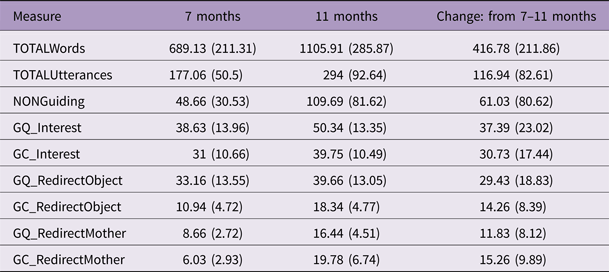
Raters reliably categorized maternal utterances into guiding command categories at 7 (R(223) = .94, κ = .74, SE = .03, p < .001) and 11 months (R(223) = .95, κ = .72, SE = .03, p < .001). Descriptive statistics for each maternal language measure are provided in Table 2.
Average number of items coded for each maternal language measure at 7 months, 11 months, and the change in each measure from 7 to 11 months (reported as M (SD))

Maternal affect
In rating maternal affect on a 9-point scale, inter-judge recording reliability was 76% between coders across all 32 sessions (κ = .64, SE = .09, p < .001 at 7 months; κ = .69, SE = .04, p < .001 at 11 months). Dominant affect scores were similar at 7 (DOMINANCE7: M = 5.51, SD = 1.56) and 11 (DOMINANCE11: M = 5.35, SD = 1.53) months (t(58) = 0.39, p = .70).
Child language outcomes
Toddler vocabulary scores were recorded at 18 (CDI18: M = 88.84, SD = 108.38) and 24 months (CDI24: M = 278.85, SD = 208.08). CDI scores differed significantly between age groups (t(58) = 4.44, p < .001), as expected.
Correlational analyses: 7 to 11 months
Maternal language
We first used partial correlational analyses to quantify associations between guiding language measures. For maternal language at 7 months, we controlled for TOTALWords7 and TOTALUtterances7 while conducting partial correlations analyses between GC_ and GQ_ for Interest7, RedirectObject7, and RedirectMother7 (Table 3). A significant correlation was found between GC_Interest7 and GQ_Interest7 (p < .001). In a similar analysis conducted for maternal language at 11 months (Table 3), a similar correlation emerged between GC_Interest11 and GQ_Interest11 (p < .001). These results imply similar or related goals of following-in questions and commands, suggesting that combined following-in language measures (Interest7, Interest11) may significantly emerge in later analysis.
Partial correlations between raw language measures at 7 and 11 months, controlling for total numbers of words and utterances at each time-point (*p < .05, **p < .01, ***p < .001)

As predicted, GC_RedirectObject7 negatively correlated with both following-in variables (GQ_Interest7, p < .001 and GC_Interest7, p = .05), indicating that following-in language and directive commands are inversely related at 7 months. This inverse correlation was not significant at 11 months (ps > .05).
Unlike GC_Interest and GQ_Interest, GC_RedirectObject and GQ_RedirectObject were not correlated (ps > .05 at 7 and 11 months). This finding matches our prediction that directive questions and commands do not share the same communicative goals. Finally, GC_RedirectMother and GQ_RedirectMother did not significantly correlate with any language measure (ps > .05) at either time-point. This finding is likely rooted in the significantly (ps < .001) fewer utterances coded in these categories relative to the other variables.
Maternal affect
We examined change in dominant affect scores between 7 and 11 months. As predicted, DOMINANCE7 and DOMINANCE11 were strongly correlated (R = 0.84), and therefore these scores were mathematically averaged to generate a single variable reflecting maternal affective communication (DOMINANCE; M = 5.43, SD = 1.40).
Maternal language and maternal affect
Correlational analyses were performed for guiding language and affect measures. No significant correlations emerged between DOMINANCE7 or DOMINANCE11 and any guiding language variable, nor DOMINANCE and any guiding language variable (ps > .05, range: .09 to .99).
Correlational analyses: early maternal measures and later child outcomes
Maternal language and child outcomes
We performed separate bivariate correlational analyses for associations between guiding language measures at 7 and 11 months and CDI18 and CDI24 scores, respectively (Table 4).
Correlations between raw language measures at 7 and 11 months (including an amassed Interest measure) and CDI scores at 18 and 24 months, respectively. GQ_ and GC_RedirectObject and RedirectMother are reported as RO and RM, respectively (*p < .05, **p < .01, ***p < .001).

Of the maternal language measures assessed when the infant was 7 months of age, no language measures correlated with CDI18, and only GC_Interest significantly correlated with CDI24 (p = .004). Of the remaining measures, only the associations between GC_Interest and CDI18 (p = .06) and between GQ_Interest and CDI24 (p = .09) trended towards significance.
Of the maternal language measures assessed when the infant was 11 months of age, GQ_Interest significantly correlated with both CDI18 (p = .001) and CDI24 (p = .001). GC_Interest did not significantly correlate with either CDI18 or CDI24 (ps > .10). These findings suggest that, despite their strong correlations, following-in commands and questions have variable associations with later child language outcomes. These results also indicate that both categories of redirecting questions and commands were not correlated with later child expressive vocabulary outcomes measured in this study.
As partial correlations analyses performed above (Table 3) suggested that GC_Interest and GQ_Interest were likely related at both 7 and 11 months, these variables were added together to generate amassed Interest7 (M = 69.63, SD = 22.42) and Interest11 (M = 90.09, SD = 21.92) variables. As reported in Table 4, Interest7 was not predictive of CDI18 (p = .23) but was correlated with CDI24 (p = .02). Interest11 was significantly correlated to both CDI18 (p = .05) and CDI24 (p = .007). These correlations remained significant when TOTALWords and TOTALUtterances were controlled for (Table 5).
Correlations between change scores (for all 6 guiding language measures) and CDI scores at 18 and 24 months, controlling for change in total number of words and utterances across the 7 and 11 month time-points. GQ_ and GC_RedirectObject and RedirectMother are reported as RO and RM, respectively. Correlations between CDI scores and Interest measures at 7 and 11 months, as well as maternal dominant affect, are also reported (*p < .05, **p < .01, ***p < .001)

Maternal affect and child outcomes
DOMINANCE in early maternal communication was significantly correlated with both CDI18 (R = –0.45, p = .01) and CDI24 (R = –0.49, p = .005), indicating that maternal dominance is negatively associated with later child language outcomes. These correlations remained significant when we controlled for TOTALWords and TOTALUtterances (Table 5).
The role of change in early maternal language
A primary study goal was to examine if responsive guiding language affected later child language outcomes. Therefore, controlling for TOTALWords and TOTALUtterances,Footnote 1 we first performed correlational analyses to observe associations between CDI measures and change in each of the six language measures (GC_Interest, GQ_Interest, GC_RedirectObject, GQ_RedirectObject, GC_RedirectMother, GQ_RedirectMother) from 7 to 11 months (Table 5). While only following-in (GC_Interest, GQ_Interest, and Interest) measures directly correlated with CDI outcomes, we wanted to assess whether change in any of these guiding language measures was associated with CDI outcomes.
As seen in Table 5, CHANGE_GC_Interest correlated with CDI scores (CDI18: p = .04; CDI24: p = .003). Likewise, CHANGE_GQ_Interest correlated with CDI outcomes (CDI8: p = .01; CDI24: p = .001) All other change scores were not significantly correlated with child vocabulary / CDI scores.
Importantly, CHANGE_GC_Interest and CHANGE_GQ_Interest significantly correlated (R = 0.77), indicating that change across these measures may be summed to a single change score measure (CHANGE_Interest; M = 20.47, SD = 34.57). CHANGE_Interest correlated with CDI18 (R = 0.45, p = .01) and CDI24 (R = 0.58, p = .001). This finding suggests that not only Interest guiding language, but also responsive change in Interest may be valuable to assess in longitudinal studies of child vocabulary development. Therefore, we performed regression analyses to assess independent contributions of TOTALUtterances (i.e., quantity of maternal communication), Interest (i.e., quantity of following-in language), and CHANGE_Interest (i.e., change in following-in language use between 7 and 11 months) to CDI18 and CDI24 (i.e., later child language outcomes).
Regression analyses: maternal language and child vocabulary
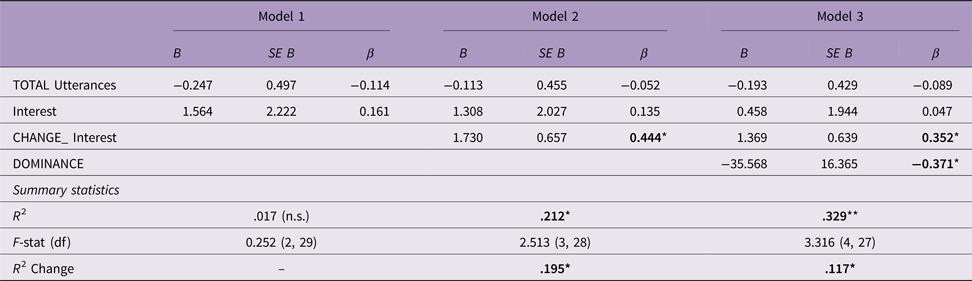
Tables 6 and 7 present models for which CDI18 and CDI24, respectively, are outcome variables. Model 1 in both Tables 6 and 7 presents regression analyses in which TOTALUtterances and Interest are the predictor variables; Model 2 in both tables also includes CHANGE_Interest as a predictor variable.
Fitted regression model comparison for predictors of CDI score at 18 months (CDI18) (n.s.) p < .10, *p < .05, **p < .01, ***p < .001)

Fitted regression model comparison for predictors of CDI score at 24 months (CDI24) (n.s.) p < .10, *p < .05, **p < .01, ***p < .001)

Model 1 is not significant for either CDI18 (p = .78) or CDI24 (p = .93). However, Model 2 is significant for both CDI18 (p = .05) and CDI24 (p = .01). In Model 2 for CDI18 (Table 6), CHANGE_Interest is the only significant predictor of CDI18 (p = .01). Similarly, for Model 2 for CDI24 (Table 7), CHANGE_Interest is the only significant predictor of CDI24 (p = .001).
Furthermore, across both Model 2s, TOTALUtterances and Interest do not become more significant with the addition of change scores, suggesting that they do not independently contribute to the models. CHANGE_Interest is positively correlated with CDI18 and CDI24, indicating that mothers responsively increasing their use of following-in language between 7 and 11 months have children with higher vocabulary scores at 18 and 24 months, respectively.
Regression analyses: maternal language, maternal affect, and child vocabulary
We next explored the role of dominant affect in predicting later child vocabulary, as DOMINANCE was inversely correlated with both CDI18 and CDI24.
In a second set of stepwise regression analyses (Tables 6 and 7), DOMINANCE was added as a predictor variable (Model 3). At 18 months (Table 6), Model 3 was significant (p = .03, F change p = .04), explaining 23% of the variance in CDI18. Both CHANGE_Interest (p = .04) and DOMINANCE (p = .04) significantly predicted CDI18. Importantly, CHANGE_Interest was positive correlated with CDI18, while DOMINANCE was negative correlated with CDI18.
Model 3 was also significant at 24 months (Table 7; p = .002, F change p = .02), explaining 38% of the variance in CDI24. As before, both CHANGE_Interest (p = .003) and DOMINANCE (p = .02) significantly predicted CDI24. Likewise, CHANGE_Interest positive predicted CDI18, while DOMINANCE negative correlated with CDI18.
Regression analyses: interactions between maternal language and affect on child vocabulary
Finally, we aimed to address if DOMINANCE and CHANGE_Interest were independent predictors of CDI scores. Therefore, we added a DOMINANCE and CHANGE_Interest interaction variable to Model 3 for both CDI18 and CDI24. At 18 months, the addition of the interaction term added to model strength, but this effect was not significant (p = .01, sig. F change = .08). Further, the interaction term was not a significant in this model (p = .80), while CHANGE_Interest (p = .03) and DOMINANCE (p = .03) remained significant predictors. Likewise, the addition of the interaction term did not significantly boost model strength at 24 months (p = .001, sig. F change = .78). The interaction term was also not a significant predictor in this model (p = .48), while CHANGE_Interest (p = .002) and DOMINANCE (p = .02) remained independently predictive. These findings indicate that DOMINANCE does not influence the path between CHANGE_Interest and CDI outcomes, suggesting that early maternal affect and responsive following-in language make independent contributions to later child language outcomes.
Discussion
The goal of this study was to unravel the concept of responsive parenting into two components of early mother–child interaction: responsive following-in language, or malleability in maternal following-in guiding language from 7 to 11 months, and maternal dominant affect, or expression of controlling influence during communication. Our aim was to determine how these indicators of maternal responsivity were associated with later child language performance. In line with previous research (e.g., Kuhl et al., Reference Kuhl, Conboy, Padden, Nelson and Pruitt2005) indicating that caregiver behavior has longitudinal influences on child language, this study predicted that both aspects of maternal responsivity to infants – change in motherese and dominant affect – would be associated with later toddler expressive language.
In the present study, results indicated that maternal verbalization and affect towards their infants separately contributed to the development of child vocabulary. Responsive linguistic input (here, specifically guiding language to the child's engaged object of interest) was found to be uniquely correlated to later children's language acquisition, as compared to total number of utterances, guiding or otherwise. Further, this change score variable and dominant affect distinctly – and oppositely – reflected on child language outcomes, such that at both 18 and 24 months, previous maternal dominant affect negatively affected child vocabulary, while previous responsive guiding language positively influenced toddler language measures.
These findings were largely in line with our predictions, demonstrating that not only can the verbalized and expressive aspects of mothers’ communication be separately assessed, but also that these factors play unique roles in the development of child vocabulary. Moreover, the influence of maternal responsivity early in a child's communicative life was shown to be longitudinally associated with later child performance, extending the findings of previous studies (e.g., Tamis-LeMonda et al., Reference Tamis-LeMonda, Bornstein and Baumwell2001; Kuhl et al., Reference Kuhl, Conboy, Padden, Nelson and Pruitt2005) and highlighting the role responsive parenting plays in building early semantic capabilities in children. The results of this study further expand upon previous findings regarding the functional role of reactivity parenting, generally – and motherese and maternal affect, specifically – in influencing children's language development outcomes (Tamis-LeMonda et al., Reference Tamis-LeMonda, Bornstein and Baumwell2001; Masur et al., Reference Masur, Flynn and Eichorst2005).
Early maternal language and later child language
Rogoff (Reference Rogoff2003) suggests that internal working models are based on co-constructive interchange between caregivers and infants; this study's results similarly illustrate how flexibility in dyadic co-construction can be linked to later linguistic benefits in children. In addition, the findings of this current study show that mothers who altered their speech to include increased use of child-focused guiding commands across 7 to 11 months – known to be a critical time-point in infant development – did in fact have children who developed higher expressive vocabularies earlier in their developmental trajectories. Not surprisingly then, studies have shown that following-in guiding language provides a clear, highly anticipated, and increasingly referential framework for children to use in understanding how toys are being referred to in guided play situations (e.g., Hitotani et al., 2008). For instance, Hirotani also showed that object-referring commands used to guide child behavior are both theoretically and demonstrably useful in better segmenting speech. Consequently, across these studies and our own, increased use of reactive motherese across a critical time-point of infants’ language development appears to be positively linked to later child vocabulary development in this study.
Interestingly, guiding language at 7 months was negatively associated with later language outcomes, while guiding language at 11 months was positively associated with later language outcomes. This dissociation may be linked to the shift in child attentional interest in guiding language noted in Kitamura and Lam (Reference Kitamura and Lam2009). Infants may be less reactive to guiding language at 7 months, and therefore may gain less semantic knowledge from this type of language than they would at 11 months – at which time guiding commands are both more of interest and more effective (i.e., because children are more likely to be able to operate the toys as guided) to children.
This study uniquely found that following-in questions and commands are correlated, while directive questions and commands are not correlated. Before considering the long-term consequences of maternal use of question versus commands, it will be critical for future research to address why these differences may arise. In line with previous literature, we suggest that maternal intent for following-in language is similar across questions and commands. We further offer that directive questions may have the same redirecting intent as directive commands, but may necessitate forming a different infant–new object–caregiver model than commands. Because questions often engender responses, directive questions may place more emphasis on the infant–mother element of the model than the infant–new object element – especially relative to directive commands.
Early maternal affect and later child language
How caregivers express motherese to their infants – for instance, whether dominant emotional valence of speech directs toy referencing within the child's expressed interest range – has been shown to influence the ways in which infants attend to incoming speech (Mumme & Fernald, Reference Mumme and Fernald2003; Page, Wilhelm, Gamble, & Card, Reference Page, Wilhelm, Gamble and Card2010). Interestingly, and not surprisingly, dominance in maternal affect during dyadic communication was negatively associated with later language performance, similar to the results reported by Kitamura and colleagues (Kitamura & Burnham, Reference Kitamura and Burnham2003; Kitamura & Lam, Reference Kitamura and Lam2009). In line with previous research indicating that dominant affect diminishes infant attention maintenance, it appears that non-dominant affect styles may allow infants increased time and opportunity to map words onto objects of interest. In this way, the dominance findings are very similar to those of general receptive reactivity in caregivers; highly supportive parenting environments are those which are guided by the child's own interests – including focusing on toys and supporting actions the child has self-selected (e.g., Landry, Smith, & Swank, Reference Landry, Smith and Swank2006; Wooldridge & Shapka, Reference Wooldridge and Shapka2012). Consequently, the findings of the aforementioned studies as well as this current study concur that lower levels of dominant maternal affect in dyadic play scenarios are likely linked to increased lexicon building across the child's early developmental trajectories.
Limitations
One potential confound of this study design is that linguistic and affective interactions observed between mother and child at 7 and 11 months were assumed to be representative of typical communication in free play for that dyad despite confounding effects of videotaped communication, semi-structured play, and enforced seating and distance arrangements within the room (for filming and standardization purposes).
The hypotheses of this study were generated based on models of bi-directionality in dyadic communication. However, our early maternal language variables do not directly account for the infant's role in guiding responsive communication. Off-line measures of infant cognitive development may provide a control measure for infant developmental level (i.e., to determine how well caregivers are responding to change in the child). Further, eye-tracking during similar lab experiments may provide a means of directly measuring infant attention, which may moderate the efficacy of maternal language in these settings.
Another limitation results from the measurement of the change in maternal speech. In this design, this change score was assessed across two time-points (7 and 11 months), given the comprehensive data available in this particular sample; including additional time-points along the developmental trajectory could provide a more temporally representative slope of maternal moderation of motherese, as opposed to a change score. The 9-month critical time-point of cognitive and linguistic development is unlikely to be the sole rapid shift in infant development (as suggested in Albrecht & Miller, Reference Albrecht and Miller2001). A more widely distributed timeline would determine if (i) continuous responsivity or (ii) critical point-timed responsivity on the part of the mother resulted in larger effects on later child language development.
Conclusions
The findings in this study are best interpreted in the rich context of maternal and child behaviors at these time-points. A number of studies (reviewed in Saint-Georges et al., Reference Saint-Georges, Chetouani, Cassel, Apicella, Mahdhaoui, Muratori and Cohen2013) point to the crucial role of prosody in maternal responsivity; while prosodic components of communications are likely enveloped in the dominant affect measures used here, the affect measure is unlikely to contain the breadth of tone, rhythm, and intonation information covered in prosodic research. Further, guiding language is couched in a broader category of guiding communicative patterns – ranging from gesture (Tomasello et al., Reference Tomasello, Carpenter, Call, Behne and Moll2005) to gaze (Brooks & Meltzoff, Reference Brooks and Meltzoff2008). Finally, in future research, infant responsivity – for instance, through eye-tracking measures of attentional focus – may be gauged in a study alongside maternal measures in order to more completely assess mother–infant contingency and synchrony (Saint-Georges et al., Reference Saint-Georges, Chetouani, Cassel, Apicella, Mahdhaoui, Muratori and Cohen2013).
The present study has provided a distinct methodological approach by investigating the longitudinal association between responsive use of following-in guiding language to preverbal infants and their early lexicon development. Further, by separating and distinctly correlating responsive motherese and early maternal affect with later vocabulary development, the effects of both components of responsive parenting are shown to be predictive of language in young children, beyond effects of the sheer amount of verbal communication to children. As such, reactive parenting – both on linguistic and emotional levels – contributes to emerging cognitive skills in very young children.
Acknowledgements
This research was funded in part by the University of Washington Institute for Learning and Brain Sciences, formerly Center for Mind, Brain, and Learning, ‘Early Signals of Communication and their Relationship to Later Language and Social Skills’, PI-Lesley B. Olswang, September, 2001 to March, 2003.