Implications
Grasslands provide numerous foods, goods and services, and are central to the livelihoods and economies of many including over a billion low-income people. Management of grassland ecosystems must balance many competing demands including food production, livelihoods and ecosystem services. Production of meat and milk to meet increasing global demand will require increased herd productivity within constraints for sustainability of grassland ecosystems and continuing provision of livelihoods and services. Improved knowledge of soil–plant–animal constraints in grazing ruminant ecosystems should allow improved management to meet competing demands. Alternatives and directions for improved animal management and productivity from grasslands are discussed.
Introduction
Grasslands comprise ∼26% of the world's total land area and 80% of agricultural land, and represent a wide variety of ecosystems (Steinfeld et al., Reference Steinfeld, Gerber, Wassenaar, Castel, Rosales and de Haan2006; Wright et al., Reference Wright, Jones, Davies, Davidson and Vale2006). For millennia grasslands have been one of the foundations of human activities and civilizations by supporting production from grazing livestock. This is still the situation, particularly for developing countries where 68% of grasslands are located.
From the perspective of animal scientists, the utilization of grasslands has historically focussed on their use for livestock, particularly to produce meat and milk and to lesser extents fibre and draught power. This has arguably been at the expense of many other current and potential functions of grasslands, and of many peoples who have historically derived their livelihoods and cultures from the same grasslands (DeFries and Rosenzweig, Reference DeFries and Rosenzweig2010; Ayantunde et al., Reference Ayantunde, de Leeuw, Turner and Said2011). However, perspectives and perceptions of the most appropriate roles and functions of grasslands have been changing in recent decades. There has been recognition that there are numerous regional, national and global issues with which utilization of grasslands are inextricably linked. These include the function of grasslands to provide social and cultural needs for many rural societies, their role in reducing greenhouse gas (GHG) emissions, as water catchments, and the preservation of ecosystem biodiversity (DeFries and Rosenzweig, Reference DeFries and Rosenzweig2010). At the same time increased global demand for food must be met without unacceptable adverse effects (Food and Agriculture Organization (FAO), 2009; Godfray et al., Reference Godfray, Beddington, Crute, Haddad, Lawrence, Muir, Pretty, Robinson, Thomas and Toulmin2010). Solutions to such issues are complicated by the need to meet the short-term and long-term needs of those whose livelihoods depend on grasslands. There are more than 800 million in the world with very low income, and an additional 200 million in the more marginal-arid and semi-arid areas, who are highly dependent on grasslands for their livelihoods (Reynolds et al., Reference Reynolds, Batello, Baas and Mack2005; Kemp and Michalk, Reference Kemp and Michalk2007; McDermott et al., Reference McDermott, Staal, Freeman, Herrero and Van de Steeg2010; Ayantunde et al., Reference Ayantunde, de Leeuw, Turner and Said2011).
Because grasslands are of such major global importance there are compelling reasons why they need to be better managed in order to best fulfil various functions. Knowledge is often lacking, particularly for tropical grasslands. The knowledge that is available from the much more extensive studies of temperate grasslands often cannot be directly applied to tropical grasslands. Optimal management of tropical grasslands is challenging, especially given the diversity of agro-ecological contexts, the animal production constraints and soil–plant–animal interactions. Optimal management for defined production, environmental and social targets will generally include inventories and assessments of the grasslands and grazing animals available and knowledge of the important herbage–animal relationships. In this review some of the important functions of grasslands are discussed. Strategies that have been developed to manage pastures for improved productivity of grazing animals, and more recent developments in evaluation of the utilization of pastures by grazing animal are outlined. Improved methods would be desirable to evaluate the current status and the potential of grassland systems, and to guide management. A number of technological developments provide, or have the potential to provide, opportunities for improved measurement, monitoring and management of grasslands. The present review sets out to provide an overview of such issues.
The multifunctional roles of grasslands
The variety of grassland systems
Natural grasslands generally extend in areas where moisture is sufficient for the growth of grass, but where climatic, anthropogenic and other environmental conditions inhibit the growth of trees and/or limit the suitability of the land for food crops (White, Reference White1983). Grasslands have been defined as areas dominated by grasses and with less than 10% trees or shrubs. Such areas are mainly used for grazing wild and/or domesticated herbivores as the most appropriate, or only, economic utilization of the land resource (Suttie et al., Reference Suttie, Reynolds and Batello2005). In addition, some pastures are derived from formally forested areas.
Extensive pastoral systems occupy the majority of global dry zone regions where agricultural production is generally marginal and/or is confined to a small proportion of the landscape. Examples are zones of Subsahal Africa, northern Australia and South America (Suttie et al., Reference Suttie, Reynolds and Batello2005). Pastoral, and semi-natural and marginal areas, represent ∼47% and 36%, respectively, of total grasslands (Kruska et al., Reference Kruska, Reid, Thornton, Henninger and Kristjanson2003; Bouwman et al., Reference Bouwman, van der Hoek, Eickhout and Soenario2005). These systems are often dominated by herbaceous plants and/or shrubland, and are often populated by communal and nomadic peoples with livestock comprising cattle, sheep, goats and camels that are primarily dependent on pasture, which provides almost all the feed (Bouwman et al., Reference Bouwman, van der Hoek, Eickhout and Soenario2005). Globally, these systems provide all ∼7% of beef, 12% of sheep meat and 5% of milk production (FAO, 2009).
Mixed crop-livestock systems involve interaction between livestock and their feed based on pastures and annual food crops (maize, rice, sorghum, pulses) or perennial tree crops (e.g. oil palm, rubber; Sere et al., Reference Sere, Steinfeld and Groenewold1996). In East Asia and South America, the cropping systems are usually irrigated (as classified by Kruska et al., Reference Kruska, Reid, Thornton, Henninger and Kristjanson2003), whereas in the sub-humid regions of tropical Africa and Latin America the cropping systems are usually rainfed. The mixed irrigated systems are usually in the tropics and are associated with high population density regions; the importance of livestock is indicated by their provision, typically, of up to one-third of farm income (FAO, 2009). These areas may comprise ∼13% of the total grasslands (Bouwman et al., Reference Bouwman, van der Hoek, Eickhout and Soenario2005). Forage typically represents 35% to 75% of the feed base for beef cattle, and 45% to 95% of that for sheep and goats (Bouwman et al., Reference Bouwman, van der Hoek, Eickhout and Soenario2005). These mixed systems contribute substantially, providing globally ∼20% of beef and 30% each of sheep meat and milk (FAO, 2009; Herrero et al., Reference Herrero, Thornton, Notenbaert, Wood, Msangi, Freeman, Bossio, Dixon, Peters, van de Steeg, Lynam, Parthasarathy Rao, MacMillan, Gerard, McDermott, Sere and Rosegrant2010).
Intensive grazing and forage systems that can carry high densities of highly productive animals are rare in the tropics as such land systems are usually used for intensive food crops. Such systems are often found near large urban centres and are common in Europe and North America and in parts of East and Southeast Asia, Latin America and the Near East. These systems represent ∼4% of global land area and are valuable resources for low-cost production of high-quality meat, milk and eggs. Globally, they contribute ∼17% of beef, veal and sheep meats and 7% of milk (FAO, 2009).
The value of livestock products from tropical grasslands
Livestock productivity per hectare is obviously constrained by, and directly related to, primary production of forage matter. Production of meat can range up to ∼75 kg liveweight (LW) gain/ha per year in some environments, can commonly be up to ∼120 kg LW gain/ha per year in mixed crop-livestock systems (Bouwman et al., Reference Bouwman, van der Hoek, Eickhout and Soenario2005), and up to 1000 kg LW gain/ha per year in some specialized systems (e.g. Leucaena leucocephala – grass with irrigation, Shelton and Dalzell, Reference Shelton and Dalzell2007). The observation that ∼80% of the increase by 16 million tonnes in global beef production from 1970 to 1995 was derived from mixed crop-livestock systems (Iiyama et al., Reference Iiyama, Kaitibie, Kariuki and Morimoto2007), indicates the importance of these systems to increase global livestock production.
Intensification of tropical grassland production systems may be highly profitable, especially where high-quality forages can be produced or crop by-products are available at low cost (Roy, Reference Roy2009). This has been demonstrated and reported in developing country pastoral systems in Kenya (Kosgey et al., Reference Kosgey, Van Arendonk and Baker2004) and in Uganda (Mwebe et al., Reference Mwebe, Ejobi and Laker2011) in contexts with limited infrastructure. In Uganda, farmers using a tethering practice with low costs and which allow grazing of small herds, made higher profits than with other strategies developed (Mwebe et al., Reference Mwebe, Ejobi and Laker2011).
Apart from low-cost production of animal products, grasslands offer opportunities to produce high-quality premium and/or niche foods with higher market value than the similar product derived from intensive livestock industries. The effects of pasture diets on the characteristics of beef are well known (Muir et al., Reference Muir, Deaker and Bown1998; Schreurs et al., Reference Schreurs, Lane, Tavendale, Barry and McNabb2008); the attractiveness of differences in such characteristics appears to be strongly influenced by regional culture. In addition, forage diets can impart small effects, some beneficial, on meat and milk quality, particularly in relation to the fatty acid profile and antioxidant content quality (Doyle et al., Reference Doyle, Stockdale, Wales, Walker and Heard2001; Dunne et al., Reference Dunne, Monahan, O'Mara and Moloney2009; Doreau et al., Reference Doreau, Bauchart and Chilliard2011). Also, the last decade has seen the emergence in wealthy countries of social subgroups who are willing to pay price premiums for foods and other livestock products which are perceived to have been produced in a ‘natural’, ‘environmentally friendly’ and ‘welfare-friendly’ manner (Gracia and Zeballos, Reference Gracia and Zeballos2011).
Provision of livelihoods, employment and social–cultural needs
The contribution of livestock to regional or national economies in developing countries is often underestimated by statistics which identify only saleable livestock food products (Sansoucy et al., Reference Sansoucy, Jabbar, Ehui and Fitzhugh1995; Thomas and Rangnekar, Reference Thomas and Rangnekar2004). Apart from saleable livestock products, grasslands provide a variety of social and economic goods, and cultural services which constitute important components of the agricultural economy (Sansoucy, Reference Sansoucy1997; McDermott et al., Reference McDermott, Staal, Freeman, Herrero and Van de Steeg2010; Thornton and Herrero, Reference Thornton and Herrero2010). Contributions of grazing livestock systems include:
(i) the opportunity to produce otherwise scarce high-quality foods such as meat and milk;
(ii) the provision directly and indirectly of employment and economic activity, including for disadvantaged social subgroups (FAO, 2009);
(iii) the provision of household security and greater ability to deal with seasonal fluctuations such as crop failure and other disasters;
(iv) the transport of goods and people and a work force for various agricultural activities;
(v) the contribution to soil fertility and crop yields (especially in marginal situations) while contributing to the recycling of by-products and reduction of wastes;
(vi) the control of weed and crop pests and diseases;
(vii) the provision of fuel as manure and biogas;
(viii) opportunities for tourism as an industry (e.g. hunting, fishing, ecotourism; Kemp and Michalk, Reference Kemp and Michalk2007);
(ix) catchment areas for water supply to control runoff and to maintain water quality for urban supply and estuarine and marine environments; and
(x) the contribution to the national identity and to cultural and religious aspects of rural societies. In many countries these are important for social stability and social structures (FAO, 2009).
In developing countries, many of the rural poor depend on livestock primarily as a security and safety net, and this role is often more important than that of livestock as a commercial enterprise. Such functions have to be considered for policy decisions on the livelihoods of the poor (FAO, 2009). In the context of developing countries one important reason to improve the efficiency and reduce the adverse effects of the use of grasslands resources by livestock is that livestock products are among the few commodities widely produced by smallholder farmers for which global demand is growing rapidly (Delgado et al., Reference Delgado, Narrod, Tiongco, Barros, Catelo, Costales, Mehta, Naranong, Poapongsakorn, Sharma and Zen2008). There is thus opportunity for poverty alleviation.
Grasslands and potential for GHG reduction
Grasslands can potentially offset a major proportion of the global emissions of GHG due to livestock (Soussana et al., Reference Soussana, Tallec and Blanfort2010). These GHG are derived primarily from emissions of enteric methane by ruminants, to a minor extent from nitrous oxide produced from excreta, indirectly from production of grain crops for animal feedstuffs and from deforestation to create new pastures (FAO, 2009).
The 3.5 billion hectares of global permanent grassland are estimated to contain 182 billion tonnes of organic soil carbon (C) or ∼30% of total soil C. This comprises an important C pool (Intergovernmental Panel on Climate Change, 2007) comparable with ∼50% of total soil C in forest soils (Amthor and Huston, Reference Amthor and Huston1998). If grasslands have an annual sequestration potential of up to 0.3 billion tonnes of organic soil C/year (Lal, Reference Lal2005; Powers et al., Reference Powers, Corre, Twine and Veldkamp2011), grasslands could offset up to 4% of global GHG emissions. Tropical grasslands represent a storage pool of C almost twice that of temperate grasslands and are thus more important. Furthermore, as the C sequestered in grasslands as soil C is largely underground it is a more stable form of storage than the aerial components of forests.
The net C storage in grassland soil may differ between years and between sites. It is affected by grassland type and age (Byrne et al., Reference Byrne, Kiely and Leahy2007), changes in land use such as from cropping to grassland, and burning (Suyker and Verma, Reference Suyker and Verma2001). It may also vary with annual rainfall, temperature and radiation (Hunt et al., Reference Hunt, Kelly, Smith, Fahnestock, Welker and Reiners2004; Soussana et al., Reference Soussana, Allard, Pilegaard, Ambus, Amman, Campbell, Ceschia, Clifton-Brown, Czobel, Domingues, Flechard, Fuhrer, Hensen, Horvath, Jones, Kasper, Martin, Nagy, Neftel, Raschi, Baronti, Rees, Skiba, Stefani, Manca and Sutton2007).
Independently of the characteristics of the soil and location, the extent of C storage may depend of the management of grassland, application of N fertilizer (Ammann et al., Reference Ammann, Flechard, Leifeld, Neftel and Fuhrer2007) and grazing pressure (Allard et al., Reference Allard, Soussana, Falcimagne, Berbigier, Bonnefond, Ceschia, D'Hour, Henault, Laville, Martin and Pinares-Patino2007). Storage of C is higher under extensive management and low grazing pressures providing that soil nutrients are not limiting (Soussana et al., Reference Soussana, Tallec and Blanfort2010). In a meta-analysis involving trials from 19 global grazing land regions, Follett and Schuman (Reference Follett and Schuman2005) observed a general positive relationship between the C sequestration rate and the animal stocking density as livestock per hectare, the latter being obviously directly associated with pasture primary productivity. Bagchi and Ritchie (Reference Bagchi and Ritchie2010) concluded that stocking density and impacts of livestock on vegetation composition were equally important in influencing soil C sequestration in grazing ecosystems. Thus, according to studies conducted mainly in temperate grasslands, C sequestration is likely to vary considerably across regions and grassland management practices. However, further information is needed for tropical grasslands. The range of management practices that can influence the loss of soil C sequestration and increase C (Soussana et al., Reference Soussana, Tallec and Blanfort2010) includes (i) avoiding soil tillage and the conversion of grasslands to cropping, (ii) moderate intensification of nutrient-poor permanent grasslands, (iii) the use of lower stocking density, (iv) increasing the duration of grass leys and (v) converting grass leys to grass-legume mixtures or to permanent grasslands. Comprehensive assessment of soil organic C sequestration requires net C accounting which also considers the global warming potential of non-CO2 gas fluxes associated with defined agricultural practices (Bavin et al., Reference Bavin, Griffis, Baker and Venterea2009). Improved understanding of the animal and pasture systems and appropriate management options are essential.
Grasslands for biodiverse ecosystems
Grasslands are places of biodiversity, particularly in the humid tropics which are the origin of some 50% of existing plant species even though they comprise only 7% of land surface (Bond and Parr, Reference Bond and Parr2010). An example is the Cerrado Biome of Brazil which is one of the world's biodiversity hotspots with a flora and fauna unique to this open vegetation (Ratter et al., Reference Ratter, Ribeiro and Bridgewater1997). Grassy biomes are a very old land cover and have persisted in some landscapes for millennia (Mayle et al., Reference Mayle, Langstroth, Fisher and Meir2007); forests are frequently the recent invaders of grasslands rather than the reverse (e.g. Burbridge et al., Reference Burbridge, Mayle and Killeen2004). Ancient grasslands which have persisted for millennia as ecosystems in forest and grassland mosaics would be expected to be rich in endemic species (Bond, Reference Bond2008), even though in most parts of the world this biodiversity is still poorly known (Bond and Parr, Reference Bond and Parr2010).
In addition to the biodiversity in flora, the faunal assemblages in tropical grasslands are diverse and distinct but have received little attention (Bond and Parr, Reference Bond and Parr2010) compared with European grasslands (Curry, Reference Curry1994). The fauna of grassy biomes is usually an entirely different community to forested areas. For example, the high diversity of grassland vegetation in the Cerrado is observed in the high diversity and endemism of a range of faunal groups including birds (Piratelli and Blake, Reference Piratelli and Blake2006), small mammals (Lacher and Alho, Reference Lacher and Alho2001) and insects (da Mata et al., Reference da Mata, McGeoch and Tidon2008).
High biodiversity is threatened by anthropogenic factors including livestock grazing, land clearance, introduction of exotic species, soil cultivation, fertilizer application and altered fire management (Lunt et al., Reference Lunt, Eldridge, Morgan and Witt2007; Prober and Smith, Reference Prober and Smith2009). Livestock, as the largest user of grasslands, increases pressure on ecosystems, natural resources and biodiversity (Lunt et al., Reference Lunt, Eldridge, Morgan and Witt2007; FAO, 2009). Extensive grazing animal systems generally use a wide range of plant resources for livestock feed and impose variable pressure on habitats. Intensive grazing systems are usually based on a small number of species which are managed intensively, and have been considered responsible for the degradation of ecosystems (FAO, 2009).
It is now recognised that some agricultural practices, and grazing in particular, are central issues in the on-going debate on wildlife conservation such as in European wet grasslands (Durant et al., Reference Durant, Tichit, Kerneis and Fritz2008) but little information is available for tropical grasslands. Metera et al. (Reference Metera, Sakowski, Sloniewski and Romanowicz2010) concluded from an extensive review that animal grazing can be a tool to maintain or restore biodiversity of open landscape and contribute to the aesthetic and leisure. In extensive tropical rangelands of northern Australia, Hunt et al. (Reference Hunt, Petty, Cowley, Fisher, Ash and MacDonald2007) suggested that key factors which modify distribution of cattle include fencing to divide the landscape into paddocks and provision of water points to distribute grazing more evenly across the landscape. Rapid regeneration of lands can occur, although the derived grasslands may differ from the original grasslands (Jepson, Reference Jepson2005; Bond and Parr, Reference Bond and Parr2010). According to Suttie et al. (Reference Suttie, Reynolds and Batello2005), pastoral systems in dry zones with annual growing periods of less than 120 days are capable of regulating themselves for long periods. There is a need for research to develop agro-environmental schemes to protect grassland biocecenoses (Hunt et al., Reference Hunt, Petty, Cowley, Fisher, Ash and MacDonald2007).
Resource allocation and management of grasslands for multifunctionality
Appropriate management of grasslands is obviously essential to maximize provision of various functions such as those discussed above. These include provision for the livelihoods of small farmers and pastoralists (Matose, Reference Matose2009; Roy, Reference Roy2009) while addressing environmental impacts, promoting C sequestration and biodiversity.
The allocation of grassland resources for competing demands clearly depends on governmental decisions. The role and responsibility of scientists is presumably to provide reliable information on animal production systems and their likely impacts on grassland ecosystems. These include aspects and situations where livestock grazing is complementary, neutral or conflicts with alternative uses of grasslands with varying degrees of intensification. This will require greater integration of scientific disciplines and greater exchange of information. In the hierarchy of objectives for utilization of grassland resources, food production will usually be an important or dominant role. An important consideration within the global context is that, in addition to the intensification of existing arable land, the tropical grasslands comprise one of the few substantial resources potentially available for expansion of agricultural production (DeFries and Rosenzweig, Reference DeFries and Rosenzweig2010).
Strategies for management of grasslands
Numerous studies have been conducted over decades to improve pasture management. Clearly, management objectives for specific tropical pastures systems vary widely; aspects of management of tropical pastures to improve performance of grazing animals have been reviewed by Minson (Reference Minson1990), Humphreys (Reference Humphreys1991), Poppi et al. (Reference Poppi, McLennan, Bediye, de Vega and Zorrilla-Rios1997) and Lemaire et al. (Reference Lemaire, Da Silva, Agnusdei, Wade and Hodgson2009). In recent years, the management objectives have often focused on improving the vegetation, sustainability, biodiversity and nutrient cycling of the ecosystems (Ash et al., Reference Ash, Corfield, McIvor and Ksiksi2011; Orr and O'Reagain, Reference Orr and O'Reagain2011) as essential aspects of sustainable grazing systems. However, historically there has been limited focus on various objectives which relate to the multiple functions of grassland.
Where a management priority is to increase output of animal products from grasslands a key objective will usually be to achieve the highest possible intakes of metabolizable energy (ME) and other nutrients required for the maximum animal production, within the limitations set by the animal genotype and physiological status and seasonal fluctuations in pasture quantity and quality. Although some forms of animal production (e.g. leather, manure, fine wool) may require only low or even restricted intakes of ME and other nutrients, these livestock outputs will seldom be the principal products of livestock production systems. There are many management strategies to increase productivity in terms of quantity and quality of products from livestock grazing and this review will focus on a range of them likely to be the most significant.
Fertilization
Application of nitrogen (N) fertilizer has been widely used to increase animal production from pasture. Increases in annual LW gain have ranged from 1.3 to 4.7 kg LW/kg N (Jones, Reference Jones1990; Humphreys, Reference Humphreys1991). The gain in livestock production appears to be primarily due to the increased amount of forage produced. The increase in forage production per unit of N fertilizer tends to be greater for tropical than for temperate grasses (Norton, Reference Norton1984), and for tropical grasses has ranged from 19 to 30 kg forage dry matter (DM)/additional kg N (Boval et al., Reference Boval, Cruz, Ledet, Coppry and Archimede2002). However, there has usually also been some increase in the nutritive value of the forage as N concentration (Minson, Reference Minson1973; Monson and Burton, Reference Monson and Burton1982), leaf mass and leaf density in the upper sward (Stobbs, Reference Stobbs1975), and digestibility of stems (Cruz and Boval, Reference Cruz and Boval2000; Boval et al., Reference Boval, Cruz, Ledet, Coppry and Archimede2002). Because the effects of fertilizer application depend on soil fertility and have often been confounded with other variables such as stocking rate (SR) or supplementation it is difficult to provide general conclusions of the dose–response effects of fertilizer. Other fertilizers such as Ca, P and S, it can be expected to have similar effects where they are limiting as soil nutrients (Minson, Reference Minson1990).
Constraints include the high costs and potential for water pollution, but these may be offset by the use of organic fertilizers (Jouquet et al., Reference Jouquet, Bloquel, Doan, Ricoy, Orange, Rumpel and Duc2011). Composts and vermicomposts derived from wastes may provide good organic fertilizers, and the latter may have additional advantages associated with elimination of parasitic nematodes (d'Alexis et al., Reference d'Alexis, Loranger-Merciris, Mahieu and Boval2009).
Stage of regrowth of pasture
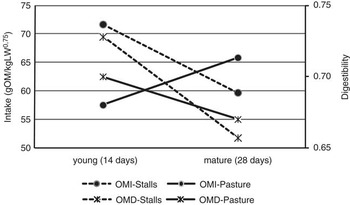
Stage of pasture regrowth has major effects on plant morphology and forage quality, with the progressive decrease in leaf-to-stem ratio and in digestibility (Minson, Reference Minson1990), which are accentuated in rapidly maturing C4 tropical grasses (Wilson et al., Reference Wilson, Deinum and Engels1991). In pen-fed animals given tropical grass forage harvested at 4 to 6 weeks regrowth, the increasing stage of regrowth was, as expected, usually associated with decreases in digestibility and voluntary intake (Minson, Reference Minson1990; Arthington and Brown, Reference Arthington and Brown2005). However, in grazing animals although there was a similar decrease in digestibility with stage of regrowth, there was an increase in voluntary intake in some studies (Gulsen et al., Reference Gulsen, Coskun, Umucalilar and Dural2004; Boval et al., Reference Boval, Archimede, Cruz and Duru2007a; Figure 1). The difference between pen-fed and grazing animals appears to be because the prehensibility of young tropical grass pasture by grazing animals is constrained by its low density, and this leads to low bite mass and thus low voluntary intake. The structure of the forage and its presentation to the grazing animal are clearly very different for the grazed sward and for harvested forage fed in pens.
Organic matter intake (OMI, g OM/kg LW0.75,  ) and digestibility (OMD, in proportion,
 ) measured with young or mature grass, either in stalls (dotted line, Archimede et al., Reference Archimede, Boval, Alexandre, Xande, Aumont and Poncet2000) or at pasture (solid line, Boval et al., 2007a).

These studies demonstrate the importance of sward structure for the evaluation of the nutritive value of tropical grasses when they are directly grazed, compared with when they are mown and offered in stalls.
Experimental information is still needed to understand the relationships between the various components of pasture and voluntary intake by various species of herbivores. Strategies based on manipulating stage of pasture regrowth have the advantage that only low-management inputs may be required, but the disadvantage that they are likely to be appropriate only in situations where grazing management can be closely controlled.
Modifying duration and frequency of grazing and grazing animal species
Grazing systems as used in practice often involve a variety of interrelated strategies. For example, rotational grazing systems, with intervals of grazing followed by removal of animals to allow rest of the pasture from grazing and plant regrowth, are often used and have profound effects on the quantity and quality of pasture grown and that available to the grazing animal (Humphreys, Reference Humphreys1991; Lemaire et al., Reference Lemaire, Da Silva, Agnusdei, Wade and Hodgson2009). In the extreme, this may involve ‘strip-grazing’ as used for dairy and intensive finishing systems or ‘cell-grazing’ where animals sequentially graze a large number (e.g. 10 to 40) paddock areas. The advantages and disadvantages of such systems, the input costs, and the consequences for the pasture, the grazing animal and its productivity, remain controversial despite considerable research and farmer experience (McCosker, Reference McCosker2000; Quirk, Reference Quirk2000). A variation is a ‘leader-and-follower’ system using pasture rotation but with separate herds; a herd of animals with higher nutritive requirements or where higher individual animal production is targeted, are preferentially allowed to graze the pastures of the highest nutritive value (Stobbs, Reference Stobbs1978).
Systems involving concurrent grazing of two or more animal species have been proposed to increase pasture utilization and control pasture weeds while reducing parasitism. Principles that various herbivore species selectively utilize different pasture components, and that parasites are often specific to the herbivore species, underpin this concept. Gains in production due to a greater utilization of the pasture have been demonstrated in temperate grazing systems (Hoste et al., Reference Hoste, Torres-Acosta, Paolini, Aguilar-Caballero, Etter, Lefrileux, Chartier and Broqua2005; Wright et al., Reference Wright, Jones, Davies, Davidson and Vale2006) and in tropical conditions (Mahieu and Aumont, Reference Mahieu and Aumont2009).
Crop residues and by-products
In crop-livestock systems, large amounts of cereal crop residues (e.g. straw, stubble) and other food crop by-products with little alternative value (oilseed meals, cereal grain offals, reject fruit and vegetables) are often available on a seasonal basis (Preston and Leng, Reference Preston and Leng1987; Devendra and Leng, Reference Devendra and Leng2011). Such crop residues are used extensively as feedstuffs for herbivores, usually in conjunction with forages from grasslands, and are especially useful to alleviate feed gaps in the seasonal pasture cycle. In the seasonally dry tropics their availability often coincides with the seasons of low nutritive quality, and availability of pastures, and they provide an important feed resource. There has been extensive research on the utilization of crop residues and by-products, particularly in the context of developing economies (Sundstol, Reference Sundstol1991; Ben Salem et al., Reference Ben Salem, Priolo and Morand-Fehr2008). A frequent constraint is that many crop residues are highly fibrous, are of low digestibility, contain low concentrations of N and minerals, and may contain anti-nutritional factors. Technologies have been developed and demonstrated (e.g. chemical treatment with urea or alkalis, fractionation to separate the more nutritionally useful components, heat treatment) to improve the nutritive value of crop residues but often considerable effort and input costs are required to upgrade a low-quality feedstuff to only a moderate-quality feedstuff (Doyle et al., Reference Doyle, Dixon and Egan1991).
Utilization of legumes and browses
As has long been recognized, the nutritive value of many groups of dicotyledonous plants tends to be higher than from graminaceous plants, and in particular legumes are usually higher in N and many other nutrients (Norton, Reference Norton1984; McIvor, Reference McIvor2007). There has been major effort to introduce and develop appropriate forage legumes for tropical pasture systems. For example, in northern Australia introduced Stylosanthes spp. and Leucaena spp. have had important impacts (Miller et al., Reference Miller, Rains, Shaw and Middleton1997; Jones et al., Reference Jones, McDonald, Clements and Bunch2000), although not without constraints (Jones, Reference Jones2003). Introduction of legumes into Africa appears to have been less successful (Sumberg, Reference Sumberg2002). Herbaceous non-leguminous dicotyledonous plants, and browses from shrubs and trees, also often provide valuable forage resources (Ben Salem et al., Reference Ben Salem, Priolo and Morand-Fehr2008), particularly in extensive rangeland systems (Norton et al., Reference Norton, Gutteridge, Johnson, Beale, Oldham and McNeill1996). The presence of anti-nutritional constituents often sets limitations (Ben Salem et al., Reference Ben Salem, Priolo and Morand-Fehr2008). Utilization of pasture legumes, other herbaceous dicotyledonous plants and browses often increases the amount, and even more importantly the nutritional quality, of forage available (Norton and Poppi, Reference Norton and Poppi1995; Coates and Dixon, Reference Coates and Dixon2007). This is particularly important to provide N and other essential nutrients in the diet, and to alleviate feed gaps when only low-quality senesced grasses are available.
Utilization of supplements
Supplementation has long been used to supply the animal with additional minerals, N and ME when these are deficient in the pasture for target levels of production (Prasad and Gowda, Reference Prasad and Gowda2005). It is useful to consider supplements in two broad categories considering the cost–benefit ratio.
First, a supplement may provide a nutrient which is deficient in the pasture diet and which constrains voluntary intake of pasture, and therefore ME intake. Examples are seasonal deficiencies of N, P, S, Cu and Na in cattle grazing tropical pastures (Winks, Reference Winks1990; McDowell, Reference McDowell1997; Dixon and Coates, Reference Dixon and Coates2010). Supplementation with the appropriate deficient nutrient (or nutrients) often leads to large increases in voluntary intake of pasture (e.g. by 30% to 50%) and thus of ME, and thus large and cost-effective increases in animal productivity.
A second category of supplements are those based on crop by-products such as protein meals, molasses or cereal grain offal. They have been investigated for grazing sheep and cattle in the tropical pasture systems such as of northern Australia to increase productivity and to meet market specifications (Preston and Leng, Reference Preston and Leng1987). A major constraint to the use of supplements based on cereal grain or their by-products in this context is that voluntary intake of pasture may be substantially reduced and the increase in ME intake due to the supplement may be quite small (Dixon and Stockdale, Reference Dixon and Stockdale1999). In general, the highest animal responses per kg supplement have been observed with protein meal (e.g. cottonseed meal, copra meal) for supplementation of low-quality forages (Leng, Reference Leng1990; Poppi and McLennan, Reference Poppi and McLennan1995; Dixon and Egan, Reference Dixon and Egan2000).
SR and/or herbage allowance (HA)
The important, and often dominant, effects of both SR and HA on grazing animal productivity are clear, and these will often interact with other management and strategic approaches such as those described above.
Individual LW gain per animal has been related to SR using linear or quadratic models (Garay et al., Reference Garay, Sollenberger, McDonald, Ruegsegger, Kalmbacher and Mislevy2004; Jones and LeFeuvre, Reference Jones and LeFeuvre2006). In general, as SR increases the individual animal performance decreases. However, animal production per hectare initially increases, then changes little across a range of moderate SR, and then decreases at high SR (Inyang et al., Reference Inyang, Vendramini, Sollenberger, Sellers, Adesogan, Paiva and Lunpha2010). The effects of SR on ingestive behaviour appear to be inconsistent (Deresz et al., Reference Deresz, Paim-Costa, Coser, Martins and de Abreu2006; Fukumoto et al., Reference Fukumoto, Damasceno, Deresz, Martins, Coser and dos Santos2010). The optimum SR for a particular forage-livestock system will be a compromise between production per individual animal and production per hectare (Inyang et al., Reference Inyang, Vendramini, Sollenberger, Sellers, Adesogan, Paiva and Lunpha2010). It will also depend upon the production goals over both the short and long terms, and will vary according to the amount and quality of herbage available through seasonal fluctuations as determined by, for example, rainfall and temperature (O'Reagain et al., Reference O'Reagain, Bushell, Holloway and Reid2009 and Reference O'Reagain, Bushell and Holmes2011).
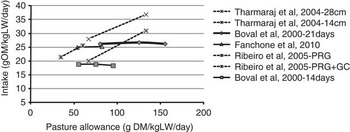
Forage allowance (i.e. the amount of forage available per animal) may often be a more useful tool than SR to predict animal performance (Sollenberger et al., Reference Sollenberger, Moore, Allen and Pedreira2005), even though it is more difficult to appraise. Some studies in both temperate and tropical pasture systems have observed asymptotical relationships between animal productivity, as LW gain or milk production (Stobbs, Reference Stobbs1977; Humphrey, Reference Humphreys1991), whereas others (Boval et al., Reference Boval, Cruz, Peyraud and Penning2000; Pinto et al., Reference Pinto, Carvalho, Frizzo, da Fontoura, Nabinger and Rocha2007; Fanchone et al., Reference Fanchone, Archimede, Baumont and Boval2010) have observed no such effect on intake or digestibility (Figure 2). A fundamental difficulty in interpreting these studies is that the herbage, expressed as DM/ha, varies with the structure and the nutritional value of the different components of the sward and is influenced by the grazing management, such as, for example, rotational or continuous grazing systems. Although the amount of pasture on offer is important, it is not necessarily the primary determinant of a voluntary intake; the characteristics and availability of the pasture sward are also important.
Evolution of intake (g/kg LW) with pasture allowance (kg DM/kg LW) measured in temperate or tropical grasslands. Measurements were made at various sward height (14 v. 28 cm), stages of regrowth (14 v. 21 days) or with perennial ryegrass swards (PRG) combined or not with white clover (GC).

Choice of management strategies for specific grazing situations
Despite extensive research on grassland management and animal production in a wide range of production systems, it is often difficult to quantify the effectiveness of specific strategies, and to choose the most appropriate strategy for a specific context. Difficulties are associated not only with the range of conditions of the various studies, but also with the wide range of criteria used to test various strategies. Criteria may be classified as measurements of the pasture or of animal production, and of ingestive behaviour, selection, intake and digestibility of forages. Clearly, criteria have to be evaluated with consideration of the available method of measurement. Relationships between measured variables and outcomes have often been assumed on the basis of established principles. However, many such assumptions may be challenged and some are likely to be incorrect; for example, increased digestibility of the diet is not always associated with increased ME intake and animal LW (Sollenberger and Vanzant, Reference Sollenberger and Vanzant2011).
Thus, it is necessary to improve quantitative understanding of the relationships among the measurements and criteria often reported, to achieve better understanding of the impacts of a specific strategy and to identify major sources of variation. This may reinforce the need for appropriate diagnostic tools. A consensus of terms would be helpful for description of grazing lands and animals (Allen et al., Reference Allen, Batello, Berretta, Hodgson, Kothmann, Li, McLvor, Milne, Morris, Peeters and Sanderson2011). Quantitative analyses of published data using approaches such as described by Sauvant et al. (Reference Sauvant, Schmidely, Daudin and St-Pierre2008) are needed for empirical modelling of biological responses. Information and models derived from large and comprehensive data sets have much greater likelihoods of yielding predictions which are relevant and robust to reach general conclusions. This would be helpful to develop and gain acceptance for new and innovative strategies based on quantitative knowledge and on understanding of established strategies.
Criteria and advances in technologies to evaluate and manage grasslands and grazing livestock
The consideration of appropriate criteria to assess a management strategy for a given production situation is essential, but is also crucial for ongoing adjustments for maximum effectiveness. For stable long-term production of livestock from grasslands it is obviously essential to maintain a balance between the utilization by herbivores and both the short-term and the long-term viability of the pasture (Sidahmed, Reference Sidahmed2008; Laca, Reference Laca2009). Production from grazing animals clearly depends on the provision of pasture through seasonal fluctuations within and between years, and the resilience of the pastures (Pautasso et al., Reference Pautasso, Dehnen-Schmutz, Holdenrieder, Pietravalle, Salama, Jeger, Lange and Hehl-Lange2010; Godfree et al., Reference Godfree, Lepschi, Reside, Bolger, Robertson, Marshall and Carnegie2011). The various strategies discussed above to increase animal production can, to varying degrees, improve the regrowth of pastures. However, due to heterogeneity of diet selection, pasture composition and plant growth in space and time (Laca, Reference Laca2009) specific criteria are necessary to manage a given strategy. An ideal approach would be to predict animal performance or nutrient supply directly from criteria of the pasture. Models have been developed for this purpose, for temperate pastures and some have been quite successful to predict animal production (Baumont et al., Reference Baumont, Cohen-Salmon, Prache and Sauvant2004; Delagarde et al., Reference Delagarde, Faverdin, Baratte and Peyraud2011). However, this has yet to be achieved for tropical pastures, apparently mainly due to the difficulty in estimating the diet selected; this is likely associated with an often greater heterogeneity of tropical pastures and a much higher degree of selection of diet components by grazing animals (Chilibroste et al., Reference Chilibroste, Gibb and Tamminga2005; Sollenberger and Vanzant, Reference Sollenberger and Vanzant2011). It follows that two main types of criteria are needed, those related to assessing the intake of ME, and those assessing the pasture.
Evaluation of pasture attributes
To plan the use of pastures and to define appropriate SRs and grazing pressures it is necessary to evaluate the quantity and quality of the forage available throughout seasonal variations. The parameters usually measured are the biomass, canopy height and the morphological and the chemical composition (e.g. N, fibre fractions) of the forage.
The most accurate method to estimate forage biomass is by cutting numerous quadrats of forage and drying, but this is time consuming. Alternatives such as the pasture capacitance meter and the pasture plate meter or rising plate meter (Gourley and McGowan, Reference Gourley and McGowan1991) have been developed, and in reasonably uniform stands of a single or two-species pastures these can be effective (Murphy et al., Reference Murphy, Silman and Barreto1995; Martin et al., Reference Martin, Astatkie, Cooper and Fredeen2005). However, in tropical pastures, herbage mass was often overestimated by the indirect methods and revalidation was frequently necessary (Braga et al., Reference Braga, Pedreira, Herling, Luz, Marchesin and Macedo2009; Lopez-Guerrero et al., Reference Lopez-Guerrero, Fontenot and Beatriz Garcia-Peniche2011). Advances in methodologies in this area include various laboratory-based approaches and spectroscopy.
Laboratory analysis of pasture samples has been facilitated by developments in near infrared spectroscopy (NIRS) to analyse a wide array of chemical, physical and morphological attributes of forages (Andres et al., Reference Andres, Murray, Calleja and Giraldez2005; Landau et al., Reference Landau, Glasser and Dvash2006). This includes capacity to measure morphological attributes such as the leaf-to-stem proportions, which are particularly important in tropical grass pastures, the proportions of major plant groupings (Garcia-Criado et al., Reference Garcia-Criado, Garcia-Cuidad and Perwz-Corona1991; Pilon et al., Reference Pilon, Klumpp, Carrere and Picon-Cochard2010), and to some extent of specific plant species (Coleman et al., Reference Coleman, Christiansen and Shenk1990; Atkinson et al., Reference Atkinson, Jervis and Trueman1996).
Improved spectrometers measuring in the visible and NIR ranges provide opportunities for improved measurement systems. Forage composition, attributes, biomass and plant species and cultivars can be measured using field-portable instruments at ground level or from planes or satellites (Milton et al., Reference Milton, Schaepman, Anderson, Kneubuhler and Fox2009). This has been applied to pastures and rangelands (Kumar et al., Reference Kumar, Schmidt, Dury and Skidmore2001; Schellberg et al., Reference Schellberg, Hill, Gerhards, Rothmund and Braun2008). For example, in temperate Australia 50% to 70% of the variance in growth rate of annual pastures could be predicted from satellite imagery (Hill et al., Reference Hill, Donald, Hyder and Smith2004; Donald et al., Reference Donald, Gherardi, Edirsinghe, Gittins, Henry and Mata2010) and accumulated pasture growth usefully estimated from sequential measurements. Such satellite-based spectral information appears most useful to estimate plant community distribution and pasture cover in extensive rangelands (Booth and Tueller, Reference Booth and Tueller2003; Karfs et al., Reference Karfs, Abbott, Scarth and Wallace2009). Ground-based instruments have been used with moderate success to measure composition of swards of tropical grasses (Richardson et al., Reference Richardson, Everitt and Gausman1983; Starks et al., Reference Starks, Coleman and Phillips2004), but application to botanically complex and variable pastures appears more difficult (Mutanga et al., Reference Mutanga, Skidmore and Prins2004; Tarr et al., Reference Tarr, Moore and Dixon2005).
Evaluation of the utilization of pastures by animals
Because of the complexity of the processes of diet selection by grazing animals, it is generally very difficult to estimate the diet ingested and nutrient intake, even when measurements are available of the herbage mass and its structural characteristics. The generally high heterogeneity of tropical pastures accentuates the difficulties.
The LW change of animals is a useful criterion of nutrient supply and with knowledge of the class of animal can be used to estimate the intake of DM and ME from pasture. Also, it is often used as a measure of magnitude and efficiency of production, and for economic evaluations of production systems. However, for measurements of LW change to be reliable they must be measured in the longer term (e.g. over intervals of at least a month), and with standardization of the weighing procedures to reduce errors associated with variations in digesta load. Substantial error may occur even when the measurement procedure is carefully standardized due to changes in digesta load of ruminants associated with diet and thermal environment (McLean et al., Reference McLean, McCown, Little, Winter and Dance1983; Schlecht et al., Reference Schlecht, Sangare and Becker2003). Thus, regular measurement of LW change is not a very practical approach to adjust management of grassland according to a timescale consistent with the forage production.
The voluntary intake of DM, or preferably intake of digestible nutrients, is an excellent indicator of the performance of grazing animals. In forage diets with usually low lipid concentrations the concentration and intake of ME can be calculated from digestible DM intake with only minor error. Thus, intake of DM and digestible nutrients are the most reliable measurements to predict animal production potential (Lippke, Reference Lippke2002; Coleman, Reference Coleman2006). The time step for the daily digestible intake is similar to the time step for regrowth of the grass and the knowledge of daily digestible intake is central to understanding of the relationships between the grass and animals.
Digestibility is more commonly used than intake as an indicator of the nutritional value of pastures. Many methods are available but that most widely used is in vitro digestibility (Kitessa et al., Reference Kitessa, Flinn and Irish1999) even though values often have to be adjusted to estimate in vivo digestibility. Also, although in tropical pastures some studies (Minson, Reference Minson1990; Archimede et al., Reference Archimede, Boval, Alexandre, Xande, Aumont and Poncet2000) have reported good relationships, in many others there was often a poor relationship between digestibility and voluntary intake or LW gain (VanSoest, Reference VanSoest1996; Boval et al., Reference Boval, Fanchone, Archimède and Gibb2007b).
Knowledge of feeding behaviour also can be useful to understand herbage–animal relationships (Burns and Sollenberger, Reference Burns and Sollenberger2002; Chilibroste et al., Reference Chilibroste, Soca, Mattiauda, Bentancur and Robinson2007). Bite mass has been shown to be the variable generally most sensitive to changes of sward structure (Benvenutti et al., Reference Benvenutti, Gordon, Poppi, Crowther, Spinks and Moreno2009; Hirata et al., Reference Hirata, Yamamoto and Tobisa2010; Kondo, Reference Kondo2011). However, few studies have been reported relationships between measurements of feeding behaviour and intake (Boval et al., Reference Boval, Fanchone, Archimède and Gibb2007b) or LW gain. It appears unlikely that measurement of specific behavioural variables in the short term will estimate daily intake as these variables vary during the day (Gibb et al., Reference Gibb, Huckle, Nuthall and Rook1999) apart from the difficulty that they are often measured in fasted animals. Although measurements of feeding behaviour are important in understanding the mechanisms of ingestive behaviour it appears that they have limited utility to manage grasslands. Intake of digestible nutrients remains the most appropriate criteria to assess management strategies despite the difficulties in measurement. It is perhaps this methodological limit which explains why so many different criteria have been investigated as alternatives in grazing studies. As discussed above, various criteria may be useful but only if they are related to a criterion such as average daily gain or ME intake. However, recent methodological developments are likely to contribute to easier and accurate estimation of key criteria such as the intake of ME. These approaches are mainly based on faeces which have the advantage of clearly representing the diet selected (Putman, Reference Putman1984; Hobbs, Reference Hobbs1987).
Plant wax constituents as diet markers
There has been substantial development of plant wax components as markers to measure forage intake, diet composition and digestibility (Mayes and Dove, Reference Mayes and Dove2000; Dove, Reference Dove2010). These plant wax constituents vary greatly among plant species or plant morphological components, and are largely excreted in faeces. The long-chain alcohols and fatty acids (Ali, Reference Ali2004) have comparable variation and characteristics and should allow discrimination of a greater number of species in the diet including of plant species or components containing low concentrations of alkanes. Numerous studies have examined constraints and potential errors associated with use of these plant waxes, particularly n-alkanes, as markers (e.g. sampling of herbage, diurnal variation, faecal recovery of individual constituents, animal species) and there is consensus that in temperate pasture systems reliable results can be obtained (Dove and Mayes, Reference Dove and Mayes2005; Oliván et al., Reference Oliván, Ferreira, Celaya and Osoro2007).
Knowledge of the use and constraints of the plant waxes as markers in tropical pasture systems is limited. The concentrations of a variety of n-alkanes are sufficient, and vary sufficiently, in many tropical grasses for alkane marker procedures to be applied (Smith et al., Reference Smith, Mayes and Raats2001). Validation studies with cattle fed tropical grass forages reported that voluntary intake and diet digestibility could be satisfactorily measured with alkane markers (Molina et al., Reference Molina, Matamoros, Almeida, Tedeschi and Pell2004; Morais et al., Reference Morais, Berchielli, de Vega, Queiroz, Keli, Reis, Bertipaglia and Souza2011). However, in some tropical grasses the concentrations of important alkanes may decrease markedly with increasing age of leaves (Laredo et al., Reference Laredo, Simpson, Minson and Orpin1991); this is of concern as the method depends on estimation of alkane concentration in the leaf ingested. A further difficulty is that some tropical forages and edible browses contain very low concentrations of alkanes (Laredo et al., Reference Laredo, Simpson, Minson and Orpin1991; Ali et al., Reference Ali, Mayes, Hector, Verma and Orskov2005) so that the presence of these plant species in the diet could not be measured from faecal alkane concentrations. Even if these constraints associated with the markers can be overcome, a further consideration is that tropical native pasture grassland systems often contain a very large and diverse range of edible plant species.
NIRS of faeces
NIRS of faeces can be used to estimate many constituents of the diet, and also digestibility and voluntary intake of domestic and wild herbivores (Boval et al., Reference Boval, Coates, Lecomte, Decruyenaere and Archimede2004; Landau et al., Reference Landau, Glasser and Dvash2006; Decruyenaere et al., Reference Decruyenaere, Lecomte, Demarquilly, Auffere, Dardenne, Stilmant and Buldgen2009). Diet constituents measured include the concentrations of N, fibre fractions, tannins, lignin and the proportions of monocotyledonous to dicotyledonous plants (Lyons and Stuth, Reference Lyons and Stuth1992; Landau et al., Reference Landau, Glasser and Dvash2006; Dixon and Coates, Reference Dixon and Coates2009). The precision in measurement of diet digestibility is generally high with a standard error of generally less than 2.5 percentage units (Dixon and Coates, Reference Dixon and Coates2009). Voluntary intake has been predicted with a precision of less than 6 g/kg metabolic weight with tropical forage system (Boval et al., Reference Boval, Coates, Lecomte, Decruyenaere and Archimede2004), although differences in physiological status of animals may introduce error (Dixon and Coates, Reference Dixon and Coates2009). Considering the difficulties with alternative approaches to estimate voluntary intake, such estimation may be useful for the management of grazing systems.
The measurement of diet characteristics from faecal NIR spectra depends, as with most applications of NIR for forage and feedstuffs analysis, on the development of calibration equations from spectral databases of known samples. Such databases have allowed the development of calibrations for regions such as tropical grasslands (Boval et al., Reference Boval, Coates, Lecomte, Decruyenaere and Archimede2004; Fanchone et al., Reference Fanchone, Boval, Lecomte and Archimède2007 and Reference Fanchone, Archimede and Boval2008; Tran et al., Reference Tran, Salgado and Lecomte2009) including in northern Australia (Dixon et al., Reference Dixon, Playford and Coates2011). Knowledge from the application of NIR to measurement of forage indicates that the accuracy and robustness of prediction of diet from NIR spectra of faeces may be improved by use of calibrations for specific circumstances, or amalgamation of information into large databases and use of local calibrations (Tran et al., Reference Tran, Salgado and Lecomte2009). More comprehensive data sets and development of local calibrations may be able to substantially improve the reliability and precision of estimation of diet from NIR spectra of faeces.
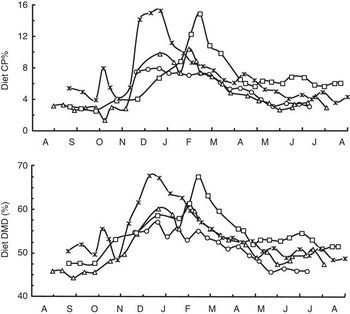
NIRS of faeces allows rapid, low-cost and frequent estimations of the diet selected by grazing ruminants through seasons and years such as shown in Figure 3. This allows application of quantitative nutritional management to achieve target production outcomes (Coates and Dixon, Reference Coates and Dixon2008; Dixon, Reference Dixon2008; Lyons, Reference Lyons2010). Faecal NIR has been combined with field measurements of microbial protein synthesis, animal LW and reproduction to provide comprehensive information on the nutrient intake and responses of the grazing cattle (Dixon et al., Reference Dixon, Playford and Coates2011). It has also been used to assess milk production of small ruminants at pasture (Boval et al., Reference Boval, Ortega-Jimenez, Fanchone and Alexandre2010).
Dietary CP(%) and dietary dry matter digestibility (DMD; %) measured from NIR spectra of faeces sampled at fortnightly intervals through four annual cycles in reproducing Bos indicus × Bos taurus cows grazing a 200 ha paddock of speargrass native pasture in a seasonally dry tropical environment at Millaroo, Queensland in northern Australia. Measurements were made in groups of cattle (n = 24 to 47), which were replaced each year; the variation in diet CP and digestibility between groups was due to seasonal variation between years at the site. ○ = Group 1; Δ = Group 2; □ = Group 3; x = Group 4 (after Dixon et al., Reference Dixon, Smith and Coates2007).

Other measurement technologies
Other technologies developed in recent years have been demonstrated, or are likely, to have potential to improve knowledge, understanding and management of grazing animals in tropical grasslands and provide opportunities for improved production. Extensive experimentation has established the validity of the use of excretion of purine derivatives in urine as a measurement of microbial protein synthesis. In grazing ruminants this requires estimation of urinary excretion, and this has usually depended on use of creatinine as a marker; this may introduce error. Development of more satisfactory urinary markers (Mayes et al., Reference Mayes, Dove, Chen and Guada1995) would be very valuable. Nevertheless, these techniques have been applied to grazing cattle to measure microbial protein synthesis in grazing cattle (Dixon et al., Reference Dixon, Playford and Coates2011). Limited information suggests that laser-induced fluorescence spectroscopy of faeces is likely to be a valuable technique to identify the plant species and plant species groups in the diet of grazing ruminants from measurements of faeces (Anderson et al., Reference Anderson, Frederickson, Nachman, Estell, Havstad and Murray1998; Obeidat et al., Reference Obeidat, Glasser, Landau, Anderson and Rayson2007). Plant DNA in faeces has been examined to identify the plant species present in the diet of herbivores (Ho et al., Reference Ho, Krebs, McCafferty, van Wyngaarden and Addison2010). However, much more research is needed to evaluate and develop both of these techniques before they can be applied routinely to grazing livestock.
The development of global position systems technology with units which can be readily attached to a collar on a grazing animal has greatly increased knowledge from research on how grazing animals utilize and graze vegetation in extensive landscapes and how this might be manipulated (Tomkins and O'Reagain, Reference Tomkins and O'Reagain2007; Trotter et al., Reference Trotter, Lamb, Hinch and Guppy2010; Swain et al., Reference Swain, Friend, Bishop-Hurley, Handcock and Wark2011). It also has potential for improved control of grazing in landscapes such as with ‘virtual fencing’ (Swain et al., Reference Swain, Friend, Bishop-Hurley, Handcock and Wark2011). An active field of investigation is using animal behaviour and training of animals to achieve improved management of the grazing system (Goetsch et al., Reference Goetsch, Gipson, Askar and Puchala2010). Individual animal identification using electronic tags, as has become mandatory in countries such as Australia for animal health traceback, also provides an opportunity for individual animal management for increased production efficiency.
Conclusions
Pasture management is a major issue, particularly in tropical pasture systems which are of immense global importance. There is a compelling need to improve nutritional management for increased production of grazing livestock, especially in areas where demand for animal products is highest and where there are major consequences for regional economies and livelihoods of the poor in developing countries. In addition, grassland management has important impacts on biodiversity and mitigation of global GHG emissions. The implementation of effective and appropriate management tools is therefore needed to fulfil these various functions.
A great variety of knowledge has been developed. Although such information indicates how grassland management may be improved and be more efficient in many situations, it is still often difficult to provide rules and strategies for specific circumstances. The results of studies have often been inconsistent and sometimes contradictory due at least in part to consequences of local conditions, high spatial and vertical heterogeneity and limited understanding of dietary selection by grazing animals. The development of knowledge has also been limited because of the diversity of criteria used to evaluate strategies, and by dependence on criteria which are not always clearly linked to animal products or other outcomes. There is an awareness of the importance of grasslands, including tropical grasslands, and it should be possible to develop and implement better management for sustainable systems.
First, it is suggested that it is necessary to prioritize the objectives of grassland management for specific regions based on production goals and agro-ecological contexts. It is important to focus on achieving the primary management objectives while minimizing negative impacts on other outcomes. It is also necessary to develop multidisciplinary approaches and studies which should assist focus on the most relevant criteria and interactions.
Second, it is necessary to make better use of existing knowledge, including from temperate grasslands, through bibliographic databases for exchange among researchers. The establishment of such databases with the implementation of a quantitative analytical approach should lead to better overall understanding and a better prediction of biological processes. This requires the search for greater coherence among the criteria used in past studies, and further studies should attempt to improve the links among various criteria. Such a quantitative approach can improve progress in grassland management and avoid replication of effort.
Third, it is necessary to develop methodological studies that facilitate the measurement of relevant criteria and provide tangible information for animal production. This will facilitate multidisciplinary studies, the emergence of the most informative and multiple criteria possible, and the dissemination of the most relevant and measurable of them, for livestock managers to improve and adjust strategies. Clearly those directly responsible for the management of grasslands and the implementation of change are livestock owners and pastoralists who will in large part determine the success of sustainable management of these regions of immense importance.