Introduction
The UK sees itself as a ‘world leader’ (DWP, 2004a) in the development and delivery of policies to promote the employability of unemployed and inactive people. The National Reform Programme for employment (HM Treasury, 2005) and recent policy documents outlining the ‘next steps' in the government's welfare reform agenda (DWP, 2004b, 2005, 2006) confirm the UK's self-perceived position as a leader in the development of innovative, supply-side labour market strategies.
Critics of the UK employability model have argued that its main aim is to ‘encourage’ the unemployed and inactive to enter the labour market as quickly as possible, potentially by accepting low-paid or inappropriate jobs (Dean, Reference Dean2003). The government has accepted that its policies can be characterised as promoting Work First (HM Treasury, 2005), reflecting a belief that there are important benefits associated with encouraging jobseekers to make a prompt return to employment. However, it has also been argued that the government's employability agenda forms the basis of a new type of ‘ethical employment policy’ (White, Reference White2000) informed by a ‘client-centred approach’ (Lindsay and Mailand, Reference Lindsay and Mailand2004), which distinguishes it from the more workfarist policies pursued, for example, in the US. The suggestion is that programmes such as the New Deal, to some extent, reflect a commitment to an HCD approach, which reiterates the responsibilities of the unemployed to take action to move towards work, but also provides a range of ‘holistic’ measures to improve skills and address individuals' barriers to work (Lødemel and Trickey, Reference Lødemel and Trickey2001). Recent developments in employability policy – in particular the piloting of the community-level ‘Working Neighbourhoods' (WN), and the introduction of ‘Pathways to Work’ (PtW) linking employability and health – may also reflect an understanding within government that standard employability measures have reached their logical conclusion, under current relatively buoyant labour market conditions, and that more holistic HCD-oriented approaches are required. However, we will argue below that the evidence suggests that there remains a reluctance to provide for the resources and flexibility required by such approaches.
To what extent can the UK's policies to promote employability be characterised in terms of paradigmatic models of HCD and Work First? Are HCD and Work First approaches to employability policy compatible? What are the implications for the quality and impact of labour market interventions? The article considers these issues, first through a brief review of the content and performance of the New Deal (the UK's primary employability programme); then, crucially, by discussing the results of case-study research on two new, recently piloted initiatives: Working Neighbourhoods and Pathways to Work. Following this introduction, we first define Work First and HCD approaches to employability, and discuss the compatibility of these concepts and their value in analysing labour market policy. We then briefly describe recent developments and the current UK policy context in the field of employability, including an analysis of the main elements of the New Deal. In the penultimate section of the article, we present the results of case-study research on Working Neighbourhoods and Pathways to Work, and discuss whether these programmes mark a shift towards HCD-oriented approaches in the UK. Finally, drawing on the preceding analysis, we conclude with a discussion of the extent to which the UK model of employability is able to balance Work First and HCD approaches, and review implications for future policy.
Work First and HCD approaches to employability
The UK government has described its labour market policy as a ‘Work First approach to moving people from welfare into work’ (DWP, 2003: 3). The precise definition of Work First remains unclear from policy documents, but there is an emphasis on jobseekers, wherever possible, moving quickly towards work, reflecting the idea that the best way to succeed in the labour market is to join it. From the government's perspective, this emphasis is supported by research suggesting that, for some jobseekers, ‘Work First over training first’ has produced better labour market outcomes (Layard, Reference Layard2004). It is an approach that argues that ‘any job is better than no job’ (Layard, Reference Layard2003: 5) in terms of social and economic benefits for unemployed people, but is less concerned with the quality of the initial job outcomes produced by employability policies.
International reviews of Work First approaches have noted that these programmes vary widely in their detailed aims, the services they offer, and their use of compulsion. What is common is that Work First is concerned with moving people from welfare to work as quickly as possible, and that job search itself is a key activity (but not the only activity) in these programmes (Bruttel and Sol, Reference Bruttel and Sol2006). Reflecting on the New Deal's application of these principles, Bellamy and Rake criticise Work First as militating against personal development by introducing ‘programmes [that] have targeted participation in employment above and beyond access to quality employment . . . The assumption by government is that training will follow with employment, but this is not necessarily true of all jobs' (Reference Bellamy and Rake2005: 27). The European Foundation, reviewing the US policy context, argues that ‘a Work First approach means that workers are allowed to access intensive services such as training only after they prove they cannot find a job without additional skills' (2004: 9). Handler similarly characterises the US approach as ‘a “work first” strategy, which encourages recipients to take any job, even a low-wage entry-level job, rather than offering . . . education and training’ (Reference Handler, Henman and Fenger2006: 119–120).
However, it is Sol and Hoogtanders' discussion of the Netherlands' labour market policy that perhaps provides the clearest working definition of Work First:
Work First programmes seek to move people out of welfare and into unsubsidised jobs as quickly as possible, and job search itself is a central activity in these programmes . . . For those who fail to get a job straight away, Work First provides additional activities directed at addressing those factors impeding employment. These activities might include education, training and work experience. In the context of Work First, they generally are short-term, closely monitored and either combined with or immediately followed by additional job search. The aim is not to establish a long-term career goal but to reinforce the belief that any job is a first career step, no matter how precarious this employment might be. In addition, Work First uses sanctions as a main component in its approach, rather than trust. (Sol and Hoogtanders, Reference Sol, Hoogtanders, Sol and Westerveld2005: 147)
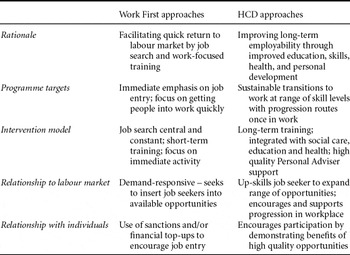
Sol and Hoogtanders (Reference Sol, Hoogtanders, Sol and Westerveld2005), and others, distinguish between Work First and HCD approaches. They argue that HCD approaches are distinguished by the rationale that jobseekers will often require substantial support (potentially over a prolonged period) in order to improve their long-term employability (with the implication that this will require substantial investments in the education, skills and health of individuals). The aim is to facilitate the development of skills and attributes that will equip people to find and retain suitable jobs, and advance through in-work progression routes (Peck and Theodore, Reference Peck and Theodore2001). Its targets are less concerned with ‘quick wins' (that is, immediate placement of clients into any type of job) and more focused on sustainable transitions to work and progression through education, training or work experience. Its intervention model requires that standard employability services (and, if necessary, long-term education and training) are integrated with a range of other holistic services addressing the full range of barriers to work faced by jobseekers (Bruttel and Sol, Reference Bruttel and Sol2006). This in turn requires professionals, such as ‘personal advisers’ (PAs) or case managers, capable of working with clients in a holistic way to improve their employability (Lødemel and Trickey, Reference Lødemel and Trickey2001). In connecting with both the individual and the labour market, HCD approaches focus on high-quality, sustainable outcomes, prioritising measures to promote continuous skills development and in-work progression. Drawing together these themes, Table 1 presents key features of Work First and HCD approaches to promoting employability.
Characteristics of Human Capital Development (HCD) and Work First approaches to employability

Sources: adapted from Peck and Theodore (Reference Peck and Theodore2001); Lødemel and Trickey (Reference Lødemel and Trickey2001); Bruttel and Sol (Reference Bruttel and Sol2006).
The UK approach to employability: Work First, HCD or both?
The election of a new Labour government in May 1997 marked a significant change in the direction of UK employability policy. A substantial investment in the New Deal programmes and the amalgamation of social security and public employment service (Jobcentre Plus) facilities into a single ‘work-focused’ agency has transformed the policy landscape. The UK approach to employability has, since 1997, relied upon a combination of three key elements (DWP, 2005, 2006): the enforcement of existing job-seeking requirements under the main benefit for unemployed people – the Jobseekers' Allowance (JSA) – as part of the pre-existing ‘stricter benefits regime’; a range of employability programmes, mainly under the ‘New Deal’ banner; and a series of tax-benefit measures designed to ‘make work pay’.
There are important Work First elements in the UK model. The focus is on directing clients towards unsubsidised work, with ‘quick wins’ rewarded through output-oriented funding for delivery agencies. In terms of the New Deal, dedicated job-search sessions remain a constant element throughout the training process, which increasingly consists of flexible, short-term interventions. The establishment of Jobcentre Plus's ‘work-focused gateway’ and the extensive use of compulsory work-focused interviews have also produced a benefits system that generally ‘manages claimers more actively’ (Taylor-Gooby et al., Reference Taylor-Gooby, Larsen and Kananen2004: 581).
However, with labour demand and employment rates generally buoyant in recent years in the UK, those who are near job-ready (and are most likely to be assisted by Work First strategies) have tended to represent a relatively smaller proportion of the total unemployed population, while an increasing proportion of those without work are multiply disadvantaged (and therefore require more personalised, intensive support). There is evidence that the New Deal has seen some improvement in PA services for clients (see below), but the most disadvantaged are likely to require more intensive support of a type that, even with the increasing flexibility introduced by successive reforms, the New Deal is generally able to provide. Relatively short-term employability programmes cannot be expected to assist people facing severe health, personal or social problems that require interventions that are personalised, intensive, flexible and (if necessary) long-term (Dean, Reference Dean2003). Nor is the situation of the most vulnerable assisted by ‘the corrosive effects of an ideological ethos that encourages people with multiple needs and problems to blame themselves for their failure in the labour market’ (Dean et al., Reference Dean, MacNeill and Melrose2003: 24).
Furthermore, while initial job entry figures were encouraging, it is clear that the New Deals face an increasing problem of ‘revolving-door’ participation, where clients move from training programmes into short-term employment, and then back into unemployment, eventually repeating their participation in training. Approximately 20 per cent of those currently participating in the flagship New Deal for Young People are attending the programme for at least the second time; two-fifths of those claiming Jobseeker's Allowance are experiencing their second spell of unemployment in a six-month period (ONS, 2006). Sunley et al. (Reference Sunley, Martin and Nativel2006) have also shown that the impact of policies such as the New Deal (in all its forms) has varied across regions of the UK. In areas where massive job losses followed from the decline of traditional industries in the 1980s and 1990s, the New Deal's performance has been least effective; clearly, local labour demand must be considered when assessing the appropriateness of employability policies.
Yet some characteristics of more HCD-oriented approaches are also in place in the UK. Bruttel and Sol (Reference Bruttel and Sol2006) suggest that HCD models require a strong PA approach, to ensure individualised advice and support. In the areas and among the client groups where the New Deal has been most effective, this PA role has emerged as the ‘linchpin of success’ (Walker and Wiseman, Reference Walker and Wiseman2003). Qualitative evaluation evidence has suggested that the emphasis within New Deal on building relationships between clients and PAs has been welcomed by both groups (Millar, Reference Millar2000). While clients' experiences have been diverse, many have noted a genuine shift in the way that Jobcentre Plus delivers services, with provision under the New Deal for Young People apparently of a particularly high standard: ‘the client-centred experience of the New Deal for Young People seems to be far more positive than the monolithic instrument of social control suggested by some critics' (Finn, Reference Finn2003: 721).
Nevertheless, Lødemel and Trickey (Reference Lødemel and Trickey2001) may be premature in arguing that the UK has converged with a European mainstream characterised by a shared human capital approach. As noted above, the New Deal has not been sufficiently HCD-oriented to respond to the needs of many disadvantaged individuals and areas. As more employable jobseekers have been ‘creamed’ from the unemployment register, the most disadvantaged have been left to repeat participation in employability programmes. Even in local economies where there is high demand, there remain pockets of unemployment and inactivity, reflecting both the complexity of jobseekers' barriers to work and the characteristics of low-paid, entry-level jobs. Meanwhile, weak labour demand and the linked problem of ‘unemployment hidden as sickness’ (where many redundant manual workers have been directed towards incapacity benefits and so off the unemployment roll) have not been addressed by the New Deal's standardised, supply-side approach.
Indeed, a realisation that the New Deal model has reached its logical conclusion may have informed recent experiments testing area-specific employability programmes such as Working Neighbourhoods, and the piloting and rapid expansion of Pathways to Work. Certainly, neighbourhood-level initiatives and holistic measures to activate claimants of incapacity benefits are at the centre of what the government describes as ‘the next stage of welfare reform’ (DWP, 2006). However, previous successful pilots such as Employment Zones have seen their most progressive, HCD-oriented elements watered down once a permanent model of provision has been established (Bruttel, Reference Bruttel2005). The question remains as to whether these new approaches have seen a real shift towards more holistic, HCD approaches to employability.
Case studies: new approaches to employability
Context and methodology
UK policy makers have recently piloted a range of new approaches to employability in an attempt to address weaknesses in the performance of standard labour market programmes. New initiatives have sought to address issues ranging from the need to promote retention and advancement for those entering low-paid work to ‘activating’ the unemployed partners of New Deal clients (DWP, 2005, 2006). However, a review of recent strategy documents suggests that two particularly important themes for reform focus on: the development of ‘tailored policies to meet individual needs’ among people of working age claiming incapacity benefits (HM Treasury, 2006: 39); and ‘ensuring that efforts are more effectively targeted at areas of greatest deprivation’ (HM Treasury, 2005: 46).
The introduction of a new Employment and Support Allowance in 2008 will impose more rigorous work tests, restricting access to incapacity benefits to those with severe health problems: an approach that builds upon recently introduced Personal Capability Assessments and work-focused interviews (DWP, 2006). The government claims that this will be balanced by a ‘holistic approach’ (HM Treasury, 2005) providing intensive support for those with mild–moderate health problems. Emerging evidence from the piloting of such intensive services is therefore of considerable interest. Since 2003, Pathways to Work (PtW) has established partnerships between Jobcentre Plus, the National Health Service (NHS) and other health providers in order to take forward this agenda: the initiative's operation in one pilot area provided a focus for one of our case studies.
Successive government strategies have highlighted the importance of measures to combat area-based disadvantage. An emerging Cities Strategy will result in the allocation of additional resources to local authority ward-level areas, with Jobcentre Plus leading the establishment of multi-agency ‘City Consortia’ with a remit to ‘pool resources and expertise in order to tackle unemployment’ in these disadvantaged micro-areas (HM Treasury, 2006: 46). The government has explicitly acknowledged that these neighbourhood-level initiatives will build on lessons from predecessors such as the Working Neighbourhoods (WN) pilot (HM Treasury, 2005). During 2004–06, WN tested new neighbourhood-level approaches in areas characterised by concentrations of long-term worklessness: the initiative's operation in one pilot area provides a focus for the second of our case studies.
By presenting case studies across these pilot programmes and areas, we are able to report on innovative initiatives (involving new forms of inter-agency cooperation) that target different, complex client groups; operate in inner-city and peri-urban environments; and involve leadership from public and private sector bodies. In the case of PtW, the research focused on the piloting of the programme in a mainly peri-urban/urban Jobcentre Plus district in central Scotland. The research involved a review of policy and evaluation documents and six in-depth interviews with: senior regional innovation managers leading Jobcentre Plus's involvement in the development of PtW in the pilot area (two interviews); a regional Jobcentre Plus operations manager involved in planning its delivery; a regional project director who led NHS involvement in PtW; a mental health project manager involved in delivering (and managing other NHS staff involved in the delivery of) PtW; and a senior NHS rehabilitation coordinator involved in the delivery of services. Interviews were undertaken during two case-study visits, first to the relevant Jobcentre Plus office, and then to a health centre providing the base for NHS services delivered under PtW.
In the case of WN, a review of policy and evaluation documents was supplemented by case-study research in one of the pilot areas, located in a major English city, where the delivery of the programme was led by a subsidiary of a large private sector employment and training agency. In addition to a review of local strategy and management documents and outcome data, the case-study research involved four in-depth interviews with: the CEO and a senior company manager within the WN Lead Partner; the Lead Partner's national director for welfare-to-work services (who was previously closely involved in the development of services in the case-study area); and the local project manager leading the delivery of the WN pilot. Interviews were undertaken during two case-study visits, first to the Lead Partner's main regional service centre, and then to the ‘Local Advancement Centre’ facility that provided the base for WN services in the pilot area.
Pathways to Work
Pathways to Work was piloted in seven delivery areas from 2003, and rolled out to a further fifteen areas across the UK in 2005–06. Target areas were selected on the basis of their relatively high numbers of claimants on long-term incapacity benefits (Incapacity Benefit and its means-tested social assistance equivalent, Income Support). The government has described PtW as offering ‘a new intervention regime to activate people's aspirations to return to work’ (DWP, 2004a: 16): the first step in a process of activating the incapacity benefits regime in order to ‘focus on what people are capable of doing’. All new claimants of incapacity benefits (and in some areas those who started claiming during the two years preceding the introduction of the programme) are eligible. The programme rolls out to more than 30 districts across the UK from 2007–08. The content of PtW includes:
• a compulsory assessment interview, followed by five compulsory work-focused interviews with Jobcentre Plus PAs;1
• voluntary access to short ‘Choices’ training options (for example, ‘work preparation programmes’ that provide basic employability skills and preparation for the workplace, delivered in partnership with training providers and employers);
• a one-year ‘Return to Work Credit’ paid at £40 per week tax free for full-time work;
• access to a PA Discretionary Fund;
• a Condition Management Programme (CMP): a six to thirteen week voluntary intervention designed to enable clients to cope with the main ‘moderate medical conditions’ experienced by Incapacity Benefit claimants (mental health, cardio-respiratory, and musculo-skeletal conditions). The CMP is not designed to replace standard health care interventions; rather it uses ‘cognitive behaviour therapy’ and related techniques to challenge negative attitudes and help clients to learn to cope with conditions in such a way that they may return to some form of employment. In the study area – and in many other pilot areas – CMP services are entirely delivered by NHS Allied Health Professionals (AHPs), such as occupational therapists and physiotherapists, or by mental health nurses, who are highly trained in CMP.
The rationale informing PtW can, to some extent, be seen as reflecting Work First thinking. Throughout, NHS and other delivery partners have been reminded that progressing clients towards work, rather than treating their medical problems per se, is the objective of the programme. NHS professionals acknowledged that the ‘classic, medical model’ of diagnosis and treatment has been replaced (for the purposes of this programme) by a more proactive approach that concentrates on what the individual is capable of achieving. A senior health practitioner emphasised how AHPs have been challenged to modify standard practice, to ‘de-medicalise’ their interactions with clients.
We tend not to meet people in medical centres or health centres if possible. We are trying to de-medicalise the process as much as we can. We will meet in the Jobcentre, our own office, a community centre, or occasionally their own homes. (Mental Health Project Manager, NHS)
While clearly quantified job entries are not part of the programme targets regime for the CMP, Jobcentre Plus staff managing the overall PtW initiative are required to promote sustained employment as the ultimate objective for all participants. It was acknowledged that some health professionals have been concerned by the different objectives associated with a programme that focuses on helping people cope with ill health in a work setting, rather than eradicating the health problem first. While occupational therapists – who make up the majority of CMP staff in the study area – have been understandably more comfortable with this work-focused model, some other AHP professional groups initially voiced concerns about the potential danger of pushing clients towards work ‘too soon’. NHS professionals interviewed for the research suggested that these concerns have been allayed, to some extent, by the absence of compulsion in the CMP, and by the quality of provision that CMP teams have been able to develop. Research with CMP practitioners involved in other PtW pilots has produced similar findings (Barnes and Hudson, Reference Barnes and Hudson2006).
There are also some Work First elements in the PtW intervention model. The work preparation programmes that form an important element of the PtW Choices training provision offer a familiar combination of short-term employability-raising measures, which, in many cases, will have a limited impact on clients’ longer-term skills development. As with many other UK labour market programmes, the focus is on inserting the jobseeker into available (often entry-level) opportunities, and there was some acknowledgement among Jobcentre Plus stakeholders that closer partnership working with employers may be required if harder-to-reach clients are to be supported while in work (not currently a major focus for the programme). In this sense, the relationship to the labour market articulated through the programme is, so far, demand-responsive; PtW seeks to insert clients into existing positions rather than supporting the individual in the workplace, challenging employers’ perceptions of such clients or delivering opportunities for career progression.
PtW also maintains a link to the ethos of Work First through a relationship with individuals characterised by a combination of compulsion and financial incentives. Mandatory work-focused interviews remain a central element of PtW. Furthermore, a compulsory Personal Capability Assessment (a medical examination) must be completed with PtW clients within twelve weeks of a benefit claim. By deploying a series of quantitatively assessed health checks, the Personal Capability Assessment provides a ‘score’ reflecting clients’ work fitness: those assessed as capable of work will see their benefit claim terminated. National evaluations of PtW have noted that improvements in clients’ health have in some cases been identified during delayed Personal Capability Assessments, and used as a basis to terminate benefit claims: ‘a particular concern amongst some Incapacity Benefit Personal Advisers was that where medicals were taking place later than when they were supposed to, customers were failing because they had been significantly helped by services such as the CMP’ (Knight et al., Reference Knight, Dickens, Mitchell and Woodfield2005: 95). Barnes and Hudson's (2006) evaluation research also notes the difficulties in regaining the confidence and commitment of returning clients who have had their benefits terminated following a Personal Capability Assessment. PtW has been presented to both clients and service delivery partners as not being about ‘forcing people off benefits’. The use of Personal Capability Assessments to ‘fail’ clients’ benefit claims therefore has the potential to undermine trust in the programme. Finally, the programme's main approach to supporting people in work is financial: a Return to Work Credit enabling clients to consider lower-paid jobs.
Despite these familiar Work First elements, there is again evidence of investment and innovation towards a more HCD approach. For example, PA advice services are central to Jobcentre Plus's delivery of the programme, and pilot area managers suggested that the re-engineering of these services (and retraining of PAs through a two-month intensive development programme) had produced more flexible and individualised adviser services.
The training for PAs has been about challenging their own perceptions around disability, employment and how best to engage clients. The training is challenging and participative. The idea was to develop a new kind of PA regime that was less regimented, less programme-focused and more client-focused. (Senior Manager, IB Innovations Unit, Jobcentre Plus)
It is important that such claims are critically assessed, and extensive evaluation data are not available at the time of writing. However, early qualitative research with clients has been positive, suggesting that PA services – if focused on individuals’ needs and provided by skilled staff – can deliver high-quality support (Corden et al., Reference Corden, Nice and Sainsbury2005). Any renewal of Jobcentre Plus's commitment to delivering high-level PA services is to be welcomed.
Crucially, the CMP element of this PtW pilot marks a step change in Jobcentre Plus's approach to programme development and delivery, and a shift towards a more holistic, HCD-focused intervention model. Jobcentre Plus has formed a partnership with the NHS, which has the expertise to implement effective occupational health services, building credibility and trust with clients. At the outset of the partnership, Jobcentre Plus agreed to replace its rigid contractual model with more flexible financial structures, allowing NHS managers considerable freedom in the recruitment of staff and resourcing of programme development. The emerging programme is flexible, but takes the principles of cognitive behaviour therapy (CBT) as its starting point. A combination of cognitive and behavioural therapies are used: the former help the client to understand their behaviour in terms of their beliefs, and to dispute and expose irrational beliefs; the latter seek to address problem behaviours, for example by teaching stimulus control techniques, or gradually helping the individual to challenge perceived risks, in order to build confidence in their ability to cope with employment.Footnote 2
NHS professionals involved in the delivery of PtW pointed to the increasing credibility of CBT approaches among clinicians, which has helped to build trust in the quality and coherence of the CMP model among those AHPs charged with its delivery. A senior rehabilitation specialist involved in the delivery of PtW noted that ‘there is a strong evidence base on CBT’, that has helped to gain the ‘buy-in’ of NHS managers by demonstrating the value of the CMP in terms of delivering health benefits.
Some people are more receptive, more ready to ‘buy in’ to the model, than others. We have adapted a flexible model to address the needs of individual clients and find something that all our professionals could use. We mix and match, based on what the clients want. (Mental Health Project Manager, NHS)
The CMP seeks to assist clients to make gradual progress towards managing their own condition: clients’ personal development was clearly seen by NHS professionals as a key target and outcome alongside progress towards work. Research conducted in other pilot areas has noted the range of benefits delivered by the CMP:
Practitioners reported a full spectrum of progress, from those who made rapid and extensive progress, to those who had moved only a small distance. Improved confidence, self-esteem, physical appearance and stamina were all noted as immediately observable effects of participation. While acknowledging that a return to paid work of over 16 hours was ‘the gold standard’ from the point of view of Jobcentre Plus, CMP practitioners themselves also had different outcome measures in mind when working with customers. These included reduced need for medication . . ., increased functioning . . . and improved quality of life. (Barnes and Hudson, Reference Barnes and Hudson2006: 3)
Evaluations of PtW have acknowledged the inherent limitations of the CMP approach: CBT and related therapies will be inappropriate for some clients (a point fully acknowledged by NHS professionals participating in our case study) and particularly those with severe or chronic problems (Corden et al., Reference Corden, Nice and Sainsbury2005); and the vulnerability of even those willing to participate means that attendance and completion rates can be variable (Corden and Nice, Reference Corden and Nice2006). Nevertheless, for those able to participate and willing to ‘buy in’ to CBT-type approaches, there appear to have been benefits (Barnes and Hudson, Reference Barnes and Hudson2006).
Finally, in the case-study area, one senior health professional pointed to the particular value in basing the CMP within the NHS, due to the wealth of professional expertise both within and beyond the core team of CMP staff.
We have great strength in depth. On our team we have people who specialise in drug and alcohol addiction; acute mental healthcare; mental health rehab; community physical healthcare; physiotherapists; occupational therapists; learning disability specialists. We've got a great pool of knowledge. (Rehabilitation Coordinator, NHS)
As noted above, there have been cases where some of the most progressive, HCD-oriented aspects of piloted labour market initiatives have been replaced by cheaper, Work First content once programmes have been rolled out nationally. There remain concerns that, without the expert (but admittedly resource-intensive) contribution of NHS professionals, the high-quality provision established by some PtW pilots will not survive the programme's continued expansion (Barnes and Hudson, Reference Barnes and Hudson2006). Recent government announcements that ‘future PtW provision will be delivered primarily by the private and voluntary sectors, with payment by results’ (HM Treasury, 2006: 43) mean that two key factors in the success of this PtW pilot – the capacity, expertise and credibility brought to the programme by the NHS; and relative freedom from the rigid contractualism that characterises most government labour market programmes – are now under threat. Furthermore, programmes that reward providers for achieving quick job entries may assist those with mild incapacities who are near job-ready, but are unlikely to deliver the intensive support required by the more disadvantaged. It suggests a ‘peeling the onion’ approach, where those easiest to support into employment are assisted immediately, before progressively targeting those requiring more assistance, but potentially leaving behind the hardest to help.
This PtW pilot may represent a move towards a more holistic, HCD-oriented approach. The re-engineered PA services provided by Jobcentre Plus seek to acknowledge the complexity of the barriers faced by clients. Choice is a feature of the more structured employability options within PtW, and although these have tended to reflect the fairly standardised services available through other programmes, there are some examples of innovative practice (for example, in the piloting of intensive ‘work hardening’ programmes that offer clients experience within a supported work environment). The CMP also represents an important development. Jobcentre Plus has empowered NHS professionals to design and deliver this voluntary element of the programme, which offers expert therapeutic support for clients. Although the CMP targets work as a final objective, its emphasis on gradual progression and one-to-one support (delivered by health professionals) reflects a more sophisticated attempt to deliver personal development and coping and enabling skills, and a more HCD-oriented approach to reducing the numbers dependent on incapacity benefits. The proposed reduction of NHS inputs into PtW, and the imposition of rigid contracting out based on job entry targets, may undermine these important gains.
Working Neighbourhoods
Working Neighbourhoods was a two-year pilot programme, which ran from April 2004. Twelve sub-ward level localities were targeted (each reporting around 2,000 people of working age receiving benefits). Each Working Neighbourhood was able to access the resources and services available through mainstream programmes such as New Deal, but was also allocated an annual Flexible Discretionary Fund of approximately £1 million. The WN programme involved employability services normally provided by Jobcentre Plus being transferred to consortia or individual lead contractors. In pilot areas, Jobcentre Plus was restricted to administering benefits, while WN providers were charged with delivering job search and job matching, PA assistance and a range of other ‘holistic’ services. In addition, WN also saw jobseekers given more immediate access to, and compelled to accept, existing employability services: all JSA claimants resident in WN areas were required to participate in New Deal options after only three months of unemployment (rather than the usual duration thresholds ranging from six to eighteen months), and most people claiming incapacity benefits were required to attend quarterly work-focused interviews (DWP, 2003).
The government chose not to continue funding WN after March 2006, but has argued that the experience of the pilots has informed policy; City Consortia have been proposed to bring together skills, regeneration and health stakeholders within a ‘holistic’ service environment aimed at tackling concentrations of worklessness in disadvantaged urban areas (DWP, 2006). The case-study research focused on the delivery of a WN pilot in one disadvantaged area within a large city in central England. The case-study area was one of five across the UK where delivery of WN was led by a private sector employability service provider (in this case the company was a member of a larger employment agency group).
The approach adopted by the lead provider involved the establishment of a ‘Local Advancement Centre’, at a cost of approximately £750,000 (then €1.1 million), in a previously disused retail facility in the pilot area. As well as providing the base for the lead provider and partners to deliver employability services, the Centre was designed to offer a focal point for the community, providing free computer facilities, sports, meeting and childcare facilities. Employability provision focused on: the delivery of PA services (by ‘employment coaches’, employed by the lead partner); additional assistance from dedicated job matching and benefits advice staff; and a structured pre-vocational ‘Personal Advancement Programme’ provided by the lead partner. This provision was supplemented by services based within the Local Advancement Centre: skills assessment and development advice delivered by LearnDirect; debt advice and specialist learning services provided by local voluntary organisations; and financial support from a newly formed credit union. During the pilot period, the case-study project engaged more than 1,300 clients, with 44 per cent entering employment (and 64 per cent of these sustaining work for at least thirteen weeks).
WN represented an acknowledgment that some local areas require greater assistance than others, but also a renewed commitment to Work First, exemplified in the increased compulsion imposed on all jobseekers in the target neighbourhoods. The introduction of the programme saw an unusual hardening of rhetoric, as Ministers spoke of the ‘culture of worklessness’ and ‘poverty of aspirations’ in some areas, promising to tackle ‘the worst concentrations of unemployment, street by street, estate by estate’ (Brown, Reference Brown2002). The emphasis here is on the need to: challenge people's aspirations and expectations; address the lack of local role models and work-related social networks; and target very small localities, and perhaps increasingly individuals.
There are elements of the WN model that reflect a continuation and extension of Work First approaches. The programme's rationale suggests that a consistent focus on effective job seeking and quick job entry to promote labour market integration, along with early interventions to prevent long-term unemployment, will produce results. Case-study visits and interviews confirmed the view that early, repeated and extensive job search activities were at the centre of the WN rationale. The programme targets for WN similarly reflected a commitment to maximising quick job entries (DWP, 2003).
The extensive use of work-focused interviews and structured job search training reflects the intervention model traditionally associated with Work First. Similarly, the relationship to the labour market articulated through WN was one in which responding to existing labour demand was a central aim: longer-term skills upgrading and progression were less of a priority. WN saw substantial investment in a number of inner-city areas, but with the emphasis on producing community-based facilities and more intensive, compulsory job search services, rather than investing in long-term skills. Indeed, despite initially setting aside resources for literacy services, WN professionals in the case-study area explained that take-up had been low and that literacy gaps were ‘not a big problem’. This view is common among employability service providers, yet there is evidence of both widespread literacy problems among adults in many areas of the UK, and a relationship between these problems and labour market disadvantage (DfES, 2005), suggesting that some agencies may not have the expertise or incentive to identify such fundamental problems.
The manner in which WN pilots struggled to deal with the most complex and fundamental barriers to work (such as literacy gaps) was also identified by official evaluations. Reviewing progress after the first year of the national programme, Dewson noted that ‘very little provision has been put in place to tackle the more deep-rooted barriers to employment’ (2005: 86). Finally, in terms of service providers’ relationships with individuals, compulsory activities were more extensive, applied to a wider client group, and happened earlier after registering as unemployed. With compulsory early entry on to New Deal, WN clients were immediately subject to the close scrutiny and strict ‘actively seeking work’ rules familiar to the long-term unemployed.
However, there is some evidence that compulsion and a focus on work as the first option for clients was again tempered with a greater commitment to HCD approaches under WN. The rationale and targets for WN focused on job entry, but its intervention model provided flexible support and more holistic services (such as debt counselling, careers and skills advice and childcare). The discretionary funding provided by DWP (itself a departure from standard approaches) enabled the Lead Partner to establish flexible memoranda of understanding with local agencies rather than the more rigid contracting agreements favoured within many traditional programmes. Together, the range of services offered through WN constituted a recognition that the problems faced by jobseekers are complex and multi-dimensional, requiring holistic, multi-agency responses. A senior manager involved in the WN pilot emphasised the commitment to adopting innovative, flexible approaches to addressing jobseekers’ needs.
We have tried to escape the Jobcentre Plus approach, focusing on outcome statistics; we try to focus more on what we actually need to do to achieve those end results. We realised the need for a creative approach that involves community engagement. We also realised the need to address the different problems [that] job seekers face. We identified problems like debt and lack of childcare. This resulted in services such as debt counselling and crèche facilities. (Senior Manager, WN Lead Partner)
The WN Lead Partner also emphasised the importance of partnering local community organisations. Organisations representing local residents and working with the Black and minority ethnic community were consulted during programme development and encouraged to use the Local Advancement Centre to host their own activities, enabling WN to ‘reach out’ to, and gain credibility among, communities perceived to be ‘hard to reach’. There was an explicit acknowledgement that the WN Lead Partner – as a national agency – was unable alone to address all the complex needs of disadvantaged groups and win the trust of excluded communities.
Our partners add value to our services. They have experience in specific service areas. They add to our credibility. . . by partnering with community organisations and working in the community we have established a presence and credibility. (CEO, WN Lead Partner)
The PA services that are central to HCD approaches to employability were also a key component of WN, with each client assigned a personal employment coach. WN staff and managers considered these services to be crucial to the success of the model. Previous studies have suggested a degree of satisfaction with the PA aspect of WN services. Dewson's (Reference Dewson2005: 64) qualitative research with clients found that many thought that WN PA services were ‘more holistic and offered emotional as well as practical job-related support’ compared with standard Jobcentre Plus interventions. The skills of WN PAs, their perceived sense of commitment and the time that was available to talk through issues appear to have been noted by clients. Dewson's interviewees also considered the WN approach to be more ‘tailored to each person’ than standard Jobcentre Plus services.
At a practical level, PAs also had access to an extensive Flexible Discretionary Fund under the WN pilot, which allowed them to buy in services on behalf of clients, including, for example: basic/pre-vocational and vocational skills training; childcare; and specialist services to address mental health and substance dependency issues. These forms of personalised support services are distinct from Work First job brokerage and are consistent with HCD approaches that focus on the range of personal barriers faced by jobseekers.
The WN pilot reflected current thinking behind UK employability policies: that there should be a clear focus on a prompt return to work, but that the concentration of worklessness in disadvantaged communities and the complexity of the barriers faced by unemployed and inactive people means that more flexible, locally and individually responsive services are required. The WN approach was informed by a strong Work First ethos, reflecting policy makers’ beliefs that combating a ‘culture of worklessness’ was necessary to reduce unemployment in disadvantaged communities. However, while investment in long-term skills development was not a key priority, the pilot did provide an insight into the benefits of more holistic, community-based employability services. These services in themselves do not necessarily represent an HCD-oriented approach, but WN reflected an acceptance that it is necessary to help jobseekers to deal with the multiple and diverse factors limiting their employability if Work First-type job search interventions are to have any real impact.
Discussion and conclusions
It should be noted that the research discussed above was based upon a review of policy literature and evaluation data, combined with a relatively limited number of in-depth practitioner interviews and case-study visits; our conclusions reflect primarily upon these particular cases rather than the broader policy agenda. The discussion does, however, provide some useful early insights into one potential future direction for UK employability policy. Pathways to Work will be rolled out to more than 30 districts across the UK, while the kind of localised, partnership-based approach piloted by Working Neighbourhoods has influenced thinking within the UK and devolved governments. Further research is required into how PtW and the successors to WN balance the priority of ‘increasing the number of people leaving benefits quickly’ (DWP, 2006: 6) with the need for more tailored services, and support to promote career progression and so ensure that transitions to work are sustainable. We conclude this initial discussion by reviewing the extent to which the case-study pilots reflect moves towards a more HCD-oriented approach, before considering some implications for policy.
An emerging HCD approach?
The UK government has described its employability strategy as being based around Work First. Critics of Work First will argue that there is indeed much that is familiar in the PtW and WN pilots. The rationale for both programmes is that facilitating a quick return to work should be central to the aims of employability interventions. As with previous UK programmes, the target is to assist people to move into (often relatively low-paid) jobs that are easily accessible to them. Work-focused interviews and structured job search activities are central to both pilots’ intervention models, although it is notable that under PtW only work-focused interviews and related activities are compulsory (training and therapy options are voluntary), and there is a commitment to administering clients’ benefit claims before requiring activity from them. The extensive use of work-focused interviews under WN (combined with the fast-tracking of clients on to structured employability programmes) is more reminiscent of the kind of Work First seen in the US and now the Netherlands, where immediate compulsory activity is viewed as both an effective early intervention and a means of deterring benefit claims.
The longer-term skills development activities that characterise HCD approaches to employability were not prioritised in the case studies. In both cases, the work-focused services provided for jobseekers, excluding CMP services under PtW, followed a fairly familiar model of pre-vocational and job search assistance: measures to prepare jobseekers for (and support their progression towards) higher-skilled employment remained under-developed. An apparent reluctance to invest in training-based employability provision and to engage employers in the delivery of long-term training for the unemployed seems to have again found expression in both pilots. In their relationship to the labour market, both pilots adopted a demand-responsive approach, seeking to place clients into existing positions, rather than prioritising longer-term career progression or in-work support. In their dealings with individual clients, both pilots reflect the government's strategy of combining benefit sanctions to enforce cooperation with measures to ‘make work pay’ (that is, help people to cope with low-paid work).
However, other aspects of both pilots also suggest some progress towards an HCD-oriented approach. The development of high-quality PA services was a priority under both pilots, and evaluation data from elsewhere within the same programmes indicate that clients generally valued their engagement with PAs, which compared favourably with standard Jobcentre Plus services. The delivery of improved PA services – to offer one-to-one support and channel clients towards appropriate provision – therefore appears to be one HCD element shared by both pilots.
Furthermore, the CMP element of PtW, using established cognitive behaviour therapy and related techniques, represents an innovative approach that can deliver health, employability and quality of life benefits. By sharing the responsibility and resources for programme development with the NHS, Jobcentre Plus managers in the pilot area were able to produce a high-quality intervention based upon credible therapeutic principles, delivered by skilled health professionals. The CMP is not an HCD programme in the traditional sense – it does not deliver vocational skills – but it has the potential to impact positively on individuals’ employability by delivering the coping skills required to deal with mild-moderate health problems (in turn empowering individuals to develop and apply vocational skills more effectively). For many claimants of incapacity benefits, these coping skills can be the crucial element in a process of personal development towards a return to work. WN interventions were less intensive, but attempted to address a broad range of the barriers to work faced by many jobseekers, such as debt, health and childcare problems.
UK employability policy has retained strong Work First elements, reflected in its reliance upon compulsory work-focused activity and the relative weakness of vocational training. However, with the introduction of New Deal and recent pilot programmes there have been some improvements in the quality of services for jobseekers: ‘[the government] has increased very substantially the resources available for training and advice, developed much more sophisticated and precise policies for specific groups of unemployed people and . . . pursued policies to increase incomes for the low-waged’ (Taylor-Gooby et al., Reference Taylor-Gooby, Larsen and Kananen2004: 579). Our case studies suggest that the extension of welfare to work to new client groups, and the intensification of compulsory activation in certain local areas, appears to have been tempered by the introduction of new approaches with a greater emphasis on some aspects of personal development and HCD.
Implications for policy
Improving the employability of people excluded from the labour market requires action to address a range of individual problems, adverse personal circumstances and external barriers to work (McQuaid and Lindsay, Reference McQuaid and Lindsay2005). If standardised Work First approaches are to succeed, they need buoyant labour market conditions, and jobseekers to be relatively near job-ready. Employability service providers are instead increasingly faced with multiply disadvantaged client groups, requiring more holistic, HCD-oriented services. Our case studies do not provide conclusive evidence of a shift towards a coherent, HCD-oriented approach in the UK, but they suggest continued progress towards a type of hybrid system: one where Work First compulsion is combined with ‘coping and enabling’ services that promote some forms of HCD.
However, the progress made under these pilots is threatened by proposed changes that will re-impose contracting mechanisms that reward ‘quick wins’ and favour certain types of provider; once again, the benefits reported by innovative pilots may be lost to the rigid contractualism and centralism that characterises too many UK labour market initiatives. Furthermore, during mainstreaming, many of the HCD components targeted at the disadvantaged may be lost in the shift towards a more Work First approach targeting those easier to place in employment. Similarly, those who would benefit from more intensive, and expensive, HCD-orientated support and training may be moved into work first with little support to access suitable training and development before or after they enter employment.
Meanwhile, current employability services continue to fail many among the most disadvantaged. With the rollout of PtW, some of those with mild-moderate health problems will be assisted to move towards work, but there is a need for more intensive and in-work support for people with limiting long-term illnesses and disabilities. Despite the proposed piloting of City Consortia, which share some features with WN, there has been little concerted effort to address the geographical disparities in the performance of programmes such as the New Deal, disparities that can often be traced to continuing weak demand and area-based social exclusion. And crucially, the approaches discussed above are limited to specific client groups and areas, while major employability programmes such as the New Deal are required to deal with often severely disadvantaged clients using an increasingly standardised, short-term intervention model. The result, as noted above, is declining job entry rates and the increasing ‘churning’ of repeat participants between periods of unemployment, New Deal activity and low-quality, short-term jobs. Despite these problems, there remains a reluctance to move beyond short-term piloting of ‘special programmes’ for the most disadvantaged towards an adequately resourced national model providing holistic support and HCD for all clients. Policy makers point to the UK's relatively low spending on activation as evidence of the New Deal's efficiency (DWP, 2004b), but it is an expected consequence of a failure to offer the long-term education and training that would benefit many disadvantaged adults.
Finally, there has been limited progress towards the kind of well-resourced, vocational training that is arguably the cornerstone of any genuinely HCD-oriented labour market strategy. There is a need for a comprehensive approach that builds upon the (to some extent) HCD-oriented provision introduced through recent pilots, in order to: address the needs of those economically inactive people with health and other problems who want to work; target a combination of supply- and demand-side strategies in disadvantaged areas; and provide HCD (and the time and space for personal and skills development) for those with multiple barriers to work. Policy makers can act to encourage the development of such a model: more flexible funding mechanisms and targets that reward both the sustainability of jobs gained and the ‘distance travelled’ by clients during the process would promote a wider range of better quality outcomes. In general, more flexible governance and funding structures appear to have helped to facilitate the relatively holistic approach developed by both pilots discussed above. Freed from the micro-managed contractualism that has come to characterise the governance of UK labour market policy, delivery agencies would be better able to create innovative, client-centred interventions based on partnerships with specialist providers.
At the most basic level, policy makers must accept that Work First works for some but not all jobseekers, and so promote the development of more intensive, longer-term, HCD-oriented provision. If UK policy makers are to reconcile Work First and HCD approaches to employability, compulsory work-focused activity must be balanced by both a strengthening of holistic ‘coping and enabling’ services, and a commitment to credible, high-quality training that can deliver sustainable transitions to work and career progression.
Acknowledgments
The research reported in this article was supported by the Department for Employment and Learning, Northern Ireland. All views are those of the authors. We are grateful for the helpful comments of two anonymous referees.