


Introduction
Up to 50% of individuals with psychosis experience persisting positive psychotic symptoms, such as auditory verbal hallucinations (or ‘voices’) and delusions, despite the use of anti-psychotic medication (Elkis, Reference Elkis2007). Treatment of these refractory symptoms has been a major target in the development of psychological therapies for psychosis (Burns et al., Reference Burns, Erickson and Brenner2014). Cognitive behavioural therapy (CBTp) is currently the primary recommended psychological treatment targeting psychotic symptoms in clinical practice guidelines (e.g. NICE, 2014). CBTp has been found to be moderately effective for medication-resistant positive symptoms (Burns et al., Reference Burns, Erickson and Brenner2014), and more specifically for the treatment of hallucinations (van der Gaag et al., Reference van der Gaag, Valmaggia and Smit2014). However, there has been increasing interest in applying third-wave therapies that promote mindfulness and acceptance (Khoury et al., Thomas et al., Reference Thomas, Hayward, Peters, van der Gaag, Bentall and Jenner2014).
Mindfulness has been one of the most prominent areas of psychosis treatment advancement since the development of CBTp (Thomas et al., Reference Thomas, Hayward, Peters, van der Gaag, Bentall and Jenner2014), with small to moderate pre–post treatment effects on positive symptoms being reported by a previous meta-analysis (Hedge's g = 0.32; Khoury et al., Reference Khoury, Lecomte, Gaudiano and Paquin2013). Mindfulness involves non-judgementally, and purposely, paying attention to present-moment experiences (Kabat-Zinn, Reference Kabat-Zinn1994), a skill that can be applied to positive psychotic experiences. In psychosis, as in other populations, mindfulness is typically cultivated through formal meditation practices and experiential exercises, via group-format courses (Strauss et al., Reference Strauss, Thomas and Hayward2015). However, mindfulness has frequently been included as a small, and often optional, component of broad multi-component interventions, such as acceptance and commitment therapy (ACT), with formal mindfulness practice often being encouraged but not a core element of the therapy (Strauss et al., Reference Strauss, Thomas and Hayward2015). Yet, qualitative feedback from such multi-component approaches often specifically mentions the acceptability and perceived benefits of mindfulness (Bacon et al., Reference Bacon, Farhall and Fossey2014).
More focused psychological interventions may be simpler to disseminate than formulation-based multi-component approaches (e.g. CBTp and ACT) that require advanced therapy skills (Thomas, Reference Thomas2015; Thomas et al., Reference Thomas, Hayward, Peters, van der Gaag, Bentall and Jenner2014). Given the widespread popularity of mindfulness among practitioners, development of a mindfulness protocol for voices is timely. In addition, extant research on interventions with a primary focus on mindfulness has been solely of group format delivery (Strauss et al., Reference Strauss, Thomas and Hayward2015). However, in practice, psychological therapies for people with psychosis are typically delivered one-to-one. Research needs to be pragmatic in considering the effectiveness of interventions in this format, in order to inform evidence-based practice and facilitate dissemination. Furthermore, hearing voices and psychotic phenomenology present heterogeneously, thus it is possible that one-to-one delivery of mindfulness-based interventions (MBIs) may have greater treatment effects than group delivery, as has been observed for individual versus group CBTp (van der Gaag et al., Reference van der Gaag, Valmaggia and Smit2014).
Although several randomized control trials (RCTs) have considered outcomes of focused MBIs for psychosis (Chadwick et al., Reference Chadwick, Strauss, Jones, Kingdon, Ellett, Dannahy and Hayward2016; Chien and Lee, Reference Chien and Lee2013; Chien and Thompson, Reference Chien and Thompson2014; Langer et al., Reference Langer, Cangas, Salcedo and Fuentes2012; López-Navarro et al., Reference López-Navarro, Del Canto, Belber, Mayol, Fernández-Alonso and Lluis2015), to date only one of these trials has focused on the impact of distressing voices (Chadwick et al., Reference Chadwick, Strauss, Jones, Kingdon, Ellett, Dannahy and Hayward2016). However, in two case studies, Newman Taylor et al. (Reference Newman Taylor, Harper and Chadwick2009) described the use of individual mindfulness therapy, involving 12 sessions of guided mindfulness practice, with two men with schizophrenia experiencing distressing voices. Following the intervention, both participants showed increased mindful responding to voices, decreased voice-related distress, decreased belief that voices were real, and feeling less overwhelmed by and better able to manage living with voices (Newman Taylor et al., Reference Newman Taylor, Harper and Chadwick2009).
Strauss and colleagues (Reference Strauss, Thomas and Hayward2015) have proposed several theoretical reasons for the potential benefits of MBIs for distressing voices: (1) active acceptance of voices as an alternative to suppression or resistance, (2) targeting of the rumination and worry found to be associated with persistent voice hearing, (3) decentring as a protective factor against negative voice content/cognitions, and (4) mindful observation as an alternative to preoccupation with verbal dialogue.
In addition, developing targeted therapeutic approaches enables more precision in examining the efficacy for, and potential mechanisms of change involved in mindfulness training for voices, by reducing the confounds of other therapeutic processes (Strauss et al., Reference Strauss, Thomas and Hayward2015; Thomas, Reference Thomas2015), akin to the interventionist-causal paradigm that has been applied to other experiences in psychosis (Brand et al., Reference Brand, Rossell, Bendall and Thomas2017; Farrelly et al., Reference Farrelly, Peters, Azis, David and Hunter2016; Freeman, Reference Freeman2011). Potential mechanisms of change identified by qualitative literature include: (1) reorientation of attention away from voices, (2) decentring, and (3) acceptance of voices (Strauss et al., Reference Strauss, Thomas and Hayward2015). For instance, previous literature has suggested that individuals who experience hearing voices have less control over their ability to switch their attention, which may be the result of increased attentional resources on the voice-hearing experience (Hugdahl, Reference Hugdahl2009; Waters et al., Reference Waters, Allen, Aleman, Fernyhough, Woodward and Badcock2012). These deficits in attentional switching or set-shifting have also been evidenced through significantly poorer performance on the Trail Making Test-Part B, compared with healthy controls (Siddi et al., Reference Siddi, Petretto, Burrai, Scanu, Baita and Trincas2017). Past research has also suggested that mindfulness training, even in the short-term, can improve specific attention processes, such as attentional control or switching and sustained attention (Chambers et al., Reference Chambers, Lo and Allen2008; Jha et al., Reference Jha, Krompinger and Baime2007; Tang et al., Reference Tang, Ma, Wang, Fan, Feng and Lu2007).
In this study, an individual, brief mindfulness intervention for persistent voices (iMPV: individual Mindfulness Program for Voices) was developed and evaluated. The aim of the current non-randomized pilot study (Eldridge et al., Reference Eldridge, Lancaster, Campbell, Thabane, Hopewell and Coleman2016) was to ascertain the acceptability and feasibility of this program with persistent voice hearers. Small-scale studies are often conducted in advance of full RCTs to determine if procedures are sufficiently feasible for larger trials to be worthwhile (Eldridge et al., Reference Eldridge, Lancaster, Campbell, Thabane, Hopewell and Coleman2016; Lancaster et al., Reference Lancaster, Dodd and Williamson2004). Whilst randomized pilot studies may include questions of recruitment and retention rates, in developing an MBI for voices, initial acceptability and feasibility questions concern whether such a focused intervention can be successfully delivered and engaged with, e.g. whether a client group with persisting psychosis would be able to engage in exercises during appointments, complete homework, and find the use of mindfulness acceptable. Hence, piloting this program with the aim of addressing these questions was the focus of this study. This study also examined the potential effects of this program to reduce the negative impact of voices on the subjective experience of mental health and wellbeing, as well as depression, voice-related distress and disturbance. Also, we aimed to obtain further information on potential psychological and neurocognitive mechanisms of change, specifically mindfulness and attention.
Methods
Design
This non-randomized pilot study was designed to assess the feasibility and acceptability of the intervention and provide preliminary outcome data. The protocol was initially tested with four participants, who completed the assessment measures at two time points, approximately one month apart (Time 1 and Time 2). Following this, a baseline-controlled pilot study design was adopted including two pre-intervention time points 1 month apart (Time 0 and Time 1), as well as post-treatment (Time 2) and a follow-up 2 months later (Time 3). Given the small overall sample size, the authors decided, prior to analysis, to use data from the first four participants in the examination of pre- to post-effects as a method for maximizing numbers for analyses.
Participants
Overall, 14 participants were recruited from a specialist Voices Clinic and partner networks in Melbourne, Australia. Inclusion criteria were: (1) a self-reported previous diagnosis of schizophrenia or schizoaffective disorder, (2) between the ages of 18 and 65, (3) experienced hearing persistent medication-resistant voices for more than 2 years, and (4) these voices were currently experienced at least once per week. Exclusion criteria were: (1) history of stroke, neurological illness or epilepsy, (2) English as a second language, (3) a current substance abuse disorder, (4) a past head injury or significant loss of consciousness, (5) a Wechsler Test of Adult Reading (WTAR; Wechsler, Reference Wechsler2001) estimated IQ < 70, or (6) having commenced a new anti-psychotic medication within the previous 2 months. A basic telephone screen of eligibility was conducted prior to participants providing informed written consent. Participants were financially reimbursed for assessment sessions.
Intervention
Individual Mindfulness Program for Voices (iMPV)
The current intervention was developed by S.L. under the supervision of N.T. The intervention was based on mindfulness-based cognitive therapy (MBCT; Segal et al., Reference Segal, Williams and Teasdale2002) and mindfulness-based stress reduction (MBSR; Kabat-Zinn, Reference Kabat-Zinn1994) approaches, incorporating adaptations described by Chadwick, Taylor, and Abba (2005) and Thomas et al. (Reference Thomas, Morris, Shawyer, Farhall, Morris, Johns and Oliver2013) for individuals who hear voices, and previous experience of applying mindfulness to voices in a specialist Voices Clinic.
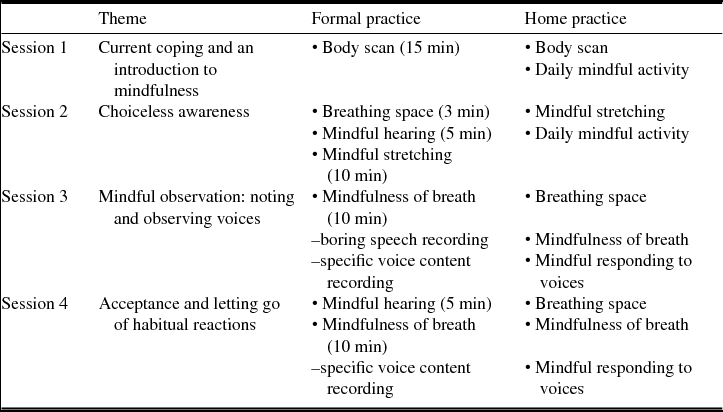
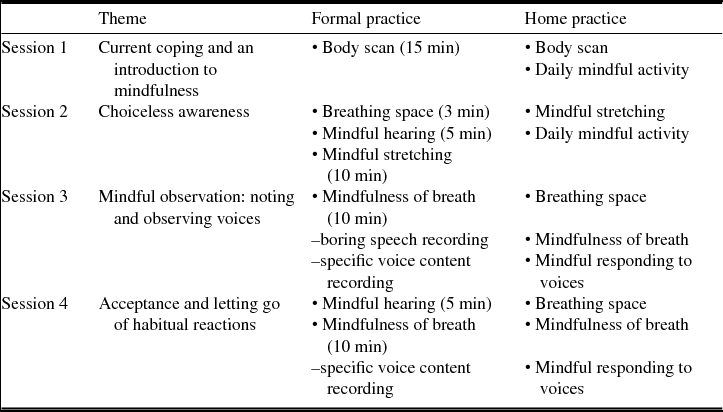
iMPV entailed four weekly one-hour sessions. The therapist was trained in MBCT and had received training in CBTp and ACT for psychosis. Sessions were of individual format and included guided mindfulness practice alongside discussions around mindful responding as an alternative to habitual reactions to voices, non-judgemental awareness of voices and acceptance of symptoms and self. Sessions 1 and 2 provided an introduction to the foundations of mindfulness and sessions 3 and 4 focused specifically on mindful responding to voices. Home mindfulness practice between sessions was facilitated with hand-outs, audio-recordings of guided mindfulness exercises on an MP3 device, and a home practice record.
In contrast with existing mindfulness interventions, this mindfulness protocol for voices included several experiential practices that simulated the voice-hearing experience. These were used to produce voice-like stimuli with which to practise mindfulness skills with the therapist, given that the participants’ own hallucinated voices are often not reliably present in-session. For instance, participants were first introduced to the concept of mindful responding to voices using a pre-recording of speech playing during a mindfulness of breath practice. This enabled participants to practise mindfully observing and noting voice topography. A recording of speech selected to be boring, rather than engaging, was used for initial practice to minimize its salience in capturing attention during initial practice. Subsequently, to simulate the emotional reaction to negative voice content often reported by clients, mindfulness-of-breath practices were completed with pre-recorded individual voice content from each participant playing in the background. This facilitated the practice of mindful responding to voices under more realistic conditions in regard to attentional resources and mood state.
Additional precautions were taken to reduce the likelihood for participants to become preoccupied with internal psychotic experiences for long periods of time. For instance, mindfulness practices were kept to a maximum of 15 minutes and participants were instructed to practice with their eyes open and gazed dropped, if this felt more comfortable. Lastly, the focus of home practice in the third and fourth sessions was practising letting go of habitual reactions to voices (e.g. resistance or avoidance) and informally and formally practising mindfulness observation and responding to voice-hearing experiences.
Further details of the session content are given in Table 1.
iMPV session content
The use of technology to overcome participant engagement barriers
It is important to highlight the use of technology within iMPV. Participants often report difficulties engaging with home mindfulness practice. There are a variety of reasons for this, but one significant barrier that has been identified by the authors, is the common use of audio CDs in mindfulness-based interventions. Participants often report they either do not have CD players, or if they do these players are located within common areas of their residence. To try and overcome this barrier for engagement, the iMPV trial provided audio-files of guided mindfulness practices on an MP3 player. This player was inexpensive and battery operated, with spare batteries provided to participants to address any charging complications.
In addition, a voice loop smartphone application was used to record participant's specific voice content to play during the mindfulness of breath practice in the third session. This application made this process time efficient and easy to complete in collaboration with participants within the session. Lastly, a portable speaker connected to a smartphone used by the therapist, was used to play the ‘boring speech recording’ and the specific voice content recorded on the voice loop application, during the mindfulness of breath practices within sessions 3 and 4.
Measures
Acceptability and feasibility
Attrition
Information regarding the number of sessions completed by participants, drop-outs rates and reasons for attrition, were recorded.
Engagement
Engagement with the mindfulness practices was assessed using the percentage of in-session formal mindfulness practices completed by participants during the intervention. In addition, information regarding the number of short (<5 min) and long (>5 min) mindfulness practices and the total minutes spent on practiced mindfulness at home were recorded.
Participant feedback
Participants provided feedback to assist with the program development process, in the form of a short qualitative interview during the post-assessment. Feedback items included ‘do you think you are likely to continue with formal mindfulness practice?’ and ‘would you recommend mindfulness for other people who experience hearing voices?’.
Outcome measures
All assessments were conducted in face-to-face interviews (the current article presents data on main outcomes only). Prior to the baseline assessment, participants were asked to provide demographic information, the Wechsler Test of Adult Reading (WTAR; Wechsler, Reference Wechsler2001) as an estimate of premorbid intellectual functioning, and the Positive and Negative Symptom Scale (PANSS; Kay et al., Reference Kay, Fiszbein and Opler1987) to index severity of baseline positive and negative psychotic symptomatology.
Primary outcome
Subjective Experience of Psychosis Scale (SEPS; Haddock et al., Reference Haddock, Wood, Watts, Dunn, Morrison and Price2011) – Negative impact of experience subscale
The SEPS is a self-report questionnaire measure of the impact of psychotic experiences in the last week on 29 domains identified by consumers as impacted upon by psychotic experiences (e.g. concentration, ability to socialize, levels of anxiety and stress). Items of the SEPS are answered using a 5-point response format (1: not at all, to 5: very much), with two ratings given for both the negative impact on the domain, and the positive impact. The negative impact of experience subscale has demonstrated excellent reliability, with a Cronbach's α of 0.93 and a high test–retest coefficient of 0.83 (Haddock et al., Reference Haddock, Wood, Watts, Dunn, Morrison and Price2011). Adequate convergent evidence for construct validity has been supported by small to moderate correlations with the PANSS and PSYRATS scales of auditory hallucinations (Haddock et al., Reference Haddock, Wood, Watts, Dunn, Morrison and Price2011). The SEPS was administered with a specific instruction to rate the impact of hearing voices.
Secondary outcomes
Psychotic Symptoms Rating Scales – Auditory Hallucinations (PSYRATS; Haddock et al., Reference Haddock, McCarron, Tarrier and Faragher1999)
This is a measure of the specific characteristics of auditory hallucinations, consisting of 11 items assessing: frequency, duration, location, loudness, beliefs about origin, amount and degree of negative content, amount and intensity of distress, disruption and control. Items are 5-point (0 to 4) anchored interviewer-rated scales, with higher scores indicating greater severity. The PSYRATS has demonstrated excellent inter-rater reliability (item coefficients between 0.78 and 0.90) and good test–retest reliability and validity (Haddock et al., Reference Haddock, McCarron, Tarrier and Faragher1999). The scale was given to participants to obtain specific information about voice-related distress, disruption and voice topography (frequency, duration, loudness).
Calgary Depression Scale for Schizophrenia (CDSS; Addington et al., Reference Addington, Addington and Maticka-Tyndale1993)
This is a measure of depressive symptoms over the previous 2 weeks designed to assess depression in individuals with schizophrenia, separate from positive and negative symptomatology. The scale consists of nine interviewer-rated items, each ranging from 0 (absent) to 3 (severe). The CDSS has demonstrated good reliability with a Cronbach's α of 0.79 and adequate convergent validity, as evidenced by high correlations with other measures of depression (e.g. BDI-II and the Hamilton Depression Scale; Addington et al., Reference Addington, Addington, Maticka-Tyndale and Joyce1992). The CDSS was used to measure the severity of and changes in participants’ depressive symptoms.
Process measures
Southampton Mindfulness Questionnaire (SMQ; Chadwick et al., Reference Chadwick, Hember, Symes, Peters, Kuipers and Dagnan2008)
The SMQ was given to patients to measure usual responses to and relationships with distressing thoughts and images. The SMQ consists of 16 self-report items that are answered on a 7-point strongly disagree to strongly agree Likert scale, with eight items keyed positively and eight negatively. Item scores are summed to generate a total score ranging from 0 to 96, with higher scores indicating a greater degree of mindful responding. Four additional factor scores can be calculated for Mindful Observation, Letting Go, Absence of Aversion and Non-Judgement. The SMVQ has demonstrated a good level of internal reliability, with a Cronbach's α of 0.84 and moderate concurrent validity with a measure of everyday mindfulness (MAAS; Chadwick et al., Reference Chadwick, Hember, Symes, Peters, Kuipers and Dagnan2008).
Attentional switching
Delis-Kaplan Executive Function System (D-KEFS; Delis et al., Reference Delis, Kaplan and Kramer2001) - Color-Word Interference Test – switching condition
The D-KEFS Color-Word Interference Test is designed to assess inhibition and attentional switching or set-shifting in individuals aged between 8 and 89 years (Delis et al., Reference Delis, Kaplan and Kramer2001; Strauss et al., Reference Strauss, Sherman and Spreen2006). The test consists of four conditions, each consisting of 40 stimuli. Condition one required respondents to name patches of colour. In the second condition, respondents are required to read colour names written in black ink. The third condition requires respondents to name the dissonant ink colour that words are written in. In the fourth condition, respondents are required to switch between naming the dissonant ink colour and reading the words. Each condition is timed and both self-corrected and unknown errors are summed for each condition to calculate a score for both raw time and total errors, ranging from 1 to 40, with higher scores indicating greater number of errors (Delis et al., Reference Delis, Kaplan and Kramer2001; Strauss et al., Reference Strauss, Sherman and Spreen2006). The Color-Word Interference Test has shown moderate to adequate reliability with Cronbach's α figures ranging from .70 to .79, and test–retest reliability, with a coefficient of 0.65 for the switching condition (Delis et al., Reference Delis, Kaplan and Kramer2001). It has also demonstrated good convergent evidence of construct validity, with an association with the California Verbal Learning Test-Second Edition (CVLT-II; Delis et al., Reference Delis, Kaplan and Kramer2001).
Trail Making Test-Part B (TMT-B; Reitan, Reference Reitan1992)
The second component in the Trail Making Test, TMT-B is a paper and pencil task that was administered to participants as a measure of executive functioning and more specifically visual attention and cognitive switching. The test consists of 25 circles, randomly placed on a page, with numbers 1 to 13 and letters A to L within the circle. Participants are required to connect the circles in sequential order, but alternating between numbers, in ascending order, and letters, in alphabetical order. The aim of the task is to connect the circles as fast as possible, whilst still maintaining accuracy. The primary score calculated for TMT-B is the time taken to complete the task, with higher scores indicating poorer task performance. Practice effects on the TMT-B over several administrations have been noted by previous research (Wagner et al., Reference Wagner, Helmreich, Dahmen, Lieb and Tadić2011). Given that participants in recruitment phase 2 completed this task at four different time points, as little as 1 month apart, an alternate form for the test was used at time points 2 and 4. This form was developed by Wagner and colleagues (2011) and has demonstrated good reliability with the original form, with a Cronbach's α of 0.86.
Sustained attention
Continuous Performance Task (CPT; Riccio et al., Reference Riccio, Reynolds, Lowe and Moore2002)
The CPT is a computer-based task that was given to patients to assess selective and sustained attention. The task requires participants to observe a series of digit sequences and respond with a mouse click each time a sequence is presented that is identical to the one shown just prior. The task consists of three trials: two-digit sequences, three-digit sequences and four-digit sequences. Scores are generated for the number of hits (correct responses) and two types of commission errors: false alarms (responses to nearly identical digits) and random errors. Signal detection analyses combine hit and false alarm information, for each of the three conditions, into d-prime (d') scores, which signify the ability to discriminate identical pairs from nearly identical pairs. These scores are averaged to create a total summary score, with higher scores indicating greater attention. The CPT-IP has demonstrated high test–retest reliability, with an intraclass correlation coefficient of 0.84 (Nuechterlein et al., Reference Nuechterlein, Green, Kern, Baade, Barch, Cohen, Essock, Fenton, Frese III, Frederick and Gold2008). This particular version of the CPT task was chosen as it is included in the MATRICS Consensus Cognitive Battery, which was specifically designed to assess intervention outcomes in schizophrenia (Strauss et al., Reference Strauss, Sherman and Spreen2006). The neurocognitive battery was administered using counterbalancing to reduce order effects and fatigue.
Statistical analysis
All raw scores were processed using SPSS version 24 (SPSS Ltd) to produce the summary data. Differences on measures between the two pre-intervention time points (Time 0 and Time 1) were all small and non-significant (p >.1). Consequently, only pre-intervention data from Time 1 were included in further analyses, and the four cases from the initial phase of the study were included in Time 1 to Time 2 contrasts to maximize numbers for analyses and increase statistical power. Descriptive data were then derived to show change from Time 1 to Time 2, and Time 1 to Time 3, on each of the outcome variables. Confidence intervals for change scores were calculated using the t distribution for paired samples, also used to derive significance levels. Wilcoxon signed-ranks tests, most suitable for ordinal data, were conducted to derive significance levels for PSYRATS items. Standardized effect sizes were expressed as Hedge's g av (bias-adjusted standardized mean difference) for all change scores, as recommended for sample sizes < 20 (Lakens, Reference Lakens2013). Analyses were conducted on a per-protocol basis for the participants (n = 12) who completed the iMPV program.
Results
Participant characteristics
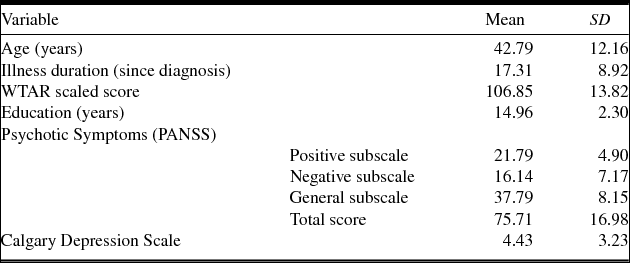
Participants included 14 persistent voice hearers (43% men) with a mean age of 42.8 years (SD 12.2; range 26–62). All participants had a diagnosis of schizophrenia (79%) or schizoaffective disorder (21%). Further demographic and clinical participant characteristics at baseline are given in Table 2.
Demographic and clinical participant characteristics at baseline

Acceptability and feasibility
Attrition
Of the 28 potential participants who were referred to the study and screened for eligibility, seven declined participation and seven did not meet inclusion criteria. Overall, 14 participants completed consent procedures and baseline assessments. Two participants dropped out of the study during the intervention phase: one participant (one session attended) said they preferred practising a different form of meditation (in which they detached from awareness of present moment experiences), and one participant (one session attended) only wanted to continue participation if paid for the therapy sessions in addition to research assessments (this was not part of the protocol or budget). The remaining 12 participants completed all four iMPV sessions.
Engagement
Formal practice completion rates
During sessions, the 12 participants completed all eight of the in-session formal mindfulness practices used. With regard to home practice, on average participants completed 10.29 (SD = 10.94) short (<5 min) and 4.56 (SD = 2.25) long (>5 min) formal mindfulness practices per week. In total, participants completed an average of 67.76 min (SD = 37.64) of formal home practice per week.
Safety
To examine if there was any evidence of the iMPV intervention leading to increases in hearing voice severity, the Reliable Change Index (RCI; Jacobson and Truax, Reference Jacobson and Truax1991) was calculated for two participants whose PSYRATS Auditory Hallucination total scores were higher at post-intervention. Using baseline internal consistency to index reliability, neither of these participants showed an increase that represented reliable change (>1.96).
Participant feedback
All 12 participants said they would recommend mindfulness for other people who experienced hearing voices. Of the most elaborated quotes from the interview, one participant stated ‘. . .I think it can help everybody who experiences hearing voices. I think it can help everybody in general’ and another participants stated ‘Yes I would, to calm you down, focus your attention and get yourself away from the hassle and trial that you are going through and have a new focus on your wellbeing’.
Feedback also revealed that all 12 participants indicated that they thought they were likely to continue with formal mindfulness practice, with one participant stating ‘. . .I'll do it regularly, because it calms me down, slows me down’ and another participant stating ‘. . .because now I've got meditation tapes, so it will be a lot easier to focus and practice’.
Outcomes
Post-intervention outcomes
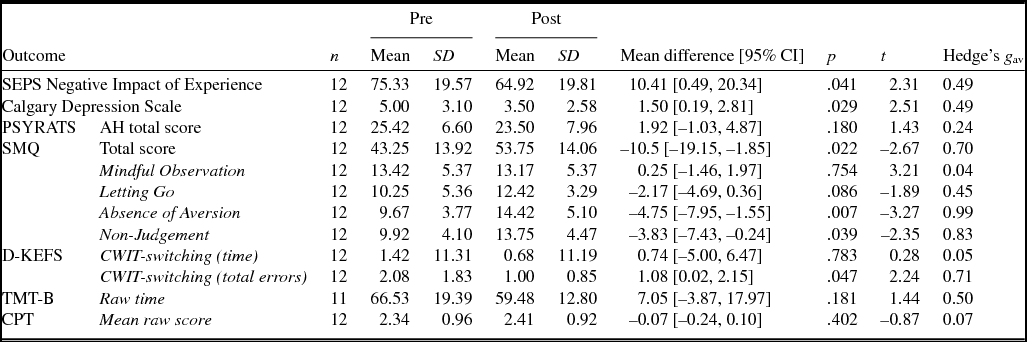
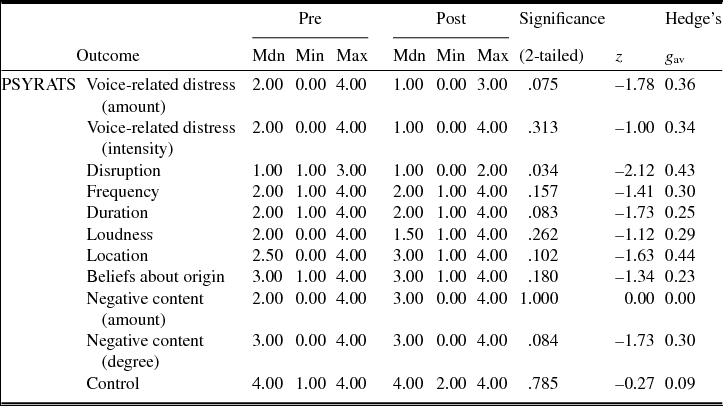
Results on outcome and process variables are given in Tables 3 and 4, respectively. As recommend in guidelines for good practice for the analysis of pilot studies (Lancaster et al., Reference Lancaster, Dodd and Williamson2004), the focus of the results is on the estimates of the treatment effects and corresponding 95% CIs for the mean difference, rather than providing definitive hypothesis tests, but p-values are reported for completeness.
Pre–post descriptive statistics and paired samples t-test results

CWIT, Colour-Word Interference Test; PSYRATS, Psychotic Symptom Rating Scales; SEPS, Subjective Experience of Psychosis Scale; SMQ, Southampton Mindfulness Questionnaire; D-KEFS, Delis–Kaplan Executive Function System; TMT-B, Trail Making Test-Part B; CPT, Continuous Performance Test.
Descriptive statistics and Wilcoxon signed-rank test results for PSYRATS items

PSYRATS, Psychotic Symptom Rating Scales.
On the primary outcome measure, SEPS Negative Impact of Experience, a moderate effect was observed from pre- to post-intervention, which was statistically significant in spite of the small sample. Among the secondary outcomes, moderate (and statistically significant) effects were also observed for depressive symptoms, and voice-related disruption. Small-to-moderate effects were estimated on other PSYRATS dimensions, but these were not statistically significant.
Process measures
SMQ total scores increased with a large effect size following the iMPV program, found to be statistically significant. When examined on a factor level, the largest effects were seen for Absence of Aversion and Non-Judgement scores.
With regard to attentional switching, a significant and large effect for a reduction in errors on the switching condition of the Colour-Word Interference Test following mindfulness intervention was found. In contrast, no significant pre–post changes were observed for time on the switching condition of the Colour-Word Interference Test, TMT-B raw time or CPT mean raw score following iMPV.
Follow-up
A total of eight participants continued on to complete a 2-month follow-up assessment. With regard to the primary outcome, the change from pre (mean = 73.50, SD = 20.92) to follow-up (mean = 81.00, SD = 26.37) of 8.42 (95% CI [–9.47, 24.47], Hedge's g av = 0.28) was in the small effect size range, and was not statistically significant, t (7) = –1.05, p = .331. Similarly, analyses revealed there were no longer significant changes from pre-follow-up on all secondary and process outcomes, with small effects identified.
Discussion
This article has described a novel brief MBI for persistent voice hearers of individual format (iMPV). Hallucination specific focused mindfulness programs are still emerging in the literature (Chadwick et al., Reference Chadwick, Strauss, Jones, Kingdon, Ellett, Dannahy and Hayward2016), and the authors believe this is the first reported MBI for persistent voices of individual delivery modality. The current study aimed to establish the acceptability, feasibility and potential effectiveness of this program on the negative impact of voices on the subjective experience of mental health and wellbeing, as well as depression, voice-related distress and disturbance. The study also aimed to identify potential psychological and neurocognitive mechanisms of change that warrant further examination, and is subsequently the first trial of an MBI for psychosis that has assessed for changes in executive attention.
Findings demonstrated low participant attrition rates, high session attendance, high in-session and at-home formal practice engagement levels, and positive participant feedback. These indicate that this program is both acceptable and feasible for individuals with psychosis, suggesting that not only are persistent voice hearers able to complete formal mindfulness practices, but they also value learning mindfulness. As suggested by previous literature, the fact that mindfulness is a practice adopted by many individuals, regardless of the existence of psychiatric diagnosis, potentially normalizes the process and empowers participants to explore new ways of responding to their experiences, without a focus on deficits or pathology (Davis et al., Reference Davis, Strasburger and Brown2007). In addition, the safety for this intervention was supported by a lack of reliable or significant deterioration in hallucination symptoms. This is important given early fears for using mindfulness meditation with individuals with psychosis leading to increases in psychosis.
Results on pre–post measures suggest that after completing the iMPV program, participants reported that their experience of hearing voices was having significantly less negative impact on their mental health and wellbeing. Similarly, findings demonstrated a significant small-to-moderate pre–post reduction in depressive symptoms and voice-related disruption following the intervention. This significant improvement in depressive symptoms supports recent findings from an RCT of Chadwick and colleagues (2016), looking at group mindfulness for voices. Additionally, this is contrary to a lack of improvement in depressive symptomatology seen in large-scale trials evaluating CBTp for hallucinations (see examples using the Calgary Depression Scale: Birchwood et al., Reference Birchwood, Michail, Meaden, Tarrier, Lewis and Wykes2014; Trower et al., Reference Trower, Birchwood, Meaden, Byrne, Nelson and Ross2004). The current study failed to identify changes in voice-related distress on the PSYRATS, following the intervention. However, it should be noted that even the largest CBTp study reporting on voice-related distress also failed to find an effect on this measure (Birchwood et al., Reference Birchwood, Michail, Meaden, Tarrier, Lewis and Wykes2014), raising the possibility of measure insensitivity, given that large clinical changes are required to show improvements (Thomas et al., Reference Thomas, Hayward, Peters, van der Gaag, Bentall and Jenner2014).
With regard to process measure outcomes, large effects were identified for improvements in both mindfulness and attentional switching following the iMPV intervention. These findings suggest that changes in mindful responding, and more specifically an increased ability to not avoid or judge difficult internal experiences, may be a potential mechanism for observed changes in the subjective impact of voice hearing and depression. This is in line with large between-group effects on the SMQ reported by Langer and colleagues (2012) in a recent RCT of group MBCT for psychosis. These findings also suggest that improvements in ability to accurately shift attention from one task to another may also be a potential mechanism of observed symptom change in mindfulness training for voices. Taken together with a lack of observed pre–post changes in sustained attention, this suggests that mindfulness training is teaching individuals to switch their attention more easily between their experiences, rather than to focus on one experience to the exclusion of others (e.g. voice hearing) for long periods of time. Given that previous research has identified that individuals who experience hearing voices demonstrate deficits in control over attentional switching, this potential neurocognitive mechanism may be particularly salient for interventions targeting this population (Hugdahl, Reference Hugdahl2009; Siddi et al., Reference Siddi, Petretto, Burrai, Scanu, Baita and Trincas2017; Waters et al., Reference Waters, Allen, Aleman, Fernyhough, Woodward and Badcock2012).
However, it should be noted that the effects on the primary and secondary outcomes and process measures revealed by this study appeared to decrease at 2-month follow-up. This suggests that a longer course of mindfulness practice may be required to sustain positive changes to one's relationship with hearing voices. For instance, in contrast to the advanced clinical skillset required to deliver CBTp, routine mindfulness boosters delivered post-intervention by a range of allied health workers, including caseworkers may be a pragmatic approach to intervention delivery and continued care.
Limitations and recommendations
Although this pilot study yielded encouraging findings relating to the acceptability, feasibility and potential effects of a new MBI for voices, results are limited to small pre–post comparisons on outcome measures with limited experimental control. Further examination is needed, including more extensive examination of feasibility and acceptability in a larger sample (including of participant recruitment and retention as well as of the intervention). Examination of feasibility can be improved in future trials by setting out feasibility criteria for recruitment, participant retention and intervention engagement. The study design did not test efficacy, which would require a methodologically rigorous, randomized controlled design. Pre- and post-assessments with participants being conducted by the mindfulness therapist may have introduced bias into measures. Although the therapist completed a 3-month practitioner training in MBCT, more extensive training and supervision in delivering mindfulness has been recommended by the UK Network for Mindfulness-Based Teachers Good Practice Guidelines for Teaching Mindfulness-Based Courses. Additionally, the therapist was a graduate psychologist undertaking clinical psychology training, so generalization of the current results to other disciplines cannot be assumed. Given the need for broad dissemination of psychological therapies for psychosis, it is recommended that future research should include adequately trained mindfulness therapists from other allied health backgrounds to assess the suitability of this model in clinical practice. In line with much of the literature for therapies for hearing voices, the sample focused on people with schizophrenia-spectrum disorders, although this was not formally assessed. Generalization to other voice hearing populations is hence unknown.
Conclusion
This pilot study is the first trial to examine a mindfulness intervention for persistent voices of individual format. Our findings suggest this novel treatment protocol is appropriate, engaging and safe for individuals experiencing hearing voices. Small-to-moderate effects were revealed for pre–post improvements in the negative impact of voices, depressive symptoms and voice-related disruption. Large effects for changes in process measures of mindful responding and attentional switching accuracy suggest these to be potential mechanisms of change warranting further investigation. Although low levels of methodological control limit these findings, results suggest that further RCTs are warranted to ascertain the feasibility and efficacy for focused mindfulness interventions for voices. Such efforts should focus on aiding dissemination in clinical practice by using an individual delivery modality and include other mindfulness therapists in addition to those with clinical psychology training, as previously utilized. Additionally, appropriate outcome measures of voice-related distress and disruption should be carefully considered, as opposed to relying on less sensitive single item measures.
Acknowledgments
The authors would like to thank all of the individuals who kindly participated in this research. We would also like to acknowledge Dr Justin Trounson for providing invaluable assistance drafting this article and Mr Sean Carruthers for his contribution to the follow-up data collection.
Ethical statement: During this research the authors have abided by the Ethical Principles of Psychologists and Code of Conduct as set out by the APA. Additionally, this research was conducted following ethical approval obtained from The Alfred Hospital Human Research Ethics Committee (138/14) and The Swinburne University of Technology Human Research Ethics Committee (2015/029). All procedures outlined in this article were in accordance with these relevant institutional ethics committee clearances and the Declaration of Helsinki.
Conflicts of interest: The authors have no conflicts of interest with respect to this publication.
Financial support: This work was supported by a grant from the Barbara Dicker Brain Sciences Foundation, Melbourne, Australia, (S.L., N.T. and S.L.R.) and an Australian Postgraduate Award scholarship (S.L.).



Comments
No Comments have been published for this article.