Introduction
Populations of spittlebug Mahanarva fimbriolata (Stål) (Hemiptera: Cercopidae) infesting Brazilian's sugarcane fields used to be controlled by field burning prior to harvest. However, due to the detrimental effects of this practice on the environment, mechanized harvest has replaced burning and, as a result, populations of spittlebug have increased to the point that it is currently considered as one of the major pests of sugarcane in the country (Madaleno et al., Reference Madaleno, Ravaneli, Presotti, Mutton, Fernandes and Mutton2008; Ravaneli et al., Reference Ravaneli, Garcia, Madaleno, Mutton, Stupiello and Mutton2011).
Spittlebug nymphs feed in the sieve-tube elements of the root's primary phloem, damaging the tracheary system and consequently, hindering water and nutrient uptake (Garcia et al., Reference Garcia, Grisoto, Botelho, Parra and Appezzato-da-Glória2007a). Additionally, spittlebug adults feed on the metaxylem sap of the vascular bundles of the leaves, causing ‘sugarcane burn’ by reducing carbon assimilation (Garcia et al., Reference Garcia, Grisoto, Botelho, Parra and Appezzato-da-Glória2007a). Overall, spittlebug attack causes significant losses in sugarcane juice quality since it reduces its total soluble solids and sucrose content. This interference with sugar accumulation affects the sap fermentation during the process of ethanol production (Ravaneli et al., Reference Ravaneli, Garcia, Madaleno, Mutton, Stupiello and Mutton2011).
The damage caused by this pest is more pronounced when the infestation occurs in the early stages of plant growth, in which case, yield losses can reach up to 41% (Ravaneli et al., Reference Ravaneli, Garcia, Madaleno, Mutton, Stupiello and Mutton2011). According to Madaleno et al. (Reference Madaleno, Ravaneli, Presotti, Mutton, Fernandes and Mutton2008), infestation with 7.3 nymphs m−1 day−1 may reduce yield, sucrose in juice and purity of the sugarcane juice by as much as 29.8, 5.8, and 1.2%, respectively. Moreover, a field experiment showed that the economic injury level occurs when insect population reaches between 2 and 3 insects m−1 during the rainy season (Dinardo-Miranda et al., Reference Dinardo-Miranda, Pivetta and Fracasso2008).
The development of resistant sugarcane cultivars is an important tool in Integrated Pest Management (IPM) of spittlebug. However, few studies have been reported about the susceptibility of sugarcane genotypes to this insect pest. These few studies have shown that sugarcane genotypes have different effects on development (Garcia et al., Reference Garcia, Prado, Vendramim, Botelho and Paulo2011) and survival (Guimarães et al., Reference Guimarães, Mutton, Ferro, Silva, Mutton, Kalaki and Madaleno2007; Dinardo-Miranda et al., Reference Dinardo-Miranda, da Costa, Fracasso, Perecin, de Oliveira, Izeppi and Lopes2014, Reference Dinardo-Miranda, Fracasso, Perecin, Oliveira, Lopes, Izeppi and Anjos2016) of spittlebug nymphs. In addition, preference for both feeding and oviposition by adults also differ among sugarcane genotypes (Dinardo-Miranda et al., Reference Dinardo-Miranda, Fracasso, Perecin, Oliveira, Lopes, Izeppi and Anjos2016). Nonetheless, not all genotypes will show an evident reduction in biomass fresh weight gain and chlorophyll content upon pest attack, suggesting some level of resistance in action (Dinardo-Miranda et al., Reference Dinardo-Miranda, da Costa, Fracasso, Perecin, de Oliveira, Izeppi and Lopes2014, Reference Dinardo-Miranda, Fracasso, Perecin, Oliveira, Lopes, Izeppi and Anjos2016), although what the underlying specific mechanisms of resistance to spittlebug nymph attack may be, remains unclear.
Field observations have indicated that under high natural infestation, sugarcane genotype H. Kawandang was more resistant to spittlebug attack than other genotypes, including the well-known susceptible cultivar SP81–3250 (Garcia et al., Reference Garcia, Prado, Vendramim, Botelho and Paulo2011). More recently, a greenhouse study has confirmed the resistance of H. Kawandang to spittlebug (Valverde, Reference Valverde2012); this cultivar belongs to genus Erianthus, which is closely related to genus Saccharum. Some Erianthus species have actually been used in breeding programs as gene sources for disease and pest resistance (Cheavegatti-Gianotto et al., Reference Cheavegatti-Gianotto, de Abreu, Arruda, Bespalhok Filho, Burnquist, Creste, di Ciero, Ferro, de Oliveira Figueira, de Sousa Filgueiras and de Fátima Grossi-de-Sá2011).
Therefore, to understand the underlying mechanisms of sugarcane resistance to spittlebug, this study sought to investigate and compare the morpho-anatomical traits and physiological responses of susceptible (SP81–3250) and resistant (H. Kawandang) sugarcane genotypes exposed to attack by spittlebug nymphs.
Material and methods
Insects and plant material
Experiments were carried out at the ‘Centro de Pesquisa e Melhoramento da Cana-de-açúcar’ (CECA) at Universidade Federal de Viçosa (UFV), in partnership with the Inter-University Network for Development of Sugarcane Industry (RIDESA), located in the Oratórios municipality; experiments were also conducted in a greenhouse in the experimental field at UFV in the Viçosa municipality, both located in the state of Minas Gerais, in southeastern Brazil.
Spittlebug adults and nymphs were manually collected in the sugarcane fields at CECA for mass rearing in the laboratory. Insects were maintained in cages (80 × 100 × 50 cm3) containing plants of the genotype SP80–1816 for feeding, mating, and oviposition, as per Garcia et al. (Reference Garcia, Botelho and Parra2007b). The eggs collected from the reared colony were placed on moistened filter paper in Petri dishes and maintained in a BOD (Bio-Oxygen Demand) incubator (26 ± 2°C, 70% ± 10% relative humidity and 12:12 photoperiod) until hatching.
Two sugarcane genotypes were used in all experiments: H. Kawandang (Erianthus arundinaceus Retz.), a wild relative of commercial sugarcane cultivars, which shows resistance to spittlebug, and cultivar SP81–3250 (Saccharum spp.), which is known to be a susceptible genotype (Garcia et al., Reference Garcia, Prado, Vendramim, Botelho and Paulo2011; Dinardo-Miranda et al., Reference Dinardo-Miranda, da Costa, Fracasso, Perecin, de Oliveira, Izeppi and Lopes2014). Single-node stem cuttings containing one lateral bud, obtained from the germplasm unit at the UFV, were placed in plastic trays filled with agricultural substrate (Plantmax®); primary shoots started to elongate 30 days after and the sugarcane stubs were then transplanted into cell-trays (60 cm length × 30 cm width) half-filled with a mix of substrate and soil (50:50). After the transplant, the volume of each cell was completed with vermiculite to stimulate superficial rooting. Plants were watered daily and fertilization was performed by adding 0.20 g of NPK (nitrogen (N), phosphorus (P) and potassium (K )) per plant (4-14-8 formulation) weekly.
Plants were exposed to insect infestation by removing the vermiculite and submitting the root system to the newly hatched nymphs to feed on it. A plastic cap (4.9 cm diameter, 5.5 cm long) with a 1.9 cm central perforation for the stalk to grow through was used to top each tray cell in order to maintain a humid and dark environment for the nymphs. As for preventing insects from escaping through the cap central opening, a foam strip was inserted around the stalk.
Two independent assays were carried out in order to evaluate structural (morpho–anatomical) and physiological response to an attack by the nymphs.
Assay I – Morphological and anatomical responses of sugarcane plants to spittlebug attack
Forty-five days after planting, plants of both genotypes were submitted to the infested and non-infested (control) treatments. The infestation was set with six newly hatched nymphs per plant. Twenty-one days after infestation (DAI), damage was evaluated by using a damage score based on the methodology proposed by Cardona et al. (Reference Cardona, Miles and Sotelo1999), according to which, scores one, two, three, four and five depicted 0, 25, 50, 75, and 100% of leaf area damaged, respectively. At the end of the experimental period, the soil was washed off the roots and whole plants were harvested to measure their fresh weight on a precision balance. Finally, plants were dried in a kiln at 72°C for 72 h and weighed again for dry weight.
For the study of root anatomy, samples were fixed in glutaraldehyde solution (Karnovsky, Reference Karnovsky1965, modified – 2.5% glutaraldehyde, 4% paraformaldehyde, 3% sucrose, CaCl2 5 µM cacodylate buffer 0.1 mol l−1, pH 6.8) for 24 h, then dehydrated in ethylic series and finally embedded in Poly (methyl methacrylate) (Historesin, Leica). A fully automated advance rotary-microtome (RM 2255 – Leica) equipped with a glass blade, was used for obtaining transversal cuts 5 µm in width. Cuts were colored with toluidine blue (pH 4.4) (O'Brien & McCully, Reference O'Brien and McCully1981) for 10 min, and the blades assembled with synthetic resin (Permount). Photographs were obtained by a light microscope (Olympus-AX 70) connected to a microphotography system (Olympus U-Photo).
To quantify the lignin content in the stalk, dried samples were powdered and sieved in a sequence of 20 and 80 mesh sieves. The samples retained in 80 mesh sieves were used to estimate lignin content by using a Near Infrared spectrophotometer (NIR) according to the methodology proposed by Assis (Reference Assis2014). Approximately 1 g of each sample was placed in a quartz cuvette for NIR readings. The specters were obtained in a Fourier transform (FT) spectrometer Agilent 660 with aim of a reflectance accessory using an integration sphere acquired from PIKE Technologies. The wavebands from 10,000 to 40,000 cm−1 were read in 4 cm−1 increments. The specters were obtained by using the software Resolutions Pro version 5.1, which records the information as log (1/R), where R is the reflectance collected. For each sample, a total of 64 readings were made and the mean value was recorded. The specters were exported to the software Matlab7.8 (Math Works, Natick, USA) and the estimates of lignin content were obtained by using the multivariate calibration models built for it (Assis, Reference Assis2014).
Assay II – Damage and physiological responses of the resistant and susceptible sugarcane genotypes to spittle bug attack
As in the previous assay, both genotypes were submitted to two treatments: infested and non-infested. However, in this case, the plants were infested with three nymphs instead of six, so that the plant–insect interaction would last longer. The plants were checked at 3-day intervals and dead nymphs were replaced by new nymphs in order to maintain the initial number of nymphs per plant. At 7, 15, 30, and 37 DAI, three plants from each treatment were used for assessment of damage, physiological response and root anatomy; thus, different plants from all treatments were evaluated on each sampling date.
Damage was assessed as described in Assay I. The greening of leaves was measured with a Soil Plant Analytical Division (SPAD) (Minolta Corp®) on leaves +1, +2, +3, according to the Kuijper classification (Cheavegatti-Gianotto et al., Reference Cheavegatti-Gianotto, de Abreu, Arruda, Bespalhok Filho, Burnquist, Creste, di Ciero, Ferro, de Oliveira Figueira, de Sousa Filgueiras and de Fátima Grossi-de-Sá2011). Each leaf was assessed three times and the mean values were used for statistical analysis.
Gas exchange parameters were measured with a portable Infrared Gas analyzer (IRGA) LCpro Portable (ADC BioScientific Ltd. Hoddesdon, UK) configured as an open system. The leaf chamber was calibrated to deliver a photon flux flow of 1000 µmol m−2 s−1 at constant temperature (27°C). Ambient air was drawn into a 20 l container and homogenized there before reaching the foliar chamber. Gas exchange measurements were carried out between 9 a.m. and 11 a.m., on the middle portion of the second fully-expanded leaf. Each leaf was measured six times and mean values for each leaf were used for statistical analysis.
At the end of the physiological evaluations, the roots were collected to verify the presence of phenolic compounds. A fully-automated advance rotary microtome (RM 2255 – Leica) equipped with a glass blade was used for obtaining transversal cuts 5 µm in width. The root cuts were stained with ferric chloride and potassium dichromate. The images were obtained in a light microscope (model AX70 TRF, Olympus Optical) with a U-Photo system linked to a digital photographic camera (model Spot Insight color 3.2.0, Diagnostic Instruments Inc.) and a computer to run the image capture program Spot Basic.
Experimental design and data analysis
Assay I consisted in a 2 × 2 factorial (2 genotypes × 2 infestation levels), randomized block design with six replications. The comparison between genotypes for damage score was performed by the t-test (P < 0.05). The data of fresh and dry biomass weight and lignin content in the stalk were analyzed using factorial Analysis of Variance ANOVA and means compared by Tukey's test (P < 0.05).
Assay II consisted in a 2 × 2 × 2 factorial (2 genotypes × 2 infestation levels × 4 DAI), completely randomized design with three replications. The data on damage score were submitted to factorial ANOVA. The SPAD and gas exchange data were also submitted to factorial ANOVA and means compared by Tukey's test (P < 0.05). The data were transformed into square root (x + 0.5) to meet ANOVA assumptions when necessary. The software R 3.3.2 (R core team, 2016) was used for statistical analysis.
Results
Damage score
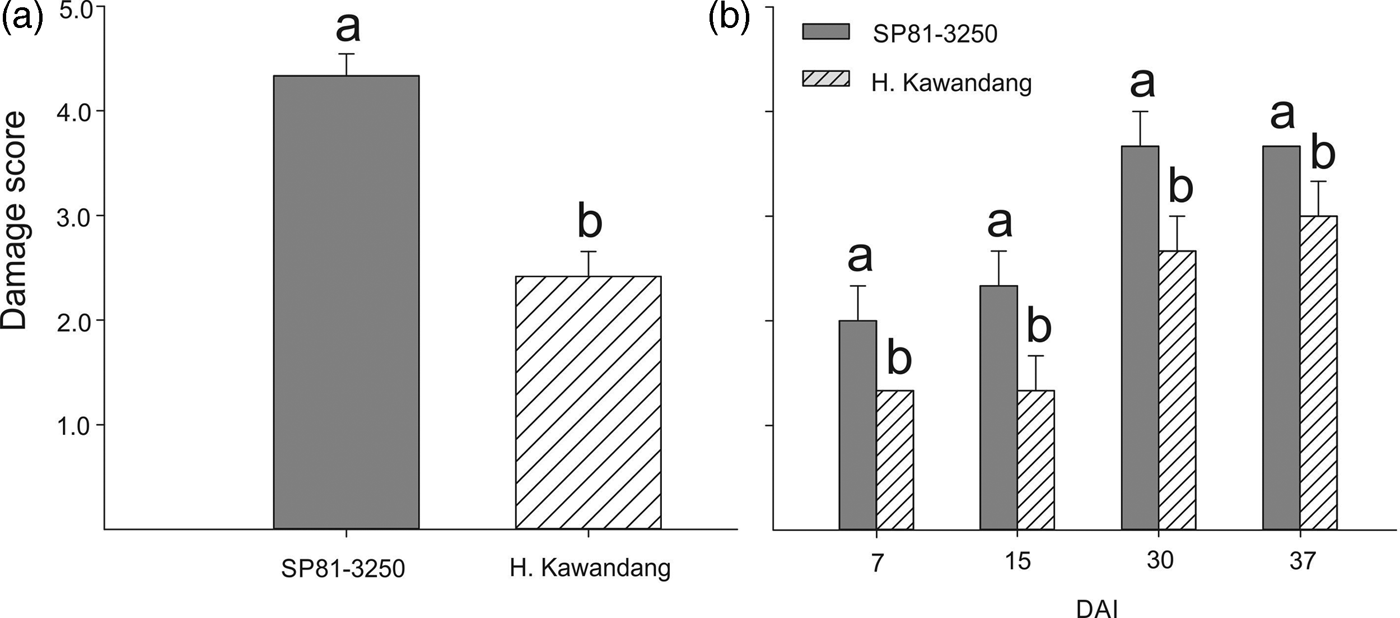
There was a significant difference between genotypes for damage score (t = 6.02; P < 0.001) in Assay I (Figure 1a). Significant genotypic (F = 23.08; df = 1, 6; P = 0.003) and time (F = 25.23; df = 3, 6; P < 0.001) effects for damage score were evident in Assay II with damage increasing over time in both genotypes. In both assays, damage score for the susceptible genotype SP81–3250 was higher than for the resistant genotype H. Kawandang (Fig. 1a, b). In both experiments, we observed that more nymphs died and had to be replaced by new nymphs in the case of the resistant genotype H. Kawandang (mean = 41 nymphs) in comparison with SP81–3250 (mean = 26 nymphs), indicating some antibiotic or anti-feeding activity in the former.
Damage score in susceptible (SP81–3250) and resistant (H. Kawandang) sugarcane genotypes infested with spittlebug nymphs. (a) Assay I, damage score at 21 DAI; (b) Assay II, damage score at 7, 15, 30 and 37 DAI. Histograms topped by different letters indicate the difference between treatments according to t-test (a) and Tukey's test supported by ANOVA (b).

ASSAY I – Morphological and anatomical responses of sugarcane plants to spittlebug attack
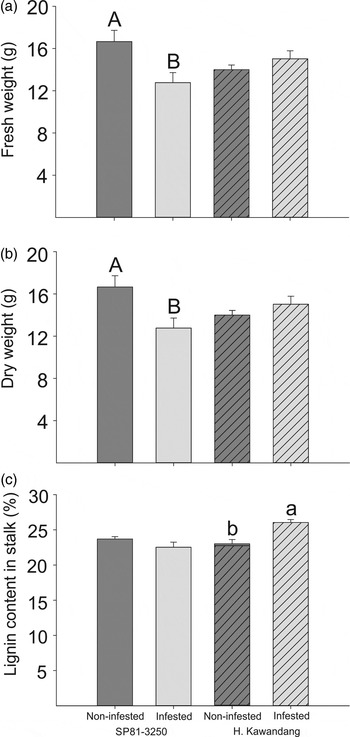
There was significant interaction between genotype and infestation for both, fresh (F = 8.59; df = 1, 20; P = 0.008) and dry weight (F = 18.95; df = 1, 20; P < 0.001) of whole plants and for lignin content in the stalks (F = 15.31; df = 1, 20; P < 0.001). The fresh and dry weights of SP81–3250 infested plants were lower than those of control plants of the same genotype. In contrast, there was no significant difference in fresh or dry weight between infested and non-infested plants of H. Kawandang (fig. 2a, b). Additionally, infested plants of the latter had higher lignin content in the stalk than control plants, while, in SP81–3250, no differences between infested and non-infested plants were observed in this regard (fig. 2c). Thus, while the nymph attack disrupted plant growth in the susceptible genotype, the H. Kawandang infested plants displayed normal growth and increased lignin deposition.
Responses of susceptible (SP81–3250) and resistant (H. Kawandang) sugarcane genotypes to attack by spittlebug nymphs at 21 DAI. (a) Fresh weight of whole plants (b) Dry weight of whole plants and (c) Lignin content in stalks. Bars topped by different letters are different according to Tukey's test, supported by ANOVA (P < 0.05). Capital letters refer to comparisons between infested and non-infested plants of genotype SP81–3250, whereas lower case letters refer to comparisons between infested and non-infested plants of genotype, H. Kawandang. Comparisons for which no significant differences were found are not indicated by any letter.

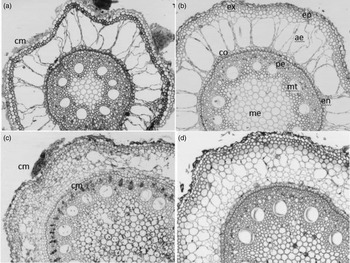
Anatomical analysis showed that the roots of both genotypes present intact and lignified epidermal, exodermal, and sclerenchymatous cells. However, there were visible anatomical differences between the two genotypes. The roots from plants of SP81–3250, presented a well-developed aerenchyma in their cortex, regardless of infestation status (fig. 3a, b). In contrast, the roots of plants of the resistant genotype H. Kawandang, exhibit a cortex formed by parenchyma cells arranged in a more compact layer, regardless of the treatment. Additionally, an unidentified mucilaginous compound was observed near the root vascular-cylinder in infested plants of H. Kawandang (fig. 3c). These structural traits seem to be related to the resistance of H. Kawandang to spittlebug. Tests for the presence of phenolic compounds were negative (data were not shown), indicating that these compounds were not related to the resistance to spittlebug in the genotypes used here.
Root anatomy of susceptible (SP81–3250) and resistant (H. Kawandang) sugarcane genotypes in response to an attack by spittlebug nymphs at 21 DAI. (a) SP81–3250 infested plant; (b) SP81–3250 non-infested plant; (c) H. Kawandang infested plant; (d) H. Kawandang non-infested plant. Darker grey indicates the higher lignin contents in all treatments. ae = aerenchyma; co = cortex; ep = epidermis; ex = exodermis; en = endodermis; me = medula; mt = metaxylem; pe = pericycle; cm = mucilaginous compound. Scale = 1:100.

ASSAY II – Physiological responses of sugarcane plants to spittlebug attack
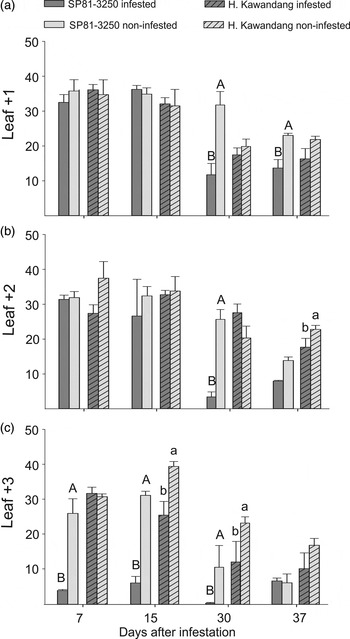
Significant interactions infestation × time (F = 4.29; df = 3, 30; P = 0.012) and genotype × infestation (F = 5.33; df = 3, 30; P = 0.03) were observed for SPAD values for intensity of green color of the leaf, in leaf + 1. Genotype × infestation × time triple interaction for SPAD values in leaf + 2 (F = 6.06; df = 3, 30; P = 0.002) and leaf + 3 (F = 3.35; df = 3, 30; P = 0.032) were also significant. Infested plants of the susceptible genotype SP81–3250 scored lower SPAD values than control plants in leaf +1 at 30 and 37 DAI, in leaf +2 at 30 DAI, and in leaf +3 at 7, 15 and 30 DAI. Infested plants of the resistant genotype H. Kawandang, scored lower SPAD values than the control plants only in leaf +2 at 37 DAI, and in leaf+3 at 15 and 30 DAI (P < 0.05, fig. 4a–c). This delay in time and leaf progression to display chlorophyll content decay is an important indication of the resistance of H. Kawandang to spittlebug attack.
SPAD responses of susceptible (SP81–3250) and resistant (H. Kawandang) sugarcane genotypes to spittlebug nymphs attack at 7, 15, 30, 37 DAI. (a) leaf +1, (b) leaf +2 (c) leaf +3. Bars topped by different letters are different according to Tukey's test, supported by ANOVA (P < 0.05). The capital letters refer to comparisons between infested and non-infested plants of genotype SP81–3250 whereas lower cases refer to comparisons between infested and non-infested plants of genotype, H. Kawandang. Comparisons for which no significant differences were found are not indicated by any letter.

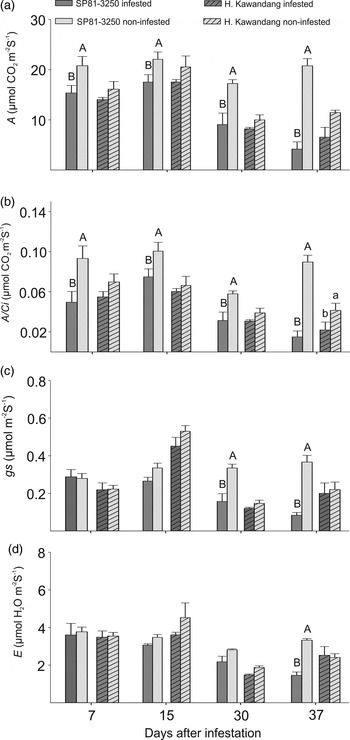
Interactions infestation × time (F = 6.09; df = 3, 30; P = 0.002) and genotype × infestation (F = 17.98; df = 1, 30; P < 0.001) were also significant for photosynthetic rate (A). Similarly, the interactions infestation × time (F = 4.69; df = 3, 30; P = 0.008) and genotype × infestation (F = 16.89; df = 1, 30; P < 0.001) were also significant for instantaneous carboxylation efficiency (A/Ci). Overall, infested plants of SP81–3250 showed lower A and A/Ci values than control plants (P < 0.05) during the period of exposure to spittlebug attack, while infested plants of H. Kawandang showed A and A/Ci lower values than control plants only at 37 DAI (P < 0.05, fig. 5a, b). There was significant interaction genotype × time for stomatal conductance (g S) (F = 8.74; df = 3, 30; P < 0.001) and transpiration rate (E) (F = 4.28; df = 3, 30; P = 0.013). The SP81–3250 infested plants showed lower gs values than controls at 30 and 37 DAI and lower E values than controls at 37 DAI. In contrast, neither gs nor E differed between infested and non-infested plants at any DAI in the case of H. Kawandang (P > 0.05, fig. 5c, d). Clearly, plants of genotype H. Kawandang were able to maintain photo assimilate production despite spittlebug attack, whereas the same process had already been negatively affected by the 7th DAI in plants of genotype SP81–3250.
Gas exchange responses of susceptible (SP81–3250) and resistant (H. Kawandang) sugarcane genotypes to spittlebug nymphs attack at 21 DAI. (a) photosynthetic rate, (b) instantaneous carboxylation efficiency, (c) stomatal conductance, (d) transpiration rate. Bars topped by different letters are different according to Tukey's test, supported by ANOVA (P < 0.05). The capital letters refer to comparisons between infested and non-infested plants of genotype SP81–3250 whereas lower cases refer to comparisons between infested and non-infested plants of genotype, H. Kawandang. Comparisons for which no significant differences were found are not indicated by any letter.

Discussion
This study investigated the effect of an attack by spittlebug nymphs on sugarcane genotypes H. Kawandang (Erianthus arundinaceus) and SP81–3250 (Saccharum spp.), a resistant and a susceptible genotype, respectively. In both assays carried out, infested plants of SP81–3250 obtained higher damage mean score than their H. Kawandang counterparts, regardless of nymph population size per plant; thus, confirming the difference in susceptibility level between these genotypes to spittlebug. The damage score successfully discriminated resistance to spittlebug among Brachiaria grasses (Cardona et al., Reference Cardona, Miles and Sotelo1999; López et al., Reference López, Cardona, Miles, Sotelo and Montoya2009; Resende et al., Reference Resende, Auad and Fonseca2014). Furthermore, the genotypes tested here showed contrasting anatomical, morphological and physiological responses under the experimental conditions, a fact which confirms the difference between the characteristic levels of resistance to the attack by the pest in each case. As expected, the stress onset in the susceptible genotype occurred earlier and more strongly than in the resistant one.
In our study, spittlebug caused reduced fresh and dry biomass weights in plants of SP81–3250. The likely explanation, as Garcia et al. (Reference Garcia, Grisoto, Botelho, Parra and Appezzato-da-Glória2007a, Reference Garcia, Botelho and Parrab) have proposed is that, as spittlebug nymphs damage the tracheary system of the roots, water, and nutrient uptake is impaired and consequently, plants gradually become dehydrated and malnourished; as these conditions worsen, biomass accumulation is compromised. In contrast, spittlebug nymph attack did not affect either fresh or dry biomass weight in H. Kawandang. In support of this observation, Dinardo-Miranda et al. (Reference Dinardo-Miranda, da Costa, Fracasso, Perecin, de Oliveira, Izeppi and Lopes2014, Reference Dinardo-Miranda, Fracasso, Perecin, Oliveira, Lopes, Izeppi and Anjos2016) also observed that some sugarcane genotypes are able to maintain aboveground biomass accumulation even under spittlebug attack, indicating the existence of some mechanism of resistance. In addition, differences in biomass weight losses are being successfully used to assess resistance to spittlebug in all sorts of grasses (Cardona et al., Reference Cardona, Miles and Sotelo1999, Reference Cardona, Fory, Sotelo, Pabon, Diaz and Miles2004; López et al., Reference López, Cardona, Miles, Sotelo and Montoya2009).
Guimarães et al. (Reference Guimarães, Mutton, Ferro, Silva, Mutton, Kalaki and Madaleno2007) observed that spittlebug did not affect fresh weight accumulation of a resistant sugarcane genotype, presumably as a consequence of higher nymph mortality due to antibiosis. In both assays of our study, more nymphs were replaced in infested plants of H. Kawandang than in those of SP81–3250, indicating that antibiosis or feeding-deterrence factors may also be an attribute of H. Kawandang. However, since the same number of nymphs per plant was maintained during both experiments, it is likely that nymph mortality was not the only factor explaining the ability of H. Kawandang to resist spittlebug attack, as pointed by Dinardo-Miranda et al. (Reference Dinardo-Miranda, da Costa, Fracasso, Perecin, de Oliveira, Izeppi and Lopes2014, Reference Dinardo-Miranda, Fracasso, Perecin, Oliveira, Lopes, Izeppi and Anjos2016), who failed to find a clear relationship between antibiosis and resistance of sugarcane to spittlebug, suggesting that either resistance mechanisms (tolerance and antibiosis) may be present in a particular sugarcane genotype, as it is also often observed in grasses (Cardona et al., Reference Cardona, Miles and Sotelo1999, Reference Cardona, Fory, Sotelo, Pabon, Diaz and Miles2004; López et al., Reference López, Cardona, Miles, Sotelo and Montoya2009).
The spittlebug nymph stylet reaches the sieve-tube elements of the primary phloem after penetrating across and damaging all tissues on the way from the root surface to the vascular cylinder (Garcia et al., Reference Garcia, Grisoto, Botelho, Parra and Appezzato-da-Glória2007a). The presence of aerenchyma tissue in the root cortex of SP81–3250, may, in fact, facilitate the nymph stylet reaching the vascular cylinder due to the absence of physical obstacles, regardless of experimental treatment; thus, explaining the higher susceptibility of this genotype to the nymph attack (fig. 2a, b). In support of this conjecture, we observed that the roots of the resistant genotype H. Kawandang presented a more compact parenchymatous layer and no aerenchyma. The thicker parenchyma layer may act as a barrier obstructing insect access to the vascular sap; thus, providing the genotype with a higher ability to defend itself from the pest. A similar study by Thimmaiah et al. (Reference Thimmaiah, Panchal, Kadapa and Prabhakar1994) proposed a close association between the resistance of some cotton genotypes to aphid attack, and the presence of a well-developed parenchyma tissue in the leaves, which is made up of denser and more compact cells. Moreover, in Kawandang the roots of infested plants presented a mucilaginous compound near the vascular cylinder. As this substance was not observed in non-infested plants, its production may likely be either stimulated by nymph action or it may be the waste product of damaged tissue during the initial feeding process. However, the chemical nature of this compound and its possible anti-feeding or antibiotic effect on spittlebug remains to be investigated.
Although production of phenols is often related to herbivory by insects (Schoonhoven et al., Reference Schoonhoven, Van Loon and Dicke2005; Smith, Reference Smith2005), no considerable difference in the content of phenols was observed in this study, regardless of infestation status or genotype. Therefore, it is likely that these chemicals were less active in the defense against the pest. Silva et al. (Reference Silva, Guimarães, Garcia, Botelho, Ferro, Mutton and Mutton2005) found that roots of susceptible sugarcane genotype SP80–1816 infested with spittlebug nymphs had more phenolic compounds than non-infested plants. However, higher levels of phenolic compounds were found in leaves and roots of non-infested plants of the resistant genotype SP86–42. Thus, induction of phenolic compounds production in sugarcane roots is genotype-dependent and may not always relate to resistance.
Spittlebug attack caused increased lignin content in stalks of H. Kawandang, but did not affect it in stalks of susceptible genotype SP81–3250. Although the stalk is not the spittlebug nymph primary site for feeding, increases in lignin content in that organ is likely related to an ongoing defense response mechanism. Pest attack usually induces the expression of genes that control protection metabolism (Smith, Reference Smith2005), as indicated by previous studies, which have shown that the concentration of phenolic compounds (Madaleno et al., Reference Madaleno, Ravaneli, Presotti, Mutton, Fernandes and Mutton2008) and fiber content in stalk of sugarcane (Ravaneli et al., Reference Ravaneli, Garcia, Madaleno, Mutton, Stupiello and Mutton2011) increased following spittlebug attack, which is a clear indication that spittlebug nymphs feeding on roots can affect other organs.
Spittlebug attack caused little reduction in SPAD values in H. Kawandang, especially in older leaves (+3), showing that spittlebug attack can affect greening (often correlated to chlorophyll content) of the leaves, even in resistant genotypes. However, spittlebug had a higher effect in the greening of susceptible genotype SP81–3250, affecting all leaves including the youngest fully-developed leaf, (+1) in a shorter period of time. The response of leaf greening to pest attack may differ between resistant and susceptible plants, as observed in sugarcane (Dinardo-Miranda et al., Reference Dinardo-Miranda, da Costa, Fracasso, Perecin, de Oliveira, Izeppi and Lopes2014, Reference Dinardo-Miranda, Fracasso, Perecin, Oliveira, Lopes, Izeppi and Anjos2016) and Brachiaria grasses under attack by spittlebug (López et al., Reference López, Cardona, Miles, Sotelo and Montoya2009), indicating that the ability of some genotypes to maintain leaf greening, even under spittlebug attack, may relate to resistance mechanisms in them.
Spittlebug attack reduced all gas exchange parameters analyzed (A, A/Ci, gs and E) in the susceptible genotype SP81–3250. However, in plants of H. Kawandang spittlebug caused reduced photosynthetic rate and instantaneous carboxylation efficiency, only after a longer time of exposure and even then, did not affect stomatal conductance, thus showing its higher ability to resist spittlebug attack. Previous studies have shown that resistant plants can compensate for sink demand of the sap-feeding pests by increasing photosynthetic activity. Similarly, Gutsche et al. (Reference Gutsche, Heng-Moss, Higley, Sarath and Mornhinweg2009) found that attack by Russian wheat aphid (Diuraphix noxia) reduced photosynthesis rate of a susceptible barley genotype, but did not interfere with gas exchange in a resistant genotype. In another instance in accordance with our own findings, a resistant wheat genotype infested with D. noxia showed higher maximum photosynthesis (A max) rate than control plants, while in two other genotypes, no difference in A max was recorded between infested and control plants (Franzen et al., Reference Franzen, Gutsche, Heng-Moss, Higley, Sarath and Burd2007).
The damage caused by spittlebug nymphs in the roots may impair water absorption thereby inducing water stress like symptoms. Under conditions of water deficit, plants usually respond by reducing the size of the stomatal opening to minimize extreme water loss; consequently, photosynthesis is inescapably reduced due to lower CO2 availability, as has been recorded in sugarcane (Gonçalves et al., Reference Gonçalves, Ferreira, Silva, Endres, Barbosa and Duarte2010; Medeiros et al., Reference Medeiros, Silva, Nogueira, Teixeira and Buckeridge2013). Furthermore, our own data revealed that instantaneous carboxylation efficiency in infested plants of SP81–3250 was reduced over the experimental period, indicating that nymph attack affected carboxylation activity of Rubisco. Since the reduction in instantaneous carboxylation efficiency in this genotype was observed earlier than the reduction in stomatal conductance, it is likely that the primary factor affecting the photosynthetic rate was of biochemical, rather than stomatal nature. Similarly, attack of D. noxia aphid affected CO2 assimilation and carboxylation efficiency of barley (Gutsche et al., Reference Gutsche, Heng-Moss, Higley, Sarath and Mornhinweg2009) and wheat (Franzen et al., Reference Franzen, Gutsche, Heng-Moss, Higley, Sarath and Burd2007) plants, without affecting stomatal conductance. Decreases in chlorophyll content (as observed in our study) and photochemistry of PSII caused by sap-feeding insects can also interfere with the photosynthetic capacity of susceptible plants, as observed in lemon and fern (Golan et al., Reference Golan, Rubinowska, Kmieć, Kot, Górska-Drabik, Łagowska and Michałek2015), tobacco (Li et al., Reference Li, Tan, Xue, Zhao and Wang2013) and tomato plants (Huang et al., Reference Huang, Zhang, Zhang, Lu, Huang and Li2013).
Our study confirmed the contrasting response of sugarcane genotypes SP81–3250 and H. Kawandang to spittlebug as susceptible and resistant, respectively. We conclude that the H. Kawandang genotype has anatomical, morphological and biochemical mechanisms that enable plants to cope with the stress imposed by the spittlebug nymphs feeding on them. On the one hand, the presence of a well-developed parenchyma in the roots, and the concomitant secretion of a mucilaginous compound seems to hinder nymph feeding activity on H. Kawandang. In contrast, roots of SP81–3250 possess a well-developed aerenchyma, which probably facilitated the insertion of the nymph's stylet into the root vascular system. Because of these differences, spittlebug attack had a lower effect on chlorophyll content, stomatal conductance, photosynthetic capacity and, consequently in biomass accumulation in resistant genotype H. Kawandang, in relation to the susceptible genotype SP81–3250.
Acknowledgements
The authors gratefully acknowledge technical assistance provided by the Inter-University Network for the Development Sugarcane Industry in Brazil (RIDESA); Similarly, financial support from the National Council of Scientific and Technological Development (CNPq), from CAPES Foundation (Brazilian Ministry of Education), from the Minas Gerais State Foundation for Research Aid (FAPEMIG), and from the RIDESA-UFV Sugarcane Breeding Program, are all heartedly appreciated and acknowledged here.