In which manuals have you read that theatrical action is a dream?
Theatrical action is a struggle, not a dream.Footnote 1
Introduction
On 13 April 1961, during the 24th International Festival of Contemporary Music, Intolleranza 1960, an ‘azione scenica [scenic action] in two parts based on an idea of Angelo Maria Ripellino, music by Luigi Nono’, was staged at the Teatro La Fenice, Venice.Footnote 2 The opera was presented as the experimental climax of a festival programme that, on the theatrical side, also included stagings of Noye's Fludde by Benjamin Britten and La via della croce by Giorgio Federico Ghedini. The event's significance was twofold: on the one hand here was a composer approaching thirty-seven years of age, who already had such masterpieces as Il canto sospeso under his belt, and who, with this theatrical début, was putting an end to a decade of reflections, abortive projects, and delays;Footnote 3 on the other hand here was an institution (the Biennale) that with this première, and in the aftermath of the furore that accompanied it, effectively gave birth to avant-garde music theatre in Italy.Footnote 4 The appearance of a work like Intolleranza 1960 – as problematic, rich in compromises, and, in certain aspects, contradictory as it turned out to be – was inevitably controversial, and its echoes resounded for over two years in the pages of newspapers and specialist periodicals, reaching as far even as the Italian senate chamber.Footnote 5 The debates about the work crystallized essentially around two positions: Intolleranza as ‘a product of partisanship’ versus Intolleranza as ‘a product of art’, depending on how the critics concerned judged its musical and extramusical content. But where both of these views were concerned it was the political dimension, and indeed the political engagement of the composer more than that of the opera, that prevailed over musical considerations, whether the work was hailed as an ‘undisputed masterpiece’ or dismissed as ‘overambitious’ or a ‘failure’.Footnote 6 Some, like Mario Bortolotto, accused the production of shallowness, of shying away from political engagement and, in particular, the issue of ‘intolerance’ promised by the title.Footnote 7 More drastic still was the condemnation of Gian Francesco Malipiero who, convinced that ‘such programmes are useful for electoral rallies, not for any new art’, was, as late as 1963, still contemptuous of the stage action and the ideas Nono had set out in his theoretical essay ‘Possibilità e necessità di un nuovo teatro musicale’ (Possibility and Necessity of a New Music Theatre, 1962).Footnote 8 For the music critic Fedele d'Amico (stirred to reflection by Bortolotto's arguments) nothing was less revolutionary than an opera in which ‘the antagonist’ responsible for the tragedies and tribulations represented in the drama ‘lacks a face’, and in which
a character not otherwise described as a good good good man is a victim of equally anonymous bad bad bad characters, about whom we are given not the least bit of information […] regarding the origins and reasons and situations of their respective goodness and wickedness.Footnote 9
D'Amico thus perceived in this ‘directionless protest’ a gap between intentions and results, a gap whose nature was in fact very different, and perhaps, for that reason, even more radical than he could have imagined.
I Initial ideas and the complex genesis of the text
Everything began with my enthusiasm for the theatre of Meyerhold and Piscator. Mario Labroca, who was then in charge of the Biennale, invited me to write, in the space of three months, an ‘opera’. It was a unique opportunity. I turned to Ripellino, and with great insistence asked him to write me a text for a ‘spatial theatre’ after the example of Meyerhold and Piscator. Ripellino accepted.Footnote 10
A dependence on Nono's recollections twenty-seven years after the fact would cause one erroneously to date back to January 1961 a proposal that was, in fact, extended to him by the superintendent of the Biennale, Mario Labroca, nearly a year before the première, in May 1960. Even by this earlier date, Nono had already been in contact for several months with Angelo Maria Ripellino in order to collaborate on various ideas, including a text for a work of music theatre.Footnote 11 What is more, the origins of the work go back, before his first contact with Ripellino (in January 1960), to the years in which Nono was exploring possible theatrical projects with two other writers, Giuseppe Ungaretti, the Italian poet, and Alfred Andersch, who, as it turned out, would be the eventual German translator of the libretto of Intolleranza 1960.
It was, in fact, to Andersch that Nono confessed on 25 September 1957 his readiness and, indeed, his need to create theatre:
Contacts continued, and on 19 November the composer enthusiastically declared to Andersch his conviction that together they could succeed in creating ‘something new and genuinely humane’ (‘etwas neues wahres menschliches’). The letter is full of heated comments on the international political situation, in which the boundaries between art and life are hard to discern:
The parallel between this letter and certain words of the final scene of the stage work completed more than three years later are so obvious as to leave no doubt as to the original ‘source’ of the text. As we shall see in Nono's final text, even the month of the flood remains the same: ‘Every year in early November / the same sacrifice’, ‘here we must remain and here change’ (Intolleranza 1960, Part II scene IV).
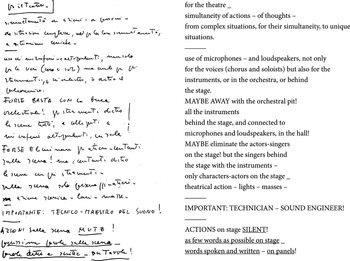
At the same time that he was writing to Andersch of floods, the will towards reconstruction, and political intolerance, Nono was also making notes and sketches for future, ultimately unrealized projects of music theatre. One of these in particular, dating back to the first half of the same year, 1957, can be connected directly to the future work (see Figure 1). In its impulsive and concentrated stream of ideas, lucid if underdeveloped, can be discerned a number of the future dramaturgical characteristics of Intolleranza 1960, here postulated as problems in need of a solution: the idea of the simultaneity of actions and situations; the rejection of the visual apparatus typical of conventional music theatre; the need to modulate and transform sounds in a no longer monodirectional space; the separation of actors and singers, of what is seen from what is heard (hence the idea of the autonomy of sensory capacities as a crucial component of the ‘engaged’ artwork); the use of placards as a means of visually materializing the musical message and enhancing its expression; the need to reduce the text component to a minimum in favour of the action (expressed in correspondence once again to Andersch on 7 February 1958: ‘not very many words, just the essentials, with strong action: exactly as life is lived’).Footnote 14 Last but not least, the presence of the expression azione scenica (scenic action), used here by Nono very probably for the first time, connects these jottings to the work to come.Footnote 15 The proposal to put the orchestra ‘behind the stage’ returns again, and frequently, in further notes that can be attributed with certainty to Intolleranza 1960. The orchestra was seen by Nono from the start as a barrier – and not just a visual one – between the audience and the actors, an obstacle to his desire to eliminate the boundary between public and stage (i.e. between reality and illusion), and thus to overcome every residual element of ritual and artifice in the theatrical medium.Footnote 16
Notebook Q.76 (c1956–7), folio 1r, detail (I-Valn, reproduced by kind permission).

The project with Andersch eventually failed,Footnote 17 and Nono was left in 1958–9 to develop the idea of intolerance as the seed of oppression and persecution in a non-theatrical context: that of the Composizione per orchestra n. 2 – Diario polacco '58. The initial conception of this work shows more than an affinity with Intolleranza 1960: it was originally conceived as a condemnation of the Nazi extermination perpetrated at Auschwitz, Birkenau, and Warsaw, precise places that in the azione scenica were conflated into a single, unnamed ‘concentration camp’. According to the initial plans for Diario polacco '58, a ‘stereophonic tape’ was to be added to the projected scoring of solo flute and orchestra at the beginning and end of the work. As eventually in the protest scene (Part I scene III) of Intolleranza 1960 it was also to feature the simultaneous use of ten different languages. Just as Nono would later quote Il canto sospeso (1955–6) in Part I scene IV of the opera (bars 500–44), so Nono's self-borrowing from the same work is fittingly associated with the climax of dramatic and sonorous intensity in Diario polacco '58.Footnote 18 Certain sketches concerning the internal mobility of instrumental and electronic sound (with the pursuit of various ‘combinations’ of simultaneity and alternation between loudspeaker channels, the orchestra, and the solo flute) are also explicitly directed by Nono to the future: ‘all towards the opera!!!’Footnote 19 That the idea of a ‘documentation’, of a ‘journal’ (Diario) is also closely linked with the theatrical idea is revealed in a note outlined on the same sketch pages. Among his various ‘ideas for the theatre’, Nono thought to develop
Following a ‘working plan’ sketched out between the end of 1958 and the beginning of 1959 Nono determines (with surprising accuracy, given the vicissitudes that will accompany its genesis) to bring the opera to completion ‘within two years’, even though there is as yet no destination or specific commission for it.Footnote 21
These fragmentary ideas were soon to receive a fresh stimulus, one that would provide Nono with ways of realizing the theatrical conception he had already developed on the basis of his wide readings on the subject of modern theatre (including general texts on theatrical history, Giulio Carlo Argan's volumes on the Bauhaus, studies of German expressionist and Russian avant-garde theatre, and especially the theatrical productions of Brecht).Footnote 22 Then, on a trip to Prague at the end of 1959, he saw performances given by the innovative Laterna magika theatre, set up by director Alfréd Radok and stage designer Josef Svoboda.Footnote 23 This theatre's stagecraft, based on a mixture of multiple and mobile projection systems, live action, and stereophonic sound, impressed him deeply with its potential for sonic mobility and spatial transformation, and he immediately recognized its possible repercussions for the staging of music theatre.
Indeed, Nono's enthusiasm for the Laterna magika (and the direct acquaintance he had made with Radok and Svoboda) was his initial reason for making contact with Angelo Maria Ripellino.Footnote 24 Returning to Venice in early January 1960, Nono wrote in warm but deferential tones to the ‘Professor’, whose Majakovskij e il teatro russo d'avanguardia he had recently read.Footnote 25 Nono proposed a meeting with Ripellino in Rome around March, adding that the experience with Radok and Svoboda will be ‘most useful for my future theatre’.Footnote 26 Ripellino's response turns the composer's possessive singular (‘my’ theatre) into a plural (‘our attempt at avant-garde theatre’),Footnote 27 a gesture of common purpose that clearly emboldens Nono, in his reply of 11 January, to extend to the writer an express request ‘not only for advice and information, but openly for your complete cooperation’ and to explain to him the outlines of the project.Footnote 28 And it is in this letter that we become aware of Nono's indebtedness to the American director David Wark Griffith's film Intolerance (mentioned in the letter to Andersch of November 1957 quoted above).Footnote 29 Griffith's epic, made in 1916 and with a running time of more than two-and-a-half hours, intercuts and interweaves four different episodes each from a different period of history (the fall of the Babylonian empire, the time of Christ, Paris in the reign of Charles IX, and contemporary America) to demonstrate the ‘fight of love against intolerance’.Footnote 30 In Nono's remarks to Ripellino, which recall those made to Andersch about three years earlier, the technical-narrative outline of the film is again discernible:
I am thinking of four episodes different in time, in action, and in the type of intolerance, to develop simultaneously from beginning to end, passing from one to another, with an absence of chronological succession: first this one, then that one, then III, but beginning with episode I, continuing with III and II together, then IV and I, then three together, then only one, then all of them etc. (this, of course, to give the idea an outline).
i.e., one develops the idea – the fundamental theme across time, not in the succession of time.
But the model, as always with Nono, is immediately transformed and exceeded:
furthermore I am thinking of an episode V not of intolerance, but its opposite – strength and direct confidence – to counterpoint with the others.
that's four episodes of intolerance, where of course, also in spite of all tortures life and human conduct is not crushed – physically yes – and episode V where the contrary, or better the complement: life and human conduct overcomes and eliminates any Nazi violence. (Nazism as synthesis and symbol and reality of the anti-human.)Footnote 31
The four eras selected by way of example for the first four episodes are the Middle Ages, the Renaissance (to which idea Nono appends the words ‘Galilei-Brecht?’, referring to Brecht's Life of Galileo), the first half of the twentieth century (with the genocide of the Jews), and the immediate present, in the form of the brutal French campaign in Algeria witnessed through the figure of the French journalist Henri Alleg.Footnote 32 The theme is thus sketched out in its main outlines, and although the final version of Intolleranza 1960 unfolds within a single historical timeframe, the dramatic focus of the project would remain consistent throughout its subsequent phases: the ‘journey’, the ‘human pilgrimage’ through self-consciousness, episodes of force, opposition to racism, torture, and reaction, set in a time that is at once both actual and symbolic, susceptible to rereadings in terms of both past and future.
If at this point (11 January 1960) Nono was still uncertain as to the destination of the work, envisaged possibly for the scheduled inauguration of the Darmstadt theatre in 1964, the ideas about the relationship between words, music, and stage are nonetheless unequivocally clear. Nono's refusal of every traditional operatic convention is total. The new music theatre must start afresh from the point at which the experiments of the Russian-German avant garde were interrupted, in order to repair the breach that had occurred within spoken theatre: ‘theatre no longer as church-mass at which an audience is present, but one in which the audience itself participates, at certain moments itself becoming the active actor (an idea that is not new, but a development of what has been [done] hitherto in the noteworthy theatre of Meyerhold, Piscator etc.)’.Footnote 33 The intentions and ideals revealed to Ripellino go back directly to the notes outlined some years previously (see Figure 1): the performance space would no longer be ‘limited to the stage (as in a church)’, but extended to the entire hall, no longer with a unity of place, time, and action. The opera would also bring together all the most advanced compositional techniques: the new vocalism, simultaneity of sound layers, and the electroacoustic spatialization of sound. The stage, cleared of the singers and orchestra that are now located behind it, is completely occupied in Nono's imagination by mime-actors engaged in simultaneous and parallel ‘mute actions’; the singing is diffused throughout the hall by means of loudspeakers or by the chorus, while the projections onto panel screens (by means of the laterna magika) and the actions of the mimes make visible the drama of each scene:
maximum enlargement now of the possibility and human capacity for communicating-speaking-acting-showing-moving-shaking, of the maximum possibilities now for human reception.
here then the 4 or 5 episodes should create a unity in their diversity and in their amplified-autonomous implementation.Footnote 34
Ripellino did not hide his doubts about the possibility of achieving these ideals within the resources of theatrical establishments of the time – ideals which, not coincidentally, led him to think of the Totaltheater of Walter Gropius or Nikolay Okhlopkov, both known also to the composer.Footnote 35 In his subsequent communications with Nono, moreover, he became distracted by other issues in a way that gradually brought the opera project close to a standstill.Footnote 36 At the beginning of May, more than four months from the start of the collaboration, there are still no actual developments. The joint enterprise, sustained only by a vague sense of purpose, remains unencumbered by any firm commission and imagined, depending on which of the two one follows, as either the means (Ripellino) or the end (Nono) of an artistic ‘struggle’ to reach out and shake the rest of society. The apparent ‘communion of intent’ that had initially prevailed between the two gradually drifted into a misunderstanding that would ultimately leave a permanent mark on their professional and personal relationship. And yet, in the light of that eventual misunderstanding, their correspondence, which records every detail that passed between composer and writer, assumes an even greater importance. Nono's letters especially constitute a true logbook of the project, and it is remarkable to note the consistency with which each item discussed with, proposed to, or requested of the writer will find an eventual place in Intolleranza 1960, whether as a musical idea or a verbal suggestion recovered by Nono in his revision of the text. In addition, a number of the stylistic innovations and technical-compositional achievements that Nono had tried out in the vocal compositions completed between April and May 1960 – Sarà dolce tacere and “Ha venido”: Canciones para Silvia – are now envisaged as ‘studies on new possibilities of expressive techniques of singing’ and the sources of a new musical language – ‘all for our opera!’Footnote 37
It is at this point that the invitation arrives from Mario Labroca, the Biennale superintendent, to write an opera for the 1961 International Festival of Contemporary Music in Venice. The request, first mentioned to Ripellino at the beginning of April,Footnote 38 is confirmed by Nono in a letter of 25 May 1960:
The deadline is envisaged in the same letter as July 1961 and, in order to speed things up, Nono immediately asks for a meeting in Venice to establish definitively ‘the situations to develop. This way I too can start making plans’. The generative nucleus of the drama becomes a documentary text, drawn from the journalist Henri Alleg's account of his interrogation and torture during the Algerian war of independence, which the composer had already sent to Ripellino to develop along with one or more different texts ‘in order to have a dialectic of situations’.Footnote 40 A similar assemblage of phrases and situations on the subject of man's inhumanity to man had initially been considered by Nono as an independent theatrical project, to be completed ideally by August and staged, in collaboration with Emilio Vedova, by the end of 1960. Nono now encourages Ripellino to work with Achille Perilli to develop this first idea, associating it with other texts or fragments of similar dramatic significance and structuring it into two parts of between two and three scenes each:
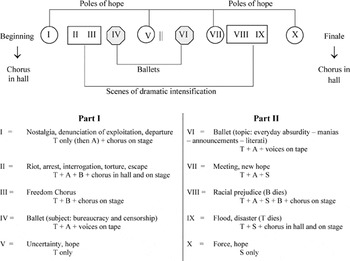
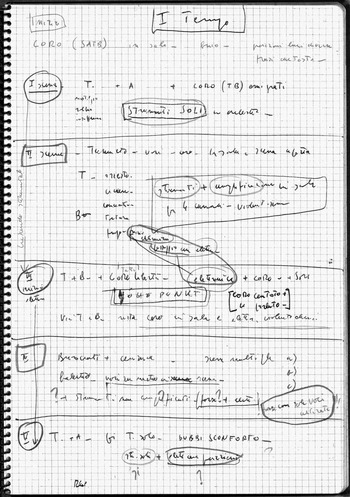
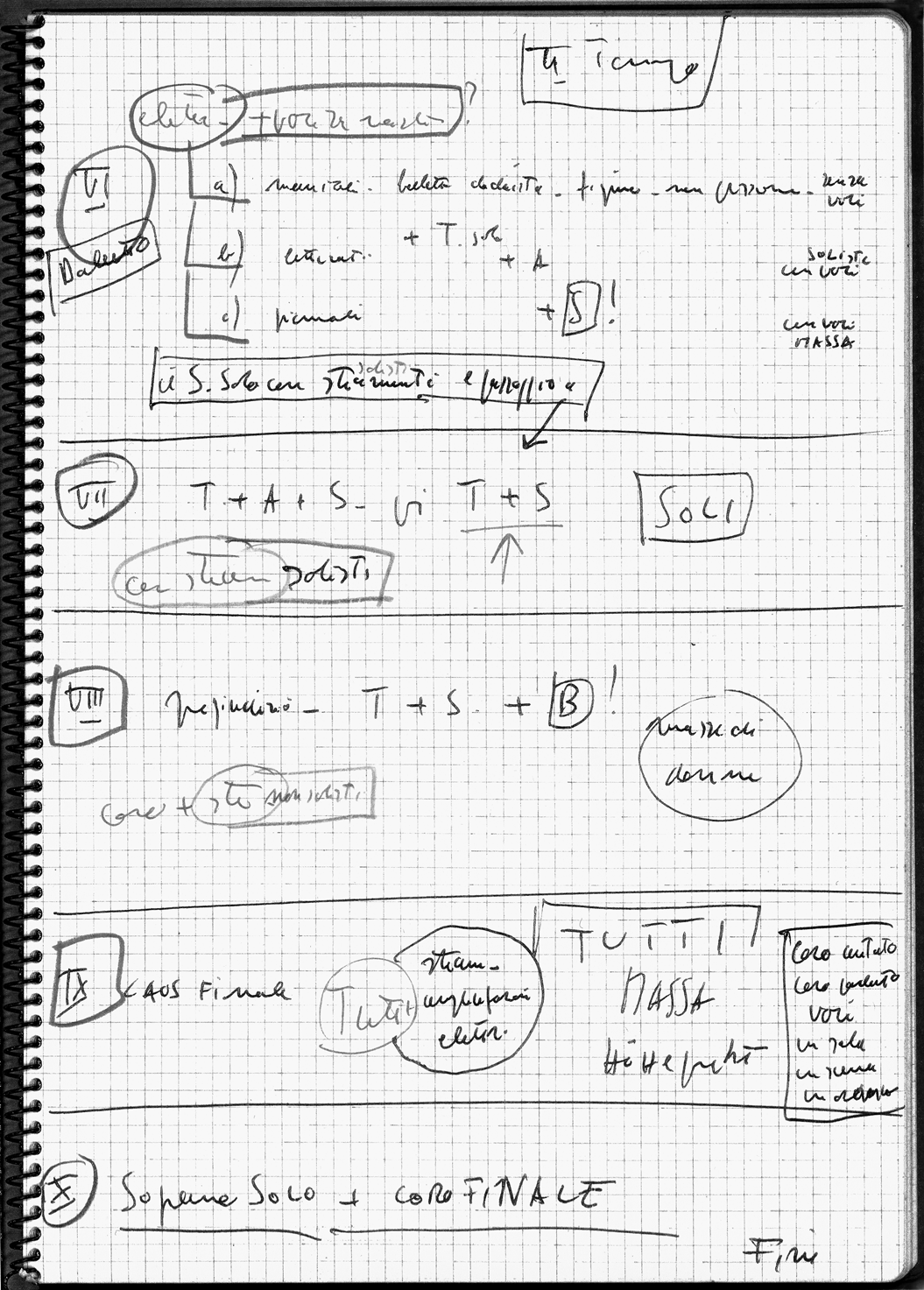
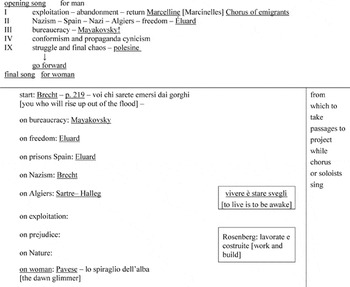
But the situation grinds to a halt again: on 4 October 1960, after months of silence, Ripellino confesses that he is ‘in a tight spot’ with the promised libretto,Footnote 42 for which, according to Nono's notebooks, he should by now have had a clear formal and thematic outline. With only six months left before the première the impatience of the composer is now palpable. In mid-November, despite the fact that the libretto is still far from established, Nono begins to sketch out the first detailed schemes of the drama's development, following an ‘outline of situations’ that deals with both form and staging (see Table 1 below). In these sketches one sees what in nuce will be the contents of Ripellino's libretto, for which Nono continues to provide suggestions and materials.Footnote 43 Among these are three handwritten pages on which the composer outlines a provisional formal plan of the opera, quite similar to the outline in his notebooks (see Figure 2), accompanied by explicit requests concerning the content of scenes yet to be defined. (For example, for the projected scene VIII, dedicated to ‘prejudice’, Nono urges Ripellino to use ‘also the K. K. K. / and therefore the baritone fellow […] he may be a negro, who is here lynched or burned’).Footnote 44
Schematic overview of initial conception of Intolleranza 1960. This schematic outline is based on sketches in the following notebooks at I-Valn: Q.07, Q.08, Q.22, and B.15. In keeping with the composer's notational habits, individual scenes are indicated, here and in the main text, by means of Roman numerals.

General plan of the opera, handwritten sketch (I-Valn, Q.08, folios 2r and 3r, reproduced by kind permission). In the sketch Nono highlights dramaturgical references through the use of particular colours: scenes I, III, V, VII, and X (in the original circled in blue) refer to positive poles of the drama, associated with liberty and rebellion; the remaining scenes (circled in red) are associated with negative poles: oppression, exploitation, violence, etc.

Continued
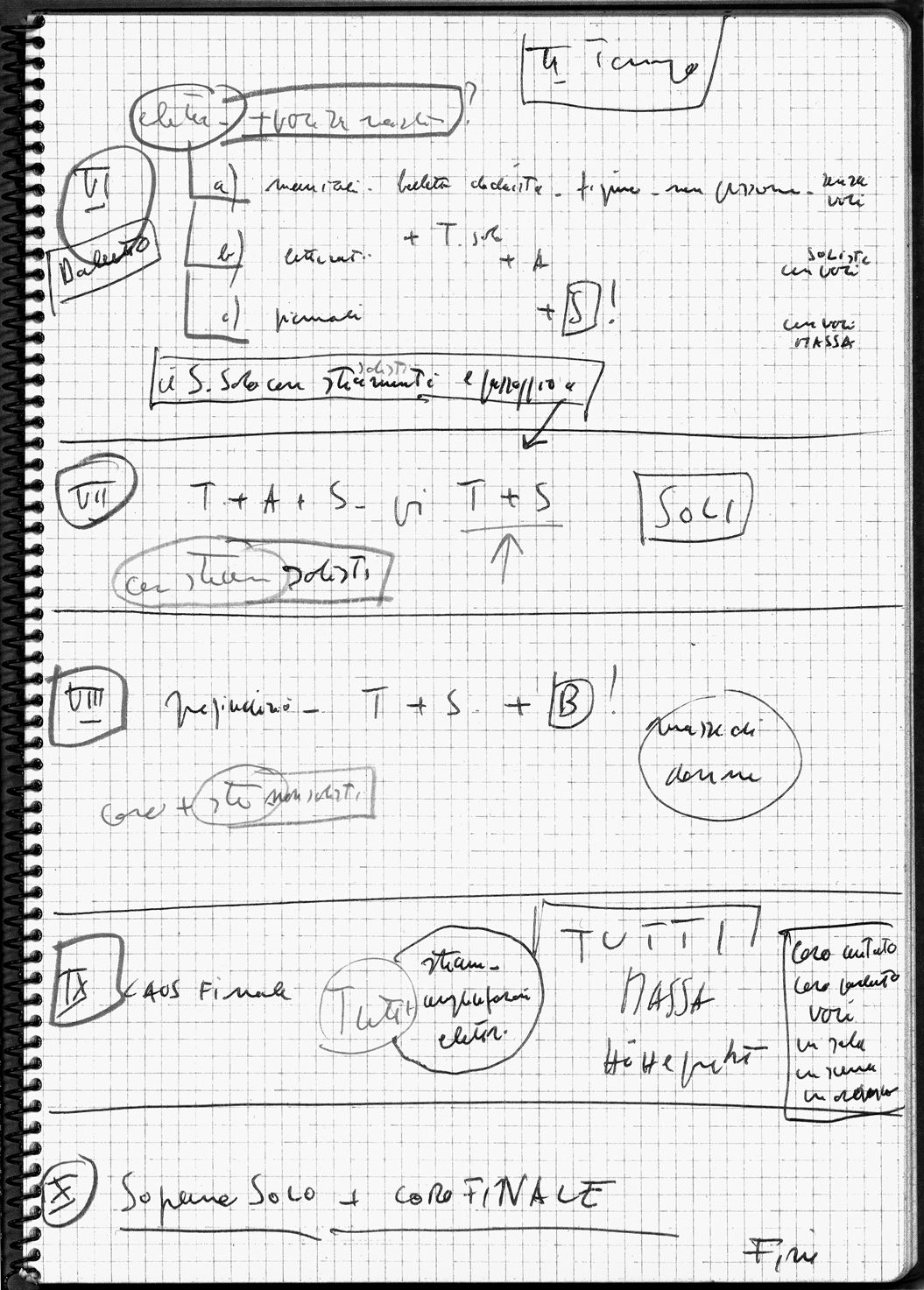
As can be seen from Table 1, the opera is currently divided symmetrically into ten scenes, five to an act; Nono defines these as ‘situations’ in the manner of Sartre, and his decisions involve every musical and theatrical detail, with particular attention to dramaturgical balance, internal symmetry, and the relationships between the various scenes (see Figure 2 and Table 1). During the journey of the protagonist, an anonymous emigrant, tragedy and hope alternate in equal proportion; and among the episodes that express the drama using singing and action, Nono plans to include two ballets, conceived as allegorical moments denouncing ‘everyday absurdity’.
Alongside the drafting of these sketches, Nono sets out in his notebooks a list of authors, texts (sometimes indicated by the page number of the printed source), and historical events to connect directly with the different scenes and characters (see Table 2). References to these textual sources are then further honed, in relation both to the sung texts and the ‘emotional captions’ (the words to be projected on screen along with them): Paul Éluard's poem ‘Espagne’ is chosen specifically ‘for freedom in prison / perhaps: song in captivity’; words from Ethel Rosenberg's poem ‘If We Die’ (here indicated by the poem's incipit, ‘lavorate e costruite’) are envisaged for the finale.Footnote 45 Nono draws heavily on Mayakovsky, whose texts appear at a number of points: ‘La nostra marcia’ (Our March) is associated with ‘freedom’, and another three poems are destined for the bureaucracy scene: ‘Burocraziade’ (Bureaucratish), ‘Fabbrica di burocrati’ (A Factory of Bureaucrats), and ‘Orrori cartacei’ (Paper Horrors). On the other hand ‘Con tutto l'urlo delle sirene’ (With All the Wailing of the Sirens), a proud proclamation of Leninist thought, and ‘Marcia di 25.000’ (March of the 25,000) are yet to be assigned a place.Footnote 46 For scene II (later to become scene III, the protestors' scene) Nono also considers the projection of stills from Eisenstein's film October.Footnote 47

The contents of these notebooks show the way in which the formal framework already incorporates such considerations as the alternation of timbres (vocal and instrumental, and their density), the planning of the scenography (lighting, projections, actor-space relationships, etc.), transformations involving the density of sound (including the interchangeability of solo roles between voices and instruments), and the dramatization of the acoustic space. For the first act Nono imagines a systematic procedure involving a crescendo and decrescendo of sound density: following the introductory choral parodos, scene I consists in its entirety of a vast crescendo–decrescendo, while between scenes II and III this is reversed, leading from a climax of intensity to maximum acoustic rarefaction, before a further crescendo to the violent Höhepunkt finale, which breaks off sharply with the start of scene IV (see Figure 2).Footnote 48 It is impossible to separate this projected evolution of sound from the ideas taking shape in the libretto. Between scenes II and III, for example, Nono imagines a dynamic and mirror-like relationship between torture and hope, the latter intensifying as the former weakens: the sonic climax at the beginning of the torture scene is mirrored, as it diminishes, by a climax of hope.Footnote 49 To the macroformal symmetry, the inner symmetry of the single acts operates as a pendant: in the first, for example, scene V is the natural counterpart of scene I (see Figure 2 and Table 1), in that both involve the presence of just the Tenor and both represent ‘positive’ poles of the drama. Also the scenes are balanced in a mirror-like fashion, and the 3+2 of the first act corresponds to the 2+3 planned for the second (see Table 1).
The general framework of the opera is therefore defined, and everything is ready for composing to begin; all that is missing is the final text. In early December Ripellino writes to the composer: ‘I have almost finished the first act. (It's a first draft, naturally, but good enough). Tomorrow I will start the second. Then I will put it all together.’Footnote 50 Ripellino's vagueness takes on worrying undertones when we consider that the date of the production is only four months away.Footnote 51 Meanwhile decisions concerning other likely collaborators are reaching an advanced stage: so advanced, in fact, as to lead to potentially embarrassing situations of asynchrony. On 6 December 1960, for example, Alfréd Radok, thrilled at the Biennale superintendent's invitation to collaborate as director on the project, asks first Labroca then Nono for the score of the work.Footnote 52 But, far from having completed the score, the composer is still waiting for a version of the libretto that will do justice to his ideas. On reaching this point he realizes he can wait no longer: he begs Ripellino to supply if only just the first scene, and begins simultaneously to extract from a provisional draft of the first act a typewritten guide which, in accordance with his usual practice, can serve as a basis for composition.Footnote 53 During this working-out phase the first proper outline (a total of five typewritten pages) reaches Nono from Rome, again with the timorous clarification ‘this is not to say that everything is final. We can still change anything’.Footnote 54
II The changes to Ripellino's text and the modification of the project
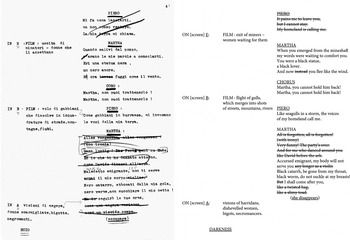
Following the original plan (in ten scenes) the musical composition of the first scene can now finally begin: a work outline sketched hastily by hand immediately following the receipt of Ripellino's outline reveals that we have now reached 10 December.Footnote 55 Precomposed plans for the timbral, dramatic, and theatrical evolution of the work are now outlined in various notebooks, clearly enough to allow the process of composition to advance by stages. But the verbosity and pomposity of this first scene sent by the writer (later subdivided into two scenes) leave Nono perplexed. After drastic and vigorous editing (Figure 3), he is able to save for ‘his’ final text only 46 of Ripellino's 108 lines.Footnote 56
Angelo Maria Ripellino, original Part I Quadro I, page 4 of definitive typescript with handwritten interventions by Luigi Nono (I-Vanl, reproduced by kind permission). The choral interjections, though not struck through in this document, are absent from the final libretto. The names of the characters Piero and Martha were later changed to the generic ones of, respectively, Emigrant and Woman.

As Ripellino's individual texts continue to arrive, the disappointment Nono felt on receiving the first submission turns to anger with the second and to complete refusal with the third.Footnote 57 The text was not only far from what he wanted (above all: ‘very few words on stage’) but in some ways quite opposed to the ideal of music theatre to which he aspired – a theatre of commitment and denunciation, free of masks and disguises. Ripellino's text, dreamlike rather than realistic and verbose and long-winded in its versification, directly juxtaposed fantastic and surreal elements with factual information drawn from current or recent news stories.Footnote 58 As if to emulate the narrative strategies of the Russian-German avant-garde theatre of the 1920s, Ripellino sought to use a surreal kind of comedy to personify a collective imagination and those reified abstract nouns (Bureaucracy, Misgovernment, etc.) that conjure up the vices and false morals of a society worthy of derision. This is why (with the sole exception of Ripellino's Part I scene II, the torture scene, later to become scene V) unlikely tyrants, harridans, clowns, imaginary high priests, insipid bourgeois and arriviste writers are thrown in with a chameleon-like woman – the deluded lover (here given the name Martha) – who herself plays various roles, including sorceress, clown, and scholar. Their purpose is to hinder the journey of the emigrant (Piero) and his courageous companion (Zina), and to repeatedly torture the Jewish prisoner (Erni). In addition to the fantasy element, already opposed to Nono's ideal, the metaphorical and bloated style of Ripellino's libretto blunts the impact of the drama, giving it almost a ‘lyric’ nuance. Especially foreign to Nono must have been the almost Dadaist interventions of clown-like figures (with their refrain ‘Lomolarm, cache-cache, / ni-gugu, miche-mache’), the use of onomatopoeic caricature (as in the refrain of the sacristan: ‘Bim-bom: Glockenton’), and the repeated intrusion of grotesque elements (whether phrases of the libretto or secondary characters) into tragic situations – for example, the ‘ministers’, ‘secretaries’, and ‘chancellors’, who, during the dramatic final scene of the flood, ‘wear divers' suits’, or the ‘general’ loaded with medals who, rejoicing in the launch of the third atomic bomb, triumphantly declares ‘one more mushroom, and we'll be joining the Mycological Society’.Footnote 59
But there was no time to rewrite the text, and the only solution was to reformulate ideas from the existing libretto, sometimes copied and revised progressively by Nono until there were twelve different typescripts and/or manuscripts. In the various stages of his editing, it is possible to observe the transformations he enacts on Ripellino's characters – including the humble and oppressed Piero, Erni, and Zina, and the peasants – with their sad, resigned, and often oppressive tones. Their feeble and desperate reactions, their surrender to situations against their own will, and their vague invocations cast in the future tense or the conditional (‘Will I overcome …?’, Will I carry on …?’, ‘I would like to comfort you’) are overturned in Nono's rewriting with impetuous force. As reshaped by the composer, they become symbols of a community, represented no longer by a proper name but by a generic noun (the Emigrant, a Woman, the Companion, and so on). In situations both good and bad, they rise up as proud and purposeful figures: victims, but of a kind that remain committed to resistance, moved by a desire for change, tenacious and fully aware of their situation right up until their tragic death in the floods.
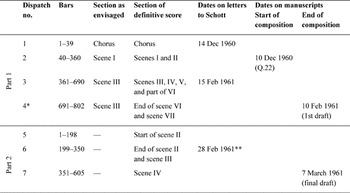
In the meantime, by the beginning of December, contact with the work's publishers, B. Schott's Söhne, as well as the director and scenographer, were well underway, and all were relying on the delivery of a score that was, in fact, not yet begun. To facilitate the various editorial tasks, Otto Sertl of Schott asked the composer to send scenes to the publishers piecemeal as they were being composed.Footnote 60 Following a procedure that would be unique in his compositional career, Nono delivered the sections of the score to the publisher in a total of seven dispatches (Table 3), a procedure that had a notable influence on later creative events. A first conspicuous departure from the initial project occurs in fact at the time of the second submission to the publisher: in making ready for press his fair copy of the first scene, Nono resolves on account of its length to split it into two distinct scenes.
General outline of submissions to the Schott publishing house sent during the period of composition. Diagram based on the analysis and collation of multiple sources (first and second drafts of the manuscript score, correspondence with Schott, and different drafts of the libretto).

In the welter of changes, and in order to gain direct advice and confidence, Nono sought the assistance of his friend Bruno Maderna, whose hand is directly visible on the typescript of the second scene sent by Ripellino (alongside the portions of text merged into the eventual Part I scene IV).Footnote 61 For this scene, Nono transcribes more typewritten outlines than there are ‘situations’: uproar, arrest, interrogation, torture, and escape (see Table 1).Footnote 62 And with the last of these typescripts, based on Mayakovsky's revolutionary poem ‘Our March’,Footnote 63 Nono makes the abrupt decision to conclude the first act. By this time all previous plans, technical and dramaturgical, find themselves abandoned. The composer divests himself almost completely of any obligation towards Ripellino, either remaining silent or keeping him only partially informed about the changes to the text.Footnote 64 Nono is now his own librettist (or rather, the rewriter of a text from which he anxiously salvages his initial ideas) and, in a manner that goes against all his normal habits, has to manage simultaneously and in almost extemporary fashion the redaction of the text, the composition of the music, and the proofreading.
Important decisions are being taken along the way: before sending to the publisher the final section of the long scene III (Table 3, dispatch no. 4) he makes the sudden decision to divide it into five different scenes, one for each dramatic situation, leaving Part I with an unexpected total of seven scenes (the date written by Nono at the end of this first draft is 10 February 1961). He then recopies the final text of this first act and forwards it to Schott, who, until the end of March, will continue to report in letters and contracts the designation: ‘L'intoleranza [sic], Oper in 7 Szenen’.Footnote 65 Later, on 20 February, he sends a copy of it to Erwin Piscator, who is now asked to be the director of the production. Hopes for Alfréd Radok's involvement had vanished a couple of months earlier at the end of December owing to political and bureaucratic impediments. On 31 December 1960 Radok informed Nono that ‘the arrangements for my trip to Italy are not to be carried through’ (a letter with the same date and identical content was sent to Labroca). On 15 January 1961 an official letter was sent by the Czechoslovak Ministry of Culture, describing the director as ‘indisposed and gravely ill’ (ailments of which, of course, there is no hint in Radok's own letters). They proposed to send in his place ‘one of the best directors of lyric theatre in Czechoslovakia, the meritorious artist Václav Kašlík, head director of the Opera of the National Theatre in Prague and the architect Josef Svoboda, head scriptwriter.Footnote 66 Although the composer had not accepted this solution with any great enthusiasm (going as far as to complain directly to Palmiro Togliatti),Footnote 67 he did, however, agree to the Ministry's proposal.Footnote 68 Perhaps it was while preparing himself to accept this forced substitution that Nono extended his simultaneous invitation to Piscator, to avoid embarrassment in the event of new or sudden obstacles from the Czech government; or perhaps, on 20 February, he had still not confirmed his decision with the Czechoslovak Ministry and, with all hope gone of getting Radok, resolved to call on the ‘great master’ with whom he had been attempting to collaborate since 1952:
While the idea of using Piscator was very quickly abandoned,Footnote 70 this letter to him is revealing in many ways. While it contains a degree of dissembling – the ‘final text’ of Part I is actually just one of many intermediate editorial stages (twelve, in fact, from the first typescript to the text printed by Schott)Footnote 71 – it is the earliest source to associate the intention of projecting ‘small fragments of film’ with the work of the Belgian filmmaker Joris Ivens. In the copy of the text he sends to Piscator, Nono contextualizes this suggestion, making reference in the margins of the typescript for Scene I, near the stage directions ‘shacks of miners / desolate countries’, to ‘Borinage of Ivens’.Footnote 72 Not a trace of this idea will remain in the final production of the work.
The promise ‘Part II will be finished shortly’ turns out to be a slightly optimistic assessment. On 20 February Nono was still in the process of composing Part II scene III – and the entire opera would not be completed until the beginning of the following March. For Part II scene I, which returns to the idea of ballet accompanied by electronic music on tape, the entire montage process was carried out by Bruno Maderna at the Studio di Fonologia of RAI Milan. Of the remaining three scenes of Part II there exists just one sketch relating to the choral finale: the long-awaited ‘new’ opera now resorts to a kind of impromptu writing or to mining pre-existing music from Nono's output. Of little more than six hundred bars, about half are taken either from music already composed for Part I or from compositions of the 1950s; and if the resurfacing of Il canto sospeso in the interrogation scene (Part I scene IV) seems appropriate to the theme of resistance or, similarly, the use of Incontri for the Emigrant's encounter with the Companion (Part II scene II) to that of love, the borrowing in Part II scene III of the second of the Due espressioni per orchestra of 1953 has no plausible explanation other than that of urgency.Footnote 73
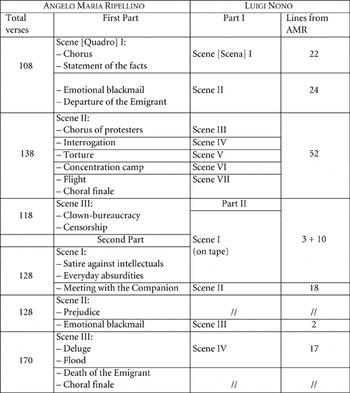
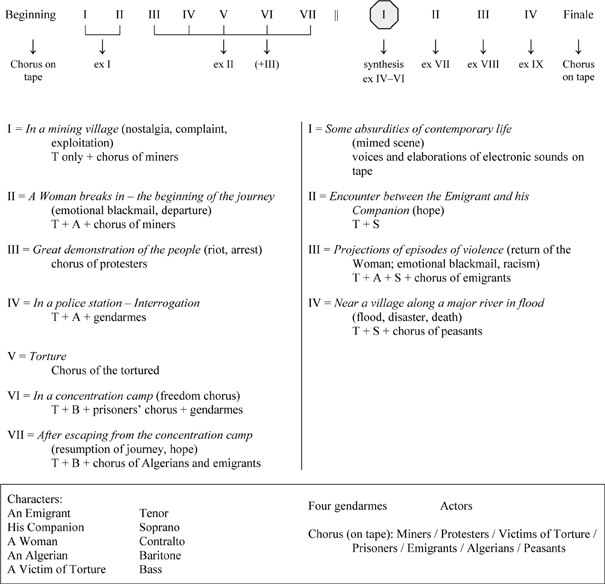
On 7 March 1961, with the completion of Part II scene IV, the entire work may be regarded as finished. Of Ripellino's contribution there remains but a pale echo (see Table 4), and the overall result emerges as the fruit of a singular compromise between intention and necessity, something very different from the original conception (see Table 5). In the final text reworked by Nono, among fragments of Ripellino's verses and passages or citations originally inserted by Ripellino at Nono's request, places are found for almost all the texts selected by the composer during the preparatory phase of the work. The initial chorus opens with words from Ripellino's poem, ‘Vivere è stare svegli’ (‘To live is to be awake’).Footnote 74 From Julius Fučík's Notes from the Gallows, which had been on the horizon of Nono's theatrical projects for some time, he draws the tight questioning of the First Gendarme in Part I scene IV (‘Your name? Your address? Talk! …’);Footnote 75 in this same scene are phrases, given to other gendarmes-torturers, drawn from La gangrène, a volume that assembles testimonies of Algerian students tortured in Paris in December 1958 (‘Speak! If I get mad I am capable of anything, I learnt torture from the Nazis’, ‘You're going to the spit! Here we control everyone’, ‘Spy! You will spill everything! …’).Footnote 76 The brief text prerecorded on tape as the ‘Voice of Alleg’ and amplified through the hall after the violent interrogation at the end of that same scene is drawn from Alleg's La question (‘For whole nights during the course of a month I heard the screams of the tortured. Their cries will resound for ever in my memory’).Footnote 77 From the preface to La question is extracted the text of the ‘Voice of Sartre’ that closes the following torture scene (‘In no era, the desire to be free…’).Footnote 78 Part I scene VI is set in a concentration camp, and it turns out to be the result of a veritable collage of texts that includes: a) a selection of stanzas from Éluard's poem ‘Liberté’, which, in an Italian translation of uncertain origin, is entrusted to the chorus of prisoners; b) new passages from La gangrène, given to the ruthless gendarmes; and c) a new passage taken from Notes from the Gallows and declaimed by the Tortured/‘Voice of Fučík’ (‘Death, you have been a long time coming …’), amplified like all the other ‘Voices’ through the loudspeakers in the hall.Footnote 79 Mayakovsky closes the first act, with the first stanza of the poem already mentioned, ‘Our March’, later resumed verbatim in the finale of Part II scene III. For the conclusion of the work as a whole Nono entrusts to the Chorus the third part of a long poem by Brecht, ‘An die Nachgeborenen’ (To Those Born After), ‘You who will rise up out of the flood’, intended at the planning stage to be at the beginning of the opera.Footnote 80 This decision, although taken in a seemingly impromptu manner, is not without significance: in his copy of the text Nono circles the date 1938 at the foot of the poem and notes ‘Intolleranza 1960 / choral finale’. The correspondence with the end of the first act is thus perfect, as Nono had likewise highlighted the date of publication of Mayakovsky's ‘Our March’, 1918. The period of time circumscribed by the closing choruses of the two acts is therefore that from the end of the First World War to the beginning of the Second. The decision to close with Brecht's words thus allows for dual interpretation, as either a resolution of the drama or a rupturing of the illusion it provides: from metaphor to reality, after the full flood and the destruction of men and things, there still remains the confidence in ‘you who will rise up out of the flood / beneath which we were submerged’, words that at the same time shatter the theatrical illusion and confront the audience with the reality of a warning (that ‘man is helper to man’) written as a response to Nazi barbarity.
Comparison between Ripellino's original libretto and lines chosen by Nono for each scene.

Schematic diagram of Intolleranza 1960 (final version). Text in italics reproduces descriptions taken from the original stage directions (see the Schott libretto AVV269).
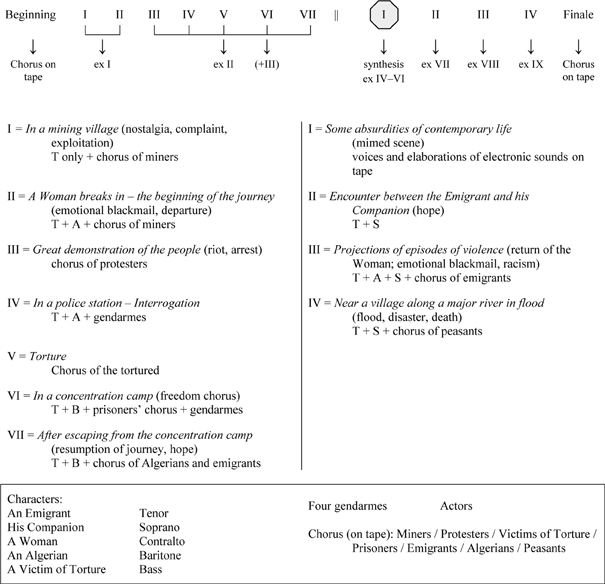
The realization of the quality and quantity of the changes made to his libretto by the composer was for Ripellino a source of disillusionment and bitterness. Already at the end of February he wrote to Nono:
from what you told me, it seems to me that of my modest contribution very little has remained in the opera. I don't have anything against that and I absolutely understand your musical and dramaturgical reasons. And I also know that such is the eternal destiny of texts for music […]. In reality, the work is yours, and not just for the music, but for the concept, the editing, the setting, etc. Of my work there remains only the carcass of some verses. Is it really worth me getting implicated with the academic and superfluous name of librettist? Would it not be more honest, now that we are at the culminating moment and, to my joy, the problem of the director is solved, for me to withdraw myself to the sidelines? You could, if anything, put under the title, if you wanted to, the wording ‘on themes of Eluard, Mayakovsky, A. M. R., etc.’.Footnote 81
This apparently conciliatory tone seems to be eclipsed entirely in future communications regarding the libretto. Seeking clarification, Ripellino turns to Emilio Vedova – now called upon to produce costumes and scenes – as well as the superintendent of the Biennale, Labroca. It is in Labroca's letter to Ripellino of 6 March 1961 that we encounter for the first time the locution ‘da un'idea di’ (based on an idea of), which appears to owe itself to Ripellino's initiative rather than to any grateful acknowledgement on Nono's part:
Dear Ripellino,
I very much regret what you told me about Nono's opera and the limited use he has made of your text. / I am absolutely in agreement with you to use the expression ‘based on an idea of Angelo Maria Ripellino’. I am only sorry that the first publications of the Festival speak of the libretto; however the clarification you request will be in the general programme and on the posters.Footnote 82
The new expression, ‘Nach einer Idee von’ (also accepted without hesitation by the work's publisher, Schott) inevitably entailed for the writer an economic loss that compounded his discontent.Footnote 83 From then on, an eloquent silence fell between the opera's two ‘collaborators’, broken only on the occasion of the Venetian première on 13 April.
The work performed that evening, in spite of the stormy events of its genesis, tenaciously kept faith with its initial premise of breaking away from conventional theatrical models: after Intolleranza 1960 avant-garde theatre, and not just music theatre, acquired a new physiognomy. Paradoxically, this effect was thanks to a reception that involved heated debates, and perhaps misunderstandings, but little of the sounding reality. After only one reperformance two days later on 15 April the opera would not be performed again in Italian for another half century.Footnote 84 In June 1961, in anticipation of the Cologne première of 3 April 1962, the libretto was translated into German by Alfred Andersch. With Andersch's not coincidental reappearance back on the scene the fate of the opera unexpectedly took a new, paradoxical course. The score was published by Schott at the end of 1962 with German text only;Footnote 85Intolleranza 1960 became associated almost exclusively with a German linguistic and cultural milieu, its original Italian version lost from view, even though its text-music relationship is so strongly dependent on the Italian idiom.Footnote 86 In sixteen subsequent performances (from Cologne in 1962 to Munich in 2007) the work was performed exclusively in German, the language also of the commercial recordings to date.Footnote 87 The heated debate that developed around Intolleranza 1960 in the aftermath of its première was based essentially on just one hearing (seriously undermined by cunningly organized Fascist ructions at the Teatro La Fenice),Footnote 88 and it was on the strength of those views that it became for many the emblem, or the target, of the ‘new music theatre’. It is perhaps for this reason that in the creative trajectory of Luigi Nono, and in the history of late-twentieth-century music, Intolleranza 1960 has found itself in the category of a part literary, part legendary event, handed down as memory and thus all too distant from the work's sounding reality and the practical musical issues it involves.
III Intervals in the service of dramaturgy: the ‘character rows’
Speaking of the relationship between the music and text leads naturally on to an investigation of the more purely technical aspects of the compositional process, above all those involving the organization and treatment of the note rows. Behind these processes, nonetheless, lies a lucid and unmistakable dramaturgical logic. Intolleranza 1960 can be seen as a watershed work, a ‘laboratory’ in which the compositional techniques that Nono had developed up to this point give way to an ever greater freedom and procedural experimentation that will have significant consequences for his future output. And this greater extemporary freedom can itself be attributed to a large extent to the turbulent circumstances of the work's genesis.
The path towards Intolleranza 1960 had been marked by other projects, in particular vocal pieces, that Nono intended as preparatory ‘studies’ for the development of a ‘new dramaturgy’ closely linked with specific technical-compositional procedures. The first technical aspect that differentiates Nono's works after 1960 from those composed in the preceding decade concerns a gradual emancipation of rhythmic from intervallic relationships. Pitch and rhythm, conceived in Nono's earliest compositions (at least until 1952) as interdependent dimensions, seem to have undergone in these years a reversal of priority in their role in the compositional process: whereas rhythm had been the primary structural dimension in the compositions of the first half of the 1950s, it is now the interval, an element previously subordinate to temporal decisions, that takes centre stage.Footnote 89 Such a shift in technical priorities seems to have been favoured by Nono's simultaneous reflection on the ‘meaning’ and importance of the interval, in expressive as much as structural terms. Some of Nono's earliest pieces – such as the orchestral Variazioni canoniche sulla serie dell'op. 41 di Arnold Schönberg (1949–50) and La victoire de Guernica (1954), for mixed chorus and orchestra – had drawn their intervallic materials from pre-existing rows or harmonic models. For the next few years Nono turned to all-interval rows, used for the first time in Canti per tredici (1955) and then systematically in all the compositions between Il canto sospeso (1955–6) and Cori di Didone for choir and percussion (1958). While on one hand the all-interval row allowed Nono to put into practice the idea of the series as an athematic entity, on the other hand it provided him with a sufficiently neutral and malleable grid to indulge any expressive need. With the statistical control of pitch overcome by the constant circulation of the all-interval rows, the choice of intervals became increasingly intuitive, defined locally and directed towards the creation of complex sound surfaces (or better, harmonic surfaces) such as blocks, pitch bands, groups, continua, and so on.Footnote 90
So, while in the compositions of the early fifties the dramatic-expressive characterization of musical situations (or of characters, in the case of unfinished theatrical projects) is entrusted initially to rhythmic series or formulas (very often based on pre-existing rhythms and used in the manner of leitmotifs),Footnote 91 at the start of the 1960s, and specifically in the original conception of Intolleranza 1960, the same function comes to be assumed by the interval, now used to generate pitch series that take on the function almost of ‘dramatic Gestalten’.Footnote 92 The interval thus gradually becomes the most important musical element and the raw material on which the initial decision-making phases of the compositional process are focused. This is also evidenced by traces in non-musical sources: for instance, in the case of compositions associated with a text, notes of basic intervals suited to the emotional temperament of the situation or character described can be found even in the margins of Nono's copy of the relevant book or source text.
The tendency to isolate specific intervals in order to construct series endowed with precise expressive meanings is clearly evident in his two vocal works from the start of the 1960s, Sarà dolce tacere and “Ha venido”: Canciones para Silvia. For both compositions the choice of the constituent basic intervals of the different rows (each intended for a single section of the piece) is based on a personal ‘sonic reading’ or musical interpretation of the respective texts by Cesare Pavese and Antonio Machado set in these works. By virtue of the constellations of intervals associated with individual stanzas or passages of text, the composer underlines the semantic and/or expressive correspondences within each poem. In these vocal works the selection of key intervals, their deployment to create series of pitches, and the use of these rows in the compositional process are based on procedures somewhat different from those that had governed the compositions of the second half of the 1950s. All sound events (vocal lines, groups, etc.) are now developed using a particular technique of pitch generation: thanks to the selection of ‘basic intervals’ (‘intervalli base’, as they are called in the sketches), Nono models twelve-note rows as generative matrices in which each of the twelve pitches can potentially produce other notes on the basis of precise relationships of multiplication that respectively determine the quantity (the number) and quality (the intervallic distance) of the pitches generated. The ‘complementary intervals’ that regulate the distances between the pitches generated can for their part be identical to the intervals of the ‘mother series’ (the generative Gestalt), or be selected locally on a case by case basis, following variable criteria.Footnote 93 Nono creates in this way a mechanism for the ‘production of pitches’, still guided at this stage by grids and matrices for the statistical distribution of notes, that enables the creation of sound phenomena in constant transformation. Underpinning this technique was the interval, with all the expressive implications conferred on it by the composer.Footnote 94 This complex process is further developed in Intolleranza 1960, where the considerable lapse of time between the selection and preparation of the compositional materials and the final phase of writing allows privileged insight into the evolution of particular technical/compositional processes, the most interesting of which concerns precisely the use of the interval and its gradual ‘liberation’ from the structural logic of prearranged rows or modules.
There are, as discussed earlier, five main characters in Intolleranza 1960: ‘an emigrant’ (Tenor), ‘his companion’ (Soprano), ‘a woman’ (Alto), ‘an Algerian’ (Baritone), and ‘a victim of torture’ (Bass). The chorus interacts with these characters sometimes as an autonomous voice, providing comment, and sometimes as an amplification of the individuals' sentiments or feelings. The sketches show how and on the basis of what reasoning Nono arrives at the choice of different generative rows for each individual character. In the first phase of the project, having decided upon the voice types of the solo roles and their order of appearance in the various scenes (still following the original 5+5 model), Nono proceeds to outline in a brief note the character and emotional disposition of each:
The composer anticipates using different approaches for the Alto on the one hand, and the Tenor, Baritone, and Soprano on the other: the first is to be ‘always differentiated!!!’ (i.e., her dramatic interventions must always be clearly distinctive and different from those of the others); the other three voice-types ‘become integrated with each other, according to the situations, whether symbolic or not. (as for intervals)’. As a result, the vocal lines of the Tenor, Soprano, and Baritone may, depending on the situations represented, become interchangeable (‘therefore the Tenor, when he becomes like the Baritone or the Soprano, together even with the registers-timbres of the other two, and vice versa’). For the Alto, on the other hand, Nono envisages a separate treatment, with the exception of occasional ‘integrations of registers and timbres [voice-types], especially that of the Tenor’. Also established for each of the four soloists is the possibility of setting up ‘harmonic pedals’, designed as amplifications or intensifications in choral, or indeed orchestral, terms of the respective vocal harmonic line.
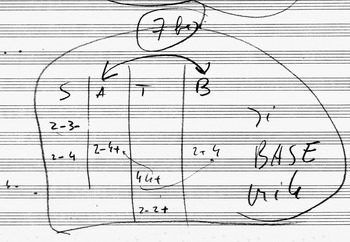
Nono then proceeds to define the generative note rows for the individual characters and for the chorus. The latter had to fulfil, again by means of the use of specific intervals, one of the composer's most important musical and dramaturgical requirements, the articulation of the complementary relationship between soloist and mass viewed as a ‘transition from individual situations to collective situations’.Footnote 96 Among his first ideas was that of creating leitmotifs by means of intervals and rows:Footnote 97 in other words immediately recognizable musical structures for each character. The responsibility for achieving integration between various voice-types is now shifted more substantively to the domain of intervals: ‘same possibility of interval integration between the 4’.Footnote 98 For each character, then, Nono envisages one or more ‘basic’ generative rows, each involving the alternation of two specific intervals. The basic intervals are limited to five of the six interval classes: major and minor second, minor third, perfect fourth, and tritone. The final choice was set out by the composer in the sketch reproduced as Figure 4.
Intolleranza 1960: sketch showing the choice of basic intervals for the four individual voices (‘sì/BASE per i 4’; I-Valn, f. 23.07/01, detail; courtesy of I-Valn).

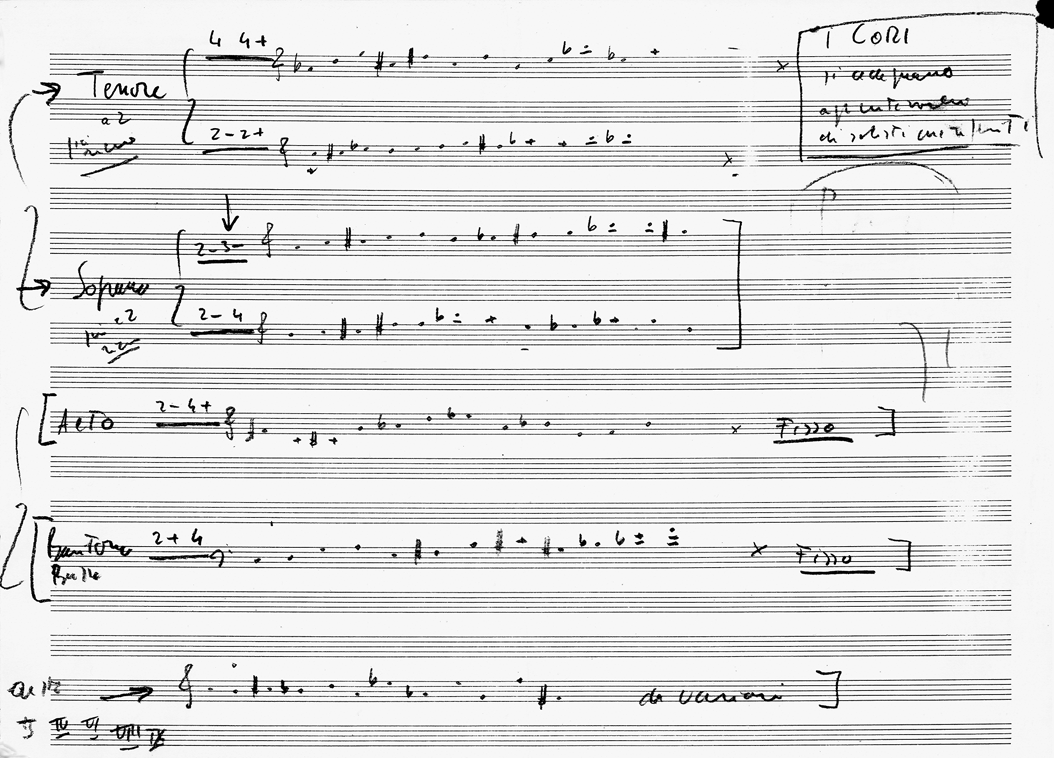
In a following sketch Nono outlines in detail the individual generative rows, arriving at a total of seven. Each is constructed by alternating the two preselected basic intervals, assigned to the different roles according to their expressive character: two rows are assigned to the Tenor, one based on the intervals of the minor and major second (−2/+2), the other on the perfect fourth and tritone (4/+4); there are two rows also for the Soprano, based respectively on the minor second and perfect fourth (−2/4) and on the minor second and minor third (−2/−3); the row for the Alto alternates between minor second and tritone (−2/+4); finally the Bass-Baritone's row is based on the major second and perfect fourth (+2/4). For the seventh row (meant for scenes II, IV, VI, VIII, and IX in Table 1 and for the chorus when it functions as an autonomous entity) Nono resorted to the all-interval row. For the choral sections that are intended to amplify the feelings of individual characters, the composer does not envisage specific rows because, as we read in the top right-hand corner of Figure 5, ‘The chorus conform to the intervals of the soloists they refer to’ (‘i cori si adeguano agli intervalli di solisti cui referiti’). The transition from individual to collective situations is therefore realized by the chorus's adoption of the same interval rows as those used by the soloists (Figure 5).Footnote 99
Intolleranza 1960: sketch defining the harmonic ‘character rows’ (I-Valn, f. 23.07/02, reproduced by kind permission).

Confirmation of the relationship of Intolleranza 1960 to Nono's previous vocal compositions is provided by the fact that the four rows of Tenor, Alto, and Bass are identical to those adopted in “Ha venido”: Canciones para Silvia.Footnote 100 Furthermore, one can recognize precise symbolic references in the intervals chosen to form the respective generative rows: the first row for the Tenor, who represents the positive pole of the opera, is based on the perfect fourth – revealer of hope, of the desire for stability, of the ‘transparency’ of feelings and of love.Footnote 101 But the Tenor is also the character who, more than any other in the course of the entire opera, both feels and instils in others ‘doubt, uncertainty’.Footnote 102 Hence, seemingly, the oscillation, in his two series, of the same interval alternating in either its major and minor form (the second) or in its perfect and augmented form (the fourth). As the composer himself highlights in his sketches, through the use of the arrows in Figure 5, the intervals selected for the Tenor's rows can be found used in antithetical ways in the rows of the Alto and the Bass-Baritone. In this way, the Tenor seems to assume almost (symbolically) the meta-role of ‘heart’ or ‘harmonic centre’ of the opera.
For the Alto, symbol of emotional blackmail, vengeance, and the persecution resulting from frustrated feelings, Nono symbolically derives from the Tenor's rows the two intervals with a negative connotation: the minor second and the augmented fourth (−2/+4). The tritone seems to be used by Nono less for its historical significance as diabolus in musica than, in the wake of Hindemith, as the autonomous and unclassifiable interval par excellence, the central pivot on which ‘melodic force’ and ‘harmonic force’ converge.Footnote 103 And perhaps for this reason the interval seems a fair representation of antithetical sentiments, whether ‘hope–pain’ or ‘hate–love’. The combination of the perfect fourth and the tritone in one of the Tenor's rows, not to mention the centrality of the tritone in the Alto's series, indicates that the two characters are also intertwined in a relationship of ‘integration’ (to use Nono's words) and antithesis. The Alto can also be seen as embodying the symbolic antithesis of the Tenor's values, acting autonomously and unpredictably in her vindictive displays of intolerance rather than representing a straightforward manifestation of evil. Following this logic of juxtaposition/opposition, Nono had planned in an initial sketch to base the entries of the Tenor (the Emigrant) and Alto (his ex-lover, now persecutor) in the first scene on the respective alternation of the perfect fourth (Tenor) and the tritone (Alto).Footnote 104 This idea, which here dramatizes the opposition between positive and negative poles, also permits the observation that both the Tenor's rows themselves embody this dramaturgical ambiguity.
Antithetically in respect of the Alto, the Tenor cedes the ‘positive’ intervals of freedom and trust, the major second and perfect fourth, to the Baritone, the character associated always in the sketches with situations of ‘freedom and revolution’. For the Soprano too, a character linked with ‘hope’, ‘force’, and ‘resistance’,Footnote 105 the ‘negative’ interval, the tritone, is ruled out. Alongside the (−2/4) row, intended as the expressive synthesis of the Tenor's feelings, her second row, (−2/−3), is based on the minor second (an interval common to the Tenor as well as the Alto) and the minor third, the latter interval associated with her alone.
As noted earlier, the same rows were also designed by Nono for the creation of ‘harmonic pedals’,Footnote 106 sound continua in both choir and orchestra that amplify the atmospheres and intervallic ‘landscapes’ linked to the soloists. ‘Orchestra and chorus same techniques’, notes the composer: like the chorus, therefore, the orchestra is intended to participate in the creation of acoustic atmospheres that are designed to embody symbolic references. Here too the technique designated for the instruments, based on the use of the rows chosen for the soloists with these ‘echoes – harmonic traces’ (scie armoniche), develops what Nono had previously achieved between soloist and chorus in “Ha venido”: Canciones para Silvia.Footnote 107
Up until now, everything suggests that this attempt to render the drama acoustically perceptible through intervallic characterization is set to be realized. The composition of the opening chorus – still following the original ten-scene conception – reveals how far Nono intended the choice of intervals as a principal means for the musical communication of the drama and its symbolic oppositions. At a technical level the writing of this choral section follows closely, with just a few exceptions, the previously envisaged generative process based on the multiple coordination of parameters. As in “Ha venido”: Canciones para Silvia and Sarà dolce tacere, Nono uses a different note row for each stanza of Ripellino's text, ‘Vivere è stare svegli’. The relationship between text and chosen series clearly reveals the role of dramatic entr'acte intended by Nono for this introductory chorus. In the succession of four stanzas, and in the musical articulation of their semantic content, the composer enacts a sort of ‘harmonic presentation’ of the main characters of the opera:
Stanza 1: ‘To live is to be awake / and to yield to others, / to give always the best of oneself / and to not be cunning’:Footnote 108 the first stanza is based on the first row (−2/−3) of the Soprano, the companion in struggle and in life who seems to be portrayed in these initial verses;
Stanza 2: ‘To live is to love life / with its funerals and its dances / to find fables and myths / in the most squalid events’:Footnote 109 the Baritone's row is chosen on the other hand to express unconditional love for life. He is variously the outcast, the persecuted, the tortured, indeed the representative of the ‘most squalid’ of human situations;
Stanza 3: ‘To live is to wait for the Sun / in the days of black storm / to shun inflated words / dressed in festive fringes’:Footnote 110 the third stanza is based instead on the row of the Alto, symbol of amorous vengeance but also, fundamentally, of the anger that is a consequence of abandonment and the hatred bred by frustrated love. For the ‘days of black storm’, furthermore, the choice of the only series in which the tritone appears is not coincidental;
Stanza 4: ‘To live is to choose the humble melodies / without screaming and gunshots, / descending towards autumn / and not to get tired of loving’:Footnote 111 the chorus then closes with the series that combines the minor and major second chosen from the rows of the Tenor, the character who is a symbol of tenacious, humble, and unconditional love.
The harmonic vestiges of the Tenor's row close the choral prelude (prerecorded on tape and amplified in the darkened hall, with the curtain down) and links seamlessly to the harsh journey of the Emigrant in the first scene. The same F♯ that concludes the introduction (on the last word, ‘loving’) begins the first scene (bar 40), based entirely on the Tenor's two generative rows: the orchestral introduction (bars 40–79) uses the (4/+4) series, while in bars 80–219 the Emigrant's vocal part continues with the same series, while the complementary pitches of the accompaniment are derived from the Tenor's other row (−2/+2).Footnote 112 Notwithstanding the fact that the rows are not read in a linear fashion, and that in the final score it is therefore impossible to distinguish between generative and generated pitches, these intervals permeate the entire harmonic atmosphere of the first scene. From the opening chorus, then, the dramaturgy is articulated musically by means of harmonic fields that can be understood equally as ‘character fields’.
Once the first scene had been composed, however, the unexpected and hasty course taken by events had a forcible impact on the compositional technique. From an analysis of the work's compositional materials it is evident that the application of the generative technique based on the character rows – and hence the scrupulous association of the intervals with the drama – is followed fairly rigorously only up to scene II of the definitive version. From this moment onwards the plans and previously organized sketches are abandoned. In the vortex of the simultaneous creation of libretto and music, only certain particular schemes for the coordination of the parameters in the choral parts are salvaged; in fact, these are the only parts that continue to be written on the basis of the generative technique right up to the final chorus that concludes the opera. The writing of all the other vocal and instrumental parts becomes the result of decisions taken along the way or often, as mentioned above, the ground for recoveries and quotations (in original or retrograde form) of vocal parts written for the initial scenes. And the dramaturgical logic recognizable in some of these recoveries,Footnote 113 in which one can sometimes see the initial idea of the Leitmotif, leads gradually (from Part I scene IV onwards) to a manifest and anguished compositional compromise.
What remains, then, in the final work of all that was planned and established with such care in the sketches? How much of this ‘intervallic dramaturgy’ has survived in the pages of the printed score, and how much disappeared into the furrow that so often separates an idea from its artistic realization?
Intervals, Hindemith maintained, are made not of clay but of steel. In other words, they are both elastic and strong, so strong that, with judicious treatment, the sound material will allow itself willingly to be bent and knit together.Footnote 114 In the case of Intolleranza 1960 what survives in the final version of the opera is the strength of the idea, saved precisely by the malleability of the intervallic material. The association between interval and character remains almost intact (at times more, at times less noticeable) even when the composer is forced to discard precompositional plans and the various note rows as originally conceived. It is the rows themselves that, in the course of the compositional process, are first gradually transformed from generative matrices into genuine vocal lines, from which the soloists' parts are sometimes realized directly; subsequently the basic intervals free themselves even more radically from the twelve-note rows, becoming instead the primary structural element of the work, self-sufficient for the formation of every type of sound phenomenon, a potentiality that Nono was to refine and elaborate in Canti di vita e d'amore.
Among the many revolutions of Intolleranza 1960, one of the most important and complex (not coincidentally absent from the main debates on the work) can be seen in the very substance of the compositional technique and in the consequences that the work had for Nono's creative development. The liberation of the interval from numerical grids and modules of parametric coordination on the one hand, and its free use for the formation of vocal lines openly conditioned by dramaturgical needs on the other, led directly to a reinterpretation of its functions and its purpose. Gradually, and gaining ever greater propulsive force, the autonomous interval completely replaced the concept of the pitch series in Nono's organization of material. It came to be for him among the most important structural elements of composition (if not indeed the structural element par excellence), acting as a stimulus towards the complete abandonment of predetermination and classic serial grids. It is precisely this conquest that is realized, as impetuously as it is decisively, in the compositions of the later 1960s, from Canti di vita e d'amore to La fabbrica illuminata – ‘dramatic actions’, albeit not theatrical, that are indebted to Intolleranza 1960 for a ‘freedom’ in which commitment, human ideals, and technical principles converge.