Introduction
Increases in repeat cesareans underscore the need to examine how women make the decision about birth options after a prior cesarean.Reference Gregory, Fridman and Korst1 Guidelines from the Royal College of Obstetricians and Gynaecologists and the American College of Obstetrics and Gynecology state that pregnant women with a prior cesarean birth should be counseled about a trial of labor after cesarean, if it is a medically reasonable choice.Reference Gupta, Smith and Chodankar2 However, despite being clinically eligible, many women are not being offered, or are not selecting a trial of labor, at least in the United States.Reference Cox, Barger, Dunn, Bearman, DeLain and Gates3 Fear about malpractice litigation in the event of a bad outcome contributes to the decreased support for a trial of labor in hospitalsReference Korst, Gregory, Fridman, Phelan, Leeman, Beagle, Espey, Ogburn and Skipper4 and as a birth choice offered by clinicians.Reference Yang, Mello, Subramanian and Studdert5 One approach to mitigate malpractice liability is to educate women about risks and benefits of both a repeat cesarean and trial of labor by actively engaging patients in making a shared decision with the clinician and then documenting their preferences.
Patient decision aids (PDAs) are structured tools for facilitating conversation between a patient and clinician about the risks, benefits, and alternatives for tests and treatments. This process, which is called shared decision making (SDM), accomplishes an “ethical imperative” to inform patients about their options and elicit their preferences so that the test or treatment option selected aligns with their values.Reference Mulley, Trimble and Elwyn6 When patients use PDAs, they are more knowledgeable, informed, and clear about their values,Reference Stacey, Legare, Lewis, Barry, Bennett and Eden7 which allows for greater patient involvement in their own health decisions.
In 2006 the Informed Medical Decisions Foundation reported results of a study assessing the reactions of potential jurors to a hypothetical malpractice suit alleging failure to perform a PSA screening test for prostate cancer.Reference Barry, Wescott, Reifler, Chang and Moulton8 In this study, we replicated the PSA study methodology for a hypothetical bad outcome after a trial of labor following a prior cesarean birth. We used potential jurors to adjudicate a case in which an infant dies as a complication of uterine rupture at the time of an attempted vaginal birth after a prior cesarean. The approach used and level of documentation were varied to test whether a well-documented shared decision-making process including a PDA provides protection from liability compared to a poorly or incompletely documented process.
Methods
A Boston-based recruitment company identified sixty participants to attend one of six focus groups held in Boston, Massachusetts in March 2017. Participants were selected to reflect the demographics of Suffolk County, which includes Boston. Potential participants were asked to role play being part of a jury deciding about liability and harm in a medical malpractice case involving labor and delivery. Individuals were excluded if s/he or a partner had one or more cesarean births, was currently pregnant, had lost a family member or baby during birth, or had a serious complication in labor and delivery, which reflect exclusions that would likely apply when selecting a jury for this type of case. Each person signed consent and received a stipend of $200 for participating.
At each focus group, participants were asked to imagine they were potential jurors in a trial addressing a malpractice suit brought by a patient (plaintiff) against an obstetrician (defendant) alleging a breach of the standard of care and subsequent harm to the baby based on the mother not being fully informed about the risks of a trial of labor after a cesarean birth. In each group the mother opted for a trial of labor, which ended in the death of the infant. The mock jury process involved presentations of summaries by experts for the plaintiff and the defendant. Participants voted on varied scenarios to determine if the physician met the standard of care, and if not, whether harm was causally related to the deviation from the standard of care. The facts of the case were fictitious. Participants were blinded to the study hypothesis.
For each of the six focus groups, a physician (MB) presented the medical facts of the case and an attorney (BM) presented the arguments for the defense and plaintiff, and provided jury instructions. The facts of the case are described in the Appendix. All six groups were presented the same medical facts followed by one of three scenarios that differed by level of documentation and whether a PDA was used (Figure 1). Once the facts of the case were presented and jury instructions given, MB and BM left the room and PW and SB facilitated discussion.
Figure 1

The PDA used was certified by the Washington State Health Care Authority in 2016 pursuant to legislation to promote SDM as an alternative to traditional informed consent.Reference Pope and Lessler9 Certified PDAs are judged by the certifying body to be standardized, conflict-free, tested with patients, and assessed for numeracy and literacy. The PDA compares risks and benefits of a trial of labor after a prior cesarean and a repeat cesarean. To evaluate if the patient understood the facts, she is asked five basic knowledge questions about the two birth options. A values clarification exercise asks the woman to rate five statements to help her clarify what is most important as she manages uncertainty. Next, patients answer questions about what option they are leaning towards and how far along they are with making the decision. The four short videos in the tool include patients and providers discussing the decision in a balanced way.
The PDA, available as a web-based tool, was shown on a large screen in the meeting room. The content was read aloud to the group so that we could account for likely variability in literacy. The videos that are embedded in the PDA were played for the group.
The goal of facilitated discussion was to identify the rationale for why participants voted the way they did. Facilitators presented each scenario and immediately took a “straw poll” by show of hands, which was tal-lied. This poll was followed by a group discussion, as would take place during a jury deliberation, and then the participants were asked to record their final vote on an anonymous ballot. If an individual voted that the standard of care was not met, they were asked to write down if they thought damage resulted. Both a breach in the standard of care and resultant harm causally related to that deviation in the standard of care are required for a successful malpractice suit. The standard of care was described as “what the average qualified practitioner would do” in similar circumstances. Ballots were collected after each vote and tal-lied after the focus group ended.
Scenario Descriptions
The methodology included presenting up to three scenarios each followed by a series of votes.
No Note Scenario: The defendant testified that the risks and benefits of a trial of labor were discussed orally and the patient agreed to a trial of labor. Jurors were told the defendant did not write a note documenting the discussion in the medical record. The plaintiff testified she recalled the obstetrician briefly mentioned a repeat cesarean, but thought the obstetrician was discouraging it.
Note Scenario: The defendant testified that the risk and benefits of a trial of labor were discussed orally and the patient agreed to a trial of labor. Jurors were told the defendant wrote a note in the medical record documenting that the risks and benefits were discussed and the woman agreed to a trial of labor. As in the first scenario, the plaintiff testified she recalled the obstetrician briefly mentioned a repeat cesarean, but thought the obstetrician was discouraging it.
PDA with Note Scenario: The defendant testified that the risks and benefits of a trial of labor were discussed and a PDA was provided as part of the discussion with the patient. Jurors were told there was a note in the medical record stating the patient had been given a PDA, the patient had watched it, she took a knowledge quiz with provision of the correct answers, and had a chance to review the information with her doctor. The plaintiff testified she recalled the obstetrician and the PDA mentioned a repeat cesarean, but she thought both were discouraging it.
In all three scenarios, the defendant testified that his standard practice was to discuss the pros and cons of a trial of labor and a repeat cesarean with all pregnant women who had a prior cesarean. The plaintiff testified she did not recall any discussion about the risks of uterine rupture or potential death of her baby if she tried a trial of labor. The plaintiff's lawyer argued the patient was not properly informed of the risks if a trial of labor was attempted.
Focus Groups 1 and 2 were presented with three scenarios in the following order: 1) No Note, 2) Note, 3) PDA with Note. Focus Groups 3 and 4 were presented with two scenarios in the following order: 1) Note, 2) PDA with Note. Focus Groups 5 and 6 were presented with three scenarios, but in reverse order from Groups 1 and 2: 1) PDA with Note, 2) Note, 3) No Note.
Participant characteristics were summarized using means with a range for continuous variables and frequencies with percentages for categorical variables. To assure participants of the anonymity of their final votes, linkage of the decisions across the three scenarios from the same participant was not available. Therefore, Fisher's exact tests were used to compare the difference in the proportions of participants' votes in response to the different scenarios. A two-sided p<0.05 was considered statistically significant. Analyses were performed using SAS version 9.4 (SAS Institute, Cary, NC).
The target sample size of six groups with ten participants per group was chosen with the consideration that if 90% of participants voted the standard of care was met with the PDA with Note Scenario and 68% of participants voted the standard of care was met with the Note Scenario, then the statistical comparison would be likely to detect the difference (power=80%) while the observed result would be unlikely to be due to chance (p<0.05).
Results
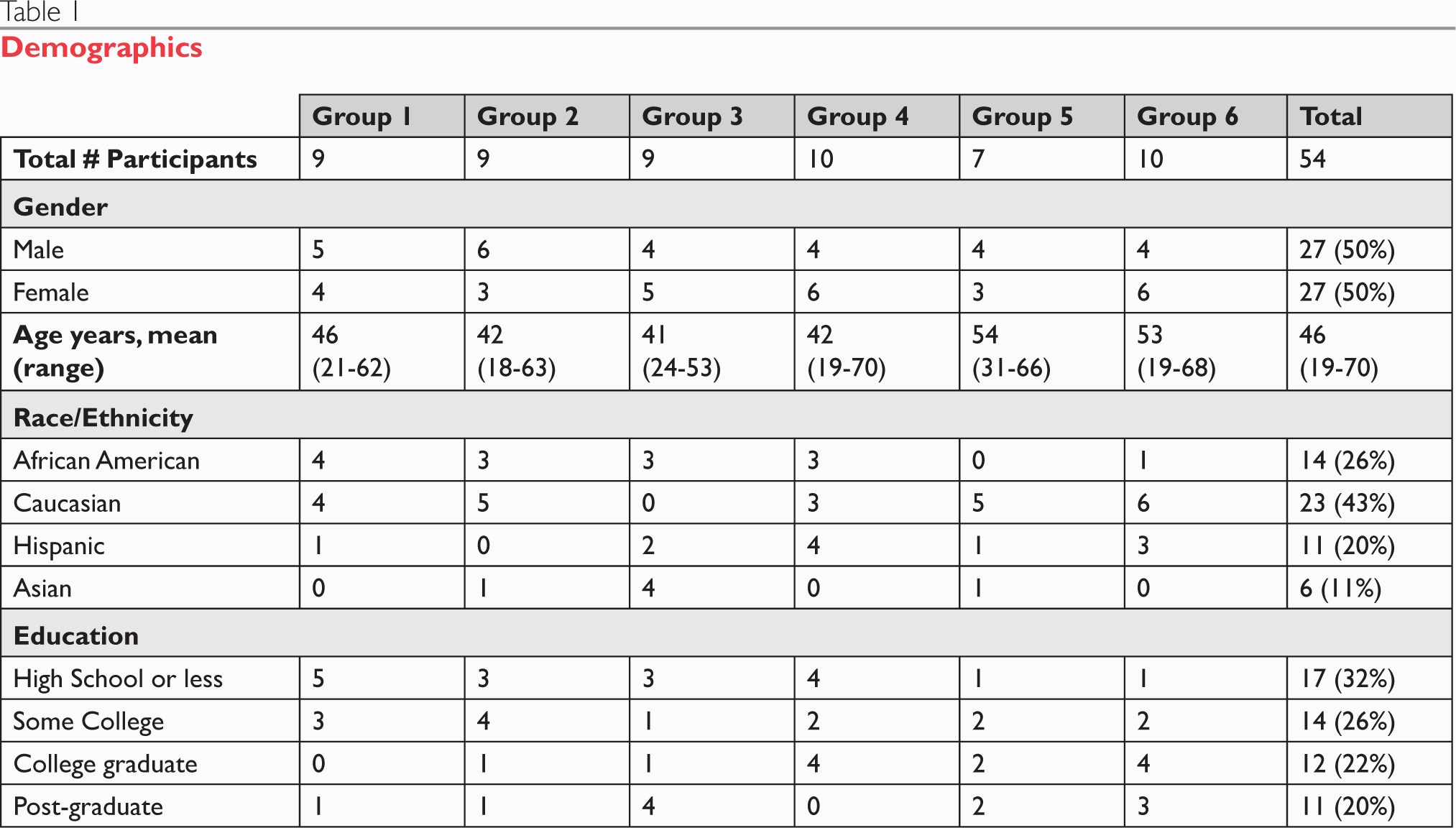
Of the sixty patients recruited, six did not attend a focus group (one each from Group 1, Group 2, Group 3, and three from Group 5). The demographics of the attendees are provided in Table 1. The mean age was 46 with a range of 19-70 years. The gender, age, race and ethnicity of participants closely mirrored that of Suffolk County, Massachusetts. The original date for the Group 5 focus group was rescheduled due to inclement weather, which may have resulted in fewer attendees in this group.
Demographics

No Note Scenario
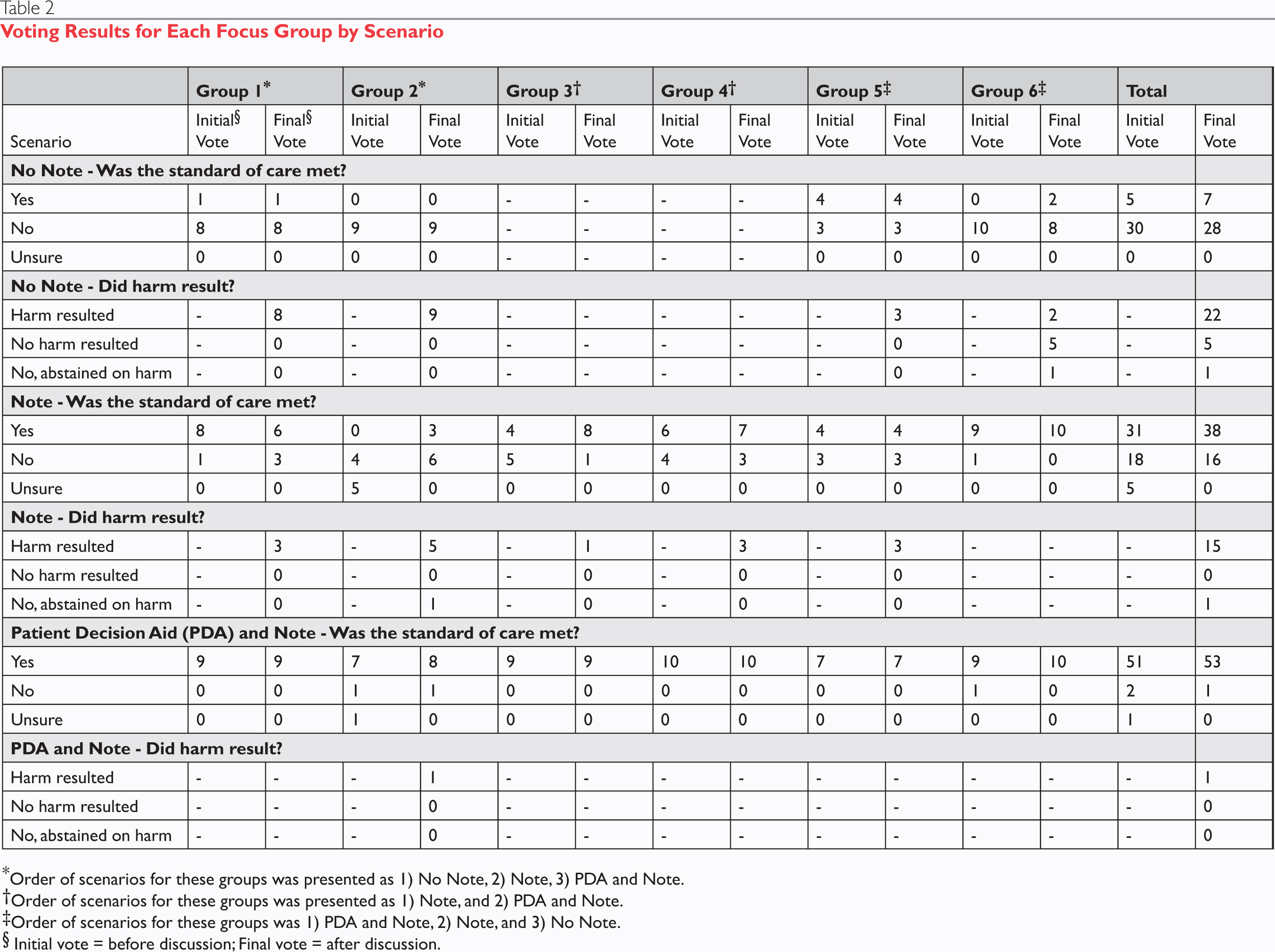
Table 2 provides the initial and final voting results for each of the focus groups across the three scenarios. Across all groups in response to the No Note Scenario, 7 of 35 participants voted after discussion, as would represent the conclusion after a jury deliberation, that the standard of care was met. Of the 28 participants voting the standard of care was not met, 22 (78.6%) voted that harm resulted. The initial vote varied slightly from the final vote, 30 of 35 (85.7%) initially voted the standard of care was not met.
Voting Results for Each Focus Group by Scenario

* Order of scenarios for these groups was presented as 1) No Note, 2) Note, 3) PDA and Note.
† Order of scenarios for these groups was presented as 1) Note, and 2) PDA and Note.
‡ Order of scenarios for these groups was 1) PDA and Note, 2) Note, and 3) No Note.
§ Initial vote = before discussion; Final vote = after discussion.
In Groups 5 and 6 the order of the scenarios was reversed so that the participants voted on the scenario where the PDA with Note was used first, the Note Scenario was presented second, and the No Note Scenario was presented third. In Group 5, 4 of 7 participants voted that the standard of care was met even when there was no note in the medical record. All of those who said the standard was not met voted that harm resulted. The results of the Group 5 initial and final votes were the same. In the initial vote for Group 6, all 10 of the participants voted the standard of care was not met. After discussion and final vote, 8 of 10 in Group 6 still voted that the standard was not met, though only 2 voted harm resulted.
Note Scenario
When jurors were told there was a Note in the medical record documenting the birth options discussion had taken place, 38 of 54 (70.4%) indicated in the final vote that the defendant met the standard of care. Of the 16 who voted the standard of care was not met, 15 (93.8%) voted that harm resulted and one participant was unsure. Prior to the discussion and final vote, more participants, 23 of 54 (42.6%), were either unsure or didn't think the standard of care had been met. Across all groups, the proportion of participants who voted that the defendant met the standard of care was higher with the Note Scenario (38/54 [70.4%]) compared to the No Note Scenario (7/35 [20.0%]) (p<0.001).
The Note Scenario was considered by a majority of participants in five of the six groups as meeting the standard of care. One person in Group 2 maintained the doctor should have obtained a signed consent from the woman stating that she understood the risks and benefits of a trial of labor. She felt strongly and persuaded others in the group that a note in the chart did not ensure that the patient understood the risks and benefits. She maintained throughout the discussion that a note was not proof, but the patient's signature would be. This person was the individual who voted in the initial and final votes that the standard of care was not met when the PDA was given to the patient (53 of 54 jurors voted otherwise).
PDA and Note Scenario
When participants were presented the PDA and Note Scenario, 53 of 54 (98.1%) in their final vote indicated the standard of care had been met, similar to the 51 of 54 (94.4%) in the initial vote. Documenting that the patient was given a PDA (53/54 [98.1%] compared to not having a note in the medical record (7/35 [20.0%]) resulted in a significantly higher proportion voting that the defendant met the standard of care with the PDA, p<0.001. When the PDA and Note Scenario was compared to the Note scenario, the proportion who voted the defendant met the standard of care with the PDA (53/54 [98.1%]) was significantly greater than the Note scenario (38/54 [70.4%]) (p<0.001). A similarly high percentage of participants voted the defendant met the standard of care in the PDA and Note Scenario whether they were presented that scenario first (17/17), second (19/19), or third (17/18) (p=0.65).
When a certified PDA on birth options after a prior cesarean was provided to the patient and a patient-clinician discussion is documented in the medical record, 98% of the focus group members voted that the defendant met the standard of care. The results were similar whether focus group members were presented this scenario first, second, or third; or whether the conclusion was based on their initial votes or their votes after discussion with other focus group members. However, when just a note was included in the medical record stating that the patient and provider discussed the options, only 70% of the participants thought the standard of care was met. Only 20% of the participants voted that the standard of care was met when there wasn't a note in the medical record documenting the conversation.
Discussion
Main Findings
When a certified PDA on birth options after a prior cesarean was provided to the patient and a patient-clinician discussion is documented in the medical record, 98% of the focus group members voted that the defendant met the standard of care. The results were similar whether focus group members were presented this scenario first, second, or third; or whether the conclusion was based on their initial votes or their votes after discussion with other focus group members. However, when just a note was included in the medical record stating that the patient and provider discussed the options, only 70% of the participants thought the standard of care was met. Only 20% of the participants voted that the standard of care was met when there wasn't a note in the medical record documenting the conversation.
Strengths and Limitations
This study has several strengths. The PDA used in this project was certified by Washington State Health Care Authority and is the only certified tool on this topic. This study replicated the methodology from a previously published paper, which concluded almost identical findings, but in a different clinical area about ten years after the original study was published. Another strength is the diversity of the participants who reflect those who could have been selected as jurors. Finally, the results of the initial and final votes by the participants were similar, mitigating any concerns about bias being introduced by the moderators. This study has limitations. Mock jurors recruited from a single geographic area and their opinions might not reflect those of jurors from other areas. Focus groups, each conducted over a few hours, were not an actual court trial that would have unfolded over several days. Even though we varied the order of the scenarios, bias may have been introduced due to the potential carryover effect from considering the scenarios in sequence. Nevertheless, we feel the conclusion that a well-documented shared decision-making process provides substantial protection in such a situation remains robust.
Interpretation
Physicians in high risk specialties practice defensive medicine by using “assurance” or “hedging” behaviors and “avoidance” behaviors.Reference Bourne, Wynants, Peters, Van Audenhove, Timmerman, Van Calster, Ortashi, Virdee, Hassan, Mutrynowski, Abu-Zidan, Studdert, Mello, Sage, DesRoches, Peugh and Zapert10 Assurance includes actions such as ordering additional tests and having a low threshold for diagnostic procedures. Avoidance includes referring high risk patients or discontinuing some elements of practice. Obstetric practice is well-documented to follow an avoidance pattern. Providing the option for vaginal birth after cesarean is suppressed by higher regional malpractice rates, concerns that the facility or the practice cannot consistently meet care guidelines for immediately available cesarean, worry about litigation, individual experience with prior malpractice litigation, and concern about consequences of uterine rupture.Reference Cheng, Snowden, Handler, Tager, Hubbard and Caughey11 These are avoidance behaviors. In contrast, engaging patients in shared decision-making can be an assurance behavior. Decision-making that directly engages the patient in understanding risks, conceptualizing options, and making an explicit choice may reduce liability of the provider by making the decision process transparent, patient-driven, and provider endorsed.
The notion that a signed consent protects the doctor was discussed and debated in all six groups. Participants did not agree that a signed document obtained at the hospital admission would ensure patients understood the risks and benefits. The moderators reminded the group repeatedly that the case focused on the conversation that happened in the doctor's office before the patient went into labor. The issue of using informed consent for a trial of labor, vaginal birth or cesarean birth has been discussed in the literature,Reference Malik, Awonuga and Iglesia12 though use of written informed consent for vaginal birth or trial of labor is not widespread in the U.S.
The use of PDAs results in gains in knowledge and less regret about the treatment decision.13 Many women facing the choice between a trial of labor or repeat cesarean lack knowledge about the decision, though they perceive that they are educated.Reference Friedman and Srinivas14 In one study when women increased their knowledge about their birth choices, more women opted for trial of labor compared to a repeat cesarean.Reference Scaffidi, Posmontier, Bloch and Wittmann-Price15 By using PDAs, communication improves, which results in women understanding their options, more often selecting the option that fits with their values, and perhaps even prevents claims from being filed in the first place.
Conclusions
This study demonstrates use of a shared decision-making process assisted by a PDA resulted in a high level of liability protection when potential jurors were presented with a hypothetical case of a malpractice claim against an obstetrician after an adverse outcome following a trial of labor. Given the mitigation of malpractice risk suggested in this study by a strong, well-documented shared decision making process including use of a PDA, we hope more eligible women will be offered a trial of labor and scheduled cesarean section both as reasonable birth options.
Appendix
Facts of the case
The patient (plaintiff) was a 22-year old in good health presenting with her second pregnancy. Two years ago, with her first pregnancy, her baby was in a breech position, and could not be turned, and the baby had to be delivered by an unplanned cesarean section. Although the baby was born healthy, the plaintiff's recovery from surgery took several weeks. She was disappointed she couldn't give birth vaginally. Since her last birth, her previous obstetrician had retired. Her new obstetrician determined the baby was in a head down position all through the pregnancy. He told the woman she could try delivering vaginally, and she agreed.
The plaintiff went into labor, and despite monitoring, her uterus developed a tear. She was taken to the operating room for an emergency cesarean section. Though the woman survived, the baby died. She was devastated and regretted the decision to try a vaginal birth. The patient thought that if she had delivered her second baby by a planned cesarean section everything would have been fine. She sues the obstetrician for malpractice saying she was not adequately made aware of the risks of trying to deliver the baby vaginally, including the risk of a rupture of the uterus or the baby dying.