INTRODUCTION
With respect to the peopling of and adaptation to the Arctic and subarctic environments, Aleutian prehistory has great potential for understanding adaptations to a changing environment over the course of the last millennia. Ancient Aleuts crossed the Bering Land Bridge in the Terminal Pleistocene (Coutouly and Holmes, Reference Coutouly and Holmes2018) and probably reached the Aleutian archipelago around 11,000 yr (Black, Reference Black1976). The oldest archaeological sites found on the Fox Islands date to 7000 BC (Laughlin, Reference Laughlin1975; Davis and Knecht, Reference Davis and Knecht2010; Davis et al., Reference Davis, Rogers, Knecht, Friesen and Mason2016); the subsequent expansion of Aleuts through the Aleutian chain westward is documented through radiocarbon-dated archaeological sites (West et al., Reference West, Lefèvre, Corbett and Savinetsky1999; O'Leary, Reference O'Leary and Dumond2001; Corbett et al., Reference Corbett, Lefèvre, West, Corbett, West and Lefèvre2010; Savinetsky et al., Reference Savinetsky, West, Antipushina, Khassanov, Kiseleva, Krylovich, Pereladov, West, Hatfield, Wilmerding, Lefèvre and Gualtieri2012). Hrdlička (Reference Hrdlička1945) first noted two skull morphologies in Aleutian burials that he believed represented two distinct groups, which subsequently have been called Paleo-Aleuts and Neo-Aleuts (Laughlin, Reference Laughlin1974, Reference Laughlin1975). Recent studies have shown that Neo-Aleuts were genetically divergent from Paleo-Aleuts and relied on a higher trophic diet (Coltrain et al., Reference Coltrain, Hayes and O'Rourke2006; Smith et al., Reference Smith, Hayes, Cabana, Huff, Coltrain and O'Rourke2009; Coltrain, Reference Coltrain2010). The Neo to Paleo-Aleut transition occurred sometime between AD 1150 and AD 1250 (West et al., Reference West, Khasanov, Krylovich, Hatfield, Khasanov, Vasyukov and Savinetsky2019). Misarti and Maschner (Reference Misarti and Maschner2015) proposed that this transition resulted from increasing social complexity accompanied with intensified interactions with Kodiak people, and these authors argue that genetic change was due to an influx of Kodiak women.
Zooarchaeological investigations are not only valuable to archaeological investigations, but also to conservation ecology and biogeography (Wolverton and Lyman, Reference Wolverton, Lyman, Wolverton and Lyman2010). In zooarchaeological studies, often rare taxa are underestimated until cumulative data indicate they may be significant. Compared with sea mammals, canids rarely appear in Aleutian archaeological sites and only include the domestic dog (Denniston, Reference Denniston1972; Turner and Turner, Reference Turner and Turner1974; Knecht and Davis, Reference Knecht and Davis2003), arctic fox (Crockford et al., Reference Crockford, Frederick, Wigen, McKechnie, Knecht and Davis2004), and red fox (Denniston, Reference Denniston1972; Turner and Turner, Reference Turner and Turner1974; Yesner, Reference Yesner1977; Davis, Reference Davis2001; Knecht and Davis, Reference Knecht and Davis2003). It remains unclear, however, whether canids really were uncommon and what specific roles they played in prehistoric Aleut culture. The Aleutian histories of these three canid species are quite unique.
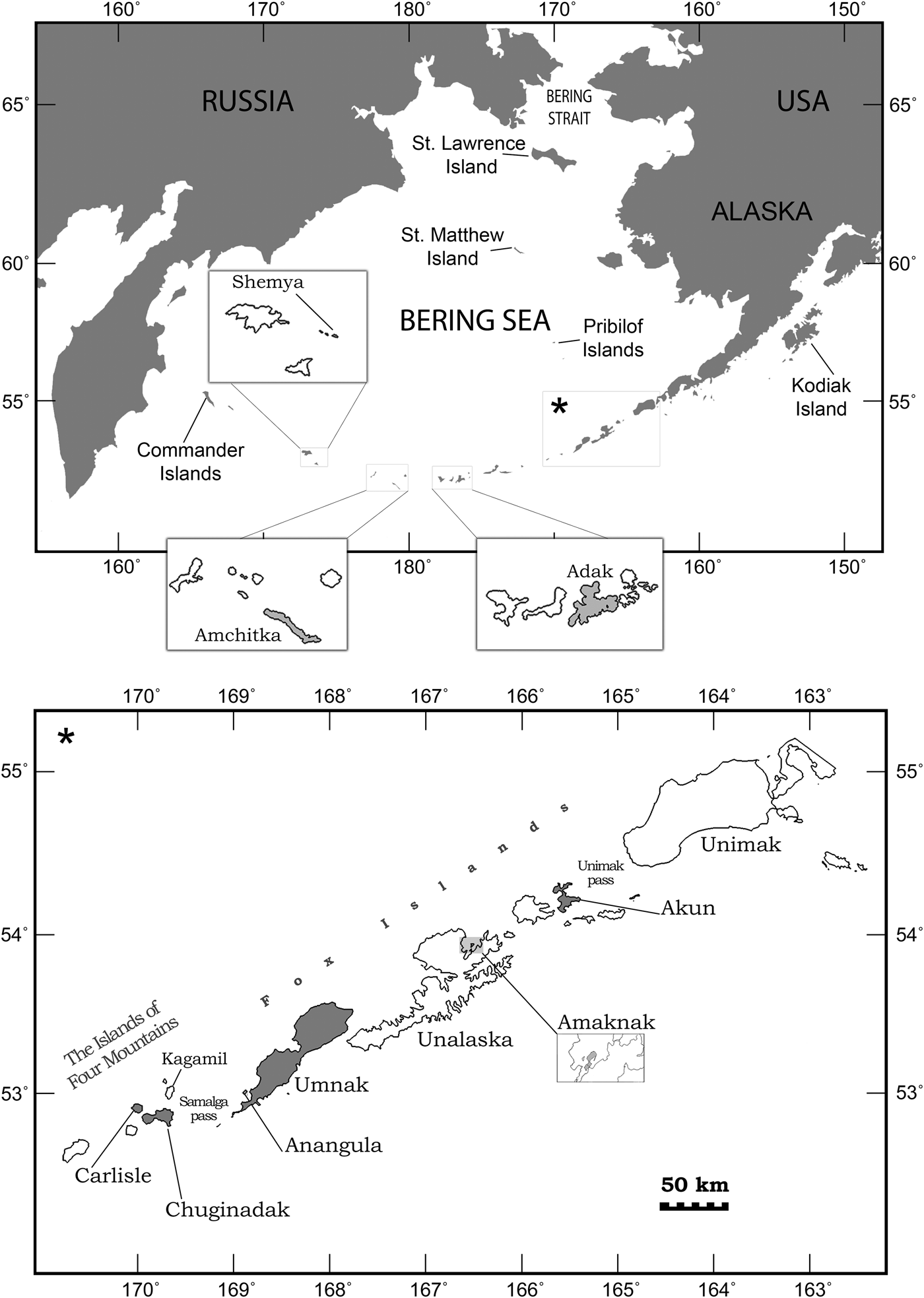
Both red (Vulpes vulpes) and arctic foxes (Vulpes lagopus) played important roles in the past 250 yr of Aleutian history, but their ecology and distribution during the pre-contact period remains largely unexplored. After Russians discovered and claimed Alaska in 1741, they intensively harvested Aleutian sea otters, fur seals, seals, and foxes for their furs. Seeing a wealth of ground nesting Aleutian birds as a ready food supply, Russians introduced foxes as early as 1750 to the Near, Rat, Andreanof, and Islands of the Four Mountains island groups (Fig. 1). Fox “farming” escalated after the United States purchased Alaska in 1867. In 1913, the United States government established the Alaska Maritime National Wildlife Refuge. Although American wildlife managers regulated hunting of the endangered sea otter, refuge officials initially promoted fox farming. Fox trappers released and trapped foxes in the Aleutians between 1900 and 1920. By the 1930s, arctic or red foxes had been introduced on more than 450 islands (Black, Reference Black1984; Bailey, Reference Bailey1993). In the mid-twentieth century, foxes comprised the most widespread invasive species in the Aleutian Islands and the U.S. Fish and Wildlife Service introduced a program to eradicate them from all islands (Bailey, Reference Bailey1993). Ethnographic and archaeological records, however, suggest that foxes were native to some of the Aleutian Islands. If proven indigenous to particular islands, foxes should not be eradicated there. Thus, it is important to determine where foxes prehistorically lived. The archaeological record can provide valuable information on this important wildlife management topic.
Map of Aleutian Islands showing geographical names mentioned in text. *Enlarged region of the eastern Aleutians.

The term “unexpected fauna” (Holland, Reference Holland2004) is commonly used when dog bones are recovered from Aleutian archaeological sites. Dog remains are rare in Aleutian archaeological sites (Denniston, Reference Denniston1972; Turner and Turner, Reference Turner and Turner1974; Knecht and Davis, Reference Knecht and Davis2003) and thus have warranted little attention. Ethnographic accounts of dogs are also sparse. Veniaminov (Reference Veniaminov, Pierce, Black and Geoghegan1984) mentioned nothing about dogs in his descriptions of domestic animals in the Aleutians. Ransom (Reference Ransom1946) stated that, by the middle of the twentieth century, wild dogs inhabited Aleut villages, except on Umnak and Unalaska. Khlebnikov (Reference Khlebnikov1979) mentioned that locals used numerous Kodiak dogs for hunting. The presence of historic Kodiak dogs, however, does not indicate dogs existed on this island during the pre-contact period. Their absence in the ethnographic literature could indicate that dogs, if prehistorically present, did not play an important role in Aleutian lifeways. Meanwhile, Holland and Turner (Reference Holland and Turner1987) emphasize that the presence of dogs, even in small numbers, helped differentiate Neo-Aleut village sites from those occupied by Paleo-Aleuts.
In this paper, we discuss fox and dog remains recovered from two units of the Ulyagan archaeological site (Carlisle Island) and compare our data with other published zooarchaeological information for the Aleutian Islands. Beyond osteological analyses, we use stable isotope techniques to reveal the trophic position of dog and foxes in Aleutian prehistory.
MATERIALS AND METHODS
The bones of red fox (Vulpes vulpes) and dog (Canis lupus familiaris) came from Units 4 and 5 of the Ulyagan site (AMK-0003), located on Carlisle Island (Fig. 1). A detailed description of the site can be found in Hatfield et al. (Reference Hatfield, West, Bruner, Savinetsky, Krylovich, Vasyukov, Khasanov, Nicolaysen and Okuno2019) and Krylovich et al. (Reference Krylovich, Vasyukov, Khasanov, Hatfield, West and Savinetsky2019). Accelerator mass spectrometry (AMS) radiocarbon dates indicate that Unit 4 dates to 460 BC–AD 95 and Unit 5 to AD 1450–1645 (Krylovich et al., Reference Krylovich, Vasyukov, Khasanov, Hatfield, West and Savinetsky2019).
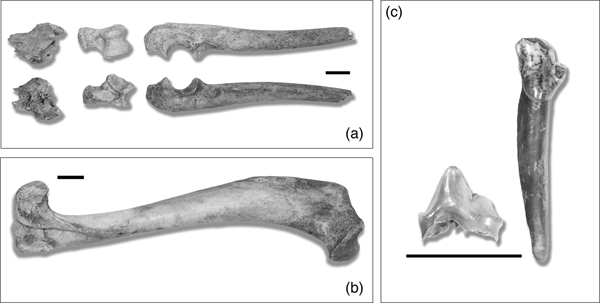
We identified three fox bones recovered in two layers of the Ulyagan Site Unit 4. A left distal fragment of a tibia and a left astragalus were recovered from the 84–89 cm level and one left ulna fragment, missing the proximal epiphysis, was found in the 84–78 cm level (Fig. 2a). We recovered three skeletal elements of dog in 500-yr-old Unit 5 deposits: two teeth belonging to young and subadult dogs (Fig. 2c) including a deciduous premolar from the right mandible, recovered in the 70–80 cm level, and an incisor, found in 40–50-cm level, and a humerus (Fig. 2b), representing a subadult individual recovered from the adjacent profile exposure that is associated with the 70–80 cm level of Unit 5. The dog humerus was subjected to radiocarbon dating by AMS at the Center for Chronological Research at Nagoya University (laboratory code prefix NUTA2). Sample preparation for AMS (graphitization) was performed in the Radiocarbon Laboratory of the Institute of Geography Russian Academy of Sciences (RAS) using an AGE-3 graphitization system (Ionplus). Calibration of conventional radiocarbon date was conducted in Oxcal 4.3 using Marine13 calibration curve (Reimer et al., Reference Reimer, Bard, Bayliss, Beck, Blackwell, Bronk Ramsey and Grootes2013) with ΔR = 495 ± 20 (West et al., Reference West, Khasanov, Krylovich, Hatfield, Khasanov, Vasyukov and Savinetsky2019). The date is reported below in the “Results” section.
Canid remains found in Ulyagan site of Carlisle Island. Bold lines are equal to 1 cm. (a) Red fox bones found in Unit 4. From left to right: distal tibia fragment, astragalus, and ulna fragment. The bottom images display the opposite sides of same specimens. (b) Dog humerus and (c) teeth found in Unit 5.

Stable isotope analysis
Stable isotopes of carbon and nitrogen are frequently used to determine an animal's trophic position, which is strongly linked to its diet (DeNiro and Epstein, Reference DeNiro and Epstein1978, Reference DeNiro and Epstein1981). If we know the average isotopic signature of the animal's tissue, we can compare it with stable isotopes of available local resources to determine the animal's food sources. We have conducted stable isotope analyses only on Pacific cod, red fox, and dog remains from the Ulyagan site on Carlisle Island so far. The other faunal remains from the site have not yet been analyzed; for this reason, we used Byers et al. (Reference Byers, Yesner, Broughton and Coltrain2011) isotopic data for various animals from the Chaluka archaeological site (Umnak Island) to compare dog and fox isotopic signatures with the isotopic signatures of other Aleutian fauna.
Stable isotope analyses on the dog humerus and fox tibia and ulna were conducted in the Severtsov Institute of Ecology and Evolution, RAS. Collagen extraction was carried out using a modified Longin (Reference Longin1971) method. Samples of cleaned bone (0.3 g) were soaked in 1 M HCl until complete demineralization. The sample was rinsed to neutrality with distilled water and the insoluble collagen was placed in a slightly acidic solution (pH ~2.5) and heated in plastic tubes at 70°C for 24–36 h to gelatinize the collagen. The gelatinized fraction of collagen was transferred into glass vials and placed in a drying chamber at 80°C until the sample was totally dried. The extracted, dried collagen was then transferred into a tin cup for isotopic analysis (~500 μg). The stable isotope composition of the bone collagen was determined using a Thermo-Finnigan Delta V Plus continuous flow isotope-ratio mass spectrometry coupled with an elemental analyzer (Thermo Flash 1112) in the Joint Usage Center at the Institute of Ecology and Evolution, RAS. The isotopic composition of N and C was expressed in the δ-notation relative to the international standard (atmospheric nitrogen or VPDB): δX (‰) = [(Rsample / Rstandard) −1] × 1000, where R is the ratio of the heavier isotope to the lighter isotope. Samples were analyzed with reference gas calibrated against International Atomic Energy Agency (IAEA) reference materials USGS 40 and USGS 41 (glutamic acid). The drift was corrected using an internal laboratory standard (acetanilide and casein). The standard deviation of δ13С and δ15N values in reference materials (n = 4–8) was less than 0.2‰.
Comparative archaeological data
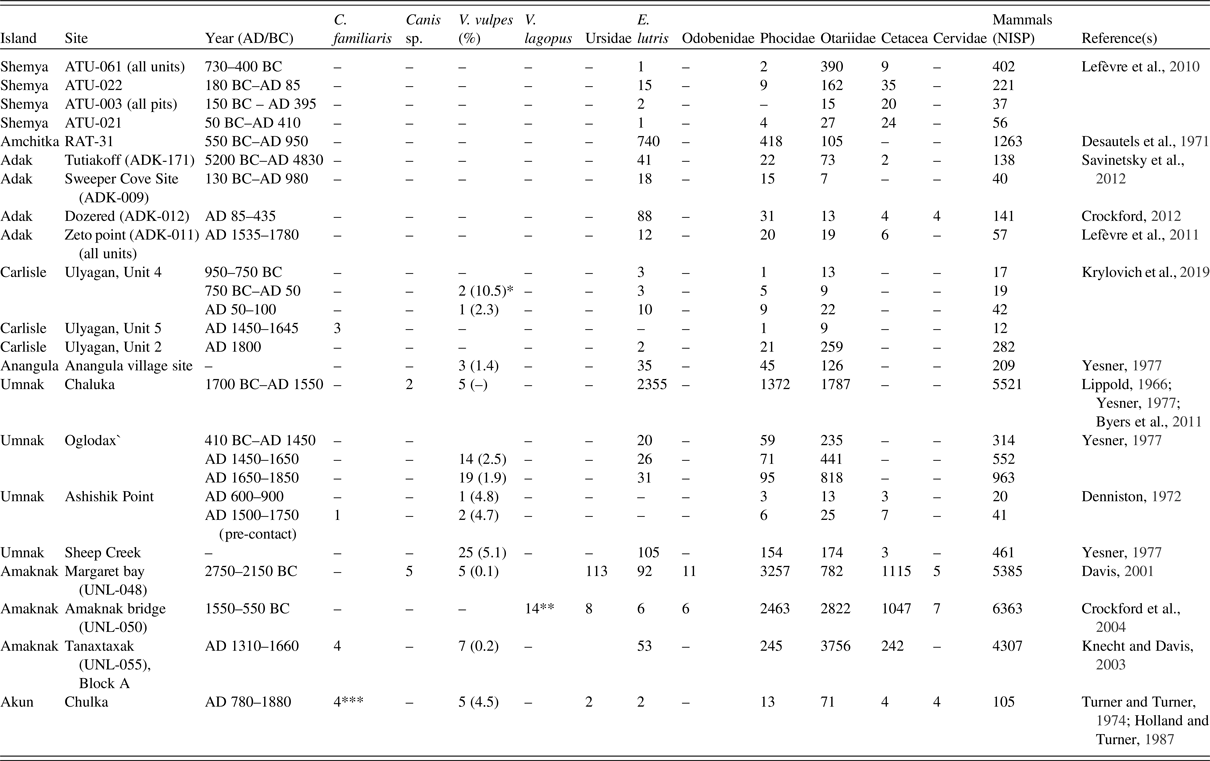
The main goal of this study was to compare all published zooarchaeological data for the Aleutian Islands in order to evaluate spatial and temporal distribution of canids. The dataset of mammal bone identifications (Table 1) was created using Lippold (Reference Lippold1966), Desaultes et al. (Reference Desautels, McCurdy, Flynn and Ellis1971), Denniston (Reference Denniston1972), Turner and Turner (Reference Turner and Turner1974), Yesner (Reference Yesner1977), Holland and Turner (Reference Holland and Turner1987, Reference Holland, Turner, Shaw, Harritt and Dumond1988), Davis (Reference Davis2001), Knecht and Davis (Reference Knecht and Davis2003), Crockford et al. (Reference Crockford, Frederick, Wigen, McKechnie, Knecht and Davis2004), Lefèvre et al. (Reference Lefèvre, Corbett, Crockford, Czederpilz, Partlow, West, Corbertt, West and Lefèvre2010, Reference Lefèvre, West and Corbett2011), Byers et al. (Reference Byers, Yesner, Broughton and Coltrain2011), Crockford (Reference Crockford, West, Hatfield, Wilmerding, Lefèvre and Gualtieri2012), and Savinetsky et al. (Reference Savinetsky, West, Antipushina, Khassanov, Kiseleva, Krylovich, Pereladov, West, Hatfield, Wilmerding, Lefèvre and Gualtieri2012) as sources.
Zooarchaeological records of mammal remains recovered from Aleutian Islands sites. The sites are ordered from west to east. *, 2 bones are likely from a single individual (see text for details); **, 11 bones are likely from a single adult individual (see Crockford et al., Reference Crockford, Frederick, Wigen, McKechnie, Knecht and Davis2004 for details); ***, 2 dog remains are of prehistoric context, 1 from historic layer and 1 of unknown origin (see Holland and Turner, Reference Holland and Turner1987 for details)

All statistics and plotting were carried out in R v.3.4.4 (R Core Team, 2018), and all bone measurements were taken using techniques developed by von den Driesch (Reference von den Driesch1976).
RESULTS
Osteological analysis
Fox remains
As previously noted, we recovered three fox bones in two levels of Unit 4: a distal fragment of a tibia, an astragalus, and an ulna fragment. All bones represent the left side. Comparison of these three bone fragments with red and arctic fox skeletons in our osteological collection at the IPEE RAS suggest they represent red fox (Vulpes vulpes). Both the tibia fragment and ulna possessed cut marks. All the cut marks were located near the joints, which reflects skinning rather than butchering for meat (Monchot and Gendron, Reference Monchot and Gendron2011).
The tibia fragment and astragalus originated from the same archaeological layer; joint surfaces of these two bones articulate well with each other and highly likely represent a single individual. The distal breadth of the tibia fragment is 16.5 mm. This is 2 mm larger than the mean values of both adult red and arctic foxes sampled in Canada and the northwestern USA (Monchot and Gendron, Reference Monchot and Gendron2010). However, the Carlisle tibia measurement appears within the range (16–18 mm) of red foxes sampled in Russia. The distal tibia breadth of Russian arctic foxes ranges from 12–16 mm (Gromova, Reference Gromova and Gromov1950). The astragalus and tibia exhibited slight porosity, suggesting a subadult individual. Although the ulna possessed the same articular size as an adult individual, it was porous, especially at the distal, broken end. The ulna exhibited an unfused proximal epiphysis and possessed a relative robustness characteristic of juveniles (Sullivan and Haugen, Reference Sullivan and Haugen1956). According to Harris (Reference Harris1978), the proximal ulnar epiphysis fuses at 16–18 weeks, which approximately corresponds to July–August fusion time for foxes today; on the other hand, the distal epiphysis of the tibia fuses with the shaft at 23–25 weeks (September). Therefore, despite the close stratigraphic positions of the ulna and heel fragments, these two subadult bones represent two individuals that died at different times.
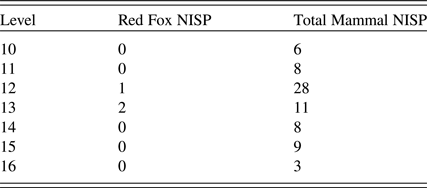
A χ 2 test is often used in zooarchaeological studies (Grayson, Reference Grayson1984; Lyman, Reference Lyman2008) to show whether the actual frequency of a variable(s) diverges from the expected one in which the estimate is based on the variable distribution in the sample. It can be used for intersite comparisons of species frequencies or for estimating whether the single species frequency deviates somewhere in the sample group based on stratigraphic levels or time periods. In order to test whether the observed frequencies of red fox in the Ulyagan Site Unit 4 excavation were linked to the sample size (i.e., due to chance) in specific levels (Table 2), we used the Pearson's χ 2 test. The relative abundance of the red fox bones in seven layers of Unit 4 (Table 2) occurred by chance (χ 2 = 5.9014, P = 0.4343). Although archaeological layers 12 and 13 both contain fox remains and are in close proximity, our statistics could suggest multiple episodes of fox harvesting and not a single event. Increasing the size of the excavation area and obtaining more faunal samples could increase our chances of finding more fox bones in other stratigraphic levels.
The archaeological levels of Ulyagan Site Unit 4, showing the relative abundance of fox remains.

Dog remains
We identified one humerus and two teeth of dog in Unit 5 of the Ulyagan site. The humerus exhibited no cuts or chew marks. The distal epiphysis showed an indistinct fusion line; the proximal epiphysis was absent (Fig. 2b). The maximum length minus the proximal epiphysis is 130 mm, minimal diaphysis width is 10.1 mm, and the distal breadth is 26.7 mm. Harcourt's (Reference Harcourt1974) formulae let us calculate the withers height of a dog by substituting the total lengths of long bones. Thus, if we add 0.5 cm to the humerus bone length (the approximate height of the proximal epiphysis) and substitute this 135 mm into the corresponding formula, we obtain 43.7 cm — the approximate withers height of the dog from Carlisle Island. The distal humerus epiphysis of a medium sized dog fuses between 5–8 months and the proximal epiphysis fuses around 10–12 months (von Pfeil and DeCamp, Reference von Pfeil and DeCamp2009). The nearly invisible fusion line at the distal epiphysis indicates that the dog was 8–12 months old at time of death.
In canids, deciduous teeth are smaller and slightly differently shaped than permanent teeth. Using Baryshnikov and Averyanov (Reference Baryshnikov, Averyanov, Baryshnikov and Kuzmina1993) and comparative analysis, we differentiated the archaeological canid dPM3 from a fox deciduous tooth. Deciduous premolar teeth are usually shed between 1.5 and 2 months (Miller et al., Reference Miller, Christensen and Evans1964) or up to 3 months (Dmitry Vasyukov, personal observation). The probability of finding the deciduous teeth of an 8–12 month old individual represented by the humerus bone seems highly unlikely. Although found in the same stratigraphic level as the humerus, this tooth probably represents a second dog. We also identified the incisor of a juvenile or subadult dog; the occlusal surface was sharp, indicating very little tooth wear (Crockford, Reference Crockford2009).
Radiocarbon dating and stable isotope analysis
The calibration of the dog humerus conventional date (1417 ± 27 14C yr BP, NUTA2-24994) matches the Unit 5 occupation dates of AD 1340–1470 (2-sigma range).
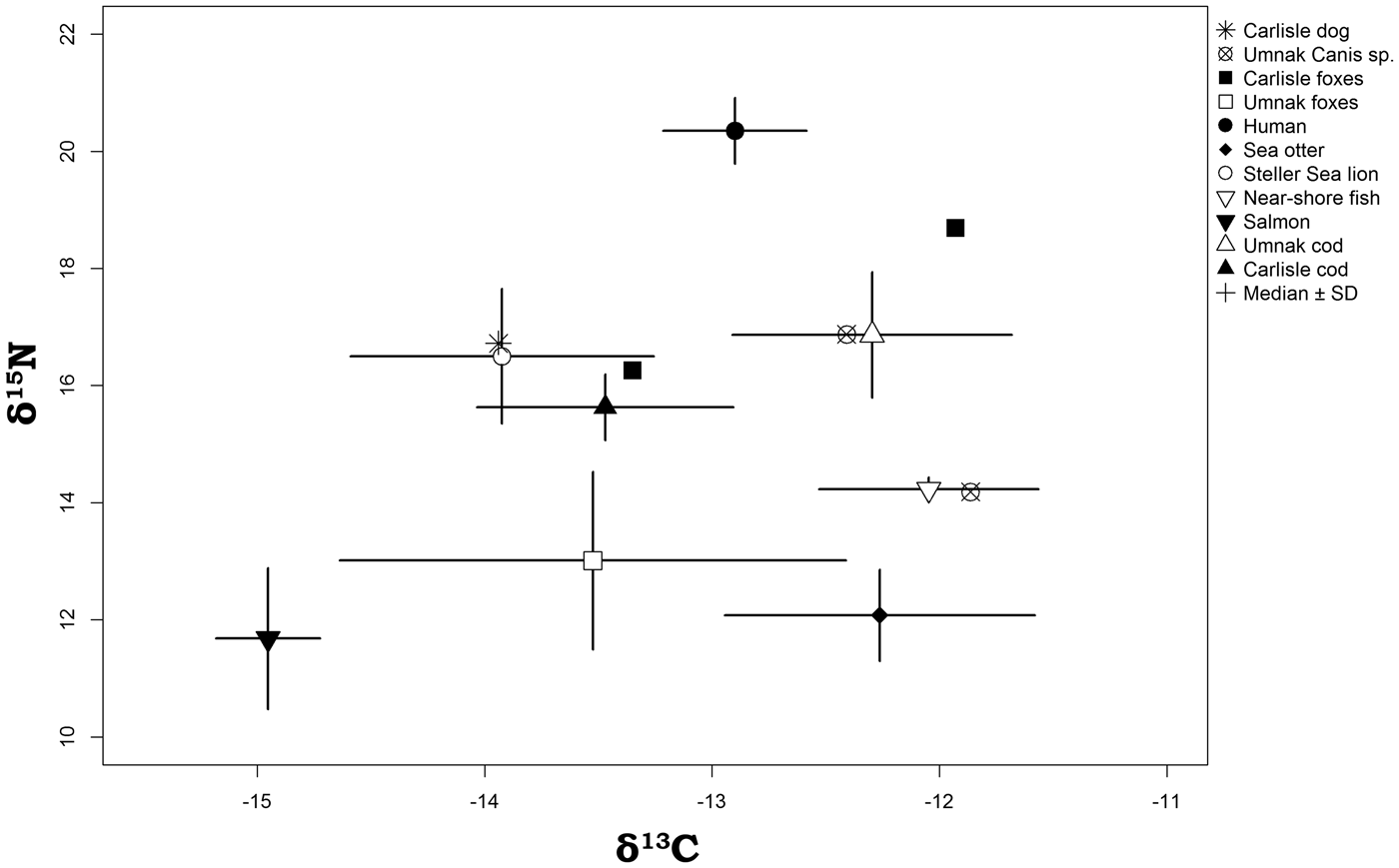
Collagen yield (15–17%) and atomic C/N ratio (3.3) both indicate adequate preservation of collagen in both dog and fox bone remains. The δ15N is + 16.72‰ and δ13C is −13.94‰ for the dog humerus. Stable isotope composition of the two fox samples showed dissimilarity both in δ15N and δ13C: ulna, δ15N + 18.69‰, δ13C -11.93‰; tibia, δ15N + 16.26‰, δ13C -13.35‰. Both fox and dog samples indicate that these canids consumed a maritime diet.
We plotted the obtained isotopic values with: (1) 53 samples of Pacific cod from archaeological sites on Carlisle Island (Krylovich et al., Reference Krylovich, Vasyukov, Khasanov, Hatfield, West and Savinetsky2019); (2) various groups of fauna from the Chaluka archaeological site (1700 BC–AD 1550; Byers et al., Reference Byers, Yesner, Broughton and Coltrain2011) because Chaluka is the closest site with isotopic data on animals harvested by Aleuts; and (3) Neo-Aleut human remains from Kagamil Island (Fig. 3; Byers et al., Reference Byers, Yesner, Broughton and Coltrain2011). Given the pronounced trend both in δ15N and δ13C plankton across the Aleutian Islands (Schell et al., Reference Schell, Barnett and Vinette1998) along with the strong discontinuity in maritime ecosystems which Samalga Pass exhibits (Fig. 1; Hunt and Stabeno, Reference Hunt and Stabeno2005), the direct comparison of animal diets is complex, even from neighboring islands like Umnak and the Islands of Four Mountains. It is likely that the δ13C shift in both cod and Canis sp. samples between Umnak and Carlisle could be explained by such ecological complexity.
Stable nitrogen and carbon isotopes composition of the dog found in Ulyagan site of Carlisle Island in the space of isotopic signatures of Neo-Aleuts from Kagamil and various groups of animals from Chaluka archaeological site (Umnak Island). All the data, except Carlisle dog, foxes, and Carlisle cod from Byers et al. (Reference Byers, Yesner, Broughton and Coltrain2011).

The different isotopic signatures in the two fox samples appear to agree with the osteological analysis suggesting that these bones came from different individuals of different ages. The higher values of ulna δ15N collagen might be the consequence of the “nursing effect,” when a nursing offspring appears to have a higher trophic position than its mother (Jenkins et al., Reference Jenkins, Partridge, Stephenson, Farley and Robbins2001). Although there are no direct investigations of when the nursing effect disappears from fox bone collagen, some studies suggest that the difference should be near 1‰ (Roth and Hobson, Reference Roth and Hobson2000; Jenkins et al., Reference Jenkins, Partridge, Stephenson, Farley and Robbins2001).
The measured Carlisle dog sample shows the same isotopic signature as the mean isotopic value of Stellar's sea lion from Unmak and is close to Pacific cod from Carlisle. One Canis sp. from the Chaluka archaeological site has a similar trophic level to the Carlisle dog, while another Canis sp. specimen is significantly lower.
The increase of δ15N and δ13C at each trophic level in respect to the prey's isotopic composition is commonly known and frequently used to establish trophic interactions between predators and prey species (DeNiro and Epstein, Reference DeNiro and Epstein1978, Reference DeNiro and Epstein1981). In this respect, it is worth noting the relative trophic positions of humans, dogs, and foxes. Regardless of the similarity between human and dog diets, the distance between their δ15N is common for many ancient cultures and comprises around 3‰ in various maritime hunter-gatherer sites (Guiry and Grimes, Reference Guiry and Grimes2013), which is similar to the distance between Neo-Aleuts and the Carlisle dog in Figure 3. Modern Aleutian foxes feed on both marine and terrestrially derived foods (Murie, Reference Murie1959); however, maritime input of the Carlisle fox diet is higher than in Umnak fox diets. Although this could be explained by the nursing effect in these particularly young individuals, it is important to remember that no rodents live on the Islands of Four Mountains. However, rodents do live on Chaluka and foxes there may have had access to more terrestrial food on Umnak Island.
The stable isotope signature might indicate that the Carlisle dog and foxes ate seabirds. The stable C and N isotope composition of seabird collagen from Aleutian archaeological sites is not well-studied. The average δ13C and δ15N of muscle tissues from modern Aleutian seabirds are -20 and + 10‰, respectively (Ricca et al., Reference Ricca, Miles, Anthony, Deng and Hung2007). The contribution of seabirds in the Carlisle dog and fox diets could explain their isotopic position. However, multiple corrections should be considered for this comparison including: (1) muscle-bone isotopic composition differences, (2) the geographical position of the analyzed birds, and (3) age of birds. Additional stable isotopic investigations for Islands of Four Mountains fauna are required to clarify the interspecies isotopic landscape.
DISCUSSION
Foxes
Prior to our discovery of the Carlisle red fox, this species was identified in seven archaeological sites on four eastern Aleutian Islands: Anangula, Umnak, Amaknak, and Akun (Table 1). The ages of all eastern Aleutian archaeological layers containing red fox bones spanned from 2750–2150 BC to Russian contact. Prior to our research, no prehistoric red foxes had been recorded west of Carlisle Island. Currently, the Islands of Four Mountains should be considered the westernmost islands where red fox are indigenous. Veniaminov (Reference Veniaminov, Pierce, Black and Geoghegan1984) mentioned that red fox existed on Chuginadak Island in the Four Mountains in 1840; however, it remains unclear ethnographically whether foxes were indigenous or introduced.
Arctic fox was identified in only one site (UNL-050) on Amaknak Island (Crockford et al., Reference Crockford, Frederick, Wigen, McKechnie, Knecht and Davis2004). The Fox Islands (Umnak, Unalaska, Amaknak, Akutan, Akun, and other smaller islands) were named “Lees'iy ostrova” by Glotov and Ponomaryov in 1759–1762 (Makarova, Reference Makarova1968). In the Russian language, “leessa” means red fox and “pessetz” means arctic fox. Thus, the Fox Islands were named for the presence and assumed abundance of red foxes living there at Russian contact. In his memoirs, Khlebnikov (Reference Khlebnikov1979, p. 125) writes: “The Headquarters ordered the breeding of arctic foxes on the Fox Islands, and in 1810 two pairs were delivered from Pavel to Unalaska and released there, but they were never seen after that. They think that they were exterminated by red foxes. However, on the Fox Islands, they should not be raised at all, because if they mixed with the red foxes, the quality of their furs would deteriorate from their breeding. For arctic foxes, besides the Fox Islands, there are still groups of Andreanof, Rat, and Near Islands, where there are no red foxes at all. And therefore, there should be paid attention on reproduction of ” (translation by the authors).
The large number of red fox pelts harvested confirms the abundance of red foxes in the Fox Islands during the eighteenth century (Murie, Reference Murie1959; Khlebnikov, Reference Khlebnikov1979). Zooarchaeological data indicate that red fox, if not abundant, was at least prehistorically present in the Fox Islands, but has never been found in the central and western Aleutians (Table 1). Red foxes are detrimental to arctic foxes (Hersteinsson and MacDonald, Reference Hersteinsson and Macdonald1992). Currently, red foxes are used as biological control agents to eradicate arctic foxes in the Aleutian Islands (West and Rudd, Reference West and Rudd1983; Bailey, Reference Bailey1992). Three archaeological site components on Amaknak Island—UNL-048 (2750–2150 BC), UNL-055 (AD 1310–1660), and UNL-050 (1550–550 BC; Davis, Reference Davis2001; Knecht and Davis, Reference Knecht and Davis2003; Crockford et al., Reference Crockford, Frederick, Wigen, McKechnie, Knecht and Davis2004)—have red foxes (UNL-048 and UNL-055) and arctic fox (UNL-050). If the identification of these fox species and the supposition that red fox and arctic fox cannot cohabitate are correct, then evidence suggests that red foxes did not live on Amaknak Island during 1550–550 BC. Crockford and Frederick (Reference Crockford and Frederick2007) suggest that the occurrence of arctic fox on Amaknak might be a consequence of the Neoglacial period (1050–50 BC). If true, the habitat of red foxes may have substantially decreased while that of arctic foxes expanded during the Neoglacial. We cannot test this hypothesis because UNL-050 on Amaknak Island is the only site with bones representing the Neoglacial time period.
Arctic foxes were introduced on Carlisle Island in 1929 (Bailey, Reference Bailey1993) and fox-trapper cabins on Carlisle date to the early twentieth century (Cooper, Reference Cooper1991). Although there was historic introduction of fox farming, we emphasize that the red fox bones we recovered were in situ within prehistoric deposits from well-stratified excavation Unit 4 (Hatfield et al., Reference Hatfield, West, Bruner, Savinetsky, Krylovich, Vasyukov, Khasanov, Nicolaysen and Okuno2019; Krylovich et al., Reference Krylovich, Vasyukov, Khasanov, Hatfield, West and Savinetsky2019). The thick volcanic ash layer above the midden level containing fox bones was undisturbed, indicating that the fox remains were not intrusive and that the bones do not represent historically introduced fox. The origin of those prehistoric fox remains, however, is still under question. Were red foxes local or were these animals or their bones transported by prehistoric Aleuts from elsewhere (e.g., from the Fox Islands)? It is currently impossible to ascertain the origins of the Carlisle fox; however, herein, we try to: (1) explain how the red foxes could naturally occur in the Islands of Four Mountains and on Carlisle Island specifically and (2) estimate the value of foxes for Four Mountain Aleuts as well as for Aleuts in general.
The natural occurrence of the red foxes on the Islands of Four Mountains
Red and arctic foxes are very similar species in ecological terms; the arctic fox is a “small red fox in white clothing” (Hersteinsson and MacDonald, Reference Hersteinsson and MacDonald1982, p. 512). Both species are well adapted to the Arctic climate; however, the low primary and secondary production in the Arctic allows only the arctic fox to live there (Hersteinsson and MacDonald, Reference Hersteinsson and Macdonald1992). Therefore the arctic fox area is largely restricted to the Arctic and subarctic zones (Monchot and Gendron, Reference Monchot and Gendron2010) and is bordered on the south by red fox, the larger species that dominates in direct competition (Hersteinsson and MacDonald, Reference Hersteinsson and Macdonald1992).
Both red and arctic foxes are the most frequent carnivorous species in Holocene subfossil assemblages (Sommer and Benecke, Reference Sommer and Benecke2005) and exhibit an incredible ability to enlarge their range. For example, due to the permanent foraging migrations (Chesemore, Reference Chesemore and Fox1975), arctic fox shows almost no genetic variation within its circumpolar area (Carmichael et al., Reference Carmichael, Krizan, Nagy, Fuglei, Dumond, Johnson, Veitch, Berteaux and Strobeck2007); however, its spread significantly depends on the presence of ice corridors (Geffen et al., Reference Geffen, Waidyaratne, Dalén, Angerbjörn, Vila, Hersteinsson and Fuglei2007). Arctic fox was seen arriving on ice floe to the Commander Islands (Iljina, Reference Iljina1950). Evidently, this is a common method for fox colonization of islands located far from the continental seashore and was recently used by red foxes to colonize St. Matthew Island in the Bering Sea, 400 km distant from the Alaska mainland (Colson et al., Reference Colson, Smith and Hundertmark2017). Arctic foxes colonized the Pribiloff Islands in the same way (Veltre et al., Reference Veltre, Yesner, Crossen, Graham and Coltrain2008). These data demonstrate the great potential for foxes to expand their territory via seasonal sea ice or rafting on ice floes or logs. Several obvious conditions are necessary for a species to successfully establish an insular population; these include (1) at least two individuals of different sexes, (2) the island must have an adequate food supply, and (3) for foxes in particular, the island (especially a small one) should be free of predators or stronger competitors. These conditions were met for the colonization of the Commander Island by the arctic fox (Vulpes lagopus beringensis [syn. semenovi]; Dzhikiya et al., Reference Dzhikiya, Ploshnitsa, Kolesnikov and Goltsman2008) and for the Channel Islands of California by the island fox (Urocyon littoralis; Wayne et al., Reference Wayne, George, Gilbert, Collins, Kovach, Girman and Lehman1991). However, taking into account the fox burials found on the Channel Islands (Raab et al., Reference Raab, Bradford and Yatsko1994), researchers argue that foxes were introduced on these islands by humans (Rick et al., Reference Rick, Erlandson, Vellanoweth, Braje, Collins, Guthrie and Stafford2008a). Once on these islands, foxes that are able to establish viable populations evolve in isolation. Although no genetic research exists for Aleutian red foxes, a high percentage of black and cross-color phases (up to 84%) of red foxes harvested in the Fox Islands (Murie, Reference Murie1959) was noted in the 1760s and 1770s. In 1912 in Alaska, however, red color foxes comprised 91% of 8,624 pelts (Evermann, Reference Evermann1913). Murie proposed this to be a consequence of economic selection for the more valuable black (silver) or cross-color phases of fox fur. In the Quebec region of Canada selective killing did not significantly affect the color phase composition ratio in the harvested population of red fox (Haldane, Reference Haldane1942); however, it might have had consequences for the insular population. It is still unknown which factors determine the ratio of color phases in natural populations of red foxes (Anderson, Reference Anderson2009), whether the contribution of heredity (particularly gene flow effect) is greater than the potential adaptive advantages of some phase in specific region. Until genetic studies are conducted, it is impossible to estimate the degree of isolation of red foxes in the Fox Islands.
Red foxes colonized North America at the end of the middle Pleistocene (Péwé and Hopkins, Reference Péwé, Hopkins and Hopkins1967; Aubry et al., Reference Aubry, Statham, Sacks, Perrine and Wisely2009), it remains unknown when red foxes first appeared in the Aleutian Islands. Sea level was approximately 100 m lower during the Pleistocene than today (Lambeck, Reference Lambeck1990), making the Aleutians more accessible. However, the northern border for the range of red fox was then further south. Sea level rise, beginning 18,000 yr, reached its current level circa 5000 yr BP (Lamb, Reference Lamb1995). The Alaska Peninsula and the eastern seashore of the Bering Sea were likely the centers for the dispersal of red fox into the Aleutian Islands. This idea is based on the proximity of these areas to the Alaskan stream, which originates near Kodiak and flows west-southwest along the south side of the Aleutian Island arc (Stabeno et al., Reference Stabeno, Kachel, Kachel and Sullivan2005). To reach the Four Mountains from Alaska during the Holocene, the red fox had to cross two deep passes: Unimak Pass, separating Unimak Island from the Fox Islands, and Samalga Pass, separating Umnak from the Islands of Four Mountains (Fig. 1). The Alaskan stream prevents ice floes from the north from landing on Aleutian shores; however, extreme ice conditions in 1973–1978 along with the strong northern winds resulted in advection of sea ice floes to Unimak Pass (Hood, Reference Hood, Hood and Calder1981; Stabeno et al., Reference Stabeno, Napp, Mordy and Whitledge2010). Once advected or even stacked in the pass, it could have served as a bridge between Unimak and the Fox Islands. This likely occurred during the late Pleistocene and early Holocene with similar or colder/windier climatic conditions.
Samalga Pass (Fig. 1) shows a strong discontinuity in marine ecosystems (Hunt and Stabeno, Reference Hunt and Stabeno2005). Much deeper than Unimak Pass, this pass probably never served as a land bridge when sea level was lower (Aigner, Reference Aigner1977). No rodents inhabit the Aleutian Islands west from Samalga Pass (Murie, Reference Murie1959), except ground squirrels introduced as fox fodder and synanthropic (dependent upon humans) rats. Samalga Pass functioned as a natural barrier restricting the migration of terrestrial animals from the Fox Islands westward. This has been confirming by zooarchaeological investigations on either sides of Samalga Pass. Until the current study, rodents, wild canids, caribou, and bears—species whose bones have been recovered in Fox Island archaeological sites (e.g., Davis, Reference Davis2001; Crockford et al., Reference Crockford, Frederick, Wigen, McKechnie, Knecht and Davis2004)—have never been found in prehistoric archaeological sites west of Samalga Pass (e.g., Desautels et al., Reference Desautels, McCurdy, Flynn and Ellis1971; Lefèvre et al., Reference Lefèvre, Corbett, Crockford, Czederpilz, Partlow, West, Corbertt, West and Lefèvre2010).
The absence of rodents on the Aleutian Islands west of Samalga Pass begs the question regarding the availability of food resources for foxes. Rodents are valuable resource for foxes, specifically noted in the Fox Islands (Murie, Reference Murie1959). Other resources for Aleutians fox would include sea bird colonies, sea mammal rookeries, invertebrates and other resources in the littoral zone, and resources washed ashore. The Islands of Four Mountains are circular and lack littoral zones or bays, significantly decreasing the resources available for the red fox. Similarly, the Commander Islands also were never naturally inhabited by rodents (Barabash-Nikiforov, Reference Barabash-Nikiforov1938) and arctic fox population date to the late Pleistocene (Dzhikiya et al., Reference Dzhikiya, Ploshnitsa, Kolesnikov and Goltsman2008). However, the Commander Islands feature large, undulating shores and pronounced littoral zones that provide a rich resource for foxes. Thus, the natural occurrence of red foxes on Carlisle Island is not an obvious explanation for their occurrence in the archaeological deposits.
Foxes can substantially enlarge their home range depending on landscape productivity (Walton et al., Reference Walton, Samelius, Odden and Willebrand2017). This species possesses both natural affinity and capability to migrate (Gritsenko et al., Reference Gritsenko, Kreslavsky, Mikheev, Severtsov and Solomatin1983). If mainland Alaska was the dispersal center of red foxes, then the prehistoric rodent populations, bays, and littoral zones of the Fox Islands provided suitable colonization conditions but we would expect to see the trend of fox density decline from east to west as ocean passes became wider and deeper. Variations in climatic conditions may have opened corridors, which allowed foxes to migrate westward. Given an insufficient resource base on the Islands of Four Mountains, it is possible that the foxes that once occurred on those islands and having had no ability to escape could not establish a viable, long-lived population or were immediately killed by humans. It is possible that red foxes spread west, even beyond the Four Mountain Islands; however, the probability of recovering such remains is very low.
The value of foxes for Aleuts
Archaeological material usually represents common everyday items associated with ancient people and only occasionally reveals something rare or unknown. Most materials left behind by ancient people were not deposited or were lost/destroyed or dropped in the other unexcavated areas of the site (Dinesman et al., Reference Dinesman, Kiseleva, Savinetsky and Khassanov1999; Lyman, Reference Lyman2008). We generally assume that a single animal bone represents several or many of the same species and is not an isolated example. If we assume that these three fox bones from Unit 4 on Carlisle Island were transported there by Aleuts from elsewhere, then this behavior was likely a common action; in other words, Aleuts regularly brought foxes (as pets, pelts, or skeletons) to their villages. No ethnographic evidence supports the use of fox pelts by Aleuts (Unangax̂) for clothing or meat (Khlebnikov, Reference Khlebnikov1979; Veniaminov, Reference Veniaminov, Pierce, Black and Geoghegan1984). There is some ethnographic evidence to suggest that Aleuts did not value fox fur and only hunted foxes during the Russian period for their value to the Russians. This idea is suggested by this quote that indicates Aleuts were not selective of the fur quality, just the quantity: “The prohibition to harvest animals in spring- and summertime cannot stop the Aleuts, though the animal furs are very thin in those seasons and are half-valued” (Khlebnikov, Reference Khlebnikov1979, p. 39, translation by the authors).
The majority of tools Aleuts manufactured were made of bird or sea mammal bones; no tools made of fox bone have been documented in Aleutian archaeological contexts (McCartney, Reference McCartney1967; Holland, Reference Holland1982; Turner, Reference Turner2008; Margaris, Reference Margaris2009). The Fox Islands and Kodiak never saw the introduction of foxes by Russians, because red foxes already inhabited these islands. Tools made of fox have never been recovered on the Fox Islands or on Kodiak, where the natural occurrence of red foxes is unquestionable. Thousands of red fox pelts were harvested annually in the Fox Islands at the beginning of eighteenth century (Khlebnikov, Reference Khlebnikov1979). Kodiak Island saw a similar annual exploitation of red fox (Khlebnikov, Reference Khlebnikov1979). Although we cannot directly compare modern harvesting data with prehistoric activities, this evidence suggests a high carrying capacity for foxes at the time of Russian contact. Yet, there are very small numbers of prehistoric fox remains recovered from Fox Islands middens (Table 1); on Kodiak, the percentage of fox remains is significantly higher (Etneir et al., Reference Etnier, Partflow and Foster2016), which probably correlates with other cultural variables between these two island societies.
The small numbers of fox remains in prehistoric Aleutian archaeological sites indicate that Aleuts only occasionally harvested canids. On Carlisle, foxes could have naturally migrated and established a viable population in the absence of humans. Given the small size of the Islands of Four Mountains and limited resources, however, both competition with human predation and direct human predation may have limited their population size or ability to maintain a viable population. Given the cultural similarities between the Four Mountains and Fox Island prehistoric Aleuts (Hatfield et al., Reference Hatfield, Bruner, West, Savinetsky, Krylovich, Khasanov and Vasyukov2016), we assume that if red foxes were not valued by prehistoric peoples of the Fox Islands, foxes would also not be valued in the Four Mountains. Thus, the red fox remains from Ulyagan Unit 4 on Carlisle were probably not brought to Carlisle by ancient Aleuts.
Dogs
Besides the dog materials recovered on Carlisle Island there are at least three documented records of prehistoric dogs in Aleutian archaeological sites: Ashishik Point on Umnak (Denniston, Reference Denniston1972), Tanaxtaxak on Amaknak (Knecht and Davis, Reference Knecht and Davis2003), and Chulka at Akun (Table 1; Holland and Turner, Reference Holland and Turner1987). Dog bones, identified as historic, were reported at the Akun Chulka site (Holland and Turner, Reference Holland and Turner1987). Currently, Carlisle Island represents the westernmost point in the Aleutian Islands for pre-contact dog.
Prehistoric dogs from Carlisle, Umnak, and Amaknak (Unalaska) Islands date later than the fourteenth century AD (Table 1). Archaeological and human biological evidence from the Chulka site, the oldest village site where dog bones have been identified (AD 1000), suggests this site was a Neo-Aleut settlement lacking any Paleo-Aleut components (Holland and Turner, Reference Holland and Turner1987, Reference Holland, Turner, Shaw, Harritt and Dumond1988).
Davis (Reference Davis2001) reported four Canis sp. bones from levels dated 2750–2150 BC on Amaknak Island. Byers et al. (Reference Byers, Yesner, Broughton and Coltrain2001) reported two Canis sp. bones, which are possibly wolf, at Chaluka from levels dated 1700 BC–AD 1550; however, wolf has never been described west of Akun Island (Murie, Reference Murie1959; Veniamonov, Reference Veniaminov, Pierce, Black and Geoghegan1984).
Radiocarbon-dated human skeletons from Chaluka, Shiprock, and Kagamil indicate that Neo-Aleuts inhabited the eastern Aleutians at least by AD 1375 (West et al., Reference West, Khasanov, Krylovich, Hatfield, Khasanov, Vasyukov and Savinetsky2019). It remains unclear how long Paleo-Aleuts and Neo-Aleuts interacted (communicated, traded, raided, or warred) prior to transition to the Neo-Aleut phase in the eastern Aleutians. Correct dates are critical for this important time in the prehistory of the eastern Aleutians. Nevertheless, all pre-contact dog remains identified in Aleutian archaeological sites are associated with Neo-Aleut aged layers; however, the unidentified canid remains from the Paleo-Aleutian context (e.g., Davis, Reference Davis2001) leave place for uncertainty in postulating whether or not Paleo-Aleuts had dogs.
Why would Paleo-Aleuts not use dogs, while Neo-Aleuts did? Was it because Paleo-Aleuts were not acquainted with dogs or because they did not know that these animals could be useful? Why did Neo-Aleuts keep or obtain dogs? Where did they get them? Why did they want them? These questions lead to more general issues regarding use of dogs by ancient people (Morey, Reference Morey2010). Dogs possess great antiquity with humans, and local (e.g., geographical and climatic) conditions played a crucial role for people when evaluating the profitability of dogs versus their maintenance. Maintenance primarily involves feeding; for island populations, however, transportation can become an issue. The amount of effort that goes into feeding dogs depends on their number, resource availability, and the abilities of the hunter/gatherers. Thus, when resources are scarce, dogs have a higher maintenance cost and their value may shift toward their use as a food resource. This theoretical situation can be and has been overridden by other cultural values, which will be mentioned further.
There are two important case studies with respect to the maintenance of dogs and their role in a society. One case is from the Arctic, where dogs strictly depend on humans due to the severe environment. In the Arctic, a dog requires 350–500 kg of food/yr (Foot, Reference Foot1965; Saladin d'Anglure, Reference Saladin d'Anglure, Sturtevant and Damas1984); a dog team consisting of 12 dogs consumes two times more food than a family of 4–7 people (Bogoras, Reference Bogoras1901). In this situation, dog maintenance is very expensive; thus, their profit must be high. While travelling to the North Pole, Cook (Reference Cook1911) noted that the number of dogs and the number of children was a measure of wealth in Eskimo settlements because both are important for prosperity. However, dogs became widespread in the Arctic and played a vital role only in Thule culture by 1000 yr (Darwent, Reference Darwent, Mondini, Muñoz and Wickler2004; Morey, Reference Morey2010). The Thule, ancestors of the modern Inuit, used dogs tied to sleds for transportation and this critical innovation allowed for the rapid expansion of ancient Arctic peoples across vast areas in a short time (Mathiassen, Reference Mathiassen1927; Jenness, Reference Jenness1940; Maxwell, Reference Maxwell1985; McGhee, Reference McGhee1996; Morey and Aaris-Sørensen, Reference Morey and Aaris-Sørensen2002). They also used dogs for breathing-hole sealing (Cox and Spiess, Reference Cox and Spiess1980). Prior to this Arctic expansion, dogs, identified only in isolated patches and scarce in archaeological sites, were used far less intensively by Paleo-Eskimo populations for at least 3500 yr (Morey, Reference Morey2010). Recent genetic studies showed that modern Inuit dogs likely derive from the Thule dog gene pool, not from Paleo-Eskimo dogs or the dogs of the first North American colonizers (Brown et al., Reference Brown, Darwent and Sacks2013, Reference Brown, Darwent, Wictum and Sacks2015). It is important to note that in the Arctic: (1) despite the environmental severity, the Arctic seas are highly productive (e.g., Pabi et al., Reference Pabi, van Dijken and Arrigo2008) and provide the necessary food resources; (2) the region is environmentally conducive to dog sleds, with sea ice and snow cover for most of the year; and (3) dog sled technology was either invented late or was slow to be adopted by people, perhaps because it took a while for the profit margin to catch up to the cost of dog maintenance. Regarding this, the Aleutians lack most of the characteristics that made dogs so valuable for Neo-Eskimo people over the past millennium.
A second case derives from tropical and remote oceanic islands. With other domesticated plants and animals, ancient people transported dogs to Polynesia (Steadman, Reference Steadman1995; Burney et al., Reference Burney, James, Burney, Olson, Kikuchi, Wagner and Burney2001), Micronesia (Intoh and Shigehara, Reference Intoh and Shigehara2004), California's Channel Islands (Raab et al., Reference Raab, Bradford and Yatsko1994; Rick et al., Reference Rick, Walker, Willis, Noah, Erlandson, Vellanoweth, Braje and Kennet2008b), and the Carribean (Lippold, Reference Lippold, Ayubi and Haviser1991; Wing Reference Wing, Purdue, Klippel and Styles1991; Newsom and Wing, Reference Newsom and Wing2004) to “provide the necessary means to survive over the long term” (Fitzpatrick et al., Reference Fitzpatrick, Thompson, Poteate, Napolitano and Erlandson2016, p. 6; see also Steadman et al., Reference Steadman, Plourde and Burley2002; Anderson, Reference Anderson2009; Fitzpatrick and Callaghan, Reference Fitzpatrick and Callaghan2009). On the Channel Islands (Rick et al., Reference Rick, Walker, Willis, Noah, Erlandson, Vellanoweth, Braje and Kennet2008b), dogs were recovered from burials rather than in kitchen middens (Newsom and Wing, Reference Newsom and Wing2004), suggesting dogs played a different cultural or ritual purpose in those societies. Giovas (Reference Giovas2006) demonstrated that island biogeography determined the survivorship for pigs that, like dogs, were introduced to many Polynesian sites. Although effects of island biogeography has not yet been shown for dogs, it is also likely applicable for them due to the close trophic and ecological position between dogs and pigs. According to the general biogeography statements, species home range depends on its size and trophic position: the higher these characteristics are, the larger the range that is needed, and this is how the island area impacts survivorship of any given species (Brown and Lomolino, Reference Brown and Lomolino1998). Isolation is another factor in island biogeography predictions (MacArthur and Wilson, Reference MacArthur and Wilson1967; Brown and Lomolino, Reference Brown and Lomolino1998) and has been used to explain the loss of domestic animals during human migrations to Polynesia, as well as the lack of pigs on Easter Island, Norfolk Island, the Chatham Islands, and New Zealand (Giovas, Reference Giovas2006). Dietary examinations of dog remains from Polynesia revealed that in many cases dogs ate maritime food or a mixed diet (maritime and terrestrial), likely fed to them by humans (Clark Reference Clark1997a, Reference Clark1997b; Leach et al., Reference Leach, Quinn, Morrison and Lyon2003; Valentin et al., Reference Valentin, Bocherens, Gratuze and Sand2006). On the Marquesas Islands (French Polynesia), researchers noted a descending trend of maritime food in dog's diet during the initial stages of island occupation (Richards et al., Reference Richards, West, Rolett and Dobney2009). Richards et al. (Reference Richards, West, Rolett and Dobney2009) suppose that both pigs and dogs were part of the basic subsistence strategy for these islanders; however, others suggest that they were prestige foods, available only to elites and resulting from social complexity in these Polynesian societies (Rechtman, Reference Rechtman1992; Leach, Reference Leach2003; Valentin et al., Reference Valentin, Bocherens, Gratuze and Sand2006). Even if dogs and other transported animals were valuable as prestige food items, they also provided insurance for basic subsistence and this insurance role is very different from the role dogs played in Arctic. The mildness of tropical/subtropical climate in contrast to the Arctic suggests dog maintenance was easier in terms of human efforts where dogs could scavenge their own food. In the tropics, the cost of dog maintenance would be far less.
Given these two scenarios, the question regarding dog usage in Aleutian Islands can be refined. The people that colonized North America circa 14,000–12,000 yr (Starikovskaya et al., Reference Starikovskaya, Sukernik, Schurr, Kogelnik and Wallace1998; Fiedel, Reference Fiedel2000) brought dogs into the New World (Leonard et al., Reference Leonard, Wayne, Wheeler, Valadez, Guillen and Vila2002). Archaeological evidences from North American archaeological sites support that dogs were present elsewhere during the Paleo-Aleut occupation. Dog remains have been found in small numbers at several Paleo-Eskimo sites in Canada and Greenland (Morey and Aaris-Sørensen, Reference Morey and Aaris-Sørensen2002; Morey, Reference Morey2010), St. Lawrence Island, and Alaska (Murie, Reference Murie, Geist and Rainey1936; Giddings and Anderson, Reference Giddings and Anderson1986; Darwent, Reference Darwent and Arnebord2006). Dog burials, “the most obvious sign of a close prehistoric human-animal relationship” (Clark, Reference Clark1996, p.34), were found in Newfoundland dating back 4000 yr (Tuck, Reference Tuck1976). Even if Paleo-Aleuts or their ancestors “got rid” of their dogs on the way to Aleutian Islands 9000–11,000 yr, dogs continued to be present on the mainland and interactions with or migrations back to the mainland would have re-introduced dogs to the Aleutians. Thus, Arctic peoples could have had periodic access to dogs (Morey and Aaris-Sørensen, Reference Morey and Aaris-Sørensen2002). However, there is no association between Paleo-Aleut populations and dogs. It is likely that both isolation and the high maintenance of dogs explain their absence in Paleo-Aleut contexts. The rugged terrain that precluded much overland travel (Lantis, Reference Lantis, Sturtevant and Damas1984), and year-round ice-free seas negated the use of dogs for transportation (Clark, Reference Clark1974). The isolation could also prevent the appearance of dogs in the Aleutian Islands prior the Neo-Aleut period. Isolation is obviously not as pronounced as in Polynesia, because many of the Aleutian Islands are relatively close to each other and can be observed from one another.
Misarti and Maschner (Reference Misarti and Maschner2015) suggested that the Paleo-Neo-Aleut transition could reflect increased social complexity accompanied with the appearance of elite groups with close ties to Kodiak people. They argue Neo-Aleuts married Kodiak women who imported their slate tool kits as they moved into the Aleutians. Kodiak Island is the closest place with abundant dog remains (Holland and Turner, Reference Holland and Turner1987; West and Jarvis, Reference West and Jarvis2015) and these animals may also have been imported with slate and other cultural materials. This could explain their sudden appearance in the eastern Aleutians associated with Neo-Aleut occupations. Koniag peoples might have imported dogs from Kodiak as insurance, like in Polynesia. Carlisle dogs were either juvenile or subadult. Allen (Reference Allen1939) suggested puppies were used as a food resource during migrations. Stable isotope analysis from one dog sample suggests that it had a maritime diet, as did the foxes found at the same location, thus demonstrating the same trophic position, which can be explained by the similar food source. Probably fed during seasons of plenty, dogs could serve as “walking larders” to be sacrificed and eaten during periods of starvation when migratory and other food sources were scant or entirely absent (Bogoras, Reference Bogoras1904). It has generally been assumed that late winter and early spring constituted lean months for Aleuts. During these seasons, Aleuts relied on low calorie shellfish for sustenance (West et al., Reference West, Coltrain, Hayes, O'Rourke, Lefèvre, Corbett, Bouchet, Savinetsky, West, Hatfield, Wilmerding, Lefèvre and Gualtieri2012). If this is correct, then it is easy to imagine that prehistoric Aleuts would have eaten dogs during famines, thus not giving them the chance to breed. However, it is also possible that the consumption of dogs was for the elites. No dog remains have been recovered west of the Islands of Four Mountains, which reflects a migration trend, declining further from the source of migration. For foxes, migration was probably natural, but for dogs, migration was undoubtedly cultural.
The ethnographic literature says nothing about Aleutian dogs (Holland and Turner, Reference Holland and Turner1987; West and Jarvis, Reference West and Jarvis2015). This may be due to: (1) an actual absence of dogs in the regions of ethnographic studies, (2) imperfect ethnographic records on aboriginal dogs, or (3) the inability of ethnographers to distinguish pre-contact dogs from historic ones. In contrast, for many regions ethnographic literature mentions aboriginal dogs and their usage, presumably because of their abundance in the Arctic (Sarychev, Reference Sarychev1802; Hooper, Reference Hooper1853; Nordenskiöld, Reference Nordenskiöld1881; Nelson, Reference Nelson1900; Bogoras, Reference Bogoras1901, Reference Bogoras1904; Cook, Reference Cook1911, Malaurie, Reference Malaurie1965) or Polynesia (Luomala, Reference Luomala1960). The only evidence concerning nineteenth-century dogs near the Aleutians comes from Khlebnikov's (Reference Khlebnikov1979, p. 39) memoirs, in which he describes the harvesting of ground squirrels and foxes by locals on Kodiak: “For ground squirrel trapping, hunters use up to 200 dogs, which, when running with them, sniff the holes and show where the critters hide”, and “[f]oxes are much caught by dogs, which the Aleuts have bred everywhere” (translation by the authors). It is worth noting that the large number of dogs on Kodiak during the Russian era is demonstrated by the high relative frequency of dog remains (5–10% of identified mammals) in the kitchen middens dated to AD 1790–1830 (Etnier et al., Reference Etnier, Partflow and Foster2016). It remains unclear, however, whether the local hunters bred dogs after contact with Russians, or before. Genetic studies are needed to discern these dynamics.
CONCLUSION
Ethnographic accounts provide little to no information about either Aleutian dogs or pre-contact foxes. Due to this absence of data, dog and red fox remains from Carlisle Island are valuable findings. One of the primary goals of this study was to consider the canid remains found in the Ulyagan archaeological site on Carlisle Island in the light of other canid discoveries in the Aleutian Islands. The understanding of the cultural role of particular species in ancient human societies, especially the domestic dog, often sheds a light on some aspect of human history of the region. Tracing the natural living areas of wild species in the past is also valuable for conservation and biogeography knowledge.
Red fox remains occur periodically in eastern Aleutian archaeological sites from 2750–2150 BC to historic times. Given the proximity of the most likely dispersal place (mainland Alaska) and the fox's ability to cross sea passes, our identification of red fox suggests that this species was sometimes indigenous to the Islands of Four Mountains. The great potential of foxes to migrate allows us to suggest the existence of a westward migration trend from Fox Island (eastern Aleutians) with its relatively rich food base to as far as the Four Mountains. However, it is likely that, if they ever existed, the fox populations west of the Fox Islands (e.g., on the Carlisle Island) were not permanent due to the small island area, poor food base, competition with humans for food resources, and/or direct predation by humans.
According to our zooarchaeological data, pre-contact domestic dogs as well as red fox occurred in the eastern Aleutians at least as far west as the Carlisle Island. The reasons for such a match remain unclear, but the similar trends could have taken a place. We consider two cases of dog uses reported from other part of the world to provide some comparison for the Aleutian case in the paper: (1) an Arctic case, where dogs were actively used for sledding for at least the last millennium, and (2) the set of cases from remote Oceania, where people transported dogs for food. Costs versus benefits must have played a key role in choice of dog ownership and use. Unlike foxes, dogs usually migrate with people. Dogs could not be effectively used for transportation in the Aleutians like in Arctic, but these domestic canids, possibly arising from Kodiak to the east, could serve as a food resource during long, westward trips. No cut marks or other butchering evidences have ever been noted on the dog bones from Aleutian Islands archaeological context, however, which is probably due to the small number of findings.
All Aleutian dog remains date from AD 950 to more recent times, falling within the “Neo-Aleut” period. Whether Neo-Aleuts came from elsewhere and/or instigated some social changes in Paleo-Aleut societies, we find dog remains associated only with the Neo-Aleut time period, which suggests cultural differences between Paleo- and Neo-Aleuts.
Excavations on Yunaska, Amukta, Amlia, and Atka islands, which lie between the Islands of the Four Mountains and Adak (central Aleutians), would clarify both dog and fox dispersal history and fill a large spatial zooarchaeological data gap for the North Pacific. Finally, continued analysis of fox remains from the Neoglacial period (1050–50 BC) of the Aleutian Islands could help us to understand: (1) whether this climatic period shifted both arctic and red fox distributions, and (2) Aleut interactions with these canids in relation to climate fluctuations and social changes in that interval.
ACKNOWLEDGMENTS
This research was funded by the National Science Foundation, Office of Polar Programs (OPP#1301927, OPP#1301925, and OPP#1301929), Grant RFBR No. 15-04-07969 and 15-04-09024, Keck Geology Consortium (REU#1358987), with additional funding and support from the Russian Programs “Living Nature,” “Bioresources,” and “Origin and Evolution of Biosphere”. The work was carried out in accordance with the government order for Severtsov Institute of Ecology and Evolution, RAS (project # AAAA-A18-118042490054-0). The authors are very thankful to Bulat F. Khasanov and Olesya I. Smyshlyaeva for their helpful advice and to the anonymous reviewers and editors of this special issue, who helped us to substantially improve the paper. Work was conducted in collaboration with the Aleut Corporation, the Alaska Volcano Observatory, and the Alaska National Maritime Wildlife Refuge. Any opinions, findings, and conclusions or recommendations expressed in this material are those of the author(s) and do not necessarily reflect the views of the National Science Foundation