Implication
Assessment of sperm morphology is one of the most important aspects for semen evaluation and successful fertilisation. High percentage of morphologically abnormal spermatozoa had been correlated with lower fertility in bulls and other species. Production of required doses of quality frozen semen from crossbred (Bos indicus × Bos taurus) dairy bulls maintained under tropical environment is a serious problem and as many as 60% of crossbred bulls are rejected from frozen semen production stations because of poor semen quality, higher sperm abnormality and poor semen freezability. Although Holstein Friesian (HF) bulls have been extensively used as improver breeds in most of the parts of world, problems with respect to higher sperm morophological abnormalities, poor semen freezability etc. by large numbers of HF × Zebu crosses under tropical conditions have not been properly addressed. In this paper, spermiogram of HF × Sahiwal crossbred bulls in relation to semen freezability and its age-wise changes have been reported. Young bulls that are consistently producing 25% or more total abnormal sperms have remote chance to become a potential sire for artificial insemination (AI), because of poor semen freezability. Such bulls need immediate culling to reduce the economic losses in bull stations.
Introduction
Semen quality and sperm morphology are some of the important determinants of bulls’ fertility or cow conception rate. Sperm head contains the half of the genetic material, and structural and functional soundness of sperm tail assures forward progressive movement to carry the genetic materials to the fertilization site. Thus, structural and functional health of entire spermatozoa is essentially important for successful fertilization. Production of required doses of quality frozen semen from crossbred bulls maintained under tropical environment is a serious problem and as many as 60% of Bos indicus × Bos taurus crossbred (dairy) bulls are rejected from frozen semen production stations either because of poor semen quality or unsatisfactory freezability (Mathew et al., Reference Mathew, Joseph and Jose1982; Sagdeo et al., Reference Sagdeo, Chitnis, Deshmukh and Kaikini1990; Tyagi et al., Reference Tyagi, Mandal, Kumar and Mathur2006). Breeding unsoundness in B. indicus × B. taurus crossbred (beef and dual purpose) was the highest (46%) as compared with either B. indicus or B. taurus bulls maintained at tropical environment of Costa Rica and crossbred bulls had highest sperm abnormalities as compared with either B. indicus or B. taurus (Chacón et al., Reference Chacón, Pérez, Müller, Söderquist and Rodriguez-Martinez1999) breeds. Most of the studies concerned with reproductive unsoundness in crossbred bulls have reported about lower scrotal circumference, pathological conditions of primary and secondary sex organs and deviations in the spermiogram (Carter et al., Reference Carter, Wood and Wright1980; Chenoweth et al., Reference Chenoweth, Chase, Thatcher, Wilcox and Larsen1992 and Reference Chenoweth, Spitzer and Hopkins1996; Chacón et al., Reference Chacón, Pérez, Müller, Söderquist and Rodriguez-Martinez1999) as major reasons of poor performance. Total abnormal sperm percent or presence of any single types of abnormal sperms in higher frequencies are often considered as one of the most important criteria for breeding unsoundness and poor fertility. Thus, assessment of sperm morphology before and during semen collection/breeding programme always remains an important aspect for AI industry. Available literatures on spermiogram of B. indicus × B. taurus crossbred bulls revealed information mostly on the incidence of total head, mid piece, tail abnormalities and with one or two other kinds of specific abnormalities (Prasad et al., Reference Prasad, Verma and Tripathi1990; Chacón et al., Reference Chacón, Pérez, Müller, Söderquist and Rodriguez-Martinez1999; Sori et al., Reference Sori, Prasad and Zewdie2006). There is lack of information on detailed accounts of occurrences of different types of sperm aberrations in crossbred bulls maintained under tropical environment. At younger age semen quality is inferior and there is higher incidence of sperm abnormalities than mature bulls (Kumi-Diaka et al., Reference Kumi-Diaka, Nagaratnam and Rwuaan1981; Troconiz et al., Reference Troconiz, Beltran, Bastidas, Larreal and Bastidas1991; Chacón et al., Reference Chacón, Pérez, Müller, Söderquist and Rodriguez-Martinez1999), however, information on age-related changes on spermiogram of B. indicus × B. taurus crossbred bulls are inadequate and their problems on higher prevalence of morphologically abnormal sperms, poor semen quality and freezability have not been investigated extensively.
HF breed of cattle has long been used extensively as an improver dairy breed in many parts of the world. In India, 15% of total cattle population (185 million) are B. taurus × B. indicus crossbreds and majority of them are having HF inheritance. This study gives a detailed enumeration of different kinds of sperm morphological abnormalities in various freezable grade semen producers HF × Sahiwal crossbred bulls and age-related changes in their spermiogram.
Material and methods
The study was conducted on 94 Frieswal bulls (2 to 6 years) maintained at Bull Rearing Unit (BRU), Project Directorate on Cattle, Meerut, India located at 77°46′E Latitude and 29°4′N longitude. Frieswal bulls are crosses between HF (B. taurus) × Sahiwal (B. indicus); having 5/8 HF and 3/8 Sahiwal inheritance. Young bulls produced by nominated mating (progeny tested Frieswal sires × elite Frieswal dams of high production indices) are selected at 6 months age from different Military farms located at various agro-ecological regions of the country. They are brought to the BRU of the institution for further rearing and to be used in AI. All the bulls are fed and managed uniformly under intensive close housing system as per standard management practices. All the bull calves and bulls are given anthelmentics periodically and vaccinated against foot and mouth diseases, haemorrhagic septicaemia and black quarters at regular intervals.
Bulls were put to training for semen collection at 15 to 18 months of age at about 350 kg body weights. Before putting under collection all the bulls were examined for their physical soundness and those having gross anatomical defect in body and reproductive organs were discarded immediately. Semen was collected once/week from young bulls and twice /week from adult bulls using an artificial vagina (42°C to 45°C) at early morning by one semen collector. Immediately after collection ejaculate was placed in a water bath at 34°C and evaluated for volume, sperm concentration and progressive motility percent. Two technicians (one semen collector and one semen evaluator) remained unchanged throughout the study period to keep subjective human variation as minimum as possible. Sperm concentration was estimated by using a photometer (Accucell, IMV, France). Semen after dilution in Tris – egg yolk – citric acid – fructose-glycerol (6.4%) extender, progressive motility was determined on a subjective scale of 0% to 100% with a nearest of 5% intervals, viewing at least five microscopic fields at magnification ×200 using a phase-contrast microscope fitted warm stage (37°C).
Sperm morphology was evaluated by eosin-nigrosin staining technique (Blom, Reference Blom1950; Hancock, Reference Hancock1952) by counting 100 spermatozoa per ejaculate and observed (1000×) under differential interference contrast microscope using immersion oil. When multiple abnormalities were observed in the same spermatozoa, only one abnormality was lodged by giving first priority to abnormal head, followed by mid piece and tail as second, proximal droplet with third and distal droplet as the last priority. Ejaculates having 60% or more initial progressive motility were subjected to processing for cryopreservation, else discarded. French mini straw (0.25 ml) containing 25 million spermatozoa per dose were filled and sealed by a semi-automatic straw filling sealing machine (IMV, France). After equilibration of 3 to 4 h, cryopreservation of semen was carried out as per standard vapour freezing method (Hafez, Reference Hafez1980). Thawing was carried out in 37°C water for 60 s. Frozen semen samples having 40% and above post-thaw motility were considered as freezable and accepted for storage and use of AI, otherwise discarded. Bulls were categorized into three groups based on their semen freezability potential visualising bulls of consistent freezable semen producer grade (Group 1), inconsistent or intermittent freezable grade (Group 2) and nonfreezable grade (Group 3). Under each group, bulls were further divided into two subgroups based on their age visualising young (⩽30 months) and adult /mature (31 to 70 months). The same bulls were followed over the age (young and adult stage) for taking observation on sperm morphology.
Data were subjected to one-way analysis of variance using the Statistical Package for Social Sciences (SPSS 7.5). Individual categories (i.e. Groups 1, 2 and 3) as well as pooled data were analysed separately to find out differences in spermiogram between young and adult bulls belonging to each category. On overall basis, at least three ejaculates per bull (total numbers of ejaculates = 532, total number of bulls = 94) were used for statistical analysis.
Results
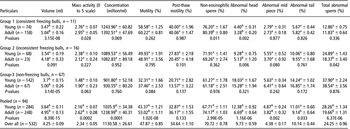
In this study, 11 of 94 bulls were consistent, 16 bulls were inconsistent and rest 67 bulls were non freezable semen producers. Thus, it was evident that a large mass (71.28%, 67 of 94) of B. taurus × B. indicus crossbred bulls had unsatisfactory semen freezability and very high levels of abnormal spermatozoa in their ejaculates (Table 1). About 17.02% bulls (16 of 94) showed intermittent problems of semen freezability with higher frequencies of abnormal sperm morphology at younger age. Only 11.70% (11 of 94) crossbred bulls had satisfactory semen quality, spermatozoal morphology and acceptable semen freezability both at their young and adult age (Table 1). Hence, a large proportion of initially selected physically sound and healthy B. taurus × B. indicus crossbred bulls were unsuitable for artificial insemination because of the production of poor quality semen with high percentage of morphologically abnormal sperms and unsatisfactory semen freezability.
Semen quality and total sperm abnormality (mean ± s.e.) of young and mature Frieswal bulls of different freezable semen-producer grades

n = number of ejaculates; young (age up to 30 months), adult (31 to 70 months age); column wise means with in a group with different superscripts differed significantly (a, b for P < 0.05, A, B for P < 0.01).
Effect of age was significant (P < 0.01) on most of the semen characteristics and spermatozoal morphology (Table 1). Overall semen volume, mass activity, and sperm concentration were 36%, 17.56% and 19.6% higher in adult bulls as compared with their younger age. Over all progressive initial motility (%) and livability (non-eosinophilic sperm %) showed significant (P < 0.01) improvement with the advancement of age (Table 1).
In consistent semen freezing bulls, semen volume, mass activity and sperm concentration enhanced by 45.24%, 6.88% and 11.94%, respectively, at mature age as compared with their younger age. Initial motility and post-thaw motility were also increased marginally. Live sperm percent was increased (P < 0.05) and head abnormality decreased significantly (P < 0.01) with age.
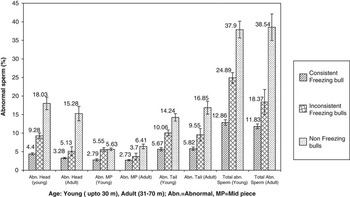
In inconsistent freezing bulls, no significant (P > 0.05) differences were observed in semen volume, mass activity, sperm concentration, motility and livability over the age. Abnormal sperm head (%) decreased significantly (P < 0.01) at adult hood. Prevalence of mid piece and tail abnormalities were decreased with age advancement, however, difference was statistically non-significant (P > 0.05). Decrease of total abnormal sperms from 24.89 ± 1.43% to 18.37 ± 3.40% in the ejaculates of adult bulls (significant P < 0.05) indicate that sperm morphologies were improved in inconsistent freezing bulls with maturity.
In case of non-freezing grade bulls, only semen volume was increased significantly (P < 0.01) with maturity. No other semen characteristics and over all sperm morphology did show any improvement with age advancement; rather some of the traits such as dead sperm, abnormal mid piece, tail and total abnormal sperm per cent showed increasing trend with the increase of age (Figure 1).
Changes in spermiogram of various freezing category Frieswal bulls at their young and adult stage.

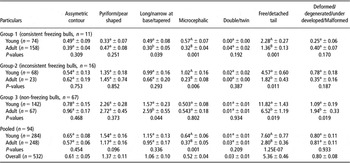
Mean (±s.e.) values of various kinds of sperm head, mid piece and tail abnormalities of young and adult Freiswal bulls of different freezable categories are given in Tables 2, 3 and 4, respectively. In Group-1 bulls, occurrence of narrow head (P < 0.05), micro cephalic sperms and free heads were significantly (P < 0.01) less in adult as compared with young age (Table 2). Similar trends were also observed in case of inconsistently freezing grade bulls. In non-freezing grade bulls, incidence of slender/tapered head and under developed/malformed head increased significantly (P < 0.05) from young to adult stage, however, free heads decreased significantly (P < 0.05).
Mean (±s.e.) sperm head abnormalities (%) of young and mature Frieswal bulls of different freezable semen-producer grades

n = number of ejaculates; young (age up to 30 months), adult (31 to 70 months in age); column wise means with in a group with different superscripts differed significantly (a, b for P < 0.05, A, B for P < 0.01).
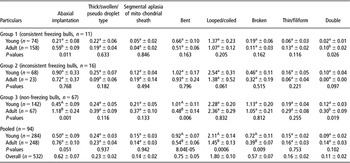
Mean (±s.e.) sperm mid piece abnormalities (%) of young and mature Frieswal bulls of different freezable semen producer grades

n = number of ejaculates; young (age up to 30 months), adult (31 to 70 months in age); column wise means with in a group with different superscripts differed significantly (a, b for P < 0.05, A, B for P < 0.01).
Mean (±s.e.) sperm tail abnormalities (%) of young and mature Frieswal bulls of different freezable semen producer grades

n = number of ejaculates; young (age up to 30 months), adult (31 to 70 months in age); column wise means with in a group with different superscripts differed significantly (a, b for P < 0.05, A, B for P < 0.01).
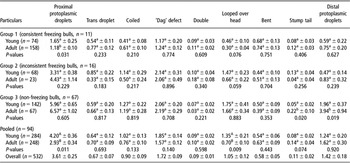
In consistent freezable grade semen producer bulls, prevalence of bent, looped/coiled and broken mid piece (Table 3) were lower (P < 0.01) in adult as compared with the younger age. Total percentage of defective mid piece also decreased significantly (P < 0.01). The incidences of thick or swollen mid piece, segmental aplasia in mitochondrial sheath, bending, coiling and broken mid piece showed non-significant (P > 0.05) but decreasing trends with age. Similarly, in inconsistent freezing bulls occurrences of abaxial implantation of mid piece, thick/swollen, bent, looped, broken, filiform and double mid piece also showed decreasing trends. In non-freezing bulls, unlike Groups 1 and 2, occurrences of most of the mid piece abnormalities showed reverse trend that is abnormalities were increased from young to adult stage. In this study abaxial implantation of mid piece and incidence of double mid piece was significantly more (Table 3) in adult stage as compared their younger stage, both in consistent freezing and non freezable grade bulls. Frequencies of proximal protoplasmic droplets was more (P < 0.01) in younger than older (Table 4) Frieswal bulls.
In consistent freezable grade semen producer bulls both the semen characteristics and sperm morphology were improved from young to adult stage. In inconsistent freezing grade bull’s only sperm morphologies were improved with the age advancement and other semen characteristics remained almost unchanged. In non-freezing grade bulls neither semen quality (except ejaculate volume) nor the sperm morphologies (except free heads) showed any significant improvement from young stage to their adulthood/maturity. Contrary to the age-related improvement in sperm morphology in freezable quality semen producer bulls, in poor quality semen producer bulls, the prevalence of pyriform head, slender head, undeveloped/malformed head, swollen or thickend mid piece, segmental aplasia in mitochemical sheath, looped mid piece, filiform and double mid piece, proximal and distal protoplasmic droplets, dag defect, stump tail and total abnormal sperm percent were tend to increase with the advancement of age.
Young bulls with over all mean total abnormalities of 24.89 ± 1.43% (inconsistent freezing bulls) also showed improvement with the age and total abnormal sperm percent came down to 18.37 ± 3.40% at adult stage, which was with in the acceptable limit (up to 20%) of AI. Thus young bulls of this category (Group 2) had chance for quality improvement with maturity of reproductive organs and can be continued further for germ plasm harvest subjected to yield acceptable post-thaw motility (⩾40%). It was recommended that young Frieswal bulls (<30 months age) consistently producing high numbers of morphologically abnormal sperms (total abnormal sperm more than 24.89 ± 1.43%, for about 25%) along with poor quality semen (mean motility <50%, mean concentration <1000 million/ml) should be culled immediately from frozen semen production programme without any further expectation of improvement in semen quality and freezability with the advancement of age.
Discussion
The prevalence of very high frequencies of morphologically abnormal sperms in the ejaculates, poor semen characteristics and unacceptable semen freezability as evident from these findings is a typical problem in frozen semen production programme from B. taurus × B. indicus crossbred bulls under tropical environment. Higher incidences of breeding unsoundness in B. indicus × B. taurus bulls as compared with either B. indicus or B. taurus (Mathew et al., Reference Mathew, Joseph and Jose1982; Usmani et al., Reference Usmani, Shah and Zafar1993; Chacón et al., Reference Chacón, Pérez, Müller, Söderquist and Rodriguez-Martinez1999) and very higher reproductive wastage rate in crossbred dairy bulls (Mathew et al., Reference Mathew, Joseph and Jose1982; Sagdeo et al., Reference Sagdeo, Chitnis, Deshmukh and Kaikini1990 and Reference Sagdeo, Chitnis and Kaikini1992; Tyagi et al., Reference Tyagi, Mandal, Kumar and Mathur2006) have also been reported earlier. Mal adaptation of B. taurus and their crosses with B. indicus in tropical climate (environmental stress) had been attributed for functional impairment of testes, testicular degeneration and poor reproductive performance (Vale-Filho et al., Reference Vale-Filho, Pinto, Megale, Fonseca and Soares1980; Wildeus and Entwistle, Reference Wildeus and Entwistle1983; Ohashi et al., Reference Ohashi, Souza, Ribeiro and Vale1988; Crabo, Reference Crabo1988).
Introduction of exotic taurine-blood in Zebu cattle under tropical climate was carried out for the enhancement in production traits that would supposed to come from taurus component and supportive back up for heat tolerance and disease resistant traits was expected to be imbibed from B. indicus component. Probably, the same has not happened exactly what was expected on experimentation with crossbreeding for breed development. Reports concerning fertility of crossbred bulls under tropical condition showed similar rates of testicular degeneration both in B. taurus and B. taurus × B. indicus crossbred cattle (Vale-Filho et al., Reference Vale-Filho, Pinto, Megale, Fonseca and Soares1980; Crabo, Reference Crabo1988; Ohashi et al., Reference Ohashi, Souza, Ribeiro and Vale1988). Interestingly, some of the reports indicated higher prevalence of breeding unsoundness, more frequencies of sperm head abnormalities and poor reproductive performance in B. indicus × B. taurus crossbred bulls as compared with their parental breeds either B. indicus or B. taurus (Mathew et al., Reference Mathew, Joseph and Jose1982; Nazir et al., Reference Nazir, Mushtaq, Masood, Munir and Naseer1987; Usmani et al., Reference Usmani, Shah and Zafar1993; Chacón et al., Reference Chacón, Pérez, Müller, Söderquist and Rodriguez-Martinez1999) reared under similar feeding and management conditions in tropics.
Mathew et al. (Reference Mathew, Joseph and Jose1982) reported that semen quality and freezability in Brown Swiss × Zebu bulls was poorer than exotic Brown Swiss bulls (B. taurus) maintained under similar feeding and management practices of tropical Indian climatic conditions. When 28.3% of Brown Swiss bulls were rejected from semen production centre because of poor semen quality, freezability and sexual performance, the culling rate were 63.9%, 73.8% and 76.9% in 3/4 Brown Swiss × 1/4B. indicus, 5/8 Brown Swiss × 3/8B. indicus, and 1/2 Brown Swiss × 1/2B. indicus crossbred bulls, respectively. Studies conducted at Pakistan also revealed that semen quality (sperm concentration and percent motility) of Friesian × Sahiwal crossbred bulls was poorer as compared with either Sahiwal or Friesian breeds. Incidence of sperm abnormalities was higher in crossbreds as compared with the purebreds (Nazir et al., Reference Nazir, Mushtaq, Masood, Munir and Naseer1987). Semen producing ability and semen quality of pure HF was better through out the year as compared with their crosses with Sahiwal maintained at subtropical climatic conditions of Punjab in Pakistan. Percentage of discarded ejaculates was higher (33.7% to 50.1%) in Holstein × Sahiwal bulls as compared with pure Holstein (11.5% to 33.0%) bulls (Usmani et al., Reference Usmani, Shah and Zafar1993).
Some of the genetic sperm defects (Chenoweth, Reference Chenoweth2005) such as Dag and stump tail defects are prevalent in Frieswal bulls; however, their overall mean (±s.e.) frequencies per ejaculate were less. However, in some ejaculates their prevalence with higher percentage might be suggestive for their genetic predisposition, which needs further investigation. Although this study was not conducted to compare the sperm abnormalities between breeds, however, available literature suggests that the lower sperm abnormalities in both B. taurus and B. indicus bulls (Brito et al., Reference Brito, Silva, Rodrigues, Vieira, Deragon and Kastelic2002; Sori et al., Reference Sori, Prasad and Zewdie2006) as compared with poor grade Frieswal crossbred bulls. Under similar environmental conditions poor reproductive performance, higher breeding unsoundness, poor semen characteristics, higher sperm abnormalities, unacceptable semen freezability in B. indicus × B. taurus bulls as compared with either B. taurus or B. indicus indicated possibly there might have some problems in genetic amalgamation in crossbreeding between B. indicus × B. taurus breeds, if not general, but evidently particular in HF × Sahiwal crosses. The possibility of genetic incompatibility between these two breeds could not be ruled out. Detailed investigation on genetical aspects of breed compatibility while crossbreeding between B. indicus and B. taurus needs to be carried out to elucidate such enigma.
Higher percentage of sperm morphological abnormalities in young Frieswal bulls than older Frieswal bulls might have been because of the delayed sexual maturity, as sexual development tends to occur slowly under tropical conditions (Troconiz et al., Reference Troconiz, Beltran, Bastidas, Larreal and Bastidas1991). Earlier studies on B. taurus dairy breeds indicated that sperm motility does not seem to change with age (Diarra et al., Reference Diarra, Pare and Roy1997; Mathevon et al., Reference Mathevon, Buhr and Dekkers1998) and sperm defect are unaffected (Chandler et al., Reference Chandler, Adkinson, Hay and Crain1985) or decreased significantly with age (Söderquist et al., Reference Söderquist, Janson, Haard and Einarsson1996). Contradictory observations of decreased sperm motility and increased minor defect with age had also been reported (Brito et al., Reference Brito, Silva, Rodrigues, Vieira, Deragon and Kastelic2002). In this study semen quality showed improvement in consistent and inconsistent freezable grade semen producer bulls with the age, but in non freezable grade bulls it showed no improvement with maturity rather indicated a deteriorating trend with age advancement. Possible reasons might be the severe testicular dysfunction of permanent nature in the poor grade semen producer bulls, since it was evident with consistently higher occurrences of both primary and secondary or major and minor sperm morphological abnormalities in their ejaculates in younger as well as at older age. Higher percentage of proximal cytoplasmic droplets was reported to be associated with epididymal dysfunction when induced by thermal insult to mimic the environmental stress (Wildeus and Entwistle, Reference Wildeus and Entwistle1983; Januskauskas et al., Reference Januskauskas, Gil, Rodriguez-Martinez, Söderquist and Lundeheim1995). In non-freezing grade semen producer Frieswal bulls have higher prevalence of proximal and distal cytoplasmic droplets both at younger and older age suggested for epididymal dysfunctions too. Increase incidences of sperm abnormality, is because of the environmental stress, are transitory in nature because after stress withdrawal frequencies of sperm abnormalities are decreased gradually to normal within few months (Wildeus and Entwistle, Reference Wildeus and Entwistle1983). However, consistent occurrence of sperm abnormalities for a prolonged period (both at young and adult age) in poor grade Frieswal bulls is speculative to the irreversible or permanent dysfunction of germinal layers of seminiferous tubules of testes and functional impairment of epididymis in these bulls. Testicular histopathological examination of poor grade Frieswal adult bulls (N = 4) was conducted earlier at the Indian Veterinary Research Institution, Izatnagar, India which revealed degenerative changes in germinal epithelium and fibrosis (Personal communication), which is supportive to this findings of higher abnormal sperm morphology in non freezable grade semen producer bulls.
Prevalence of abaxial implantation of sperm mid piece defect was increased with the age of Frieswal bulls suggested that probably the expressivity of this defect was more in adult stage. However, abaxial implantation of mid piece is considered as minor defect and had little impact upon fertility (Barth, Reference Barth1989; Pant et al., Reference Pant, Mittal, Patel, Shukla, Kasiraj, Prabhakar and Barot2002). Occurrence of pseudo droplet and stump tail defect had earlier been reported to increase with the age of the bull (Blom, Reference Blom1968; Barth and Oko, Reference Barth and Oko1989).
The reasons for higher incidences of abnormal sperm morphology in B. indicus × B. taurus crossbred Frieswal bulls might be attributed to genetic cause, environmental pre disposition and/or a combination of both. Higher abnormal sperm percentage in the ejaculate reduce the fertility rate (Graham and Mocé, Reference Graham and Mocé2005), however, this study revealed that incidence of higher abnormal sperm morphology was one of the major concerns for poor or unacceptable freezability of semen in large number (71%) of crossbred bulls, although there are many other factors that affect the freezability of semen (Pangawkar et al., Reference Pangawkar, Sharma and Sharma1988; Jobim et al., Reference Jobim, Oberst, Salbego, Souza, Wald, Tramontina and Mattos2004).
Inconsistent freezing bulls producing relatively higher abnormal sperm (about 25% total abnormal sperm) at younger age showed improvement with maturity, but Group-3 bulls (>37% total abnormality) never produced satisfactory freezable quality semen. Thus, the mean semen quality parameters of Group-2 bulls at younger age (<30 months) can reasonably be taken as a yard sticks for continuation/discontinuation of a precious bull (as all are the progenies of elite dams mated with progeny tested sires with good production indices) in routine frozen semen production programme in relation to age advancement. It was evident from this study that irrespective of type of abnormality (major/minor, primary/secondary, compensable /non-compensable), bulls consistently producing >25% abnormal sperms in their ejaculates had remote chance (Group-3 bulls) to be turn out as a good/freezable quality semen producer bull at their maturity. Hence, it would be rational to cull such dairy crossbred bulls at younger age (<30 months). However, other classical semen evaluation parameters such as initial progressive motility (<50%) and sperm concentration (<1000 million/ml) must also be taken in combination while taking a decision on culling of young crossbred bulls.
Acknowledgements
The authors are thankful to Director, Project Directorate on Cattle and Director, Frieswal Project, Meerut Cantt for providing necessary facilities.