The quantity and quality of linguistic input addressed to young children has a significant effect on their language development (Hart & Risley, Reference Hart and Risley1995) which in turn correlates with subsequent literacy and academic attainment (Curtis, Reference Curtis1980; Morgan, Farkas, Hillemeier, Hammer, & Maczuga, Reference Morgan, Farkas, Hillemeier, Hammer and Maczuga2015). A range of studies have investigated the effects of caregiver linguistic input on grammatical development, and highlight the importance of syntactic diversity in the acquisition of adult-like linguistic competence (e.g., Hoff, Reference Hoff2003; Huttenlocher, Vasilyeva, Cymerman, & Levine, Reference Huttenlocher, Vasilyeva, Cymerman and Levine2002; Price, Van Kleeck, & Huberty, Reference Price, Van Kleeck and Huberty2009). For example, Huttenlocher et al. (Reference Huttenlocher, Vasilyeva, Cymerman and Levine2002) identified clear associations between the number of complex constructions addressed to young children and their subsequent production of complex syntax at age four. Researchers working within constructivist frameworks have also highlighted strong links between the grammatical profile of child-directed speech (CDS) and the patterns of grammatical development attested in the speech of young children (e.g., Farrar, Reference Farrar1990; Kirjavainen, Theakston, Lieven, & Tomasello, Reference Kirjavainen, Theakston, Lieven and Tomasello2009; Tomasello, Reference Tomasello2003).
While there is strong evidence for a link between the grammatical features of CDS and language development, it is also well known that the speech addressed to young children displays lower levels of syntactic diversity than that addressed to more mature interactants (Snow & Ferguson, Reference Snow and Ferguson1977). In particular, structurally rich constructions such as canonical subject–predicate constructions and complex constructions (operationalised here as utterances containing more than one lexical verb) appear to be relatively rare in speech addressed to young children. For example, in Cameron-Faulkner, Lieven, and Tomasello (Reference Cameron-Faulkner, Lieven and Tomasello2003), subject–predicate constructions and complex constructions accounted for just 24% of the CDS addressed to two-year-old children. The relatively low frequency of structure-rich constructions leads to the question of whether other forms of caregiver–child interaction may bridge the gap between everyday CDS and the more sophisticated grammatical representations necessary for adult-like linguistic competence. The activity of shared book reading, that is the activity of reading and sharing a book with a young child, provides a logical starting point for three reasons.
First, a wealth of studies report positive correlations between shared book reading and a range of language development measures (e.g., Bus, van Ijzendoorn, & Pellegrini, Reference Bus, van Ijzendoorn and Pellegrini1995; Farrant & Zubrick, Reference Farrant and Zubrick2011, Reference Farrant and Zubrick2013; Horst & Houston-Price, Reference Horst and Houston-Price2015; Moll & Bus, Reference Moll and Bus2011), though few of these include grammatical development specifically as an outcome variable. Of the studies that do consider grammatical development, the findings are mixed. For example, Whitehurst et al. (Reference Whitehurst, Falco, Lonigan, Fischel, DeBaryshe, Valdez-Menchaca and Caulfield1988) identified gains in mean length of utterance (MLU) during a book reading intervention aimed at promoting an interactive approach to sharing books (dialogic book reading) with young children. Similar gains were identified by Cronan, Cruz, Arriaga, and Sarkin (Reference Cronan, Cruz, Arriaga and Sarkin1996) during a book reading intervention aimed at low-income communities. Crain-Thoreson and Dale (Reference Crain-Thoreson and Dale1992) also identified a correlation between shared book reading and syntactic comprehension at 2½ years. However, a meta-analysis conducted by Scarborough and Dorbrich (Reference Scarborough and Dobrich1994) failed to identify compelling evidence for an association between shared book reading frequency and grammatical development. Similarly, DeBaryshe (Reference DeBaryshe1993) only found correlations between shared book reading and receptive scores on the Reynell Developmental Language Scales.
Second, studies examining the extra-textual talk produced by caregivers when sharing books with young children (see Fletcher & Reese, Reference Fletcher and Reese2005, for a comprehensive review; also Leech & Rowe, Reference Leech and Rowe2014) demonstrate its qualitative and quantitative benefits when compared to everyday CDS (e.g., Hayes & Ahrens, Reference Hayes and Ahrens1988; Snow, Arlman-Rupp, Hassing, Jobse, Joosten, & Vorster, Reference Snow, Arlman-Rupp, Hassing, Jobse, Joosten and Vorster1976). For example, Hoff-Ginsberg (Reference Hoff-Ginsberg1991) analysed mothers’ speech across four contexts (mealtimes, dressing, toy play, and book reading) and found that the mothers’ rate of speech, MLU, and lexical diversity was highest during the book reading activity. Similarly, Crain-Thoreson, Dahlin, and Powell (Reference Crain-Thoreson, Dahlin and Powell2001) reported that caregiver extra-textual talk consisted of longer utterances and greater lexical diversity than the speech produced during toy play or remembering contexts.
Finally, there is also a sound body of evidence pointing to the direct effect of book type on the nature of extra-textual talk. Sénéchal, Cornell, and Broda (Reference Sénéchal, Cornell and Broda1995) found that caregivers produced more verbal interactions when sharing wordless picture books with their two-year-old infants than when sharing books containing short sentences. Nyhout and O'Neil (Reference Nyhout and O'Neill2013) found that caregivers produced more complex decontextualized talk (e.g., talk about mental states and non-present tense events) when sharing prototypical storybooks in comparison to didactic word learning books. Recent work has also highlighted the beneficial nature of rhyming text with regard to the acquisition of lexical items (e.g., Read, Macauley, & Furay, Reference Read, Macauley and Furay2014). There has been less examination of the influence of book genre on grammatical features of the input, but a recent study by Price et al. (Reference Price, Van Kleeck and Huberty2009) found that caregivers produced longer utterances in their extra-textual talk when sharing expository books as opposed to storybooks. The literature therefore points to a systematic difference with regard to the structural properties of extra-textual talk in terms of broad measures such as MLU, but to date does not provide a detailed picture of the grammatical profile of the extra-textual talk generated by shared book reading.
The text within a book can also be considered as a means of providing young children with access to grammatical constructions which occur relatively infrequently in everyday interaction. It is well known that written text differs qualitatively to spoken language (e.g., Halliday, Reference Halliday1989; Montag & MacDonald, Reference Montag and MacDonald2015). In adult books, written language tends to contain more complex grammatical constructions (e.g., subordinate clauses) and rarer sentences (e.g., passives) than colloquial speech (e.g., Montag & MacDonald, Reference Montag and MacDonald2015).
While children's books obviously do not contain the same levels of complexity as adult texts, there is evidence to suggest that the language contained in children's books differs significantly to everyday CDS both in terms of vocabulary (e.g., Mesmer, Reference Mesmer2016) and grammar. For example, Cameron-Faulkner and Noble (Reference Cameron-Faulkner and Noble2013) investigated the grammatical constructions found in twenty best-selling picture books and compared the grammatical profiles with a sample of CDS generated by toy play. The results of the study showed that the books fell into one of two categories: SV-heavy books, defined as books containing significantly more canonical (i.e., subject–predicate) and complex constructions than CDS; and SV-light books which contained significantly fewer canonical and complex constructions than CDS. Given the previously discussed interaction between book type and extra-textual talk, the findings from Cameron-Faulkner and Noble lead to the question of whether the grammatical profile of the book (i.e., SV-heavy or SV-light) may have an effect on the grammatical profile of the caregivers’ extra-textual speech.
In the current paper, we investigate whether (1) the extra-textual talk generated during shared book reading contains higher levels of structurally rich constructions than everyday CDS, and whether (2) the grammatical profile of the book read during shared book reading affects the grammatical profile of the extra-textual talk generated by the caregiver. We address these aims by comparing the grammatical profile of the input addressed to young children during the delivery of a simple one-word per page storybook (a SV-light book), a more traditional prose storybook (a SV-heavy book), and during a toy play session. Our key measure is the relative frequency of grammatical constructions within each activity.
It is important to be clear that this is not an intervention study. The aim of this study is not to investigate whether shared book reading can enhance grammatical development. Rather, this study aims to determine whether shared book reading generates grammatically richer linguistic input in comparison to the input generated during toy play. If the CDS generated by shared book reading is a grammatically enriched form of linguistic input, then intervention studies to investigate the effect of shared book reading on aspects of grammatical development beyond MLU should follow. This study should be seen as an important first step in a long-term aim to determine whether shared book reading has the potential to enhance early grammatical development.
Method
Participants
Forty-three parent–child dyads were invited to take part in the study. A pre-verbal sibling was present during one testing session. Two dyads were excluded due to failure to complete the book reading task and one dyad was excluded due to equipment failure. The mean age of the remaining 40 children was 2;0 (range 1;11–2;4, 18 girls). The dyads were recruited from a database of local families interested in taking part in research. The caregivers were given travel expenses and the children were given a book for their participation. All children were typically developing, monolingual English speakers from the UK. Of the 40 dyads, only one consisted of a male caregiver and child. Level of education of the caregiver who attended was collected for a subset of families (N = 38). Level of caregiver education in the sample was high, with 31 caregivers holding at least an undergraduate university degree.
Materials
Reading session
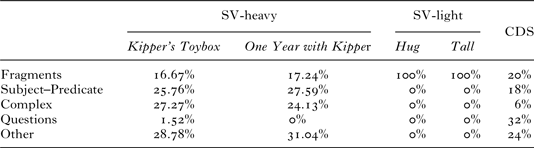
Two types of age-appropriate books were used in the study; SV-heavy books and SV-light books. These grammatical profiles were identified by Cameron-Faulkner and Noble (Reference Cameron-Faulkner and Noble2013) in their comparison of grammatical constructions in books and CDS. SV-heavy books contain significantly more canonical subject–predicate and complex constructions than CDS, and SV-light books contain significantly fewer canonical subject–predicate and complex constructions than CDS. To identify books of each type for use in the present study, we performed a construction-based analysis of the book text using the same coding scheme as Cameron-Faulkner and Noble, more details of which are given in the ‘Coding scheme’ section.
To determine whether a book was SV-heavy or SV-light we compared the relative frequency of constructions within the book to a sample of CDS. We used the same sample of CDS as Cameron-Faulkner and Noble (Reference Cameron-Faulkner and Noble2013). This sample is taken from Cameron-Faulkner et al. (Reference Cameron-Faulkner, Lieven and Tomasello2003), which analysed English-speaking mothers from the Manchester corpus (Theakston, Lieven, Pine, & Rowland, Reference Theakston, Lieven, Pine and Rowland2001), hosted on the CHILDES website (MacWhinney, Reference MacWhinney2000). The corpus contains the naturalistic linguistic interaction of 12 British English-speaking mother–child dyads during free-play sessions. The analysis reported in Cameron-Faulkner et al. (Reference Cameron-Faulkner, Lieven and Tomasello2003) was based on two hours of recording for each dyad in which the age of the children ranged between 1;9.28 and 2;6.23. In total, 16,903 CDS utterances were included in the data sample. Cameron-Faulkner et al., report the percentage of constructions within the sample and we used this as the basis of our comparison.
Table 1 shows the relative frequency (expressed as a percentage) of each global construction category in the Cameron-Faulkner et al. (Reference Cameron-Faulkner, Lieven and Tomasello2003) CDS sample and the books selected for the present study.
Relative frequency (expressed as a percentage) of each global construction category in the CDS sample and the books selected for the present study

We selected two SV-heavy and two SV-light books to make sure that any effects of book type were not a consequence of one particular book. Both books of each type were written by the same author and chosen to ensure that both books within each category had comparable grammatical profiles. The SV-heavy books were Kipper's Toybox and One Year with Kipper, written by Mike Inkpen. The SV-light books were Hug and Tall, written by Jez Alborough. Both SV-light books contained only single word fragments. Hug contained the following words: hug, Mummy, and Bobo. Tall contained the following words: tall, small, Mummy, and Bobo. These words were never combined and appeared only in isolation. In contrast, both SV-heavy books contained continuous prose with sentences of varying length. The SV-heavy books included a range of constructions, as shown in Table 1.
Toy play session
A toy kitchen, pretend food, and utensils were used to collect a fifteen minute sample of each caregiver's CDS. This was used as a comparison to the caregiver's CDS during the shared book reading session. A toy kitchen was used as it is representative of the type of toys two-year-old children play with at home.
Procedure
Caregivers and children were welcomed to the centre by the experimenter and shown to a waiting room. Before commencing the study the experimenter explained the procedure and gave the caregiver an opportunity to ask questions.
Book reading session
The experimenter gave the caregivers an instruction sheet outlining the task, in addition to discussing the procedure verbally. The caregivers were told to read two books to their children, and that they should read the books “as they would at home”. The caregiver and child were then shown into a small testing room which contained a sofa, rug, and small coffee table in order to make it comfortable and conducive to book reading. The caregivers sat on the sofa and read the first book to their child. The caregivers were instructed to do their best to finish the first book and then to read the second book. Each mother–child dyad read one SV-heavy and one SV-light book.
Toy play session
The experimenter gave the caregivers an instruction sheet outlining the task, in addition to discussing the procedure verbally. The caregivers were instructed to play with their children for 15 minutes and to play “as they would do at home”. The caregiver and child were then shown into a large testing room and told that the experimenter would return at the end of the toy play session.
After the completion of both activities, the experimenter gave the caregiver a verbal explanation of the aims of the study and answered any questions. The caregiver and child were thanked for their time and a small gift was given to the child.
Counterbalancing
The order of session (Book reading session 1st vs. Toy play session 1st), order of presentation of the books (SV-light 1st vs. SV-heavy 1st), and the pairings of the books (Hug and Kipper's Toybox vs. Hug and One Year with Kipper vs. Tall and Kipper's Toybox vs. Tall and One Year with Kipper) were all counterbalanced across the sample.
Coding scheme
As explained above, we used the same construction-coding scheme when (a) analysing books to be used in the study and (b) coding the caregiver speech during the activities. Both book text and caregiver speech was broken down into utterance-level grammatical construction types and coded by two of the authors. The global categories used in the current study are outlined below and are based on previous research that has identified the frequency of these global construction categories in other contexts (e.g., toy play; Cameron-Faulkner et al., Reference Cameron-Faulkner, Lieven and Tomasello2003). Reliability tests were conducted on 12% of the data. The reliability analysis indicated a high level of agreement and consistency within the coding (kappa = .976).
Fragments – utterances without either a subject or a predicate (e.g., one-word utterances, noun phrases, verb phrases, prepositional phrases, e.g.:
big cat
yellow
Subject–Predicate – utterances with both a subject and a single lexical verb (e.g., transitives, intransitives, ditransitives), e.g.:
He ate the cake
She's running
They posted her the letter
Complex – grammatical constructions containing two lexical verbs, e.g.:
I know that you love doing puzzles
Questions – utterances transcribed with a question mark and having question syntax in the main clause (wh-questions and yes/no questions), e.g.:
Where's the ball?
Is it in the box?
Other – utterances which did not fit the four categories above. These included copulas (e.g., this is the best one) and reported speech (e.g., said Kipper).
Coding
Each activity was video-recorded using two video cameras. In the book reading sessions, the cameras were mounted on a tripod. One video camera was positioned in front of the dyad and the other video camera was positioned behind the dyad. This gave two different views of the dyad's interaction with the book. In the toy play session, the cameras were wall-mounted. The video cameras were mounted in opposite corners of the room and gave two different views of the dyad's interaction with the toys. The caregivers’ speech was transcribed from the video-recordings using CLAN (MacWhinney, Reference MacWhinney2000), and coded by two of the authors according to the coding scheme detailed earlier.
Episodes of off-task speech lasting for more than five utterances were excluded from the analysis. Off-task speech was defined as speech that was completely unrelated to the book (e.g., when the child was exploring the room or asking for a drink). All speech that was in any way related to the book was included. For example, discussions in which the parent and child related the book to similar events experienced by the child were included.
Results
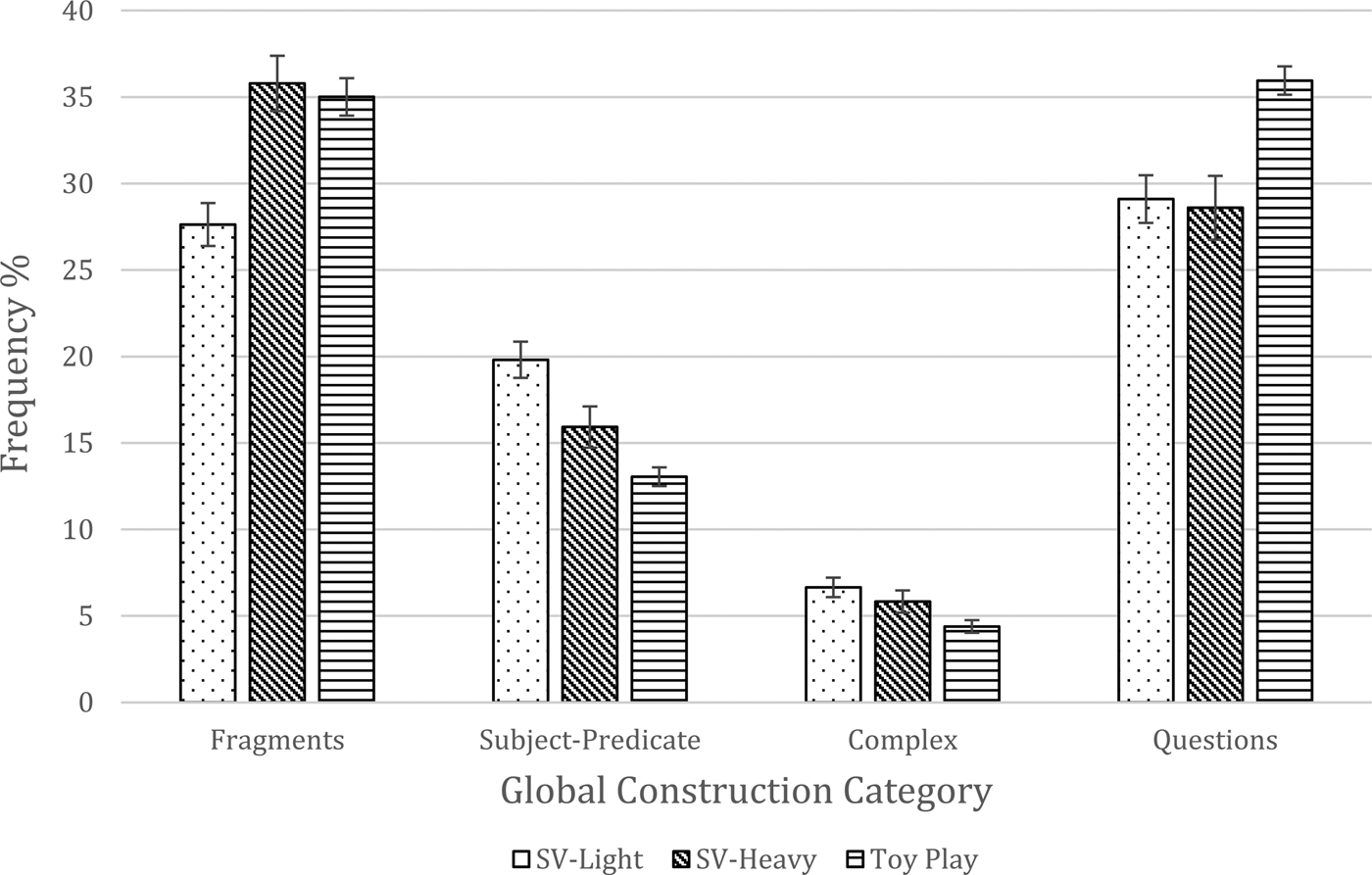
A one-way repeated measures MANOVA was run with activity (SV-light book vs. SV-heavy book vs. Toy play) as the independent variable, and the relative frequency of each global grammatical construction category expressed as a percentage (fragments, subject–predicate, complex, and questions) as the dependent variables. Figure 1 shows the relative frequency of each global grammatical construction category for each activity.
Caregiver extra-textual speech: frequency (SE) of each global grammatical construction category for SV-light books, SV-heavy books, and Toy play.

There was a significant main effect of activity (Wilks’ λ = .23, F(8,32) = 13.75, p = .001, ηp2 = .78). Given the significance of the overall test, the univariate main effects were examined. The alpha level was corrected to 0.013 to account for multiple tests. Significant univariate main effects of activity were obtained for all the global construction categories (fragments: F(2,78) = 24.19, p = .001, ηp2 = .38; subject–predicate: F(2,78) = 13.64, p = .001, ηp2 = .26; complex: F(2,78) = 5.19, p = .008, ηp2 = .12; questions: F(2,78) = 12.84, p = .001, ηp2 = .25). Given the significant univariate main effects for each global grammatical construction category, the pairwise comparisons were examined for each structure. Bonferroni adjustment was used due to multiple comparisons.
Fragments: Pairwise comparisons indicate that SV-light books (M = 27.63, SE = 1.25) generated significantly fewer fragments than SV-heavy books (M = 35.79, SE = 1.60, p = .01) and Toy play (M = 35.01, SE = 1.08, p = .001). There was no significant difference between fragments generated by SV-heavy books and toy play (p = 1.00).
Subject–Predicate: Pairwise comparisons indicate that SV-light books (M = 19.81, SE = 1.05) generated significantly more subject–predicate constructions than SV-heavy books (M = 15.92, SE = 1.20, p = .012) and Toy play (M = 13.05, SE = 0.54, p = .001). There was no significant difference in the rate of subject–predicate constructions generated by SV-heavy books and toy play (p = .150).
Complex structures: Pairwise comparisons indicate that SV-light books (M = 6.65, SE = 0.56) generated significantly more complex constructions than Toy play (M = 4.39, SE = 0.36, p = .001). There was no significant difference in the rate of complex constructions generated by SV-heavy books (M = 5.83, SE = 0.64) and SV-light books (p = .98) or SV-heavy books and Toy play (p = .14).
Questions: Pairwise comparisons indicate that Toy play (M = 35.95, SE = 0.82) generated significantly more questions than SV-light books (M = 29.10, SE = 1.38, p = .001) and SV-heavy books (M = 28.60, SE = 1.84, p = .001). There was no significant difference in the rate of questions generated by SV-light and SV-heavy books (p = 1.00).
Discussion
In the present study we compared the grammatical profile of extra-textual talk generated during shared book reading with CDS generated during a toy play activity. Our key research aim was to ascertain whether the extra-textual talk associated with book reading could be viewed as a grammatically enriched form of CDS and whether the type of book (SV-heavy and SV-light) affected the grammatical richness of the caregivers’ extra-textual talk. Our findings indicated that the shared book reading activity generated significantly more subject–predicate constructions and complex constructions than the toy play activity.
Furthermore, the findings indicate that the grammatical profile of a book affects the grammatical richness of the caregivers’ extra-textual speech. SV-light books displayed the added advantages of providing significantly more subject–predicate constructions than both SV-heavy books and toy play, and significantly more complex constructions than toy play. In addition, SV-light books generated a significantly lower percentage of fragments than SV-heavy books and toy play. When reading a SV-light book, which contains very little text, the caregivers produced more canonical ‘who did what to whom’ type constructions to create a story. In contrast, when reading a SV-heavy book with considerably more text, the caregivers relied on the text to deliver the story.
The effect of book type on extra-textual speech supports and extends previous work on the interaction between book genre and caregiver speech. Previous research has indicated that the genre of a book can affect the amount of talk produced during shared book reading, the diversity of vocabulary, and the length of extra-textual utterances (see Price et al., Reference Price, Van Kleeck and Huberty2009). Most relevant to the current findings is previous research which indicated that caregivers produce more verbal interactions when sharing wordless picture books with young children than when sharing books containing short sentences (e.g., Sénéchal et al., Reference Sénéchal, Cornell and Broda1995). Our study extends this previous research by indicating that book type may affect not just the amount of extra-textual speech, as previously documented, but also the grammatical profile of the caregivers’ extra-textual speech. The findings suggest that reading even a simple one word per page book has the potential to generate grammatically enriched linguistic input.
The study therefore indicates that the extra-textual talk generated by shared book reading has the potential to provide the young language-learning child with increased exposure to structures such as subject–predicate and complex constructions which are typically infrequent in everyday CDS (see also Cameron-Faulkner et al., Reference Cameron-Faulkner, Lieven and Tomasello2003). In terms of language development, subject–predicate constructions are essential in facilitating abstract knowledge of linguistic structure – the encoding of ‘who did what to whom’. The findings therefore demonstrate that the delivery of a very simple picture book story can generate extra-textual talk which fills the structural gaps found in everyday CDS and could provide a valuable source of input to young language learners. Our findings accord with a range of studies conducted over the years, all of which point to the enriched nature of the input generated during book reading in a range of linguistic domains (e.g., Crain-Thoreson et al., Reference Crain-Thoreson, Dahlin and Powell2001; Hoff-Ginsberg, Reference Hoff-Ginsberg1991).
It is important to note that the frequency of the subject–predicate and complex constructions, although significantly higher than in everyday CDS, is still relatively low in the shared book reading activity. We present the raw frequencies to illustrate this point. In the book reading activity, there were on average 35 subject–predicate constructions and 13 complex constructions. In comparison, in the toy play activity, there were on average 28 subject–predicate constructions and 9 complex constructions. This demonstrated that the raw frequencies were higher in the shared book reading activity but still relatively low. However, the fact that these constructions are delivered in the shared book reading activity, which is a high joint attentional activity, may well enhance their accessibility and effect on a child's linguistic knowledge. It is well documented in the literature that tuning into a child's focus and the amount of time spent engaged in joint attention are both related to a child's language development (e.g., Carpenter, Nagell, Tomasello, Butterworth, & Moore, Reference Carpenter, Nagell, Tomasello, Butterworth and Moore1998; McGillion, Herbert, Pine, Keren-Portnoy, Vihman, & Matthews, Reference McGillion, Herbert, Pine, Keren-Portnoy, Vihman and Matthews2013; Tomasello & Farrar, Reference Tomasello and Farrar1986). As shared book reading naturally affords a high level of joint attention (Farrant & Zubrick, Reference Farrant and Zubrick2011), the presentation of new words and more complex constructions may be particularly salient and thus more accessible in this activity.
Our study makes a unique contribution to the literature by providing the first grammatical analysis of extra-textual talk and adds to the growing body of research demonstrating the positive effects of shared book reading on language development. The next step is to investigate whether the grammatically rich input generated by shared book reading has an effect on the child's grammatical development. Given our findings that caregiver speech during shared book reading can provide the child with grammatically enriched linguistic input, it is certainly possible that children who are read to more often, and consequently receive grammatically richer input, will master the grammatical structures of their target language more rapidly.
There are three limitations regarding our study which should be considered. First, our sample, like many others, is drawn from a generally affluent and well educated population of caregivers. At this stage we need more research in order to ascertain whether our findings generalise to other socioeconomic status (SES) groups. There is evidence in the literature that book reading has a levelling effect on maternal speech (e.g., Hoff-Ginsberg, Reference Hoff-Ginsberg1991; Snow et al., Reference Snow, Arlman-Rupp, Hassing, Jobse, Joosten and Vorster1976). Therefore, we can be cautiously optimistic that caregivers from lower SES groups may also present similar grammatical profiles within our three activities to the current sample.
Second, it should be remembered that our study focuses on one age group only. There is ample evidence to suggest that caregiver speech changes in response to the child's age and linguistic ability (e.g., Sénéchal et al., Reference Sénéchal, Cornell and Broda1995). Therefore, a longitudinal analysis of the grammatical profile of caregivers’ extra-textual talk during book reading would be an interesting follow-on from the current study.
Third, our analysis is based predominantly on the extra-textual talk of mothers. Research points to gender differences in terms of frequency and effects of shared book reading (e.g., Duursma, Reference Duursma2014), and therefore future research should examine the extra-textual talk of both mothers and fathers.
Finally, it is important to remember that shared book reading offers many benefits to both caregiver and child above and beyond language development, and therefore making the activity more accessible to groups which report low rates of shared book reading is essential.