INTRODUCTION
Increasing crop yield remains one of the main objectives of wheat breeding programmes (Fischer Reference Fischer2007; Reynolds et al. Reference Reynolds, Foulkes, Slafer, Berry, Parry, Snape and Angus2009). This can be achieved by increasing potential yield, which could concomitantly increase yield under stress at least when the stress is mild or moderate, or by improving yield stability (Blum Reference Blum2005; Slafer & Araus Reference Slafer, Araus, Spiertz, Struik and van Laar2007). To improve productivity of wheat, Iran has been in collaboration with the International Center for Agricultural Research in the Dry Areas (ICARDA) and the International Maize and Wheat Improvement Center (CIMMYT) for the past two decades. Wheat is grown under rainfed and irrigated conditions in Iran: rainfed wheat covers two-thirds of the total wheat area (6·5 million ha), but accounts for only about one-third of the total wheat production. However, about half of the irrigated wheat farms do not receive full irrigation due to water scarcity and in about a quarter (625 000 ha), just one or two irrigation events (supplemental irrigation) are possible per year. As water scarcity increases, so do the areas unable to fully irrigate their crops.
In many crops and certainly in durum wheat, insufficient yield stability has been recognized as one of the main factors responsible for the gap between yield potential and actual yield, particularly in drought-prone environments (Tollenaar & Lee Reference Tollenaar and Lee2002; Cattivelli et al. Reference Cattivelli, Rizza, Badeck, Mazzucotelli, Mastrangelo, Francia, Marè, Tondelli and Stanca2008). In the long term, breeding and selection for yield potential (Loomis & Connor Reference Loomis and Connor1996) reduces stability. Using the approach of Finlay & Wilkinson (Reference Finlay and Wilkinson1963), Calderini & Slafer (Reference Calderini and Slafer1999) showed that the modern wheat varieties had lower yield stability than their older counterparts. This decrease in stability was associated with the improved capacity of modern varieties to capture the benefit of better growing conditions and to show lower yield reduction under stress.
There is general acceptance that high levels of genetic variation within natural populations improve the potential to withstand and adapt to novel biotic and abiotic environmental changes, including tolerance of climate change. A portion of this genetic variation determines the ability of plants to sense changes in the environment and produce a plastic response (Weiner Reference Weiner2004).
However, yield production depends on environmental (E) and genetic (G) factors, and often strong G×E interactions (Chapman Reference Chapman2008). Understanding, quantifying and exploiting G×E interaction is at the core of plant improvement. Breeders are well aware of the difficulties involved in dealing with G×E interaction (Blum Reference Blum2005), whereas physiologists and ecologists look at the same type of problem from the perspective of phenotypic plasticity or norms of reaction (Bradshaw Reference Bradshaw1965, Reference Bradshaw2006; Pigliucci et al. Reference Pigliucci, Whitton and Schlichting1995; Pigliucci Reference Pigliucci, Fox, Roff and Fairbairn2001; DeWitt & Langerhans Reference DeWitt, Langerhans, DeWitt and Scheiner2004; Sadras et al. Reference Sadras, Reynolds, de la Vega, Petrie and Robinson2009).
Numerous authors have defined phenotypic plasticity (Bradshaw Reference Bradshaw1965; Futuyma Reference Futuyma1998; Pigliucci Reference Pigliucci, Fox, Roff and Fairbairn2001; Schlichting & Smith Reference Schlichting and Smith2002; West-Eberhard Reference West-Eberhard2003; DeWitt & Langerhans Reference DeWitt, Langerhans, DeWitt and Scheiner2004; Freeman & Herron Reference Freeman and Herron2007). According to Bradshaw (Reference Bradshaw1965), phenotypic plasticity is ‘the amount by which the expressions of individual characteristics of a genotype are changed by different environments’. Plasticity can be quantified as the slope of norms of reaction, which are in turn mathematical functions relating phenotypic traits and key environmental variables (DeWitt & Langerhans Reference DeWitt, Langerhans, DeWitt and Scheiner2004) with variance-based indices (Dingemanse et al. Reference Dingemanse, Kazem, Reale and Wright2010). Using these quantitative approaches, a focus on phenotypic plasticity is improving understanding of crop adaptation and the links between phenotype and genotype (Reymond et al. Reference Reymond, Muller, Leonardi, Charcosset and Tardieu2003; Lacaze et al. Reference Lacaze, Hayes and Korol2009; Sadras et al. Reference Sadras, Reynolds, de la Vega, Petrie and Robinson2009; Sadras & Trentacoste Reference Sadras and Trentacoste2011).
However, environments can influence phenotypes in diverse and complicated ways, and it is among these varied effects that opinions about plasticity begin to diverge. Virtually any trait can show phenotypic plasticity. The concept was first applied to morphological traits (Schlichting & Pigliucci Reference Schlichting and Pigliucci1998) and some authors still link phenotypic plasticity to morphology. Measuring selection on plasticity is more complex because each trait must be measured in multiple environments, so that the degree of plasticity can be determined and then related to fitness.
Therefore, the main objectives of the present study were to: (i) analyse phenotypic plasticity of grain yield (YLD) and several related traits for 11 promising durum wheat breeding lines compared with a modern cultivar and landraces grown across 21 diversified environments in Iran and (ii) study the correlations in the plasticity of agronomic traits.
MATERIALS AND METHODS
Plant materials
Fourteen genotypes including 11 durum wheat breeding lines, selected from the durum wheat joint project of Iran/ICARDA, and three control cultivars were evaluated in 21 environments. Entries 12, 13 and 14 were the controls: entry 12 was a newly released durum cultivar (Saji), entry 13 was a durum-wheat landrace (Zardak) and entry 14 was a bread-wheat landrace (Sardari). Among the control genotypes, Sardari is an outstanding landmark bread-wheat genotype, which has been grown on a large scale in rainfed cold and moderate cold regions in Iran for 40 years. Similarly, the Zardak landrace is another old variety with a very limited cultivation area. The modern cultivar (Saji) is an outstanding durum-wheat cultivar, recently released by the Dryland Agricultural Research Institute (DARI), for rainfed and supplemental irrigation conditions in moderate cold and warm regions of Iran, and is well appreciated by farmers. It is a high-yielding cultivar with stable performance, high pasta quality, and resistance to lodging, pests and diseases. These three control genotypes are ones that are usually used in DARI durum-breeding programmes.
However, under rainfed conditions, bread-wheat cultivation is more profitable than durum wheat due to higher yield production and even the higher price of durum wheat (6% higher than bread wheat) has not encouraged farmers to expand durum cultivation. Thus, in durum-breeding programmes a dominant bread-wheat cultivar is usually used as a control to test for superior genotypes. The superiority of Saji cultivar, in comparison with the bread-wheat control Sardari, was proven in this way.
Test environments and experimental layout
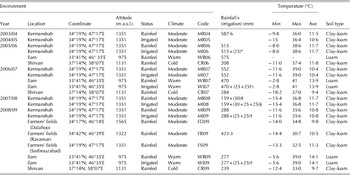
In the present study, 21 field trials were conducted during six cropping seasons (2004–09) under different growing conditions in Iran. Each trial represented one environment (combination of year and location). The environments covered a wide range of conditions differing in winter temperatures (cold, warm and moderate climate conditions), water regimes (rainfed v. supplementary irrigation) and management conditions (research stations v. farmers’ fields). More details on the test environments are given in Table 1. In the case of supplemental irrigation, one or two irrigations of 25 mm each were applied at the flowering and/or grain-filling stages to cope with terminal drought, which is a common stress in most rainfed areas of Iran.
Description of 21 test environments during 2004–2009 cropping seasons

* The irrigation was applied at grain-filling stage.
† The irrigations were applied at flowering and grain-filling stages, respectively.
‡ The irrigation was applied at booting stage.
§ The irrigations were applied at booting, flowering and grain-filling stages, respectively.
One of the main objectives in breeding programmes conducted under rainfed conditions is to find genetic material with good responses to high rainfall or supplemental irrigation during the flowering to grain-filling stage. Under this situation, the effects of terminal drought stress on crops will be mitigated and consequently yield production will be improved.
The experimental sites were representative of target environments in the region, so the results can be generalized for them. Owing to fluctuations in rainfall and temperature under rainfed condition in the region, no consistent relationships could be found between variations in spatial and temporal environments, and this makes G×E interaction much more complex. G×E interaction, defined as the variation in relative performance of genotypes in different environments (Cooper & Byth Reference Cooper, Byth, Cooper and Hammer1996), is challenging to plant breeders because it complicates testing and selection of superior genotypes, thereby reducing genetic progress.
At each environment, the experimental layout was a randomized complete block design with three replications. Plot size was 7·2 m2 (6 rows, 6 m long and 20 cm row spacing). Fertilizer rate was 50 kg N/ha (urea) and 50 kg P2O5/ha (triple super phosphate) applied at planting. The traits recorded for each genotype at each environment were: days to heading (DH), plant height (PH), days to maturity (DM), 1000-kernel weight (TKW) and YLD. The DH was designated as the time when 0·5 of the plants in a plot had at least one open flower. The DM was recorded when 0·5 of the plants in a plot had yellow leaves. The PH was also measured for each genotype at physiological maturity. The YLD and TKW were measured after machine harvesting of each plot. The plot yields were converted to productivity per hectare (kg/ha) and subjected to statistical analysis.
Quantifying plasticity
Phenotypic plasticity represents measurable variation and as such can often be expressed and analysed by analysis of variance (ANOVA) (Pigliucci Reference Pigliucci, Fox, Roff and Fairbairn2001). A statistical measure of variation is variance, which quantifies the deviation of values around a mean. The variance of a phenotypic trait can be partitioned as follows:
 $$\sigma _p^2 = \sigma _g^2 + \sigma _e^2 + \sigma _{ge}^2 + \sigma _\varepsilon ^2 $$
where, σ p 2 is the total phenotypic variance for a trait; σ g 2 is the genetic variance (proportion of phenotypic variation attributable to genes); σ e 2 is the environmental variance (proportion of variation caused by the environment); σ ge 2 is G×E interaction (genetic variation for phenotypic plasticity); σ ε 2 is the unexplained variance, including developmental noise, measurement error, etc.
Here, σ g 2 and σ ge 2 are unknown, but σ p 2 can still be partitioned into what is explained by σ e 2 (i.e., phenotypic plasticity) and all other sources of phenotypic variation. σ ge 2 is an important term because it shows that different genotypes express different plastic responses. Such genetic variance in plasticity allows plasticity to evolve.
Accordingly, ANOVA partitioned phenotypic variation for each trait studied into the above components.
The level of plasticity could be estimated as the slope of a regression of phenotype on environment if there are many different environments, or it could be the amount (and direction) of change in the phenotype across environments.
The coefficient of phenotypic plasticity was derived as the dimensionless slope of the linear regression between the trait (e.g. yield, TKW, PH, DH and DM) of genotype in a particular environment, and the mean of the trait across all genotypes in that environment.
Thus, the regression analysis model can be defined as follows:
 $$Y_{ijk} = \mu + \alpha _i + \beta _i \hat \delta _{\,jk} + \varepsilon _{ijk} $$
where Y
ijk
is the observed value, μ is the grand mean, α
i
is the intercept, β
i
is the regression coefficient (plasticity) for the ith genotype and
 $\hat \delta _{\,jk} $
is the environmental parameter estimated by ANOVA and ε
ijk
is the error.
Thus, β=1 indicates the average plasticity over all environments, β>1 indicates above-average plasticity, and β<1 indicates below-average plasticity. Correlation and regression analyses were used to test association between plasticity of different traits and association between yield plasticity and estimated means of genotypes.
RESULTS
Analysis of variance
The results of the combined analysis of variance for each agronomic trait across environments are given in Table 2, which presents an overall picture of the relative magnitudes of the genotype (G), environment (E) and G×E interaction variance terms. Significant variations (P<0·01) were found among the genotypes for the traits of YLD, TKW and PH. The G×E interaction effect was found to be significant (P<0·01) for all traits studied, indicating that the genotypic values for the traits were influenced by environmental effects (Table 2). For all agronomic traits, the environment was always the most important source of variation, accounting for 68·4% (for TKW) to 92·1% (for DM) of total variation. The greatest G×E interaction effect was found for TKW (23·5% of total variation) followed by DH (17%), YLD (7·5%), DM (7·4%) and PH (6·3%). The largest genotype effect was observed for PH (10·8% of total variation) followed by TKW (8%), DH (0·9%), YLD (0·8%) and DM (0·5%).
Combined analysis of variance for 14 genotypes across 18–21 environments for each studied traits

* The DF values in parenthesis are for PH, DH and DM traits.
† Mean squares.
‡ Percentage of relative to total sum of squares.
Depending on trait, 3·4–26·4% of the significant G×E interactions were attributed to the heterogeneity among regressions, whereas the remaining variance was attributed to deviation mean squares (S2di). A large portion of the G×E interaction was due to the non-linear component and can be regarded as a very important parameter for selection of stable genotypes.
However, the significant G×E interactions for yield and related traits indicates that the genotypes studied responded differently to the different environmental conditions, confirming the importance of assessing genotypes under different growing conditions in order to identify the best genetic make-up for a particular environment.
Yield and yield plasticity
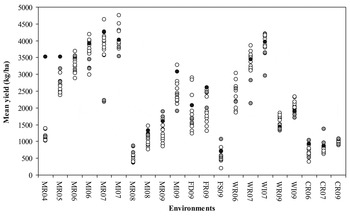
Figure 1 shows three aspects of the YLD data of 14 genotypes grown in 21 environments: (i) genotypic variation for YLD in each environment; (ii) G×E interaction which indicates that the ranking of genotypes differed from one environment to another and (iii) plasticity. The genotypic mean yields varied from 524 (environment MR08) to 4024 kg/ha (environment MI07). The lowest yield production was seen in a cold location (833 kg/ha), whereas the highest yield production was obtained at warm location (2626 kg/ha). The breeding lines were poorly adapted to cold conditions compared with the landraces (Fig. 1). In contrast, landraces were poorly adapted to warm location. In farmers’ fields the ranking of breeding lines, the modern cultivar and the landraces were not consistent and differed depending on location (Fig. 1). However, across 21 environments, the modern cultivar produced the highest (2419 kg/ha) and landraces the lowest yield (1974 kg/ha).
Comparison of the rank of 11 durum breeding lines (○) for grain yield with a modern durum cultivar (●) and landraces () across 21 test environments differing in climatic conditions (C, cold, M, moderate cold and W, warm), water regime (R, rainfed and I, irrigated) and farmers field (F) during 2004–2009 cropping seasons in Iran.

The modern variety and breeding lines were superior to landraces in higher-yielding environments, but not in lower-yielding conditions (cold location). There was genetic gain (GG) from 3·1 to 31·2% for the modern cultivar and breeding lines over landraces under moderate cold, from −34 to 15·4% in farmers’ fields, from 14·8 to 29·2% at the warm location and from −25·2 to −2·6% at the cold location.
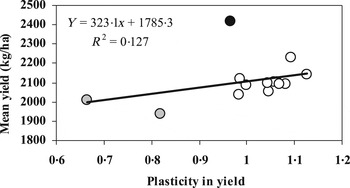
Across environments and genotypes, yield ranged from 524 to 4024 kg/ha and yield plasticity ranged from 0·665 to 1·127. The modern cultivar had high YLD compared with landraces across environments (Fig. 2). The landraces were also out-yielded by all breeding lines. The breeding lines, however, had the highest yield plasticity, resulting from the combination of high yield benefits in favourable environments and higher susceptibility to stress in poor environments.
Relationship between mean yield performance and plasticity in yield of 11 durum breeding lines (○), a modern durum cultivar (●) and landraces ().

The modern cultivar, with average yield plasticity, had the highest yield production across environments. An increase in plasticity of 0·1 unit was associated with increase in maximum yield of 32·3 kg/ha in durum wheat breeding lines. However, a positive trend for higher yield plasticity was observed in breeding lines and the modern cultivar compared with landraces.
Response of genotypes to different climate and water regime conditions
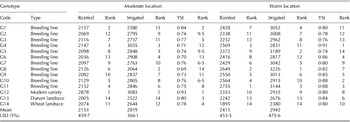
Mean yields and the ranks of genotypes for their yield potential under rainfed and irrigated conditions in moderate cold and warm locations are given in Table 3. The variation in yield among genotypes differed from one location to another, indicating different genotypic responses to different environmental conditions. Significant differences were observed among genotypes in each environmental condition. In the moderate location, the top five highest-yielding genotypes under rainfed conditions were the modern cultivar (G12) followed by breeding lines G1, G4, G11 and G10, whereas the landraces (G13 and G14) were among the five lowest-yielding genotypes. Under irrigated conditions, the modern cultivar followed by G8, G4, G6 and G5 were found to be the highest-yielding genotypes.
Mean yield (kg/ha), yield ranks and yield stability index for tested genotypes under rainfed and supplemental irrigation conditions in each moderate and warm location across years

YSI: Yield stability index, was calculated for each genotype as: YSI=Ys/Yp, where Ys and Yp are the mean yield of genotypes under rainfed and irrigated conditions. The genotypes with high YSI values can be regarded as drought-resistant genotypes under stress and non-stress conditions.
The G12 (first rank) and G4 (third rank) were among the top five highest-yielding genotypes in the both rainfed and irrigated conditions and the two landraces were among the five lowest-yielding genotypes in both conditions. Yield stability index (YSI) evaluates the yield under stress of a genotype relative to its non-stress yield, and should be an indicator of drought-resistant genetic materials. Thus, the genotypes with a high YSI are expected to have high yield under both stress and non-stress conditions. The modern cultivar with the highest YSI was found to be a drought-resistant genotype with the highest yields under both rainfed and irrigated conditions. In contrast, the two landraces with high YSI value (ranks of 3 and 4) were found to be relatively resistant with low-yielding performance. The breeding line G1 with high YSI value (rank of 2) exhibited the highest yield under rainfed conditions (rank of 2) and low yield under irrigated conditions (rank of 13).
In warm locations, the high-yielding genotypes under rainfed conditions were breeding lines G11, G8, G3, G10 and G9, whereas under irrigated conditions the low-yielding genotypes were G14, G13, G3, G2 and G12. No significant relationships were found between responses of genotypes to rainfed conditions in two moderate and warm locations (r=0·014). Under irrigated conditions the top five highest-yielding genotypes were G4, G10, G3, G6 and G9 and the lowest ones were G13, G14 (landraces), G6, G4 and G10.
The genotype G4 with the highest YSI was found to be a drought-resistant genotype in the warm location, and exhibited the highest yield under rainfed conditions but low yield under irrigated conditions. Breeding line G11 with a high YSI value (rank of 3) exhibited the highest yield under rainfed conditions and high yield under irrigated conditions.
Grain yields under rainfed and irrigated conditions were positively correlated in moderate (r=0·502, ns) and warm (r=0·742; P<0·01) locations (data not shown), suggesting that a high potential yield under optimum conditions will necessarily result in improved yields under stress. Thus, indirect selection for a drought-prone environment based on the results of optimum condition will be efficient.
Relationships between yield plasticity and related traits
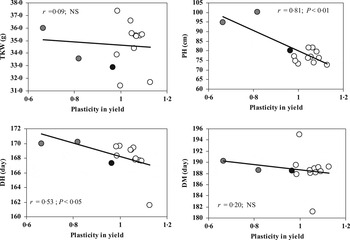
A negative relationship (P<0·01) was observed between plasticity of yield and PH (Fig. 3). Thus, genotypes expressing higher plasticity in yield were short in stature. The breeding lines differed significantly for their plasticity in yield and their stature with landraces. The relationship between plasticity of yield and DH was negative (P<0·05), showing that the genotypes with higher plasticity in yield tend to early heading. Thus, the breeding lines with the highest plasticity in yield reached maturity earlier compared with landraces.
Relationships between plasticity of yield with studied traits for 11 durum breeding lines (○), a modern durum cultivar (●) and landraces ().

No significant associations were found between yield plasticity with TKW and DM. Genotypes characterized with high yield plasticity tended to reach maturity earlier, except for one breeding line (breeding line G1) (Fig. 3).
According to Fig. 3, the landraces with below average plasticity in yield could be characterized as tall in stature, with late heading and low-to-high TKW, whereas the breeding lines with above-average plasticity in yield were early for heading and maturity, with average stature and high YLD, indicating the success in breeding the materials for unpredictable environmental conditions.
Associations between plasticity of traits
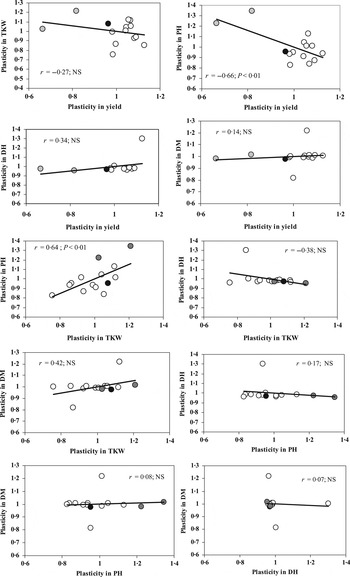
A considerable variation in association between plasticities of traits, ranging from significantly negative to significantly positive correlations, was observed (Fig. 4).
Associations between phenotypic plasticity of yield and plasticity of each other traits for 11 durum breeding lines (○) a modern durum cultivar (●) and landraces ().

The range of plasticity in PH, yield and TKW was broader than the plasticity in phenological traits. In most cases, associations between plasticity of traits were not significant. Yield plasticity tended to be more closely associated with plasticity in PH than with other traits, albeit negatively. The plasticity of TKW positively associated (P<0·01) with plasticity of PH. The genotypes with high plasticity in YLD had lower plasticity in TKW and slightly high phenological plasticity. The genotypes with higher plasticity in TKW tended to low plasticity in heading and high plasticity in maturity.
Comparison of plasticity of traits
Across environments and genotypes, plasticity differed from one trait to another: ranges were 0·665–1·127 for yield, 0·756–1·212 for TKW, 0·827–1·346 for PH, 0·954–1·301 for heading and 0·816–1·217 for maturity. The high yield plasticity of breeding lines was associated with their ability to capitalize on favourable environmental conditions, and was negatively correlated with yield in low-yielding environments. The landraces had higher plasticity than the breeding lines for PH and TKW, indicating the superior ability of landraces to grow in unfavourable environments.
DISCUSSION
A significant environmental effect indicates that the character in question is plastic and a significant interaction term indicates the existence of differences among genotypes for plasticity. Phenotypic variation across a range of environments measures the amount of phenotypic plasticity and the existence of variations among genotypes (Scheiner Reference Scheiner1993). In the present study, significant yield improvements were observed mostly in environments without stress rather than those with stress. This agrees with findings reported by others (Ceccarelli Reference Ceccarelli, Cooper and Hammer1996; Muñoz et al. Reference Muñoz, Voltas, Araus, Igartua and Romagosa1998; Voltas et al. Reference Voltas, Romagosa, Lafarga, Armesto, Sombrero and Araus1999). However, in the present study the breeding lines and modern cultivar showed 3·1–31·2% superiority over landraces under moderate and warm conditions, whereas the landraces showed 2·6–25·2% superiority over the modern cultivar and breeding lines under cold stress conditions. The high superiority of landraces over the breeding lines and modern cultivar under cold stress conditions suggested that the evaluation of breeding lines in moderate and warm locations should be continued. These differences could be attributed to differences in the genetic material tested as well as to differences in the testing environments. However, the rate of GG in crop yield is usually larger in favourable environments (Austin et al. Reference Austin, Ford and Morgan1989; Slafer et al. Reference Slafer, Satorre, Andrade and Slafer1994).
The present study tested plasticity of promising breeding lines in comparison with landraces and a recently released durum cultivar introduced into long-term experiments within the last decade, and identified that often the breeding lines tested were above the average yield plasticity of all genotypes. The positive association between yield and plasticity of yield in the present study is consistent with previous findings and reinforces the notion that increased plasticity, or reduced stability, is linked with progress in yield potential (Calderini & Slafer Reference Calderini and Slafer1999) and with the ability to benefit from high-yield potential in favourable conditions (De Vita et al. Reference De Vita, Mastrangelo, Matteu, Mazzucotelli, Virzi, Palumbo, Lo Storto, Rizza and Cattivelli2010). The recently released durum cultivar (Saji) combined higher grain yields than wheat landraces with the same level of plasticity. This implies that plant breeders have been successful in improving yield stability with yield potential, which is of great importance for farmers in rainfed conditions of Iran where production is limited by abiotic stresses, i.e. drought, cold and heat. Yield plasticity was associated with heading date and PH per se as well as with the plasticity of these two traits. The relationships between plasticity of yield and plasticity of phenology deserve further attention, because biologically, this relationship adds a new dimension to the understanding of crop adaptation (Sadras et al. Reference Sadras, Reynolds, de la Vega, Petrie and Robinson2009).
In conclusion, yield plasticity was associated with yield improvement. Breeding for yield reduced not only PH but also the environmental responsiveness of PH. In addition, yield improvement was associated with earliness under unpredictable environmental conditions. Thus, yield plasticity is a characteristic to consider and screen further in breeding programmes, which is supported by the finding that the range of plasticity was in general high among genotypes in yield, PH and TKW and with the lowest range in phenological traits. Based on the results, high yield plasticity tends to associate with high YLD, earliness and shorter plants in durum wheat.
This work was a part of regional durum wheat research project of the Dryland Agricultural Research Institute (DARI) of Iran and sponsored by the Agricultural Research and Education Organization (AREO). The author thanks all members of the project who contributed to the implementation of the field work.