Implications
In Rendena dual-purpose breed, the selection for meat aptitude is based on beef traits evaluated in young bulls during performance testing and muscularity linear type traits scored in first parity cows. This study analysed the genetic structure of performance test beef traits and muscularity type traits scored in both primiparous cows and young bulls. The positive genetic correlations obtained among beef and muscularity traits indicated a common pathway towards improving meat aptitude in dual-purpose breeds, suggesting to select both young bulls’ beef traits and cows’ muscularity as in current genetic improvement.
Introduction
Currently, most European dual-purpose cattle breeds are traditional local populations spread in marginal areas (Gandini and Villa, Reference Gandini and Villa2003). Selection in these populations requires a good balance between milk and beef traits due to the close ties that local breeds have with milk and beef products obtained in their specific environment (Gandini and Villa, Reference Gandini and Villa2003). Selection for beef in cattle is often based primarily on growth and in vivo conformation recorded at test stations on young candidate bulls (Andersen et al., Reference Andersen, De Baerdemaeker, Bittante, Bonaiti, Colleau, Fimland, Jansen, Lewis, Politiek, Seeland, Teehan and Werkmeister1981; Albera et al., Reference Albera, Mantovani, Bittante, Groen and Carnier2001; Sbarra et al., Reference Sbarra, Mantovani, Quaglia and Bittante2013). Alternatively, muscularity traits scored during routinely linear-type evaluation (Mantovani et al., Reference Mantovani, Cassandro, Contiero, Albera and Bittante2010; Frigo et al., Reference Frigo, Samorè, Vicario, Bagnato and Pedron2013), or, more recently, quantitative and qualitative traits data recorded at abattoirs (Bonfatti et al., Reference Bonfatti, Albera and Carnier2013; Sbarra et al., Reference Sbarra, Mantovani, Quaglia and Bittante2013) are used. However, differently than in specialized beef cattle, in dual-purpose breeds slaughter data have been introduced for selection purposes only recently, and particularly in populations like the French Normande and Montbeliarde (Croué et al., Reference Croué, Fouilloux, Saintilan and Ducrocq2017) that are characterized by a larger population size than the other European dual-purpose breeds. Slaughter data are not routinely collected in Italian dual-purpose cattle breeds; therefore, the selection for beef traits is based on predicted traits of the same slaughter data (EUROP fleshiness evaluation; dressing percentage or DP) recorded at the performance tests for evaluating young bulls (Sbarra et al., Reference Sbarra, Dal Zotto and Mantovani2009a). In European dual-purpose cattle, selection is also based on the evaluation of linear type traits on primiparous cows (Frigo et al., Reference Frigo, Samorè, Vicario, Bagnato and Pedron2013; Mazza et al., Reference Mazza, Guzzo, Sartori, Berry and Mantovani2014, Reference Mazza, Sartori and Mantovani2015 and Reference Mazza, Guzzo, Sartori and Mantovani2016), and, in many cases, both these evaluations are included in a global index used for selection (Sölkner et al., Reference Sölkner, Miesenberger, Willam, Fürst and Baumung2000; Fuerst-Waltl et al., Reference Fuerst-Waltl, Fuerst, Obritzhauser and Egger-Danner2016; Mazza et al., Reference Mazza, Guzzo, Sartori and Mantovani2016). Among the type traits included in the global index of dual-purpose cattle breeds, muscularity and/or mammary traits are the most commonly used (Sölkner et al., Reference Sölkner, Miesenberger, Willam, Fürst and Baumung2000; Fuerst-Waltl et al., Reference Fuerst-Waltl, Fuerst, Obritzhauser and Egger-Danner2016; Mazza et al., Reference Mazza, Guzzo, Sartori and Mantovani2016).
The Rendena breed is native to the Italian Alps and particularly to the homonymous alpine valley located in the north-east of Italy, in the province of Trento, enclosed between the Adamello and the Brenta mountain groups. The Rendena has ancient origins, and it outlived the massive introduction of cosmopolitan breeds in the northern part of Italy during the 20th century (Forabosco and Mantovani, Reference Forabosco and Mantovani2011). At present, the Rendena population is mainly raised in the mountainous area of origin and in the flatlands of the Veneto region (provinces of Padua and Vicenza) in the area called ‘Destra Brenta’, which lies on the right bank of the river Brenta. This zone is a highly fertile area of alluvial origin in which a lot of land is under grass, and the remaining is mostly dedicated to the production of maize used for silage. The Destra Brenta is one the most important dairy areas of the Veneto region.
The coat of the Rendena cattle is usually dark brown, accounting for a white ring around the black muzzle. Animals are of small to medium body size and are characterized by a good grazing ability expressed on mountain pastures in both the area of origin and in the Veneto region (Mantovani et al., Reference Mantovani, Gallo, Carnier, Cassandro and Bittante1997). The present Rendena population accounts for about 4000 registered cows selected for the dual-purpose attitude by a global index (called ILQCM). This index accounts for the following sub-indexes or single traits recorded either in males or females, depending on the phenotypes: a protein and fat-corrected milk yield index (65% of incidence in ILQCM), a performance test index, measured on candidate young bulls and based on average daily gain (ADG; 4.5% of incidence in ILQCM) plus in vivo estimates of DP and EUROP score (10.5% of incidence in ILQCM), and muscularity and mammary traits obtained from linear type classification of primiparous cows (10% of incidence in ILQCM for each trait; Mazza et al., Reference Mazza, Guzzo, Sartori, Berry and Mantovani2014; Sartori et al., Reference Sartori, Guzzo, Mazza and Mantovani2018). The composite index is the same for all males and females and includes estimated breeding values (EBVs; for animals with phenotype) or pedigree indexes. Selection on males is carried out in two stages, that is, at the end of performance test and at the end of progeny testing, only for a limited number of bulls. In most cases, performance tested bulls (with an EBV only for performance test traits and pedigree indexes for the remaining trait in ILQCM) are used simultaneously as bull-dams (i.e. progeny tested bulls) and bull-sires (i.e. to be mated to bull dams). This system, based on low accuracy in EBVs but also on the use of as many as possible young bulls and heifers as bull-dams, allows a quick generation turn-over lowering inbreeding (Mantovani et al., Reference Mantovani, Gallo, Carnier, Cassandro and Bittante1997).
In recent years, accurate analyses of the genetic relationships between milk and meat traits have been carried out in many breeds to identify the proper combination of traits when antagonistic aspects concur in selection (de Haas et al., Reference de Haas, Janss and Kadarmideen2007; Mazza et al., Reference Mazza, Guzzo, Sartori and Mantovani2016; Sartori et al., Reference Sartori, Guzzo, Mazza and Mantovani2018). However, to our knowledge, only a previous study (Crews and Kemp, Reference Crews and Kemp2001) has been carried out to evaluate the genetic structure of beef traits obtained in different sexes and at different times of life (i.e. longissimus muscle area and other carcass traits in steers, bulls and heifers). The present study aimed to estimate the genetic relationships of muscularity type traits obtained in primiparous cows with the same type traits scored on candidate young bulls and performance test traits. The Rendena cattle breed was chosen as a case study for evaluating the beef traits to be included in the global selection index for dual-purpose attitude in small local breeds.
Material and methods
Data and pedigree information
Data were provided by the National Association of Rendena cattle Breeders (ANARE) and included linear type and performance test traits recorded, respectively, in primiparous cows and in candidate young bulls at about 1 year of age (i.e. before the progeny testing for milk yield). Linear type traits recorded between the years 1994 and 2014 on 14 231 first parity Rendena cows were initially considered. The linear type classification system consists of four composite traits and 20 linear description traits (Mazza et al., Reference Mazza, Guzzo, Sartori, Berry and Mantovani2014) evaluated by trained experts. The composite traits summarize body size, fleshiness, body shape and udder. The individual type traits describe specific body regions of the animal (Mazza et al., Reference Mazza, Guzzo, Sartori, Berry and Mantovani2014). For this study, only four individual muscularity traits scored on a linear scale from 1 to 5 points were considered: front muscularity (FM, i.e., the evaluation of chest and shoulders); back, loins and rump (BLR); thigh, buttocks side view (TBS); and thigh, buttocks rear view (TBR; Table 1). To enter the data set for further analysis, only cows with age at first calving between 22 and 48 months and with days in milk (DIM) at scoring between 10 and 305 days were included. In addition, data from herd-year-classifier contemporary groups with less than two records were discarded. After editing, the linear type data consisted of 11 992 single records of first parity Rendena cows.
Descriptive statistics of individual linear muscularity type traits and performance test traits measured in Rendena primiparous and young bulls, respectively

OBS no.=number of observations; ADG=average daily gain; DP=dressing percentage.
1 Grades E, U, R, O and P were subdivided into +, = or − subclasses and transformed in a linear scale that attributed 100 to R class and ±3.33 points to each subclass below or above the R, obtaining a continuous scale from 76.66 to 123.33.
For the study, type traits were merged with beef traits recorded in 957 Rendena young bulls at a performance test station between the years 1997 and 2014. The young bulls were measured for ADG (obtained by linear regression of weight on age recorded 11 times during the stay of young bulls at the test station), estimated in vivo DP and estimated in vivo fleshiness score (EUROP). These three traits are identified in the manuscript as performance test traits. Moreover, in the study also the linear type evaluation carried out at the end of the test, that is, at about 11 months of age, has been considered. For the aim of the research, only the four linear type traits related to muscularity, with the same biological meaning of cows’ type traits (FM; BLR; TBS; and TBR), were taken into account (Table 1). Although being measured at the testing stations, for readability these traits were not referred in the manuscript as performance test traits. Muscularity traits were evaluated in both males and females via a visual appraisal by a classifier of ANARE. The linear type traits evaluation form used in primiparous and young Rendena bulls was not different, except the mammary traits recorded only in females. The in vivo EUROP score considering the grades E, U, R, O and P, from the best to worst conformation, was further subdivided into + or − subclasses (Croué et al., Reference Croué, Fouilloux, Saintilan and Ducrocq2017). The scores were then transformed in a linear scale from 80 (for P) to 120 (for E) with the addition or subtraction of 3.33 points about the full class; that is, for an R+ the score was 103.33, whereas for the U− it was 106.66. The whole numeric interval, ranging from 76.66 (less muscular) to 123.33 (more muscular), was considered as continuous. Both the evaluations of in vivo EUROP and DP for young bulls were carried out by three trained experts of the slaughter industry by visual appraisal on live animals and values were averaged within bull before the analysis. One of the three experts also evaluates the muscularity type traits of both primiparous cows and young bulls, together with another trained expert.
Finally, the two data sets described above were joined into a single data set accounting for 12 949 records (11 992 cows and 957 bulls phenotypic records). Specifically, the cows with phenotype are also daughters of 733 bulls, about half of them (363) with also a phenotypic record in the final data set. The remaining 370 bulls are born before 1997 (the first year of performance test data included in the data set) or removed (nine bulls) by data editing. An amount of 648 of the 957 bulls with the phenotype in the final data set are sons of the 11 992 cows with phenotypic record. The other 309 bulls are sons of very old cows (with morphological evaluation before 1994) or cows removed due to the data editing. The pedigree file obtained, having the same structure for cows and bulls, traced back subjects up to 10 generations and contained a total of 19 265 animals with two phantom groups (i.e. unknown male and female).
Genetic analyses and models
(Co)variance components were estimated via animal model analysis by running the AIREMLF90 program from the BLUPF90 family (Misztal, Reference Misztal2008). For data on young bulls, a multiple trait model (seven traits) was carried out to obtain (co)variance components between type (FM; BLR; TBS; and TBR) and performance test traits (ADG; EUROP; and DP). Then, bivariate animal model analyses were run on all the possible trait pairs obtained by combining muscularity type traits and performance test traits recorded on young bulls with muscularity linear type traits recorded on primiparous cows to estimate (co)variance components.
In matrix notation, the models used were as follows:
 $${\bf{y}} {\equals}{\bf{X\bbeta }} {\plus}{\bf{Zu}} {\plus}{\bf{e}} ,$$
where y is the vector of a given observed phenotype; X and Z are the incidence matrices of fixed effects and genetic effects, respectively; the vectors u and e represent the additive genetic and residual effects, respectively; and the vector β includes the fixed effects. For type traits recorded on primiparous cows, the fixed effects accounted in the model were, as described in Mazza et al. (Reference Mazza, Guzzo, Sartori, Berry and Mantovani2014): the herd–year-classifier (1729 levels), the age at calving (nine classes: <24 months, from 25 to 38 using 2-month intervals, and ⩾39 months for the last class) and the DIM (eight classes from 10 to 30 days after calving and from 31 to 210 days after calving, using 30-day intervals, or for later evaluation, >210 days). The herd-year-classifier effect was treated as fixed after a preliminary analysis that revealed the absence of any advantage in accounting this effect as random (data not shown). For performance test traits and for muscularity type traits of young bulls, the fixed effects considered were: the contemporary group (84 levels), the parity order of the mother (four classes: first parity; second parity; third to seventh parity; over the eighth parity) and for the estimated DP and EUROP scores only, the age at the end of performance test used as a linear covariate.
The assumptions on estimated (co)variances for the bi-trait analyses were obtained as G⊗A and R⊗I, with G and R as 2×2 matrices, respectively, including the additive genetic and residual (co)variance matrices of the respective trait pair; A and I are the additive relationships matrix and an identity matrix; and ⊗ is the Kronecker product. The residual (co)variance was set at zero in bivariate analyses of traits coming from different data sets because those traits were measured at different times and in different locations.
Results
Descriptive statistics for all considered beef traits are reported in Table 1. Mean values for all the individual muscularity type traits in primiparous cows and young bulls (obtained by the same classifiers and scored with the same approach) were close to 3, although slightly lower in females than in males (2.77v.3.04; 2.93v.3.15; 3.00v.3.24; and 2.83v.2.98 for FM, BLR, TBS and TBR, respectively). An ADG of 1011 g/day was observed in young bulls under performance test, with an in vivo EUROP score and DP at the end of the test, which were on average 98.9 points (R−/R) and 53.7% respectively. The DP showed the lowest CV (0.012) followed by the EUROP score (0.036), muscularity type traits in females (0.28) and muscularity type traits in young bulls (0.27).
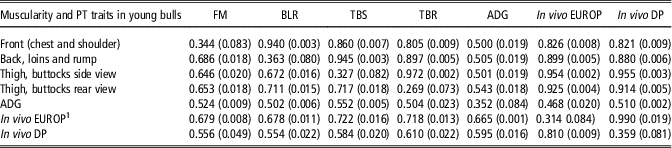
The estimated heritability (h 2 ), genetic and residual correlations (r a and r e, respectively) for muscularity linear type traits and performance test traits recorded in young bulls are reported in Table 2.
Heritability (h 2; diagonal), genetic (r a; above the diagonal) and residual correlations (r e; below the diagonal) and standard error of h 2, r a and r e (within brackets) for muscularity linear type traits and performance test traits recorded in young bulls of the Rendena breed

PT=performance test; FM=front muscularity; BLR=back, loins and rump; TBS=thigh, buttocks side view; TBR=thigh, buttocks rear view; ADG=average daily gain; DP=dressing percentage.
1 Grades E, U, R, O and P were subdivided into +, = or − subclasses and transformed in a linear scale that attributed 100 to R class and ±3.33 points to each subclass below or above the R, obtaining a continuous scale from 76.66 to 123.33.
The heritability values in young bulls were moderate, that is, on average 0.333. In general, standard errors of heritability were similar for all the beef traits considerate in young bulls.
The estimates of the genetic correlations between muscularity type traits recorded in young bulls were strong and positive, that is, from 0.805 (between FM and TBR) to 0.972 (between TBS and TBR). The estimated residual correlations between the same type traits were lower than the respective genetic correlations (on average 0.660), and the average of standard errors was 0.018.
Genetic correlations between muscularity linear type traits and ADG in young bulls were moderate, that is, around 0.512 on average (Table 2). On the other hand, strong genetic correlations were found between muscularity type traits and EUROP (from 0.826 with FM to 0.954 with TBS) and between muscularity and DP (from 0.821 with FM to 0.955 for TBS). The standard error for r a between muscularity and ADG was greater than standard error obtained for the r a between muscularity and EUROP and between muscularity and DP (Table 2). The residual correlation values between muscularity type traits and ADG were on average similar to the corresponding r a (0.521), whereas lower r e than r a were found between muscularity type traits and EUROP (on average 0.699), and between muscularity type traits and DP (on average 0.576). Among the performance test traits, the r a were moderate between ADG and EUROP, and between ADG and DP (on average 0.489) and strong between EUROP and DP (0.990). Moderate r e were found between ADG and EUROP and between ADG and DP (on average (0.630), whereas between EUROP and DP r e resulted in 0.810. Standard errors between performance test traits ranged from 0.002 (between ADG and DP) to 0.020 (between ADG and EUROP) for r a, and from 0.001 to 0.016 for r e.
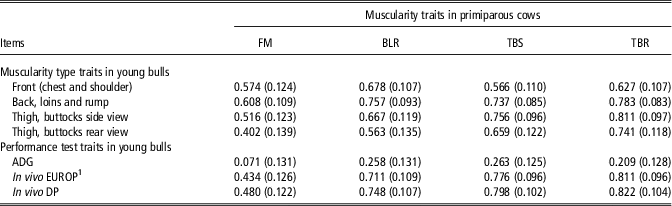
Table 3 reports the genetic correlations between muscularity type traits recorded on primiparous cows and the corresponding type traits and performance test traits recorded on young bulls. On the whole, the lowest genetic correlation was found between FM observed in primiparous cows and ADG recorded in young bulls (e.g. 0.071), whereas the highest genetic correlation was found between the TBR in females and in vivo DP in males (e.g. 0.822). In general, the single muscularity type traits observed in young bulls showed rather a strong r a with the corresponding muscularity type traits in primiparous cows (i.e. 0.574 for FM; 0.757 for BLR; 0.756 for TBS; and 0.741 for TBR; Table 3). The average standard error was 0.108 for all r a between muscularity type traits obtained in the two animal categories compared. Regarding, the r a between muscularity type traits in primiparous cows and performance test traits were recorded in young bulls; low r a were estimated between ADG and all other muscularity type traits in primiparous cows (e.g. 0.200 on average). On the other hand, EUROP and DP showed moderate r a with FM in primiparous cows (0.434 and 0.480, respectively), but higher r a with the remaining traits, that is 0.711 and 0.748 with BLR, respectively; 0.776 and 0.798 with TBS; and 0.811 and 0.822 with TBR. Again, standard error reached the average level of 0.108.
Genetic correlations (r a) and standard error of r a (within brackets) between muscularity linear type traits in primiparous cows and the corresponding linear type traits and performance test traits recorded in young bulls of the Rendena breed

FM=front muscularity; BLR=back, loins and rump; TBS=thigh, buttocks side view; TBR=thigh, buttocks rear view; ADG=average daily gain; DP=dressing percentage.
1 Grades E, U, R, O and P were subdivided into +, = or − subclasses and transformed in a linear scale that attributed 100 to R class and ±3.33 points to each subclass below or above the R, obtaining a continuous scale from 76.66 to 123.33.
Discussion
Descriptive statistics
All muscularity traits scored both in primiparous cows and young bulls have shown to be close to the mean expected values, that is mid-point of the score scale, reflecting the tendency towards a normal distribution of these traits as expected at the population level. Males of the Rendena have shown an average greater score than females after considering the same body region. This fact could be attributable to both the expected sexual differentiation due to sexes, to the younger age at which young bulls are evaluated as compared with cows and to the different feeding plan used for males and females. Indeed, performance testing in beef and dual-purpose cattle is always characterized by a feeding regimen allowing young bulls to fully express their growth potential (Andersen et al., Reference Andersen, De Baerdemaeker, Bittante, Bonaiti, Colleau, Fimland, Jansen, Lewis, Politiek, Seeland, Teehan and Werkmeister1981; Sbarra et al., Reference Sbarra, Mantovani, Quaglia and Bittante2013), whereas cows have a different feeding regimen up to the first parity. The mean ADG in the whole testing period has resulted in a low–moderate growth for the Rendena young bulls, much lower than values reported for other Italian (Mantovani et al., Reference Mantovani, Contiero, Gallo, Carnier, Cassandro and Bittante1999; Albera et al., Reference Albera, Mantovani, Bittante, Groen and Carnier2001) or Irish beef cattle (Crowley et al., Reference Crowley, McGee, Kenny, Crews, Evans and Berry2010), and also lower than growth reported for other dual-purpose tested young bulls (i.e. Norwegian dual-purpose cattle; Aass, Reference Aass1996; Czech Pied bulls; Bouška et al., Reference Bouška, Štípková, Frelich, Zedníková and Bartoň2003).
Heritability values
Heritability values for muscularity traits in primiparous cows obtained in this study (data not shown) were only slightly greater (+0.02 on average) than those previously reported in the same breed applying the same model to a smaller data set (Mazza et al., Reference Mazza, Guzzo, Sartori, Berry and Mantovani2014). The same traits measured in the local dual-purpose Aosta Red Pied breed with a close scoring method, and analysed with a similar model, produced heritabilities about one-third lower than in the present study (Mazza et al., Reference Mazza, Sartori and Mantovani2015).
Similar estimates to the present study of heritability for muscular trait development (i.e. 0.27) were also obtained by Crowley et al. (Reference Crowley, Evans, Mc Hugh, Pabiou, Kenny, McGee, Crews and Berry2011) using population data for Irish beef cattle breeds, whereas Frigo et al. (Reference Frigo, Samorè, Vicario, Bagnato and Pedron2013) have reported a value of 0.38 for the muscularity of primiparous Italian Simmental cows. Lower values than in the present study were reported by Forabosco et al. (Reference Forabosco, Bozzi, Boettcher, Filippini, Bijma and Van Arendonk2005) for Chianina cattle, with a mean heritability of 0.20 for eight different regions scored for muscularity. In general, not accounting for differences across studies and breeds, the heritability of single muscularity traits obtained from population data has always been reported to be moderate (Forabosco et al., Reference Forabosco, Bozzi, Boettcher, Filippini, Bijma and Van Arendonk2005; Crowley et al., Reference Crowley, Evans, Mc Hugh, Pabiou, Kenny, McGee, Crews and Berry2011; Mazza et al., Reference Mazza, Guzzo, Sartori, Berry and Mantovani2014), whereas factorial or composite traits have shown medium–high heritability (Frigo et al., Reference Frigo, Samorè, Vicario, Bagnato and Pedron2013; Mazza et al., Reference Mazza, Guzzo, Sartori and Mantovani2016), indicating a more efficient use of the latter as possible traits for selection.
The heritability of the four muscularity traits obtained in young bulls aged 11 months was, on average, higher than values reported for females (+0.07) due to the young age at which the evaluation was carried out that also produced an increase in the genetic variability of traits. The more homogeneous conditions in the test station should have contributed to reducing the residual variance, thus obtaining greater heritability estimates for males than for females. Indeed, the use of control stations for testing accurately beef traits in an early phase of life has been suggested as the preferred method since the 1980s, which is also due to the greater heritability attainable (Andersen et al., Reference Andersen, De Baerdemaeker, Bittante, Bonaiti, Colleau, Fimland, Jansen, Lewis, Politiek, Seeland, Teehan and Werkmeister1981). Moreover, the difference between males and females could also be a result of the different ages at scoring, of possible interference of the physiological status of females (i.e. due to milk production) or due to a partly different genetic control across sexes, which is the hypothesis of the present study. For a muscular score evaluated on young bulls at the end of the period at performance test station, Bouquet et al. (Reference Bouquet, Fouilloux, Renand and Phocas2010) reported in beef Blonde d’Aquitaine and Limousin breeds even much higher heritability (i.e. 0.65 and 0.51, respectively) than in Rendena young bulls. On the other hand, Bonfatti et al. (Reference Bonfatti, Albera and Carnier2013) reported closer results to our study, with heritability values ranging from 0.22 to 0.44 in Piedmontese tested beef bulls, depending on the body region scored (i.e. lower for the front and greater for the back). Performance test evaluation of muscularity (scale 1 to 10) in Norwegian dual-purpose cattle has shown an heritability of 0.24 (Aass, Reference Aass1996), whereas Sbarra et al. (Reference Sbarra, Mantovani and Bittante2009b) have reported a wide range of heritability values for muscularity visually assessed on Chianina, Marchigiana and Romagnola beef bulls at performance testing station (0.55 for Chianina; 0.30 for Marchigiana; and 0.19 for Romagnola, respectively).
The heritability estimates for ADG were medium to high and were in the range reported for other performance tested bulls of different breeds such as the Norwegian dual-purpose cattle (0.30; Aass, Reference Aass1996), the Czech Fleckvieh (0.28; Přibyl et al., Reference Přibyl, Krejčová, Přibylová, Misztal, Bohmanová and Štípková2007) and a mixture of breeds including beef (Charolais, Limousin, Aberdeen Angus and Hereford) and Simmental bulls tested in Ireland (0.30; Crowley et al., Reference Crowley, McGee, Kenny, Crews, Evans and Berry2010). For Chianina, Marchigiana and Romagnola tested bulls, Sbarra et al. (Reference Sbarra, Mantovani and Bittante2009b) estimated a mean heritability for ADG of 0.30. However, higher values for ADG on test stations have been highlighted for the Piedmontese breed (0.47; Bonfatti et al., Reference Bonfatti, Albera and Carnier2013).
The in vivo EUROP score and DP are not easily comparable with literature, constituting the majority of studies carried out on data from abattoirs. In this situation, heritability reported for EUROP score has been highly variable, that is, from 0.24 reported for Piedmontese cattle by Bonfatti et al. (Reference Bonfatti, Albera and Carnier2013) to 0.47 for Limousine, and to 0.62 for Blonde d’Aquitaine (Bouquet et al., Reference Bouquet, Fouilloux, Renand and Phocas2010). Analysing slaughter data from crosses of eight paternal breeds, Hickey et al. (Reference Hickey, Keane, Kenny, Cromie and Veerkamp2007) highlighted heritability estimates for EUROP ranging from 0.04 for Friesian to 0.36 for Limousine. In studies conducted on French beef breeds, the heritability of DP, calculated as the ratio of hot carcass weight:final live weight, has been reported as having higher values than those of 0.28 to 0.39 reviewed by Rios-Utrera and Van Vleck (Reference Rios Utrera and Van Vleck2004). These traits, indeed, reached a heritability of 0.43 for Charolais crosses (Fouilloux et al., Reference Fouilloux, Renand, Gaillard and Ménissier1999) or 0.47 in Blonde d’Aquitaine and 0.54 in Limousine (Bouquet et al., Reference Bouquet, Fouilloux, Renand and Phocas2010). On the other hand, lower values for DP heritability have been indicated in earlier studies conducted on Norwegian dual-purpose cattle bulls by Aass (Reference Aass1996). In general, results obtained in the present study for in vivo EUROP (but also for DP) reflect the mean heritability observed for the muscularity type scores and for ADG. The similar heritability observed for muscularity type traits and EUROP is likely knowing that the morphology score and EUROP grade are both the visual assessment of the same characteristics. Conversely, similarities with ADG estimates are less likely, as ADG comes from objective measurements of the weight, whereas the other traits are subjectively scored.
Genetic and residual correlations
A moderate genetic correlation was, indeed, estimated between ADG and all four muscularity traits in Rendena young bulls, indicating that only a partial group of genes are commonly expressed in these traits. Opposite values of correlation between ADG on test and muscularity score have been reported by Albera et al. (Reference Albera, Mantovani, Bittante, Groen and Carnier2001) on Piedmontese bulls (−0.24), whereas Fouilloux et al. (Reference Fouilloux, Renand, Gaillard and Ménissier2000) have reported almost null correlations in Charolais (0.06) or weak positive genetic correlation in Limousine performance tested bulls. These differences among breeds could also be attributable to the model adopted, particularly to the use adjusted or un-adjusted score by the weight at scoring. On the other hand, high genetic correlations were observed in the present study among the four muscularity traits when analysed in combination with in vivo EUROP and DP, further supporting trait similarity with the muscularity type evaluation. Fouilloux et al. (Reference Fouilloux, Renand, Gaillard and Ménissier2000) have also reported a greater genetic correlation between live muscularity assessed on performance tested bulls and the postmortem DP obtained from the progeny of the same Charolais and Limousine bulls (0.28 and 0.59, respectively). Conformation score and ADG have shown a highly unfavourable genetic correlation (−0.62) in Norwegian dual-purpose tested bulls (Aass, Reference Aass1996), although, once more, a positive genetic correlation was reported between the in vivo visual appraisal of conformation and DP measured only on unselected bulls (0.52). Results from our study highlight that, due to the high genetic correlations between in vivo estimates and muscularity traits, performance test traits are still preferable indicators of beef attitude: in vivo EUROP score follows the standards of the European Community evaluation system and therefore it is largely agreeable, and the DP appraisal represents important supplementary information of beef attitude.
Muscularity traits obtained in Rendena primiparous and in young bulls were positively correlated with each other, although the correlation estimates were not as strong as expected (on average, 0.65), considering that they regarded the same trait in a different situation. However, this difference could be the reason for the low correlation, considering that cows are scored during lactation, that is, in a thinner appearance due to milk yield as compared with young bulls. Furthermore, the magnitude of genetic correlation could also be due to partly different genetic control in male and female muscularity, with the possibility of being different traits in the two sexes. Comparing the results of this study with other literature reports is very difficult due to the lack of similar studies. The only possible comparison is with live and postmortem conformation data on French beef breeds, for which the correlation coefficients ranging between 0.61 and −0.79 have been reported (Fouilloux et al., Reference Fouilloux, Renand, Gaillard and Ménissier1999; Bouquet et al., Reference Bouquet, Fouilloux, Renand and Phocas2010). However, very different conditions occur in this comparison considering that, in both cases, the data obtained were the results of performance testing of young bulls and the fattening of their progeny in commercial conditions.
Muscularity type traits scored on primiparous cows have shown weak to moderate correlation with ADG, and medium–high with in vivo estimates of EUROP and DP, indicating once more, at least for animal beef conformation, a common component of the gene-pools involved in the expression of the traits, particularly for the hind quarter (TBS and TBR). To date, no previous literature has reported information about the genetic relationships between these traits. A possible comparison may be done with a recent study on French beef cattle (Montbeliarde, Normande and Simmental; Croué et al., Reference Croué, Fouilloux, Saintilan and Ducrocq2017), finding positive genetic correlations, from 0.12 to 0.59, between carcass traits of young bulls and muscularity traits of lactating cows. The moderate to strong but not close to the unit genetic correlations among cows’ muscularity and in vivo estimates of EUROP and DP support the maintenance of cow muscularity traits in form of factor score (Mazza et al., Reference Mazza, Guzzo, Sartori and Mantovani2016; Sartori et al., Reference Sartori, Guzzo, Mazza and Mantovani2018), within the selection index for dual-purpose characteristics of Rendena cattle. This maintaining is also justified by the different genetic correlations with milk yield, being respectively negative for muscularity and close to zero for performance test traits (Sartori et al., Reference Sartori, Guzzo, Mazza and Mantovani2018). This fact suggests a detriment in cows’ muscularity due to milk improvement and whether muscularity is not maintained under selection, whereas variation in milk and performance test beef traits is almost independent.
Conclusions
This study showed that traits measured during performance testing of Rendena young bulls are heritable and favourably correlated with each other. Lower heritability exists for muscularity traits evaluated on primiparous cows, but even these traits are favourably correlated to muscularity type traits scored on performance tested bulls or with growth and the in vivo commercial evaluation of bulls (EUROP and DP), indicating a common pathway of selection. As the estimated genetic correlations between young bulls muscularity traits and in vivo commercial evaluations are strong, it is not necessary to change the beef traits in the global selection index for dual-purpose attitude by introducing the young bulls’ muscularity. Therefore, the results suggest maintaining the in vivo commercial evaluations within the index as beef traits, together with the primiparous cows’ muscularity evaluation. Further analysis regarding a genetic trend for traits could be useful for a whole understanding of the relationships among the traits analysed in the present study. This analysis would make additional information available on the appropriate weight to assign beef traits under selection for the autochthonous Rendena breed. Moreover, the use of postmortem data for EUROP and DP could also be considered for genetic evaluations, as in other beef or dual-purpose breeds. The only concern is that in Rendena breed young bulls are currently slaughtered at 1.5 to 2 years of age, and not just at the end of the performance test. Concluding, results of this study may also provide useful suggestions for genetic relationships among the possible traits of interest in the genetic improvement of other dual-purpose breeds.
Acknowledgements
The authors would like to thank the National Breeders Association of Rendena breed (ANARE) for providing data and for its support to this study.
Declaration of interest
The authors declare no conflicts of interest.
Ethics statement
This study was performed with data routinely collected for breeding programmes and provided by the National Breeders Association (ANARE); thus, there is no relevance for approval of the Ethic Committee of University of Padua.
Software and data repository resources
The data are property of the National Breeders Association (ANARE) and no supplementary material was deposited in an official repository.