Implications
Poultry meat consumption is increasing worldwide. Optimizing chicken product quality is a major issue for sustainable poultry production, but this requires adjusting tissue metabolism partly by the fine tuning of rearing factors (including nutrition) to meet several quality criteria related to body composition and meat properties. This study shows that carcass composition and breast meat quality are greatly altered by varying dietary amounts of Lysine (Lys) and/or other amino acids (AA), but the interactive responses to Lys and AA were only found for meat quality criteria. These findings provide a basis for optimizing dietary AA provision in relation to product quality issues to meet various technological and consumer needs.
Introduction
Optimizing body composition and meat quality while ensuring the efficiency of production systems requires controlling the metabolic utilization of nutrients by adapting nutritional strategies. This is particularly important for the finishing period where broiler feed intake and the consequences on product quality are the highest. Amino acids are among the major factors regulating metabolism. They are components of tissue proteins and provision at insufficient levels leads to reduced protein synthesis. Provision of the different AA is therefore a prerequisite for maintaining optimal growth rates, an unquestionably major concept in protein nutrition. In chickens, as in other farm animals, AA have thus to be provided in the diet in balanced proportions to optimize performance and feed utilization (D’Mello, Reference D’Mello2003). This necessitates control of the provision of AA, the most limiting AA being supplied by incorporation of feed-grade AA. Practical formulation of a balanced diet is generally based on an ideal AA profile, in which AA requirements are usually expressed relative to Lys (National Research Council, 1994; Mack et al., Reference Mack, Bercovici, De Groote, Leclercq, Lippens, Pack, Schutte and Van Cauwenberghe1999; Wu, Reference Wu2014).
In addition to their role in animal growth, dietary AA are major determinants of the carcass components of broilers, as abdominal fat content and breast meat yield are influenced by their levels (Moran and Bilgili, Reference Moran and Bilgili1990; Leclercq, Reference Leclercq1998). Lysine in particular is known to have specific effects on carcass composition and, for instance, Lys deficiency greatly reduces the weight and proportion of breast muscle (Tesseraud et al., Reference Tesseraud, Peresson, Lopes and Chagneau1996, Reference Tesseraud, Le Bihan-Duval, Peresson, Michel and Chagneau1999 and Reference Tesseraud, Temim, Le Bihan-Duval and Chagneau2001; Urdaneta-Rincon and Leeson, Reference Urdaneta-Rincon and Leeson2004; Sterling et al., Reference Sterling, Pesti and Bakalli2006). Interestingly, increasing the level of Lys in the diet of broilers beyond the requirement for growth reduces the drip loss of breast muscle during storage by increasing its ultimate pH (pHu, determined 24 h postmortem) (Berri et al., Reference Berri, Besnard and Relandeau2008), which itself depends on muscle glycogen content (Le Bihan-Duval et al., Reference Le Bihan-Duval, Debut, Berri, Sellier, Santé-Lhoutellier, Jégo and Beaumont2008). More generally, changes in pHu affect the water holding capacity of meat, its color, processing yield (Le Bihan-Duval et al., Reference Le Bihan-Duval, Debut, Berri, Sellier, Santé-Lhoutellier, Jégo and Beaumont2008; Petracci et al., Reference Petracci, Mudalal, Soglia and Cavani2015) and consequently competitiveness for the poultry meat industry. Recent studies also highlighted the lack of muscle energy reserve and high pHu as predisposing factors favoring the emergence of white striping and wooden breast defects in heavy broiler lines (Abasht et al., Reference Abasht, Mutryn, Michalek and Lee2016, Alnahhas et al., Reference Alnahhas, Berri, Chabault, Chartrin, Boulay, Bourin and Le Bihan-Duval2016; Beauclercq et al., Reference Beauclercq, Hennequet-Antier, Praud, Godet, Collin, Tesseraud, Métayer-Coustard, Bourin, Moroldo, Martins, Lagarrigue, Le Bihan-Duval and Berri2017), the occurrence and severity of such lesions being also induced with increasing Lys levels (Cruz et al., Reference Cruz, Vieira, Kindlein, Kipper, Cemin and Rauber2017), and high energy and protein diets (Kuttappan et al., Reference Kuttappan, Brewer, Apple, Waldroup and Owens2012). There is an evidence that breast meat pHu and related quality traits can be slightly modified by variation in dietary energy and/or protein content, but the impact of protein provision seems to be very variable depending for instance on the genotype (Jlali et al., Reference Jlali, Gigaud, Métayer-Coustard, Sellier, Tesseraud, Le Bihan-Duval and Berri2012; Zhao et al., Reference Zhao, Zhao, Jiang, Zheng, Chen, Liu and Wen2012). The characteristics of diet including dietary nutrient density (Zhao et al., Reference Zhao, Zhao, Jiang, Zheng, Chen, Liu and Wen2012) and AA density (Lili et al., Reference Lilly, Schilling, Silva, Martin and Corzo2011) may be also important factors conditioning the protein effect, demonstrating the importance for poultry meat industry of better defining the responses that govern changes in pHu and meat quality according to dietary AA provision, and AA balance or imbalance. The aim of this study was therefore to describe in finishing broilers the interactive responses to varying dietary levels of Lys and other AA (expressed as a proportion of Lys) under a wide range of provision levels using 12 isoenergetic diets based on conventional feedstuffs. The responses to AA provision were evaluated in terms of growth performance, carcass composition and meat quality criteria (i.e. pHu, drip loss and color parameters).
Material and methods
Animals, experimental design and diets
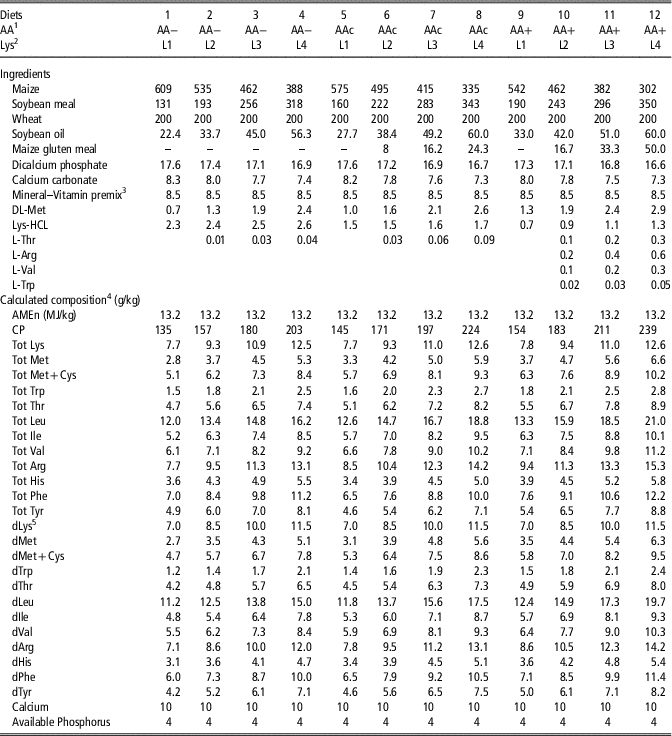
A total of 4608 1-day-old male Ross chicks (PM3) were purchased from a commercial hatchery (Grelier, Volnay, France) and reared in an experimental poultry unit (INRA, Nouzilly, France) from day 1 to day 20. Chickens were individually wing tagged at day 7. At day 21, after 4 h of fasting, 3456 birds of similar weight (1080±105 g) were randomly distributed into 96 pens each measuring 3 m², each pen containing 36 birds. The ambient temperature programme applied was 31°C from day 1 to day 3, 29°C from day 4 to day 6, 28°C from day 7 to day 13, 26°C from day 14 to day 20, 24°C from day 21 to day 24, 22°C from day 25 to day 27 and 20°C from day 28 until the end of the experiment at day 36. Birds were exposed to the following light schedule: 23 h of light day 1 to day 3, 18 h of light day 4 to day 36. During the experiment, birds were watered and fed ad libitum. Starter feed was provided from day 1 to day 9, then a grower diet was distributed from day 10 to day 20 (Table 1). In total, 12 experimental diets (Table 2) were distributed to the birds for the experimental phase from day 21 to day 36. They contained four Lys levels (i.e. L1, L2, L3 and L4) varying from 7.0 to 11.5 g digestible Lys/kg to cover a wide range of Lys provision, combined with a low (AA−), control (AAc) and high amount (AA+) of other AA calculated in relation to Lys corresponding respectively to 90%, 100% and 110% of the ideal AA profile proposed by Mack et al. (Reference Mack, Bercovici, De Groote, Leclercq, Lippens, Pack, Schutte and Van Cauwenberghe1999) for nutritionally essential AA (EAA) in finishing broiler chickens. To avoid the use of semi-synthetic diets (e.g. including starch), they were based on conventional feedstuffs and addition of feed-grade AA. Diets comprised different proportions of the same raw materials (i.e. maize, soybean meal, wheat, soybean oil and maize gluten meal) originating from the same batches, previously analyzed for nitrogen and AA content. Dietary CP content varied in proportion to Lys content, whereas the proportions of each other EAA relative to Lys were the same within a given AA amount (i.e. AA−, AAc or AA+). This included controlled amounts of EAA which are limiting in the Mack et al. (Reference Mack, Bercovici, De Groote, Leclercq, Lippens, Pack, Schutte and Van Cauwenberghe1999) profile (methionine+cysteine, threonine, valine, tryptophan, isoleucine and arginine), and also leucine, histidine, phenylalanine and tyrosine (Tables 2 and Supplementary Table S1). Other nutritional characteristics (i.e. metabolizable energy, minerals, etc.) were kept constant and the proportion of wheat was fixed at 200 g/kg in order to maintain good pellet quality. All diets were steam pelleted and distributed to broilers ad libitum. The values measured for protein and AA content in diets are presented in the Supplementary Table S1. They were consistent with the calculated values.
Composition (g/kg) and characteristics of diets fed to chickens from day 1 to day 20

Met=methionine; Thr=threonine; AMEn=apparent metabolizable energy corrected for nitrogen balance.
1 Supplied per kilogram of diet: Co=0.6 mg; Cu=20 mg; Fe=58 mg; I=2 mg; Mn=80 mg; Se=0.2 mg; Zn=90 mg; retinyl acetate=15000 IU; cholecalciferol=4300 IU; DL-alpha tocopheryl acetate=100 mg; thiamine mononitrate=5 mg; riboflavin=8 mg; calcium pantothenate=25 mg; cyanocobalamin=0.02 mg; menadione=5 mg; pyridoxine hydrochloride=7 mg; folic acid=3 mg; biotin=0.3 mg; niacin=100 mg; choline chloride=550 mg; antioxidant (buthylhydroxyanisole, propyl gallat and ethoxyquin)=50 mg; Robenz=50 mg.
2 Composition in amino acids is given as total values calculated according to Sauvant et al. (Reference Sauvant, Perez and Tran2004).
Composition (g/kg) and characteristics of experimental diets fed to chickens from day 21 to day 36

AA=amino acids; Lys=lysine; EAA=essential amino acids; AMEn=apparent metabolizable energy corrected for nitrogen balance; Met=methionine; Cys=cysteine; Trp=tryptophan; Thr=threonine; Leu=leucine; Ile=isoleucine; Val=valine; Arg=arginine; His=histidine; Phe=phenylalanine; Tyr=tyrosine.
1 AA, diets with a low (AA−), control (AAc) and high amount (AA+) of other EAA calculated in relation to Lys corresponding to 90%, 100% and 110% of the optimum AA profile of Mack et al. (Reference Mack, Bercovici, De Groote, Leclercq, Lippens, Pack, Schutte and Van Cauwenberghe1999), respectively.
2 Lys, diets with a digestible Lys content of 7, 8.5, 10 and 11.5 g/kg (diets L1, L2, L3 and L4, respectively).
3 Supplied per kilogram of diet: Co=0.6 mg; Cu=20 mg; Fe=58 mg; I=2 mg; Mn=80 mg; Se=0.2 mg; Zn=90 mg; retinyl acetate=15000 IU; cholecalciferol=4300 IU; DL-alpha tocopheryl acetate=100 mg; thiamine mononitrate=5 mg; riboflavin=8 mg; calcium pantothenate=25 mg; cyanocobalamin=0.02 mg; menadione=5 mg; pyridoxine hydrochloride=7 mg; folic acid=3 mg; biotin=0.3 mg; niacin=100 mg; choline chloride=550 mg; antioxidant (buthylhydroxyanisole, propyl gallat and ethoxyquin)=50 mg; Elancoban 200=200 mg.
4 Calculated values. Dietary protein and AA content calculated from the analyzed protein and AA composition of raw materials.
5 Theoretical digestible AA values were calculated according to AA content of raw materials analyzed and the digestibility coefficients given by Sauvant et al. (Reference Sauvant, Perez and Tran2004).
Measurements
Raw materials and diets were analyzed for dry matter (AFNOR methods V18-109), N content (ISO 16634-1, Kjeldahl method) and AA content (ISO 13903; analyzed by Ajinomoto Eurolysine SAS laboratory, Amiens, France). Growth performance was recorded throughout the rearing period and calculated for each pen. All birds were weighed individually at day 21 and day 36 after 4 h fasting. Feed intake was recorded per pen from day 21 to day 36. The feed conversion ratio (FCR) was calculated between day 21 and day 36. At day 36, four birds representing the average and the variability of the pen were selected to be slaughtered (32 birds per treatment). They were slaughtered at the experimental processing plant of the experimental poultry unit (PEAT, INRA Nouzilly, France) after 8 h of feed withdrawal. The chickens were stunned in a water bath (120 Hz AC, 80 mA/bird, 5 s) and then killed by ventral neck incision. After partial evisceration (only the gut was removed), whole carcasses were air-chilled (airflow of 7 m3/s) and stored at 2°C until the next day when they were weighed. Abdominal fat and left pectoral muscles (Pectoralis major and minor) were removed and weighed. Percentages of abdominal fat and pectoral muscles were expressed in relation to live BW.
At 24 h postmortem, the pHu of the breast Pectoralis major (P. major) muscle was measured with a portable pH meter (model 506; Crison Instruments SA, Alella, Barcelona, Spain) by inserting a glass electrode directly in the thickest part of the muscle. Breast color was measured on the cranial ventral side of the P. major muscle by using a Miniscan spectrocolorimeter (Hunterlab, Reston, VA, USA). Color was measured by the CIELAB trichromatic system as lightness (L*), redness (a*) and yellowness (b*) values. The water-holding capacity of meat was estimated by measuring drip loss of the raw meat after storage: the P. major muscle was weighed 24 h postmortem and immediately placed in a plastic bag, hung from a hook and stored at 2°C for 4 days. After hanging, the sample was wiped with an absorbent paper and weighed again. The difference in weight corresponded to the drip loss and was expressed as the percentage of the initial muscle weight.
Statistical analyses
All data were analyzed using SAS (SAS Institute Inc., Cary, NC, USA). The type I error accepted was 5%. The respective effects of levels of dietary Lys and AA were analyzed by two-way ANOVA with the AA×Lys interaction (GLM procedure). Pairwise comparisons of means for each significant effect were performed by Scheffe test using the Lsmeans statement of the GLM procedure. Values were expressed as Lsmeans and SEM. When the AA×Lys interaction was significant, effects of diet were analyzed by one-way ANOVA (GLM procedure) and the respective effects of levels of dietary Lys and AA were also presented as response surfaces (Minitab 16 statistical software). Pearson correlation coefficients were analyzed with the procedure CORR of SAS to assess the relationship between traits.
Results
Growth performance and carcass characteristics
Before the experiment started (day 21), BW was similar (mean 1079 g) for all 96 groups of birds (data not shown). There was no significant interaction between dietary Lys level and AA (other EAA expressed as proportion of Lys) for BW measured at day 36 (Table 3), but both AA and Lys levels affected BW (P<0.001). Body weight was lower (P<0.001) in broilers receiving the AA− diets than in those fed the AA and AA+ diets. Increasing dietary Lys level increased BW (P<0.001) whatever the relative amounts of other EAA. Between day 21 and day 36, feed intake was reduced when the Lys level increased (P<0.001), but was not significantly modified by the relative amounts of other EAA. Nevertheless, it should be noted that Lys intake clearly increased when dietary Lys content increased (P<0.001), without significant change related to the relative amounts of other EAA as expected (data not shown). As for BW, there was no significant AA×Lys interaction for FCR (Table 3). It was higher in broilers fed the AA− diets (P<0.001) than in those receiving the AA and AA+ diets, and decreased when Lys level increased. In our experimental conditions, FCR was improved by 20% by changes in Lys level (between L1 and L4) and by 4.4% by changes in the relative amounts of other EAA (between AA− and AA+). Breast meat yield was gradually enhanced by increasing dietary Lys level but not significantly influenced by the relative amounts of other EAA (P=0.12). Similar results were obtained for the percentage of abdominal fat calculated in relation to BW, which decreased when Lys level increased but was not significantly affected by the relative amounts of other EAA (tendency to an effect, P=0.07). Breast meat yield was negatively correlated with percentage of abdominal fat (r=−0.50, P<0.0001).
Growth performance and carcass characteristics of broilers fed experimental diets from day 21 to day 36

AA=amino acids; Lys=lysine; EAA=essential amino acids; FI=feed intake; FCR=feed conversion ratio; BMY=breast meat yield; AF=abdominal fat.
a,b,c,dWhen there is no significant interaction AA×Lys and a significant main effect, Lsmeans with different superscripts differ significantly at P<0.05.
1 AA, diets with a low (AA−), control (AAc) and high amount (AA+) of other EAA calculated in relation to Lys corresponding to 90%, 100% and 110% of the optimum AA profile of Mack et al. (Reference Mack, Bercovici, De Groote, Leclercq, Lippens, Pack, Schutte and Van Cauwenberghe1999), respectively.
2 Lys, diets with a digestible Lys content of 7, 8.5, 10 and 11.5 g/kg (L1, L2, L3 and L4, respectively).
3 n=8 pens per treatment.
4 BWd36, BW at day 36.
5 n=32 animals per treatment, values expressed as percentage of live BW.
6 Main effect: Lsmeans calculated for AA and Lys levels.
Meat quality criteria
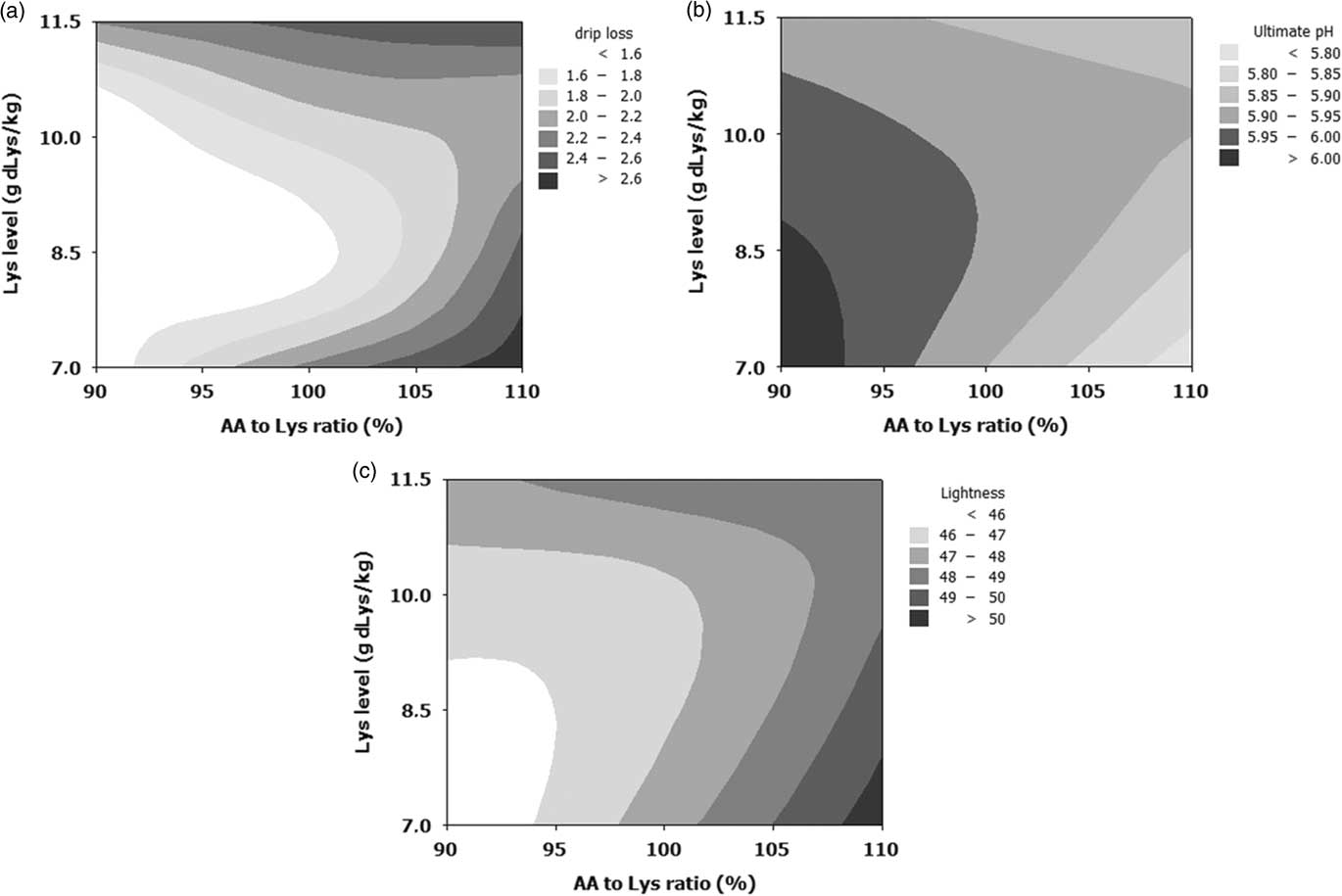
Breast meat quality was assessed through the measurement of pHu, drip loss and color (L*, a* and b*) (Table 4 and Figure 1). The pHu varied from 5.77 to 6.04, and was affected by dietary changes in Lys and AA (P<0.05), with a significant AA×Lys interaction. In particular, the lowest pHu was obtained in AA+ diets containing a low Lys level (L1 diet), whereas the highest pHu was observed in AA− diets containing a low Lys level (L1 diet). Drip loss and L* were also affected (P<0.05) by changes in Lys and AA. Drip loss varied from 1.4% to 2.7%. The lowest values were obtained for AA− diets with the three lowest levels of Lys (L1, L2 and L3 diets) whereas the highest values were observed for AA+ diets, with the lowest and highest levels of Lys (L1 and L4 diets). Breast meat L* varied from 45.0 for AA− diets with low Lys level (L1 diet) to 50.6 for AA+ diets containing a low Lys level (L1 diet). It is of note that the effects of AA (i.e. relative amounts of other EAA) on these meat quality criteria (pHu, drip loss and L*) greatly depended on Lys level, the effects being much more pronounced for the lowest level of Lys (L1 diets). Similar results were not obtained for a*, although there were significant effects on this parameter of both AA and Lys and their interaction. The lowest values of a* were observed with the L4 Lys level (−0.42, −0.64, −0.51 for AA−, AA and AA+, respectively) and a* reached 0.22 with the AA− and L2 Lys level. Yellowness was affected by AA and Lys (P<0.001), without any AA×Lys interaction. Increasing the relative amounts of other EAA (from AA− to AA+) significantly increased b* (from 8.28 to 9.14) and, in contrast, increasing the Lys level decreased b* (from 9.19 to 8.35). The pHu was negatively correlated with drip loss, L* and b* (r=−0.52, −0.61 and −0.35, P<0.0001, respectively) but not with a*.
Response surface of (a) drip loss, (b) ultimate pH and (c) lightness of chicken breast meat as a function of digestible Lys content (g/kg) and other EAA calculated in relation to Lys (AA to Lys ratio expressed in %, 100% corresponding to the control AA diets) in finishing broilers. AA=amino acids; Lys=lysine; EAA=essential amino acids.

Meat quality of broilers fed experimental diets from day 21 to day 36 (n=32 birds per treatment)

AA=amino acids; Lys=lysine; EAA=essential amino acids; pHu=ultimate pH; DL=drip loss; L*=lightness; a*=redness; b*=yellowness.
a,b,c,d,eWhen there is a significant interaction AA×Lys, values within a line with different superscripts differ significantly at P<0.05.
1 AA, diets with a low (AA−), control (AAc) and high amount (AA+) of other EAA calculated in relation to Lys corresponding to 90%, 100% and 110% of the optimum AA profile of Mack et al. (Reference Mack, Bercovici, De Groote, Leclercq, Lippens, Pack, Schutte and Van Cauwenberghe1999), respectively.
2 Lys, diets with a digestible Lys content of 7, 8.5, 10 and 11.5 g/kg (L1, L2, L3 and L4, respectively).
3 Main effect: Lsmeans calculated for AA and Lys levels. When there is no significant interaction AA × Lys and a significant main effect, Lsmeans with different superscripts differ significantly at P<0.05.
4 DL, expressed in percentage.
Discussion
The aim of the study presented here was to investigate the broiler responses to both dietary Lys and AA (i.e. relative amounts of EAA other than Lys) during the finishing period. The interactive responses to nutrients were described under a wide range of AA provision while using diets based on conventional feedstuffs and limited addition of nonusual AA. Diets were formulated on a digestible AA basis to avoid an important experimental bias linked to variations in AA digestibility and availability of the different ingredients incorporated into the diet. Similarly, we used as a reference the AA profile of Mack et al. (Reference Mack, Bercovici, De Groote, Leclercq, Lippens, Pack, Schutte and Van Cauwenberghe1999) calculated on a digestible AA basis rather than the ideal ratios calculated on total AA basis from National Research Council (1994). The AA profile of Mack et al. (Reference Mack, Bercovici, De Groote, Leclercq, Lippens, Pack, Schutte and Van Cauwenberghe1999) included nutritionally EAA requirements for finishing broiler chickens. These nutritionally EAA are AA whose carbon skeletons are not synthesized de novo by animal cells and must be provided to animals to maintain their growth or nitrogen balance (Wu Reference Wu2013 and Reference Wu2014). Here, the so-called nonessential AA were not taken into account although increasing evidence indicates that these AA can be synthesized insufficiently in the body to meet optimal metabolic and functional needs (Wu, Reference Wu2013; Hou et al., Reference Hou, Yao, Yin and Wu2016; Hou and Wu, Reference Hou and Wu2017).
As expected, reducing the dietary Lys level significantly decreased Lys intake, despite a significant increase in feed consumption in our experimental conditions. Such a Lys-related effect on feed intake was surprising in view of previous findings (Han and Baker, Reference Han and Baker1994; Dozier et al., Reference Dozier, Corzo, Kidd, Tillman and Branton2009) but could be explained by the concomitant variations in dietary protein content (Gous, Reference Gous2007; Oliveira et al., Reference Oliveira, RFM, Donzele, LFT, PHRF, Balbino, Maia and Pastora2013). In all cases, growth performance levels (i.e. BW and FCR) were significantly improved by increasing the dietary Lys level, as classically described (Tesseraud et al., Reference Tesseraud, Peresson, Lopes and Chagneau1996; Si et al., Reference Si, Fritts, Burnham and Waldroup2001; Garcia et al., Reference Garcia, Batal and Baker2006; Cruz et al., Reference Cruz, Vieira, Kindlein, Kipper, Cemin and Rauber2017). Similarly, increasing the dietary Lys level improved breast meat yield and reduced the percentage of abdominal fat in broilers, in agreement with the literature (Han and Baker, Reference Han and Baker1994; Leclercq, Reference Leclercq1998; Garcia et al., Reference Garcia, Batal and Baker2006). The underlying mechanisms have already been described: dietary Lys supplementation alters the balance between protein synthesis and degradation so that it enhances the amount of protein gain in chicken skeletal muscles, especially in the P. major muscle (Tesseraud et al., Reference Tesseraud, Peresson, Lopes and Chagneau1996 and Reference Tesseraud, Temim, Le Bihan-Duval and Chagneau2001; Urdaneta-Rincon and Leeson, Reference Urdaneta-Rincon and Leeson2004). By contrast, when Lys is not provided at a sufficient level in the diet, protein synthesis is limited and the other AA that are not incorporated into proteins are catabolized and used in the lipid pathway, thereby enhancing fat deposition (Grisoni et al., Reference Grisoni, Uzu, Larbier and Geraert1991; Leclercq, Reference Leclercq1998; Nasr and Kheiri, Reference Nasr and Kheiri2012).
In the present experiment, there was no significant interaction between dietary Lys and AA for growth performance or carcass composition, as previously reported (Si et al., Reference Si, Fritts, Burnham and Waldroup2001). In the latter study, that tested Lys and other EAA levels above National Research Council (1994) recommendations, no effect of Lys and/or AA was systematically observed for any parameter (e.g. no effect of AA on BW whatever the age; no effect of Lys or AA on breast yield and abdominal fat). Our findings provide new and interesting information on the respective influences of AA and Lys under a wide range of provision levels. Here, growth performances and carcass traits were greater affected by Lys levels in respect to other EAA levels. Although there was a very significant effect of AA on growth performance with impaired values for AA− compared with AAc and AA+ whatever the dietary Lys level, no additional benefit was found when the relative amount of other EAA was increased (AA+ v. AAc). This is likely due to the limited amount of nonessential AA in the diet and the increased amount of EAA that is catabolized to provide nonessential AA, thereby impairing their efficiency in supporting chicken growth (Wu, Reference Wu2013; Hou et al., Reference Hou, Yin and Wu2015 and Reference Hou, Yao, Yin and Wu2016). In addition, no significant AA effect was found on carcass composition despite a tendency (P=0.07) for abdominal fat percentage. Breast meat yield was not significantly affected by AA, whereas it responded dramatically to dietary Lys level, mainly with AA+ diets (P=0.052 for AA×Lys interaction). All results taken together, this study demonstrated that chicken carcass composition was not greatly influenced by the AA, in contrast to growth performance that was significantly reduced by using AA−. The results were quite different to another experimental design considering dietary Lys and CP (e.g. very significant CP effect on abdominal fat percentage, but not on BW gain; Sterling et al., Reference Sterling, Pesti and Bakalli2006), probable because dietary CP content, a factor related to AA amounts, is not equivalent to the levels of other EAA in relation to Lys (i.e. AA proportions).
Both dietary Lys and AA affected breast meat quality traits, including pHu, color and drip loss. Breast meat pHu in chickens is mainly determined by the glycogen content of muscle measured at slaughter (Le Bihan-Duval et al., Reference Le Bihan-Duval, Debut, Berri, Sellier, Santé-Lhoutellier, Jégo and Beaumont2008; Petracci et al., Reference Petracci, Mudalal, Soglia and Cavani2015). It is the main determinant of breast meat color and water-holding capacity, which is consistent with the significant correlations we reported between meat pHu, and drip loss, L* and b*. In the present study, the maximum change in pHu induced by dietary treatments reached 0.29 pH unit. This change in pHu was quite high compared with literature reports: maximum change of 0.13 pH unit between different genotypes selected for growth criteria (Berri et al., Reference Berri, Debut, Santé-Lhoutellier, Arnould, Boutten, Sellier, Baéza, Jehl, Jégo, Duclos and Le Bihan-Duval2005), 0.11 pH unit in response to dietary Lys variations (Berri et al., Reference Berri, Besnard and Relandeau2008), 0.10–0.13 pH unit with dietary CP and/or energy variations (Jlali et al., Reference Jlali, Gigaud, Métayer-Coustard, Sellier, Tesseraud, Le Bihan-Duval and Berri2012; Zhao et al., Reference Zhao, Zhao, Jiang, Zheng, Chen, Liu and Wen2012), 0.09 pH unit with a moderate imbalance in dietary AA provision (Alnahhas et al., Reference Alnahhas, Berri, Chabault-Dhuit, Bourin, Arnould and Le Bihan-Duval2017) and 0.14 pH unit with short-term variations in dietary AA provision (Guardia et al., Reference Guardia, Lessire, Corniaux, Metayer-Coustard, Mercerand, Tesseraud, Bouvarel and Berri2014). Moreover, the latter studies were not designed to define the responses that govern pHu changes according to AA provision and AA balance, leading to the oversimplified vision that increasing dietary Lys results in increased pHu. In the present experiment, the Lys-related changes of pHu depended on the levels of other EAA and pHu was more affected by the relative amount of other EAA than by Lys levels.
Consequently, our results showed for the first time that there was a significant AA×Lys interaction on most of the meat quality traits. Graphs of the respective effects of Lys and AA illustrate how it is possible to optimize dietary provision through response surface analyses (Figure 1). For example, combining a AA− diet with reduced Lys levels (L1 and L2 diets) favored the production of meat with high pHu (>6.0), whereas the most acid meat (pHu <5.8) was produced by combining the AA+ diet with a low level of Lys content (L1 diet). The effects of provision of dietary Lys and other EAA on meat L* and drip loss followed those on pHu because of the high correlations between these traits. The lightest and the most exudative breast fillets were therefore obtained by combining AA+ with low Lys content (L1 diet). Provision of Lys and other EAA, and the resulting AA balance or imbalance (present study), as well as the limited provision of nonessential AA (Hou et al., Reference Hou, Yin and Wu2015 and Reference Hou, Yao, Yin and Wu2016) likely affect the proportion of AA used for protein synthesis or catabolized, and therefore energy metabolism through AA catabolism, glucose production and storage as glycogen in muscle, with consequences on meat pHu and possibly occurrence of new meat quality defects as recently suggested by Alnahhas et al. (Reference Alnahhas, Berri, Chabault, Chartrin, Boulay, Bourin and Le Bihan-Duval2016) and Beauclercq et al. (Reference Beauclercq, Nadal-Desbarats, Hennequet-Antier, Collin, Tesseraud, Bourin, Le Bihan-Duval and Berri2016). These findings could explain the apparently controversial data obtained with regard to protein effect: no significant change in pHu and meat quality traits when reducing dietary CP from 22.5% to 15.5% through variations in AA density but not in AA balance (Lilly et al., Reference Lilly, Schilling, Silva, Martin and Corzo2011); higher pHu (0.10 pH unit increase), darker color and reduced drip loss when reducing dietary CP from 23% to 17% through variations in AA balance and density (Jlali et al., Reference Jlali, Gigaud, Métayer-Coustard, Sellier, Tesseraud, Le Bihan-Duval and Berri2012). The greatest effect (0.22 pH unit increase associated with reduced L* and drip loss) was found in a recent study where the effect of reducing the dietary CP content from 19% to 16% was investigated using an adjusted AA provision to meet AA requirements (Belloir et al., Reference Belloir, Méda, Lambert, Corrent, Juin, Lessire and Tesseraud2017). Under these experimental conditions, one can assumed that the provision of a more balanced AA profile that is associated with the reduction in CP content reduced the excess of AA, thereby decreasing the amount of nutrients available for glycogen production/storage through AA catabolism and leading to higher pHu. Noteworthy, a low carbohydrate storage in muscle may contribute to some emerging meat quality defects as recently suggested by Alnahhas et al. (Reference Alnahhas, Berri, Chabault, Chartrin, Boulay, Bourin and Le Bihan-Duval2016) and Beauclercq et al. (Reference Beauclercq, Hennequet-Antier, Praud, Godet, Collin, Tesseraud, Métayer-Coustard, Bourin, Moroldo, Martins, Lagarrigue, Le Bihan-Duval and Berri2017). Emerging evidence also shows that limited amounts of nonessential AA in the diet and inadequate provision of EAA limiting the synthesis of nonessential AA can affect meat quality traits (Hou et al., Reference Hou, Yin and Wu2015, Reference Hou, Yao, Yin and Wu2016 and Reference Hou and Wu2017). Consequently, provision of AA in adequate amounts and proportions is essential for optimizing meat quality.
In conclusion, growth performance, carcass composition and breast meat quality traits are affected by the levels of dietary Lys and AA in broiler chickens. The interactive responses of broiler chickens to Lys and AA depend on the criteria. In contrast to growth performance and carcass composition, there is a significant Lys×AA interaction for meat quality traits. Changes in AA balance greatly altered breast meat pHu as well as color and drip loss. Given the major role of pHu in controlling shelf-life and functional properties of muscle proteins, its manipulation through diet may have significant impacts on technological yields and further-process product quality, with significant consequences for the competitiveness of the poultry meat industry.
Acknowledgments
The authors thank Fréderic Mercerand (PEAT, INRA, Nouzilly, France), Jean-Marc Hallouis, Sabine Crochet, Thierry Bordeau and Estelle Cailleau-Audouin (BOA, INRA, Tours University, Nouzilly, France), Yvan Primot and Marcelle Eudaimon (Ajinomoto Eurolysine s.a.s. laboratory, Amiens, France) for their collaboration in this study. They are also grateful to Doreen Raine (Surrey, UK) for editing the English language. This study received financial support from INRA and Ajinomoto Eurolysine S.A.S. P. Belloir is supported in part by Ajinomoto-Eurolysine S.A.S. Research Grants.
Declaration of interest
The present study was supported by Research Grants from Ajinomoto Eurolysine S.A.S. and INRA and both have contributed to the study design and manuscript preparation. The funder INRA also contributed to the conduct of the study, laboratory and data analyses, and interpretation of the findings. Funders did not interfere with the full presentation of this research and objective interpretation of the data. All authors have agreed to submit the manuscript to animal – an International Journal of Animal Biosciences.
Ethics statement
Experimental procedures and animal care were carried out in compliance with the French legislation on ethics and under Authorization 04601 granted to S. Tesseraud by the French Ministry of Agriculture, by strictly following the European Convention of the Protection of Vertebrate Animals used for Experimental and Scientific Purposes, directive 86–609 of November 24, 1986 of the council of the EU and directive 2010/63/EU.
Software and data repository resources
None of the data were deposited in an official repository.
Supplementary material
To view supplementary material for this article, please visit https://doi.org/10.1017/S1751731118002306