Introduction
A genome-wide search for obesity and type 2 diabetes susceptibility genes identified several variants in the fat mass- and obesity-associated (FTO) gene region, which were strongly associated with human adiposity and metabolic disorders.Reference Frayling, Timpson and Weedon1 The human FTO is widely expressed in both fetal and adult tissues, with the highest concentration found specifically in the hypothalamus.Reference Larder, Cheung, Tung, Yeo and Coll2 At this level, FTO plays a role in the control of energy intake, but other data indicate that FTO might also be important for adipogenesis and muscle function.Reference Larder, Cheung, Tung, Yeo and Coll2, Reference Tung and Yeo3 At a cellular level, the role of FTO is not fully understood. FTO is able to demethylate single-stranded DNA and RNA and thus might regulate gene expression, but it may also act at the translational level by affecting RNA structure and protein translation.Reference Tung and Yeo3, Reference Fawcett and Barroso4 Reports of associations between FTO and a disturbed phenotype early in life have emerged recently. In mice, Fto was identified as one of the genes whose deletion was responsible for the fused-toe phenotype.Reference Tung and Yeo3 Mice homozygous for this deletion died at mid-gestation and exhibited severe malformations and growth retardation. Global loss of Fto in mice induces a high mortality rate in the immediate postnatal period and lifelong growth retardation.Reference Fawcett and Barroso4 However, mice overexpressing Fto or mice carrying a missense point mutation in the Fto gene did not display either postnatal mortality or growth retardation.Reference Tung and Yeo3, Reference Fawcett and Barroso4 In humans, loss of function of FTO induces postnatal growth retardation and numerous malformations in the head and brain, as well as, in some patients, intrauterine growth retardation (IUGR) and cardiac and genital abnormalities.Reference Boissel, Reish and Proulx5 Despite these observations, the implication of FTO in the body mass evolution during the perinatal life remains elusive. Recent findings indicate that FTO mRNA expression is highly abundant in the placenta.Reference Bassols, Prats-Puig and Vázquez-Ruíz6, Reference Sébert, Hyatt and Chan7 An association between FTO single nucleotide polymorphisms and a trend toward increased birth weight was reported,Reference Fawcett and Barroso4 and placental FTO expression was shown to relate to birth weight in uncomplicated pregnancies.Reference Bassols, Prats-Puig and Vázquez-Ruíz6 The major determinant of fetal growth is the placental supply of nutrients and oxygen, which depends on its size, morphology, blood flow and transporters’ abundance.Reference Fowden, Ward, Wooding, Forhead and Constancia8 Placental function follows a carefully orchestrated developmental cascade and a disruption of this kinetic can lead to abnormal development of the feto-placental unit and a metabolic programming in the progeny.Reference Hochberg, Feil and Constancia9 The placental development implicates numerous genes and depends largely on the genotype and epigenotype of both the fetus and parents.Reference Hochberg, Feil and Constancia9 As FTO may control placental genes and protein expression, we hypothesized that it could be involved in several pathologies related to disturbances in fetal growth. Thus, our study aimed at assessing the gene expression of FTO in placentas including both extremes of abnormal fetal growth such as IUGR and macrosomia. Rat placentas from fetuses with growth abnormalities induced by maternal nutritional modifications and human placental villi samples from pathological pregnancies with fetal growth disturbances were analyzed in the present study.
Materials and methods
Animal models and tissue collection
The experiments were conducted in accordance with the European Communities Council Directive (86/609/EEC) and with accreditation (No. 04860). Animals were maintained under standard conditions as previously described.Reference Lukaszewski, Mayeur and Fajardy10 Adult Wistar rats were purchased from Charles Rivers® and females were mated with a male. Embryonic day 1 (E1) was defined if spermatozoa were found in vaginal smears. Pregnant rats were fed ad libitum (rat chow containing 16% proteins, 3% fat and 60% carbohydrates) for controls (n = 9) or received, from E1 to E21, 30% of the food intake of controls (FR30 mothers; n = 9) for the study related to IUGR. Only control and IUGR male placentas and fetuses were collected and weighed at term (E21). Placentas were frozen in liquid N2 and stored at −80°C. In the study related to fetal overgrowth, female offspring (F1 generation; n = 6) from FR30 mothers (F0 generation) were fed a high-fat diet (HFD; 23% proteins, 23% fat and 40% carbohydrates) from postnatal day 21 to the age of 3 months; then, they were mated with a male and fed the control rat chow during gestation. At E21, only male placentas and fetuses (F2 generation) were collected, weighed and frozen in liquid N2 (Macro-F2-FR30 group). Controls (n = 6) were from F1 and F2 mothers fed the control diet ad libitum.
Human tissue collection
Placental villi samples were collected under a protocol approved by the local institutional ethics committee and informed consent was obtained from all individuals (accreditation number DC-2008-833). Placentas from normal and pathological pregnancies were collected from hospitals of Lille and Paris (France). Two cohorts of patients were used. For the study related to IUGR, the inclusion criterion used for IUGR was a pathologic flow in the uterine artery evidenced by Doppler during the first and second trimesters and a weight at birth <10th percentile for a given gestational age (n = 8 for IURG and n = 11 for controls). In the study related to macrosomia (Macro), this criterion was determined on the basis of standard growth curves for the French population.Reference Mamelle, Munoz and Grandjean11 Five cases from each group (C and Macro groups) without other pathologies (pre-gestational and gestational diabetes) were analyzed.
RNA extraction and quantitative reverse transcription-polymerase chain reaction (qRT-PCR)
Placental RNA extraction and cDNA conversion were performed as previously described.Reference Gallou-Kabani, Gabory and Tost12, Reference Mayeur, Silhol and Moitrot13 Relative expression levels of RNA were quantified by TaqMan qRT-PCR. Primers for FTO and reference genes were designed using the Primer Premier software (Premier Biosoft International, Palo Alto, USA) and validated before the experiments. mRNA expression results were normalized using Eif4A2, Tbp and Sdha for humans and with Hprt and Cyclo B for rats using the  $$--><$>{{2}^{ \minus \Delta {{C}_t}}} $$$ method. Reference genes were chosen using GeNorm software.Reference Vandesompele, De Preter and Pattyn14 Primers for FTO were selected in exon 3 of the gene (in both species) that encodes for the mature FTO protein. Primer sequences were 5′-AAATCTGGTGGACAGGTCAGCG-3′ and 5′-GGATCCCTGCCTTCGAGATGAG-3′ for human samples and 5′-CCTCAGAAAATGCCGTACTTGA-3′ and 5′-GGACTCGTCATCGCTTTCATCC-3′ for rat samples.
Statistics
Data are presented as mean ± s.e.m. Samples were analyzed using ANOVA and Dunnett's test. P < 0.05 was considered significant.
Results
Maternal, placental and fetal parameters
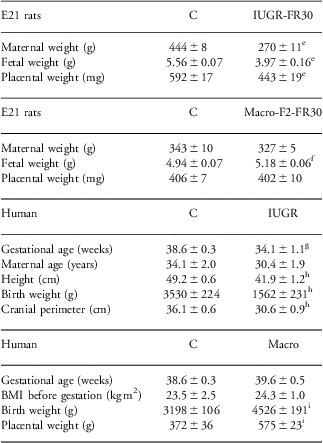
In rats, maternal FR30 drastically reduced both placental and fetal weights at E21 (reduction of 29% for body weight and 22% for placental weight; P < 0.001). In contrast, FR30-F1 mothers fed an HFD from postnatal day 21 to the age of 3 months had E21 male fetuses (Macro-F2-FR30 group) with a significantly higher body weight (Table 1; P < 0.05).
Maternal and newborns parametersFootnote a,Footnote b,Footnote c,Footnote d

IUGR, intrauterine growth restriction; BMI, body mass index.
a Values are means ± s.e.m. (n = 9 mothers/group).
b Values are means ± s.e.m. (n = 6 mothers/group).
c Values are means ± s.e.m. (n = 8–11 mothers or babies/group).
d Values are means ± s.e.m. (n = 5 mothers or babies/group).
e P < 0.001, IUGR-FR30 v. C.
f P < 0.05, Macro-F2-FR30 v. C.
g P < 0.01.
h P < 0.001, IUGR v. C.
i P < 0.001, Macro v. C.
In humans, the birth weight of IUGR babies was drastically reduced (−56%; P < 0.001; Table 1). The gestational age and some fetal parameters were also diminished, such as the height and the cranial perimeter (Table 1). Conversely, placental and birth weights were strongly increased (+55% and +42%, respectively; P < 0.001) in macrosomia for newborns with an approximately similar gestational age (Table 1).
Placental FTO mRNA expression
In rats, placental FTO mRNA expression was reduced (−38%; P < 0.05) at E21 in IUGR fetuses from FR30 mothers (Fig. 1a) but was not modified in rats with fetal overgrowth from FR30-F1 mothers (Fig. 1b).
Quantitative reverse transcription-polymerase chain reaction of fat mass- and obesity-associated (FTO) mRNA levels in rat placentas (a, b) and human placental villi (e, f) at term. Effect in rats of intrauterine growth restriction (IUGR) induced by a 70% maternal food restriction (FR30) on birth weight (c). Effect in humans of severe IUGR associated with pathologic flow in the uterine artery on the birth weight of babies (g). Effect of fetal macrosomia (Macro) in rats, induced by maternal nutritional modifications in F0 and F1 mothers, on the birth weight of F2 male offspring (d). Effect in humans of severe macrosomia without other maternal pathologies on the birth weight of babies (h). Values are means ± s.e.m. *P < 0.05; **P < 0.01; ***P < 0.001 between groups.
In humans, placental villi FTO mRNA abundance was drastically reduced (−72%; P < 0.01) when IUGR was associated with a pathologic flow within the uterine arteries (Fig. 1e), but was not significantly affected despite a marked macrosomia occurrence in fetuses (Fig. 1f).
Discussion
In accordance with a previous observation,Reference Bassols, Prats-Puig and Vázquez-Ruíz6 we reported that human placental villi, as well as rat placentas, express large amounts of FTO. Bassols et al.Reference Bassols, Prats-Puig and Vázquez-Ruíz6 have shown that placental FTO gene expression relates to fetal growth in a large birth cohort study using placentas from uncomplicated pregnancies. We found that placental FTO expression was reduced by IUGR when the latter was associated with a pathologic flow within the maternal uterine arteries. However, as the maternal gestational age for the placental samples that we used was slightly different, we cannot exclude a putative gestational age effect on placental villi FTO mRNA abundance. Nevertheless, in IUGR rat fetuses from FR30 mothers, a similar significant reduction of Fto expression was also observed at term, suggesting that IUGR is indeed the factor linked to the reduced placental Fto gene expression independently of a putative gestational age effect. Under fetal overgrowth conditions, such as a drastic macrosomia in human or a slight overgrowth in rat fetuses induced by a pre-gestational maternal HFD, no significant modulation of placental FTO expression was observed. However, owing to the limited number of human placental tissue samples used in this study, additional studies are needed to unravel whether FTO is an important contributor of fetal weight gain as hypothesized by others.Reference Bassols, Prats-Puig and Vázquez-Ruíz6 The present findings suggest that FTO may be involved in processes related to IUGR. In humans, the decreased expression of FTO could be linked to maternal vascular dysfunctions. Indeed, a potential link between FTO risk alleles and human vascular pathologies continues to emerge as, for example, with acute coronary syndrome and elevated blood pressure.Reference Larder, Cheung, Tung, Yeo and Coll2 FTO also appears to be essential for the normal development of the cardiovascular system in humans.Reference Boissel, Reish and Proulx5 Thus, the modulation of its expression under in utero vascular deleterious conditions suggests that it may act as an environmental sensor at the feto-placental interface, that is, in the placenta. In rats, we demonstrated that maternal food restriction reduces Fto expression in the placenta in accordance with previous findings showing that Fto expression is modulated by nutrition in other tissues, such as in appetite-regulating nervous centers.Reference Sébert, Hyatt and Chan7, Reference Gerken, Girard and Tung15, Reference Wang, Yang and Du16 In addition, in mice at mid-gestation, we observed that maternal HFD reduces Fto expression in female placentas, and under a control diet male placentas displayed lower levels of Fto compared with female ones (unpublished observations). Taken together, our findings suggest that maternal nutrition is a controller of placental Fto gene expression and may be involved in part in IUGR etiology. Although the physiological placental functions of FTO remain to be determined, we postulate that it may act as an environmental sensor for the feto-placental unit during uncomplicated or IUGR pregnancies. Indeed, the interactions between the in utero environment and the fetal genome are likely to play important roles in feto-placental unit development as well as in the programming of susceptibility to common forms of obesity and metabolic disorders.Reference Hochberg, Feil and Constancia9 In this organ, placental FTO may regulate nonepigenetic and epigenetic transcription mechanisms, and could be implicated in the genesis of marks that serve as a memory of exposure to inadequate chemical/nutritional/metabolic environments conveyed via changes in DNA methylation patterns, RNA structure and protein translation at critical in utero periods, potentially leading to metabolic diseases in adulthood.Reference Hochberg, Feil and Constancia9, Reference Wu, Saunders, Szkudlarek-Mikho, Serna Ide and Chin17, Reference Gabory, Attig and Junien18 The present findings suggest that the placenta may be a relevant metabolic tissue to investigate in more detail the complex biology of FTO, which remains poorly understood. In humans, FTO risk alleles are unequivocally associated with increased food intake and obesity. Although the effect of these alleles appears modest, it was reported that they are highly common in populations with an estimated rate of 1 billion homozygous carriers in the world.Reference Yeo19 We suggest that, parallel to its reported functions in adults, FTO in the placenta may control both in utero energy balance and fetal growth during uncomplicated and IUGR pregnancies.
Acknowledgments
This work was carried out with the financial support of the ‘ANR- Agence Nationale de la Recherche – The French National Research Agency’ under the ‘Programme National de Recherche en Alimentation et nutrition humaine’, project ‘ANR-06-PNRA-022’, and the project ‘PHRC 2007R/1901’.