Costs containment strategies are identified as an important added value in pharmaceutical care as drugs constitute a large portion of the total health expenditure budgets. The introduction of new drugs, especially biological ones, largely contributes to the increase of the importance of pharmaceutical budget (Reference Navarria, Drago, Gozzo, Longo, Mansueto and Pignataro1;Reference Fasola, Aprile, Marini, Follador, Mansutti and Miscoria2).
In this scenario, the hospital pharmacist becomes a decision maker, combining the needs that stem from the different processes of clinical care and the cost-containment policies imposed by national and regional healthcare authorities. In addition, pharmacists develop local strategies of cost-containment. One of the best known strategies to meet this aim is to set up a centralization of cytotoxic drug preparation: it encourages standardization processes, it guarantees a higher quality of care, and it helps to avoid medication errors, which can be fatal in the oncology ward (Reference Baldo, Bertola, Basaglia, Moneghini, Sorio and Zibardi3). In addition, centralization reduces production wastes, is less time-consuming, and it requires a lower number of operators exposed to chemotherapeutic drugs during the preparation process (Reference Hyeda and da Costa4;Reference Bach, Conti, Muller, Schnorr and Saltz5). Centralization processes became of urgent need when expensive drugs for cancer treatment entered into the market because a cost-containment policy is mandatory to guarantee the sustainability of the National Healthcare System (NHS).
A drug-day consists in handling all treatments with a determinate drug on one specific day of the week. This tool, when combined with centralization of compounding, optimizes the use of drug's vials (through vial sharing), it does not require dosage modification, as compared with dose banding, and it ensures cost-savings.
In addition to the local management of compounding, these expensive drugs also trigger the need for wider economic strategies to sustain their cost. In Italy, management strategies have been developed both on a national and regional basis. The national point of view is held by the Italian Medicines Agency (AIFA) (6). AIFA chose to keep cancer drugs prices similar to other European countries while negotiating an effective system of risk sharing/payback (Managed Entry Agreement) with the pharmaceutical industries (Reference Messori, De Rosa, Fadda and Pani7). Hence, for each indication of a certain drug there is a specific payback system that depends either on the clinical outcome (payment-by results, risk sharing, success fee) or on a financial agreement (capping mechanism, cost-sharing) (6;Reference Messori, De Rosa and Pani8;Reference van Harten, Wind, de Paoli, Saghatchian and Oberst9).
To manage this system, AIFA developed a national electronic register (AIFA register) (6). The AIFA register permits the determination of whether a patient is eligible for the treatment, the monitoring of the use of the drug (asking periodic revaluation of outcomes), and the ascertainment of the reason behind treatment discontinuation (i.e. toxicity, progression, death, medical decision). The AIFA register is also an economic tool as it contains a platform used by pharmacists to request drug cost reimbursement directly from the pharmaceutical company. This platform contains the algorithms that evaluate whether the cost of a treatment may be refunded in accordance with the payback deals negotiated by AIFA and the pharmaceutical company during the authorization process.
Therefore, the AIFA register is a tool to guarantee the appropriateness of the treatment, but it also permits the adjustment of the economic risk of each treatment.
The regional perspective described in this study is held by our regional authority (i.e., Veneto). The Veneto health policy has imposed that ipilimumab must be administered in only one cancer center in Veneto region, which is our institute, the Veneto Institute for Oncology (10). In this way, the centralization of treatment compounding is ensured. This decision was prompted by the National Health System Recommendation n°14 aimed at preventing errors during preparation and distribution of cancer treatments.
AIM OF THE STUDY
The aim of this work was to evaluate how national and local strategies may affect the containment of costs related to cancer drugs. Ipilimumab was chosen as a suitable drug for this purpose, because it is innovative, has a fixed schedule of treatment (four injections for each patient), it is subject to national cost-containment strategies (payback and pharmacovigilance managed through the AIFA register), and it has a high impact on hospital's budget plan.
At the same time, this study represents a pilot study for an ongoing multicentric project involving twenty-one Italian hospital pharmacies nation-wide with the aim to investigate clinical and economical performances of ipilimumab in the real practice.
ETHICS APPROVAL
Ethics approval was obtained from the local Ethic Committee, and all patients signed an informed consent before enrolment.
MATERIALS AND METHODS
Study Design and Patient Characteristics
This study consists of a pilot observational, monocentric, retrospective study carried-out at the Veneto Institute of Oncology (IOV), an Organisation of European Cancer Institutes accredited cancer center in Italy.
At first, the clinical course of the patients receiving ipilimumab was analyzed. This preliminary step was fundamental to ensure that the improvement generated by our management model stems from a study population having a clinical behavior similar to bigger cohorts. As a result, this analogy may guarantee the applicability of our model in other Institutes.
The second part of the study describes the economic management model applied in our institute to manage the cost of ipilimumab and how this local strategy is paralleled by national cost-containment strategies. National and regional policies were described previously in the Introduction while the local management, which is suitable for application at the single cancer institute level, is the focus of this study and it is a virtuous example of collaboration between different healthcare professionals.
Patients diagnosed with cutaneous, uveal, or mucosal advanced melanoma (n = 57) received ipilimumab (Yervoy®) 3 mg/kg in a four cycle schedule, once every 3 weeks. Patients should have previously received at least one line of chemotherapy. Patients were enrolled over 16 months from April 2013 to September 2014, and then were followed-up until May 2015. The patient characteristics retrieved for this study include age, gender, Eastern Cooperative Oncology Group Performance Status (ECOG PS), site(s) of metastatic disease, lines of prior therapy as well as the number of ipilimumab doses received, date of enrolment, and date of death. These data were obtained by the clinical pharmacist analyzing the electronic medical records of patients, which constitutes a key tool for sharing information between clinical oncologists and pharmacists.
Pharmaceutical Data
In our center, ipilimumab was administered following the drug-day procedure to maximize vial sharing. Indeed, patients were planned to start treatment in groups of four or more on the same day of the week. All patients were registered in the AIFA register. For each treated patient and each drug-day, we recorded the number of ipilimumab vials (Yervoy 50 mg/10 ml) actually used and the number that would have been used if the drug-day had not been established. Gross-cost represents the cost that would have been paid to treat the study population in absence of centralization of compounding and drug-day (representing the regional and local strategy of cost containment, respectively). Net-cost is the number of ipilimumab vials actually used. We considered ex-factory price of ipilimumab excluding taxes as approved by AIFA (11). Evaluation of payback system was performed subtracting the cost of the vials reimbursed from the net cost of ipilimumab therapy. In the analysis, we considered only drug-related costs, without considering other institutional direct or indirect costs, because we developed cost-containment strategies designed to reduce the economic resources reserved to drug purchase.
Efficacy and Toxicity Assessment
Efficacy of ipilimumab treatment was evaluated in terms of overall survival (OS) and progression-free survival (PFS). Tumor assessment by spiral total body computed tomography (CT) (in case of suspected brain metastases at CT scan, a brain magnetic resonance imaging [MRI] was added) was performed at baseline and repeated at week 12, 24, and 36 according to immune related criteria (irRC). Responses were assessed according to the immune-related response criteria and classified as complete response (irCR), partial response (irPR), stable disease (irSD), or progressive disease (irPD). Laboratory tests were carried out at baseline, after 12-16-24 weeks, and then every 3 months. Toxicity was recorded at each visit graded using Common Terminology Criteria for Adverse Events (CTCAE version 4.0).
Statistical Analysis
PFS and OS were calculated using Kaplan-Meier estimates from the first dose of ipilimumab to the date of progression or death by any cause, respectively. Differences in OS were estimated using the Log-Rank test. Differences in medians of gross and net costs of treatment were assessed using the Signed Rank Test as variables were not normally distributed. Values were expressed as median with corresponding two-sided 95 percent confidence interval. Data were considered statistically significant for p ≤ .05.
RESULTS
Patients’ Clinical Characteristics
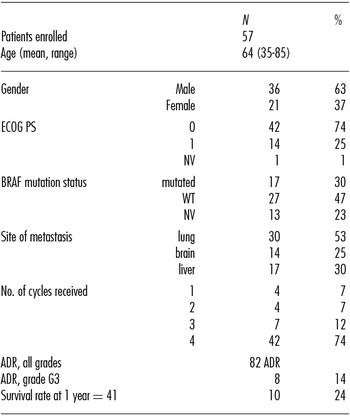
The study cohort included fifty-seven patients, among whom 53 percent were diagnosed with lung metastases (n = 30), 30 percent with liver metastases (n = 17), and 25 percent had brain metastases (n = 14). Patient characteristics are summarized in Table 1. The patients analyzed had a median age of 64.26 ± 11.57 years (range, 35–85 years) with a prevalence of males (63 percent). Most of the patients had cutaneous melanoma (n = 49): five uveal melanoma and three mucosal melanoma. Seventy-four percent of the patients completed the four cycles of ipilimumab (n = 42, 74 percent).
Patient baseline characteristics and toxicities

Note. Baseline characteristics and summary of toxicities of all ipilimumab-treated patients. All data are presented as number (N) and (%).
EGOG PS, Eastern Cooperative Oncology Group Performance Status, primary lesion presented a mutation in the V600 codon of BRAF gene (BRAF mutational status); ADR, adverse drug reaction.
An important aspect of the analysis was the percentage of patients who did not complete the treatment. Approximately a quarter (26 percent) of patients (n = 15) did not receive the four-cycles planned due to disease progression (n = 6), toxicities (n = 6) or death due to progression (n = 3). Of note, the cost of eight out of these fifteen patients who discontinued the treatment was eligible for payback according to a payment-by-results scheme. In particular, four patients completed the second cycle, while four received only one cycle. The main cause of discontinuation before the third dose was progression (n = 3; 37.5 percent), followed by toxicities (n = 3; 37.5 percent) and death (n = 2; 25 percent).
Efficacy and Toxicity of Ipilimumab in Real Practice
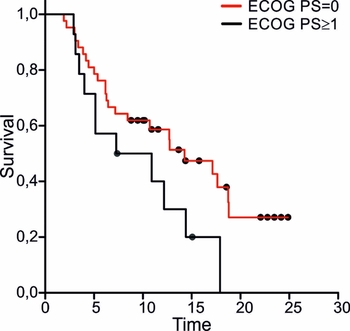
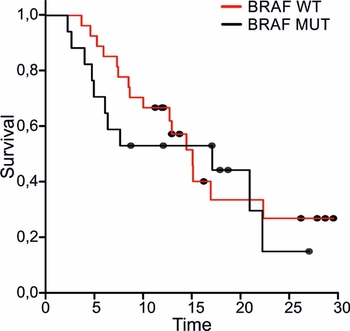
In terms of efficacy, the median OS of the fifty-seven patients enrolled in our study was 12.7 months (95 percent confidence interval [CI], 8.93–16.47), with a 1-year survival rate of 50 percent. As the identification of predictive markers for OS in ipilimumab therapy is an unmet need, we sought to identify whether some of the clinical characteristics of the patients may predict survival. Albeit the number of patients enrolled is inadequate to have sufficient statistical power of prediction: nevertheless, we tried an explorative approach. To this end, patients were stratified on the basis of the ECOG performance status and, indeed, patients with an ECOG PS higher than 0 showed a poorer, albeit not statistically significant, survival than patients with ECOG PS equal to 0 (p = .075) (Figure 1). As some patients were treated with a BRAF inhibitor before ipilimumab, the association between BRAF mutational status and OS was investigated but no statistical difference was found (Figure 2). Finally, it was hypothesized that the metastatic site may affect the survival, but neither the presence of lung or brain metastasis alone could predict OS (Supplementary Figure 1).
Association between survival and ECOG PS. The possible association between survival and the EGOG PS of patients were investigated. We divided the cohort into two groups depending on the ECOG PS of patients (ECOG = 0 [n = 42] and ECOG = 1 patients [n = 14]). Difference in survival among groups was analyzed according to Log-Rank test and depicted using Kaplan-Meier curves. Statistical significance for p ≤ .05. OS: overall survival.

Association between survival and genetic characteristics of the tumor. Association between the presence of BRAF mutation in primary melanoma and survival of patients was assessed. Patients were clustered into two groups according to the mutational status of their primary melanoma: BRAF-mutated (n = 17) and BRAF wildtype (n = 27). Difference in survival among groups was analyzed according to Log-Rank test and depicted using the Kaplan-Meier curves. Statistical significance for p ≤ .05. OS: overall survival.

The incidence of progression in the cohort of patients was also calculated. Median PFS was 4.4 months (IC 95 percent: 2.85–6.02), with a progression rate of approximately 80 percent in 12 months.
As one of the causes of treatment withdrawal is the onset of adverse drug events (AE), the toxicity profile of ipilimumab treatment in our patients was also analyzed. Almost all patients developed at least one AE, but the majorities were low grade toxicities easily managed with oral corticosteroids. The most common AE were cutaneous with pruritus and erythema (thirty-one patients experiencing this type of AE, forty events, 49 percent of total AE) and gastrointestinal (thirty-one patients experiencing this type of AE, thirty-six events, 44 percent of total AE, mainly diarrhea). No grade 4 AE were recorded. Three of the eight patients experiencing high grade toxicity had to discontinue the treatment for this reason.
Pharmacoeconomic Evaluation
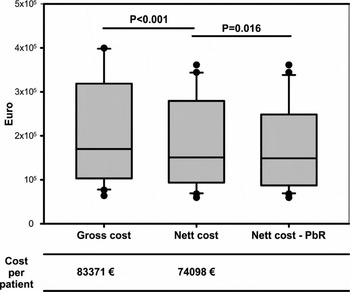
The model of cost-management of high cost cancer therapy exemplified in this study relies on three levels of cost containment strategies. The first level is based on the risk sharing deal between the Italian Medicines Agency and the producer. The applied mechanism of payback is called payment by results (PbR) and it is applicable when a therapeutic failure is certified by the AIFA register. Eight out of fifty-seven patients of our cohort were eligible for PbR. The total cost sustained to treat these patients corresponds to the 6.2 percent of the total gross cost spent for the treatment of the entire cohort and this value was refunded by the pharmaceutical industry after the pharmacist filled out the reimbursement form in the AIFA register. The payback system significantly reduced the net-cost sustained for treatment of the study population (p = .016) (Figure 3).
Economic evaluation of cost-containment strategies. Box plot represents the gross cost, the net cost, and the net cost minus the reimbursement received according to payback system. Gross-cost represents the cost that would have been paid to treat the study population in absence of any cost containment strategy. Net-cost is the number of ipilimumab vials actually used. Box plots report median, first, and third quartiles. Outliers are plotted as individual points. Significance of cost variation according to different cost-containment strategies were assed using Wilcoxon Signed Rank Test. Values were considered statistically significant for p < .05.

The regional authority has mandated to compound and administer all ipilimumab-based therapy at one cancer center in the region. Centralization of treatments is the second level of cost containment and it is necessary for the set-up of local management strategies.
The local strategy of cost containment comprises three methods: planning of the stock, drug day and vial sharing. In accordance with clinical oncologists, ipilimumab treatment was planned for 1 day (drug-day) of the week, once every 21 days. For each drug-day, physicians provided the hospital pharmacy in advance with the number of patients to be treated and their weights. This allows stock planning the of ipilimumab vials of pharmacy to an amount equal to that required for one day of administration, thus reducing the inventory value of the pharmaceutical stock. As ipilimumab is available as 50 and 200 mg vials, the smaller packages were preferred to minimize a drug waste. In addition, all therapies were prepared under the same biological cabinet so that any residual drug from one patient can be used for the subsequent one. This procedure is called vial sharing and it maximizes the efficiency of compounding while exploiting the over-fill of each vial of ipilimumab.
Considering the ex-factory price (excluding taxes), the gross cost for treating the study population was 4,088,500.00 euro, which is reduced to 3,633,750.00 by the drug-day strategy (comprehensive of vial sharing and overfill). This reduction is equal to the 11.1 percent of gross cost and the difference in the median is statistically significant (p < .001) (Figure 3). The cost sustained to treat one average patient (75 kg, 3 mg/kg, 4 cycles) is equal to 74,098.00 euro in the case of drug-day compared with 83,371.00 when no cost-containment strategies are applied.
In conclusion, the synergy between national, regional, and local management strategies permits the reduction of the gross cost of ipilimumab by 17.3 percent, corresponding to the cost sustained to treat 6 average patients.
DISCUSSION
Cost containment strategies are important as costs in oncology care and the numbers of new expensive therapies are constantly rising. In addition, drug waste from unused or partially used vials, during batch or single production, can further concur in increasing these costs. Given these premises, it is of primary importance to develop cost-containment strategies to ensure that the National Health System will continue to guarantee public access to cancer treatments. To this aim, a model of economic evaluation of an expensive and innovative drug, ipilimumab, for treatment of melanoma was described. To propose this model to other cancer centers, it was demonstrated that the clinical characteristics and outcome of the patients enrolled in this study were comparable to those of patients treated in clinical trials and expanded access of ipilimumab.
Indeed, the response rates and global toxicities recorded in our study are similar or slightly higher compared with the published results (Reference Hodi, O'Day and McDermott12;Reference Delyon, Mateus and Lefeuvre13), despite the higher average age of our sample. The challenge remains to identify predictive markers of response, given that a large percentage of patients do not benefit from treatment yet (Reference Ahmad, Qian and Ellis14–Reference Damuzzo, Pinton and Solito19). Concerning the type of AE, no new type of toxicity, besides those already reported in literature for ipilimumab, was observed and the incidence of grade 3–4 toxicity was similar to that reported in literature (Reference Postow, Chesney and Pavlick20;Reference Robert, Schadendorf, Messina and Hodi21). Toxicity was generally managed using established treatment algorithms (Reference Tarhini22); therefore, ipilimumab is generally well tolerated and manageable also in real practice settings.
One of the worries was related to the delay of treatment for 10–19 days to start with cohorts of at least 5 or more patients for each drug-day. Considering that the efficacy and safety profile of the patients is comparable with published data, our model of drug administration can be proposed and used more extensively without detrimental effects on clinical results. The model proposed is constituted by a three-step approach where the management of expensive drugs is determined by national, regional, and local policies. The Italian payback system permits savings of 6.2 percent of gross cost while the combination of regional and local policies permits an additional savings of 11.1 percent. The difference between the medians of gross- and net-costs is statistically significant.
The savings is an effect of vial-sharing and exploitations of vial overfill; however, it is not easy to discriminate between these two contributions, as the only read-out variable we have is the number of ipilimumab's vials actually used, which is affected by both factors. The economic impact of ipilimumab was previously studied by the National Centre for Pharmacoeconomics (Ireland), who, in 2011, concluded that the cost-effectiveness of ipilimumab for advanced melanoma treatment in adults who had received prior therapy was not demonstrated; therefore, they cannot recommend reimbursement at the price submitted by the producer (23). However, the centralization of ipilimumab treatments on a regional basis and a vial sharing policy permits savings up to 11 percent of the gross cost (17.3 percent in case of treatment withdrawal incidence of 14 percent). This brings us to reconsider the negative recommendation given by other regulatory agencies.
Besides the economic aspects, this management model has also produced consistent results in terms of quality of care because, being a hub-center, our institute provides a full diagnostic, therapeutic, and assistance service to these patients and ensures a complete reconciliation of the concurrent therapies and management of toxicity by an expert team. Also from a professional point of view, centralization minimizes the exposure of personnel to the drugs, giving the compounding task only to highly specialized operators.
Finally, it is worth noting that this is a monocentric study conducted on fifty-seven patients in a melanoma unit located in an Italian oncology hospital. As a result, there are some limitations we need to point out: the small cohort of patients enrolled and the retrospective and monocentric nature of our evaluation. This study was not structured to directly extend the results to wider context, but it constitutes a first step toward a nationwide multicenter study aimed at comparing different models for management of expensive and innovative cancer treatments. The final aim of this project will be to delineate a Best Operating Practice guideline. The recruitment phase of participating centers and the analysis of the data collected have just ended. The preliminary results obtained from the multicenter study confirms those obtained in this pivotal monocenter work (Russi et al. unpublished results).
CONCLUSION
This pivotal study demonstrated that a cost containment strategy is feasible and it needs the cooperation of all healthcare providers (oncologists, pharmacists, nurses and technicians) to guarantee the full efficiency of the process.
SUPPLEMENTARY MATERIAL
Supplementary Figure 1: https://doi.org/10.1017/S0266462317000332
CONFLICTS OF INTEREST
Dr. Chiarion-Sileni reports being a Consultant, outside the submitted work, for Bristol Meyer Squibb, Merck, Novartis, and Roche. Drs. Damuzzo, Di Sarra, Palozzo, Pigozzo, and Russi have nothing to disclose.