Introduction
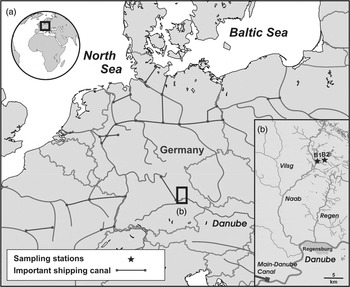
The Chinese sleeper (Perccottus glenii Dybowski, 1877) is a small (maximum length 25 cm) Asian fish species now invasive in European waters (Kottelat & Freyhof, Reference Kottelat and Freyhof2007). The fish was introduced into Europe (Ukraine) together with fry of commercial phytoplanktivorous fishes from north-eastern China as part of the former Soviet Union's programme of acclimatization of Asian phytoplanktivorous fishes (Vovk, Reference Vovk1976). It was first introduced into the Danube basin via the upper Tisza River drainage in Ukraine in 1995 (Sivokhop, Reference Sivokhop1998), later expanding its range throughout the central and lower Danube basin, including the delta region (Kvach, Reference Kvach2012; summarized in Reshetnikov Reference Reshetnikov2013). Between 1962 and 1965, P. glenii were imported into former East Germany, initially for laboratory-based scientific breeding experiments but later also by East German aquarists (Schenke & Grabow, Reference Schenke and Grabow1965). In 2009, it was recorded for the first time in western Germany, in enclosed fish ponds within the Charlottenhofener Weihergebiet Integral Nature Reserve (Bavaria; upper Danube River drainage) (Reshetnikov & Schliewen, Reference Reshetnikov and Schliewen2013). More recently, it has been found in several small creeks associated with the fish ponds, which flow into the River Naab (Nehring & Steinhof, Reference Nehring and Steinhof2015; Reshetnikov & Karyagina, Reference Reshetnikov and Karyagina2015). As the mouth of the Naab is just 26 km from the Rhine–Main–Danube Canal, which connects the Danube basin with the Rhine–Maine river system (fig. 1), there is a real possibility that Chinese sleepers could reach the North Sea basin in the near future, either through active migration or through passive dispersal on ships’ hulls as eggs attached under the waterline (Nehring & Steinhof, Reference Nehring and Steinhof2015).
(a) Map of Central Europe; (b) sampling stations (black stars; B1, Kranzloh; B2, Tongrube) on the Bücherlgraben creek, a tributary of the River Naab (upper Danube drainage; Bavaria, Germany).

As highlighted in the ‘enemy release hypothesis’ (Torchin et al., Reference Torchin, Lafferty, Dobson, McKenzie and Kuris2003), one trait often associated with a successful invasion is release from native parasites and pathogens. On the other hand, a non-indigenous host-species can introduce alien parasites into its new range or, alternatively, play a role in distributing local parasites into new habitats (Taraschewski, Reference Taraschewski2006). In the Danube River drainage, parasites of invasive Chinese sleepers have been studied in populations from Hungary, Moldova, Slovakia and Ukraine (references in Sokolov et al., Reference Sokolov, Reshetnikov and Protasova2014; Kvach et al., Reference Kvach, Kutsokon, Stepien and Markovych2016a). To date, however, the parasite fauna of invasive populations in Germany have been largely unstudied. The only data available are those presented by Sokolov et al. (Reference Sokolov, Protasova and Reshetnikov2015), who studied 25 young individuals (2.0–3.8 cm total length) from Lake Bründlweiher (Charlottenhofener Weihergebiet) preserved in 96% ethanol. They found only four local parasite species overall, including one cestode Mashonalepis macrosphincter (Fuhrmann, 1909) recorded on the Chinese sleeper for the first time (Sokolov et al., Reference Sokolov, Protasova and Reshetnikov2015). While these results certainly provide an important insight, we feel that, due to the methods used, they may not provide the best picture of parasites in this population. First, preserving fish in ethanol could result in loss of some parasite species or problems with identification (Zander, Reference Zander2004). More recent studies have shown that keeping fish alive until needed for parasitological dissection greatly improves the accuracy of parasitological community determination (Kvach et al., Reference Kvach, Ondračková, Janáč and Jurajda2016b). Second, as the Chinese sleeper matures at around 6 cm (Kottelat & Freyhof, Reference Kottelat and Freyhof2007); the 2–4 cm size group used in the study clearly represents immature 0+ specimens. Such young fish are likely to display a reduced parasite infestation, comprising just part of the parasite fauna of older fish (Sokolov et al., Reference Sokolov, Protasova and Kholin2011a).
As a progressive invader in Europe, the Chinese sleeper has the capacity to play an important role in the distribution of parasites. The aim of this study, therefore, was to provide an in-depth and up-to-date analysis of the parasite community of adult Chinese sleepers in Germany, the westernmost extent of the Chinese sleeper's invasive range in Europe.
Materials and methods
Collection and examination of fish
Chinese sleepers were sampled from two distant localities (herein Kranzloh and Tongrube) on the Bücherlgraben creek, a tributary of the River Naab in south-eastern Germany, in November 2015 (fig. 1). Kranzloh is located close to the creek's mouth, near the Kranzloh fish pond (N49°15′46.9″, E12°6′34.6″), while Tongrube is situated in a forest in the upper reaches of the stream (N49°15′52.9″, E12°7′47.4″). All fish were sampled using electrofishing and transported alive to the Institute of Vertebrate Biology of the Academy of Sciences of the Czech Republic (Brno, Czech Republic) in aerated barrels. The fish were kept alive in two outdoor basins (fish from the two different localities separated) and dissected within 3 days of collection (see Kvach et al., Reference Kvach, Ondračková, Janáč and Jurajda2016b).
In total, 50 Chinese sleepers were examined, 20 from Kranzloh and 30 from Tongrube. After measuring the standard length (SL) of each fish to the nearest millimetre, the fins, skin, gills, eyes, muscles, coelom and internal organs (gut, liver, gall bladder, spleen, swim bladder, kidneys, uterine bladder, gonads, mesentery and brain) were examined for the presence of parasites. Unicellular parasites were examined alive under light microscopy. Monogeneans were preserved in GAP (glycerine–ammonium–picrate) as semi-permanent slides (Malmberg, Reference Malmberg1970). Acanthocephalans were pressed between two microscope slides and preserved in 70% ethanol; all other helminths being preserved in hot 4% formaldehyde (Cribb & Bray, Reference Cribb and Bray2010). Digeneans and cestodes were stained with iron acetic carmine, dehydrated in ethanol of increasing concentration and mounted in Canada balsam as permanent slides (Georgiev et al., Reference Georgiev, Biserkov and Genov1986). Acanthocephalans, nematodes and glochidia were mounted in glycerol as temporary slides and examined under light microscopy. Where possible, parasites were identified to species level, otherwise to highest taxa.
Data analysis
Indices of prevalence, mean intensity and mean abundance were calculated for each parasite species (Bush et al., Reference Bush, Lafferty, Lotz and Shostak1997). The terms ‘allogenic’ and ‘autogenic’ are used sensu Esch et al. (Reference Esch, Shostak, Marcogliese, Goater, Esch, Bush and Aho1990), i.e. autogenic parasites being species whose entire life cycle is completed within the confines of the aquatic ecosystem, whereas allogenic species use fish or another aquatic vertebrate as an intermediate host and mature in terrestrial animals.
The Kolmogorov–Smirnov test was used to test normality of the data. Difference in fish size between the two sites was compared using the t-test, while similarity between parasite communities was evaluated using the Czekanowski–Sørensen index (Sørensen, Reference Sørensen1948). The importance of individual parasite species in the community was determined according to their abundance, using the scale of Zander et al. (Reference Zander, Reimer, Barz, Dietel and Strohbach2000), i.e. >2 = core species, 0.6–2 = secondary species, 0.2–0.6 = satellite species and <0.2 = rare species. Species richness and the Shannon–Wiener index of diversity and evenness, calculated using PAST software, were adopted as measures of component community structure (Hammer et al., Reference Hammer, Harper and Ryan2001), while mean number of species and the Brillouin index of diversity and its evenness (Magurran, Reference Magurran1988), calculated using R 3.2.1. (R Core Team, 2015), were adopted as measures of parasite infracommunity structure. Trichodinid species were not included in the parasite community measurements, due to their questionable status as parasites. The tendency for individual parasite species to appear in the same infracommunity was expressed using the infracommunity index, where values >0.3 suggest an increased tendency to join an infracommunity (Zander, Reference Zander2004).
Results
Chinese sleepers from Kranzloh had a mean SL of 6.6 ± 0.7 cm, while fish from Tongrube had a mean SL of 7.1 ± 1.2 cm. There was no significant difference in length between the two sample sites (t = 0.59, P = 0.11).
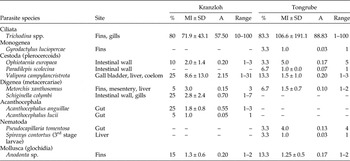
The parasite fauna consisted of 12 taxa, including ciliates (unidentified Trichodina), a monogenean, three cestode species, two digenean taxa, two acanthocephalan species, two nematode species and one mollusc glochidia (table 1). Eight species occurred at Kranzloh and nine at Tongrube, the Czekanowski–Sørensen index between the two localities being 58.8%. Just five taxa (Trichodina spp., Ophiotaenia europaea Odening, 1963 plerocercoids, Valipora campylancristrota (Wedl, 1855) plerocercoids, Metorchis xanthosomus (Creplin, 1846) metacercariae and Anodonta sp. glochidia) occurred at both localities. At both Kranzloh and Tongrube, adult helminth stages were represented by two acanthocephalan species (Kranzloh – Acanthocephalus anguillae (Müller, 1780) and Acanthocephalus lucii (Müller, 1776); Tongrube – Gyrodactylus luciopercae Gussev, 1962 and Pseudocapillaria tomentosa (Dujardin, 1843)).
The prevalence (%), mean intensity (MI ± standard deviation) and abundance (A) of parasitic infections of the Chinese sleeper (Perccottus glenii) from two localities on the Bücherlgraben creek, south-eastern Germany.

Seven species (O. europaea, Paradilepis scolecina (Rudolphi, 1819), V. campylancristrota, M. xanthosomus, Schiginella colymbi (Schigin, 1956), Spiroxys contortus (Rudolphi, 1819) and Anodonta sp.) were represented by larval stages only, all of which (except Anodonta glochidia) were allogenic in origin. Autogenic parasites were represented by six taxa (Trichodina spp., G. luciopercae, A. anguillae, A. lucii, P. tomentosa, Anodonta glochidia). The percentage of allogenic/autogenic species was similar at both localities, i.e. 55.6/44.4% at Kranzloh and 50/50% at Tongrube.
Trichodina spp. dominated the Chinese sleeper parasite community and were registered as a core species both overall (all sites combined) and by locality (table 1). While the cestode V. campylancristrota was recorded as a core species at Kranzloh, it only reached satellite species level at Tongrube. Three species, the cestode O. europaea, the trematode S. colymbi and the acanthocephalan A. anguillae, were recorded as satellite species overall (table 1). By locality, however, O. europaea and A. anguillae, along with Anodonta sp., reached satellite level at Kranzloh but were rare elsewhere. The trematode S. colymbi was only recorded at Kranzloh, reaching secondary-species level.
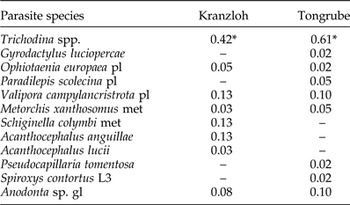
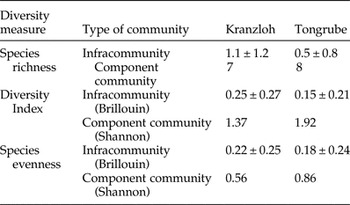
Chinese sleeper parasite infracommunities consisted of 1–5 species, with 10% of fish being uninfected in Kranzloh and 13.3% in Tongrube. While a single-species infracommunity prevailed at both localities (35% of fish at Kranzloh and 53.3% at Tongrube), richer infracommunities (with 4–5 species) were more common at Kranzloh (15% of four-species and 10% of five-species communities) than Tongrube (10% of four-species and 3.3% of five-species communities). Trichodina spp. had an increased tendency to join the infracommunity at both Kranzloh and Tongrube and in both localities combined (table 2). Both the Shannon index and species evenness were higher in Kranzloh than Tongrube (table 3).
Infracommunity index parameters for parasites of the Chinese sleeper (Perccottus glenii) at two localities on the Bücherlgraben creek, south-eastern Germany.

pl, Plerocercoids; met, metacercariae; L3, third-stage larvae; gl, glochidia.
* Increased tendency to join an infracommunity.
Parasite diversity measures of Chinese sleeper (Perccottus glenii) parasite communities at two localities on the Bücherlgraben creek, south-eastern Germany.

Discussion
All parasites occurring in this study were representatives of European fauna and no invasive parasite species were recorded. Three species (A. anguillae, G. luciopercae and P. tomentosa) are recorded on the Chinese sleeper for the first time.
Our results greatly extend the existing list of Chinese sleeper parasites in Germany, which previously consisted of just four species (Trichodina nigra Lom, 1960 and three cestodes: O. europaea, V. campylancristrota and M. macrosphincter) described from a population in Lake Bründlweiher (Sokolov et al., Reference Sokolov, Protasova and Reshetnikov2015), about 15 km north of Bücherlgraben. Ophiotaenia europaea and V. campylancristrota appear to be common parasites of the Chinese sleeper in the Charlottenhofener Weihergebiet Integral Nature Reserve (in which both our study localities and Lake Bründlweiher are situated); M. macrosphincter, however, has not been observed in the Bücherlgraben before and just one specimen has previously been recorded in Lake Bründlweiher (Sokolov et al., Reference Sokolov, Protasova and Reshetnikov2015).
Differences in parasite community
Similar freshwater localities are often characterized by differences in the parasite communities of fish. In many cases, differences are due to parasites with direct life cycles and are associated with different fish-host densities (Kuhn et al., Reference Kuhn, Kristoffersen, Knudsen, Jakobsen, Marcogliese, Locke, Primicerio and Amundsen2015). Alternatively, differences may be caused by environmental factors and/or the presence/absence and density of intermediate hosts (Marcogliese & Cone, Reference Marcogliese and Cone1991).
In this study, Trichodina was the only taxon showing an increased tendency to join an infracommunity (table 2). Infracommunity index parameters >0.4 are typical of strongly interactive parasite species (Zander, Reference Zander2007); hence, Trichodina were strongly interactive, both at Kranzloh and Tongrube. High interaction between parasites can result from an absence of competition between members of the parasite community, which is important in the colonization of new hosts (Brooks, Reference Brooks1980). As a result, these parasites tend to be present at all known localities where invasive Chinese sleepers display high infection parameters (Drobiniak et al., Reference Drobiniak, Kutsokon and Kvach2014).
Kranzloh was characterized by higher parasite diversity, mainly due to an increase in the importance of a number of parasite species common to both Kranzloh and Tongrube but rarely found at Tongrube (not including Trichodina spp. (core) and V. campylancristrota (satellite); table 1). Examples include O. europaea, which was a satellite species at Kranzloh but rare at Tongrube, and V. campylancristrota, which was a core species at Kranzloh but a satellite at Tongrube. Taxa occurring as core or secondary species on fish are generally recognized as abundant and well-spaced at the locality (Holmes & Price, Reference Holmes, Price, Anderson and Kikkawa1986).
Chinese sleepers at Kranzloh and Tongrube mainly shared allogenic parasites (metacercariae and mesocercoids), with differences between localities caused primarily by autogenic parasites, such as Acanthocephalus spp., and P. tomentosa. While the actual mechanisms involved in such differences are not clear, we can speculate that a high fish density could increase the encounter rate (and hence consumption) of intermediate parasite hosts. This could have an impact on the parasite community by reducing the abundance of specific parasite species.
Parasite life cycles
Introduced fish species tend to be more suitable parasite hosts and become infected with a wide range of generalist native parasites (e.g. Poulin & Mouillot, Reference Poulin and Mouillot2003; Emde et al., Reference Emde, Kochmann, Kuhn, Dörge, Plath, Miesen and Klimpel2016). Larvae, in particular, tend to play a strong role in the parasite fauna of exotic species as they are more adapted to infest new hosts (Kvach & Stepien, Reference Kvach and Stepien2008).
Parasites with direct life cycles were represented in this study by just two taxa: Trichodina spp. and G. luciopercae (both autogenic). Increases in the level of these ciliates can be caused by high fish densities, increasing the chances of transmission from one fish to another. Indeed, this is the typical means of transmission for monogeneans (Bagge et al., Reference Bagge, Poulin and Valtonen2004). Gyrodactylus luciopercae, a common parasite of percid species such as the European perch (Perca fluviatilis L. 1758), ruffe (Gymnocephalus cernuus L. 1758) and zander (Sander lucioperca L., 1758) (Gusev et al., Reference Gusev, Dubinina, Raikova, Khotenkovskiy, Pugachev, Ergens and Bauer1985), is the only monogenean species to have been recorded on Chinese sleepers in Germany. Gyrodactylus luciopercae was commonly found at our study sites, particularly in association with perch, which were relatively numerous at Kranzloh (BO-FfF, 2015a, b).
Other autogenic species observed include A. anguillae, A. lucii, P. tomentosa and mollusc glochidia. Adult unionids are a common component of European freshwater ecosystems, where their parasitic larvae (glochidia) display no host specificity and commonly use non-indigenous fish as hosts (Šlapanský et al., Reference Šlapanský, Jurajda and Janáč2016). The two acanthocephalan species recorded (A. anguillae and A. lucii) parasitize a wide spectrum of fish hosts in Europe but occur mainly in European eel (Anguilla anguilla L., 1758), chub (Squalius cephalus L., 1758) and perch (Golvan, Reference Golvan1969; Taraschewski, Reference Taraschewski1988), all of which were registered at Kranzloh (BO-FfF, 2015a, b). Both parasites use Asellus aquaticus as an intermediate host (Brattey, Reference Brattey1983; Brown et al., Reference Brown, Chubb and Veltkamp1986). While A. lucii has previously been recorded on invasive fish in Europe (particularly gobiids (Ondračková et al., Reference Ondračková, Dávidová, Blažek, Gelnar and Jurajda2009) but also Chinese sleepers (Zaichenko, Reference Zaichenko2015)), it has always occurred rarely. Acanthocephalus anguillae has been described as a rare parasite of invasive pumpkinseed (Lepomis gibbosus L., 1758) and black bullhead (Ameiurus melas Rafineque, 1820) (Košuthová et al., Reference Košuthová, Koščo, Letková, Košuth and Manko2009) and as a dominant parasite of introduced convict cichlids (Amatitlania nigrofasciata Günther, 1867) (Emde et al., Reference Emde, Kochmann, Kuhn, Dörge, Plath, Miesen and Klimpel2016).
The nematode P. tomentosa, which uses the benthic oligochaete Tubifex tubifex (Müller, 1774) as a paratenic host, parasitizes many fish species of the Cyprinidae, Balitoridae, Cobitidae, Siluridae, Blenniidae, Gobiidae, Percidae, Anguillidae and Esocidae families (Moravec, Reference Moravec2013). It has also been recorded parasitizing a number of invasive fish in Europe, particularly the stone morocco (Pseudorasbora parva Temminck & Schlegel, 1846) in Slovakia (Mihok et al., Reference Mihok, Košuth, Kočišová, Pekárik, Bártová and Major2011), Ponto-Caspian gobies in Germany (Ondračková et al., Reference Ondračková, Valová, Hudcová, Michálková, Šimková, Borcherding and Jurajda2015) and the Chinese sleeper in Russia (Sokolov et al., Reference Sokolov, Protasova and Reshetnikov2011b).
Of the larval allogenic parasites, two species (O. europaea and S. contortus) parasitize reptiles, usually using amphibians as intermediate hosts (Moravec, Reference Moravec2013). In the Danube drainage, both species are known to parasitize Chinese sleepers on the Tisza River and the Danube delta (Kvach et al., Reference Kvach, Drobiniak, Kutsokon and Hoch2013; Antal et al., Reference Antal, Székely and Molnár2015); however, an allogenic parasite (Opisthioglyphe ranae Frolich, 1791) previously recorded from Chinese sleepers in the rivers Tisza and Prut (Sokolov & Moshu Reference Sokolov and Moshu2013; Antal et al. Reference Antal, Székely and Molnár2015) has yet to be found in Germany (Sokolov et al. Reference Sokolov, Protasova and Reshetnikov2015; current data).
Four other species recorded at Kranzloh and Tongrube (P. scolecina, V. campylancristrota, M. xanthosomus and S. colymbi) are all parasites of fish-eating birds. The adult stage of V. campylancristrota, for example, parasitizes herons (Kozicka, Reference Kozicka1971), while cormorants are the main definitive host of P. scolecina (Dziekońska-Rynko & Dzika, Reference Dziekońska-Rynko and Dzika2011), though it is also known from the grey heron (Ardea cinerea L., 1758) (Dziekońska-Rynko et al., Reference Dziekońska-Rynko, Mierzejewska and Hliwa2015), and both S. colymbi and M. xanthosomus parasitize great crested grebes (Podiceps cristatus L., 1758) (Sudarikov et al., Reference Sudarikov, Lomakin, Atajev, Semenova and Be'er2006; Sitko & Heneberg, Reference Sitko and Heneberg2015). Sokolov et al. (Reference Sokolov, Protasova and Reshetnikov2015) recorded another parasite specific to herons, M. macrosphincter, on Chinese sleepers from Lake Bründlweiher. The parthenogenetic stages of both trematodes develop in the faucet snail (Bithynia tentaculata L., 1758) (Sudarikov et al., Reference Sudarikov, Lomakin, Atajev, Semenova and Be'er2006). Both grey herons and great crested grebes breed in the Charlottenhofener Weihergebiet Nature Reserve, and hence are likely to have been the source of these parasites (Gedeon et al., Reference Gedeon, Grüneberg, Mitschke, Sudfeldt, Eickhorst, Fischer, Flade, Frick, Geiersberger, Koop, Kramer, Krüger, Roth, Ryslavy, Stübing, Sudmann, Steffens, Vökler and Witt2014).
While Chinese sleepers play a significant role in the life cycles of amphibian and reptile parasites in some areas (Kvach et al., Reference Kvach, Drobiniak, Kutsokon and Hoch2013; Reshetnikov et al., Reference Reshetnikov, Sokolov, Chikhlyaev, Fayzulin, Kirillov, Kuzovenko, Protasova and Skomorokhov2013), this does not appear to be true in Germany. On the other hand, the Chinese sleeper does play an important role as a second intermediate host in the life cycles of parasites of herons and grebes, which are numerous in the Charlottenhofener Weihergebiet Nature Reserve.
Host and parasite distribution routes
The Danube basin forms part of a trans-European expansion route for aquatic alien species, sometimes called the southern invasion corridor (Panov et al., Reference Panov, Alexandrov, Arbačiauskas, Binimelis, Copp, Grabowski, Lucy, Leuven, Nehring, Paunović, Semenchenko and Son2009). The presence of parasites such as Amurotaenia perccotti (Akhmerov, 1941) along this corridor is directly related to the introduction of its host the Chinese sleeper (Košuthová et al., Reference Košuthová, Koščo, Miklisová, Letková, Košuth and Manko2008; Kvach et al., Reference Kvach, Kutsokon, Stepien and Markovych2016a). Indeed, specialist parasites of the Chinese sleeper have been introduced at a number of sites in the Danube drainage, including the River Tisza (the nearest site to Germany along the southern corridor where the Chinese sleeper and its parasites are found together), with Gyrodactylus perccotti (Ergens & Yukhimenko, 1973) known from the Hungarian region of the Tisza basin (Antal et al., Reference Antal, Székely and Molnár2015) and A. perccotti from the Slovak and Ukrainian regions (Kvach et al., Reference Kvach, Kutsokon, Stepien and Markovych2016a; also summarized in Sokolov et al., Reference Sokolov, Reshetnikov and Protasova2014). In addition to these two metazoan parasites, the protozoan coccidian Goussia obstinata (Sokolov & Moshu, 2014) has also been recorded in the Prut and Tisza river basins (Antal et al., Reference Antal, Székely and Molnár2015). As yet, not all of these species have been confirmed in the Chinese sleeper in Germany. Note, however, that a number of these middle-Danubian parasites could theoretically be introduced upstream into Germany without their fish host, as at least one species (A. perccotti) could be transported passively together with planktonic copepods in the ballast water of ships.
As well as spreading introduced parasite species, the Chinese sleeper could also increase the spread of some native parasite species, such as glochidia, ciliates and some helminths, which were secondary (V. campylancristrota) or satellite (O. europaea, A. anguillae) species at our study sites. This would agree with the ‘parasite spillback’ hypothesis of Kelly et al. (Reference Kelly, Paterson, Townsend, Poulin and Tompkins2009), whereby invasive hosts act as suitable reservoirs for native parasites, spreading them back among native hosts.
The Bavarian Chinese sleeper population is clearly isolated from the main Danubian population and was probably introduced with imports of commercial fish (Reshetnikov & Schliewen, Reference Reshetnikov and Schliewen2013). Note, however, that one parasite frequently recorded in Chinese sleeper populations introduced with commercial fish, the cestode A. perccotti (Kvach et al., Reference Kvach, Drobiniak, Kutsokon and Hoch2013, Reference Kvach, Kutsokon, Stepien and Markovych2016a), is presently lacking in the German population; suggesting a possible alternative route, such as the aquarium trade. There have been no records of its use as an ornamental species in Germany since the 1960s (Schenke & Grabow, Reference Schenke and Grabow1965; Nehring & Steinhof, Reference Nehring and Steinhof2015), however, and the developmental stages of A. perccotti require planktonic copepods (Hanzelová et al., Reference Hanzelová, Dudiňák and Oros2007), making the latter route unlikely. Active upstream migration (i.e. by swimming) of the Chinese sleeper also appears highly unlikely as this limnophilic species prefers lentic waters with aquatic vegetation and silty substrates, such as ponds, small lakes and marshes (Kottelat & Freyhof, Reference Kottelat and Freyhof2007). Overall, therefore, the first occurrence of the species in an aquacultural fish-pond region would make introduction along with imports of commercial fish (without specific parasites) the most likely route. Any future downstream migration of the Chinese sleeper from Germany through the southern invasion corridor is likely to result in contact with the main Danubian population (in the Hungarian sector of the Danube basin).
Acknowledgements
We thank Drs Thomas Ring and Christian Harrandt (Expert Service for Fishery, Oberpfalz District, Regensburg) and Jürgen Steinhof (Amberg), who assisted us with the sampling. We thank Dr Kevin Roche (Institute of Vertebrate Biology, Academy of Sciences of the Czech Republic) for proofreading the English text.
Financial support
This study received financial support through the European Centre of Ichthyoparasitology – Centre of Excellence – GACR No. P505/12/G112.
Conflict of interest
None.