Introduction
Depression is a leading cause of disability worldwide (Murray & Lopez, Reference Murray and Lopez1996). Among older adults, the relationship between depression and physical functioning has been documented in both cross-sectional and longitudinal studies, among patients with major depression and among adults with depressive symptoms (Lenze et al. Reference Lenze, Rogers, Martire, Mulsant, Rollman, Dew, Schulz and Reynolds2001). Penninx et al. (Reference Penninx, Leveille, Ferrucci, van Eijk and Guralnik1999) followed a cohort of 6247 community-dwelling adults aged ⩾65 years originally free from disability for 6 years, and found that those who were depressed at baseline had an increased risk of incident self-reported disability in both activities of daily living (ADL) and mobility, controlling for baseline chronic conditions and sociodemographic factors. Depression was defined as a score of ⩾20 on the Center for Epidemiologic Studies Depression Scale (CES-D; Radloff, Reference Radloff1977) in order to examine outcomes associated with more severe depression. Depressive symptoms also predicted physical decline measured through objective tests of physical performance (Penninx et al. Reference Penninx, Guralnik, Ferrucci, Simonsick, Deeg and Wallace1998). In a sample of high-functioning elderly subjects free of any disability, high levels of depressive symptoms predicted an increased risk of onset of disability in basic ADL over a 2.5-year interval (Bruce et al. Reference Bruce, Seeman, Merrill and Blazer1994). In this study, depressive symptoms were measured on a continuous scale, and an increased risk was associated with increased symptoms. Depression has also been shown to accelerate the disablement process in older adults (van Gool et al. Reference van Gool, Kempen, Penninx, Deeg, Beekman and van Eijk2005). The Italian Longitudinal Study on Aging recently reported that baseline depressive symptoms were associated with higher rates of reported disability in men and women and performance-based disability in men over 3.5 years (Carbonare et al. Reference Carbonare, Maggi, Noale, Giannini, Rozzini, Cascio and Crepaldi2009). In a systematic review of variables predicting functional decline in community-dwelling older adults, depression was one of the key risk factors identified (Stuck et al. Reference Stuck, Walthert, Nikolaus, Bula, Hohmann and Beck1999).
Other studies, however, have not found any association between depression and function. In a prospective study of low-functioning older adults, depressive symptoms did not predict change in self-reported basic ADL limitations over 2 years (Kempen et al. Reference Kempen, Sullivan, van Sonderen and Ormel1999a). In another study, functionally independent older adults with symptoms more similar to major depression did not experience functional decline in basic ADL over a multi-year follow-up (Kivela & Pahkala, Reference Kivela and Pahkala2001). Depressed mood was not associated with functional decline or with improvement in a sample of adults aged ⩾75 years when the outcome was a global measure that included basic ADL, instrumental ADL (IADL) and mobility items (Hebert et al. Reference Hebert, Brayne and Spiegelhalter1999). Others have found a cross-sectional but not a longitudinal relationship. For example, Everson-Rose et al. (Reference Everson-Rose, Skarupski, Bienias, Wilson, Evans and Mendes de Leon2005) found a cross-sectional relationship between depressive symptoms and physical performance, but depressive symptoms at baseline were not associated with greater functional decline over time. These investigators modeled four levels of depressive symptoms and, though finding a graded relationship with physical performance, did not observe a threshold effect for depressive symptoms in relation to change in physical performance. In a longitudinal study of the effect of depressive symptoms on the recovery of IADL function after a fall-related injury, depressive symptoms at baseline were not predictive of recovery/disability (Kempen et al. Reference Kempen, Sanderman, Scaf-Klomp and Ormel2003). Some researchers have suggested that depressive symptoms can predict functional decline, but most probably through changes in physical health (Geerlings et al. Reference Geerlings, Beekman, Deeg, Twisk and Van Tilberg2001; Ormel et al. Reference Ormel, Rijsdijk, Sullivan, von Sonderen and Kempen2002). For example, in a study from The Netherlands, depression at the index measurement was associated with functional limitations at the next measurement only in the presence of chronic physical disease (Geerlings et al. Reference Geerlings, Beekman, Deeg, Twisk and Van Tilberg2001). In another study using structural equation models, the investigators found a 1-year lagged effect of depressive symptoms on disability, but a stronger effect of disability on depressive symptoms (Ormel et al. Reference Ormel, Rijsdijk, Sullivan, von Sonderen and Kempen2002).
In a discussion of this complex relationship between depression and disability, Bruce (Reference Bruce2001) identified some challenges raised by differing definitions of both constructs. Expanding the definition of depression has been informative. Gallo et al. (Reference Gallo, Rabins, Lyketsos, Tien and Anthony1997) found that older adults who reported depressive symptoms but no sadness or dysphoria were at increased risk for impairments in ADL and IADL after a 13-year interval compared to those without symptoms. Cronin-Stubbs et al. (Reference Cronin-Stubbs, Mendes de Leon, Beckett, Field, Glynn and Evans2000) reported that the likelihood of becoming disabled over 6 years increased with each additional symptom of depression at baseline, and this association was observed for basic ADL tasks, mobility, upper and lower body strength and basic motor functions. These findings are consistent with others suggesting a dose–response relationship. Using a sample of primary care patients, for example, Lyness et al. (Reference Lyness, Heo, Datto, Ten Have, Katz, Drayer, Reynolds, Alexopoulos and Bruce2006) reported that functional outcomes associated with subsyndromal or minor depression were not as poor as for those among patients with major depression but poorer than observed for those who were non-depressed.
Although the term ‘depression’ is primarily reserved for a clinical diagnosis of depression, there has been much focus over the past decade on predictors, correlates and outcomes associated with depressive symptoms not meeting criteria for major depression or dysthymia. In previous work, we examined the cross-sectional relationship between subthreshold depression and variables known to be associated with more symptomatic depression in older adults, and reported that subthreshold depression was significantly associated with impairment in physical functioning. We defined subthreshold depression as clinically significant depressive symptoms below the threshold used in depression screening (Hybels et al. Reference Hybels, Blazer and Pieper2001). This syndrome has been variously called subthreshold, subsyndromal or minor depression (Pincus et al. Reference Pincus, Davis and McQueen1999), and has been defined in a number of ways. Although not categorized by the current nomenclature, these depressive symptoms are thought to be of clinical relevance to older adults (Judd & Akiskal, Reference Judd and Akiskal2002), and have also been shown to be related to functional status in primary care patients (Lyness et al. Reference Lyness, King, Cox, Yoediono and Caine1999).
Studies examining functional outcomes related to depressive symptoms in community studies have tended to focus on depressive symptoms as a continuous variable (Bruce et al. Reference Bruce, Seeman, Merrill and Blazer1994; Cronin-Stubbs et al. Reference Cronin-Stubbs, Mendes de Leon, Beckett, Field, Glynn and Evans2000), at an identified threshold indicating more severe depression (Penninx et al. Reference Penninx, Leveille, Ferrucci, van Eijk and Guralnik1999), or at levels comparable to major depression (Kivela & Pahkala, Reference Kivela and Pahkala2001). Findings differ as to whether the outcome is incident disability or change in one or more of the domains among those with or without functional impairment. Although in cross-sectional studies, both major and minor depression are associated with disability (Beekman et al. Reference Beekman, Deeg, Braam, Smit and van Tilberg1997), less is known about longitudinal outcomes associated with subthreshold depression in community samples of older adults, and particularly whether outcomes differ by the type of functional limitation.
The purpose of our research was to examine the impact of subthreshold depression on change in functional status in a sample of community-dwelling older adults followed for 10 years. Using a cutpoint for subthreshold depression established in our prior work, we hypothesized that subthreshold depression would be a predictor of decline in three domains of function: basic ADL, IADL and mobility. We used an innovative approach to examine the impact of subthreshold depression. Specifically, our aim was to determine the importance of subthreshold depression by exploring the incremental effect of more symptomatic depression over the effects of lower levels of depressive symptomatology predicting functional change.
Given the complexity of the relationship between depressive symptoms and functional status, we had as a second objective to model the functional form of the relationship between depressive symptoms and functional change across the three outcomes. Specifically, as summarized above, the literature suggests that as depressive symptoms increase, the likelihood of functional limitations increases in a linear manner. Our previous work in the area of subthreshold depression, using cutpoints that were arbitrarily defined, suggested that there may be a threshold effect lower than the traditional screening point on the CES-D that may indicate a level of depressive symptomatology that shared similar correlates with more symptomatic depression and differed from little or no depressive symptomatology. Our aim therefore was to assess the linearity of the relationship between the number of depressive symptoms and functional change, and whether there was support for our defined threshold and/or if there were naturally occurring thresholds in this longitudinal association that may be more suitable for modeling this relationship.
In cross-sectional studies, the prevalence of depressive symptoms has been shown to be associated with several demographic, health and social variables (Blazer et al. Reference Blazer, Burchett, Service and George1991; Beekman et al. Reference Beekman, Deeg, van Tilberg, Smit, Hooijer and van Tilberg1995; Hybels et al. Reference Hybels, Blazer and Pieper2001), and some of these variables have also been shown to predict functional decline in older adults. For example, functional decline has been shown to be associated with older age and fewer years of education (Ho et al. Reference Ho, Woo, Yuen, Sham and Chan1997; Ishizaki et al. Reference Ishizaki, Watanabe, Suzuki, Shibata and Haga2000; Kempen et al. Reference Kempen, Ranchor, van Sonderen, van Jaarsveld and Sanderman2006). Some studies have shown functional decline to be more prevalent in women and Blacks (Mendes de Leon et al. Reference Mendes de Leon, Beckett, Fillenbaum, Brock, Branch, Evans and Berkman1997; Dunlop et al. Reference Dunlop, Manheim, Sohn, Liu and Chang2002, Reference Dunlop, Semanik, Song, Manheim, Shih and Chang2005). Being married has been shown in a sample of nursing home residents to predict worsening ADL dependencies (McConnell et al. Reference McConnell, Pieper, Sloane and Branch2002). Chronic medical conditions and poorer self-rated health have been reported to put older adults at risk for poor functional outcomes (Stuck et al. Reference Stuck, Walthert, Nikolaus, Bula, Hohmann and Beck1999; Wang et al. Reference Wang, van Belle, Kukull and Larson2002). In a study from The Netherlands, poor self-perceived health was not a risk factor for functional decline, but good perceived health predicted healthy functional trajectories (Kempen et al. Reference Kempen, Ranchor, van Sonderen, van Jaarsveld and Sanderman2006). Low cognitive function has also been shown to predict decline in physical functioning in older adults (Stuck et al. Reference Stuck, Walthert, Nikolaus, Bula, Hohmann and Beck1999; Wang et al. Reference Wang, van Belle, Kukull and Larson2002; Dodge et al. Reference Dodge, Du, Saxton and Ganguli2006), and this association has been observed among older adults both with and without dependence at baseline (Mehta et al. Reference Mehta, Yaffe and Covinsky2002). Having poor social roles and fewer social contacts has also been shown to be associated with functional decline (Stuck et al. Reference Stuck, Walthert, Nikolaus, Bula, Hohmann and Beck1999; Ishizaki et al. Reference Ishizaki, Watanabe, Suzuki, Shibata and Haga2000). To address our objective examining the direct effects of depressive symptoms on change in functional status, we therefore hypothesized that we would find an association controlling for these potential confounders.
Method
Sample design and data collection
The data were derived from the Duke Established Populations for Epidemiologic Studies of the Elderly (EPESE), a multi-site National Institute on Aging (NIA)-sponsored longitudinal study of community-dwelling older adults. The study design has been described in detail elsewhere (Cornoni-Huntley et al. Reference Cornoni-Huntley, Blazer, Lafferty, Everett, Brock and Farmer1990; Blazer et al. Reference Blazer, Burchett, Service and George1991). The Duke site used a multi-staged area probability sample representative of a five-county area in central North Carolina. One county was predominantly urban, and four were rural. Blacks were oversampled, and comprised 54% of the baseline sample. A total of 4162 adults aged ⩾65 years were selected in 1986–1987, an interview response rate of 80%, and followed for up to 10 years. In-person surveys were conducted at 3, 6 and 10 years post-baseline. Proxy interviews were conducted for those who were physically or cognitively unable to participate. Approximately 50% of the sample was deceased at 10 years, but attrition for reasons other than death was minimal. Participants provided written consent each round of data collection, and the study protocol was reviewed and approved annually by the Duke Institutional Review Board (IRB).
Measures
Depressive symptomatology was measured using the CES-D (Radloff, Reference Radloff1977). The original 20-item scale ascertains the degree to which a symptom was present in the previous week. Each symptom is scored from 0 to 3, for a total scale range of 0–60, with a score of ⩾16 considered the threshold for clinically significant depression (Radloff & Locke, Reference Radloff and Locke2000). For the Duke EPESE, we used a modified version that coded whether each symptom was present the previous week (Y/N), with a possible range of scores 0–20. Our modified scale showed good internal consistency in our baseline data (Cronbach's coefficient α=0.82). To model the functional form of depressive symptoms as they impact functional change, we used the total score from the modified CES-D as a continuous variable. To assess subthreshold depression we created three levels of depressive symptoms (0–5, 6–8 and ⩾9 symptoms). We previously reported that a score of ⩾9 on our modified scale corresponded to a score of ⩾16 on the original scale (Blazer et al. Reference Blazer, Burchett, Service and George1991), and in earlier work defined subthreshold depression as a score of 6–8 on the modified scale (Hybels et al. Reference Hybels, Blazer and Pieper2001). For the analyses presented in the current paper, we conducted a sensitivity analysis using data from the Yale EPESE (Cornoni-Huntley et al. Reference Cornoni-Huntley, Brock, Ostfeld, Taylor and Wallace1986), where the CES-D was used in its traditional format, to identify a corresponding cutpoint on the full scale that corresponded to our coding of subthreshold depression. Within the Yale data, we recoded the Yale responses to Yes/No, and confirmed that a code of 9 on the modified scale was comparable to a score of 16 on the traditional scale (sensitivity=92%, specificity=93%, c index=0.98). Our cutpoint of 6 corresponded best to a score of 8 on the traditional scale (sensitivity=94%, specificity=92%, c index=0.98). Our definition of subthreshold depression therefore corresponds to a score of 8–15 on the traditional CES-D scale.
Sociodemographic variables included age as a continuous variable, race, years of education as a continuous variable, marital status (1=not married, 0=married), and sex (1=female, 0=male). We classified sample members as African American (coded 0) or White/Other (coded 1), with less than 1% of our sample classified as Other.
Physical functioning was measured using three scales. Basic ADL tasks were measured as needing help with five items identified by Katz et al. (Reference Katz, Downs, Cash and Grotz1970): bathing, dressing, eating, getting from the bed to a chair, and toileting (scale range 0–5). IADL tasks were measured using five items from the Older Americans Resources and Services (OARS) survey (Duke University Center for the Study of Aging and Human Development, 1978): driving car/traveling alone, shopping for groceries/clothes alone, preparing own meals, doing own housework and handling own money (scale range 0–5). Mobility was measured using three of the six items used by Rosow & Breslau (Reference Rosow and Breslau1966): doing heavy work, ability to walk up and down stairs, and ability to walk half a mile (scale range 0–3). Missing items within a scale did not contribute towards the count of limitations. Overall, the mean number of limitations at baseline was somewhat low: 76% of the participants did not have any IADL limitations, 92% did not have any ADL limitations, and 57% did not have any mobility limitations. For the regression models, the number of limitations was used as a continuous variable, with higher values corresponding to more limitations.
Cognitive functioning was measured using the Short Portable Mental Status Questionnaire (SPMSQ; Pfeiffer, Reference Pfeiffer1975). For our analyses, we used a continuous variable indicating the number of errors, with a possible range of 0 to 10.
Health status was measured using a summary measure of chronic disease that recorded the number and impact of conditions present (heart problems, hypertension, diabetes, stroke and cancer) (Fillenbaum et al. Reference Fillenbaum, Leiss, Pieper and Cohen1998). We used the health index score as a continuous variable with a possible range of 0 (no health conditions) to 189 (multiple conditions with high impact). We also included a measure of self-rated health modeled as an ordinal variable with excellent (coded 1) to poor (coded 4).
Perceived social support was measured by asking sample members how much they felt they could count on or talk about their deepest problems with family members and friends. The range of responses was 2–6, with higher levels indicating stronger perceived support (Hybels et al. Reference Hybels, Blazer and Pieper2001).
Data analysis
We first ran a repeated-measures mixed model using depression score at the index wave as a predictor of functional change 3–4 years later. CES-D score was modeled as a continuous variable and each of the three outcomes was modeled separately. Functional status at the index interview for the appropriate measure was entered for each interval (e.g. baseline mobility status was included in the interval predicting 3-year mobility status), resulting in residualized change models. Some participants improved in function over the interval, others declined in function, but the majority stayed primarily at the same level of function. We plotted the residuals for the three mixed models, and the residuals seemed to follow a normal distribution. We evaluated three possible error structures to adjust for the correlated measures over time, and based on Bayesian Information Criteria (BIC) fit statistics, an unstructured covariance structure provided the best fit to these data.
Three intervals 3–4 years apart were incorporated into each model: baseline depressive symptoms predicting function at the 3-year follow-up, 3-year status predicting function at the 6-year follow-up, and 6-year status predicting function at the 10-year follow-up. Marital status, cognitive status, chronic health conditions, self-perceived health, and perceived social support were entered as time-varying covariates; that is, their status at the index interview was entered for each interval. To contribute data for a particular interval, sample members had to have complete depression data at the index interview and complete function data at the index and subsequent interview. Depression data were not collected from proxy respondents, but proxy information for functional status was accepted.
We modeled the functional form of the relationship between CES-D score and functional change in ADL, IADL, and mobility in several ways. (1) We checked for any naturally occurring thresholds or inflection points in the CES-D score. Specifically, using proc mixed (SAS Institute, 2004), we output the residuals from a model which included all the covariates but not the CES-D score for each of the three outcomes. To examine the impact of CES-D score on the error, we applied a smoothing algorithm using proc loess (SAS Institute, 2004). (2) We checked for the presence and location of steps or thresholds using a mixed model that included the CES-D score as a continuous variable and all possible cutpoints (e.g. score of ⩽1 v. ⩾2, ⩽2 v. ⩾3, etc.) to identify any statistically significant thresholds above and beyond the linear score for each outcome, removing non-significant CES-D terms through backward elimination. (3) We assessed the impact of spline effects at the two cutpoints we defined in our previous work (6 and 9). (4) We assessed the impact of higher order polynomials of the CES-D score on functional change.
To address our key research question, the impact of subthreshold depression on functional change, we used the CES-D thresholds defined as we had done in previous work. We were interested in this analysis in examining the importance of subthreshold depression (a score of 6–8) by measuring the incremental effect of more symptomatic or CES-D-defined depression (a score of ⩾9). Specifically, we wanted to compare functional outcomes in those with either subthreshold or CES-D-defined depression to those who were non-depressed, and outcomes among those with more symptomatic or CES-D defined depression to those with subthreshold depression. This type of analysis is slightly different to what is often seen, and can be further explained as follows.
In a traditional model, we would look at the effect of both groups by creating two dummy variables:
Dummy 1: coded 1 if the score was 6–8 and 0 if the score was <6 or ⩾9;
Dummy 2: coded 1 if the score was ⩾9 and 0 if the score was <6 or 6–8.
By including both dummy variables in the model, the estimated effects for both groups would be compared to those who were non-depressed (score <6, the lowest group).
In this regression analysis, we are modeling the incremental effect of more symptomatic depression, similar to the effect modeled using ordinal variables. Here, each effect is the incremental effect relative to the next lower group. We created two dummy variables:
Dummy 1: coded 1 if the score is ⩾6 and 0 if the score is <6;
Dummy 2: coded 1 if the score is ⩾9 and 0 if the score is <9.
By including both these dummy variables in the regression model, the group with scores ⩾6 would be compared to the non-depressed, and the group with scores ⩾9 would be compared to the next lower group (those with scores 6–8).
There were 4162 participants at baseline and 618 died during the first interval. A total of 3052 had complete depression and function data for the first interval. There were 3337 participants at the second in-person survey 3 years after baseline and 663 died during the second interval. A total of 2209 had complete depression and function data for the second interval. There were 2569 participants in the third in-person survey 6 years after baseline and 867 died during the third interval. A total of 1408 had complete data for the third interval. Among the participants, ⩽1% were missing data for marital status, cognitive status, health status, self-perceived health, or perceived social support. A total of 237 (3.6%) observations were dropped from the analysis because of missing data on one or more of these variables, resulting in an analysis sample of 6432 observations (1–3 per participant) for the mixed models.
All analyses were run using SAS software (SAS Institute, 2004). Significance thresholds were set at p<0.05, and all tests were two-tailed. We did not adjust for the unequal probabilities of selection in the sample design, but variables used in the stratification process were included in the regression models (Korn & Graubard, Reference Korn and Graubard1991).
Results
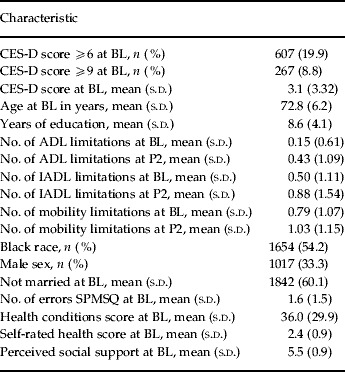
Table 1 shows the characteristics of the sample members who participated in the first two in-person interviews. Although the mean depression score was fairly low, 19.9% of the sample had several depressive symptoms (11.1% of the sample had subthreshold depression with a score of 6–8), whereas 8.8% had a CES-D score of ⩾9. These prevalence estimates are slightly different from those reported earlier from the baseline sample alone (Hybels et al. Reference Hybels, Blazer and Pieper2001). Limitations in mobility and IADL were more common than limitations in basic ADL function.
Characteristics of the respondents who participated in the first interval (n=3052)

CES-D, Center for Epidemiologic Studies Depression Scale; BL, baseline; ADL, activities of daily living; P2, Second in-person survey 3 years post-baseline; SPMSQ, Short Portable Mental Status Questionnaire; s.d., standard deviation.
Prior to running the mixed models, we checked for collinearity among the predictors including depression. The variable with the lowest tolerance in each of the three models was marital status (0.74), suggesting that there was no extreme correlation among the variables that could impact the results.
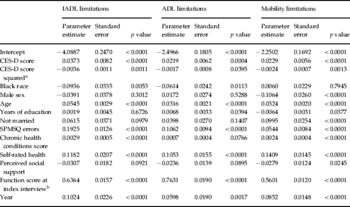
The results of our models assessing the functional form of the relationship between depressive symptoms and functional change were inconclusive. In our first assessment, there were no visibly apparent thresholds identified through the smoothing algorithm for any of the three outcomes. In our second assessment examining all possible cutpoints, we found differences across the three outcomes. For the IADL model, significant thresholds remaining in the model were at CES-D scores 1, 4 and 8. For ADL, the only significant threshold was 15, and for mobility, the only significant threshold was a score of ⩾1 versus 0. These results suggest that some score or scores less than our cutpoint of 9 may be a significant threshold for depressive symptoms as they predict change in IADL function. The cutpoints of 1 and 15 for change in mobility and ADL were less meaningful in defining a threshold for subthreshold depression. In our third assessment, the two spline effects at the cutpoints defined in our previous work were not significant for any of the three outcomes. Finally, for each of the three models where we assessed the impact of linear and higher order polynomials of CES-D score on the outcomes, the squared term was significant (the cubic term was not and was subsequently removed). The results of these models are provided in Table 2. We plotted the quadratic terms and found that, for each of the three outcomes, an increase in CES-D score was associated with an increase in limitations until a score of around 8–10 and then an increase in CES-D score was associated with a decrease in limitations, suggesting a possible threshold effect.
Depressive symptoms as a predictor of functional limitations using a mixed model repeated-measures design and CES-D score as a continuous variable

ADL, Activities of daily living; IADL, instrumental activities of daily living; CES-D, Center for Epidemiologic Studies Depression Scale; SPMSQ, Short Portable Mental Status Questionnaire.
a Quadratic term is difference between CES-D score and the mean squared.
b For the model predicting IADL limitations we controlled for IADL score at the index interview; for the model predicting ADL limitations we controlled for ADL score at the index interview; for the model predicting mobility limitations we controlled for mobility score at the index interview.
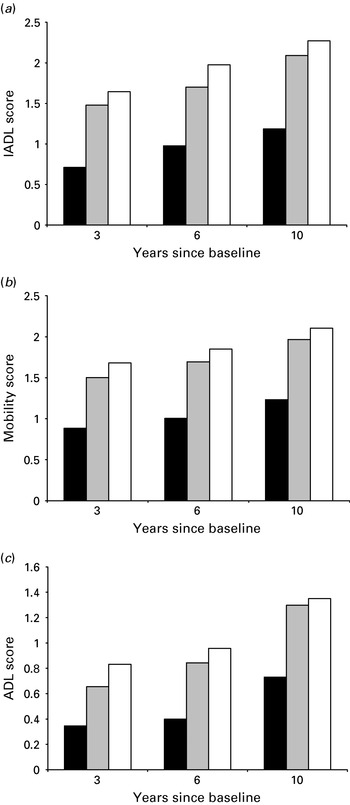
In the absence of consistently defined thresholds, we turned to our main objective of examining the impact of subthreshold depression on functional change using the cutpoints defined in our earlier research. In Fig. 1 we show the uncontrolled mean scores for IADL, ADL and mobility limitations by depression status (scores <6, 6–8, and ⩾9) at the previous in-person interview. It is important to note that those who were non-depressed at baseline may or may not be part of the group that was non-depressed at 3 years predicting 6-year outcome. Although there seems to be an expected overall increase in limitations over time, the figures suggest that there is no differential effect of depressive symptoms over time. The effect of 6–8 symptoms is similar to the effect of ⩾9 symptoms.
Score by depression status (Center for Epidemiologic Studies Depression Scale; CES-D) at previous in-person interview for (a) instrumental activities of daily living (IADL); (b) mobility; (c) activities of daily living (ADL). CES-D score: ▪, 0–5;  , 6–8; □, 9–20.

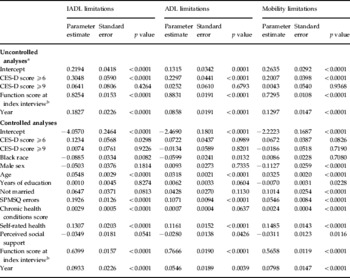
In Table 3, we present the results of the three mixed models measuring the effect of subthreshold depression and the incremental effect of CES-D-defined depression. We show both uncontrolled models (with only the two depression variables, functional status at the index wave, and time as predictors) and models examining the effect of depressive symptoms controlling for other identified potential confounders as well. In uncontrolled analyses, a score of ⩾6 on the modified CES-D was a significant predictor of IADL, ADL and mobility limitations 3–4 years later, whereas the incremental effect of CES-D-defined depression was not significant. The parameter estimates changed when potential confounders were included in the models. In controlled analyses, having ⩾6 depressive symptoms predicted an increase of 0.12 IADL limitations at the subsequent interview (p=0.0298). A score of ⩾6 was not a significant predictor of change in mobility or ADL function. The incremental effect of more symptomatic depression (a score of ⩾9) compared to a score of 6–8 symptoms was not significant for any of the three outcomes when potential confounders were controlled.
Depressive symptoms as a predictor of functional limitations using a mixed model repeated-measures design and three levels of depressive symptoms as predictors

ADL, Activities of daily living; IADL, instrumental activities of daily living; CES-D, Center for Epidemiologic Studies Depression Scale; SPMSQ, Short Portable Mental Status Questionnaire.
a The uncontrolled model includes the two variables measuring depression and time as predictors in the same model. Including the ⩾9 variable in the model in addition to the ⩾6 allowed us to measure the incremental effect of CES-D-defined depression compared to the effect of subthreshold depression.
b For the model predicting IADL limitations we controlled for IADL score at the index interview; for the model predicting ADL limitations we controlled for ADL score at the index interview; for the model predicting mobility limitations we controlled for mobility score at the index interview.
For each of the three models, we also included two interaction terms, each of the two depression terms×year, to see whether the effect was consistent over time. The interaction terms were not significant in any of the three models, and were subsequently removed.
Discussion
We present new findings in this work. First, we conclude that the effect of depression on decline in IADL abilities occurs at low levels of depressive symptomatology, and that more symptoms may not confer significantly greater risk of decline. Second, we conclude that the relationship between depressive symptoms and functional change is complex, may differ by domain of function assessed, and may not necessarily be linear. That is, as the number of depressive symptoms increases, the degree of functional decline may not correspondingly increase.
Using the cutpoints we identified in previous research, older adults with ⩾6 depressive symptoms had an increased risk of IADL limitations 3–4 years later, controlling for functional status at the index wave and the effects of other known predictors of change in functional status. Our key finding was that the incremental effect of more symptomatic depression was not significant in this model, suggesting that the effect of more symptomatic depression did not add to that of subthreshold depression. Our findings are consistent with those of other investigators who reported that depressive symptoms not meeting criteria for major depression predicted functional decline in older adults (Gallo et al. Reference Gallo, Rabins, Lyketsos, Tien and Anthony1997; Penninx et al. Reference Penninx, Leveille, Ferrucci, van Eijk and Guralnik1999), and support those of Cronin-Stubbs et al. (Reference Cronin-Stubbs, Mendes de Leon, Beckett, Field, Glynn and Evans2000) that mild depressive symptoms can increase the likelihood of becoming disabled.
To the best of our knowledge, the incremental effect of more symptomatic depression compared to fewer symptoms has not been examined previously in community populations. We were able to show in these results that the effect of depressive symptoms predicting a decline in IADL can be seen at symptom levels far below those captured by traditional threshold scores on the CES-D. These findings are intriguing, and add to a growing body of evidence supporting the importance of subthreshold depression in older adults.
There has been a considerable amount of research looking at depressive symptoms on a continuous scale or above a designated screening threshold predicting functional decline, but we were interested in looking at the risk of functional decline below a particular threshold. Cutpoints can be informative to both clinicians and researchers. These cutpoints are often chosen theoretically (e.g. systolic blood pressure >160 mmHg) and then tested empirically to see whether they have clinical meaning. Our intent was to choose a cutpoint below the usual screening threshold and explore outcomes associated with this level of symptomatology to see whether this particular threshold had a meaningful clinical outcome. Specific guidelines are also often important for clinical interventions and prevention. Clinicians should be observant for functional decline even when depressive symptoms do not meet the severity of DSM-IV criteria or even screening thresholds.
We believe this is the first study to explore the functional form of depressive symptoms as they relate to functional change in older adults. We modeled the functional form of the modified version of the CES-D, and were unable to identify naturally occurring inflection points in the curves or provide quantitative support for the cutpoints we had used previously. We conducted several analyses to identify thresholds in the continuous scale, but the findings were inconsistent and varied somewhat across the three outcomes. The cutpoint of six symptoms was therefore selected more on theoretical than statistical grounds. Our finding that depressive symptoms and functional change were not linearly related is particularly interesting, and suggests that a greater number of symptoms is not necessarily associated with a significantly greater risk of decline. Both the quadratic model and the cutpoint model supported a non-linear relationship.
Our findings also suggest that the relationship between depressive symptoms and functional status may differ by domains of function assessed. The analyses exploring optimal or naturally occurring thresholds indicated a possible step for changes in IADL function that would be consistent with our categorization of subthreshold depression. Similarly, using our previously established thresholds, we found a significant effect of subthreshold depression for IADL change but not change in mobility or basic ADL. IADL tasks may have a stronger cognitive component than basic ADL or mobility, and this component may play a role in this association. Research by other investigators has shown through structural equation modeling that depressive symptoms may affect IADL abilities through cognition (Gallo et al. Reference Gallo, Rebok, Tennsted, Wadley and Horgas2003). We also found some similarities. In our repeated-measures mixed models, we report a similar non-linear effect for each of the three outcomes, with an increased risk of decline with fewer symptoms but then a similar or decreased risk with more symptoms.
Subthreshold depression may be a prodrome to a more serious form of depression or be indicative of a chronic condition that could lead to functional change. Subthreshold depression may reflect an overall awareness that a patient's health is not optimal. Our findings suggest that more symptomatic levels of depressive symptoms may indeed confer greater risk for future impairment, but that the incremental difference above the risk conferred by subthreshold depression is not significant. These findings build on our earlier work that levels below the threshold typically used to screen for depression can be informative.
Our study has several limitations. Previous research has suggested that the validity of the CES-D in older adults is not affected by physical disabilities (Berkman et al. Reference Berkman, Berkman, Kasl, Freeman, Leo, Ostfeld, Cornoni-Huntley and Brody1986), and others have reported that depressive symptoms were not associated with poorer self-report of functional status (Sinclair et al. Reference Sinclair, Lyness, King, Cox and Caine2001), but we cannot rule out this potential bias. That is, because depressive symptoms and functional status were simultaneously assessed at each of the index waves, there is a potential validity issue. Persons with depressive symptoms may be more likely to misrepresent self-reported functional status. We have relied on self-reported data to measure both depressive symptoms and functional status, as is frequently done in community-based epidemiological surveys. Depression data were not available for those who participated by proxy, so some older adults in poorer health or with cognitive impairment may have been excluded from the analysis. If participants with cognitive impairment also had more depressive symptoms, we may have underestimated the true effect of depressive symptoms on functional change. If depressive symptoms predict mortality, then persons with depressive symptoms may have been less likely to participate in future waves. The Duke EPESE also did not capture data on psychiatric co-morbidity, which could contribute to the association between depressive symptoms and functional change. Similarly, we did not control for psychological attributes such as mastery, which have been shown to be protective in older adults (Kempen et al. Reference Kempen, van Sonderen and Ormel1999b) and may interact with depressive symptoms.
We used a modified version of the CES-D but conducted a sensitivity analysis comparing this version to the traditional version used in the Yale EPESE. Other investigators have successfully used modified versions of this instrument to address this association (Penninx et al. Reference Penninx, Guralnik, Ferrucci, Simonsick, Deeg and Wallace1998). For each interval, we assessed physical function in three areas at only one time point 3–4 years after the index interview, but research has shown that transitions from independence to disability and also from disability to independent mobility are dynamic (Gill et al. Reference Gill, Allore, Hardy and Guo2006). We used a measure of depressive symptoms at the index wave to predict change in functional status. By only inquiring about depressive symptoms in the previous week using intervals 3 to 4 years apart, we were unable to capture changes in depressive symptoms that occurred at other times. We also looked at functional change 3 to 4 years after the measure of depressive symptoms, but we are aware that depressive symptoms may have their effect on functional status within a shorter interval.
To explore depressive symptoms as a predictor of functional status 3–4 years later, we used a residualized change model that looked at change in functional status from the index interview. Our sample at baseline and the other index waves included persons who already had one or more limitations, so we cannot separate incident and prevalent disability, only change in functional status. Although these persons with limitations could improve in function, there were several participants who already had the maximum number of limitations. Across the three index waves, the proportion of participants who were not at risk for decline was 2.4% for IADL limitations, <1% for basic ADL limitations, and 12.8% for limitations in mobility. We cannot rule out the possibility of a Type I error in that we looked at three outcomes. In future work, we plan to explore the longitudinal relationship between these measures of depression and the three functional outcomes in a multivariate model that would allow us to control for Type I error and adjust for the correlations among the three outcomes in one model.
It is not known whether interventions could reduce future functional disability. Meaningful reductions in depressive symptoms that may help to reduce future disability are difficult to measure when so few symptoms are present at the index wave. Other investigators may want to address the effectiveness of interventions in community-dwelling older adults.
Strengths of the study include a large representative sample of community-dwelling older adults followed for 10 years. We had a low attrition rate for reasons other than death. By including functional status and associated covariates at the time of the index interview to predict functional status 3–4 years later, we were able to establish change in function from one point in time to 3–4 years later and therefore temporal ordering. This design is advantageous over studies examining changes in depressive symptoms as predictors of functional change during the same time period (Penninx et al. Reference Penninx, Deeg, van Eijk, Beekman and Guralnik2000; Lenze et al. Reference Lenze, Schulz, Martire, Zdaniuk, Glass, Kop, Jackson and Reynolds2005), which address the challenges of this dynamic relationship but make it somewhat difficult to establish an antecedent–consequent relationship. In addition, by exploring three different measures of physical function separately, we allowed depressive symptoms to have differential relationships with each component of function, as previous research has suggested that use of an aggregate measure may be misleading (Landerman & Fillenbaum, Reference Landerman and Fillenbaum1997).
In summary, these findings address an important problem regarding geriatric mental health and functional outcomes, as the prevalence of subthreshold depression in both community and clinical samples is high (Blazer, Reference Blazer2003).
Acknowledgments
The preparation of this manuscript was supported by NIMH grant K01 MH066380 and the Claude D. Pepper Older Americans Independence Center P30 AG028716. The data were gathered under NIA contract number N01 AG12102 and grant R01 AG12765. The content of this publication does not necessarily reflect the views or policies of the US Department of Health and Human Services. We acknowledge the helpful comments provided by the three anonymous reviewers.
Declaration of Interest
None.