Substance use early in life significantly contributes to death and disability in adulthood, highlighting the importance of understanding the pathways within the family that contribute to substance use during adolescence and emerging adulthood (National Institute of Drug Abuse, 2014). Deviance proneness models (also referred to as “externalizing” and “disinhibition” models) propose that there is a multilevel interplay among genetic, individual, and family risk factors that places children at increased risk for substance misuse (Iacono, Malone, & McGue, Reference Iacono, Malone and McGue2008; King, Molina, & Chassin, Reference King, Molina and Chassin2009; Krueger et al., Reference Krueger, Hicks, Patrick, Carlson, Iacono and McGue2002; Sher, Walitzer, Wood, & Brent, Reference Sher, Walitzer, Wood and Brent1991; Zucker, Heitzeg, & Nigg, Reference Zucker, Heitzeg and Nigg2011). Two of the best known models are the deviance proneness model (Sher et al., Reference Sher, Walitzer, Wood and Brent1991) and the disinhibition model (Iacono et al., Reference Iacono, Malone and McGue2008), which we collectively refer to as the deviance proneness framework. Within this framework, both models posit that children of substance-abusing parents have a genetically transmitted predisposition for behavioral undercontrol (i.e., impulsivity and sensation seeking) in childhood. The resulting undercontrolled child behavior initiates bidirectional transactions with a poor family environment, provided by substance-abusing parents. Both the poor family environment and the undercontrolled behavior contribute to early problem behavior such as academic problems and deviant peer affiliation. Over time, the poor family environment and undercontrolled behavior continue to exacerbate one another, directly contributing to substance use later in life, as well as via school failure and affiliation with substance-using peers (Iacono et al., Reference Iacono, Malone and McGue2008; Sher et al., Reference Sher, Walitzer, Wood and Brent1991).
Central to both these models is a genetic liability for behavioral undercontrol. Behavioral undercontrol has often been broadly conceptualized, encompassing characteristics as diverse as impulsivity, poor self-regulation, sensation seeking, and externalizing behavior. In such cases, the specific child phenotype responsible for associations with family processes and substance use can be unclear. In an effort to better understand these associations, we examine impulsivity as defined by a lack of premeditation as our specific index of behavioral undercontrol (Whiteside & Lynam, Reference Whiteside and Lynam2001), which during childhood and early adolescence may be characterized by behavior such as a lack of planning and acting without forethought. Direct links between impulsivity and substance use are corroborated by findings from a meta-analysis (Charach, Yeung, Climans, & Lillie, Reference Charach, Yeung, Climans and Lillie2011), and bidirectional transactions exist been child impulsivity and parenting (Kiff, Lengua, & Zalewski, Reference Kiff, Lengua and Zalewski2011). In addition, impulsivity is known to have a strong heritable component (Bezdjian, Baker, & Tuvblad, Reference Bezdjian, Baker and Tuvblad2011), and there is emerging evidence that genetically transmitted risk for impulsivity in childhood can evoke poor family environments (Harold et al., Reference Harold, Leve, Barrett, Elam, Neiderhiser and Natsuaki2013).
This preliminary evidence fits within the deviance proneness framework and led us to examine children's genetic predisposition for behavioral undercontrol within bidirectional transactions between impulsivity and family conflict in predicting substance use in adolescence and emerging adulthood. No study has examined the longitudinal interplay between children's impulsivity and poor family functioning in accounting for later substance use in a genetically informed design. Within the deviance proneness framework, the present study addresses this gap by investigating the bidirectional transactions between children's impulsivity and family conflict across middle childhood and adolescence as influenced by children's, mothers’, and fathers’ genetic predispositions for behavioral undercontrol. We examined substance use in adolescence and emerging adulthood as outcomes of these processes, and we included parents’ lifetime substance disorder diagnoses as distal predictors.
Transactions Between Children's Impulsivity and Family Processes in Predicting Substance Use
The longitudinal associations between family processes and children's impulsivity are well studied. A review by Kiff et al. (Reference Kiff, Lengua and Zalewski2011) reported consistent findings that harsh, inappropriate, and controlling parenting behaviors were related to later impulsivity in early to middle childhood. Similar research by Olson, Bates, and Bayles (Reference Olson, Bates and Bayles1990) and Olson, Bates, Sandy, and Schilling (Reference Olson, Bates, Sandy and Schilling2002) found responsive and stimulating parenting early in life to be associated with lower impulsivity at 6 years of age.
The reverse direction of effect has also been reported, that is, children's impulsive behavior predicting parenting behavior. In middle childhood, studies have found that impulsive behavior was associated with greater levels of subsequent family conflict (see Deault, Reference Deault2010, for a review). In middle to late childhood (10–16 years old), impulsivity was associated with later parenting behavior, including lower levels of constructive parenting, positive parenting, and monitoring (Glatz, Stattin, & Kerr, Reference Glatz, Stattin and Kerr2011; Latzmann, Elkovitch, & Clark, Reference Latzman, Elkovitch and Clark2009; Neumann, Barker, Koot, & Maughan, Reference Neumann, Barker, Koot and Maughan2010). These child–parent associations are theorized to occur because highly impulsive children may be difficult to parent, leading to negative communication patterns (Faraone & Biederman, Reference Faraone and Biederman1998) and greater parental stress (Fischer, Reference Fischer1990). The resulting poor family environment can subsequently contribute to children's impulsivity, perpetuating their impulsive behavior across time (Kiff et al., Reference Kiff, Lengua and Zalewski2011). This provides evidence that bidirectional transactions may exist between impulsivity and family conflict, as hypothesized by the deviance proneness framework. Based on these findings, we examined bidirectional transactions between impulsivity and family conflict from middle childhood to adolescence.
When these negative transactions take place in childhood, they may initiate harmful developmental cascades within the family, putting the child at risk for later problem behavior and substance use (Brody & Ge, Reference Brody and Ge2001; Masten & Cicchetti, Reference Masten and Cicchetti2010; Scaramella & Leve, Reference Scaramella and Leve2004). Impulsivity and family conflict both predict adolescent substance use individually (Baer, Garmezy, McLaughlin, Pokorny, & Wernick, Reference Baer, Garmezy, McLaughlin, Pokorny and Wernick1987; Sher, Grekin, & Williams, Reference Sher, Grekin and Williams2005; Vakalahi, Reference Vakalahi2001; Wong, Reference Wong2008; Zhou, King, & Chassin, Reference Zhou, King and Chassin2006). A recent paper by Bidwell et al. (Reference Bidwell, Knopik, Audrain-McGovern, Glynn, Spillane and Ray2015) examined impulsivity and sensation seeking as competing predictors of adolescent substance use. Impulsivity was the most salient predictor of substance use and also found to mediate the relation between family history of substance use and both initiation and frequency of substance use. This supports the proposition that impulsivity contributes to substance use within the deviance proneness framework through shared family origins with parental substance use.
Family conflict is also consistently associated with substance use during adolescence and adulthood. For example, greater family conflict in early adolescence predicts increases in alcohol use across adolescence (Bray, Adams, Getz, & Baer, Reference Bray, Adams, Getz and Baer2001), and elevated family conflict across adolescence predicts membership in a substance using class in adulthood (Herrenkohl, Lee, Kosterman, & Hawkins, Reference Herrenkohl, Lee, Kosterman and Hawkins2013). Family and interpersonal theories (e.g., family systems theory, social learning theory, and emotional security theory) suggest that family conflict is both a chronic and a salient stressor that contributes to poor social support and a lack of emotional security for children within the family (Cummings & Davies, Reference Cummings and Davies2010). This stress and resulting adolescent negative affect may increase risk for adolescent substance use. An alternative (but not necessarily mutually exclusive) explanation is that family conflict weakens the positive parent–child bond that facilitates children's internalization of parental values, thus making them view substance use as more acceptable and making affiliation with substance-using peers more likely (Cummings & Davies, Reference Cummings and Davies2010). In either case, children's perceptions of high levels of conflict in the family increase their likelihood of engaging in substance use behavior (Skeer, McCormick, Normand, Buka, & Gilman, Reference Skeer, McCormick, Normand, Buka and Gilman2009; Stone, Becker, Huber, & Catalano, Reference Stone, Becker, Huber and Catalano2012; Vakalahi, Reference Vakalahi2001).
Despite this evidence, relatively few studies have examined the longitudinal interplay between children's impulsivity and negative family environments in predicting later substance use. In a cross-sectional study, retrospective reports of permissive parenting during childhood predicted lowered self-regulation in emerging adulthood, which in turn predicted poorer drinking control (Patock-Peckham, Cheong, Balhorn, & Nagoshi, Reference Patock-Peckham, Cheong, Balhorn and Nagoshi2001). In a longitudinal study, Brody and Ge (Reference Brody and Ge2001) examined prospective bidirectional relations between self-regulation and conflicted parenting in late childhood, and their unique influences on alcohol use in early adolescence. Self-regulation at 10–12 years of age predicted conflicted parenting a year later, which in turn predicted concurrent self-regulation (11–13 years old). Self-regulation at 11–13 years of age predicted alcohol use a year later in early adolescence. These findings support the deviance proneness framework in that poor self-regulation in late childhood, which is associated with impulsivity, may give rise to negative family environments, which subsequently contribute to further poor self-regulation. The resulting deficits in self-regulation in late childhood and adolescence then serve as a risk factor for later substance use. We extend previous research by examining bidirectional transactions between children's impulsivity (as an indicator of “behavioral undercontrol”) and family conflict from middle childhood to adolescence, and their associations with substance use in adolescence and emerging adulthood.
Whereas a negative family environment likely exerts a proximal influence on child behavior, children's impulsivity may also be affected by other familial risk factors such as parental substance use (Alati et al., Reference Alati, Baker, Betts, Connor, Little and Sanson2014) and interparental conflict (Heinrichs, Cronrath, Degen, & Snyder, Reference Heinrichs, Cronrath, Degen and Snyder2010). The deviance proneness model hypothesizes that parental substance use disorder predicts children's impulsivity both because of a genetically transmitted risk for impulsivity and through the poor parenting and poor family environment that are provided by parents with substance use disorders (Sher et al., Reference Sher, Walitzer, Wood and Brent1991). Related research has found that parent alcoholism predicted greater initial impulsivity and less decline in impulsivity from 6 to 16 years of age (Jester et al., Reference Jester, Nigg, Buu, Puttler, Glass and Heitzeg2008). Similarly, Ohannessian and Hesselbrock (Reference Ohannessian and Hesselbrock2009) found parent alcoholism to predict adolescent disinhibition, which subsequently predicted an earlier substance use age of onset. In the current sample there was a high prevalence of parental substance disorder, allowing us to examine mothers’ and fathers’ lifetime substance disorder diagnoses as predictors of children's impulsivity, family conflict, and substance use in adolescence and emerging adulthood.
Another dimension of the family environment that might be influenced by parent substance use is interparental conflict (Leonard & Eiden, Reference Leonard and Eiden2007; Whisman & Baucom, Reference Whisman and Baucom2012). Moreover, interparental conflict, in turn, effects the quality of parenting and the level of broader family conflict (Erel & Burman, Reference Erel and Burman1995), giving rise to greater levels of hostile parenting (Krishnakumar & Buehler, Reference Krishnakumar and Buehler2000) and parent–child conflict (Bradford, Vaughn, & Barber, Reference Bradford, Vaughn and Barber2008). Interparental conflict is proposed to affect parenting and family relationships via spillover of negative affect into the family relationship (Erel & Burman, Reference Erel and Burman1995). We examined these influences by including mothers’ and fathers’ lifetime substance disorder diagnoses as predictors of interparental conflict, and interparental conflict as a predictor of children's impulsivity and family conflict.
In summary, the deviance proneness framework predicts that a genetic predisposition for behavioral undercontrol contributes to children's impulsive behavior. Impulsive behavior transacts with family conflict across childhood and adolescence, and escalated impulsive behavior and family conflict contribute to substance use in adolescence and emerging adulthood. Within this framework interparental conflict acts as an additional environmental risk, associated with both parental substance use and the family environment. However, whereas individual bivariate associations among children's impulsivity, family functioning, and substance use are well researched, less is known about the developmental transactions among them. Some longitudinal data suggest that differing measures of “behavioral undercontrol” (including impulsivity and sensation seeking) in late childhood predict later negative family environments, further increasing adolescent impulsivity or sensation seeking, leading to adolescent substance use (e.g., Brody & Ge, Reference Brody and Ge2001). However, the bidirectional interplay between children's impulsivity and negative family environments in middle childhood through adolescence, and their possible contributions to adolescent and emerging adulthood substance use, have not been studied. We address this gap in the literature by examining parents’ lifetime substance disorder diagnoses and interparental conflict as predictors of the bidirectional transactions between children's impulsivity and family conflict from middle childhood to adolescence, and their associations with substance use in adolescence and emerging adulthood. Finally, genetic influences need to be considered within these processes (King et al., Reference King, Molina and Chassin2009), which may contribute to developmental cascades of risk (e.g., Elam et al., Reference Elam, Harold, Neiderhiser, Reiss, Shaw and Natsuaki2014; Harold et al., Reference Harold, Leve, Barrett, Elam, Neiderhiser and Natsuaki2013; Masten & Cicchetti, Reference Masten and Cicchetti2010).
Impulsivity in Genetically Informed Research
In addition to impulsivity being involved in transactions with parenting, the deviance proneness framework proposes that parents with substance use disorders transmit a genetic predisposition for impulsivity to their children (Iacono et al., Reference Iacono, Malone and McGue2008; Sher et al., Reference Sher, Walitzer, Wood and Brent1991). Impulsivity has a strong heritable component with evidence of genetic continuity across childhood, adolescence, and young adulthood as well as unique genetic effects at each age (Bezdjian et al., Reference Bezdjian, Baker and Tuvblad2011; Hay, Bennet, McStephen, Rooney, & Levy, Reference Hay, Bennett, McStephen, Rooney and Levy2004; Niv, Tuvblad, Raine, & Baker, 2011). Quantitative genetic studies using twin and adoption samples have shown that impulsivity shares genetic variation with antisocial behavior and substance use disorder (Hicks, Schalet, Malone, Iacono, & McGue, Reference Hicks, Schalet, Malone, Iacono and McGue2011; Young, Stallings, Corley, Krauter, & Hewitt, 2006). A number of single nucleotide polymorphisms (SNPs) have also been associated with the overlap between behaviors such as impulsivity and substance abuse (Kreek, Nielsen, Butelman, & LaForge, Reference Kreek, Nielsen, Butelman and LaForge2005), and impulsivity and aggression (Pavlov, Chistiakov, & Chekhonin, Reference Pavlov, Chistiakov and Chekhonin2012).
A SNP is a variation in a single base pair within DNA. Genetic main effects for individual SNPs exist for impulsivity and related behaviors (Hamidovic, Dlugos, Skol, Palmer, & de Wit, Reference Hamidovic, Dlugos, Skol, Palmer and de Wit2009; McGue et al., Reference McGue, Zhang, Miller, Basu, Vrieze and Hicks2013; Villafuerte, Strumba, Stoltenburg, Zucker, & Burmeister, Reference Villafuerte, Strumba, Stoltenberg, Zucker and Burmeister2013; Wang, Chassin, Geiser, & Lemery-Chalfant, Reference Wang, Chassin, Geiser and Lemery-Chalfant2015). More recently, studies have combined multiple SNPs into indices of genetic predisposition, known as polygenic risk scores. Polygenic risk scores capture genetic variance by including multiple SNPs into a single score with each SNP proposed to exert a small, additive effect. Two studies using similar approaches have examined broad (Vrieze, McGue, Miller, Hicks, & Iacono, Reference Vrieze, McGue, Miller, Hicks and Iacono2013) and developmentally specific (Salvatore et al., Reference Salvatore, Aliev, Bucholz, Agrawal, Hesselbrock and Hesselbrock2015) genetic influences related to behavioral disinhibition.
Vrieze et al. (Reference Vrieze, McGue, Miller, Hicks and Iacono2013) created polygenic scores for behavioral disinhibition as well as alcohol, nicotine, and drug use to examine overlap in genetic variance among these behaviors. The polygenic disinhibition score was associated with the scores for substance use, indicating shared genetic etiology underlying these behaviors. This finding supports evidence from quantitative genetic studies that disinhibited behavior may indicate genetic risk for substance use (e.g., Hicks et al., Reference Hicks, Schalet, Malone, Iacono and McGue2011).
Polygenic scores have also been used to investigate associations with specific phenotypes based on how behaviors are developmentally expressed. Salvatore et al. (Reference Salvatore, Aliev, Bucholz, Agrawal, Hesselbrock and Hesselbrock2015) examined associations among a polygenic risk score for externalizing and specific developmental phenotypes including externalizing, impulsivity, conscientiousness, and sensation seeking. Broad polygenic risk for externalizing explained more variance in impulsivity in adolescence than in adulthood, and was only associated with sensation seeking in adulthood. Thus, polygenic scores can be used to examine not only broad genetic covariation across multiple traits but also genetic associations that may exist with specific phenotypes based on their developmental expression.
These findings indicate that both broad and specific genetic effects exist for impulsivity during childhood and adolescence (e.g., Bezdjian et al., Reference Bezdjian, Baker and Tuvblad2011; Niv et al., 2011; Salvatore et al., Reference Salvatore, Aliev, Bucholz, Agrawal, Hesselbrock and Hesselbrock2015). Converging evidence also indicates that impulsivity in childhood and adolescence is associated with substance use due to its effects on behavior (e.g., initiating actions without carefully considering the consequences), as well as shared family origins (Bidwell et al., Reference Bidwell, Knopik, Audrain-McGovern, Glynn, Spillane and Ray2015) and genetic covariation (Vrieze et al., Reference Vrieze, McGue, Miller, Hicks and Iacono2013). We therefore examined impulsivity as a specific index of behavioral undercontrol in all longitudinal analyses. To construct our polygenic risk score we identified SNPs by conducting a review of the literature for SNPs previously found to be associated with impulsivity and related measures of behavioral undercontrol, which we then combined into a polygenic risk score for children. The same SNPs were used to create polygenic risk scores for parents to control for common genetic risk.
Given emerging evidence that genetic predispositions for impulsivity may be related to negative family environments (Harold et al., Reference Harold, Leve, Barrett, Elam, Neiderhiser and Natsuaki2013), we examined evocative genotype–environment correlations (rGEs) using these polygenic risk scores relative to children's impulsivity and family conflict. In an evocative rGE, children's genetically influenced characteristics evoke a particular response from the environment (Plomin, DeFries, Knopik, & Neiderhiser, Reference Plomin, DeFries, Knopik and Neiderhiser2013). Previously, adoption studies have found evidence of evocative rGE in which poor behavioral motivation in toddlers evokes hostile parenting (Elam et al., Reference Elam, Harold, Neiderhiser, Reiss, Shaw and Natsuaki2014), and impulsive behavior in early to middle childhood evokes more negative and conflicted reactions from parents (Harold et al., Reference Harold, Leve, Barrett, Elam, Neiderhiser and Natsuaki2013). Studies have also examined individual genetic polymorphisms as measures of genetic risk in rGE models. For example, Pener-Tessler et al. (Reference Pener-Tessler, Avinun, Uzefovsky, Edelman, Ebstein and Knafo2013) found that the serotonin transporter gene was related to self-control in early childhood, which evoked less positive parenting. We examined evocative rGE underlying the relation between children's polygenic risk scores and family conflict, mediated by children's impulsivity.
The Present Study
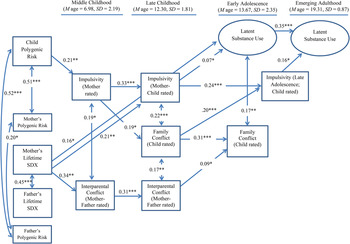
Deviance proneness models propose that a genetic predisposition for impulsivity is associated with substance use, and that this relation is partially mediated by negative family environments (Iacono et al., Reference Iacono, Malone and McGue2008; Sher et al., Reference Sher, Walitzer, Wood and Brent1991). To date, family-based and genetic research has uncovered transactions between children's impulsivity and the family environment. When viewed collectively, these transactions support a deviance proneness framework in which a genetic predisposition for elevated impulsivity evokes negative reactions from the family environment, which in turn contributes to disinhibited behavior, contributing to later substance use. However, the bidirectional transactions between impulsivity and family conflict across childhood and adolescence, and their respective contributions to substance use later in life, have not been tested. We extend previous research by examining the bidirectional transactions between children's impulsivity and family conflict from middle childhood to adolescence, and their contributions to substance use in adolescence and emerging adulthood. We also extend previous research by including children's polygenic risk scores as a predictor of these transactions and examining interparental conflict as a contributing factor (see Figure 1). We included mothers’ and fathers’ polygenic risk scores and lifetime substance disorder diagnoses as distal predictors of all primary study variables. Using this design, we were able to examine longitudinal cascades among these constructs across multiple developmental periods and their contribution to substance use outcomes in adolescence and emerging adulthood.
(Color online) Full model. N = 380, χ2 (148) = 166.19, p = .15, root mean square error of approximation = 0.018, comparative fit index = 0.98, Tucker–Lewis index = 0.96. Nonsignificant paths are not presented. Analyses control for age, gender, ancestry, and their interactions. SDX, Substance disorder diagnosis.

Based on prior research, we hypothesized that children's polygenic risk scores would be associated with their impulsivity within the longitudinal model. We also hypothesized that mothers’ and fathers’ lifetime substance disorder diagnoses would be associated with greater interparental conflict and family conflict as well as with their children's impulsivity and substance use later in life. We also hypothesized that interparental conflict would be associated with family conflict.
Most important for our model, we hypothesized that bidirectional transactions would emerge as part of a developmental cascade between children's impulsivity and family conflict in childhood and adolescence, which would predict substance use in adolescence and emerging adulthood. We predicted that a greater genetic predisposition for behavioral undercontrol would evoke greater family conflict in late childhood via children's impulsivity in middle childhood (evocative rGE), and the resulting family conflict would be associated with substance use via greater children's impulsivity in late childhood and adolescence.
Methods
Participants
Participants were part of the Adolescent/Adult Family Development Project (AFDP), a longitudinal three-generation study on familial transmission of substance use (Chassin, Barrera, Bech, & Kossak-Fuller, Reference Chassin, Barrera, Bech and Kossak-Fuller1992; Chassin, Rogosch, & Barrera, Reference Chassin, Rogosch and Barrera1991). Children in the current analyses were from the third generation of the study who were living with their two biological parents. Children were assessed in middle childhood (M age = 6.98, SD = 2.19), late childhood (M age = 12.30, SD = 1.81), early adolescence (M age = 13.67, SD = 2.35), late adolescence (M age = 16.80, SD = 2.48), and emerging adulthood (M age = 19.31, SD = 0.87). Of the children, 46.7% were female and 66.1% were non-Hispanic Caucasian. In middle childhood and late childhood children and their parents completed in-home computer-assisted interviews or telephone interviews when a family had relocated out of state. At the early adolescent assessment, adolescents completed measures via a web-based assessment, and in late adolescent and emerging adulthood assessments were administered through phone interviews.
The current analyses (n = 380 families) only included families who had a child 5 to 10 years old at the middle childhood assessment either of non-Hispanic Caucasian or Hispanic ethnicity, who was living in a two-parent household in which both parents were biologically related to the child. Families were only included in the current analyses if genetic data were available for the child, with missing mother (n = 14) or father (n = 53) genetic data permitted. We selected families for the current analyses in which both parents were biologically related to the child because this was necessary to account for genetic correlations among mothers’, fathers’, and children's polygenic risk scores. We examined all study variables for selection bias in this subsample versus the larger child (third generation) sample. The only study variable significantly different in the subsample was mothers’ lifetime substance disorder diagnosis, with lower diagnosis rates present in the current subsample (only biologically related mothers and fathers) as compared to the larger sample, which included nonbiologically related mothers and fathers, χ2 (2) = 14.84, p = .001.
Biological samples (buccal and saliva) containing DNA were collected from children and parents. Genotyping was completed at the Washington University Genome Sequencing Center. The Illumina Golden Gate technology was used which is designed for genotyping 1536 SNPs with substitutions reflecting advances in the literature (Hodgkinson et al., Reference Hodgkinson, Yuan, Xu, Shen, Heinz and Lobos2008). Quality controls included cluster plots to exclude ambiguous genotype calls, examining for Mendelian inconsistencies, improper gender assignments and sample swaps, cryptic relatedness, and flagging SNPs with low call rates (p < 10−6).
Measures
Polygenic risk score
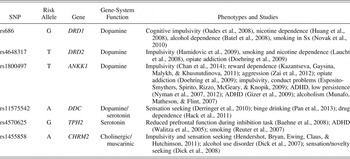
To create the literature-based polygenic risk score, a systematic review of the literature was completed in Huge Navigator Database and Google Scholar to identify studies in which SNPs were significantly associated (p < .05) with indices of behavioral undercontrol (see Table 1 for the search terms). We matched significantly associated SNPs within the resulting studies to available SNPs within the AFDP sample or a SNP in high linkage disequilibrium at r 2 ≥ .80. This resulted in 48 SNPs. Additional SNP inclusion criteria were replication in at least one other study at the gene level and partial or full sample composition of European descent. Adding these criteria resulted in 26 SNPs. SNPs were subsequently pruned for linkage disequilibrium at r 2 ≥ .80 using the pruning option within PLINK, resulting in 25 SNPs. Because there is much dissension in the literature regarding the identification of the risk alleles of individual SNPs (e.g., Gizer, Ficks, & Waldman, Reference Gizer, Ficks and Waldman2009), we required that a SNP's risk allele be replicated in at least two published studies. To fulfill this requirement, we completed a second, targeted literature search to investigate if the refined list of 25 SNPs were associated with broader measures of behavioral disinhibition including substance use. When contradictory risk alleles were reported across multiple studies, a risk allele had to be indicated by a margin of at least two studies. Applying this additional criterion resulted in 6 final SNPs (see Table 1).
Single nucleotide polymorphisms included in the present polygenic risk score
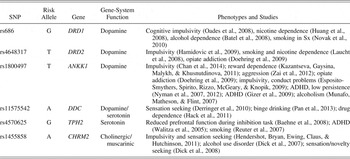
Note: The following search terms were used: impulsivity, novelty seeking, externalizing, undercontrol, delay discounting, p300, disinhibition, stop signal, gambling task, sensation seeking, go-no-go, risk taking, hyperactivity-impulsivity, conduct disorder, self-regulation, reward seeking, self-control. SNP, Single nucleotide polymorphism; DRD1, dopamine receptor D1; DRD2, dopamine receptor D2; ANKK1, ankyrin repeat and kinase domain containing 1; ADHD, attention-deficit/hyperactivity disorder; DDC, dopa decarboxylase; TPH2, tryptophan hydroxylase 2; CHRM2, cholinergic receptor muscarinic 2.
Functionally, a number of the SNPs in our polygenic risk score are from the dopamine system. These SNPs may have an effect on the influx of dopamine in the midbrain and prefrontal cortex, affecting planning and inhibition and contributing to impulsive behavior (Jentsch et al., Reference Jentsch, Ashenhurst, Cervantes, Groman, James and Pennington2014; Koepp et al., Reference Koepp, Gunn, Lawrence, Cunningham, Dagher and Jones1998; Thut et al., Reference Thut, Schultz, Roelcke, Nienhusmeier, Missimer and Maguire1997). Minor allele frequencies of all SNPs were checked in Broad Institute's SNAP database and were below 38%. We combined these SNPs into the present literature-based polygenic risks--score using the score procedure in PLINK (Purcell et al., Reference Purcell, Neale, Todd-Brown, Thomas, Ferreira and Bender2007) and created polygenic risk scores for children, and their biologically related mothers and biologically related fathers. We utilized an additive coding approach, such that for each of the 6 SNPs, participants could obtain scores between 0 and 2 (i.e., 0, 1, or 2 “risk” alleles; children's scores range = 0.17–1.50, skew = 0.26, kurtosis = 0.11; mothers’ scores range = 0.17–1.33, skew = 0.33, kurtosis = –0.47; and fathers’ scores range = 0.00–1.33, skew = –0.09, kurtosis = –0.26).
Ancestry informative markers
The larger data set of all participants who provided genetic data included 32 ancestry marker SNPs that, according to Tian et al. (Reference Tian, Hinds, Shigeta, Adler, Lee and Pahl2007), have differentiated Hispanics from non-Hispanic Caucasians. We included these 32 SNPs in a factor analysis in Mplus, using maximum likelihood estimation. These factor scores significantly correlated with self-reported ethnicity, both in the larger data set (r = .86, p < .001) and in the current sample (r = .83, p < .001), suggesting that this ancestry gene score significantly differentiated between non-Hispanic Caucasians and Hispanics. Higher scores indicated lower levels of Hispanic ancestry (Caucasian M = 0.53, SD = 0.34, range = –1.00–1.32, skew = –0.76, kurtosis = 1.45; Hispanic M = –1.12, SD = 0.75, range = –2.87–0.76, skew = 0.22, kurtosis = –0.53).
Child impulsivity
Different measures and reporters of impulsivity were available in middle childhood, late childhood, and late adolescence. In middle childhood, children were too young for self-report, so mother report was used. In late childhood, an average of mother and child report was used because children were old enough to give accurate ratings and to partially address method bias. In late adolescence, child report was used because youth were in adolescence and accurate reporters of their own behavior (Larson & Richards, Reference Larson and Richards1994).
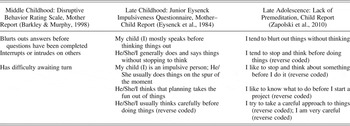
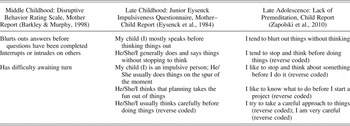
In middle childhood, mothers rated three items (0 = never or rarely to 3 = very often) regarding levels of their child's impulsivity using the hyperactive–impulsive subscale of the Disruptive Behavior Rating Scale (Barkley & Murphy, Reference Barkley and Murphy1998; e.g., “Has difficulty awaiting turn” and “Blurts out answers before questions have been completed”; α = 0.64), which were averaged into a single measure of children's impulsivity.
In late childhood, children and mothers rated six items (1 = strongly disagree to 5 = strongly agree) regarding levels of impulsivity in the child using the Junior Eysenck Impulsiveness Questionnaire (Eysenck, Easting, & Pearson, Reference Eysenck, Easting and Pearson1984; e.g., “He/She often does things on the spur of the moment” and “My child mostly speaks before thinking things out”; αs = 0.86 and 0.74 for mothers and children). We examined child and mother items using confirmatory factor analysis (CFA). A one-factor model had a good fit, χ2 (36) = 39.21, p = .33, root mean square error of approximation = 0.011, comparative fit index = 0.99, Tucker–Lewis index = 0.99, and was not significantly different from a model with two factors, in which mother and child items loaded onto respective latent factors, χ2 (1) = 3.71, p = .058. We extracted factor scores from the one-factor model to represent combined ratings of mother–child report of impulsivity in late childhood.
In late adolescence, adolescents’ reported on six items (1 = agree strongly to 4 = disagree strongly) from the lack of premeditation subscale of the Urgency–Premeditation–Perseverence–Sensation Seeking–Positive Urgency Impulsive Behavior Scale (Zapolski, Stairs, Settles, Combs, & Smith, Reference Zapolski, Stairs, Settles, Combs and Smith2010; e.g., “I tend to blurt out things without thinking”; α = 0.74), which were averaged into a single measure of children's impulsivity.
CFA was used to establish whether impulsivity items across the three assessments could be considered to assess a similar lack of premeditation (see Table 2 for impulsivity items at each assessment). To do this, we tested whether a one-factor model of impulsivity was statistically equivalent to a three-factor model in which each assessment represented a separate construct. The three-factor and one-factor models were not significantly different, χ2 (3) = 6.47, p = .091.
Item overlap among measures of impulsivity
Interparental conflict
In middle and late childhood, mothers and fathers reported on levels of stress and conflict within their marital/romantic relationship using three items (1 = not at all to 5 = a great deal) adapted from Todd, Chassin, Presson, and Sherman (Reference Todd, Chassin, Presson and Sherman1996; e.g., “How stressful is your relationship” and “How often do you have conflicts”; middle childhood, late childhood αs = 0.87, 0.76 and 0.70, 0.81 for mothers and fathers, respectively). Mother and father report were moderately correlated in middle childhood and late childhood, respectively (rs = .54 and .52, ps < .001) and averaged into single measures of interparental conflict in middle and late childhood.
Family conflict
In late childhood and early adolescence, children reported on five items (1 = strongly agree to 5 = strongly disagree) regarding levels of conflict and hostility in the family environment using items from the Family Process Scale (Bloom, Reference Bloom1985; e.g., “We fight a lot in our family” and “Family members sometimes got so angry they threw things”; αs = 0.75 and 0.81) and averaged into single measures of family conflict in late childhood and early adolescence. Child report was used because adolescent substance use should be influenced more by the child's than the parents’ perceptions of conflict (e.g., Chassin et al., Reference Chassin, Presson, Rose, Sherman, Davis and Gonzalez2005).
Adolescent/emerging adulthood substance use
We measured adolescent and emerging adult substance use using latent variables. Each latent variable had three indicators representing alcohol use, illicit drug use, and substance use-related dependence symptoms.
For alcohol use, in early adolescence and emerging adulthood, participants reported on one item assessing how often they had consumed three or more drinks at one time within the past year (1 = never to 8 = every day). For illicit drug use, in early adolescence and emerging adulthood, adolescents reported on eight items (0 = never to 7 = every day) each assessing the frequency of a specific illicit drug used in the past year (e.g., “In the past year, how many times did you use marijuana?”). Illicit drug items were averaged into a single measure of illicit drug usage.
For substance use-related dependence, participants in early adolescence and emerging adulthood reported on six alcohol and six drug use items (1 = never to 5 = always) assessing respective dependence symptoms (e.g., “How often have you felt unable to cut down on alcohol/drugs”; αs = 0.60–0.74). Alcohol and drug dependence items were averaged into a single measure of substance use dependence at each time.
Parent substance disorder diagnoses
Parents’ lifetime alcohol and drug abuse and dependence diagnoses were included from the middle childhood assessment using the Substance Abuse Module of the Composite International Diagnostic Interview (World Health Organization, 1990). Diagnoses for abuse and dependence were based on DSM-IV criteria. In the present study, parents were coded as having no previous lifetime diagnosis (0), having had either an alcohol or substance disorder diagnosis (1), or having had both alcohol and substance disorder diagnoses (2). This approach was used to capture any additive effects of comorbid diagnoses (e.g., McGue, Slutske, & Iacono, Reference McGue, Slutske and Iacono1999).
The larger AFDP study oversampled familial alcoholism in the initial grandparent sample, producing elevated rates of parental alcohol and drug lifetime disorder diagnoses (DSM-IV). In the current sample, 29% of fathers had either an alcohol or drug lifetime disorder diagnosis, and 20% of fathers had both alcohol and drug lifetime disorder diagnoses; 18% of mothers had either an alcohol or drug lifetime disorder diagnosis, and 13% of mothers had both alcohol and drug lifetime disorder diagnoses.
Covariates
Covariates were child age, gender, and ancestry. As described earlier, ancestry informative genetic markers were used to control for genetic variation across ethnicity. Two-way interactions among covariates were also included.
Statistical analyses
Structural equation modeling with full information maximum likelihood for missing data was used to conduct all primary statistical analyses using a maximum likelihood estimator. We examined all relevant statistical assumptions inherent to the application of structural equation modeling (e.g., multivariate normality) and affirmed a priori. All models were tested using Mplus 7.11 (Muthén, & Muthén, Reference Muthén and Muthén2007).
Children's polygenic risk scores were included as predictors of impulsivity, family conflict, interparental conflict, and substance use. Mothers’ and fathers’ polygenic risk scores were included as distal predictors of the same constructs. Mothers’ and fathers’ lifetime substance disorder diagnoses were also included as predictors of all constructs, except polygenic risk scores. The bidirectional transactions between children's impulsivity and family conflict were included, as well as their individual effects on substance use. Interparental conflict was included as a predictor of impulsivity, family conflict, and substance use. Substance use in early adolescence was included as a predictor of late adolescent impulsivity. Correlations between distal predictors were modeled within construct, including correlations between mothers’ and fathers’ polygenic risk scores and their respective substance disorder diagnoses. All within-time correlations were modeled. The three measures of substance use were conceptualized using a latent variable. Indirect effects were tested using RMediation (Tofighi & MacKinnon, Reference Tofighi and MacKinnon2011). Given the many parameters tested for covariates and their interactions, the significant nonhypothesized covariate effects and covariate by covariate interactions were evaluated controlling for Type 1 error using an false discovery rate correction (Benjamini & Hochberg, Reference Benjamini and Hochberg1995).
As part of the AFDP sample, multiple members were assessed from the same family both at the parent level (siblings) and at the child level (siblings or cousins). To account for this interdependence, clustering at the family level was included in Mplus (Muthén, & Muthén, Reference Muthén and Muthén2007), which adjusts standard errors for multilevel data.
Results
Descriptive analyses
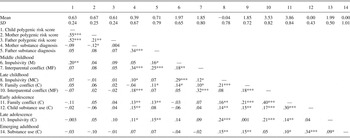
Correlations, means, and standard deviations are presented in Table 3. There was no evidence of multicollinearity among the independent variables. The correlations largely supported the theoretical model. Children's polygenic risk scores were related to mothers’ ratings of the child's impulsivity in middle childhood. Children's polygenic risk scores were not related to family conflict at any period. Mothers’ and fathers’ substance disorder diagnoses were broadly related to children's impulsivity, interparental conflict, family conflict, and children's substance use (although there were exceptions). Children's impulsivity and family conflict were related to each other within time and across time. Interparental conflict was related to family conflict within time and across time as well. Children's impulsivity, family conflict, and interparental conflict in late childhood were related to substance use in early adolescence. Children's substance use in early adolescence and impulsivity in late adolescence were primarily related to substance use in emerging adulthood.
Means, standard deviations, and correlations among study variables
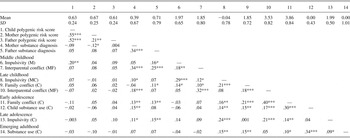
Note: M, Mother report; F, father report; C, child report. Scales for measures are as follows: polygenic risk scores: 0–2, greater scores indicate greater genetic risk for behavioral undercontrol. Parent substance diagnosis (Dx): (0) no Dx, (1) lifetime Dx of either alcohol or drug disorder, (2) lifetime Dx of both alcohol and drug disorder. Middle childhood impulsivity: 0–3 scale, 3 = high impulsivity. Late childhood impulsivity: standardized factor scores of mother–child report of impulsivity, greater scores indicate greater impulsivity. Late adolescence impulsivity: 1–4 scale, 4 = high impulsivity. Middle and late childhood interparental conflict: 1–5 scale, 5 = high interparental conflict. Late childhood and early adolescence family conflict: 1–5 scale, 5 = high family conflict. Early adolescence and emerging adulthood substance use: standardized factor scores of illicit drug use, alcohol use, and substance dependence, greater scores indicate greater substance use.
*p < .05. **p < .01. ***p < .001.
Full theoretical model
The model was a good fit to the data, χ2 (148) = 166.19, p = .15, root mean square error of approximation = 0.018, comparative fit index = 0.98, Tucker–Lewis index = 0.96. The latent measures of substance use had good loadings across the three indicators in early adolescence (alcohol use = 0.84, illicit drug use = 0.87, substance dependence symptoms = 0.74, ps < .001) and emerging adulthood (alcohol use = 0.85, illicit drug use = 0.96, substance dependence symptoms = 0.52, ps < .001).
Figure 1 presents standardized results for the model (for ease of presentation only significant paths are shown). Children's polygenic risk scores were positively correlated with both mothers’ polygenic risk score (B = 0.027, SE B = 0.004, β = 0.51, p < .001) and fathers’ polygenic risk score (B = 0.026, SE B = 0.004, β = 0.52, p < .001). Mothers’ and fathers’ polygenic risk scores were positively correlated (B = 0.010, SE B = 0.005, β = 0.20, p = .043). Mothers’ and fathers’ substance disorder diagnoses were also positively correlated (B = 0.45, SE B = 0.08, β = 0.45, p < .001).
Polygenic risk scores and parental lifetime substance disorder diagnoses as predictors
Greater levels of children's polygenic risk predicted greater mother-reported children's impulsivity in middle childhood (B = 0.63, SE B = 0.20, β = 0.21, p = .001). Mothers’ substance disorder diagnosis predicted greater parental report of interparental conflict in middle childhood (B = 0.28, SE B = 0.10, β = 0.34, p = .003). Mothers’ substance disorder diagnosis also predicted greater combined mother and child report of children's impulsivity in late childhood (B = 0.18, SE B = 0.06, β = 0.21, p = .006) and greater adolescent-reported substance use in early adolescence (B = 0.11, SE B = 0.04, β = 0.16, p = .01). Mothers’ and fathers’ polygenic risk scores did not predict any measure.
Continuity across time within measures
There was continuity across all longitudinally measured variables. There was a positive association between mothers’ report of children's impulsivity in middle childhood and combined mother and child report of children's impulsivity in late childhood (B = 0.40, SE B = 0.09, β = 0.33, p < .001), and a positive association between combined mother and child report of children's impulsivity in late childhood and adolescent's report of their own impulsivity in late adolescence (B = 0.15, SE B = 0.03, β = 0.24, p < .001). There was a positive association between children's report of family conflict in late childhood and in early adolescence (B = 0.33, SE B = 0.06, β = 0.31, p < .001), as well as between parents’ report of interparental conflict in middle childhood and late childhood (B = 0.27, SE B = 0.06, β = 0.31, p < .001). There was a positive association between the latent measures of substance use in early adolescence and emerging adulthood, as reported by adolescents and emerging adults, respectively (B = 0.59, SE B = 0.17, β = 0.35, p < .001).
Cross-lagged associations
There were a number of significant cross-lagged paths. Greater mother-reported children's impulsivity in middle childhood predicted greater child-reported family conflict in late childhood (B = 0.23, SE B = 0.09, β = 0.19, p = .013). Greater child-reported family conflict in late childhood subsequently predicted greater adolescent-reported impulsivity in late adolescence (B = 0.12, SE B = 0.04, β = 0.20, p < .001). Greater impulsivity in late childhood (combined mother and child report) and late adolescence (adolescent report) predicted greater substance use in early adolescence and emerging adult (self-report), respectively (B = 0.06, SE B = 0.03, β = 0.07, p = .043; B = 0.38, SE B = 0.17, β = 0.16, p = .027). Finally, greater parent-reported interparental conflict in late childhood predicted greater adolescent-reported family conflict in early adolescence (B = 0.11, SE B = 0.06, β = 0.09, p = .021).
Indirect effects
We tested patterns of indirect effects to assess possible pathways to substance use. No mediated pathways involving five constructs were significant, so we examined pathways involving fewer constructs, and overlapping pathways leading to substance use. Greater levels of children's polygenic risk scores predicted greater adolescent-reported substance use in early adolescence via greater parent-reported children's impulsivity in middle childhood and combined mother and child report of impulsivity in late childhood, β = 0.015, 95% confidence level (CI) = (0.001, 0.037), p < .05. Children's greater polygenic risk scores predicted greater child report of family conflict in late childhood via mothers’ report of children's impulsivity in middle childhood, β = 0.146, 95% CI = (0.021, 0.319), p < .05. Greater child-reported family conflict in late childhood predicted greater self-reported substance use in emerging adulthood via adolescent's report of their own impulsivity in late adolescence, β = 0.046, 95% CI = (0.004, 0.105), p < .05.
Discussion
The present study used the deviance proneness framework to investigate the longitudinal bidirectional transactions between children's impulsivity and family conflict as predictors of substance use during adolescence and emerging adulthood. We considered children's and parents’ polygenic risk scores for behavioral undercontrol, parents’ lifetime substance disorder diagnoses, and interparental conflict as predictors of these transactions. Few previous studies have examined longitudinal bidirectional associations between children's impulsivity and negative family environments (see Kiff et al., Reference Kiff, Lengua and Zalewski2011). Even fewer studies have investigated substance use as an outcome of their interplay (Brody & Ge, Reference Brody and Ge2001; Patock-Peckham et al., Reference Patock-Peckham, Cheong, Balhorn and Nagoshi2001). This study is the first, to our knowledge, to examine developmental cascades involving genetic predisposition for behavioral undercontrol, children's impulsivity, and family conflict in predicting substance use.
We hypothesized that our polygenic risk score would be associated with impulsivity in the longitudinal model. In support, we found a positive association between children's polygenic risk score and their impulsivity in middle childhood, explaining 4% of the variance in impulsivity in middle childhood. Other polygenic risk scores created using this method have explained similar amounts of variance in phenotypes (Davis & Loxton, Reference Davis and Loxton2013; Derringer et al., Reference Derringer, Krueger, Dick, Aliev, Grucza and Saccone2012). This validates the polygenic risk score. Previous research has indicated that impulsivity generally declines over childhood and into early adolescence, but persists for some (Côté, Tremblay, Nagin, Zoccolillo, & Vitaro, Reference Côté, Tremblay, Nagin, Zoccolillo and Vitaro2002). This relates to the idea that genetic influences on impulsivity are strongest in childhood (Bezdjian et al., Reference Bezdjian, Baker and Tuvblad2011) with persistent genetic effects exerting less influence over time (Bezdjian, Tuvblad, Wang, Raine, & Baker, Reference Bezdjian, Tuvblad, Wang, Raine and Baker2014). Whereas strong genetic continuity has been found within adolescence (11–16 years old), these genetic effects are largely unique from genetic effects in childhood (Bezdjian et al., Reference Bezdjian, Baker and Tuvblad2011; Niv et al., 2011). Studies have begun to discover genetic markers that have unique effects on impulsivity based upon developmental period. Salvatore et al. (Reference Salvatore, Aliev, Bucholz, Agrawal, Hesselbrock and Hesselbrock2015) found their polygenic score predicted greater variance in impulsivity in adolescence versus young adulthood, suggesting associations with unique genetic variance within age. The current finding that children's polygenic risk score predicted impulsivity only in middle childhood may indicate that we captured genetic effects unique to impulsivity earlier in life, exclusive from any continuity in impulsivity we found as part of our longitudinal model and CFA. The small genetic effects common to multiple periods may be more difficult to identify. Finally, as genetic influences on impulsivity decrease over time, environmental influences increase (Bezdjian et al., Reference Bezdjian, Tuvblad, Wang, Raine and Baker2014). This may be indicated by our finding that family conflict, but not our polygenic risk score, was associated with impulsivity in late adolescence. However, given the dearth of literature related to SNP-level effects on impulsivity across developmental periods, our polygenic risk score was not developmentally derived, and these results warrant replication to more clearly understand the effects of polygenic risk on impulsivity across development.
Functionally, a number of the SNPs in our polygenic risk score are from the dopamine system. These SNPs may have an effect on the influx of dopamine in the midbrain and prefrontal cortex, affecting planning and inhibition and contributing to children's impulsive behavior (Jentsch et al., Reference Jentsch, Ashenhurst, Cervantes, Groman, James and Pennington2014; Koepp et al., Reference Koepp, Gunn, Lawrence, Cunningham, Dagher and Jones1998; Thut et al., Reference Thut, Schultz, Roelcke, Nienhusmeier, Missimer and Maguire1997). The lack of effects of mothers’ and fathers’ polygenic risk scores on interparental or family conflict was somewhat surprising and suggests that this indicator of genetic risk for early impulsivity is not relevant to parents’ later conflict with each other or in the broader family.
We also hypothesized that mothers’ and fathers’ lifetime substance disorder diagnoses would be associated with interparental conflict, family conflict, and their children's impulsivity and substance use. Mothers’ lifetime substance disorder diagnosis was associated with interparental conflict in middle childhood, which is consistent with past research demonstrating that mothers’ substance abuse is associated with poorer marital relationships (Cranford, Floyd, Schulenberg, & Zucker, Reference Cranford, Floyd, Schulenberg and Zucker2011). Mothers’ lifetime substance disorder diagnosis was also associated with children's impulsivity in late childhood and with substance use in early adolescence. These effects are consistent with the deviance proneness framework and may indicate that mothers’ rather than fathers’ substance use disorder is more disruptive to family functioning because mothers traditionally serve as caregivers and thus may have more impact on family functioning. In addition, unlike paternal substance disorder, maternal substance disorders can influence offspring through prenatal exposure pathways (e.g., Mick, Biederman, Faraone, Sayer, & Kleinman, Reference Mick, Biederman, Faraone, Sayer and Kleinman2002). Finally, families with substance-disordered mothers are also likely to be particularly high risk because they are likely to contain two substance-disordered parents (Barnard & McKeganey, Reference Barnard and McKeganey2004). In the current data, among the families with mothers who had a lifetime substance disorder diagnosis, 71% contained two parents with a substance use disorder compared to only 29% in which only the mother had a substance use disorder. This may be partially driven by assortative mating in which substance-using individuals are more accepting of such behaviors and are more likely to marry one another. Also consistent with assortative mating was the significant correlation between mothers’ and fathers’ polygenic risk scores. Mothers’ and fathers’ possible genetic and phenotypic assortative mating could confer elevated genetic risk to the child. This elevated genetic risk could contribute to evocative rGE, inflating estimates of evocative rGE; however, the lack of evidence for evocative rGE in the current study does not support this.
In addition to mothers’ and fathers’ substance disorder diagnoses, we hypothesized that interparental conflict would be associated with family conflict. In support of this hypothesis, interparental conflict in late childhood predicted family conflict in adolescence. This finding is similar to previous research finding interparental conflict to be associated with negative parenting behavior (e.g., Harold & Conger, Reference Harold and Conger1997; Krishnakumar & Buehler, Reference Krishnakumar and Buehler2000). These findings are consistent with “spillover” effects of interparental conflict on broader family functioning and offspring outcomes in adolescence.
Finally, we hypothesized that bidirectional transactions would emerge as part of a developmental cascade between children's impulsivity and family conflict in support of the deviance proneness framework (Iacono et al., Reference Iacono, Malone and McGue2008; Sher et al., Reference Sher, Walitzer, Wood and Brent1991). In addition, as hypothesized in the deviance proneness framework, we predicted that these transactions would predict later substance use. In support of this hypothesis, children's polygenic risk scores predicted impulsivity in middle childhood, which predicted family conflict in late childhood. Family conflict in late childhood predicted impulsivity in late adolescence, which predicted substance use in emerging adulthood. This pattern of results fits within the deviance proneness framework in which early genetic predisposition for behavioral undercontrol manifests as impulsivity in middle childhood. This impulsivity evokes greater family conflict, which perpetuates elevated levels of children's impulsivity. Children's impulsivity in adolescence subsequently contributes to substance use in emerging adulthood.
One alternative explanation for these findings may be that more impulsive children perceive more family conflict, regardless of actual levels of conflict in the family. However, we investigated this in post hoc analyses and found that the correlation between parent and child reports of family conflict did not differ based on the level of children's impulsivity (see online-only supplemental materials). Thus, it is likely that greater impulsivity actually predicted greater family conflict, rather than reflecting children's biased perceptions of family conflicts based on their impulsivity.
Few previous studies have examined longitudinal transactions between impulsivity-related phenotypes and negative family environments, and their contributions to substance use (e.g., Patock-Peckham et al., Reference Patock-Peckham, Cheong, Balhorn and Nagoshi2001). The most comprehensive study, by Brody and Ge (Reference Brody and Ge2001), found self-regulation in late childhood to predict negative parenting a year later, which in turn was correlated with poorer self-regulation. Self-regulation prospectively predicted adolescent alcohol use a year later. We broadly supported this pattern of transactions in which impulsivity evoked poor family environments (i.e., family conflict), which contributed to continued poor impulsivity, and this impulsivity predicted later substance use over a broader scope of development. When viewed collectively, this bidirectional transaction between children's impulsivity and family conflict constitutes a pathway to substance use in emerging adulthood consistent with the deviance proneness framework (Iacono et al., Reference Iacono, Malone and McGue2008; Sher et al., Reference Sher, Walitzer, Wood and Brent1991). However, this pathway was not found to be genetically mediated by our polygenic risk score.
We also considered evocative rGEs in these transactions. Contrary to our hypothesis, we did not find an evocative rGE between children's polygenic risk score and family conflict. The genetic variance captured in our polygenic risk score was not associated with family conflict, precluding firm evidence of evocative rGE. However, there was an indirect effect of children's polygenic risk score on family conflict via children's impulsivity in middle childhood. This pattern of findings suggests that impulsivity is a genetically influenced behavior, but it is impulsive behavior and not its genetic underpinnings that evoke family conflict. The effect of impulsivity on family conflict was therefore not genetically mediated by the polygenic risk score. Few studies have investigated evocative rGE related to indices of behavioral undercontrol, but these studies have found evocative rGE for parenting behaviors (e.g., Elam et al., Reference Elam, Harold, Neiderhiser, Reiss, Shaw and Natsuaki2014; Harold et al., Reference Harold, Leve, Barrett, Elam, Neiderhiser and Natsuaki2013). Thus, one possibility is that evocative genetic effects for child impulsivity may be more specific to parent-level behaviors rather than family-level conflict. An alternative explanation is that genetically mediated effects do exist via impulsivity on family conflict but that these effects were not captured by our polygenic risk score.
The current study had several important methodological strengths. First, we were able to examine bidirectional transactions in a developmental cascade model from middle childhood to emerging adulthood. Second, within this model, we were able to include children's, mothers’ and fathers’ polygenic risk scores and to examine evocative rGE. Third, we were also able to test effects of parents’ lifetime substance disorder diagnoses and incorporate multiple reporter data of study constructs.
However, the current study also had limitations that should be noted. First, the polygenic risk scores only included six SNPs, thus capturing limited genetic variance. However, this represented a conservative composite, given our requirement of replicated findings in independent published samples for inclusion in the polygenic risk score. Second, another limitation was that different measures and reporters of children's impulsivity were available over the longitudinal assessments. However, our CFA showed that a one-factor model of longitudinal impulsivity did not differ from a model that considered each measure as a separate construct. Third, we lacked measurements of impulsivity and family conflict during middle to late childhood. Fourth, the current analyses only included children living in two-biological parent families, which had lower rates of mothers’ substance disorder diagnosis than the full sample. These results may not reflect parent–child transactions in single-parent households or alternative household structures, in which parenting may be reliant on a sole caregiver and negative family circumstances may be more deleterious to child functioning. In addition, the results may not generalize to nonbiologically related mothers. However, despite lower diagnosis rates, mothers’ substance disorder diagnosis significantly predicted impulsivity in late childhood, early adolescent substance use, and interparental conflict.
The current findings have important implications for interventions to disrupt pathways to substance use beginning in childhood. That is, it may be advantageous to target parents’ reactions to children's impulsive behavior and to target the quality of the family environment early in life as a way of disrupting these developmental cascades and preventing later substance use (Masten & Cicchetti, Reference Masten and Cicchetti2010). Previous prevention programs have espoused the utility of focusing on a parent's reactions to difficult child behavior by providing parents training in positive and constructive responses to child behavior (e.g., Leve, Harold, Ge, Neiderhiser, & Patterson, Reference Leve, Harold, Ge, Neiderhiser and Patterson2010). Moreover, the association between family conflict and impulsivity in adolescence suggests that programs aimed at reducing levels of family conflict (e.g., Sanders, Kirby, Tellegen, & Day, Reference Sanders, Kirby, Tellegen and Day2014) could lead to reductions in children's impulsivity, and subsequent substance use. Finally, given that maternal substance disorder was a distal risk factor for these cascades, these interventions are potentially useful in preventing the intergenerational transmission of substance use problems.
Supplementary Material
To view the supplementary material for this article, please visit http://dx.doi.org/10.1017/S0954579416000249.