INTRODUCTION
Melanoides tuberculatus (Müller, 1774) is an Afro-Asiatic thiarid, originally from the Middle East, eastern Africa and south-eastern Asia (Fernandez et al., Reference Fernandez, Thiengo and Simone2002). It is a gastropod common in freshwater environments, and is now present in a wide portion of the tropical and subtropical regions of the New World, as a consequence of species introductions that took place initially during the last century (Madsen & Frandsen, Reference Madsen and Frandsen1989).
The first record of M. tuberculatus in Brazil was in 1967 in Santos, State of São Paulo (Vaz et al., Reference Vaz, Teles, Correa and Leite1986), since then, it has been reported for 17 Brazilian states, including Ceará (Fernandez et al., Reference Fernandez, Thiengo and Simone2003). Other studies show the presence of M. tuberculatus in freshwater environments in Brazil (Rocha-Miranda & Martins-Silva, Reference Rocha-Miranda and Martins-Silva2006; França et al., Reference França, Suriani and Rocha2007). The first record of M. tuberculatus for Ceará was in Crato county, southern part of the state, reported by Melo Júnior & Cordeiro (Reference Melo Júnior and Cordeiro1999).
The finding of M. tuberculatus is of great importance to those involved in public health and sanitation because this snail is the first host for several trematodes, some of them parasitizing man, besides the fact that it has been employed, in some countries, as a tool in biological control of planorbids susceptible to infection by Schistosoma mansoni (Vaz et al., Reference Vaz, Teles, Correa and Leite1986; Pointier, Reference Pointier2001; Bogéa et al., Reference Bogéa, Cordeiro and Gouveia2005).
Biological invasions constitute one of the most serious threats to global biodiversity, being surpassed only by destruction of habitats (Everett, Reference Everett2000). Being an alien mollusc which occurs in high population densities in Brazil, M. tuberculatus may become a threat to the native mollusc fauna and its occurrence must be monitored and documented (Fernandez et al., Reference Fernandez, Thiengo and Simone2003; França et al., Reference França, Suriani and Rocha2007).
The objective of this study was to register the occurrence of M. tuberculatus in the area of mangrove of the estuary of the Ceará River, verifying its density and the salinity to which the specimens were submitted to verify it euryhalinity.
MATERIALS AND METHODS
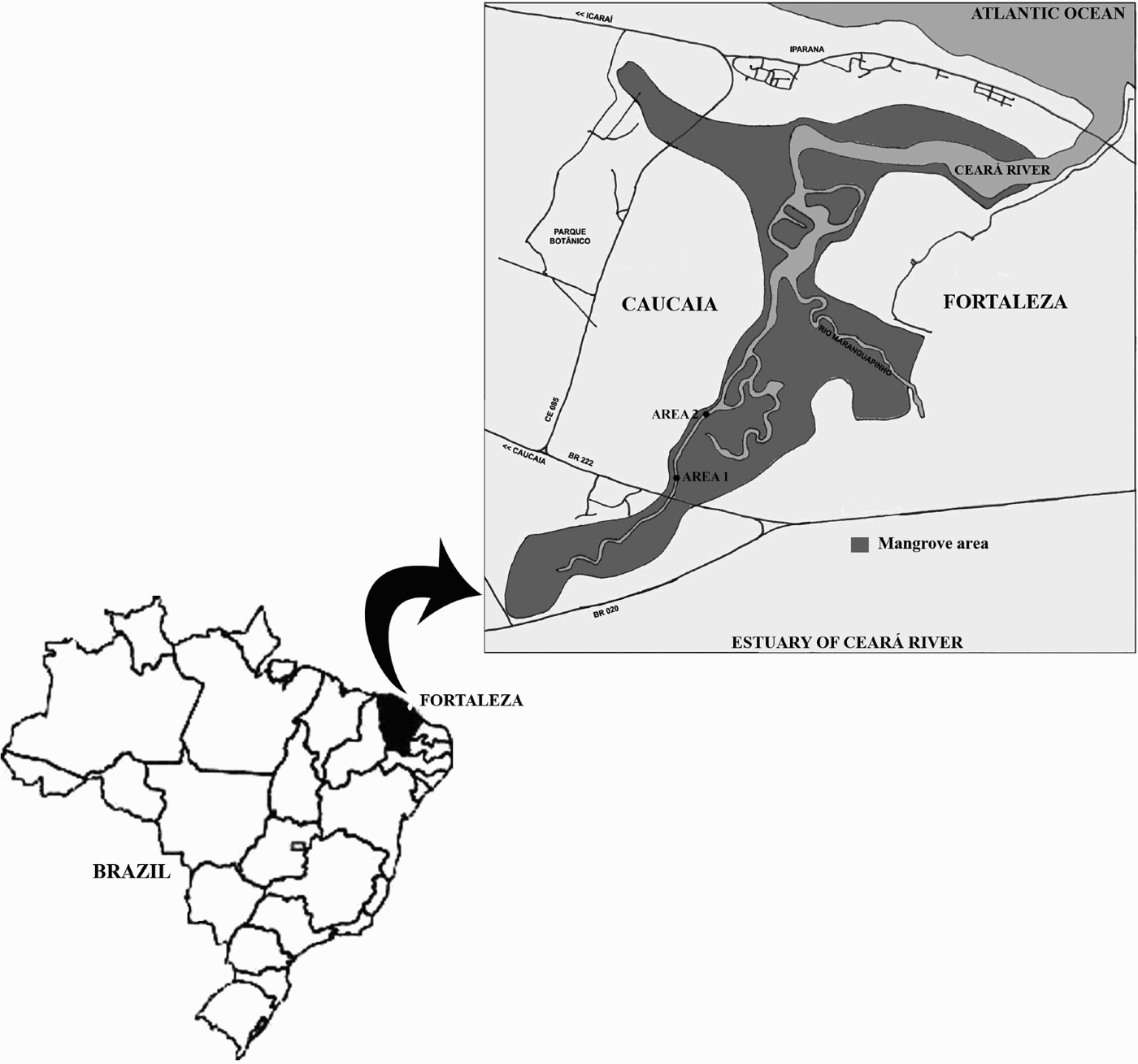
Specimens of M. tuberculatus were collected by hand and with the aid of a PVC-made cylindrical sampler (core) on the intertidal zone of two mangrove regions in the estuary of the Ceará River, located on the boundary of Fortaleza and Caucaia counties (Area 1: 03°41′19″S and 38°35′19″W and Area 2: 03°45′10″S and 38°39′15″W) (Figure 1), in September, October and November 2005, and in February, March and April 2006.
Study area, in the Ceará River, Ceará, north-eastern Brazil.

In each area of samples, a transect of 10 m perpendicular to the riverbed was determined, throughout which samples of sediment had been taken by a ‘core, with 10 cm in diameter and 15 cm in height. The samples were made to each 2 m, thus totalling five samples (Q2, Q4, Q6, Q8 and Q10) in each area of study. The samplings had been made in the low tide. The sampled sediments had been conditioned in plastic bags. In the laboratory, the collected samples of sediment had been passed in mesh of 0.5 mm of opening. The restrained sediment was conserved in ethyl alcohol 70%. After that, the sampled sediments were examined under a compound microscope. The specimens collected with the aid of the core were preserved in ethyl alcohol 70%. The animals were deposited in the Professor Henry Ramos Matthews’ Malacological Collection of the Universidade Federal do Ceará, Fortaleza.
In each one of the two areas, water samples of the surface of the river were collected for the measurement of the salinity using a refratometer.
In order to test the hypothesis that M. tuberculatus is actually inhabiting the mangrove area and that it was not brought by the stream from the upper part of the river, 30 live specimens collected by hand in February 2006 were kept in an aquarium (4 l) for a month, under salinities ranging from 25–35. The variation of the salinity in the aquarium occurred with the evaporation of the water. The salinity was measured every day using a refratometer. During the experiment, the specimens were fed fish flakes.
Data on the monthly total precipitation had been collected by the Fundação Cearense de Meteorologia e Recursos Hídricos (FUNCEME). These data referred to the Pluviometric Rank, Caucaia, located in the city of Caucaia (CE), adjacent to the study area.
RESULTS
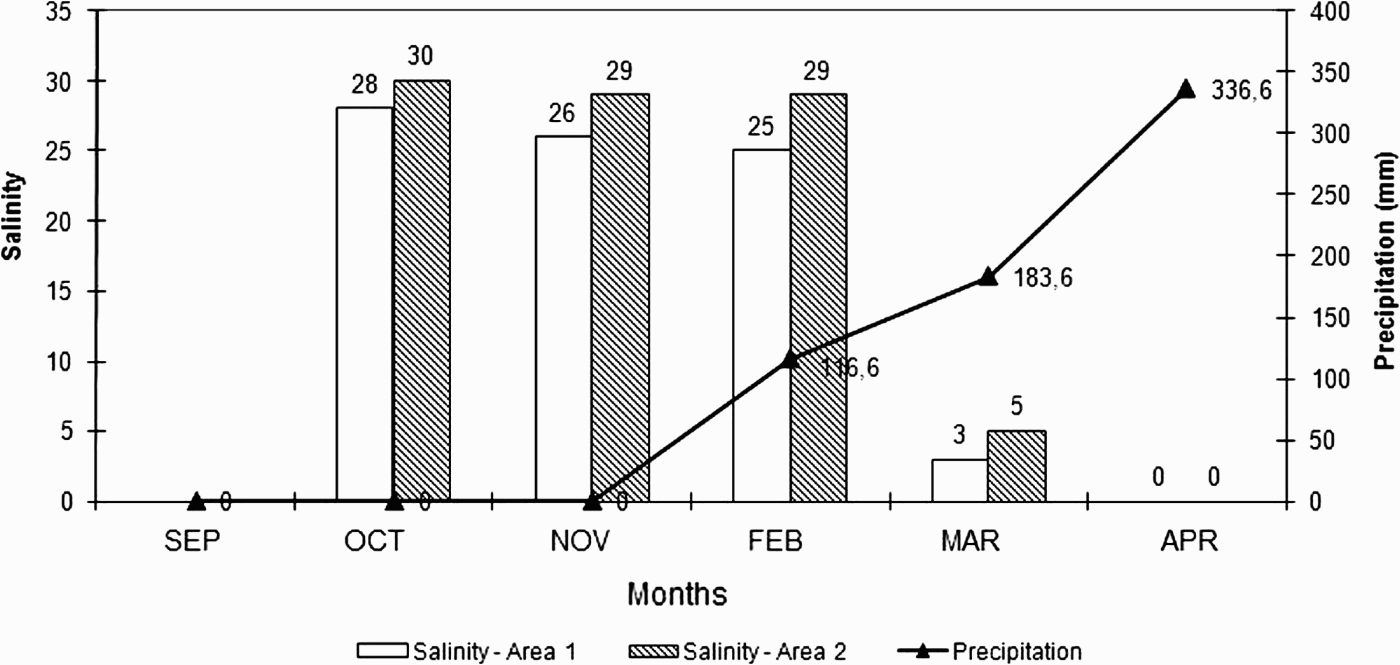
On the estuarine areas where the specimens of M. tuberculatus were collected (Area 1 and Area 2), salinity ranged from 0–30 and the precipitation ranged from 0–336.6 mm, during the sampled months (Figure 2).
Relation between salinity and precipitation in two mangrove areas of the estuary of Ceará River during the sampled months (September, October and November 2005 and February, March and April 2006).

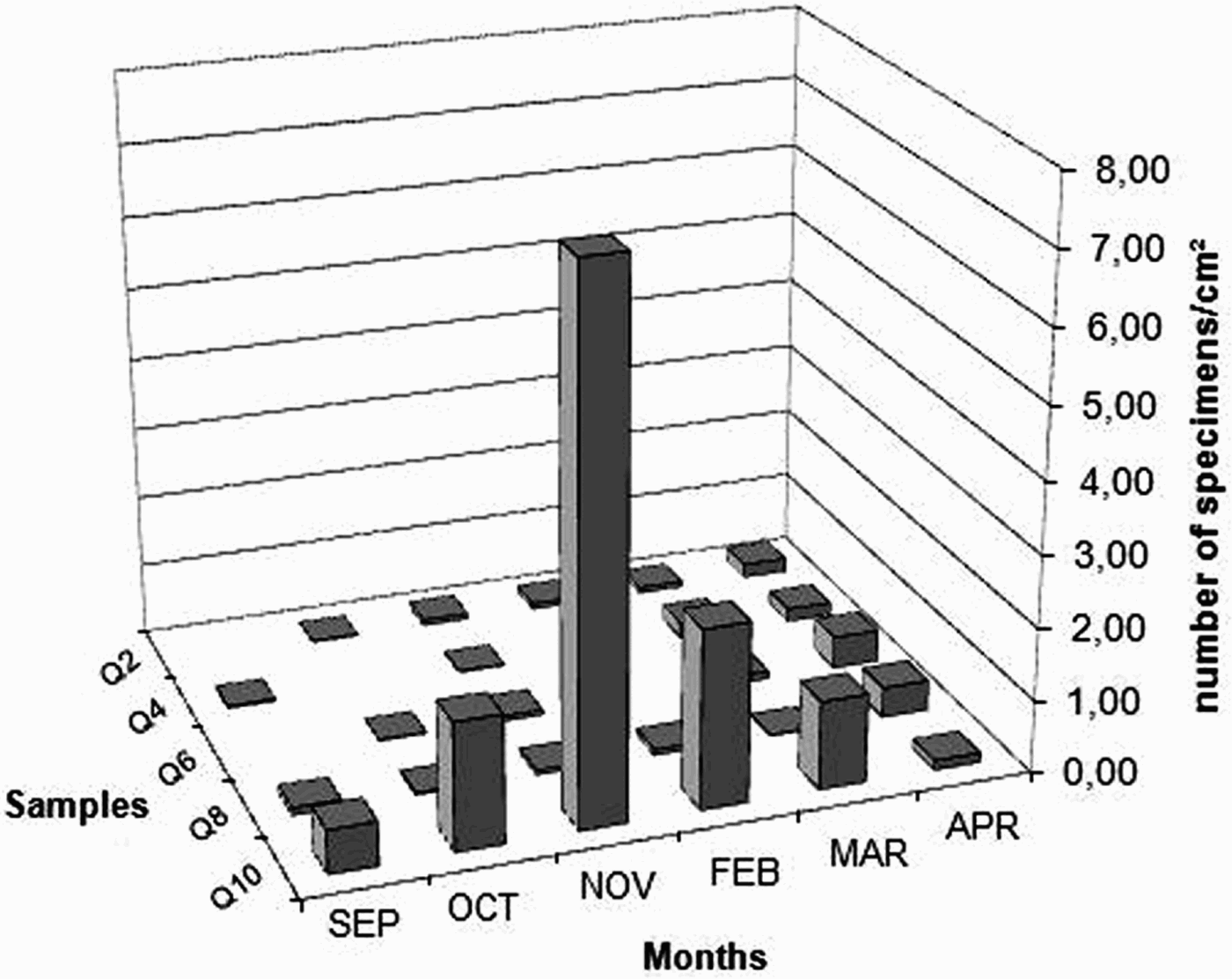
This species showed population density ranging from 0.76–10.22 individuals/cm2, with higher rates occurring near the banks of the Ceará River in both areas (Area 1 and Area 2). During the six samples months, 4.234 individuals were collected with the aid of the core; 2.994 on Area 1, and 1.240 on Area 2. The number of individuals during the sampled months showed variation in the period between September 2005 and April 2006 (Figures 3 & 4).
Density of Melanoides tuberculatus in different samples from Area 1 of the estuary of Ceará River during the sampled months (September, October and November 2005 and February, March and April 2006).

Distribution of Melanoides tuberculatus in the different samples from Area 2 of the estuary of Ceará River during the sampled months (September, October and November 2005 and February, March and April 2006).

The specimens of M. tuberculatus in the aquarium had remained active between the salinities of 25 and 35.
DISCUSSION
In their studies on the estuarine region of Shatt al Arab, Plaziat & Younis (Reference Plaziat and Younis2005) observed that annual rain, which coincides with the beginning of the hot weather, is apt to limit an increase in salinity caused by evaporation. Thus, the estuarine fauna from Shatt al Arab consists, mainly, of freshwater molluscs, except in the region adjacent to the mouth of the estuary. However, some freshwater species that are euryhaline, such as M. tuberculatus, can tolerate salinities above 2 during the lesser intake of freshwater, being able to live and even predominate on most of the estuary. According to these authors, M. tuberculatus is an euryhaline species, usually associated to low salinity environments (0.2–3), where it is predominant, but it is capable of tolerating salinities over 23. Also Englund et al. (Reference Englund, Arakaki, Preston, Coles and Eldredge2000) reported the presence of M. tuberculatus in Oahu, Hawaii, in environments whose salinity ranged from 0–34.
Because M. tuberculatus is a typical freshwater species, its presence on the estuary of Ceará River, where salinity reached a maximun of 30, may be explained by the fact that this species is euryhaline, being able to stand the great variation on salinity resulting from annual rains that occur in this estuary (Figure 3). The present study corroborates the observations by Plaziat & Younis (Reference Plaziat and Younis2005).
The presence of M. tuberculatus in the mangrove area in estuary of Ceará River, whose water salinity reached a maximum of 30, and their survival in the laboratory, under a salinity of 35, demonstrates the adaptation of this limnetic gastropod to euryhalinity.