Women make up more than half the Brazilian population (51%) and a majority of the electorate (52%). But very few have seats in legislative bodies, at all levels of the federation. In the 2016 municipal elections, among the 57,862 legislative seats to be filled, only 7,812 (14%) women were elected. In the 2018 general elections, of the 513 members of the Brazilian Chamber of Deputies (Brazil's lower house), only 77 women were elected, corresponding to 15% of the total. The Federal Senate has 13 women senators, accounting for 16% of the total 81 senators. In the state legislatures, 161 women were elected, representing 15.5% of the total number of 1,035 seats.Footnote 1 These data clearly show that women are underrepresented in elected positions in Brazil. Contrary to what one might imagine, this underrepresentation does not result from a lack of policies aimed at increasing the participation of women in the Brazilian legislative branch. Like many other countries, Brazil has adopted electoral gender quotas in elections for the Chamber of Deputies and for state and municipal legislatures.
As is widely known, electoral gender quotas are affirmative policies that have spread around the world since the 1990s with the goal of increasing the proportion of female candidates for political office. As a matter of fact, gender quotas are a worldwide phenomenon that have spread to more than 100 countries in recent decades (Baldez Reference Baldez2006; Franceschet, Krook, and Piscopo Reference Franceschet, Krook and Piscopo2012; Krook Reference Krook2006a, Reference Krook2006b). South American countries typically have adopted legal quotas—that is, electoral gender quotas established by law that provide for minimum and maximum percentages of candidates of each gender.Footnote 2 In the 1990s, most quota laws provided for a minimum percentage of 20% to 40% of candidates for the underrepresented gender, but the current trend is to establish gender parity by determining that the number of female and male representatives correspond to 50% of candidates.
In societies where women traditionally have not participated in politics, gender quotas frequently prove to be an effective means for changing the political landscape, considerably increasing the number of elected women. In some countries, such as Rwanda, Argentina, Senegal, South Africa, Uganda, and Costa Rica, gender quotas have led to historic leaps in the number of women holding seats in parliaments. The world average of the percentage of women in parliaments has increased in recent decades. According to the Inter-Parliamentary Union, the world average of the percentage of women in single or lower houses as of January 1997 was 12%. This percentage had increased to 23.4% 20 years later. In the Americas, the average percentage of women in parliaments increased from 12.9% in 1997 to 28.2% in 2017.Footnote 3 These data show that the adoption of electoral gender quotas in this region contributed to significant increases in the representation of women in politics: their presence in parliaments is meaningful, with rates exceeding 40% in Bolivia, Costa Rica, and Mexico.
In some countries, however, despite the implementation of gender quotas, the number of men both in political parties and in legislatures has remained much higher than that of women. The case of Brazil is quite peculiar. Even though a law establishing a minimum percentage of women candidates in proportional representation elections was passed in 1997, Brazil is one of the few countries in which there was a decrease in the number of women in its lower chamber in the first elections following the introduction of gender quotas.Footnote 4 Moreover, it is still a country with one of the world's lowest rates of women in legislatures. According to the Inter-Parliamentary Union, Brazil ranks 134th out of 190 countries—last among South American countries, along with Paraguay.Footnote 5
These data inevitably lead to the question of why Brazilian gender quotas have been so ineffective at increasing women's participation in politics. Political scientists and sociologists have delved into this issue in the past two decades and usually point to three main reasons: (1) peculiarities of the Brazilian electoral system, an open-list proportional representation system (Wylie and Santos Reference Wylie and dos Santos2016)Footnote 6; (2) the absence of sanctions for political parties failing to meet the minimum percentage of female candidates (see Gray Reference Gray2017; Schwindt-Bayer Reference Schwindt-Bayer2009); and (3) the political party structure and the candidate selection mechanism (see, e.g., Araújo and Alves Reference Araújo and Alves2007; Dahlerup Reference Dahlerup2006; Htun Reference Htun2002; Jones Reference Jones2004; Krook and Childs Reference Krook and Childs2010; Miguel Reference Miguel2008; Wylie and Santos Reference Wylie and dos Santos2016).
Undoubtedly, these are the main electoral reasons for the low representation of women in the Brazilian Chamber of Deputies. This article, however, aims to analyze a different variable that is rarely considered in this debate: the role of the Electoral Court. We argue that, in addition to the aforementioned variables, the quality and intensity of the control exercised by an electoral court, when called upon to decide on the enforcement of the gender quota act, can also influence the efficacy of this policy. In the Brazilian context, this is especially true because all lists must be registered before the court before elections take place. The Electoral Court thus controls the compliance of all lists with the gender quota legislation and rejects those lists that fall short of compliance. Additionally, the Electoral Court is responsible for interpreting and enforcing gender quota legislation as well as deciding concrete controversies. As will be shown in this article, this interpretive activity may have a strong impact on the number of women in each party list. Certainly, the Brazilian Superior Electoral Court is (or at least could be) a major player in this context.
Using the case of Brazil, which is an important outlier in implementing gender quotas in Latin America, this article presents an analytical tool for assessing the decisions of electoral courts and evaluating their impact on gender quota enforcement. It is important to stress that, although we mention other important experiences of gender quota enforcement by electoral courts in Latin America, such as the cases of Argentina, Mexico, and Costa Rica, this article does not have a comparative goal. It aims to define an analytical tool and apply it to a single case study involving only one court, the Brazilian Superior Electoral Court. Still, the implications for future comparative research seem to be clear. Other case studies involving other electoral courts may apply the same analytical tool in order to assess their impact in other countries, especially in those that, like Brazil, adopt proportional representation with open lists.
This article is organized into three parts: The first part focuses on the main features of the Brazilian electoral system and the structure of the electoral justice system to provide a better understanding of how judicial institutions and electoral rules operate. In the second part, we draw attention to the understudied role of the electoral courts in enforcing the gender quota law. Finally, in the third part, we present data from the case law of the Brazilian Electoral Court in the realm of gender quota implementation. We show that, in general, the decisions of this court tend to foster the participation of women in the legislature. However, based on two divides—between easy and difficult cases and between cases with low and high impact—we argue that in some crucial cases, the Brazilian Electoral Court took a rather cautious stance. More specifically, although widely acknowledged as an activist court, the Brazilian Electoral Court followed an unusual self-restrained path in those cases that we classified both as difficult and with potentially high impact.
ELECTIONS IN BRAZIL: THE ELECTORAL SYSTEM AND ELECTORAL COURTS
In order to understand the role of electoral courts in enforcing the gender quota policy, in the next two sections, we briefly present the electoral system used in Brazil for proportional representation elections as well as the organization and powers of the Brazilian electoral courts.
Proportional Representation in Brazil
With the exception of the Federal Senate, elections for legislative bodies in Brazil—at all three federal levels—are held according to the principle of proportional representation. For the Chamber of Deputies and state legislatures, the constituencies are the member states; for the local legislatures, the constituencies are the municipalities.
Candidates for the Chamber of Deputies must be affiliated with a political party (Electoral Code, Article 87). The number of candidates that each party (or party alliance) may present varies according to the district magnitude. In states with 12 or more representatives in the Chamber of Deputies, each party (or party alliance) may present a number of candidates corresponding to 150% of the seats; in states with fewer than 12 representatives, this number corresponds to 200% of the seats to be allocated (Elections Act, Article 10).
The electoral formula used in proportional elections in Brazil works in two stages. First, the seats are distributed according to the Hare quota system (Electoral Code, Article 106); second, the remaining unallocated seats are distributed according to a modified highest average system (Electoral Code, Article 109).
Unlike the case of many countries that adopt some form of proportional representation, the party lists in Brazil are open (unranked lists).Footnote 7 Parties cannot define a fixed order of candidates in advance. Everything is decided on Election Day: not only how many seats each party gets but also who (which candidates) gets these seats, according to their individual electoral performance. Thus, as candidates are not ranked in advance, all candidates individually compete for the preferences of all voters, which creates an intra-party or intra-coalition dispute. The open-list system is also marked by extreme personalization of electoral campaigns, since the success of candidates depends on the their individual ability to get political support and financial resources to fund their election campaign, which can be extremely costly.
Electoral Courts
Unlike what happens in many countries where elections are still organized by the executive and legislative branches, in Brazil, a nonpartisan judicial body, called Electoral Justice (Justiça Eleitoral), was established in 1932 to organize and control the electoral process. This judicial body was created in an effort to depart from the classical theory of electoral governance, which assigns to the executive and legislative branches the responsibility of organizing and certifying the results of elections (Lehoucq Reference Lehoucq2002). In fact, it is undisputed that the creation of the Electoral Justice system represented an institutional improvement, to the extent that election governance has been reserved for an institution insulated from the influence of those directly interested in winning elections (Bohn, Fleischer, and Whitaker Reference Bohn, Fleischer, Whitaker and Speck2002).
The Brazilian electoral court system is composed of the Superior Electoral Court (Tribunal Superior Eleitoral), the State Electoral Courts (Tribunais Regionais Eleitorais), and electoral judges. The Superior Electoral Court, the highest court of the Brazilian electoral court system, is based in Brasília and has countrywide jurisdiction. Jurisdiction of the State Electoral Courts is limited to their respective states and the Federal District.
The Superior Electoral Court is composed of seven judges. Three of them are chosen from among the Supreme Court justices; two are judges of the Superior Court of Justice (Superior Tribunal de Justiça), and two are lawyers. According to Article 119, II, of the Brazilian Constitution, the latter are appointed by the president of the republic from a list of “six lawyers of notable legal knowledge and good moral character, recommended by the Brazilian Supreme Court.” The other five judges are chosen through election, by secret ballot, within their respective courts (Brazilian Constitution, Article 119, I). The president and vice president of the Superior Electoral Court must be justices of the Supreme Court, while the electoral inspector general must be a judge from the Superior Court of Justice.
The electoral court system has thus neither judges of its own nor permanent judges. They all either stem from other courts or are lawyers empowered as electoral judges. Moreover, members of the electoral courts shall perform their duties for a minimum period of two years, with possible renewal for another two years. Therefore, it is a court system with “borrowed” members (Dantas, Oliveira, and Sousa Reference Dantas, Oliveira and Sousa2014, 47).
The powers of the electoral court system are provided for in the Constitution and in a few federal laws.Footnote 8 The electoral court system organizes elections, creates and enforces electoral rules, and settles conflicts arising from electoral competition. Hence, the electoral courts not only organize the electoral process, they also decide electoral cases and controversies (Marchetti Reference Marchetti2008). It is a very centralized and vertically organized model (Cadah Reference Cadah2014).
Studies on electoral governance usually analyze a wide range of variables and activities related to the electoral process. As noted by Mozaffar and Schedler (Reference Mozaffar and Schedler2002, 7), these variables may be organized into three levels: (1) “designing the basic rules of the electoral game” (rulemaking), (2) “implementing these rules to organize the electoral game” (rule application), and (3) “resolving disputes arising within the game” (rule adjudication). In Brazil, the Superior Electoral Court concentrates all these levels in one institution. Although the first of these activities (rulemaking) is performed primarily by the legislative branch, the Superior Electoral Court nevertheless has broad regulatory powers, based above all on Article 23, IX, of the Electoral Code, which provides that the Electoral Court shall “issue the regulations it deems necessary for the enforcement of this Code.”Footnote 9 It may be stated that the Electoral Court does not hesitate in using its regulatory powers. As will be shown in this article, in some cases, the court issues electoral orders even when such orders contradict enacted law.
ELECTORAL COURTS AND GENDER QUOTA LAW
As mentioned earlier, this article aims to analyze the role of a particular electoral court—the Brazilian Superior Electoral Court—to assess whether and how it influences the enforcement of the gender quota policy and whether its decisions foster the participation of women in legislatures. As stated in the introduction, the role of the judiciary is seldom considered when the enforcement of policies to promote the inclusion of women in the legislative branch is analyzed. Only a few studies have examined the role and impact of electoral courts. Studies on electoral gender quotas often emphasize the social and political reasons for the underrepresentation of women and fall short of including the judiciary as a relevant player in the enforcement of minority rights and gender equality in politics.
One reason for the ancillary role attributed to the judiciary in studies on the effectiveness of gender quotas is that there are few countries in which both the organization of elections and the decision of concrete cases and controversies are performed by an electoral court. As a matter of fact, most countries do not even have an electoral court.Footnote 10 In many Latin American countries, however, electoral courts play a major role both in the organization of elections and in the interpretation and enforcement of legal provisions concerning the electoral process (see Piscopo Reference Piscopo2015). As Gray (Reference Gray2017) recently showed, proper enforcement and effective sanctions for noncompliance (or lack thereof) may to a great extent explain the success or failure of very similar gender quota policies.Footnote 11 Franceschet, Krook, and Piscopo (Reference Franceschet, Krook and Piscopo2012) also recognize, among other reasons, the importance of courts in quota implementation, arguing that courts, women's organizations, and ordinary citizens may play a “direct or indirect role in enforcing quota provisions.”
A pioneering study on the performance of an electoral court in the implementation of gender quotas in proportional elections is that of Jones (Reference Jones2004). In his analysis of Costa Rica's gender quota legislation, Jones stresses the role of the Supreme Electoral Court (Tribunal Supremo de Elecciones). Costa Rica's Electoral Code was amended in 1996, when a new provision was introduced, requiring that political parties nominate at least 40% of women for their party lists for national parliamentary elections (Zamora Chavarria Reference Zamora Chavarria2009). However, this provision said nothing about how those women should be ordered within the lists, which led parties to conclude that the ordering within the list was at their discretion.
According to Jones (Reference Jones2004, 1207), the positive impact of the new gender quota provision was partially due to the decision of the Supreme Electoral Court of Costa Rica, according to which “parties must include women in at least 40% of the electable positions on the party lists (with electable positions determined using prior election results).”Footnote 12
Another study that highlights the role of the judiciary in enforcing gender quota legislation is that of Archenti (Reference Archenti2014). In her analysis of the cases of Costa Rica and Argentina, she shows that one of the main factors that contributed to the effectiveness of these provisions was the active role of the electoral courts. According to her, in addition to variables such as the constituency size and the type of party list (open or closed), electoral courts may be a key element in the implementation of gender parity, because of their role in interpreting and enforcing the law within a concrete controversy.Footnote 13
In addition to the cases of Costa Rica and Argentina, other studies show the importance of courts in strengthening the electoral gender quota policy in Mexico. When examining the factors that led to the adoption of the 30% gender quota act in 2002, Baldez, among other reasons, emphasizes the role of courts (Baldez Reference Baldez2004, 231). According to her, “existing accounts have overlooked three factors that strongly influence support for quotas: domestic political context, the courts, and cross-partisan support” (Baldez Reference Baldez2004, 232; emphasis added). As Caminotti and Freidenberg (Reference Caminotti and Freidenberg2016, 126) recently showed, the Mexican electoral court has also been playing an important role in implementing the parity rule in Mexico, which was created in 2014. Also in the Latin American context, another study emphasizes the importance of courts in recognizing the constitutionality of gender parity schemes adopted by seven countries in the region: Ecuador, Bolivia, Costa Rica, Honduras, Mexico, Nicaragua, and Panama. By examining how the process of changing gender quota policy into gender parity, Piscopo (Reference Piscopo2016) emphasizes the role of courts in enforcing gender parity.
Although still not substantial, these studies point to the fact that the judiciary can be an important player, because in some contexts the effectiveness of electoral gender quotas strongly depends on the court's interpretation and concrete enforcement of gender quota legislation. In other words, what these studies claim is that, without the intervention of the courts, the representation of women in legislatures would probably be much more limited.
This hypothesis is the background of our analysis of the role of the Brazilian Superior Electoral Court in fostering gender equality in Brazil.
THE ROLE OF THE SUPERIOR ELECTORAL COURT IN INCREASING THE PARTICIPATION OF WOMEN IN POLITICS
In order to understand the role of the Brazilian Superior Electoral Court in this realm, we analyzed the decisions rendered by this court on electoral gender quotas from 1996 (the first election with gender quotas) to 2014, the last general election held to date.Footnote 14 Three federal statutes have established electoral gender quotas over the past 20 years: (1) Federal Law 9100/1995, which first introduced quotas for women in politics; (2) Federal Law 9504/1997 (hereafter the Elections Act), which provides for a minimum and maximum number of candidates of each gender; and (3) Federal Law 12034/2009, which, among other things, amended Article 10, § 3, of the Elections Act.Footnote 15
The search of the court's database delivered 63 results.Footnote 16 After reading these decisions, 16 of them were disregarded for one of the following reasons: (1) some of them had no direct connection with the enforcement of gender electoral quotas; (2) some, although related to quotas, merely addressed formal issues; and (3) others were repeated decisions, as they already were among the decisions found using a different search term. Once these decisions were disregarded, 47 decisions remained. These decisions are related to five elections: four local elections (2000, 2004, 2008, and 2012) and one national election (2010).Footnote 17
The analysis of these decisions is organized as follows: First, we present the framework within which the results are classified for the goals of this article. The following section presents an overview of the cases, identifying who filed the lawsuits and what their main goals were. The next section is dedicated to a qualitative analysis of the decisions.
Framework of Analysis
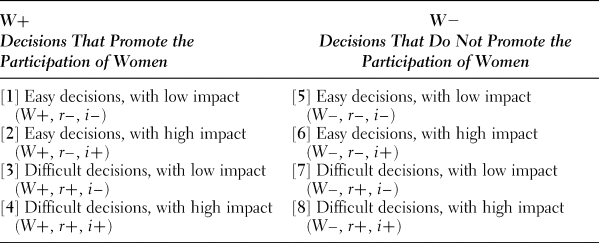
We classified each decision using three pairs of categories. The first contains the parent categories, namely, (W+) decisions that promote increased participation of women in the legislature and (W–) decisions that do not promote increased participation of women in the legislature. Simply put, the first are those decisions that, from among two possible interpretations of the gender quota legislation, choose the one that tends to include more women on party lists, whereas the latter are those decisions that do the opposite. The extent to which the increased participation of women is promoted or hindered as well as the legal reasoning underlying the decisions of the court are classified according to two other categories—impact (i) and reasoning (r)—which should be considered child categories.
Concerning their impact, decisions were simply classified as having high impact (i+) or low impact (i–). The latter are those that promote (or hinder) gender equality to a minimal extent, that is, by only slightly increasing or reducing the number of women on party lists. The first, in contrast, are those decisions that significantly increase (or reduce) the number of women. It is important to note that when it comes to classifying decisions according to these categories, we considered not only the impact of a given decision on the concrete case at stake but also its potential impact on future decisions on similar cases. Hence, even if a particular decision granted only one additional woman on a specific party list, if the application of the same rationale to other decisions may greatly increase the number of women, this is considered a high-impact decision, even though in the specific case under consideration the impact may have been minor.
The second pair of child categories is connected to legal reasoning. We classified decisions of the court as difficult (r+) or easy (r–). These categories are surely less clear-cut than the others presented earlier. For the purposes of this article, easy decisions are simply those whose rationale can be clearly ascribed to a literal or textual interpretation of a legal provision. In contrast, difficult decisions are those whose rationale does not stem solely from a literal interpretation of the law (or the constitution) and thus demand other types of reasoning, especially those based on consequential arguments. In some situations, difficult decisions are even based on interpretations that are contrary to a textual interpretation of a given provision in order to achieve a broader goal.
The combination of the categories can result in eight types of decisions, which are summarized in Table 1.
Framework: Types of decisions

Before proceeding, two analytical issues should be clarified. The first one is not unique to our framework but is an almost unavoidable issue in the process of building typologies and defining categories. In many cases, types and categories may have blurred boundaries. As already stressed earlier, this is particularly true in regard to the pair easy/difficult decisions. Still, just as this unavoidable issue does not prevent typology building in general, we argue that it does not prevent sound typology building in our case; categorization, as well as the eight possible results presented in Table 1, is a useful tool for grasping the role of the Brazilian electoral courts in enforcing gender equality.
Second, it is necessary to emphasize that the two pairs of child categories (high/low impact, easy/difficult decisions) may relate differently to the parent categories (decisions that promote the participation of women or not). This may pose some additional difficulties for our analysis. Since we are dealing with judicial decisions, there are always at least two conflicting arguments at stake. Concerning the pair of categories i+ and i– (high or low impact), if the potential impact of a decision (or group of decisions) is classified as high, this should be valid for both sides of the parent categories: the conflicting reasonings on a given issue would have led to decisions that either foster the inclusion of women on party lists to a great extent or hinder this inclusion to the same extent. In more concrete terms, a given decision may include, say, 10 more women on a given party list; if the court chooses to follow the rival reasoning, it would have denied these 10 women access to the list. The impact remains equally high, albeit in the opposite direction.Footnote 18
However, the scenario may be different in regards to the pair of categories r+ and r– (difficult or easy decisions). It may be the case that one possible reason for deciding a case is considered easy (because it is easily ascribed to a textual interpretation of a given legal provision), whereas the rival reasoning should be considered difficult (because it encompasses arguments that go beyond textual interpretation, above all those of a consequential character). In such situations, the relationship of the child categories to the parent categories is not symmetrical. It may be the case that the reasoning that could foster the inclusion of more women into party lists is a difficult one, whereas the rival reasoning, which does not foster this inclusion, would be an easy one. If this happens—and we will show that this is exactly what happened in one of our cases—the assessment of the stance of the court may be more complex.Footnote 19 In order to avoid this problem, the decisions are classified as easy (r–) or difficult (r+) taking into consideration only the reasoning put forward by the court. The assessment of possible alternative reasoning will thus not be done in the tables with the results, but only in the discussion of these results.
In the next subsections, we will first present the profile of the appellants as well as the types of controversies that gave rise to appeals to the Superior Electoral Court. Second, we analyze the reasoning of the court in its decisions, in order to classify these decisions according to the three pairs of categories we have just presented.
Profile of the Plaintiffs: Who Appeals and with What Aim?
The data reveal that four players are responsible for filing all appeals before the Superior Electoral Court: (1) the Electoral Department of the Public Prosecutor's Office (Ministério Público Eleitoral); (2) parties or party coalitions; (3) candidates who had their candidacy application denied by a State Electoral Court because of the electoral gender quotas; and (4) women candidates claiming their seats in a party list to meet the 30% minimum percentage of women.
An interesting finding is that those who appealed the least were the women: they accounted for filing only 13% of the analyzed appeals (6 of 47). Among the others, 14 were filed by political parties or party coalitions, another 14 were filed by the Electoral Department of the Public Prosecutor's Office, and another 14 were brought by men whose candidacy registration had been denied in order to align the number of candidates with the percentage targets of 30% and 70% for each gender.Footnote 20
Regarding the types of controversies giving rise to appeals to the Superior Electoral Court, the study revealed that there are four types of cases decided by the court. First, and most common, are appeals against the denied application of a male candidate; second are those cases in which the controversy is related to how percentages for each gender should be calculated. This group encompasses two different issues: (1) the basis of the calculation for the gender quotas—that is, the value from which the gender percentages should be calculated—in which two alternatives are possible: either the quotas (70% and 30%) are calculated based on the maximum number of candidates allowed by the legislation or on the actual number of candidates of a given party list; and (2) the criterion for rounding non-integer results. The third involves cases in which the issue of incumbent automatic renomination was at stake.Footnote 21 Fourth, and maybe one of the most interesting, is the decision related to so-called candidatas laranjas (fake candidates),Footnote 22 a difficult issue that challenges compliance with the gender quota law, as will be explained later.
In addition to the core elements mentioned so far (appellant profile and type of controversy), it is also possible to classify the appeals according to the type of elections they refer to. Of the 47 decisions analyzed, 30 refer to the municipal elections; 11 to state elections; 2 to elections to the Chamber of Deputies; and 4 to elections both for federal and state legislatures. In other words, in the realm of gender quotas, the decisions of the Superior Electoral Court deal mostly with local rather than with national elections. Nevertheless, since the rules governing all legislative elections are the same, decisions that establish a binding interpretation of the gender quota laws for local elections are to be considered precedents for deciding cases concerning national elections.
Qualitative Analysis of the Superior Electoral Court's Decisions: Arguments and Results
A systematic analysis of the decisions allowed us to classify them on the basis of the dichotomies presented earlier. The two main categories, based on the impact of the decision on the enforcement of gender equality in politics, are simple and direct: (1) decisions that promote gender equality and (2) decisions that do not promote gender equality. As mentioned earlier, in addition to these two general categories, we add another two, based on the intensity of the impact of those decisions (low/high) and on legal interpretative issues (easy/difficult).
Decisions That Promote Gender Equality
Most decisions rendered by the Superior Electoral Court (43 of 47 cases) favor the enforcement of the electoral quota policy, contributing to increasing the participation of women in elections. These decisions are related to only two issues: (1) to the basis of calculating the gender quotas and (2) to alleged difficulties in finding enough women to comply with the quota provision. Despite their relevance for the general compliance with the quota policy, these decisions were rather easy (in terms of legal interpretation) and, more relevant, had a minor impact on gender equality, since they did not tackle the core obstacles to the effectiveness of this policy.
This first group of decisions includes (1) cases in which the basis of calculation for the gender quotas—that is, the value from which the gender percentages should be calculated—was challenged. As mentioned earlier, two alternatives were at stake: the quotas should be calculated based either on the maximum number of candidates allowed by the legislation or on the actual number of candidates of a given party list; and (2) cases concerning the criteria for rounding non-integer results.
The second group encompasses cases in which political parties argued that noncompliance with the electoral quotas was due to the lack of women willing to be candidates. We analyze these two groups in the next subsections.
Gender Percentage Calculation Basis
Roughly one-quarter of the cases on gender quotas decided by the Superior Electoral Court concern the basis of calculating those quotas. Of the 47 decisions analyzed, 10 deal primarily with determining whether the percentages for each gender are calculated based on the maximum number of candidates allowed by the legislation or on the actual number of candidates of a given party list. This controversy is relevant because if the percentage is calculated based on the number of possible—that is, not actual—candidates, women end up being adversely affected. This consequence is not very intuitive because 30% of the maximum number cannot be less than 30% of the actual number of candidates. As a matter of fact, it is usually higher, and sometimes much higher. How then may women candidates be adversely affected by this criterion?
A fairly representative decision on this controversy is the one on Special Appeal 78,432. In the 2010 elections for the State Assembly of the state of Pará, parties could have presented up to 62 candidates in their lists. The Democratic Labor Party (PDT, Partido Democrático Trabalhista) presented only 29 candidates: 22 men and 7 women. The party argued that it did not nominate more men than allowed by the legislation, and therefore, contrary to what the appellant (the Electoral Department of the Public Prosecutor's Office) argued, it did not put any men in places reserved for women. If the maximum number of candidates on each list is 62, then the maximum number of men is 43 (70% of 62). Since the party presented only 22 men as candidates, it complied with the legislation. The appellant argued that the basis of calculation should be the number of effectively nominated candidates (29) instead of the maximum number allowed by the legislation (62). Hence, the party should have nominated at least 9 women and not more than 20 men. Since the party nominated 22 men and only 7 women, the appellant argued that it did not comply with the requirements established by the legislation.
Judge Arnaldo Versiani was the rapporteur of the case. Initially, his written opinion argued against the appeal (i.e., against the reasoning put forward by the Electoral Department of the Public Prosecutor's Office). He argued that a decision on the compliance with the electoral gender quota law should consider the maximum number of candidates that a party or party coalition may nominate for a given election. The judge rapporteur seemed not to be aware that, even if one considers the maximum number of candidates, the problem is not solved. The Elections Act provides that “each party or party coalition shall fill a minimum of thirty percent and a maximum of seventy percent of candidates of each gender.” Even if the party complied with the maximum, it did not comply with the minimum of 30% of women, no matter which basis of calculation one adopts.
Besides not being aware of this trivial mathematical fact, the judge rapporteur resorted to a peculiar argument to reject legal character to the gender quotas. Based on a previous written opinion by Judge Marco Aurélio Mello, he argued that these quotas are moral norms rather than binding legal norms,Footnote 23 because the Elections Act did not foresee any punishment for noncompliance with it.Footnote 24
Judge Ricardo Lewandowski, president of the Electoral Court at the time, challenged the reasoning of the judge rapporteur and argued that the fact that Elections Act had been amended in 2009 in order to substitute the expression “shall fill” for the expression “shall reserve” (70% and 30% for each gender) indicates that the provisions on gender quotas are binding, and noncompliance with them should have consequences. The judge rapporteur subsequently changed his written opinion, accepted the appeal, and ordered that the party adjust its list using the number of actually nominated candidates as basis for calculating the gender quotas.Footnote 25
The decisions of the Superior Electoral Court in this and in other similar cases clearly foster greater participation of women in legislative elections. Depending on the difference between the maximum number and the actual number of nominated candidates, the number of women on party lists can vary considerably. The potential impact of these kinds of decisions is thus substantial.
With respect to the dichotomy easy/difficult decisions, these decisions may be considered easy ones, both from a legal and from a mathematical point of view. Since the Elections Act provides that “each party or party coalition shall fill a minimum of thirty percent and a maximum of seventy percent of candidates of each gender,” the only way to comply with this provision as a whole (i.e., complying both with the maximum and with the minimum percentages) is by using the actual number of nominated candidates.
Criterion for Rounding Non-integer Results
Another important issue within the electoral gender quota law is the criteria for rounding the results from the calculation of the minimum and maximum percentages for candidates of each gender. The controversy here is quite simple. The Elections Act (Article 10, § 4) provides that in calculations for the composition of party lists, fractions will always be disregarded if lower than 0.5 and rounded up if equal or higher than 0.5. However, Article 22, § 4 of Electoral Order 22,717, issued by the Superior Electoral Court in 2008,Footnote 26 establishes that in the calculation of the gender quota, any resulting fraction should be rounded up to the next integer in calculations of the minimum percentage for one gender and, consequently, simply disregarded in the calculation of the remaining vacancies for the other gender. There is therefore a conflict between the Elections Act and Electoral Order 22,717.
The Special Electoral Appeal 29,190, filed by a coalition formed by the Party of the Brazilian Democratic Movement (PMDB, Partido do Movimento Democrático Brasileiro), Brazilian Labor Party (PTB, Partido Trabalhista Brasileiro), and Popular Party (PP, Partido Popular) against a decision of the State Electoral Court of São Paulo is representative of this controversy. The decision of the state court rejected the registration of the list of the aforementioned coalition for the 2008 local elections in the city of Barueri, arguing that it failed to comply with the minimum percentage of 30% women.
The coalition could nominate up to 28 candidates. The gender percentages, without rounding, would thus be as follows: 30% = 8.4 seats; 70% = 19.6 seats. As mentioned earlier, the Elections Act establishes that the fraction should be disregarded when it is lower than 0.5. As a result, the quota for women in the party list should have been rounded down from 8.4 to 8, whereas the number of male candidates should have been rounded up from 19.6 to 20. But according to the criteria established by the Electoral Order 22,717, the minimum percentage (30%) should always be rounded up, irrespective of the decimal value, and, consequently, the maximum percentage (70%) should always be rounded down. Following this rule, the quota for women should have been increased from 8.4 to 9, while the number of men should have been reduced from 19.6 to 19. The results would be as reported in Table 2.
Comparison of rounding criteria

It is easy to realize that the rounding rule established by the Elections Act could result in a number of women candidates that is lower than the minimum 30% and a number of male candidates that is higher than the maximum of 70%. The Electoral Order 22,717, issued by the Superior Electoral Court, was intended to avoid this outcome.
In his written opinion on the aforementioned case, Judge Versiani followed the criteria of Electoral Order 22,717 and thus ordered that the ratio of women to men should be 9 (32.14%) to 19 (67.86%). Other judges of the court challenged the rapporteur's reasoning and questioned why he did not follow the criteria set forth in the Elections Act.
The challenge is justified because, unlike the Elections Act, Electoral Order 22,717 is not a law passed by the legislature but an act issued by the judges of the Superior Electoral Court. In terms of normative hierarchy, therefore, an electoral order issued by the court cannot take precedence over an enacted law, as it is the case of the Elections Act. Nevertheless, the judge rapporteur maintained his stance on the grounds that the Elections Act's criterion undermines the goals of the gender quota policy. In the end, the other judges agreed with the opinion of the judge rapporteur.
Many cases analyzed in our study deal with the rounding criteria for non-integer results. The decisions in all these cases come to the same conclusion as to the rounding criteria for the fractions resulting from the calculation of candidates of both genres: they ensure compliance with the 30% minimum percentage of female candidates, thereby strengthening the electoral gender quotas. The Electoral Court's precedents, at this point, contradict the wording of the Elections Act with regard to rounding criteria and show a more favorable stance toward women.
This case can be regarded as a difficult one, because the electoral order issued by the court is contrary to enacted law. As for the dichotomy related to the impact, it can be considered as having low impact, since the variation in the number of female candidates will always be only either +1 or –1.
The Alleged Lack of Women Interested in Politics
An argument often used by political parties seeking to evade gender quota law enforcement is a supposed lack of women interested in being candidates. Among the analyzed cases, Special Appeal 2,939 illustrates this scenario and the Superior Electoral Court's stance in this respect. The appeal was filed by a coalition of two parties, the Brazilian Labor Renovation Party (PRTB, Partido Renovador Trabalhista Brasileiro) and the Communist Party of Brazil (PCdoB, Partido Comunista do Brasil), that claimed that it did not meet the gender quotas because of the “absence of women interested in being candidates for a position in the legislative of the city of Jataúba, State of Pernambuco.”Footnote 27 The list of the party coalition had 12 candidates: 11 men and only one woman. When called upon to adjust the number of candidates to meet the provisions of the Elections Act, the party coalition declared it to be impossible to reach the minimum percentage of female candidates, as there were no more women interested in running. The party coalition also claimed that interpreting the gender electoral quotas as mandatory, without considering local and regional contexts, such as the absence of women interested in applying, threatens the freedom of individuals to participate in the political life in their cities.
The written opinion of Judge Versiani rejects the argument put forward by the appellant, arguing that the provisions of the Elections Act would be ineffective if it were possible to simply claim that there are no women willing to run for elections. Judge Versiani argued that “if it is impossible to present female candidates in the required number, the only alternative to the party or coalition of parties is to reduce the number of male candidates.”Footnote 28 For the goals of this article, it does not seem to be essential to assess whether the alleged difficulty in finding women candidates is real or just an excuse for not complying with the gender quota policy.Footnote 29 Yet it is crucial to assess the stance of the court, which in this context did not deem relevant to inquire about the reasons for the noncompliance.
This reasoning is in line with the court's case law in that it never allows the vacancies intended for one gender to be filled by candidates of another gender. This understanding may be found in several other decisions of the court, especially those on the filling of remaining vacancies, provided for in Article 10, § 5 of the Elections Act.Footnote 30 Whenever would-be candidates resort to the Superior Electoral Court requesting their inclusion in the list of parties to fill the remaining vacancies, the court rules that the nomination of a male candidate for a remaining vacancy intended for a female candidate violates the maximum percentage of male candidates. Even before the enactment of Federal Law 12,034 in 2009, which altered the wording of the electoral gender quotas provision of the Elections Act in order to strengthen its mandatory character, the Superior Electoral Court had already decided that male candidates could not fill positions on the party list that were reserved for female candidates. This stance has ensured the implementation of the gender quota law since 2000.
This type of case can be considered an easy case with potentially high impact. It is easy because no consequential reasoning is required for it to be decided, with the literal interpretation of the law being enough; and, as the example mentioned earlier illustrates, the impact of decisions following this rationale may be high, because relieving parties of the duty to comply with the gender quotas due to an alleged lack of women interested in being candidates could completely undermine the gender quota policy in Brazil.
Decisions That Do Not Promote Gender Equality: The Case of Fake Candidates
Although many decisions of the Superior Electoral Court favor the enforcement of electoral gender quotas in Brazil, as seen in the foregoing sections, there are also decisions that hinder this enforcement. A paradigmatic case is that of fake candidates. One strategy that clearly undermines the enforcement of the legislative gender quota is the existence of fake candidates—that is, candidates that are formally nominated but in practice do not even campaign. Special Appeal 21,498, filed by the Electoral Department of the Public Prosecutor's Office against the party coalition Frente Popular, deals exactly with this issue.
The appeal was filed against the decision rendered by the State Electoral Court of Rio Grande do Sul, which ruled that the resignation, still during the campaign period, of five of the six female candidates nominated by the party coalition was not an infringement of the gender quota legislation. The state court decided that since the requirements of the Elections Act concerning the gender quotas were fulfilled at the time of the registration of the party list, the party coalition cannot be held responsible for actions that it could not control, such as resignation of some of the women candidates, that occurred during the election campaign.Footnote 31 Before the Superior Electoral Court, the Electoral Department of the Public Prosecutor's Office argued that the decision of the state court violated the gender quota legislation because women candidates were registered for the sole purpose of formally filling the gender quotas, without there having been actual participation by these candidates in the electoral process. Still according to the Electoral Department of the Public Prosecutor's Office, this was clearly incompatible with the purpose of the gender quota law.
The judge rapporteur, at the beginning of his written opinion, emphasized the lack of evidence demonstrating that the resignations were fraudulent and purposeful. He stressed further that, according to Article 101 of the Electoral Code, from the moment the party list is registered before the Superior Electoral Court, the cancellation of candidacies as a result of resignation depends only on the candidate's declaration of intent. The party or party coalition cannot oppose the resignation.Footnote 32 Considering that such an act is beyond the control of the party or party coalition, the judge rapporteur asserted that they cannot be held liable for an event to which they had no control over.Footnote 33
In the case of resignation of male or female candidates in proportional elections, the party or coalition of parties is allowed to replace the resigning candidates within 60 days of the elections (Elections Act, Article 13, § 3), at all times complying with the legal percentages for each gender. However, the resignation of the female candidates occurred less than 60 days before elections, and therefore there was no time available to replace them.Footnote 34 All judges of the Superior Electoral Court followed the opinion of the judge rapporteur, and the court thus decided that the parties do not violate the gender quota policy in cases in which women resign after the deadline for replacement of candidates.
The decision of the Superior Electoral Court did not favor an increase in the number of women candidates. The fake candidate issue in fact reinforces the concerns of the Electoral Department of the Public Prosecutor's Office's that the party coalition wanted to circumvent the gender quota rules and that those women had been nominated for the single purpose of formally fulfilling the quotas. By considering that the enforcement of the minimum and maximum percentage of male and female candidates should only be assessed upon the registration of the party list, rather than throughout the whole electoral process, the Superior Electoral Court fails to control potential electoral fraud, by means of the registration of candidates who will not receive any support from political parties.
The Superior Electoral Court is one of the most active courts in Brazil. On many occasions, this court established new rules for political competition in Brazil without clear support in the legislation; sometimes, this happened even against enacted law. One of the most well-known examples is the decision in the case concerning the national symmetry of electoral coalitions, also known as the “verticalization of coalitions case.”Footnote 35 Also in the realm of party loyalty,Footnote 36 the Superior Electoral Court have taken some fairly unorthodox decisions—later confirmed by the Brazilian Supreme Court—establishing that members of the National Congress who change from one party to another lose their seat in the legislature, even though the Brazilian Constitution does not include party disloyalty of any kind in its provision concerning removal from office.
In the fake candidates case, the Superior Electoral Court took a more restrained stance than usual. By arguing that there is no way to prove that the resignations of the female candidates occurred to circumvent the gender quotas, the court missed out on the opportunity to offer a firmer response to curb a practice that could be classified as electoral fraud. Moreover, it sent a clear message: parties are free to nominate fake female candidates in their party lists and they are allowed to eventually resign, without any consequences for the parties.
The Superior Electoral Court could have enforced compliance with the electoral gender quota in different ways, for example, by requiring replacement of the resigning women or by demanding a reduction in the number of men to balance the male-female candidate ratio. Although it is true that the Elections Act (Article 13, § 3) establishes a deadline for the replacement of candidates,Footnote 37 it is also true that the Superior Electoral Court has enacted electoral orders creating exceptions to rules defined by enacted law. The rounding criterion is one such case. The rounding criterion defined by the Elections Act was less favorable to women, and the Superior Electoral Court issued an electoral order that established another criterion. The court could have done the same in the case of resignation of fake candidates. But it did not. Admittedly, this would have been a difficult decision. By choosing the easiest path, the court took a decision with high-impact, but in this case, it had a highly negative impact on the enforcement of the gender quota policy.
CONCLUSION
This article assumes that one cannot neglect the role of an institution responsible for enforcing rules aimed at reducing inequalities between men and women, especially with regard to access to legislative seats. Whenever electoral gender quotas are provided for by enacted legislation, one of the institutions responsible for making such rules effective is the judiciary. Through the enforcement of electoral rules in concrete cases and controversies, courts become central players in strengthening the efficacy of the quota policy (Archenti Reference Archenti2014; Jones Reference Jones2004).
As we stressed in the introduction, even though many countries do not have electoral courts, in the Latin American context, they are an inherent institutional part of the electoral process. In such context, the judiciary is therefore responsible not only for deciding concrete judicial cases and controversies but also for organizing elections and even creating electoral rules. When this happens, as it does in Brazil and in other Latin American countries, the role of courts tends to be even more relevant. The analysis of the decisions of Brazilian Superior Electoral Court showed that, in the majority of cases, especially in those related to gender quota law enforcement, the court helped increase the participation of women in the electoral process.
Our analysis indicated that the Brazilian Superior Electoral Court has taken decisions that challenge the traditional patterns of political and electoral competition, by excluding some candidates because of noncompliance with the minimum and maximum percentage of candidates by gender and determining that political parties include more women on their lists.
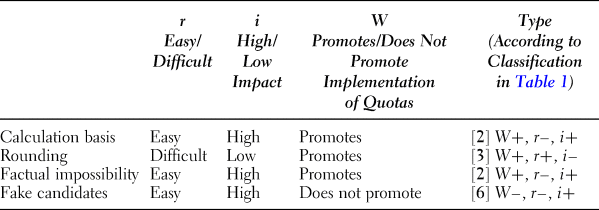
However, based on the categories presented earlier, it is possible to draw a slightly more nuanced conclusion about the court's stance. This conclusion is that (1) the decisions that foster the participation of women are usually among those classified as easy; (2) the court only takes decisions that are classified as difficult when these decisions have low impact; and therefore (3) even though the Superior Electoral Court may be considered an activist court, in the realm of gender quota policy, it seems to avoid decisions with high impact whenever these need to be supported by some type of reasoning that is considered difficult; in these situations, the court prefers the easy solution, even if this implies a weaker enforcement of the gender quota policy. Table 3 sums up this conclusion.
Summary of results

In conclusion, our analysis showed that the Brazilian Superior Electoral Court has partially changed the political status quo, when it defined, through its decisions and electoral orders, the basis of calculation and the rounding criteria to define the percentages of male and female candidates on party lists. The court has thus helped define the contours of gender quota policy by specifying how the gender percentages should be calculated. Its stance, however, was not the same in all cases involving the gender-based electoral quota rules. When the court decided the case of potential fake candidates, it took a more restrained stance.
It is important to stress that we are not arguing that an electoral court, taken in abstract—that is, irrespective of its case law, history, and legal and political background—should decide a case like the fake candidate case in this or that fashion. In other words, we do not claim that, irrespective of context, a decision that opts for upholding a given party list that, on Election Day, is composed of 92.3% men and only 7.7% women is wrong as such. The fact that, according to the Brazilian Elections Act, the period for changing the composition of party lists was already over when the five women resigned is surely a strong legal argument that runs in favor of the decision of the court. That is why we considered that a different decision (i.e., a decision that would have challenged the composition of the party list) would have been a difficult one.
Judicial constructivism, discretion, creativity, lawmaking, and other related issues are everlasting sources of controversy among legal scholars. We do not intend to take a stance on this here. What we argue is much more limited and context sensitive: as mentioned earlier, the Brazilian Superior Electoral Court is widely acknowledged as an activist court, a court that constantly changes the rules of electoral competition in Brazil. We mentioned several examples of this active profile. Hence, what we argue is simply that, against this activist background, the restrained stance of the court in the fake candidates’ case cannot be simply explained as the compelling outcome of a textual interpretation to which the court was fatally bound.
Rather, the court probably considered this an isolated case that deserved no special attention. And, as far as our research in the court's database showed, it is indeed an isolated case. But its singularity is limited to the unexpected resignation of several women at the same time. We still argue that the presence of fake candidates is, and will continue to be in the near future, one of the most important challenges to the enforcement of the electoral gender quotas in Brazil. The Electoral Public Prosecutor's Office of São Paulo, for instance, has already begun investigative proceedings on the matter. The prosecutors interviewed almost all women candidates for the 2016 local elections and found out that in many cases they campaigned only for the male candidates for mayor, without having any opportunity of appearing and speaking for their own candidacies. Furthermore, some of them did not receive any money from the party nor receive any votes on Election Day.
In light of these electoral fraud cases, the Public Prosecutor's Office filed lawsuits against political parties and party coalitions and demanded cancellation of their registration due to fraud regarding the gender quota legislation. If convicted, parties and coalitions may be fined, declared ineligible and lose legislative seats. The fake candidate issue is thus one of the most important challenges to the enforcement of the electoral gender quotas in Brazil and the Electoral Court will surely be confronted with it again in the near future.