Introduction
In January 1925, students of a secondary technical school learned that they were not popular with residents of the Shiba district in Tokyo. The Kuramae School of Engineering Skills (kuramae kōgyō senshū gakkō) taught factory workers carpentry and metalwork and was affiliated with the Harmonization Society (kyōchōkai), a semi-official labor advisory board for Minister of Interior Tokonami Takejirō. After the school's campus at Kuramae was destroyed during the Great Kanto Earthquake in 1923, Harmonization Society staff tried to buy land in Shiba Park and move the school there. But members of the Shiba District Council (shiba kukai) unanimously passed a resolution to frustrate this plan, stating that “the park is a commonwealth of citizens, and it is bewildering to recruit manual workers (rōdōsha) and build a school [in it].”Footnote 1 Instead, Shiba residents tried to have the district office (kuyakusho) in the park. Students of the school were exasperated and blamed the Shiba District Council.Footnote 2 But, Harmonization Society staff did not support students in their dispute with the Shiba District CouncilFootnote 3 and built the school in more modest Shinbori, Tokyo, instead. Despite the Harmonization Society staff's vested interests in the alleviation of class conflict, class hierarchy persisted in social and cultural terms.
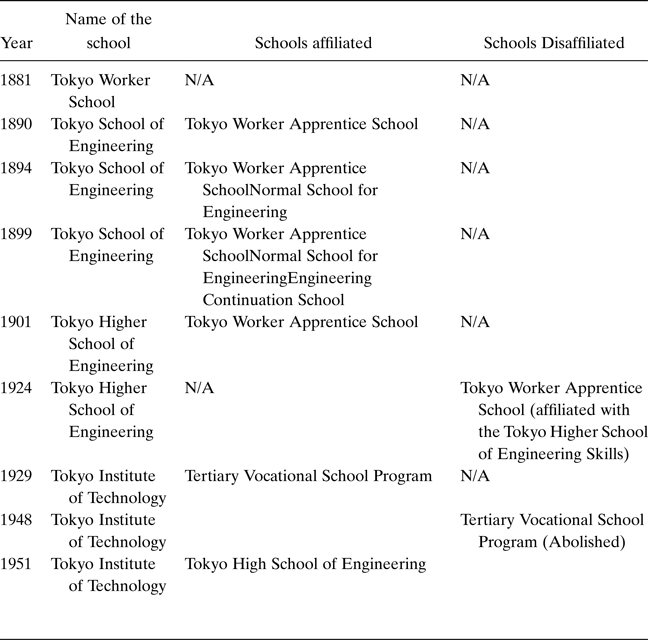
Why and how did this class hierarchy appear and persist? In this essay, I will explore the way people differentiated social classes through educational credentials. To illustrate this process, I use the case of the Tokyo Worker School (tōkyō shokkō gakkō). This school was established in 1881 by the state and was upgraded to the Tokyo Higher School of Engineering (tōkyō kōtō kōgyō gakkō, hereafter Tokyo Kōkō) in 1901, and then to the Tokyo Institute of Technology (tōkyō kogyō daigaku, hereafter Tōkōdai) in 1929. Ministry of Education bureaucrats envisioned this school as a training ground for manual workers, but engineering educators positioned their students as technical experts (gijutsusha) and eventually managed to upgrade this school to the rank of university. Historians have explored this school to trace the social ascent of engineers, but they have hardly debated the school's impact on social stratification.Footnote 4 By tracing this process, I seek to explain how the aspirations of educators and students demarcated a new white-collar profession and transformed the meaning of the social strata beneath them.
At the center of this inquiry lies the challenged legacy of social history. Through the so-called linguistic turn, social historians contested the very idea of classes that had been taken as the primary prism to explore societies as a whole.Footnote 5 In the field of Japanese history, the linguistic turn was spearheaded by historians of consumption and the middle class when the myth that all Japanese belonged to the “middle class” was challenged in the 1990s. These historians understood the middle class as a shifting cultural construct that was constituted and reconstituted through the creation and social diffusion of female domesticity, child-education, and consumer culture in modern Japan.Footnote 6 Through this historiographical innovation, historians came to better understand the diffusion of certain cultural practices associated with the middle class. However, while focusing on cross-class diffusion of culture, they rarely considered how social classes are distinguished from one another and classified into hierarchies. And whereas the middle class was closely examined as a shifting cultural construct, how the ideas of the working class were contested has not been thoroughly considered.Footnote 7
This essay approaches class hierarchy from the perspective of educational history. Labor and business historians have explored the evolution of labor-management relations,Footnote 8 but have hardly examined the birth and consolidation of the class hierarchy between blue and white-collar workers, which I will call the collar line in this essay. I envision the collar line as a hierarchy between manual workers and white-collar managers institutionalized in corporate and state bureaucracies. The collar line is constructed in two steps—the institutional and physical separation of manual and non-manual work in working places, and the consolidation of the hierarchy through educational credentials of different levels. I inherit the insight of the linguistic turn, and thus do not assume any fixed meanings of social classes, but will explore the historical shaping of the collar line as one type of social hierarchy. In other words, this essay is not about the history of the middle and working classes pinned down with essential languages. Using the case of the Tokyo Worker School, this essay examines how educators and students solidified the collar line by associating it with tertiary and secondary educational credentials. I argue that higher education was a negotiated stratifier of social standing buttressed by the life choices of aspirants and the strategies of their educators in managing schools.
The history of the Tokyo Worker School lends us a useful vantage point to consider Japan's late-developer experience of class stratification in comparative perspective. The ways that the purpose of the Tokyo Worker School education was contested reveal that employment had been associated with education in Japan already by the 1880s. While white and blue-collar labor forces were quickly separated, both physically and institutionally, in Western Europe and North America, the association of the collar line with educational credentials hardly appeared there in the 1880s. For instance, even in the United States, where university education spread most swiftly in the world, only in the 1920s did wealthy white males widely embrace college education to distinguish themselves from immigrants and women for white-collar employment.Footnote 9 Mindful of this aspect, this essay shows the Japanese experience as a late-developer of industrialization and a leader in the construction of the credential-based collar line within the global history of social stratification.
The evolution of the Tokyo Worker School and the Tokyo Worker Apprentice School

The Making of the Tokyo Worker School
Leaders of the late-nineteenth-century Japanese state wanted professionally trained technical experts to industrialize Japan. Right after creating a Ministry of Public Works (kōbushō) in 1870 to construct industrial infrastructure, such as railroads, important Japanese statesmen took a three-year-long inspection trip to Europe and North America to determine which countries had potential human resources for Japanese industry. In 1873, in order to train technicians, or “engineering officers for the Ministry,” Minister of Public Works Ito Hirobumi built a Ministry of Public Works SchoolFootnote 10 for which he invited as its educators British technicians recommended by a professor whom he met during the inspection trip. According to the regulation of the school in 1873, any man between fifteen and twenty years old who had passed the entrance examination could begin the school's six year program. In the first four years, students took classes for six months and then did hands-on training at factories for six months. During the last two years, students focused solely on hands-on training.Footnote 11 As the steam engine had been invented by craftsmen without university degrees, such as James Watt in Britain, the curriculum of the Ministry of Public Works School emphasized hands-on training that was 66.7 percent of the total hours.
Bureaucrats of the Ministry of Education, which was created in 1872, were just as enthusiastic about engineering education. Ōki Takatō, Japan's first Minister of Education, led the establishment of the Kaisei School, whose science faculty trained engineers. Students received preparatory education for three years and specialized in their preferred disciplines for another three years in the main programs. These two institutions, which trained the first generation of Japanese technical experts, eventually were incorporated into the faculty of engineering at Tokyo Imperial University (Tōdai) in 1886.
Not only was the state the primary educator of technical experts, it was also their primary employer. In 1886, an imperial order defined the rank of the engineer within the state bureaucracy. They were called technical officers (gijutsukan) and classified into three sub-categories—supervisor technicians (gikan), head technicians (gishi), and assistant technicians (gishu). Supervisor technician positions were equivalent to chokuninkan, or bureau-chief (kyokuchō) positions, head technician positions to sōninkan or director (kachō) positions, and assistant technicians to hanninkan or lower bureaucrats below the director in non-technical bureaucracies.Footnote 12 The Japanese engineer and his education could not be separated from the state and its bureaucracy in the 1880s. Between 1886 and 1921, more than one third of the graduates from Tōdai engineering landed positions in state agencies.Footnote 13
Alongside technical experts, Ministry of Education bureaucrats tried to train manual workers. In 1874, Ministry of Education bureaucrats led by Ōki Takatō established a Manufacturing School (seisakugaku kyōjō) within the Kaisei School. This program consisted of two parts. In its two-year feeder program, students learned chemistry, physics, and mathematics. In the two-year main program, students specialized in one area of applied sciences—manufacture or refinery.Footnote 14 Although this institution was abolished in 1877 due to modest student applications,Footnote 15 education bureaucrats were still interested in worker education. In 1881, Ministry of Education bureaucrats established a Tokyo Worker School in Kuramae, Tokyo. Minister of Education Fukuoka Takachika submitted a “proposal to establish a foreman school in Tokyo”Footnote 16 to Prime Minister (Taijodaijin)Footnote 17 Sanjō Sanetomi, who accepted this proposal and approved the establishment of the Tokyo Worker School in 1881.
This proposal reveals what Ministry of Education bureaucrats thought about a school for factory foremen. According to Fukuoka, the school would enable “sons of paupers (saimin),” who “did not procure meaningful jobs (yūyō no shokugyō)” and could not “go through higher learning,” to make an “independent living” as skilled workers. Fukuoka defined the mission of the school as a modern alternative to the practice of apprenticeship. “Young workers aspiring to develop skills,” noted Fukuoka, “have had to be apprentices for old craftsmen and do all kinds of their personal favors like servants, while actually not learning the essences of skills systematically, thus spending five to ten years,” which explains “the backwardness of Japanese engineering compared to the West.”Footnote 18 Fukuoka's vision reveals that the professionalization of Japanese engineering was a multilayered process. Not only did the state try to train technical experts through Tōdai, they envisioned school-based training for manual workers.
To the leaders of modern Japan, the training of factory workers was a critical project for the industrial take-off of the nation. During the late nineteenth century, foreign employees had been entrusted with the training of both technical experts at Tōdai and manual workers at the so-called model factories established by the state. For instance, the state built the Tomioka Silk Mill in 1872 and hired French trader Paul Brunat and four French female instructors to train the first generation of Japanese silk workers.
As it was considered critical for the nation, the Tokyo Worker School benefitted from educators at Tōdai and its predecessors. The minister of education appointed Masaki Taizō, then a chemistry professor at Tokyo University (Tōkyō daigaku; Kaisei School changed its name to Tokyo University in 1877), as the first principal of the Tokyo Worker School. The next principal, Tejima Seiichi, had also taught at Kaisei School. All the principals before 1945 of the Tokyo Worker School and its successor schools—the Tokyo School of Engineering, Tokyo Kōkō, and Tōkōdai—had taught at or graduated from Tōdai or its predecessors. Most of its professors studied or taught at Kaisei School or its successors (Tokyo University and Tōdai), and studied abroad during the early Meiji years with state funding.Footnote 19 In short, Tōdai and the Tokyo Worker School shared some of the same pool of instructors.Footnote 20
Newly appointed Tokyo Worker School educators created the Regulations of the Tokyo Worker School in 1881. They defined the purpose of the school as training “teachers of (other) worker schools as well as factory foremen (shokkōchō).”Footnote 21 The training consisted of two parts: the feeder and the main programs. The feeder program would last for one year, in which students learned math, physics, chemistry, drawing, and character training (shūshin). In the three-yearFootnote 22 main program, they learned applied sciences and did hands-on training (jisshū) at factories. Students took classes before noon and spent their afternoons in hands-on training, following supervisors' instruction in factories, such as the Koishikawa Cannon Arsenal. Some students denigrated this hands-on training as “stupid” and “harder than students could endure,” as “factory owners treated them very much like manual workers (shokkō) at the Koishikawa Cannon Arsenal.”Footnote 23 While worker education was taken seriously, workers did not seem to be treated respectfully in 1880s Japan.
It was at this time when educators of Tōdai engineering drastically decreased the share of hands-on training in the curricula. In 1873, hands-on training comprised two-thirds of the total classroom hours at the Ministry of Public Works School. When the school changed its name to the Ministry of Public Works College in 1877, hands-on training still accounted for half of the total school hours.Footnote 24 However, after this program was incorporated into Tōdai in 1886, the share of hands-on training became eleven to twenty-two percent of the curriculum at any department in Tōdai engineering.Footnote 25 According to the regulations for coursework and hands-on work (jisshū) created by Tōdai engineering professors in 1896, hands-on work had to be conducted on campus under the supervision of professors. Even when students went off-campus for hands-on training, they were supposed to wear the school uniform and hat, and “not to do anything that taints their dignity (taimen) as a university student.”Footnote 26 Tōdai students' accounts also implied that they did not engage in manual labor. For instance, in 1921, one student of Tōdai engineering practicing in Manchuria described himself as a “spectator (bōkan no jibun)” of “grandiose as well as ugly and dangerous” labor around furnaces.Footnote 27
In August 1882, while school buildings were under construction at Kuramae, Asakusa ward, Tokyo, educators of the Tokyo Worker School recruited students and attracted 133 applicants. After these applicants completed physical and written tests, Tokyo Worker School educators chose sixty final students. The tested disciplines were reading, writing, mathematics, and basic knowledge in algebra, geometry, physics, and chemistry.Footnote 28 Unlike the middle-school entrance examinations, there was no test for English proficiency. At this stage, there did not seem to be a clear qualification to take the school's entrance examination, and admitted students were a motley crew that included, according to a Tokyo Worker School student in 1882, a failed student of the Navy School (kaigun heigakkō), an elementary school principal, and students from the (Tokyo) University feeder program (daigaku yobimon) as well as a private academy of Chinese learning (kangaku juku).Footnote 29
The rise of engineering educational institutions was a global phenomenon, but Japan's late-developer experience is distinguished in that a university-level institution granting the baccalaureate degree appeared earlier than lower-level institutions. In Europe and North America, schools for engineers were not ranked as universities in their incipient years and only slowly claimed the university status.Footnote 30 Henry Dyer, who worked for the Ministry of Public Works College in Tokyo, came back to Britain in 1880 and championed the establishment of a technical college in Glasgow, which resulted in the birth of the Glasgow and West of Scotland Technical College, Britain's first college of engineering, in 1886.Footnote 31 The Massachusetts Institute of Technology (MIT) in the United States started as a technical school, not a university granting bachelor's degrees. Even in France, where the state supervised higher education like in Japan, the university degree in engineering was created only in 1897, which, according to historian Anna Gaugnini, “still did not carry any of the privileges” offered by other old departments.Footnote 32 But in Japan, engineering was included at its very top school whose graduates were welcomed as privileged technical experts in the state bureaucracy. The state was a ladder for the social ascent of engineers, who identified their role as expanding the “wealth of the nation.”Footnote 33
The state's active role and the presence of Tōdai engineering also affected the construction of worker education in Japan. Through the education at the Tokyo Worker School, education bureaucrats wanted to replace apprentice practices like educators in other countries, such as local industrialists who funded the mechanics' institutes in 1830s and 1840s Britain.Footnote 34 But two aspects distinguished Japan from the rest of the world. First, Japan's late-developer state staffed educators of Tōdai, its premier center of higher learning, at this worker school. Second, the Tokyo Worker School was a state-managed model school for worker education, one of a kind in Japan. Graduates of the Tokyo Worker School were rare and important resources who received engineering education from leading educators in industrial Japan. Under these circumstances, an important question remained unanswered in 1882. Would educators and students at the Tokyo Worker School endorse Fukuoka's vision as an educational institution for the working poor? As the aforementioned Tokyo Worker School student testified, there was a significant gap between the ways students were treated on campus and at hands-on training locations. These educators and students challenged Fukuoka's vision, which seemed to push students into underrated positions, and would dramatically transform the meaning of Tokyo Worker School education.
Avoiding Stigma
During the Tokugawa period (1600–1868), artisans belonged to the secondary status, below the samurai, or hereditary warrior elites, who occupied the privileged positions in the state bureaucracy. As historian David Howell documented, status hierarchy persisted through the possibility of social mobility. Many low-ranking members of the samurai status made their living as artisans or merchants due to economic pressure, but they still were able to keep their superior samurai status. In this process, a hierarchy among occupations was paradoxically reconfirmed through the underappreciated life choices of the poor samurai families in Tokugawa Japan.Footnote 35 When artisans were replaced by technical experts after 1868, the idea that engineering was an unappreciated profession hardly disappeared. The respectable job choices for warriors did not change dramatically after 1868. Although their samurai status had been abolished by 1876 and a majority of warriors were forced to become farmers, craftsmen, and merchants, they still preferred to be bureaucrats, soldiers, and teachers.Footnote 36 Tokyo Worker School principal Tejima Seiichi still felt that “engineering is not considered the profession of gentleman (shinshi no gyō)” in late-nineteenth-century Japan.Footnote 37
Technical experts in modern Japan had to fight this perceived legacy of the Tokugawa status system. They enhanced their prestige by receiving elite education and taking privileged positions. Tōdai was the primary engine for this change. Tōdai alumni became educators and technicians for the state and business enterprises. Their ascent was not instantaneous. In the state bureaucracy, graduates of Tōdai engineering received higher salaries than graduates of law at first, but their rate of promotion was far slower than law graduates. According to Kajii Takeshi, a Tōdai engineering alumnus that entered the Ministry of Communication in 1912, law students occupied director, bureau-chief level positions while engineers were left at the bottom in the bureaucracy.Footnote 38 However, their ambitions for higher positions were gradually realized during the war, as demonstrated when Tōdai engineer Miyamoto Takenosuke took the vice-minister position of the cabinet planning board in 1941.Footnote 39 Outside the state bureaucracy, advancement was easier. During the 1890s, technical experts took executive positions leading management and technological developments in the private sector. According to Morikawa Hidemasa, 37.5 percent of the business executives whose educational credentials can be identified in pre-1945 Japan were engineers.Footnote 40
The professionalization of engineering did not just mean the ascent of technical experts into well-paying white-collar positions, but also the marginalization of artisans. Tokugawa artisans, or shokunin, had authoritative knowledge and skills and trained their successors. But as they entered factory bureaucracies as manual workers (shokkō), artisans were excluded from new knowledge in engineering and came to be displaced by the technical experts now trained at higher educational institutions.Footnote 41 Leaders of the Yokosuka Mill of Iron and Shipbuilding, Japan's first model factory established in 1871 and supervised by French engineers, created the two separate bureaucracies of white-collar and blue-collar labor. In 1877, the category of technical experts (gijutsukan) included one director-level and 47 lower-level technicians, who led the technology transfer from the West to Japan, as well as 276 foremen called kōshu or unranked officers (tōgairi). In 1878, the category of shokkō, which pointed to manual workers in the factory bureaucracy, included the 804 full-time workers (teiko shokkō) and the 166 daily-waged workers (hiyatoi shokkō).Footnote 42 Yokosuka authorities hired artisans as manual workers but wages of these artisans turned workers were less than half the wages of artisans doing their own trades.Footnote 43 Through the rise of technical experts and the incorporation of artisans as workers into factory bureaucracies, mental and manual labor were separated in Japanese workplaces.
By the turn of the century, the collar line had officially been stipulated in corporate bureaucracies, becoming a visible reality in Japanese workplaces. For instance, at Yahata Steel Works, a state-managed steel mill established in 1901, manual workers were collectively categorized as inferior to white-collar workers in corporate bureaucracies. Employees were classified into two broad categories—white-collar, or shokuin, and blue-collar, or shokkō. The foremen were listed as white-collar officers between 1877 and 1883. They were no longer listed as technicians after 1884 at Yokosuka.Footnote 44 In 1901, the foremen were incorporated to the blue-collar bureaucracy at Yahata Steel Works. White-collar and blue-collar workers used different gates and stayed in two separate housing facilities at Yahata, which reflected their separate workplaces.Footnote 45 At Yahata Steel Works, some skilled workers, such as drawers, received the same pay as white-collar staff.Footnote 46 But what mattered in people's cultural sense of social class was not so much the internal stratification of manual laborers but the collar line. When they “discovered” the lives of the urban poor in Tokyo, journalists, such as Yokoyama Gennosuke, included manual laborers in the category of the “lower class” regardless of their skill levels.Footnote 47
Tokyo Worker School educators tried to avoid the fledgling stigma attached to manual labor. In May 1882, educators spearheaded a minor but revealing revision of the purpose of the school, which was now defined as training “teachers of worker schools, factory foremen and factory managers (seizōshochō).”Footnote 48 In other words, even before the recruitment of the first class of the Tokyo Worker School in August 1882, its educators envisioned the potential white-collar careers of their students. They also tried to position the school as a center for higher learning by admitting middle-school graduates. In January 1884, Tokyo Worker School educators tried to recruit middle school graduates by exempting them from taking the entrance examination.Footnote 49 By doing so, they would be able to position the Tokyo Worker School as a tertiary educational institution. Tejima considered the hands-on training of the students helpful to their careers as technical experts.Footnote 50
But it was not easy to recruit qualified students. The first forty entrants of the Department of Mechanics at the Tokyo Worker School struggled to go through the feeder program; only half of the entrants advanced to the main program, and only ten students graduated. Among the total sixty entrants of this school in 1882, only twenty-four students graduated.Footnote 51 Students were haunted by the very name of the school, the Tokyo “Worker” School. One student begged his grandfather to fund his study at the Tokyo Worker School, only to find his grandfather exasperated.Footnote 52 Tokyo Worker School alumnus Yamaguchi Kimio explained his ten years of not getting promoted in the Ministry of Agriculture and Commerce as resulting from a perception that considered him “hardly higher than a manual worker (…) because the name of his alma mater was a worker school.”Footnote 53 In 1884, only seventy-one students applied, marking a fifty-three percent drop from the previous year. Though it is not clear that this decline resulted from students' antipathy to the “worker” stigma, the declining student body was a tangible reality.Footnote 54 As Ministry of Education bureaucrats considered closing the school, Tejima and Worker School educators managed to attach the school to Tōdai as its affiliated school. While so doing, they abolished the feeder program of the Tokyo Worker School, with the hope of making the program easier to complete, and they had the Tōdai president sign the diplomas of the Tokyo Worker School.Footnote 55
Still, students managed to land white-collar positions thanks to the scarcity of technical experts in Japan. When the first class of students graduated from the Tokyo Worker School in 1886, Tōdai was the only other school that taught engineering in Japan. According to a government survey in 1902, not a single graduate from the tertiary engineering educational institutions was a blue-collar worker.Footnote 56 Tokyo Worker School professor Takamatsu Toyokichi clearly expressed his frustration with the implication of term “worker” in the name of the school. “Although this school is called a worker school,” argued Takamatsu, “students became assistant technicians (gishu) or government officials (yakunin). Not a single graduate became a manual worker (shokkō).”Footnote 57 And this understanding became the official interpretation of the history of this school. In a sixty year history of the school, published in 1940, the author highlighted that this school was originally meant to be a center of higher learning just below the level of university, not a school of blue-collar workers.Footnote 58 In 1890, students proposed to Principal Tejima that the school's name be changed to the Tokyo School of Engineering, and Tejima did so.Footnote 59 In 1896, the purpose of this school was redefined as “training those engaged in engineering,” with “factory foremen” dropped from the category of its graduates' expected careers.Footnote 60
The share of hands-on training in their curriculum did not dramatically change in 1890. In the 1888 curriculum of the Tokyo Worker School, hands-on training comprised 35.3 percent of the total classroom hours in the department of chemical engineering and 52.9 percent in the department of mechanical engineering.Footnote 61 In the 1890 curriculum of the Tokyo School of Engineering, hands-on training comprised roughly 45 percent of the total classroom hours in the both departments.Footnote 62 But the share of hands-on training eventually dropped. In 1915, students of mechanical engineering spent roughly one third of the total classroom hours on hands-on training.Footnote 63
While shaping the Tokyo Worker School as a white-collar institution, its educators created a blue-collar institution under its umbrella. In 1886, the Tokyo School of Commerce (tōkyō shōgyō gakkō) created a Commerce and Engineering Apprentice Training Center (shōkō totei kōshūjo). This center housed a Worker Section (shokkōka), which taught Japanese language, mathematics, basic bookkeeping, natural sciences, drawing, speaking (kōwa), mechanics, and carpentry.Footnote 64 In 1890, Tejima Seiichi requested that the Worker Section be transferred to the Tokyo Worker School. The Center came to be called the Tokyo Worker Apprentice School (Tōkyō shōkkō totei gakkō) affiliated with the Tokyo School of Engineering.
Tejima Seiichi echoed Fukuoka's 1881 vision of apprenticeship reform in Japan. Tejima, like Fukuoka, criticized the contemporary training practices in which apprentices had to do extraneous services for masters,Footnote 65 and he articulated the necessity of more systematically trained factory workers. But he declined to apply this vision to the Tokyo Worker School, instead, applying it to the Tokyo Worker Apprentice School. In 1890, there were two departments in the school—carpentry and metalwork, and students spent more than eighty percent of their class hours on hands-on training (jisshū), notably longer than students of the Tokyo School of Engineering and Tōdai.Footnote 66 The students took three years to graduate. After the completion of their training, they spent two years as apprentices at factories.Footnote 67 In 1893, the worker apprentice school began to issue a certificate to those who completed this two-year-long training in order to distinguish its students from others on the market.Footnote 68 Students who completed three years of the four-year elementary school program could apply to this school.Footnote 69 Building on the experiment of this school, the Ministry of Education promulgated an Apprentice School Decree in 1893, and had established twenty-three schools of the type by 1901.Footnote 70 By 1915, 397 graduates of this school procured jobs at state-run and private factories, while 176 were self-employed.Footnote 71
By the birth of the Tokyo Worker Apprentice School, the white-collar workforce in engineering was largely demarcated by the level of educational credentials within it. The Tokyo School of Engineering and the Tokyo Worker Apprentice School had different levels of admission criteria, tuition fees, and expected positions in corporate bureaucracies. The upward mobility of blue-collar workers to white-collar positions was not instantly blocked. Still in 1930, more than forty percent of head technicians in the entire Japanese industrial context did not graduate from tertiary educational institutions. Roughly thirty percent of assistant technicians were secondary engineering school graduates, not higher, in 1930.Footnote 72 Still, the level of educational credentials defined the speed of promotion. In order to be an assistant technician, a secondary engineering school graduate commonly had to spend fifteen years, while most tertiary school graduates started their careers as assistant technicians.Footnote 73 Also, exposure to new expertise mattered in this hierarchy. Electricity was incorporated into the Ministry of Public Works College curriculum already in 1884, in the Tokyo School of Engineering curriculum only in 1896, and in the Tokyo Worker Apprentice School curriculum in 1907,Footnote 74 leading holders of higher credentials to take new opportunities earlier. All of these consolidated the relative superiority of credentials at the Tokyo School of Engineering over the Tokyo Worker Apprentice School.
Equally noteworthy is the gradation within the ranks of white-collar technicians. Above the graduates of the Tokyo School of Engineering were graduates of Tōdai Engineering. They received three-year-long preparatory training in high school and completed three years of training at Tōdai Engineering. By doing so, they received bachelor's degrees (gakushi). Tōdai engineers claimed higher positions and salaries than their less privileged counterparts. Under these circumstances, Tōdai engineers quickly claimed the positions of head technician, while Tokyo School of Engineering graduates tended to stay in the rank of assistant technician for a long time.Footnote 75 At Yahata in 1910, among the thirty-eight head technician positions, Tōdai engineers took twenty-four, and only one position went to an alumnus of the Tokyo School of Engineering.Footnote 76 In other words, Tokyo School of Engineering graduates joined the white-collar world as a lesser version of Tōdai alumni, but as superiors over Tokyo Worker Apprentice School graduates.
Further Ascent and Institutional Segregation across the Collar Line
The Tokyo School of Engineering encountered an unexpected favorable turn of fortune after the first Sino-Japanese War (1894–5). The Annual Report of the Ministry of Education for 1895 noted an increased demand for the Tokyo School of Engineering,Footnote 77 and admission to this school became highly competitive. In 1898, 357 applicants applied to a class of only 95.Footnote 78 Until 1890, Tokyo School of Engineering educators had struggled to recruit students. In the 1888 Regulations of the Tokyo Worker School, middle-school graduates were allowed to enter the school without examination, while other applicants were welcome to take an entrance examination.Footnote 79 But as student applications surged, entrance in 1900 to the Tokyo School of Engineering was limited to middle-school graduates who passed the competitive entrance examination.Footnote 80 This change meant that the Tokyo School of Engineering was legally qualified as a tertiary educational institution. In 1901, its educators changed the name of the school to Tokyo Kōkō (Tokyo Higher School of Engineering), which fit the school's status as a tertiary educational institution. The surge in applicants can be partially explained by the competitive high school admissions in modern Japan. Japanese high schools were highly selective institutions in the pre-1945 period, admitting only three percent of middle school graduates in 1905. In this backdrop, Tokyo Kōkō became quite selective. In 1905, more than one thousand applicants competed for 238 seats.Footnote 81 In 1915, 1,715 applicants competed for 290 seats.Footnote 82
As admission to their alma mater became highly competitive, alumni and educators of Tokyo Kōkō envisioned an additional upgrade of their school to the level of university as with Tōdai. Students and alumni of the school had good reason to support this vision. Tokyo Kōkō students were unhappy with their limited career opportunities. They typically spent fifteen years to get promoted to the rank of head technician in state agencies, such as the Ministry of Communication, unlike Tōdai graduates. Future business leader Kurata Chikara testified to outright discrimination between Tōdai and Tokyo Kōkō graduates that he witnessed while at Hitachi. In 1912, according to his memoir, one Tokyo Kōkō graduate wrote a letter discouraging authorities of his alma mater from recommending any more graduates to Hitachi when he found that newly hired Tōdai engineers received far higher salaries than the Tokyo Kōkō graduates who had spent years at Hitachi.Footnote 83
The ambitious plans of the Hara Cabinet (1918–21) to expand higher educational institutions provided Tokyo Kōkō alumni with an opportunity to upgrade their alma mater to the rank of university. As the cabinet decided to allow the upgrade of tertiary vocational schools to one-faculty universities, Tokyo Kōkō educators and students published in 1919 a public statement that explained the necessity of upgrading Tokyo Kōkō to the rank of university. They pointed out the school's location in the metropole, its competitive admissions, and the imperial universities' insufficient capacity to accept an ever-increasing number of engineering applicants.Footnote 84 In 1921, Ministry of Education bureaucrats decided to upgrade five additional higher vocational schools, including Tokyo Kōkō, to the rank of university, and, despite the delay resulting from the Great Kanto Earthquake, Tokyo Kōkō was upgraded to Tōkōdai in 1929.
In this process, the efforts of Tokyo Worker School educators and students to destigmatize their school resulted in the birth of a university and its “bachelors (gakushi),” who could claim higher positions and better salaries than tertiary vocational school graduates. The late-developer Japanese state created a model school for worker education and allowed the school to be upgraded to the rank of university, in order to meet the need of engineers in industrial Japan. The setting of late-development—the scarcity of engineering education and the rapid pace of industrialization—can explain the speed of this upgrade. But, equally noteworthy is the active role of the educators and students of the school, not only the state, in the upgrade. The late-developer state created Tokyo Imperial University and the Tokyo Worker School, but it was educators and students of the Tokyo Worker School who were the driving force of this ascent.
Upon the approval of the Ministry of Education for the upgrade of Tokyo Kōkō to Tōkōdai in 1921, Tokyo Kōkō educators disaffiliated the Tokyo Worker Apprentice School from Tokyo Kōkō. Tokyo Kōkō professors concluded that secondary educational institutions or below were not able to be affiliated with universities, given the “first article of the University Decree promulgated in 1918 and the opinions of Ministry of Education bureaucrats.”Footnote 85 In other words, to them, the blue-collar institutions on the Tokyo Kōkō campus were not the locus of “teaching academic theories and their applications necessary to the state as well as working on character training and nurturing state ideologies.” When the Worker Apprentice School building toppled down in the wake of the Great Kantō Earthquake in 1923, Tokyo Kōkō educators managed to transfer the Worker Apprentice School to the Tokyo Higher School of Engineering Skills (tōkyō kōtō kōgei gakkō, hereafter Tokyo Kōgei), where many Tokyo Kōkō graduates were teaching. The principal of Tokyo Kōkō and Tokyo Kōgei was the same person, Yoshitake Einoshin, a Tōdai graduate.Footnote 86
Institutional segregation across the collar line on the Tokyo Kōkō campus reflected the exclusion of manual labor from the engineering profession. By 1935, according to Se'ike Tadashi, a Tokyo Kōkō alumnus and the principal of a secondary engineering school, the idea that “technicians (gijutsusha) do not need to have hands-on skills (shigoto)” and “manual workers do not need academic knowledge” was already widespread.Footnote 87 As their ranks were largely defined in the hierarchy of educational credentials, blue-collar workers were hardly considered part of engineering professionals and were eclipsed in popular media. In the typical rag-to-riches success stories that began to fill popular magazines in the 1900s, being blue-collar was a situation the aspirants had to escape in order to ultimately succeed in life. Their struggle toward higher educational credentials was not quite understood as a social question of class inequality but a glorious, legitimate personal success. In the pages of educational magazines in interwar Japan, when blue-collar workers were no longer able to join white-collar positions without going back to secondary schools, these social aspirants voiced their frustration with factory workers. Looking back to his factory life as a probation worker (minarai shokkō), a student of the Nagasaki Higher School of Commerce remembered his conversations with fellow workers as insufferably vulgar, portraying the atmosphere of his factory as “low-life.” To him, manual labor “paralyzed the pure conscience of a boy,” destroying “hope and ambition” and his exodus to middle school and to higher vocational school was a legitimate life decision.Footnote 88
The ascent of technicians' training centers to higher ranks was not limited to Japan. Britain's first mechanics' institute in Manchester created in 1824 eventually became the Manchester Municipal College of Technology, a college-level institution in 1918, and then a degree-granting university in 1955. The technical high schools (Technische Hochschulen) in Germany gained doctorate-degree-granting university status in 1899.Footnote 89 MIT in the United States, whose graduates occupied executive positions of big corporations in the 1920s, reinforced liberal-arts education and experiments in laboratories, while decreasing the share of hands-on training in the curriculum. These reforms culminated in the inclusion of MIT in the league of privileged research universities, the American Association of Universities in 1934, a marker that this school was far from a vocational school for manual labor.Footnote 90 In this sense, the story of the Tokyo Worker School was part of the global experience of modernity in which technical experts crossed but also endorsed the collar line.
Conclusion: The Elasticity of Class Hierarchy
The rise of technical experts was a global phenomenon, but the role of the state distinguished the Japanese experience from the rest of the world. The Japanese state developed a new university system replacing entire education systems from pre-1868 Japan, while importing knowledge from Western Europe and North America. In engineering, leaders of late-nineteenth-century Japan hired British engineers and created the Ministry of Public Works College, a top school in engineering that was eventually incorporated to Tokyo Imperial University in 1886. Unlike state-led late-developers in Europe, such as Germany, engineering educators were able to claim a corner at the top school, and decent job prospects for their students in the state bureaucracy in the 1880s. As for its capstone position in the entire education system, the faculty of engineering at Tokyo Imperial University was a leader, not a catch-up, in world history.
This unique setting also affected the ways class hierarchy was associated with educational credentials in Japan. The state established Japan's first worker school and staffed it with educators from its premier engineering educational institutions. Educators were sympathetic to students' aspirations to avoid the stigma attached to manual labor and join the white-collar workforce; Minister of Education Fukuoka's vision that this school should merely replace apprentice training for manual workers was quickly rejected. Instead, Tokyo Worker School educators recreated the school as a white-collar institution and created a blue-collar institution under its umbrella. Although engineering educators such as Tejima Seiichi encouraged students of the Tokyo Worker Apprentice School by emphasizing the importance of manual workers in industrial Japan,Footnote 91 he helped Tokyo Worker School students avoid this stigma by upgrading the rank of his school to a higher educational institution. In other words, the Tokyo Worker School reveals that educators' and students' aspirations, which took a negative social perception of workers as a given, was actually a driving force for the expansion of higher education.
This does not mean that manual workers were invariably poor or undereducated. There was a wide array of educational credentials within the category of manual workers. At Yahata Steel Works, those who could not complete elementary school and those who graduated from tertiary vocational schools were employed as lay workers (futsū shokkō).Footnote 92 At Yahata Steel Works in 1936, roughly a quarter of manual workers stopped schooling after graduating from elementary school, and slightly more than half of them stopped schooling after graduating from higher elementary school, which was a supplementary two-year education after elementary school. Roughly 12.5 percent of total factory workers had graduated from secondary and tertiary educational institutions, including middle school. The wages of factory workers in 1936 were of a wide variety as well. At Yahata, there were seven ranks among factory workers, and the most experienced skilled workers, or shukurō, received 7.33 yen daily, which was a director (kachō) level salary in pre-1945 Japan.Footnote 93
Then, what exactly did being white-collar mean? One critical factor that separates the two sides of the collar line is the way employers evaluated the two sides' market values. The market value of a white-collar worker reflected the prestige of the school the worker graduated from. By positioning their school as white-collar, engineering educators enabled their students to expect expenses for and future rewards from their schooling. For instance, applicants for Tokyo Kōkō in 1920 expected to spend 1,605 yen for their three-year long schooling, and to receive salaries between 75 and 130 yen per month, including bonuses, once they were employed after graduation.Footnote 94 University graduates received higher salaries than vocational school graduates.Footnote 95 In contrast, blue-collar workers' educational credentials hardly affected their wages. As historian Andrew Gordon documented, workers' wages were largely determined by their output and skill-levels as evaluated by their employers.Footnote 96 At Yahata in 1936, the average daily wage of elementary school graduates was 1.937 yen, while higher vocational school graduates received 1.912 yen.Footnote 97 In this sense, what engineering educators accomplished by rendering their school as a white-collar institution was to guarantee acceptable assessment of their market values with educational credentials.
Equally important is that two sides across the collar line were not essentially different in their attitudes to the market. Workers demanded to be buffered from market evaluations that considered only their skills and productivity through seniority-based wages, while white-collar workers began to organize for job security during the economic recessions in the interwar period. Both groups were happy to go on the market when they expected favorable assessment. Managers of the Shibaura Engineering Works sent 950 men to the Tokyo Worker Apprentice School to enhance their performance at Shibaura between 1905 and 1938, but they tended to leave their employers and come back on the job market with their newly developed skills.Footnote 98 Likewise, white-collar technicians were famous for their frequent job transfers, especially from the underpaying state bureaucracy to the private sector throughout the pre-1945 period.Footnote 99 The market often compromised the collar line embedded in higher education. For instance, full-time sports athletes were considered blue-collar in 1920s Japan, but as their prestige skyrocketed, eventually university level institutions, such as the Nihon Sport Science University, began to specialize in training them.
The experience of the Tokyo Worker School partially explains why the collar line persisted as well. The collar line that Tokyo Worker School educators and students drew between educated managers and manual laborers embodies the social ascent of technicians that had not been respected in Tokugawa Japan. Once Meiji technicians joined the elite circle and distinguished themselves from factory labor, engineering educators and students upgraded their school to a higher educational institution for white-collar employment. The long list of well-paid manual workers, from high-rank sailors and pilots to entertaining celebrities and sports stars, disrupted the hierarchy between the superior white collar and the inferior blue collar, at least economically. However, the collar line does not disappear despite these challenges, but is redrawn with the addition of universities to train them. As technical experts surfaced as respectable professionals, the Tokyo Worker School that trained them was eventually upgraded to Tōkōdai while manual laborers were left on the other side of the collar line. In other words, the expansion of privileged occupations resulted in higher prestige for the schools that trained them, rather than the collective reinstatement of manual workers, who still suffered from low respect and their exposure to market unpredictability.
The collar line in engineering persisted even after the demand of Japanese engineers became extraordinarily high during the war and the school system was shaken up in the wake of Japan's defeat in 1945. During the war, many graduates of secondary schools in engineering were able to join the white-collar workforce,Footnote 100 but after the war, the collar line was re-associated with educational credentials. The Tokyo Worker Apprentice School was reincorporated into Tōkōdai as its affiliated Engineering High School in 1951. The upgrade of this institution from the rank of secondary to high school, however, did not result in their joining the white-collar workforce. Instead, the collar line was redrawn between high school and university in postwar Japan, a global phenomenon in the post-1945 world.